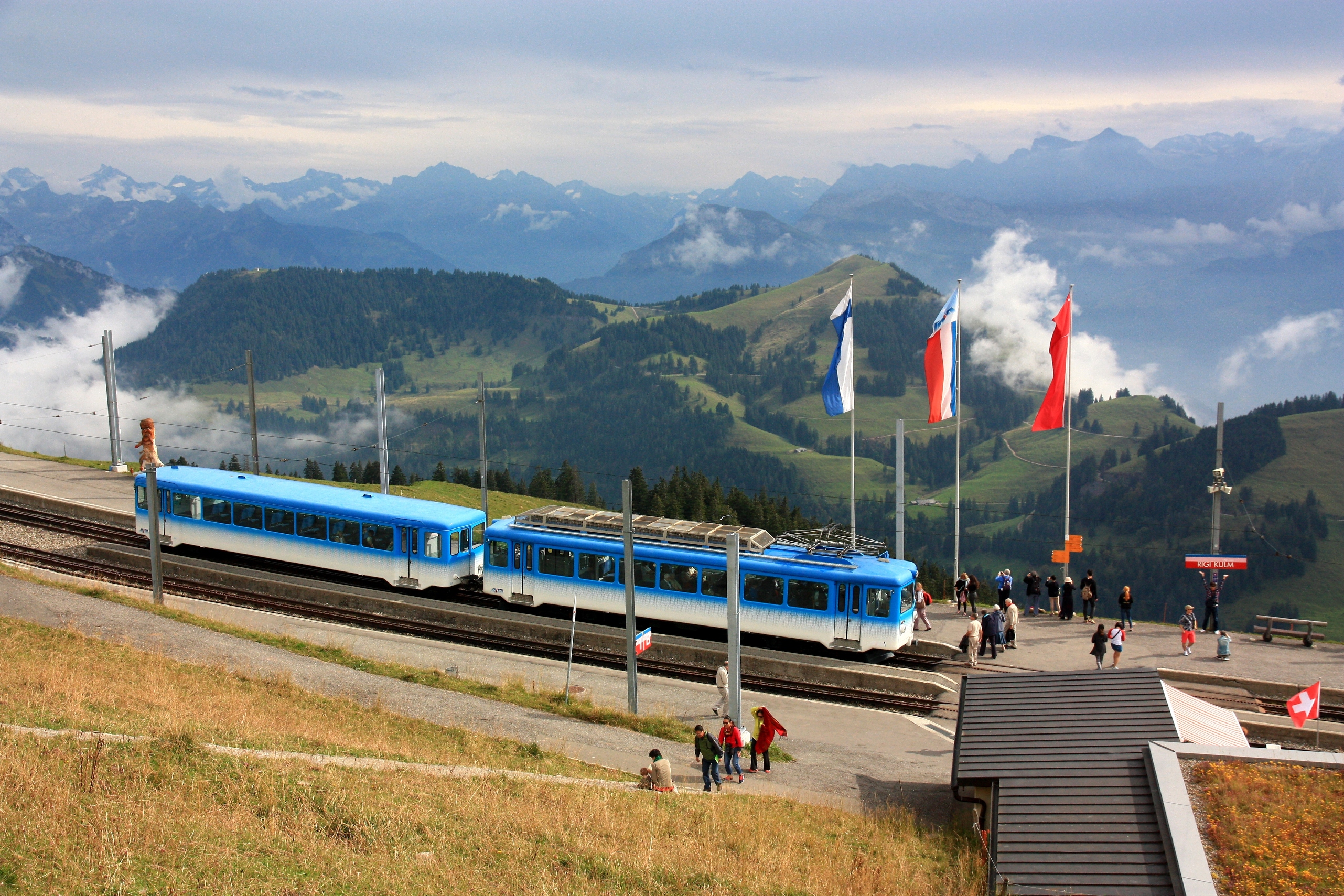
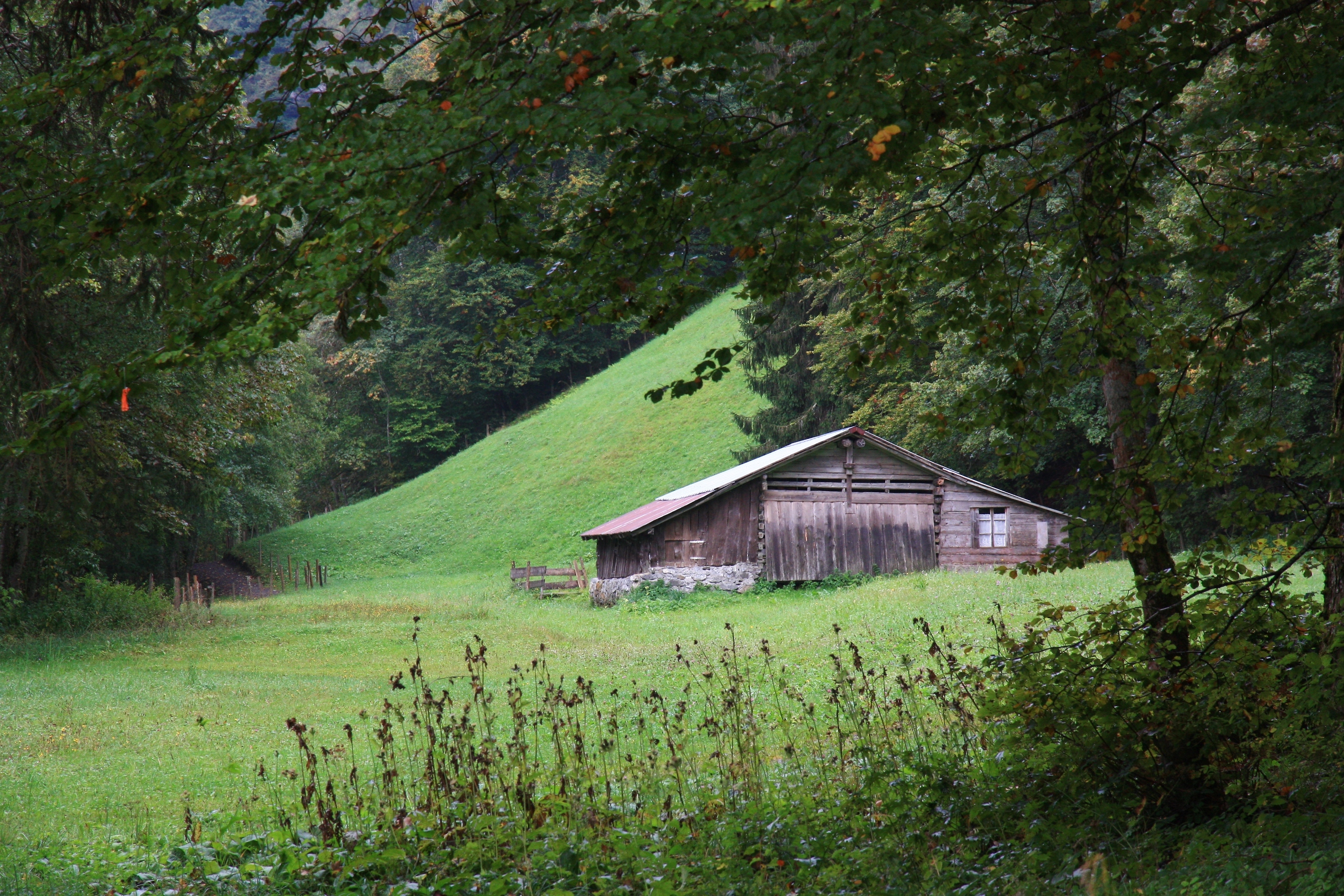
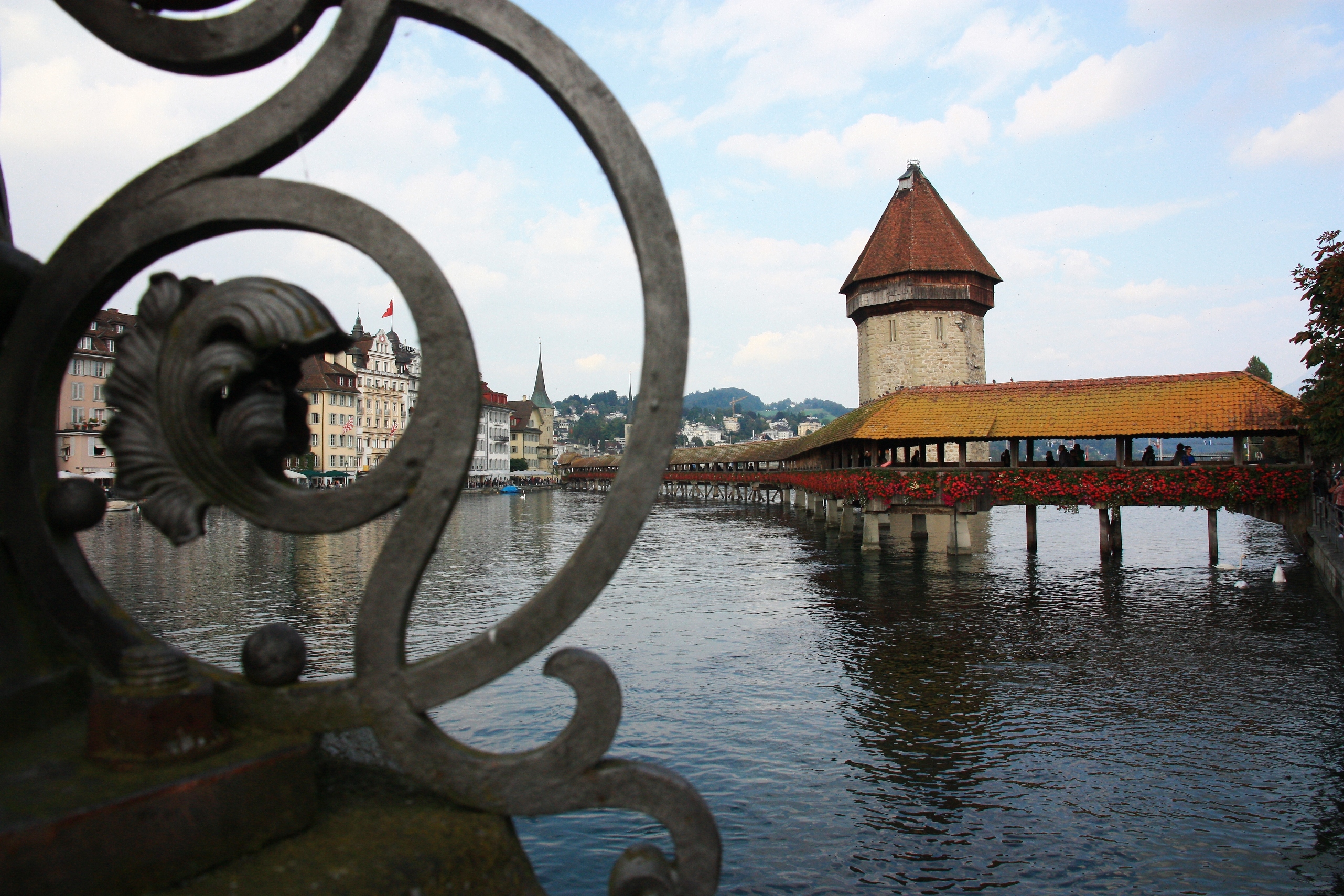
Drifting

It has been a pleasant surprise to stumble upon March without the world being blown up by some really bad or sick dude. Less surprising if you listen to scientists was the record-breaking hot Australian summer; indeed there were moments where it felt like the end of world wasn’t too far away (two successive 41 degree days in Canberra spring to mind). But, again, we made it to March, with temperatures slowly cooling and promising a period of pleasant sunny day times and sleep-friendly lows.

sum01What does one do in a hot summer which features only intermittent work? Well, trips to free air-conditioned sites of interest for a start: the cinema, the library, the gallery, the mall. Occasionally the office, mostly for a coffee and catch up. Bike rides bring a nice breeze early in the day or into the late evenings. And cooling refreshments comfort: my addiction to frozen drinks persisting (but now slowly fading), a cold beer or cider in the evenings, Dare iced coffee and occasionally something a little more extravagant.

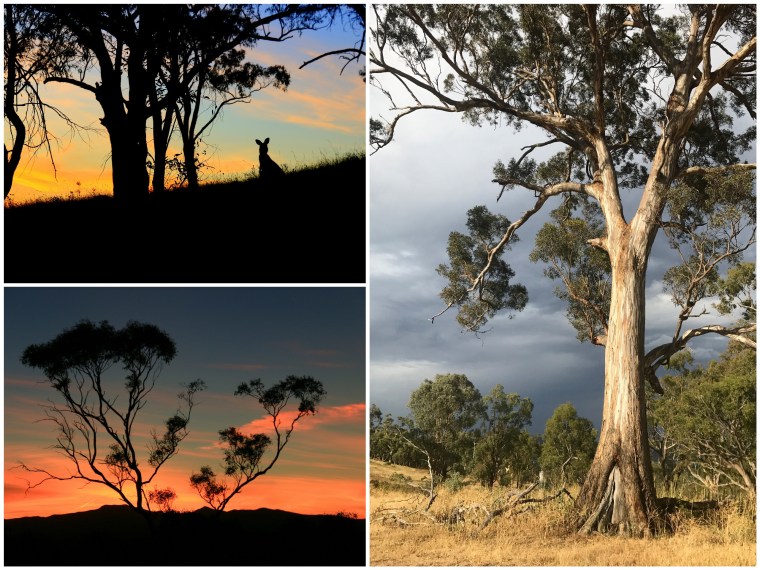
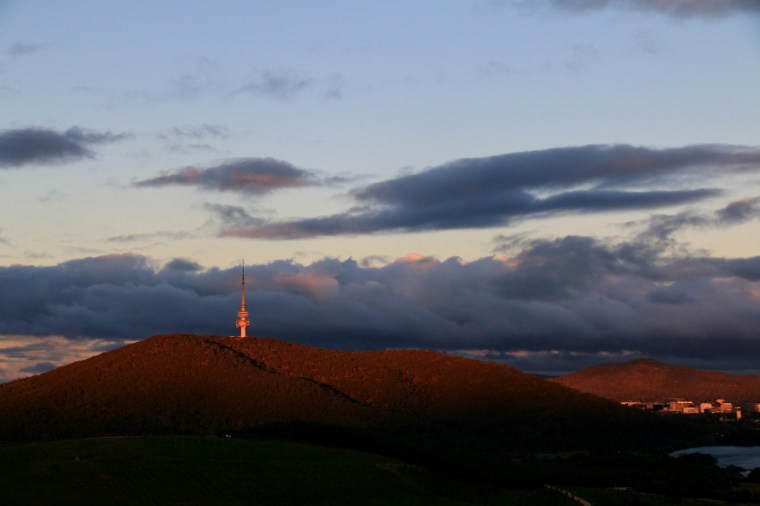
sum02Walks are practically a daily feature (they usually are), often on Red Hill (they usually are). Again, the early mornings or late evenings work best, the low light emphasising the sweeping golden grass and colouring the white trunks of gums a laser red. Sun sinks late over the ranges and smouldering skies are common. This is better evening entertainment than what’s on TV, as post-tennis, post-holiday reality shows make a comeback, spewing forth with abandon.

sum03

sum05Daytime strolls are better suited to places such as the Botanic Gardens, where shade is more forthcoming and the rainforest gully drops temperatures by five degrees. Moisture emerges here from the watering, and continues in the cafe serving a fairly average coffee. But to grab a takeaway and sit under a tree reading a book or interview transcripts is a fine way to spend an hour (and improve the experience of reading interview transcripts).

sum04

sum06aAway from nature for a moment, summer in Canberra also promises event after event as the populace makes the most of the time before entering deep freeze. There are blockbuster exhibitions in the galleries and museums; there are fetes and swimming carnivals and cricket matches all over the suburbs; fireworks, flags and protests in equal measure adorn Australia Day; and the National Multicultural Festival brings oodles of noodles in a celebration of diversity that ought to be protected. In the spirit of inclusion even certain redheads are catered for.

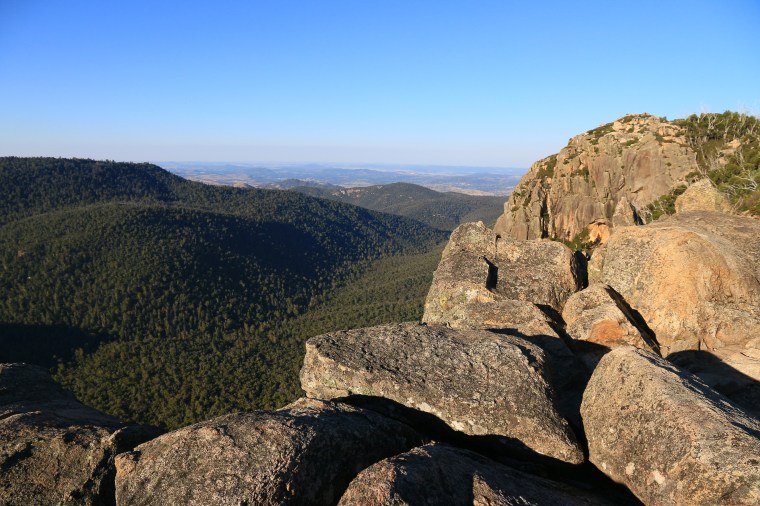
Outside the capital the countryside sizzles in much the same way, this occasionally boiling over into grass and bushfires. In 2003 of course a big one hit the fringes of Canberra and much of the rugged land to its west. Over the course of my time here – since, OMG, 2006 – I have been able to observe nature’s recovery, the transition from blackened trunks and patchwork growth to a flourishing bulbous canopy and vivid green understorey. Nine years from the last time I stepped out, the signs at the start of the track up to Booroomba Rocks still warn of falling debris from the damage, but from what you witness along the way this previous carnage is almost imperceptible.

sum08

While summer has been predictably hot and dry, previous wetter seasons have replenished the reservoirs and river systems around Canberra. No longer do we see LCD updates informing us of how many litres we consumed yesterday and imploring us not to water our lawns. At least for the time being.

sum07At Burrinjuck Dam – reached via coffee stop in Yass – water levels are high and this is a natural lure for cursed boatpeople who frolic about in a flurry of jetskis and Chardonnay lunches. Away from the excess surrounding the boat ramp, quieter coves and a cutesy scattering of cottages for those dam workers heralded surprise. And a reasonably flat, empty road on which to have a pedal.

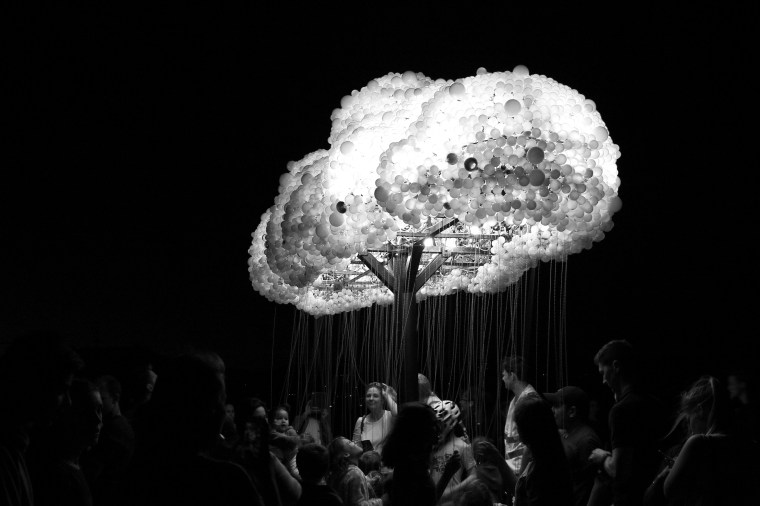
There was a cool wind on that ride, late February, and soon after the first day came in which it might be handy to have a sweater in the evening. This in many respects is a blessing because at night you can sleep again and wake to blissfully clear and fresh mornings, which impel you to get out and live. Outside, only the very first tinges of autumn are appearing on the trees but other signs are more prominent: increasing work opportunities; long pants; the first fog grounding hot air balloons; and a now perennial favourite marking the transition from summer to autumn in Canberra, Enlighten.

sum09

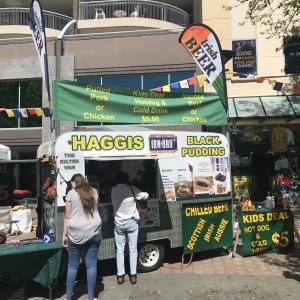
sum10My how this has grown since I was one of the few to trudge round on a pleasant evening a few years back snapping pictures of a handful of the capital’s illuminated buildings. Now practically every city does something similar on landmarks more well-known. But Canberra’s Enlighten seems to be ever more popular, judging by the crowds streaming from one site to another on a Saturday evening. Many are also here to queue for food in the night markets, which is entirely predictable; after several years you learn to visit midweek and come early, to guarantee delights such as a bao trifecta, Korean chilli pork fries, and deep fried ice cream.

I’m a little warm that Saturday evening in long trousers and the next day – today, March 12th – tops 32 degrees. But because it is officially autumn it feels acceptable for a loin of pork to be roasting in the oven. I’m kind of sick of barbecues and the promise of slow roasted feasts is one of the plus sides of the seasons changing. It won’t take long and everyone will be whingeing about the cold, wrapped like mummies in a pile of scarves and hats, scowling at the misery of “bloody Canberra”. Shorts and air-conditioning will feel like distant memories. But before we get to that point there is the promise of the transition, a period that is without doubt the best time of year here, in bloody Canberra.

sum11

Australia Food & Drink Green Bogey Photography Walking

Not quite white not quite Christmas

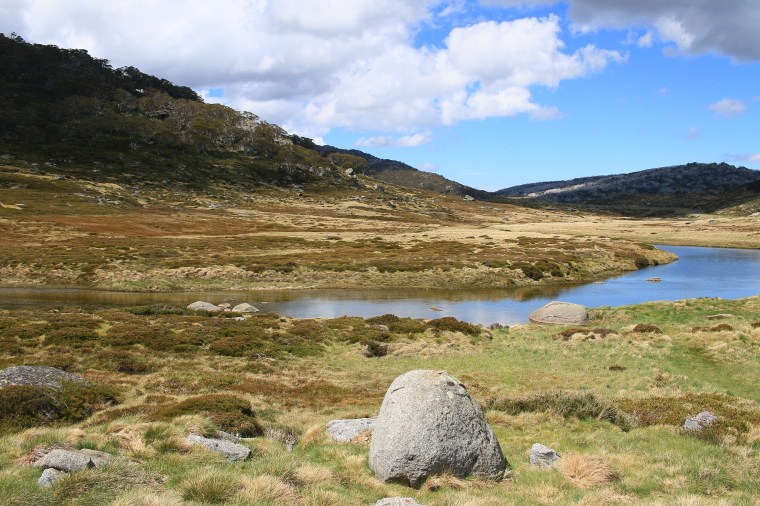
sn02Because this is Australia the ingeniously named Snowy Mountains are not perennially snowy. However, at the end of November I was not expecting to see so many chunks of frozen icy slush dotting the mountaintops. The snow gave distinction to the ranges, visible just after a picnic in Cooma with Caroline and a potato masher. And moving closer and climbing in altitude, it was possible to walk on a splodge of icy snow at Charlotte Pass, from where more white stuff was visible along the Main Range.

sn01

I have walked from here to the top of Kosciuszko and back. But this was in past times when there was not so much to contend with along the trail. A short boardwalk through the snow gums with a view at the end was more fitting today, before turning round and heading back down to Jindabyne, by way of the famous Surge Tank.

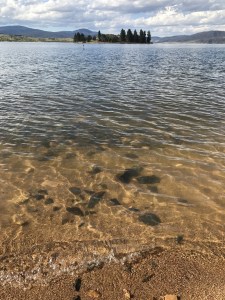
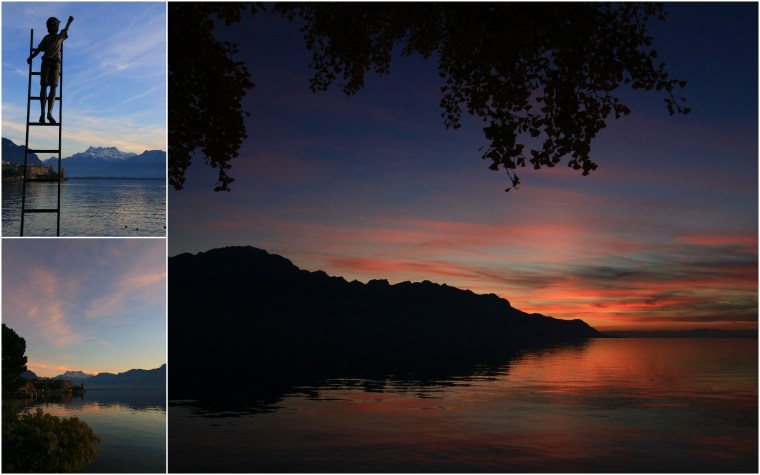
sn03Jindabyne has always proven to be a bit of a pass-through town on the way to the higher mountains. But staying here for two nights offered the chance to explore many of the highlights of the town, including its TWO shopping precincts! While these provide sufficient eating and coffee opportunities, the highlight of Jindabyne is undoubtedly the expansive lake on which it sits. Part Canada, part Lake District, part Australia, it’s a haven for boat owner people and fishy types. But don’t let that put you off…there are also charming parklands and meandering pathways fringing the shore. Benches and picnic tables offer frequent recovery. From here you can watch morning mists hovering over a dead calm mirror, or bask later on in the afternoon warmth. Or live out the end of the day with never-ending hummus and laser red light.

sn04

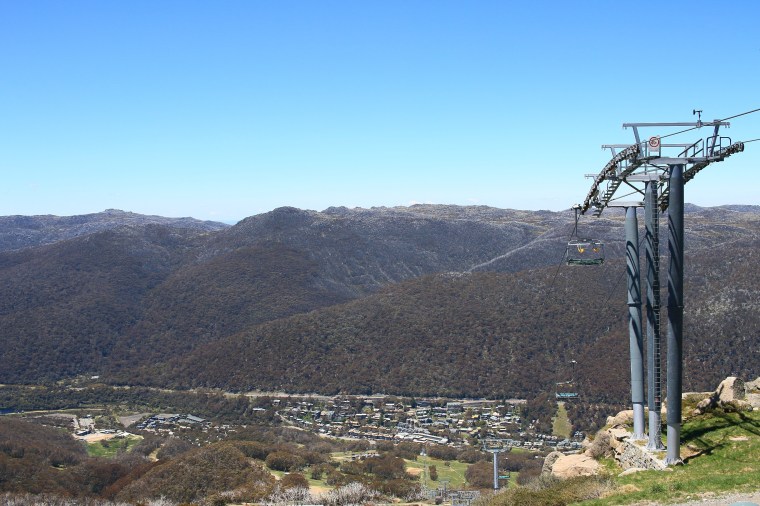
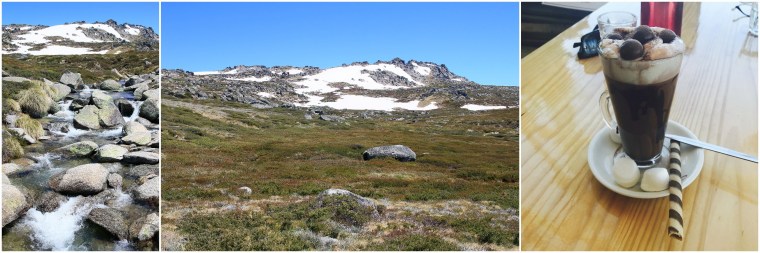
From Jindabyne the main road west narrows into the Thredbo Valley before topping out at Dead Horse Gap and plunging down towards Victoria. Thredbo itself is the closest thing Australia has to an alpine resort, nestled within the lower slopes of the steepening valley and generously adorned with A-Frame chalets and the promise of open fireplaces. In summer it seems to tick on over with a peppering of mountain bikers and day trippers. Many take the chairlift to Eagle’s Nest, either to plunge back down on two wheels or head to the top of Australia on two feet. We do neither, retreating from a strong and chilly wind for a ‘yummo’ hot chocolate.

sn06

sn05

We did however have a nice amble back down alongside the Thredbo River, walking to the soundtrack of rushing water and buzzing flies. The water here is lovely and clear and pristine and in some ways reminds me very much of Dartmoor. I think it was the sound of the water more than anything that evoked such a scene, rather than the flies and gum trees and baking hot sun at the end of November.

sn07

sn09Leaving the high mountains we drove a somewhat convoluted route back to Canberra to provide maximum adventure. First up was a brief pause at Dalgety, a tiny place perched alongside the Snowy River that could have been the capital of Australia. And they say Canberra is quiet! There must be like ten houses, a few cows, and a million flies. But it’s kinda cute nonetheless.

sn08

sn10With the unforeseen temporary closure of the Snowy Hydro Visitor Centre in Cooma, a decision was made to proceed to Adaminaby for lunch instead. And what better way to lunch than next to a great big trout! This was indeed turning into a marvellous, sponteanous adventure and the best (or worst) was yet to come.

From Adaminaby the way back to Canberra is lonely, travelling a fair distance on dirt roads that are largely in decent shape, especially once crossing over the border into the affluent ACT. There are tiny signs pointing the way to the national capital and occasional homesteads in the midst of the bush. Bitumen returns somewhere in Namadgi National Park and there is a touch of relief, and the cherishing of smoothness. That is until a faint rattling develops into a shudder and a rumble and the front left tyre decides to give up on life. Wheel nuts are unmovable and phone reception is absent. What we need – in this scenario so typical of Neighbours when they go into the bush – are a couple of heroes with fluoro vests and a ute, with tools and an air of certainty that this, here today, is their fate. Not only to dislodge the wheel nuts but to do the whole service, to send us on our way back to civilisation with the minimum of fuss and no form of payment. This is what happens in Australia, and it makes me proud!

Australia Green Bogey Photography Walking

In Seoul II: Mountain retreat

One of the things I was keen on doing in Seoul was to get out of Seoul. Not substantially, but enough to satisfy an idealised Zen-like image in my head of rugged mountains cloaked in forest with the occasional temple perched upon a rocky outcrop. The kind of scene you might expect to see on the front of a guide book, probably in the midst of a multicoloured autumn. A throwback to times past, to tradition, to a world before Samsung, M*A*S*H and Kim Jong-Un being weird across a border.

Thankfully I noticed the presence of Bukhansan National Park literally on the northern and western doorstep of Seoul. My guide book with idealised images told me you could reach here on the metro and offered a walk from one station to another, via winding trails, mountainous ridges and occasional temples. It also advised avoiding the weekends, because half of Seoul would be here.

So it was a Friday and unbeknown to me a public holiday. The train to Dobongsan was suspiciously bustling with people in sturdy shoes, sweat-proof tops and the kind of trousers with 12 pockets and 20 zips. From the station it was not at all difficult to find the park entrance – just follow the backpacked mass past more food stalls and stores selling outdoor adventure wear (should you decide you look conspicuously out of place in everyday shorts and a plain T shirt).

km01The stream of people continued along the first, generously wide and paved section of a trail, thinning slightly with the introduction of a junction. Before long, an incessant parade of steps appeared, the upward thrust causing pockets of walkers to pause and congregate in clusters for water, snack bars, some even breaking out a stove and cooking up a soupy concoction. Barring a handful of souls, almost everyone was Korean and I received the odd, surprised, what is he doing here look. One old guy offered me a boiled sweet in broken English, proclaiming them as the elixir to conquer Jaunbong. In our stilted conversation, he deduced that I was from Austria, noting his love of Mozart and possibly proclaiming the hills to be alive. For an Austrian, such climbing as it was here should be a breeze. For an Australian: faaaaaaahk.

km03There was no breeze and it was tough going…particularly given it was the day after I had arrived on a plane from England and then gorged on fried chicken. Some welcome respite came at Cheonchuksa, a small detour leading away from the upward procession and revealing a temple and its various ornaments snuggled into a cliff. Simultaneously serene and vivid, offering fresh water to refill bottles, to take a break, to tread briefly on level ground and tiptoe in a suitably reverential hush. I could have lingered and napped.

km02

km04But apparently the path to enlightenment continues up and up, past increasingly frequent groups pausing for food and water, wiping sweating brows, recovering breath and looking somewhat abject. Eyes silently pleaded when would this end, how much more of this would there be? Signs that were once in Korean and English had reverted to Korean but I deduced there was something like a kilometre to the top. And it probably took an hour, but after that time a rocky crag appeared above the forest. Bedecked with yet more picnickers, convivial and relieved, catching hazy, smoggy views of the hills and occasional snatches of suburban apartment tower sprawl.

km05

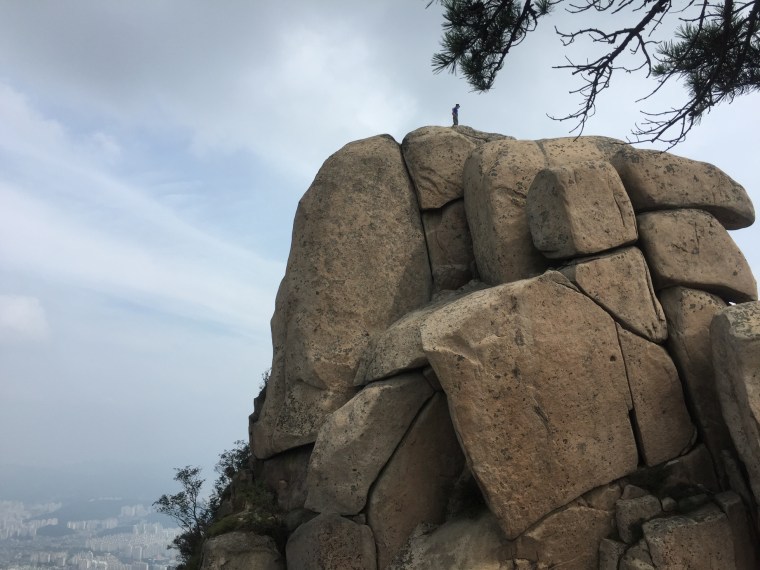
It was more like a series of mountaintops here, some reached via slick rock faces and chains, others by more sedate steps and switchbacks. In fact, there were paths leading off in any number of directions to various places unknown. The two information signs I could find were practically unfathomable and after an enthusiastic and accurate start my guidebook had given up the ghost. I’d like to say it was through rational deduction and decision-making that I made the right choice, but it was 90% luck and 10% checking the compass direction on my phone.

Beyond the top of Jaunbong the trail became blissfully less populous and delightfully more even. It broadly followed the Podaeneugsan ridgeline through a patchwork of fragrant shrubs and shady trees, pierced by a series of rocky platforms with more murky views to Seoul. In the lull between two of these outcrops, a path dropped down towards Mangwolsa Temple, where I finally found my nirvana.

km07The path to enlightenment is never easy and after a long slog upwards all day it was only when gravity was on my side that I fell completely ass over tit. A winding, gravelly descent was more competent than my footwear and I received a very nice caking of dust over one side of my body. No-one else was present to witness this event, something I was actually pleased about in terms of embarrassment management. It’s kind of like if a tree falls in a forest and if no-one is around to hear it, does it make a sound?

Unharmed and dusting myself off as best I could, a few more corners led to the reveal of Mangwolsa Temple. This was the kind of place I had imagined before coming to South Korea, the idealised image within forested mountains far from the madding crowd. Yes, for a guide book cover the sky could have been clearer, the foliage more autumnal. But this was pretty much exactly as I had imagined (making me wonder if somewhere, subconsciously, I had viewed such an image). Featuring a bonus water fountain in which to clean myself up and refresh, this pause, this retreat was worth the hike, including the looming, endless shin-jarring descent back into the confines of Seoul.

km06

asia Green Bogey Photography Walking

In Seoul I: Bright lights, giant Samsung flat screen city

Jong-no and Cheonggyecheon Stream

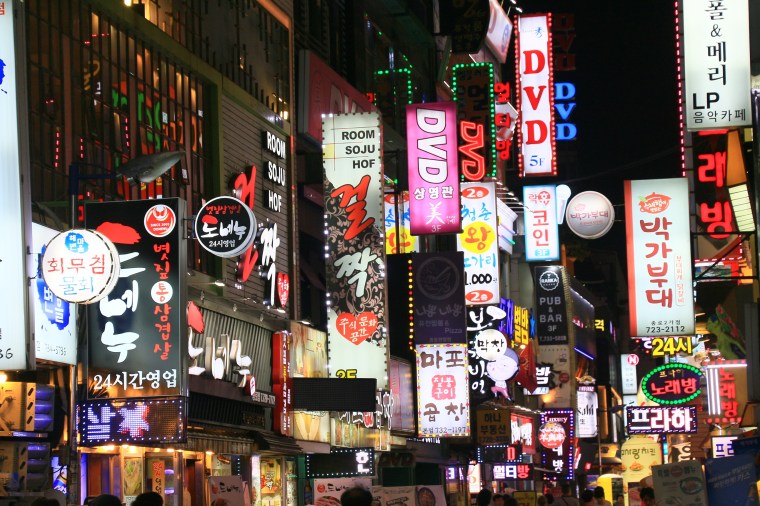
It’s hard to top that incredible sensation of arriving from a gentle, orderly place like England all tired and drained from jetlag and plunging headfirst into a blurry concoction of street food odours, flashing lights, unfathomable signs, and sapping humidity. Adrenaline, impatient curiosity and a freshly imported Double Decker propel you into the night, occasionally trance-like but always, slightly stupidly, with a smile on your face.

kl01

kl02I was staying roughly in an area listed as Jong-no, in what turned out to be a rather charming, peaceful small hotel (Makers). Exit lobby tranquillity, turn left past food stalls and weave through an animated stream of people enjoying the night air as you head towards the Cheonggyecheon Stream. This is an urban regeneration project par excellence, once a muddy, stinky waterway transformed and landscaped into swirling pools and cascades, lined with footpaths and sculptures and light projections, and populated with the whole gamut of Seoul society. A Korean busker croons, tiered steps along the water plead you to sit down, and free wifi penetrates the air, everywhere.

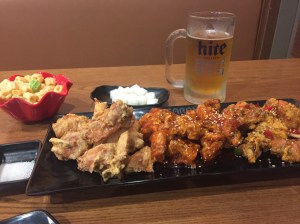
kl03The stream is in close proximity to alleyways filled with neon signs and sizzling aromas. In fact, it seems anywhere is in close proximity to food. The choice is bewildering, especially when you are tired and indecisive but also very, very hungry. In this state it seems the best option is for some Korean Fried Chicken and a beer. This is a staple, and as staples go, I’m sure down with it.

Namsan Mountain

Seoul is huge but sometimes it doesn’t seem that way. Over ten million people supposedly call it home and the population density is twice that of New York (at least according to Wikipedia). Yet I never really felt crammed in or suffocated here. I think this is in part because of the large, palatial open spaces and the visibility of forested mountains, providing the sight of wilderness from downtown (and also from my hotel room window). Indeed, the jagged hills shield the city’s spread from the viewer, particularly the case for tourists like me who largely stick to the main sights concentrated in a bowl north of the Han River.

kl06

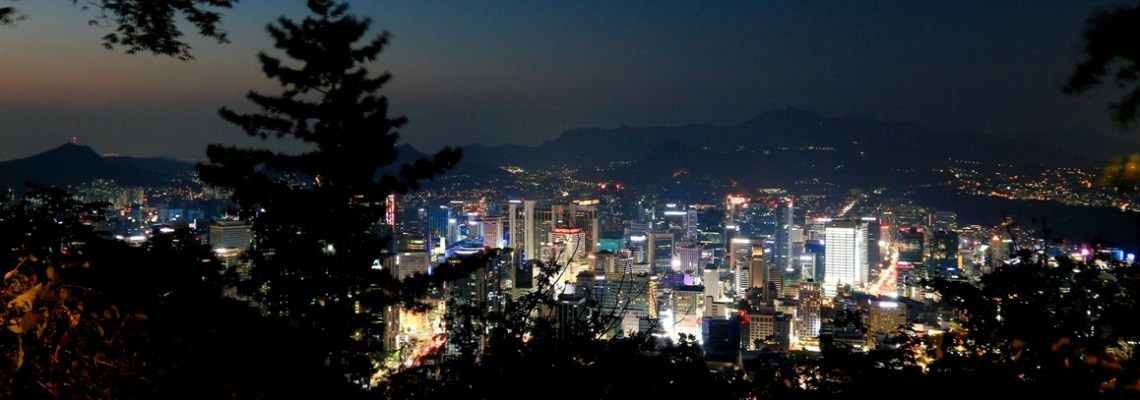
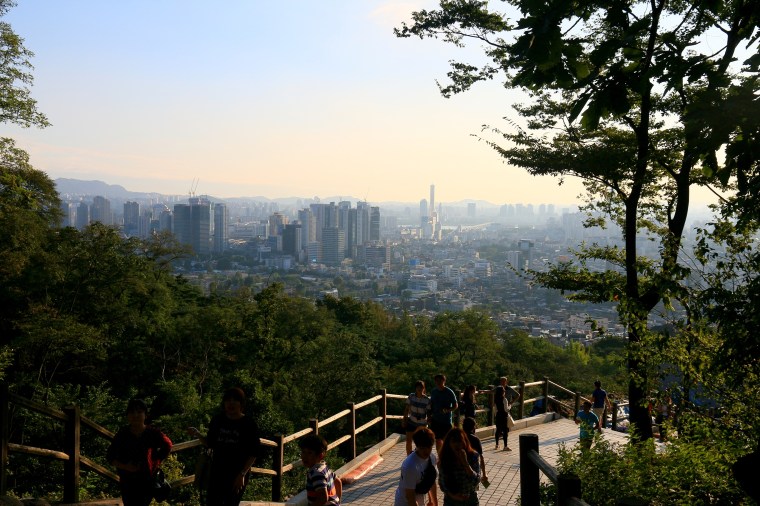
It is only when you head to Namsan Mountain – marking the southern limit of this bowl – that you grasp a whole new expanse of a city stretching east, west, and south. It also registers that atop this peak is a pointy needle called North Seoul Tower and this is south of where you have been mostly milling about. Which by a process of deduction must have been North North Seoul, meaning there sure is a lot more city out there.

In this context, comparisons to Canberra may seem rather silly. But there is a similar concealed quality to both cities, thanks to the hilly terrain. And Namsan Mountain is just like Black Mountain, complete with a summit road, walking tracks and that concrete syringe reaching into the sky on top. One added feature of Namsan though is the attraction of a cable car. For which there are mammoth queues late Saturday afternoon, impelling a sweaty, breathless hike instead. A hike which is a procession of people, several, pleasingly, struggling more than you, despite looking to have youth on their side. That Canberra hills training comes in handy sometimes.

kl04

Along the climb, alternative aspects open up and other high rise clusters emerge in different directions. Finally, with a healthy dose of perspiration, the mountain top offers a view south and glimpses of the Han River. On the other side a whole new city left and right, Gangnam style and beyond. Here, you suspect, stand Samsung Tower 20, 21, 22, 23 and more. Apartment blocks where millions of people live and work and maybe even get dressed up and perhaps dance rather stupidly.

kl05

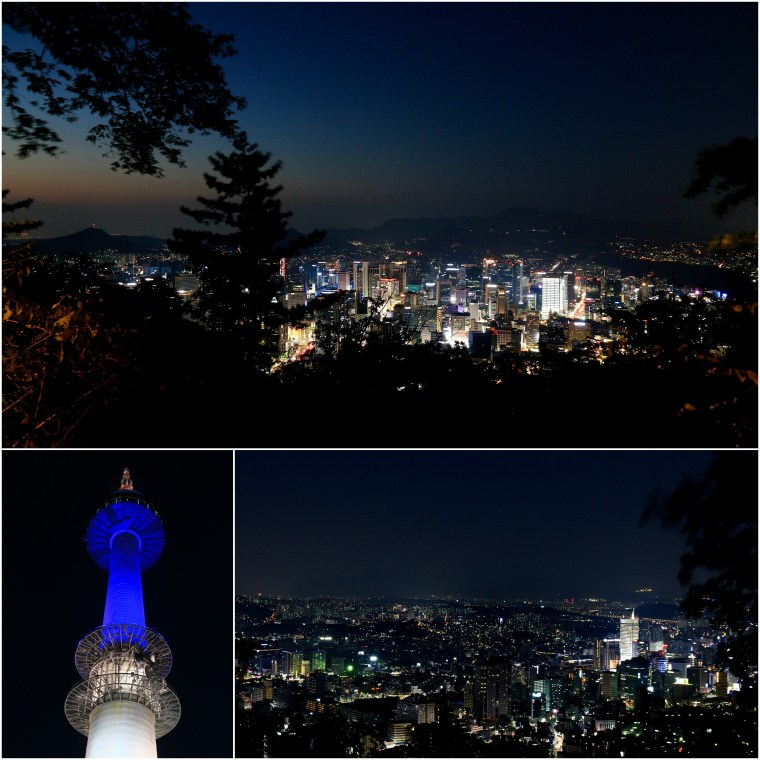
Clearly being Seoul and not Canberra, the North Seoul Tower is obviously more than that, with a multi-level mall, numerous eateries, a giant gift shop and I think even a cinema. There is also the classical 360 degree, glass-encased viewing deck, which offers pretty much the same view as from the base, only higher and with a greater degree of photo-degrading reflection. Still, milling about here winds down some time for the sun to set and the city lights to flicker on, to twinkle, to glow. And a place to eat before embracing the cooler air, gazing out over the lights, and walking down, back down to just a tiny part of Seoul and bed.

kl07

asia Food & Drink Green Bogey Photography Walking

Remain?

I was naturally curious to gauge the reaction of arriving in Europe on one of those British passports. A snide eye roll, a tutting sigh, a stale baguette in the face? But no, such was the tardiness of Easyjet that Geneva airport was practically closed (and, yes, I know, not in the EU). So with haste it was through the Swiss border and across into France.

France. Dawning on a beautiful late summer’s day on which some of its citizens were semi-productively shuffling off to work while those who worked in Switzerland – courtesy of a public holiday – were not. The French also had school, which by a happy coincidence meant a child free day to venture into the Alps with relieved parents Monsieur Alain et Veronique. And inevitably eat cheese.

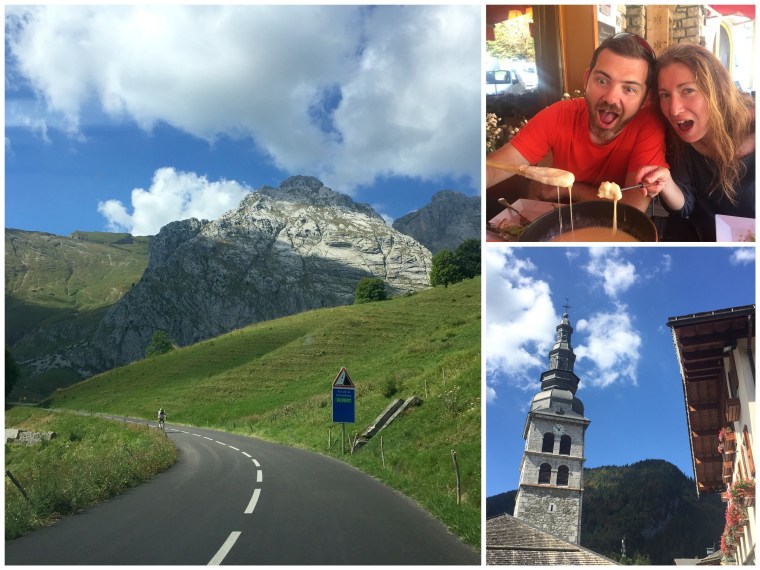
La Clusaz was a suitable lunch venue, reached via a scenic ride up a valley and into the green pasture chalet-dotted world that is so typique. Quiet streets recovering from the summer holidays led down to a clutch of shops and restaurants. Being lunchtime, the shops were closed and the shop owners in the restaurants, one of which took us in for some lazy refuge. A beer, charcuterie, fondue, tarte aux myrtilles. All inescapably inevitable and delicious.

fr01

I guess if we were keen, had bikes, several blood transfusions and some special Coke cans, we could have worked it off heading up to the Col de la Colombiere. But it was much easier to appreciate from car, rising up from Le Grand-Bornand through some of those chalet-dotted villages, alongside rustic farms and into a precipitous wilderness. Marmots whistled, cyclists huffed and puffed, and the only lump of cloud in the Alps stubbornly hovered and clung to the mountaintops above.

fr02

Descending from here was every bit as if not more fun than the climb. While I’d appreciate the distinct lack of a need to pedal on a bike I’m pretty sure I would lack the bravery. The car itself had plenty of natural momentum to hurtle down the straights and sweep round the bends. Villages and dreamy views flew by. And then we were back into the valley. A big valley with towns sprawled out and “traffic furniture” in profusion. France was leaving school and work, and we had a pick-up of our own to get back for.

fr03

Our school pick-up was without too many a problem. By contrast, another tardy Easyjet plane resulted in another late night pick-up from the airport, as the parents decided to join us for the weekend. Well, a long weekend, since the next day was Friday and the kiddies were still in school. Ahead was the prospect of another tantrum-free sojourn into the mountains, all being well.

fr04And what a lovely tour it was, revisiting some vaguely familiar territory but under glorious skies instead of disappointing murk. First stop was Carrefour, which was a little less lovely, but suitably stocked with bread and meats and cheese, staples that can be lumped together and taken up to the top of a hill in scenes reminiscent of a Peppa Pig episode in which they have a thoroughly middle class picnic.

The hill in question was situated in the Plaine Joux area, topped with wooden tables and lazing meadows, peppered with cows, and surrounded by mountains. If you didn’t want to idle in the sun, several trails could take you to the top of other hills, down into valleys, across farms, or simply round the corner to marvel at the vista in the other direction.

fr07

fr05

fr06

Down there somewhere in the Vallee Verte, past the evocative Onnion, and wedged into the mountains sat the Lac de Vallon. Placidly reflective, partly in shade from the looming hills, blissfully quiet, it was a pause in the return home. A final beautiful moment before the weekend proper and the chance of greater mayhem. A mayhem that was admittedly delightful, barring one or two moments.

fr09

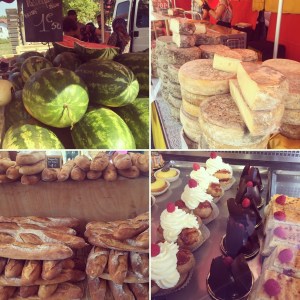
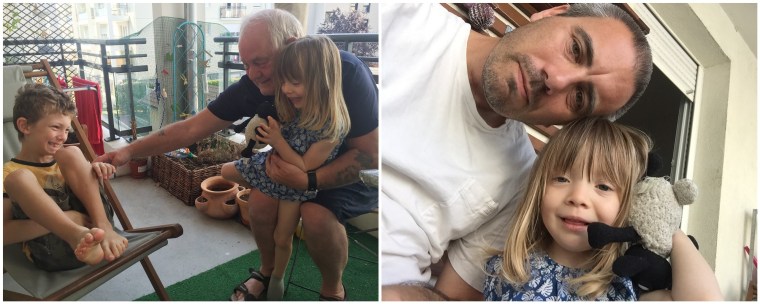
fr12And so there were walks to parks and more picnics, bouncy castles, lego blocks, hearty lunches, tickle monsters, bustling markets, outdoor petanque, selfies, tired parents and doting grandparents. Oh, and a bit of a premature gateaux anniversaire for a certain someone. It was the final family flourish before saying, again, au revoir. Goodbye. Leave.

fr10

Driving Europe Food & Drink Green Bogey Photography

Snow day

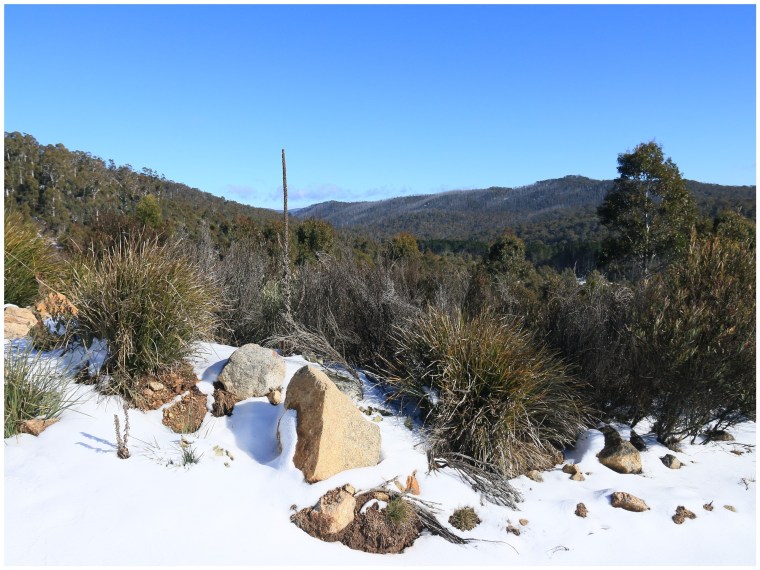
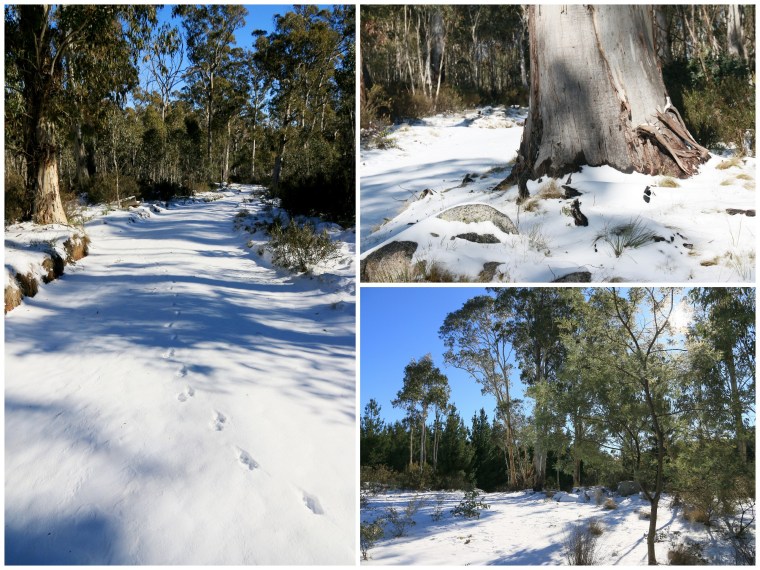
Yesterday, the morning proffered an icing of snow around the hilltops of Canberra. It is the closest that snow has got to my front door in ten years of life here. Usually, any frenzied anticipation that snow will fall is quickly dashed in much the same way it was in my childhood; Plymothian style cold rain mixed with just perhaps the odd sleety globule if you squint hard enough. But yesterday, if you got up early and aimed high, you might just have been able to build a dwarf snowman and get it featured on TV by an excitable ABC news crew.

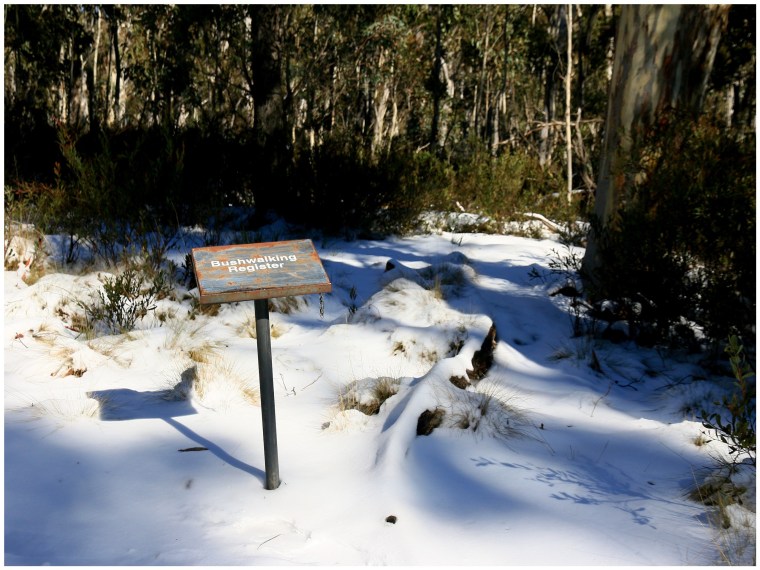
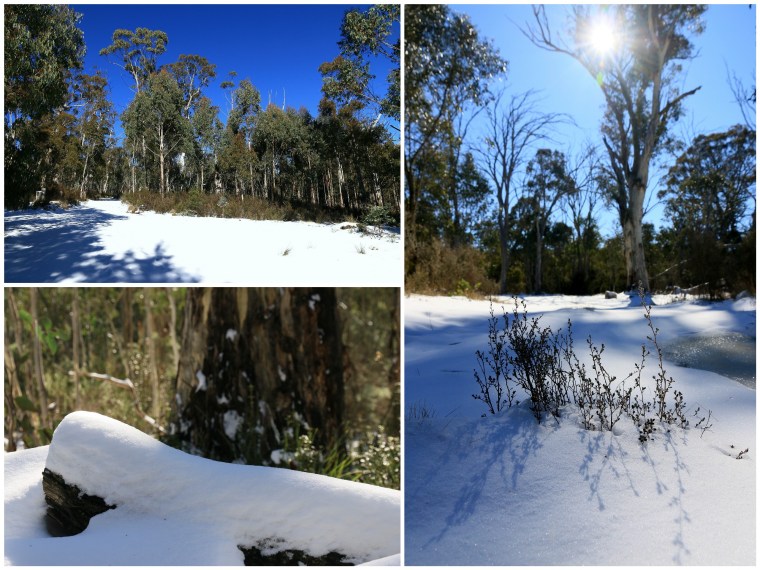
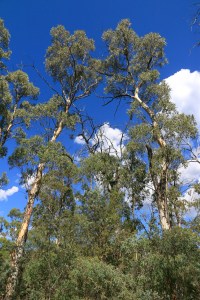
Today, waking early despite a late evening watching bikes in France, checking my work emails to see practically no-one loved me, doing laundry by nine and wondering now what, I aimed higher. Up towards Corin Forest, but largely avoiding that school holiday playground which quickly descends into brown sludge and tears. I parked in mud and ice and ventured up onto the Smokers Trail. Not for a cheeky ciggie, but for a walk under deep blue skies and fresh eucalypt forest. Leaving a pioneering trail of steps imprinted in a few centimetres of powder, a journey capped off with a bucket of hot chips amongst the browning sludge and escalating tears. Today, off the beaten track, rewarded by chips, a perfect snow day.

snow1603

snow1601

snow1604

snow1602

snow1605

Australia Green Bogey Photography Walking

Catch the pigeon

For all the scurvy, seasickness and usurping imperialism it would have been quite something to voyage with Captain Cook in 1770. Cruise the ocean, meet the locals, spot exotic wildlife, hide Joseph Bank’s acacia collection in the poop deck. You’d get to discover new lands and – best of all –name them. Cook would have had first dibs mind, and being from Yorkshire he would be undeniably dry and unimaginative about it: Wide Bay (a large open bay), Sandy Cape (sand), Red Point (red), Booby Island (wishful thinking arising from a year at sea).

Cook was having a delirious day on April 21, 1770 when cruising up the south coast of what – inexplicably – was to become called New South Wales. Somewhere beyond Point Upright (yeah he named that too) Cook “saw a remarkable peaked hill which resembles a square dovehouse with a dome on top”. He thus decided to name it Pigeon House and from that point on it has acted as a beacon for sailors, sightseers and bush bashers the world over.

Pigeon House now sits within the gargantuan Budawang wilderness covered by Morton National Park and a number of adjoining reserves, a largely unexplored, impenetrable land of sandstone cliffs and gorges, coated with eucalypts, shrubs and ferns. It is almost as it was when Cook whizzed past on the way to Botany Bay. A few roads fringe its edges and offer access to scenic vistas, waterfalls and a tangle of greenery. But it can take some work to enter, even with the newly upgraded Nerriga Road taking some of the roughness temporarily out of the equation.

pigeon01

One of the bonuses of a visit to Pigeon House is its proximity to the coast, meaning that with a bit of planning you can enjoy all that has to offer as well. Like fish tacos in Milton and leisurely golf in Mollymook and shopping in Ulladulla, before enduring a relaxing couple of hours in and around the water in Bendalong. Warm sunshine fading, ocean glimmering, cold beer flowing, is this ideal preparation for an assault on a mountain?

pigeon2

I have had far worse Monday mornings than a dawn start in Bendalong. With the seasons supposedly changing sunrise is drifting beyond seven these days, making it an ideal period to revel in that new dawn, new day vibe. It is the hour of dog walkers and anglers and people with cameras but today just sparsely scattered; most appeared to still be in bed in the Tourist Park, even by the time we had packed up to head for the hills. Leaf blowing, I guess, can wait.

pigeon3

And so, to Pigeon House Mountain, the reason we are here after all. Via a fortuitous stop at the Milton Heritage Bakery (which is definitely one that can be logged in the revisit bank). Fuel for a challenging but captivating climb. Part of the challenge being getting to the trailhead itself, via the back roads and rutted logging tracks which undulate through cool, shady, beautiful forest. The Subaru seems to love this stuff though and I quite love taking it on such journeys too.

pigeon5So the car was up to the job, but were the humans – me, Alex and Michael? The trail – well-built and marked – veers quite steadily upwards and scrambles up a number of rocks for the first kilometre. A small shelf offers the first of the views, snatched through clutches of trees and over boulders. It’s an opportune stop for breath, water and to try to dry the sweat from running down your face and into your eyes and mouth. But it’s a futile effort, with the first view of the mountaintop itself offering both allure and a sense of foreboding.

pigeon4

pigeon6True, there is some relief for a while following a sheltered ridgeline, before the steps return again and the sweat comes back in profusion. It is quite remarkable that someone has gone to the effort to build all these steps though, and the piece de resistance comes with the final climb on a series of metal steps and ladders, hopefully fixed securely to the rocky dovehouse. At the top of each series of steps, views begin to open up and you can see, sense, taste, that the salty sweat will definitely be worth it.

pigeon7

And, you know what, that old effort-reward ratio is positive in spite of the effort part of the equation. While the sea can be seen sparkling and blue, it is the wilderness of the Budawangs to the west, north and south that shines. It is immense, primeval, distinctly and majestically Australian. The Monolith Valley beckons, surrounded by tabletop plateaus carved by the meander of the Clyde River. Ranges expand north and south, and somewhere over one of those distant lumps the road back to Canberra rises.

pigeon8

pigeon9

pigeon10Pigeons were lacking but instead the summit appeared to be a bastion for numerous giant butterflies, the ubiquitous Australian fly, and a curious lizard or two. No doubt accustomed to weary walkers feasting in celebration on apples and oranges and squished cakes from Milton Heritage Bakery, waiting for the crumbs to fall. I’ll say it again, but I have had far worse Monday mornings, even when cake has likewise been involved.

And so, in a matter-of-fact Yorkshire way, what goes up must come down and back to sea level we headed by foot and by car. A sea level with fish and chips, cooling drinks and cooler ice cream, seemingly modelled on the giant summit lumps of Pigeon House. Anything worked off replenished in minutes. Extra burden for the car, which now struggled a little in the heat over the hills (I know how you feel poor car).

Oh to be sailing instead, onwards to some bay surrounded by botany and up north to a rather large reef acting as a kind of barrier. To see new things and name them after the bleeding obvious (or upper crust toffs from England). To strike out into the world like a pigeon into the skies, embracing the wonders around you, finally coming home with tales to tell and sights that will ingrain in your memory until the end of days. To embark on voyages of discovery every day, long since Captain Cook’s has passed.

Australia Green Bogey Photography Walking

Some over the hill boulder dash

I have moved into the Woden valley. Good things about this include the fact that I have a wardrobe and my own bed for practically the first time in eight months, I can cycle home without having a stroke (I think), I can avail Westfield of its air conditioning and thickshakes, and – should I wish – I can sit on the couch in my pants without undue concern for the wellbeing of others. It’s not like I do that or anything…it’s just the idea that I could, if I really wanted to, that is so gratifying.

hills03Still, with every up there’s a down and I have lost mountain views. I have also moved into an area where there is a yappy dog. I only write about this now because I just heard it, again. I always seem to find myself in a neighbourhood with a yappy dog. I think everyone does. There seem to be yappy dogs everywhere these days, coming over here, taking our peace and quiet. They frequently pester me on Canberra nature walks too, usually roaming free because their owners don’t need to pay heed to the numerous signs regarding leads and wildlife protection and all that silly nonsense. Still, at least I can see the mountains on these walks, and the dog yapping can be tolerated with such rewards.

I love the view of the mountains even more than I really do love yappy dogs. Sure, they’re not in the same league as the gargantuan cones and precipices of Switzerland, but they offer a pleasing backdrop to Canberra, particularly as the sun fades and a long shadowy ridgeline contrasts with the purpling sky and flickering lights of comfortable suburbia. And while I can no longer see them from my dog-infested ghetto in the valley, there are numerous points near and far from which to admire the heights.

hills01Take Dairy Farmers Hill, which sits in the National Arboretum on the western fringe of Canberra. I cycled up here a few times in the past, but was usually too close to fainting to really appreciate the 360 degree panorama. Driving one evening with the comfort of air con was somewhat more agreeable. The sun dipping onto and over the Brindabellas offered a treat, while the proximate lumps of Black Mountain and Mount Ainslie received a farewell glow. There were no dogs.

hills02

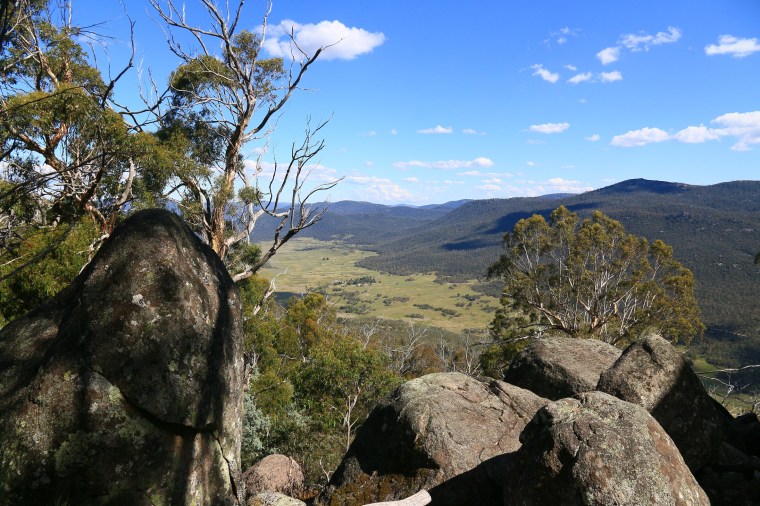
The thing about seeing the ranges to the west practically every day is that you eventually want to strike out for them and almost lose yourself in their lumpy ridgelines and tangled bushiness. It must be how those buffoons who tried to get over the Blue Mountains felt, impelled by an urge to see what is on the other side (cows as it turns out, who figured going round the mountains would  be far easier). These days, buffoons have Subarus and can churn their way up dirt tracks in Namadgi National Park to see if there are cows on the other side.

hills04

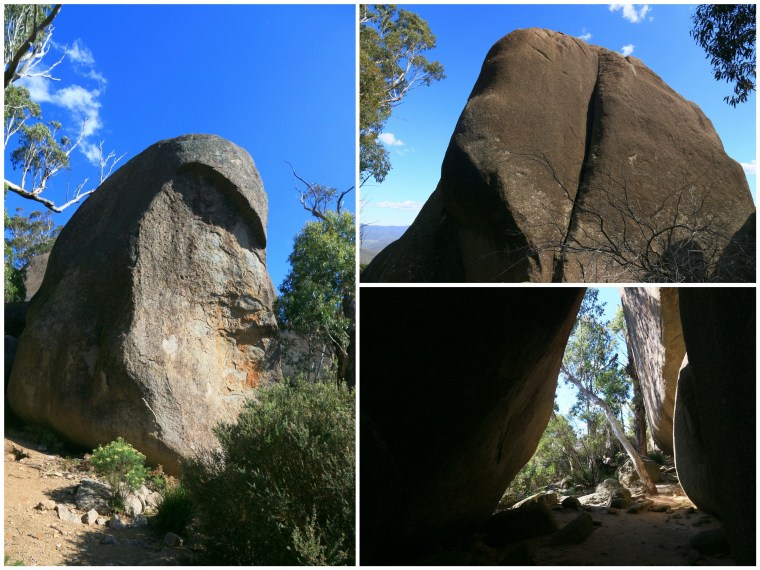
hills07You don’t notice from afar, but these ranges are peppered with giant, rounded granite boulders stacked like clumps of frozen peas that have been left in the freezer for far too many years. These boulders congregate quite generously up on Orroral Ridge, where a series of slightly neglected tracks lead to rocks named for their resemblance to animals and people and other inanimate objects which aren’t rocks. Such is the profusion of rocks that geologists have wet dreams, climbers drool onto their harnesses, and random waifs and strays seeking mountain air delight in the summer coolness of virtual caves formed in the hollows of a cluster of boulders.

hills05a

Cooling rock hollows would have been most welcome on a separate foray into the wilds of Namadgi. Technically it was autumn by the time I made it down into the Orroral Valley and struck out on a much better trail to Nursery Swamp. But so far autumn has produced unyielding temperatures in the low to mid thirties and love for my newly acquired air conditioning. It’s weather that is great for drying washing, but by time I had washed and then hung said washing out it was nearing midday, and only mad dogs and Englishmen go out in the midday sun.

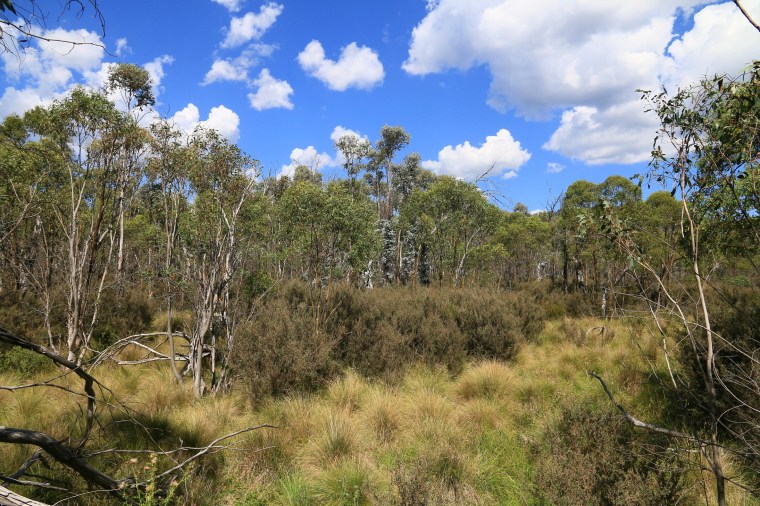
hills09I wasn’t expecting much from this walk – in truth it was something to do in a lull while my washing dried. Plus being practically the last remaining marked trail I hadn’t been on in Namadgi I felt a little obliged to complete it. The word ‘swamp’ was hardly enticing, with images of squelchy boggy plains, rotting carcasses and festering mosquitoes. But it was actually quite a delight, rising steadily through lofty Peppermint Gums, bypassing a few more giant boulders, and meandering through button grass and boardwalks under blue skies and fluffy clouds.

hills10

hills11The swamp turns out to be a fen, as the information board at the end of the walk explained. I’m not really sure of the difference, but it was fairly less swampy than I imagined. A bench here overlooked a river of vivid green grass, lapping at tall forest and rocky outcrops. Being now beyond midday it was the perfect place for a simple homemade sandwich and, once again, for all the expensive meals and gourmet plate ups*, can there be anything more satisfying than a bushwalk sandwich? I don’t think so.

Thus, even in the heart of these enduring mountains, with their magnetic heights and silhouetted ridgelines sit divine little glades like this. So, while the mountains can be marvelled at, the views readily lapped up, here’s to the valleys of this world; contented spots with a bit of simple tucker and lack of yappy dogs.

* On a complete tangent, I was in a cafe recently and someone ordered some “activated muesli”. WTF? Do they shake the muesli up in its box before serving? I noted a price tag of $14.50 to seriously activate your wallet.

Australia Green Bogey Walking

Floody ‘ell

So it turns out ‘The North’ is more than just a fictional imagining in George R.R. Martin’s gargantuan head. There is a real place in which gruff folk with grizzled beards mumble about stone walls. The weather can be cold, but it is mostly just bone-chillingly wet; sombrely leaden. Expansive wilds present a bleak, gritty beauty, tamed only in picturesque patches of lowland. Sheep cling forlornly to the slopes, anticipating, finally, the coming of winter. Further North, an ancient wall struggles to keep out wildlings, armed with Tennants Super on the 0900 to Euston. We are in Cumbria.

lk04

Cumbria before the floods, but only just. After a soggy few days on the Lancashire coast, it wasn’t much of a surprise to travel up the M6 in a medley of drizzle, dark cloud, and downpour. While a brief period where I didn’t have to use windscreen wipers offered hope, this was dashed with unending persistence once in the Lake District National Park. And so, from umbrella buying in Bowness to umbrella usage in Ambleside to umbrella drying off in a neat hotel in the middle of nowhere, there really wasn’t much to do in this greatest of outdoors.

As the dim skies faded black and the patter of rain continued apace upon the skylight I decided to make a break for it and check out the bright, Christmas lights of Keswick. I was hoping for a Dickensian scene of late night shopping, market stalls with hubbub and mulled wine, brass bands blaring out Once in Royal David’s City, and ribbons of light twinkling above curving cobbled alleyways. The reality offered some lights but little else, as the town appeared to be hunkering down for the night. With sodden shoes and a reduced-price pork pie from the Co-op, I retreated back to the car, umbrella decimated by a gust of wind, facing only the promise of driving through surface water in the dark. I made it, but Keswick did not. Two days later it was flooded.

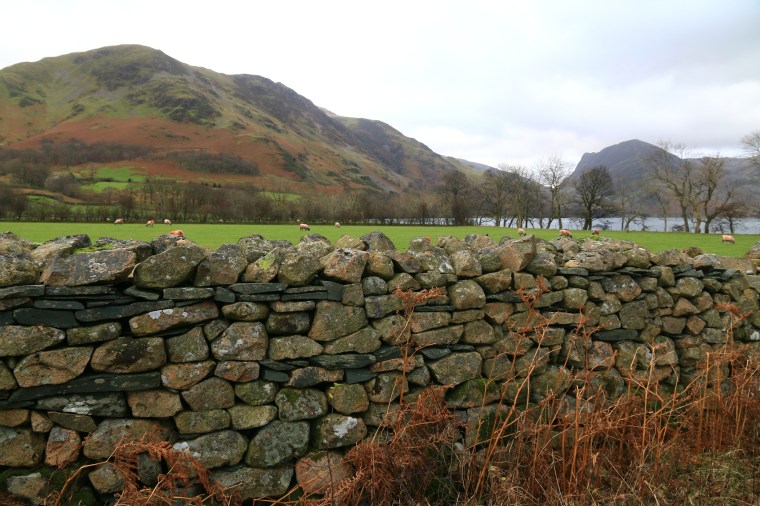
Oh for a dry day and, for most of Friday, it happened. It wasn’t exactly bright or pleasant, but for a few hours the rain had paused before it was to come back in such vengeance. A few puddles dotted the road alongside Derwentwater on the way towards Honister Pass. Softened valley villages and stonewalled farms yielded to barren upland, coated a deep brown with the dying bracken. A steep decline worthy of the Tour De France returned things to something closer to the idyllic around the idyllic sounding Buttermere.

lk01

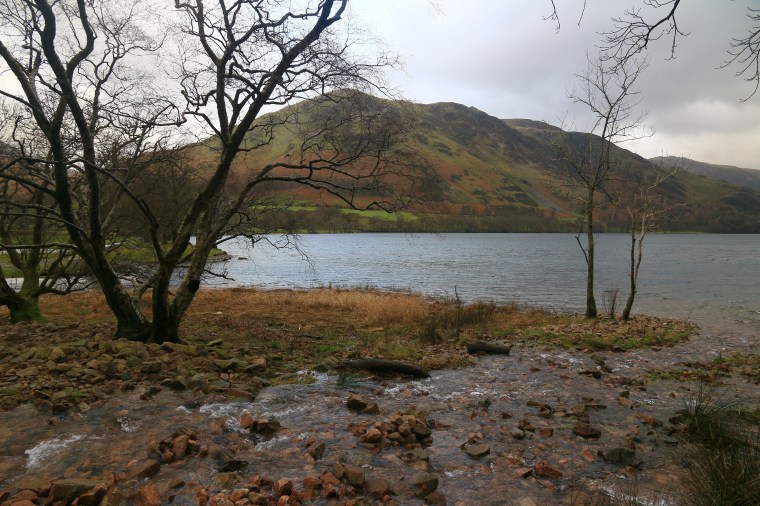
This was my chance to revel in dreary dryness, to soak up bleak melancholy, to wander lonely as a big grey cloud. The lake could be circumnavigated and it came as something of a surprise that the path was still in good condition during the two hour loop. Only once was a rocky detour required due to a swollen lake edge. Oh, and a couple of steps through a rising brook. Hang on…I almost forgot…that falling ass over tit moment on a small stretch of grass linking the road back to the path. Muddy bottom, muddy camera, but thankfully no-one around to see my slippery fall from grace.

lk03The scenery was undeniably beautiful. One wonders whether it would be improved by sunlight and fluffy white clouds, buttercups and warmth. Probably. I remember it as such on a brief stop ten years past. Today, it was moody and, to be honest, me too. After a week without it, I just really really REALLY craved the sun. But at least it was dry…so mustn’t grumble.

lk02

lk05

lk06With all the previous day’s rain it was no major surprise to encounter a series of stretched out cascades and falls plunging down the steep-sided fells towards the lake. I suppose this is some recompense for the deluge, but so frequent and incessant is the sound of water that it makes you want to pee really really badly. And there is not much in the way of foliage left to offer shelter and protection.

Still, relieved and closer to the end, an alien sliver of blue sky opened up to the northeast. A chink in the steel armour, it was something to cling to, something to chase. Briefly it illuminated some hills in the distance, but failed to deliver anything of solace on my face. There would be little chance for anything to air for long.

lk07

lk09Completing the Buttermere circumnavigation, I jumped back into the car to venture over a narrow pass and down to the western edge of Derwentwater. That chink of blue sky was somewhere in this direction, and I may have bathed in it for all of twenty seconds. Unfortunately I was in the car at the time, but it was still a very special twenty seconds. A valley glowed. A farm building shimmered. The sheep murmured quiet contentment. And then the strong wind sent it away, off into the distance.

lk08

Early afternoon in Keswick and things had actually dried out a little – perhaps it too had been briefly kissed by the sun? There were people on its streets and a hint of something Christmas-related in the air. There was no wafting smell of hot pork pie though, but then I began to question whether this ten year old recollection was actually in Kendall rather than Keswick? So, of all things, I ended up with a Cornish pasty in the cute town square.

Determined not to suffer a food disappointment to compound my rapidly redeveloping British glumness, I set out on a mission for afternoon tea. For what else is the Lake District if not the archetypal biscuit tin setting for afternoon tea? Grasmere sounds a likely spot, full of tea shoppes and crafty gifts to cater for poetic dreamers. A place where a pot of tea can – at a single moment – feel like the best thing in the world. Elation amplified by a gigantic slice of treacle tart, sickeningly delectable. A high on which to leave the lakes and to treasure a day of figurative sunshine amongst the December clouds.


Driving Great Britain Green Bogey Photography Walking

Nuage magique

In further news not westcountry, here are some more pictures and jumbled words from a recent trip to the Geneva suburbs of France and the French bit of Switzerland. Family connections make such trips possible and while this can raise some minor irritations – think early starts, couch sleeps, tricky post-dinner cheese decisions – there are more positives than negatives. Like family fun at six in the morning, afternoon naps on a comfy couch when all is quiet, and fulfilling post-dinner cheese decisions.

Fr01

In addition there is the location, which provides access to two countries and cultures and some very hilly ground. I feel like I have at one explored much and touched only little over multiple visits. New settings emerge like the sun through the lake cloud, while old haunts linger, much like the lake cloud. Thus, in conclusion, the lake cloud is very variable and largely unpredictable in late autumn and sets the tone for the disposition of the day. Linger in cold dreariness or bask in pleasant, warm sunshine. Just be prepared to deal with it one way or another…

1. Disconnect sensory and logic-processing synapses

It looks like a pile of gloom. It sounds like a pile of gloom. It smells like a pile of gloom. It is not necessarily a pile of gloom, though it could be actually. Or maybe not. What is dark and leaden at the start of the 61 bus ride can be clear and airy at the end of it. Now, I know the 61 bus ride feels like an eternity for some, but not so long to make this transition conventional. You think there is no way under the (non-existent) sun that this pile of gloom will shift today, and it does. In the twinkle of a traffic light, your body which was in winter is now firmly in autumn and possibly just absorbing a residual hint of summer.

Fr02

Fr03Of course, this is marvellous given such abysmal expectations. You find yourself beside the lake in Geneva all sapphire and topaz crystal. Leaves are ablaze with afternoon sun. A walk up into the old town warms the body further, despite its narrow cobbled streets in the permanent shadow of expensive jewellery shops and even more expensive solicitors. The Saleve – which didn’t exist before – punctures the horizon from the Promenade de la Treille. Children play merrily, students philosophise lazily, lovers embrace amorously. Where is the gloom? None of this makes sense.

Fr04

2. Ascension

There is wisdom to be had in the words of Yazz and the Plastic Population. It may take many hairpins and navigation through the inside of a big damp cloud, but go up and you may just end up above the weather.

It was looking doubtful climbing up to a car park in the shadow of Les Voirons, a lumpy ridge rising to highs of 1400 metres. Only in the last few kinks of road did the mistiness glow bright and dissipate. Even then, occasional wisps of cloud hovered over the road surface, as if a smoke machine was spewing out its final puffs from a distant eighties dance-pop-funk performance.

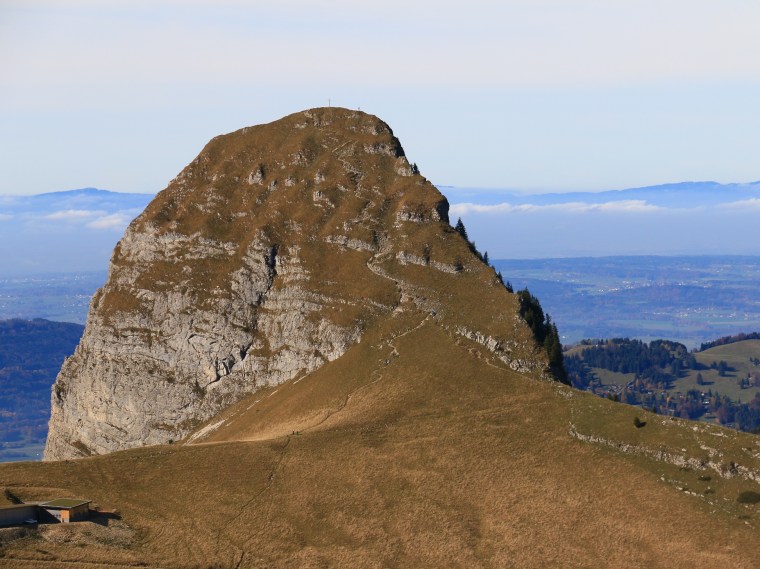
In the clear air, churned up tracks through the forest conveyed a sense of truffle hunting, rabid dogs, and people with shotguns. After piddling about along these tracks for a little while, the only way was to ascend, bay-ay-beee. Up through millions of discarded leaves, into a clearing and views of the sea; a brilliant white sea lapping at the shores of craggy peaks and ice-capped spires. The very top of the Saleve a small desert island floating in this blinding ocean.

Fr05

Fr06There was something very satisfying about being above the cloud, in brilliant blue skies, knowing that it was well miserable down there. As if you had stuck two fingers up to the weather and, for once, outsmarted it. Haha, yes weather, you are no match for altitude, mwahahahaaa! All your stupid cloud is doing is reflecting the sun and making me incredibly warm, so that I can cope in a T-shirt. And in making the valleys disappear, you accentuate the purity of the view, the drama and scale of the stunning panorama of the Mont Blanc massif. Yeah, screw you, cloud.

Fr08

3. Just eat

Sunday lunches are often best when they are lingering affairs, embellished with hearty food and infused with wine. They are the perfect antidote to grey skies and uninspiring temperatures, a strip of crispy crackling in a pile of over-boiled cabbage. Perhaps in the case of this particularly Sunday lunch it was the heat from the Raclette-melting contraption (it probably has a local name, like raclettesiennierre-de-montagne-lardonass) that generated just enough upward convection to part the clouds towards the end of the day.

Fr09Cue some reluctant shifting of our own lardonasses for a welcome amble in the nearby Swiss section of countryside. Golden light casts a serene glow on everything and everyone. A crispness in the air is refreshing and helps to dilute the strong odours of cheese. The cloud has gone again, and – in such endless skies reaching to the stars – it is hard to believe that it will so easily return.

Fr10

4. Try a different country

Okay, so perhaps Switzerland has all of the sunshine, what with millions of fancy penknives slashing at the cloud and all. So, with a free day out to use up courtesy of my rail pass I was able to penetrate deeper into the country and seek out its sunnier spots.

Fr11First, with cloud embedded deep into the valleys, I had to escape up once more. From the town of Vevey, a gleaming commuter train elegantly curves its way past chalets and chateaus to the suburb of Blonay. Here, a change of train (waiting on the other platform, naturally) shifts into a steeper grade through forest and occasional hamlets to Les Pleiades. Nothing much is at this terminus, apart from open meadows, scientific contraptions, and labourers preparing for the winter. But it is a spot well above the cloud, which sits snugly in its lake-filled indent, a luminescent glacier of cotton wool.

Numerous jet trails pierce the clear blue sky and it is warm again. This is the sunny side of Switzerland, all rolling green meadows and dotted villages. Happy to linger, I gradually stroll down, passing a small fromagerie and a couple of holiday chalets a louer. A barn sits empty, the cows having descended for the winter, the sound of their bells occasionally echoing up the valley. I move down too, only from what seems an alpine summer and back to a winter by the lake.

Fr12

———————————————-

My original plan was to hop on a boat cruise from Vevey, a sedate and civilised way to soak up the charm of the Riviera towns and the drama of the rising mountains. While some hazy breaks hinted at a clearing it was still predominantly grey; not quite the scene I had pictured in which I lazed contentedly on a wooden deck, the lowering sun illuminating the surrounding mountains. So instead – with free travel at my fingertips – I jumped on a train for twenty minutes to Aigle.

One of the problems with free travel and chronic indecision is deciding what to do with the free travel that you have decided to buy. At Aigle, two tempting options wait and time, really, for only one. Platform 13 and a train to Les Diablerets, Platform 14 Leysin. Both equipped to move upwards and no doubt deliver another hearty dose of gorgeous Swissness. One leaving in four minutes, the other in six…time barely sufficient for decision-making.

Jumping on the first to depart (Les Diablerets), the carriages immediately turned into a tram and clunked through the streets of the town. I caught a glimpse of the chateau on Aigle’s edge, and promptly jumped off at the first stop. There would be no time to visit that as well as Les Diablerets, so I crossed a road and caught the following train to Leysin.

Fr14With the sun now out in Aigle there was less imperative to climb, but the train relentlessly lumbered upwards. Surprisingly there was deception in that valley sunshine, as it became clear once up high that a layer of haze hovered at around 800 metres. The sunny valley was no longer visible, despite it being sunny when down there. What kind of sorcery was this?

Leysin itself appeared to possess charm and utility, no doubt bustling in winter and thriving in summer. In early November things were a little devoid of life apart from clusters of students, neatly attired, mostly Asian, receiving an expensive Swiss education in a school with a view. A few joined me on the train back down, through that mysterious haze which was only visible from above.

Fr13

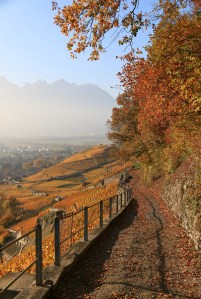
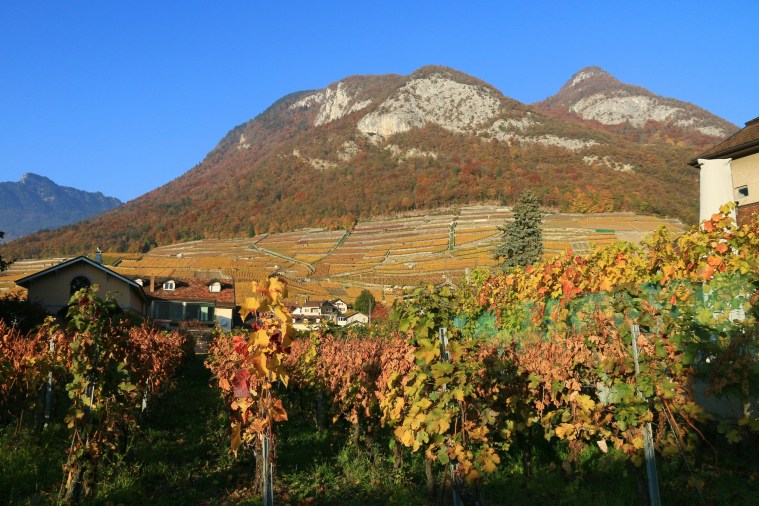
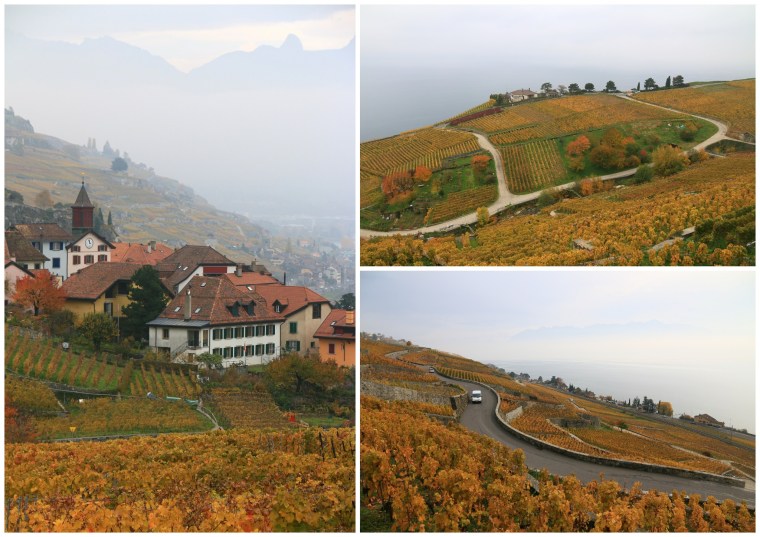
In time-honoured tradition I hopped off the train a couple of stops early, prior to it reaching Aigle level. I had noticed on the way up the glimmering terraces adorned with rows of vines, golden in the peculiar autumn sunshine. The chateau would be visible below, and there must be a walk down, because a carriage of younger schoolkids disembarked here on the way up.

Fr15I have no idea how all those schoolkids assembled on the platform, such as it was: two square paving slabs dangling over one of the walls cascading down in giant steps towards the valley. What looked like some kind of drainage channel passed steeply under the rail track; the only other person to disembark informing me that this was the road-cum-path. And despite this initial steepness, it was a glorious walk, mostly following the small chemins used to transport grapes and labour. Occasional houses adjoined the route, each proudly displaying the name of the vigneron and date of establishment. One or two tempted with open doorways, while outside a couple of workers toasted a hard day’s winemaking with a crisp glass of white.

Fr16

Fr17With the light lowering in the clear (???) sky, there was barely chance to visit Aigle’s picturesque chateau before it would be cast into shadow. While sunset time was a little way off, the narrowing of the valley and the proximity of gargantuan mountaintops meant that it would soon kiss this part of the world goodbye. Darkness would return, and with it, the infamous foggy shroud of dank.

5. Suck it up, cheese boy

There is only so much successful blue sky strategising that one can manage, and fortuitous decision-making will eventually turn sour. While I loved practically everything about an overnight stay up from Vevey in the village of Chexbres – king-sized bed, amazing shower, big screen TV with 832 channels in English, French, German, Italian, Spanish, Russian, Arabic, Cornish, Swisshornian – the balcony view was not one of them. Beyond vine terraces and tightly packed village roofs floating in the mist a sparkling blue lake had disappeared.

With a midday checkout I dawdled for as long as possible for things to clear but today was not going to happen. On top of the low cloud, some medium level cloud and then some high cloud, with a few spots of rain and little hope of sun. I faced a cloud lasagne with bits of Switzerland oozing through the layers. Suck it up, cheese boy.

Still, the setting – in the heart of the Lavaux wine region – was very pretty, just that more subdued than the previous afternoon in similar terrain around Aigle. Wine has been grown here for donkey’s years, probably with the use of donkeys on the steep-sided terraces, frisked by slavering monks gagging for their next tipple. Today, a few mechanical contraptions – steep narrow-gauge rail tracks like fairground rides, convoluted water sprinklers, grape conveyor belts – have evolved, but much must still be managed and picked by hand.

Fr18

A network of chemins provides gentle and mostly traffic-free walking across appellations, between villages, and – occasionally – directly through the rows of vines themselves. It’s such easy and serene walking that you can comfortably end up strolling all the way into Lausanne. I practically did in the hope that the sun would shine as the hour lengthened. And, towards the end, the milkiest hint of sunlight filtered through the cloud levels, briefly giving the impression of a vast lake below, and high mountains beyond.

Fr19

A large patch of blue sky greeted me as I arrived back into Geneva’s train station. It seemed – from my limited recent experience – uncharacteristic that Geneva would be clear while further up the lake it remained damp and grey. Little of the day remained to enjoy it, but the light illuminated the final 61 bus ride back to Annemasse. And it provided a salient reminder that there is only so much you can do to predict, manage, and deal with the infamous wintry shroud of Lake Geneva.

Europe Food & Drink Green Bogey Photography Society & Culture Walking

Swiss day out

The number 61 bus from Annemasse Gare to Geneve Cornavin seems to pass as one of the longest short journeys around. I don’t know what it is about it…perhaps the trundle through France, with its oil-stained Renault workshops and flashing green pharmacie signs? Or maybe the sombreness of being beneath a Leman gloom cloud, omnipresent in early November? Though a seamless (at least then) border crossing sweeps you into a more sanitised array of Swiss shops and streets, the rattling and bending and last-gasp stopping continues apace. Stylishness and affluence glides in, bag ladies and yoof dribble out. No-one, ever, stands up for anybody else, achieved (for those rare species without tablets and phones) through an accomplished display of middle-distance gazing, looking at nothing or no-one in particular.

The journey only takes forty minutes or so, which is considerably longer than the one hour, thirty six minutes and forty nine seconds it took me to travel almost all of the Piccadilly line (from Oakwood) to Heathrow, which in itself was longer than the flight duration from London to Geneva. But this bus feels the longest trip of the lot, and it is with relief and excitement that you find yourself at the virtual terminus of the Swiss railway network (not to mention round the corner from Manor).

Looking for something to do – for lake cloud to escape and bendy buses to flee – I availed myself of a Lake Geneva – Alps Regional Pass. It took some finding, for there is nothing the Swiss seem to like more (well, apart from chocolate, cheese, and referenda) than a convoluted array of rail passes, network zones and travel conditions, all in French, German, English and occasional Italian. I could get a Swiss Card for a half-priced fare, or a one-day whole-of-SBBCFFFFS roamer, or a Zug Snausserhorn Goldenpass or maybe a Cloud Cuckooclockland permit, with 70% discount on VIP chocolate train seats instead? What is certain is that no Swiss person will ever pay a full fare and that – despite such ticketing intricacies – the trains will still run like a well-worn cliché involving clock mechanisms.

It’s not just the timeliness of the trains, but the efficiency of connections, something which never fails to evoke wonder amongst travellers bred on a discombobulated British rail system or faced with a practically non-existent Australian one. Connections to other cantons and cities and major towns, but also to tiny villages, hay sheds and pieces of rock in the middle of nowhere. Like Montreux – upon glittering Leman shores – to Rochers de Naye, some two thousand metres in the sky.

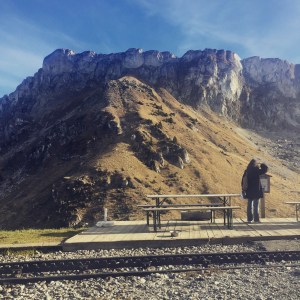
RDN01Lake cloud which started to fragment in Lausanne had virtually evaporated by the time I reached Montreux, for my seven minute transfer to platform 10 and the Rochers de Naye train. Departing exactly at 09:47 as planned, the two cogwheel carriages made no bones about it and immediately veered sharply upwards, through a tunnel and out onto sun-filled plateaus coated with luminous autumn foliage and expensive views.

Riviera homes for bankers, third rate Swiss pop stars and dairy farmers alike slowly passed by, and occasional stops in the middle of nowhere allowed regulars to jump off to reach their hidden retreat in the woods. While some stations resembled the genuine thing sited in proper villages, other stops were little more than a plank of wood or a metal gate. Here, the train would briefly pause on a 50% gradient, before rolling a tad backwards in a disconcerting motion accompanied by a grinding shriek of metal on metal. You could almost smell the sparks as Sepp hopped off and waved a cheery goodbye to Michel, brown envelope in hand, as though this was the most normal thing in the world.

With altitude the ‘suburban’ stops fade and only walkers and the curious remain at this time of the year. Many of the walkers disembark at the Col de Jaman to walk up the nearby bulbous lump that is the Dent de Jaman. The curious – such as I – stay seated, dedicated to reaching their highs the easier way.

RDN07

One final climb through a pitch black tunnel makes the dazzle of reasonably fresh snow all the more blinding. Such is the drama of the journey, the top station is a touch underwhelming. A few views are spoiled by ski infrastructure, while building work distracts from an overpriced and bitter coffee in the cafe. A couple of goats offer mild amusement but the jardin alpin is closed for the season. Fortunately there is a higher viewpoint from here, up a short series of switchbacks, from which Switzerland – and France – is on view.

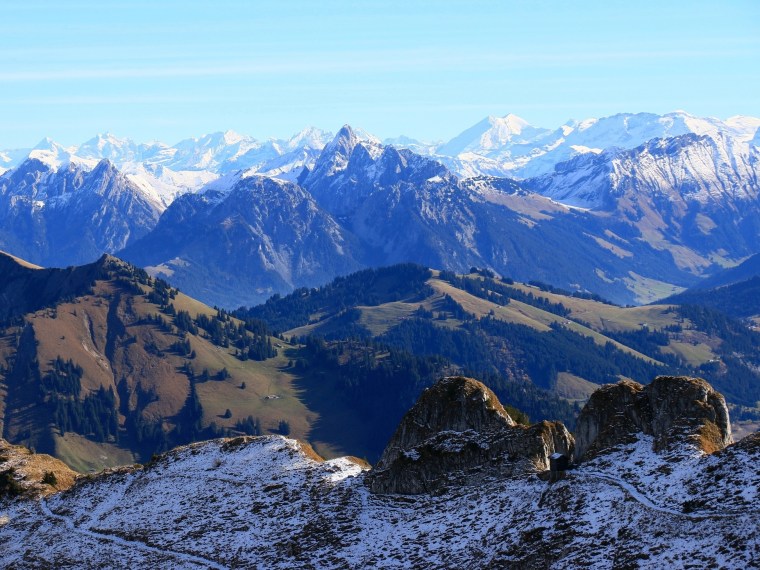
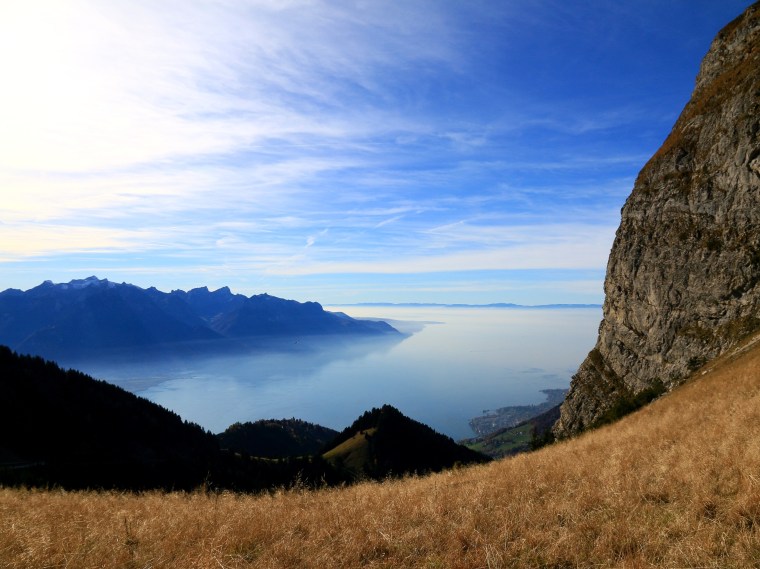
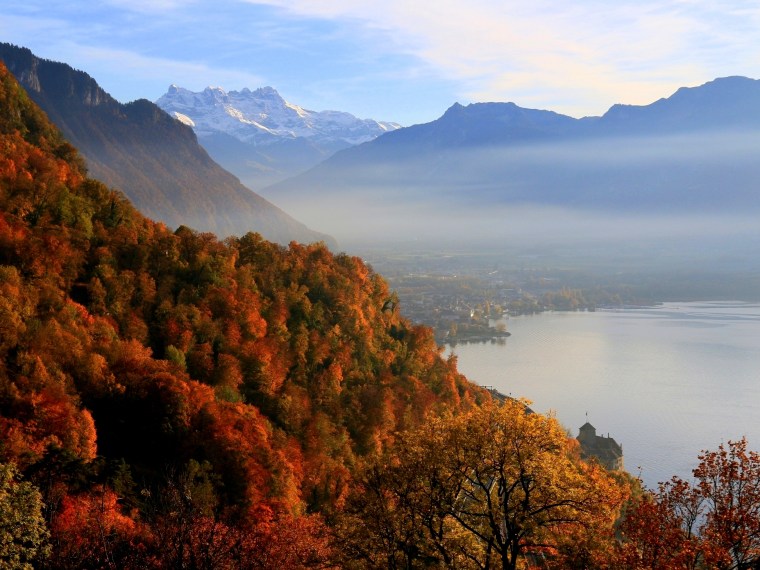
And what a view. A long way down, Lake Geneva cuts a swathe like a bloated boomerang westwards. Beyond lumpy outcrops and hills forested dark green and charred red, the lakeside towns – Montreux, Vevey, Lausanne and others – portray one elongated urban jungle. Occasional tower blocks, cranes, churches, chateaus can be picked out, while the curvature of the rail line up from there resembles some kind of herculean bobsleigh run. The alternate side of the lake sits hazily desolate, hemmed in by the pile of Haute Savoie dents, cols and monts. On the horizon, the thin line of the Jura hovers above the remaining cloud, still seemingly enveloping Geneva.

RDN02

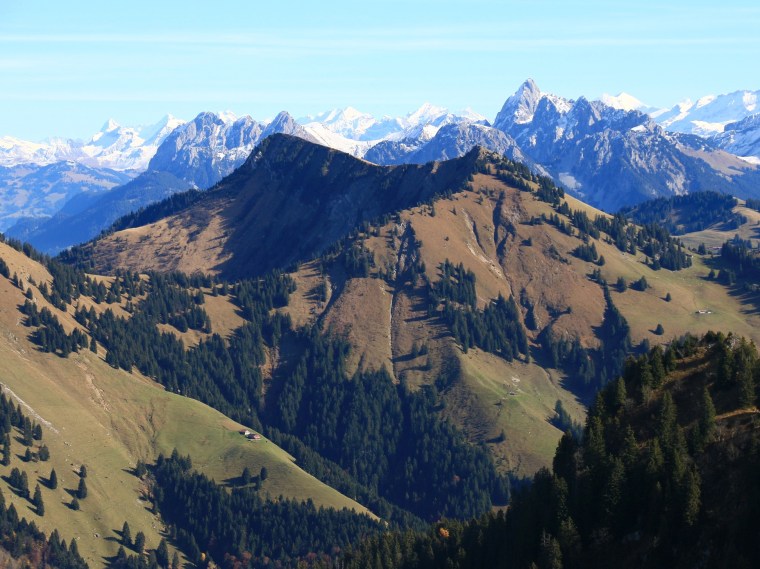
RDN06And that is just the westward view. In all other directions, a sweeping panorama of snow-capped peaks and plunging valleys reaches out into the distance. The behemoths of the Bernese Oberland pierce the sky, pointed and rutted and sharpened and sculpted. Pillars of rock – too precipitous to catch the snow – endure; like resistant teeth in a seven year old’s mouth. This raggedy snowline fades into darkly forested slopes and meadows tinged brown by the passing summer.

RDN05

There is still warmth in those upland valleys, a sun-trap that allows for wearing of T-shirts, particularly when walking uphill. Keen to take advantage of this unexpected vestige of a rapidly fading summer, I embarked on a circular walk pieced together with my Rochers de Naye leaflet and snatches of online maps for crucial moments of decision and misdirection.

Following a ridge gradually down from the viewpoint, I reached a junction: one way back through a small valley to the top station, or another down alongside a rock face to the Col de Jaman. Somewhere within this hulk of rock the train burrows through, while humans have to inch their way around on slate ledges and avalanche rubble. The route understandably prefaced with warnings involving sturdy footwear, slipperiness, and crumbling pieces of mountain made it an easy decision: lunch on a sunny patch of grass with a spectacular view, before heading back up the valley.

RDN08

RDN09Thus it was that I found myself down to a T-shirt (and trousers!) while walking through snow. The snow had obviously thinned as the day had progressed, but remained thick enough to obscure the last part of the trail up to the top station. Warm, slightly breathless, low on water…I could see the appeal of taking the train now, which again emerged out of its tunnel to taunt me. It was heading down, and – after safely completing my walk – I was to join it.

RDN11I could have plunged all the way back down to lake level but – determined to make the most of this wonderful weather (not to mention my expertly discovered rail pass) – I paused at the Col de Jaman station. Walkers were still setting off to conquer the lump nearby and close up it didn’t seem too bad. Switchbacks yes, but nothing that would cause undue alarm for someone with sturdy footwear and good heart. Maybe on another day, but today I was content to bathe in the sunshine accompanied by the remainder of my giant Raclette pretzel bought from the kings of Cornavin.

RDN12

RDN13

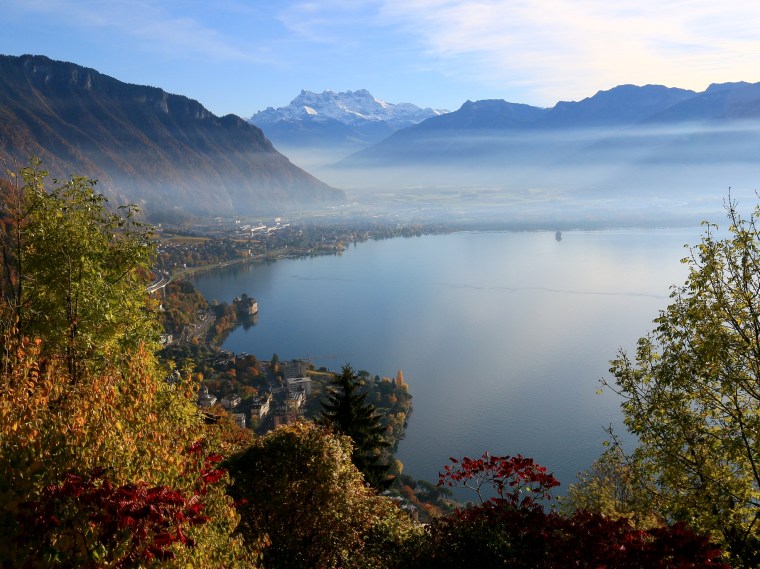
My final stop on the way down was somewhat spontaneous and turned rather fortuitous. I had made a note of Glion on the way up, purely because of the splendid views down to the lake and across to surrounding mountains, sweeping their way into the Valais. The foliage too – on this lower south facing terrace – was something to cherish in the eruption of autumn. Through the leaves and branches, glimpses of glassy water would emerge, encircled by the mountains rising upwards through the valley haze.

RDN14

RDN16The outlook was so alluring, the late afternoon light so enchanting, that I set off walking and carried on without really knowing where I was going. I assumed – given the gentle downward gradient of the lane I followed – that I would end up somewhere by the lake, from which an efficient and comfortable Swiss train would be waiting. Few cars bothered me, while occasional grand houses and health retreats sprung up on the slopes between the trees. At a kink in the road, passing two farmhouses, the view again opened out to reveal the colourful wooded hillsides tumbling down towards the lake, with a hint of winter looming upon the distant Dents du Midi.

RDN15

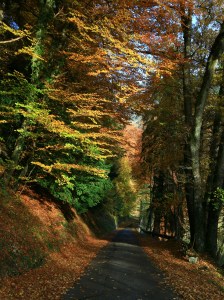
For all the fun of the train I was glad to complete this final part of the descent on foot, each turn revealing a looming mountain, glimpse of water or avenue of bronze. Merrily marching, time whizzed by and before long I did indeed reach the outskirts of Montreux, a feat achieved more through instinct than design. A long straight balcony of a road continued to descend, each house and villa passed with a tinge of envy and click of a camera. A churchyard offered one final panorama as the sun started to graze the tops of the peaks to the southwest before dipping beyond. In such a setting, even I might be tempted to attend Sunday service here.

RDN17

No doubt if I had stayed on the train descending all the way to Montreux I would have had such a simple and effective connection that I would be back in Geneva by now. Instead, arriving at the station on foot I managed to miss a train by a matter of minutes. The next was a whopping forty-five minutes away, an incredulous amount of time given Swiss standards. However, despite gathering weariness that comes with a 5:30am start and a ride on the 61 bus, I inched on down to the lake shore, feeling fortunate in the end to have missed that train…

RDN18

Such was the beauty of the day, the charm of the late afternoon, the ambience of the evening as the last light faded I was tempted to stay for some dinner and catch a late train back. Perhaps if I did I would not have had to – shockingly –stand in the vestibule of a railway carriage, at least until Vevey. It turns out (relative) congestion sometimes exists in Switzerland too.*

No such problems back in Geneva, with a seat on the 61 to push through the darkness and over into France, eventually. Some of the people – enduring a long, hard day of low-taxing money making – were quite probably on the same bus as me this morning, staring absently into the middle distance. Their laborious daily commute was my stroke of fortune, a crucial cog taking me to the top of a mountain and back. An unappreciated, maligned link in a great continental railway – and now bus – journey.

* I should add, trains can run late as well. On another journey of mine the train was once running four minutes late departing Lausanne. The conductor was beside himself with contrition and pleaded to the gods that this had not caused any inconvenience to anyone whatsoever.

Europe Green Bogey Photography Walking

British Columbian

One week…one week of finishing work, packing up a white flat, jamming in flat whites, lingering in the bush and avoiding the fog. A week successfully navigated, with the generous bonus of a grating cough and snotty nose from the city of Canberra to see me on my way. Something to make an interminable fourteen hour flight even cheerier. But one week and fourteen hours later, I descended through a cloud of smoke and a sinus of pain into the city of Vancouver, and then beyond, out into the grizzly wilds…

In Whistler while you work

Skipping through Vancouver I had decided to head straight to the hills, for some post-journey restitution and mountain air. What sounded good on paper was challenged in practice, as huge forest fires courtesy of a severe drought had enshrouded most of BC in a layer of smoke. Whistler, it seems, was quite probably the worst place to be, with an air quality rating akin to bad days in Beijing. Oh to live in Beijing.

bc01There was little for it than to venture out in short bursts, around the shops and maze of pedestrian streets that make navigating Canberra suburbs seem a breeze. Oh for a breeze, to lift this constant eau-de-campfire. It came eventually, and there was minor visibility later in the day. Enough to see a red sun above the pines, encounter a moose, and stumble across a black bear.

The black bear sighting was a definitive highlight of the day, even more for the fact that I had probably already passed it once without noticing. Just munching on some berries beside a shared cycle and walking path, possibly waiting for some hapless campers with a picnic basket. Or people like me lost and doing an about turn. I passed, I saw, I lingered for a few seconds to weigh up the pros of making the most of a picture opportunity and the cons of being eaten. I carried on and the bear carried on regardless.

So one day in and I had already ticked off a few Canadian clichés. The next day I had a Canadian coffee, which was still relatively awful despite it being called a flat white and despite at least one Australian working in the coffee shop at the time. Never fear, British coffee awaits! Oh wait. On the plus side, while there was still a distinctive campfire smell, the smoke haze had lifted a little, meaning some bigger lumps of terrain could be spotted, down which numerous mountain bikers hurtled themselves faithfully like lemmings off a cliff.

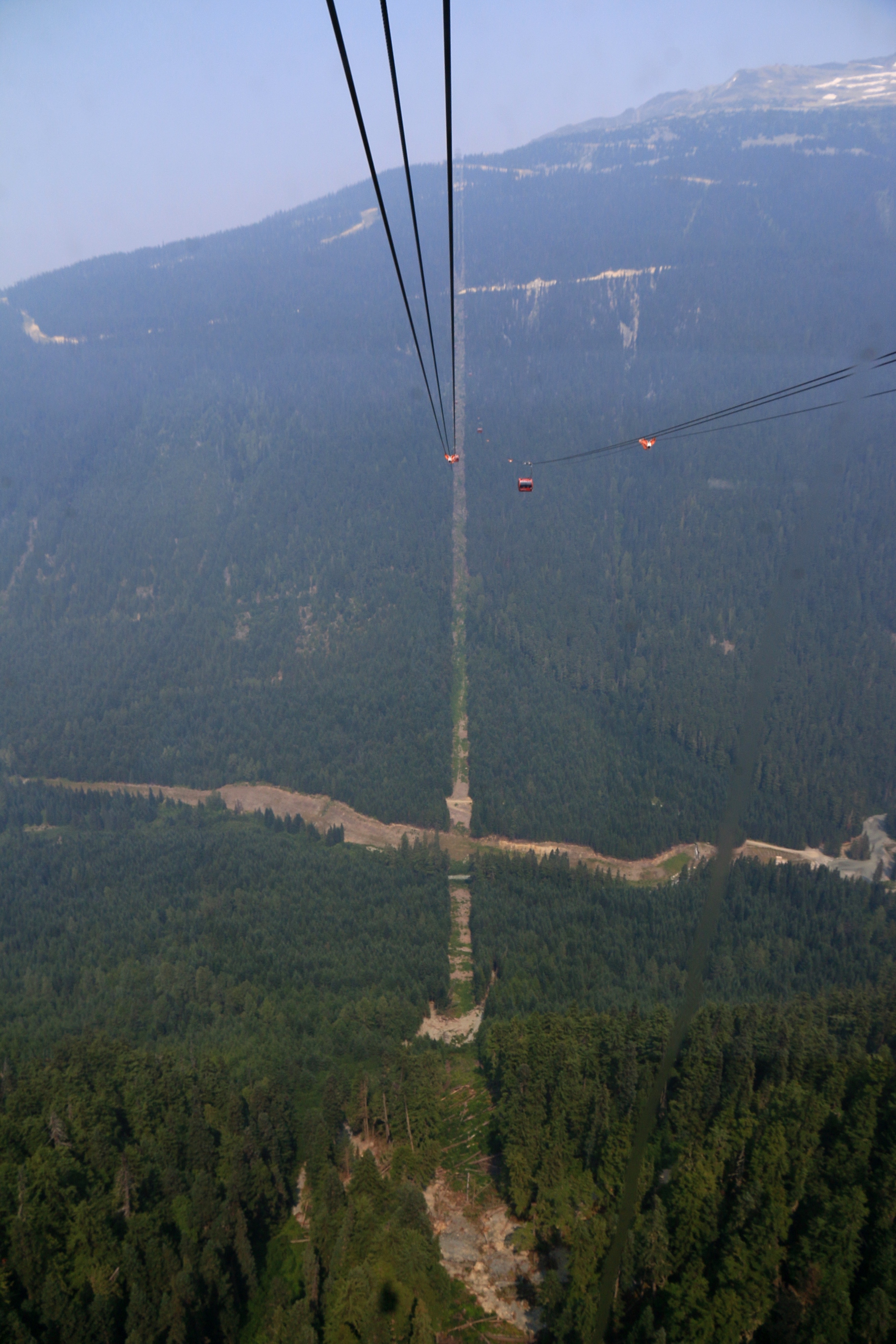
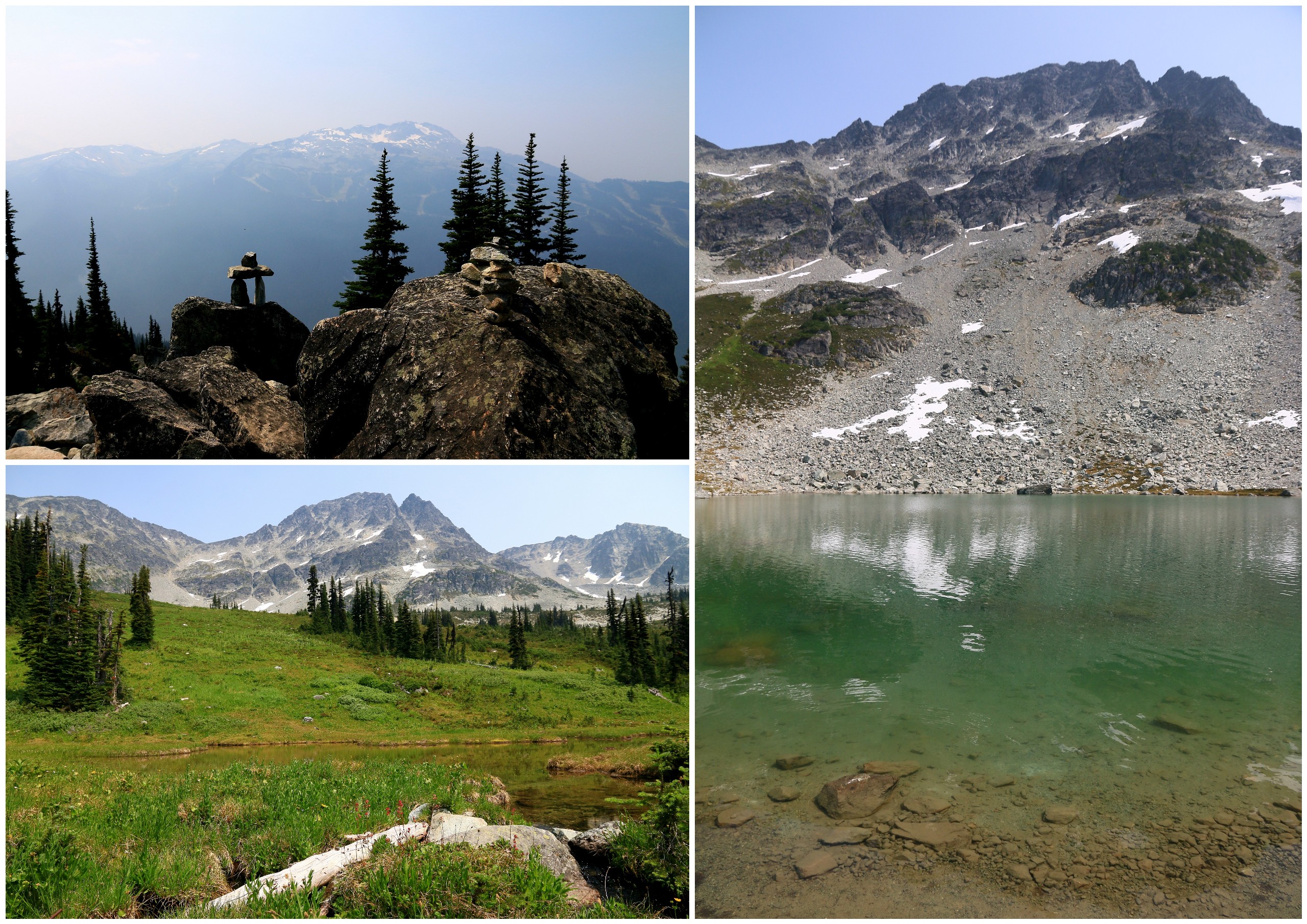
bc03What goes down must go up and there is a generous lift system in Whistler for the intrepid explorer. This includes the Peak to Peak, a seemingly endless high wire linking Whistler and Blackcomb Mountains, its small red cabins dangling over a gigantic precipice in between. Turns out the Swiss don’t have a monopoly on gravity defiance after all. Thanks to such engineering feats I was able to walk in a high alpine environment, and while the views were naturally hazy and the going a challenge (think jetlag, chest infection, altitude, smoke, heat, bad coffee) I made it to a small tarn on the Blackcomb side of the world.

bc02

The trails stretch on to glacial views and craggy ridges and summit peaks and hidden valleys and – in another time, in other conditions – I could have gone on and on. But Whistler proved hard work and there was some relief at coming down from the mountains, away from the smoke and into brief Vancouver sea-level summertime ambience.

Clearer and coola

Not that there was much time for recovery. Early Friday and I was off to the airport to hop on a twelve-seater to the Bella Coola Valley. Where I hear you ask? Exactly. I am not sure myself how I first found out about this place and how I came to be here. But, after an hour flying over an astonishing wilderness of glacial river valleys, high ridges and gigantic icefields, I emerged in clear blue skies, uplifted to arrive in a momentously attractive spot.

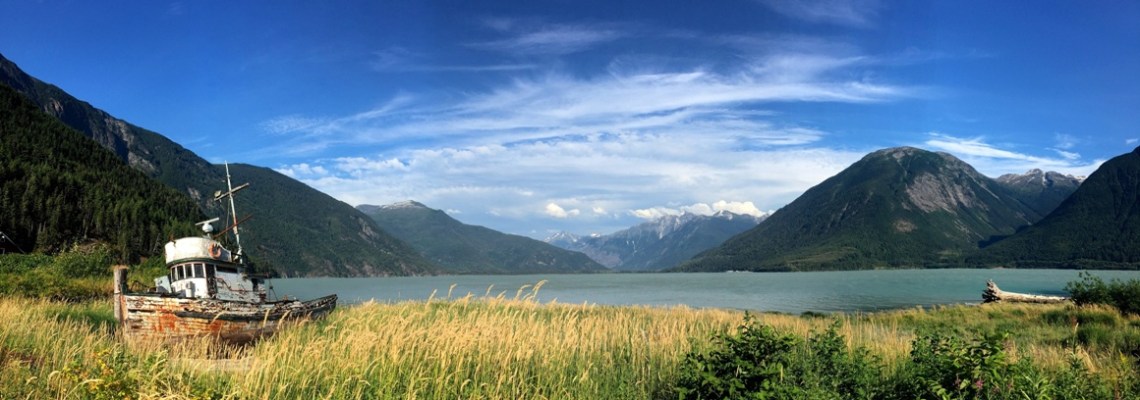
A short boat ride took me across to the ever-photogenic and sublimely blissful Tallheo Cannery. Here stand the remnants of a once bustling enterprise, in which the plentiful salmon – sockeye, pink, and the highly prized spring – were netted, off-loaded, canned and shipped away to Vancouver and beyond. Nowadays, it is preserved in a ramshackle kind of way by a young family who have taken on with passion and gusto the task of maintaining and sharing this magical place with those lucky enough to find their way here.

bc04

Making landfall again upon the small jetty I knew I had stumbled across what would be the undoubted highlight of my time in Canada. A pathway meandered through a small pocket of forest towards a rocky beach, next to which the remains of the cannery building protruded upon a series of weathered stilts, stained by the constant ebb and flow of the tide. Elsewhere, various other wooden structures – the old general store, bunkhouse, outhouse, and two or three more buildings for the important people – offered testament to the thriving place this once was, with up to 300 souls living and working here during peak seasons. Throughout, there are enough trinkets and relics – from fishing nets and boats to paperwork for credit accounts and old cans of soda – to keep anyone with curiosity and a camera happy for several hours.

bc05

In what must be a labour of love, more and more bits and pieces appear to be unearthed in cupboards and drawers on an almost daily basis, while any inclement spell can reveal a new leak, another piece of rotting timber, an additional piece of roof sheeting down. But you can likely forgive all these quirks – embrace them even – given the setting, best appreciated from the veranda or, better still, the hammock of the bunkhouse, which is now a charming guest house for people like me.

It was a house I ended up having all to myself, though I was thankful for the company of the owners in a building nearby and their dogs who were accomplished at keeping the bears and wolves at bay. There was little to do here other than relax in that hammock, broken by occasional wanderings onto the beach or out to a point to sight eagles and gaze at the changing light on the mountains, or head over behind the buildings to explore the clear waters of the back creek into which salmon spawn. Not a bad way to pass the remainder of the day, not bad at all.

bc07

bc10After the best night’s sleep so far, a new day emerged in which the weather gradually turned and cast a new mood upon the scene. Because even I could not potter around taking pictures of the same things over and over again, I caught a lift by boat into the township of Bella Coola and explored its buzzing downtown metropolis, something which took all of twenty minutes. The town is a mixed settlement, with vital services and stores, more ramshackle wooden houses, and a significant First Nations population, the local Nuxalk people, whose land provides several totem pole and traditional craft viewing opportunities.

After a lunch here involving a quite delicious burger with a Poutine topping (yes, a meat patty topped with chips, gravy and cheese!) the greying skies finally delivered some rain. This was marvellous news for the locals, who had endured weeks on end of uncharacteristic searing dry heat; however, tourists like me were somewhat less enthused. Nonetheless, the smell of fresh rain on dry earth, the droplets forming upon ferns and pine needles, the mists and grey clouds hovering upon mountainsides, offered a new perspective, a new angle, a new opportunity to potter about the cannery and soak up its serene, wood-soaked ambience.

bc11

It was an ‘ambience’ that was to persist into the next day, shrouding scenery alongside the pristine inlets and channels of the Great Bear Rainforest as the journey moved on…

A damp inside passage   

If there was one day in Canada that I was hoping would be clear and calm this was it. Bella Coola to Port Hardy, via the fjord-like waters of the Dean Channel, Inside Passage and Queen Charlotte Sound. As it turned out, it was the wettest day of my whole trip but when you are going via a place called Ocean Falls which prides itself on receiving 173 inches of rain in an average year, I guess it’s to be expected. I was, alas, viewing the area in its natural state, rather than this surreal drought of the past month.

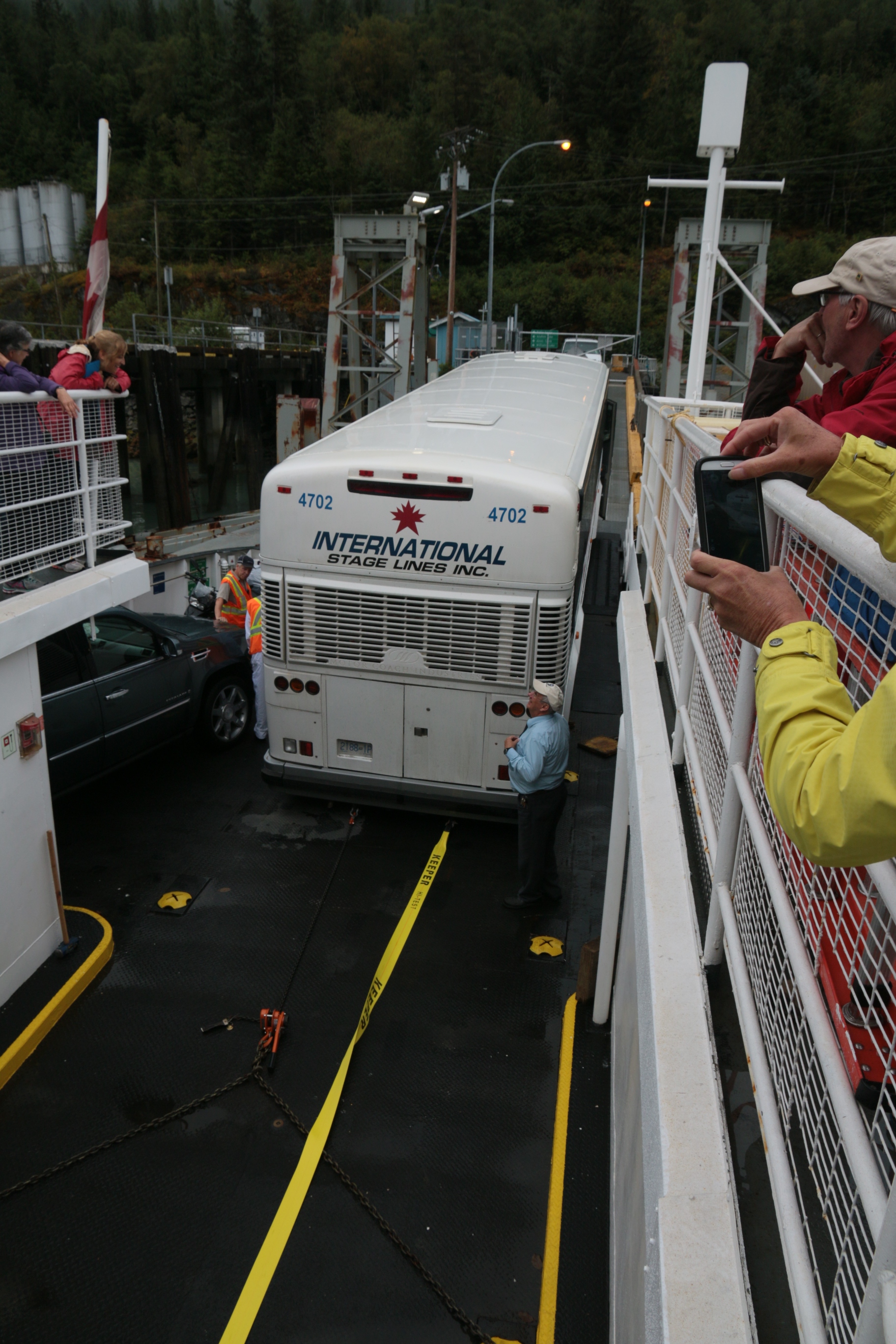
bc12In the end, the scheduled stop at the place where half the Ocean Falls was cancelled due to the late departure of the BC ferry from Bella Coola. The harbour was positively buzzing as cars, motorbikes and the odd foot passenger crammed onto a boat a third of the size of the Torpoint ferry. Oh, and there was a coach as well, transporting a delightful assortment of seniors on something called an Ageless tour. A coach that became stuck half on and half off the ferry for a good hour, grounded due to the incline. It was a fascinating drama for passengers and locals alike, whose intense gaze upon crew armed with a plethora of jacks and ramps and pulleys and increasing exasperation was only made all the better by the friendly advice shouted down from above.

Thankfully once again the Americans saved the day. Some smartass from Colorado with a monumental RV possessing incredible torque and a gas-guzzling capacity the size of Texas managed to use his diamond reinforced tow rope to budge the bus a few inches, getting it off the ground and on to the ferry. The whole episode meant that the Ageless people had aged a few more years and I feared some of them might not make the trip. But almost two hours late, we sailed out of port and passed the red maple leaf flying above the Tallheo Cannery, bound for Bella Bella.

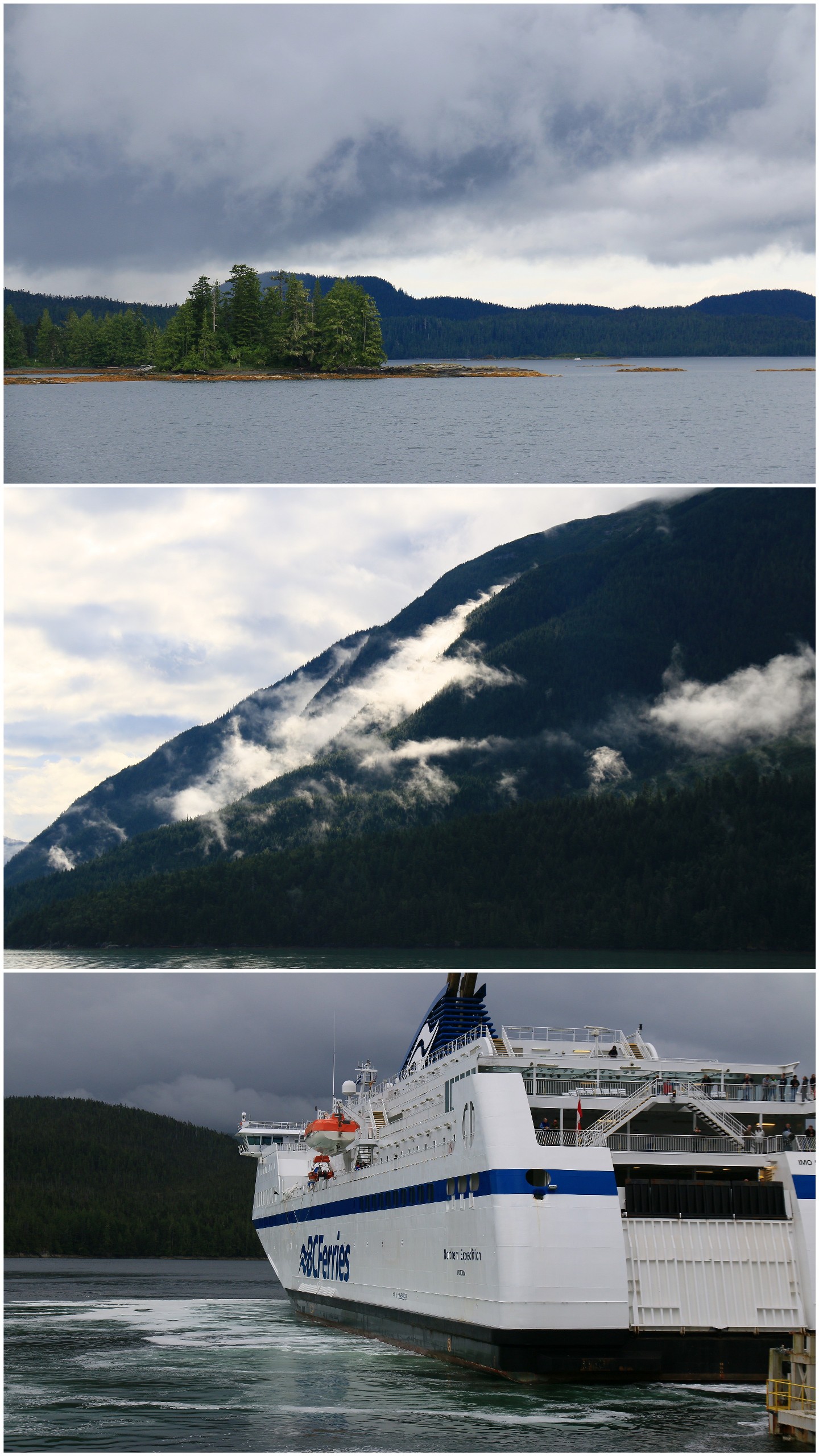
bc13The delay at least meant that the rain had stopped and there was a sense that the cloud might even lift. Every time the odd ray of sunshine filtered through, the outside decks became laden by a hubbub of grey hair and long lenses. However, the weather worsened as we approached the area of Ocean Falls, where the people were no doubt dancing with joy in the rain and wondering where on earth the ferry had got to.

bc14

So, around eight hours after leaving port, the boat arrived in Bella Bella, having failed to encounter any whales or bears or much of note at all along the way. But at least the Ageless posse were invariably entertaining, and the glimpses of scenery were serenely beautiful. Indeed, the change of boats at Bella Bella was a little sad, the intimacy and camaraderie lost with the transfer to a much larger vessel sailing the main Inside Passage between Prince Rupert and Port Hardy.

bc15With every dark cloud there is a silver lining, and the bigger ferry was far more luxurious – padded and reclining seats, cafes, even an all-you-can-eat buffet that proved ferry tempting but one I avoided in anticipation of what might happen in the open waters of Queen Charlotte Sound. The dark clouds outside also yielded silver, in the form of a marriage equality rainbow (now featuring everywhere but Australia), as the sun lowered through the heavy clouds and shimmered off a gently rolling tin foil sea.

bc16

The long day finally turned dark and the lights of Port Hardy twinkled as if some New York City in a sea of nothingness. Everyone from Ageless and the coach had made it, something that was not always inevitable. And I stepped off with many more foot passengers who had come down the entire passage, dumped onto land towards a school bus onwards to the hotels and motels of town.

The islands

bc18Port Hardy – from what I saw during a couple of early morning hours – appeared a charming, even cosmopolitan place. It’s all relative I suppose, from the isolation of the cannery and the minimalism of Bella Coola to at least three cafes and possibly even a shopping mall. While there remains enough in the way of grizzled looking locals smelling of fish and sufficient remoteness to offer a frontier feel, the continuous transit of ferry passengers has also fostered an air of gentility and rustic comfort. Bears may still invade the campgrounds and giant trucks may still trawl the streets, but you can also buy an almond croissant and city-style substandard coffee.

bc17

Meandering south and east, a half empty greyhound bus trundled leisurely beside the forests and lakes of Vancouver Island, with fleeting glances of gentle mountains and occasional snatches of the Johnstone Strait. The sun became more familiar and was amply bathing the wharf three hours down the road in Campbell River. Fish and chips for lunch proved a good use of time while waiting for another ferry, though this one just the fifteen minutes, across to Quadra Island.

bc19Like Bella Coola, I had no strong idea of what this place would be like or exactly what I would do here – the main reason for stopping being its position as an approximate halfway point between Port Hardy and Vancouver. A sunny, moderately-sized holiday island, with rocky shores, forests and a penchant for ageing hippies who have done far too many drugs in their lifetime. I did not know this before, but it became patently clear at any visit to the local shopping area.

bc21The tie-dyed highlight here was a day with a bike, which allowed me to truly explore the flatter, southern half of the island. I say flatter, but there were a few, sustained uphill workouts made all the more arduous by a lack of gears. Who would have thought getting high here would have been so difficult? But I loved being on a bike again, exploring the thin stretch of Rebecca Spit, meandering through a forest trail, cycling and then hiking down to the water, and resting up for an afternoon doze in the sun.

bc20

Departing from Quadra and onto Vancouver meant another two ferry journeys. First it was the short hop back across to Campbell River, where I feasted on a delicious breakfast wrap before getting back on another half empty greyhound. And then, there was the longer crossing from Nanaimo to Horseshoe Bay, back on the mainland. A final chance to look for elusive whales which – if this was a perfectly crafted travel story – would have launched into the sky off starboard in a climatic ecstatic finale.

bc22Alas, this is clearly not a perfectly crafted travel story but there is a happy ending of sorts. My first and best Nanaimo bar, a gooey, creamy, chocolaty concoction from this incredibly beautiful part of the world. Like this jaunt, a touch earthy and rustic but providing a heady buzz. Smoke free, devoid of whales (I assume no whales were used in the making of this bar), and useful to temper the bitterness of the local coffee. Indeed it seems to me life here is like a local bar of chocolate. Deliciously sweet.

Food & Drink Green Bogey Photography USA & Canada

January

Ingrained in the deepest reaches of my mind sits recollection of a January. Far beyond yesterday’s shopping list is a picture of a crisp clear day on high moorland. Icy cracks and crevices, like fissures of diamond, bond the huge granite boulders thrust up from the core of the Earth. Shallow pools of water are sealed with glass, only splintered with a daring footstep as satisfying as a spoon piercing a Crème Brûlée. Encased in a padding of jumpers and scarves and jackets and gloves, the wind nonetheless manages to lash the face and penetrate the body. Feet lose feeling, yet the rest of the body is invigorated. And as rosiness returns in front of an open fire, like the cold the memories fade, lost again, floating around somewhere amongst the numerous pithy sentences that would undoubtedly make a great book if somehow I could wed them to a narrative.

On the other side of the world, below the equator and quite a bit east, the tilt of the Earth has conspired to produce utopian conditions for flies, ants and mosquitoes. All seem rather attracted to me. As a quest to receive more invites to fancy barbecues and opulent garden parties I may well advertise as a portable insect attractor. Like one of those electric zappers, but with the added bonus of being able to serve drinks, cook meats and deliver witty anecdotes and sarcastic put-downs disguised as sarcasm but quite possibly not. I may well call this emerging enterprise that has literally emerged in the last few minutes, Aussie Mozzie Boy. He takes the angst out of ants.

Here in January a heat hovers and the thought of wearing anything other than shorts ever again seems quite ludicrous. It actually becomes too hot, and the parade of once-sturdy Agapanthus begins to wither, much like a Scotsman on a Melbourne tennis court awarded a succession of daytime matches in the hope of providing another sporting spectacle; that of reddening skin and dehydrated muttering, and a pile of towels so soaked in sweat they could water the vines in the Yarra Valley for the remainder of the year.

The concept of being too hot seems alien, even though it is a frequent ill-informed complaint of an Englishman in an English summer. I once heard a particularly toasty day – the kind accompanied by a generous north-westerly transporting dust and ash and smoke and flies – described in charming vernacular as a “stinker”.  And too bloody right mate. But this idea, that a hot sunny day can really suck, is perverse to an English soul. Now, if it was gloomy and dank and dreary and accompanied by drizzle at around three degrees Celsius, then I would expect that to qualify as a stinker, and I would have probably revelled in as much. Once. But now I am a soft-skinned insect allurer who may start to feel a little chilly in the legs at a garden party once the sun has set and the blood extraction procedure ramps up.

And so we note the theme of contrasts, which is not in the least bit surprising and not at all likely to be recurrent in the context of Australia and England. You say tamaaarhda, I say towmartoe, innit. Seasonality has produced an affectation of difference in January north and south, but what of that which ties us together?  A new calendar, a new year; a clean slate, a fresh page; a resolve to set goals and stride into the year with purpose; and an inevitability that most of us will – at best – be only partially successful. Rated emerging or promising, but never strongly supported.

January is the month of resolutions, from revolutions to evolutions and aspirations about dedications to somehow become superlative. As if you weren’t pretty damn fine in the first place, you endeavour to eat less cake, drink less beer, replace a cigarette with some Lycra and set some vague but worthy ‘life goals’. Inspired but daunted you cope with such change by eating more chocolate, drinking more wine, slowly jogging past the dodgy youth to inhale some suspicious-smelling haze hovering overhead, and revel in the ambiguity of those vague aims for life which can be almost unendingly put off for another time. I say you, but I could easily mean I.

I have nothing against New Year’s resolutions and annual goals, despite being someone who displays a comfortable inadequacy over such gestures. I make them, but in a very hazy manner. Yeah, I intend this year to you know just go with the flow and take opportunities as they come and, yeah, maybe go on a trip somewhere, depending on what the work situation is like, and hinging on some other stuff and things that pan out.

My goals are, in business parlance, far from SMART. But how many of us, unless in the industry of setting crude financial objectives which involve fleecing $200 million out of customers’ superannuation funds by October 2015, are able to set genuine SMART goals? I always struggled with this goal-setting process in the corporate world. I think my main problem was that if I was to be honest and list my genuine goals for work it would be somewhat out of sync with that expected: This year, I would like to make enough money to live comfortably for doing as little work as possible and avoid any responsibility or decision-making unless it enhances my long-term objective of sitting by a pool being fanned with palm fronds by statuesque goddesses immodestly attired. What should of course be spouting out of my mouth in such situations is something about client-centric fulfilment, strategic interactive opportunities for streamlined co-delivery, and some gigantic revenue target to make the overseas shareholders one hundred times richer than they already are. This last one would be implicit across everything if not always overtly stated as such.

Anyway, this has little to do with January as most work goal-setting episodes tend to take place one month before you have to achieve them…so something like November. But we do have our personal resolutions to uphold, made in an alcohol-induced glow in the wee hours of the first day of the year and foolishly blurted out to bystanders in an attempt to make it look like you do have some appetite for self-improvement. Unfortunately, we also choose to do this in January.

In cooling, northern hemispheres, this is akin to climbing a very steep mountain in a blizzard while wearing flip flops and nursing a humungous hangover. Picture the eighth of January for example. The coloured lights of Christmas are but a distant blur and all that remains from the festivities are the dregs of Aunt Agatha’s sherry and a box of those Danish butter biscuits, destined to be re-gifted. You left for work and came home in the dark. In between, the darkness cheerily lifted to a dense drizzly grey. Despite looking innocuous this soaked your new jacket as you popped out from staring at spreadsheets to get a forlorn-looking cheese and onion sandwich from Tesco. Still damp in the evening, it takes you two hours to get home on a congested train because even the points don’t see the point anymore. And for dinner: half a lettuce and a rice cake, followed by a run in the graveyard. All because you made those resolutions.

So unless your aim is to get as depressed as quickly as possible and accumulate a colony of a new species of mould on your clothes, there is a high likelihood that, come February, you’ll be back chuffing away on 40 a day and eating KFC for breakfast. Because how else are you going to make it though this? In Australia, by contrast, again, there is at least some logic to attempting self-improvement in January. The weather is good, fresh fruit and salads are de rigueur, and practically everyone else you see is glowing in an unbelievably self-contented halo of white teeth and good skin. But here, the slippage into obesity and alcoholism that commenced with Christmas lingers through January and into the next month as a constant companion. It is a protracted holiday season, a period in which it is too hot to exercise with any conviction and the beer is too cold to avoid. Resolutions are easily swayed and as enthusiastically broken as the heads of the succulent tiger prawns drawn en masse from The Pacific.

So, in semi-conclusion, is January really the best time to start afresh, a clean slate for setting aspirations and committing to arduous goals? I’d say no, but you would be justified in hypothesising that I would say this for any month of any year. You’d also be justified in accusing me of downright hypocrisy if you take into account the context in which all the above words have been written. I’d call it poetic licence, but lacking much in the way of anything poetic.

So, in an attempt to address this deficiency let me transport you to the Australian high country. January is still in its infancy and here the skies are a deeper blue, the air more comfortable in which to linger. The clear waters of the Snowy River meander in shallow pools and trickling cascades, bridged by a chain of irregular stepping stones. The walk to Australia’s highest point is well-frequented, but the expanse of open moorland and unending skies projects an excess of space. Leftover Christmas food can still be embraced overlooking a small, still tarn. Winding up to the summit, like the coiling of a Swiss railway conquering a pass, countless ridges and folds of land concertina their way toward the horizon. At 2,288 metres, you reach the top of Australia, Mount Kosciuszko. A new year, commenced on a high.

Jan

The cynics amongst you (me included) might then say, “Well, it’s all downhill from here!” But to me, there is something innately appealing about climbing a mountain at the start of the year. The concept of the fresh start is realised through the open vistas, the pure air, and the blank canvas of the fairly indistinguishable landscape of the Australian high country. There is a goal, real and tangible, I daresay even SMART. And then there is the achievement of reaching that goal, and being rewarded for it solely by the beauty and solace of nature. In my eyes, a reward that beats that excuse for a performance related bonus you received at work last year.

So in January, forget cutting back on the cream cakes and fretting about what you are supposed to achieve in the forthcoming year. Just go climb a sun-kissed mountain or tackle an ice-racked tor. The rest of the year will then be a doddle.

For more mountainous inspiration in January or beyond, check out my gallery of various high points near and far

12 Months Australia Society & Culture Walking

Show and Tell

ch13What started in the Alps finished in the Alps, with the cloud from four weeks back seemingly, stubbornly, static. It would wait until the day after I would leave to clear and then reveal deep blue skies under which spectacular chains of icily jagged mountaintops glow. I know this for I have been blessed many times in the Alps with such weather and its associated gargantuan views (plus I checked the webcams once I left just to be really irritated). Alas, this year it was not meant to be and I had realistic expectations of a few days in Switzerland; whatever the weather I would do my best to make full use of my Tell Pass – a golden ticket allowing access to many mountain trains, cable cars, chairlifts and the stock standard complex of railways conquering central Switzerland. I think I got my money’s worth…

Trip 1: Zurich Airport-Lucerne-Engelberg

‘Engelberg Humdinger’ would likely have been the hilarious title of this blog post given perfect weather. In planning a few days to end my trip (seeing I was flying out of Zurich), I was seeking a reasonably accessible spot in a mountain valley with various lifts up into the high country and opportunity for blissful Alpine walks. Somehow I came across Engelberg which appeared to fit the criteria, tucked into a valley south of Lucerne and encircled by mountains reaching up in the sky to 3,000 metres or so.

Arriving into Zurich, the weather was warm and bright enough and the train zipped through comfortable commuter towns and villages chock full – I assume – of affluent bankers and cuckoo-clock makers. In an hour, Lucerne emerged as pretty as a picture, the train looping alongside the river and parking itself close to the shores of its beautiful, far-reaching blue-green lake. No time for sightseeing but enough time to grab a salami pretzel sandwich from my old friends at Brezelkonig and hop aboard the Engelberg express.

Fringing the lake at first and then meandering into a valley, mountains began to increase in stature and presence and nomenclature…somewhere up there is the Stanserhorn, accessible via a cable car and deserving of pronunciation in a zany butch German accent. Finally, through a long, dark tunnel, up and up the train goes until it emerges into Engelberg. The sun now down for the day, the last glow of purple sky illuminates jagged mountain apexes, while a valley cluttered with wooden chalets curves along to their base. This fits the bill.

Trip 2: Engelberg-Trubsee-Titlis

ch01The next morning dawned clear and calm and I was incredibly excited about that. Thirty minutes later, eating a steadfast breakfast involving bread and cheese and cold cuts, much of the blue sky had filled in. However, there was enough hope – and predictions that this might be the best weather day – to attempt the trip up to Mount Titlis, summiting at 3,239 metres.
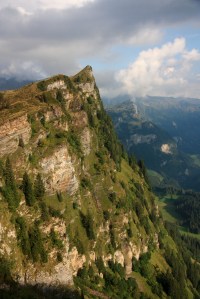
ch02Now, this may sound like the start of some intrepid adventure: hiking through wild meadows, scrambling across rocks, crawling under ice caves, and braving perishing blizzards. However, this is Switzerland and I had my Tell Pass, which comfortably took me almost to the top. First, a gentle cable car up to Trubsee (1,796m); here, the valley was still visible and pockets of sun endured. Next, a larger cable car swung its way up into the clouds at Stand (2,428m), each sway accompanied by a huge oooooooh-aaagghhhh from the hundreds of Asian tourists packed in. Finally, the last stretch takes place in – get this – a cable car that rotates 360 degrees. It’s kind of fun, weird, and in no way whatsoever disconcerting.
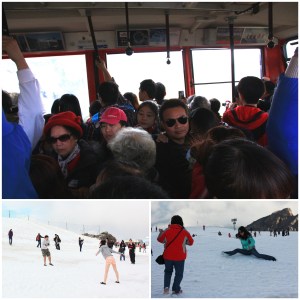
ch03The top – or the top of the cable car (3,028m) – was a little James Bond like, though not quite as James Bond like as the Schilthorn. Despite being up here fairly early in the day I was not alone; indeed, those hundreds of Asian tourists were now happily engaged in various conformist and non-conformist photo poses. Many selfies transpired, several of which were taken with the aid of some extendable stick-like gadget which holds the camera phone out at a distance without the need for arms. It’s fair to say that whoever invented this contraption is, like the loom band man, now extraordinarily minted.
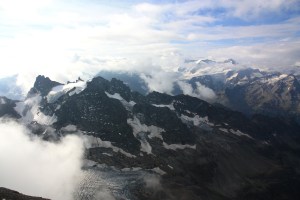
ch04The altitude made walking a little difficult at first but I ventured out onto the slushy snowy ice-like material covering the ground, avoiding people posing for selfies and looking for a view. There was a view. Then there wasn’t. Then there was again. Then a little hole appeared over there, then it filled in again, but another hole formed elsewhere. A few times I stood above the weather, above the clouds where nothing could be seen below. Then, more extensive holes in the cloud would appear and snatches of a mountain range, glimpses of a valley, and snippets of a glacier would emerge. Given I was not expecting to see beyond my nose, it was exhilaratingly breathtaking.
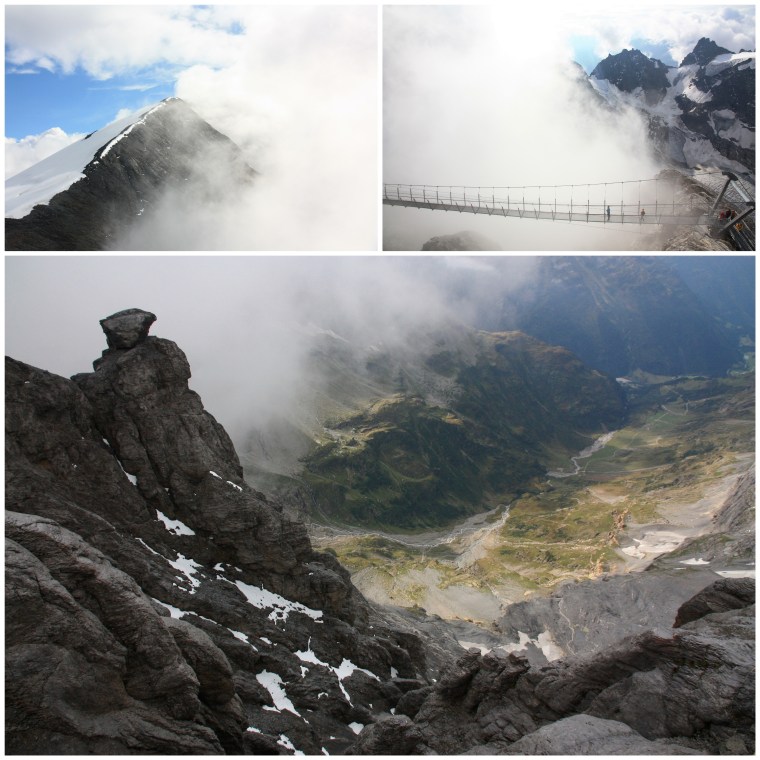
ch05

ch07Beyond the hordes of seemingly photogenic tourists, a groomed track led to some other overlook that was rarely visited. Only a kilometre round trip, but it was hard walking. Any downhill dips involved a gentle slide into some slush, hoping that the snow was not particularly deep or covering some unknown crevasse. Slight inclines uphill were arduous and oxygen-sapping. A couple of Aussies coming back advised me to stick to the path which I was planning on doing anyway thank you very much. They had gone ‘off-piste’ and sunk up to their waste. They were probably in thongs too. Not following their footsteps, I ended safely at an overlook, looking over nothing much other than cloud below. However, around and above, a large patch of blue sky had appeared and, for a few minutes, I found myself in a pleasantly warm, quiet and calm, summer winter wonderland.
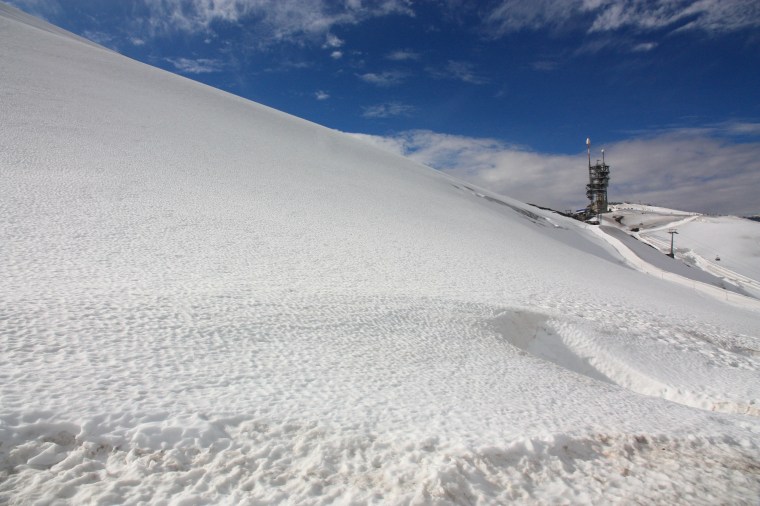
ch06

By the time I made it back to the safety of the cable car complex, cloud had started to fill in more extensively and any gaps were infrequent. Completing every other distraction (including a stroll through an ice cave, a chairlift over some crevasses, and a walk across a suspension bridge spanning a poop-inducing long drop), I headed back down. Now mid-morning, many people were still coming up and I was not sure what, if anything, they would now see.

Trip 3: Engelberg-Lucerne-Vitznau-Rigi-Goldau-Lucerne-Engelberg

I was hoping the weather would hold so that I could engage in one of those lovely Alpine walks involving meadows and flowers and lakes and cows and probably strong hard cheese and salami for lunch; I had spied a couple of small lakes, joined by a fairly even trail and a cable car for the uphill bit which seemed ideal for the job. It would have started from Trubsee, where I waited for 15 minutes to see if the heavy rain now falling would abate. It did not, and all the bad weather was coming over the mountain and falling here. Distant, somewhere I think towards Lucerne, was a large patch of blue sky, but it had no intention of coming this way. So I sought it out instead.
ch08Not for the first time I found myself in Lucerne and this time taking a boat (included in the pass of course) to Vitznau. I had made this trip before, in the glorious, warm, late September sunshine of 2012, and it was stunningly beautiful. Today it was just fairly beautiful, a tad cooler and covered by white cloud with the occasional brighter spot as the sun threatened to emerge.

ch09Previously I had 50 minutes to spare in Vitznau before the return boat trip; today, I could go further, taking the mountain cogwheel railway up to Rigi Kulm. This is proclaimed as the first such railway in Europe and it retains a classically elegant air. Trundling up, any views of Lake Lucerne fade away into haze, and small hamlets, forests, meadows and waterfalls compete for attention. Occasionally, schoolkids on their way home hop off at random points. This sure beats the school bus.

Rigi Kulm stands at a modest 1,798 metres above sea level, but the information leaflet proclaims that you can see thirteen lakes from here and points as far as Germany and France. While of course this was not so much the case today, there was a gap in the sky and some overhead sunshine that reminded of the warmth brought by summer. It was sufficiently balmy for an ice cream and I even managed a brief Alpine walk with the cows, down to a lower cogwheel station where I caught the train down the other side of the mountain, to Goldau. All the while, mountain tops flitted through the haze as Lake Lucerne disappeared under the weight of clouds, occasionally billowing up and over one side of the mountain like steam from a kettle.
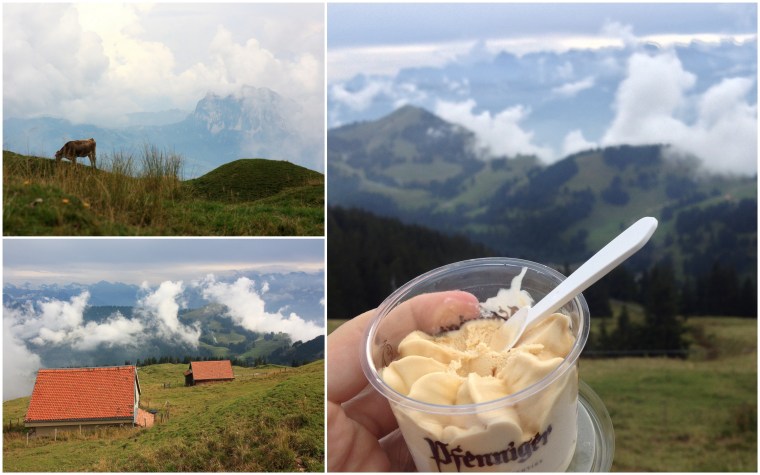
ch09b

Goldau took me back to Lucerne which again took me back to Engelberg, where the roads were still fairly wet and everything was a tad sodden. All in all, I had done well today. Very well indeed.

Trip 4: Engelberg-Brunni

After yesterday’s extensive escapades I was actually keen to minimise my travel today and stick within the valley and perhaps hop on a chairlift to undertake one of those Alpine walks I may have mentioned already. It looks so obvious on the fold out map of Engelberg: walk up the valley, jump on a cable car here, do a circular walk on this plateau, come back down, have some lunch, go back up somewhere else and have another walk back down into the valley to round off the day.

Breakfast time and Engelberg had disappeared. There was nothing to see from the window apart from a vision of grey-white. Drizzle floated haphazardly in the air. The one other couple chomping breakfast at the same time as me also stared out of the window with a sullen look of inevitable despair. Helpfully, in the corner, there was the Engelberg TV channel showing various webcams atop mountains and cable car stations. Turns out the cloud reached 2,000 and 3,000 metres as well. Still, we can be nothing but hopelessly optimistic having spent a small fortune to stay in Switzerland; carry on regardless, looking for small trinkets of hope – a brief whitening of the greyness of the cloud, a murky dark fleeting vision of some trees over the other side of the valley – that may herald a turnaround in the weather.

ch10Indeed, things had cleared a little by time I had got myself ready to stroll up the valley. That is to say, stuff was at least visible, including the steadily tumbling river, the dark foreboding forest, and the occasional cosy glade. A golf course, treacherously criss-crossing the river at cunningly placed intervals, held some appeal, particularly as the drizzle had briefly ceased. A man was out blowing leaves around his chalet in Wasserfall, a sure sign that things were to clear, right? But at Wasserfall, water fell, and the Furenalp cable car I had hoped would propel me to a sunny walk seemed a pointless endeavour.
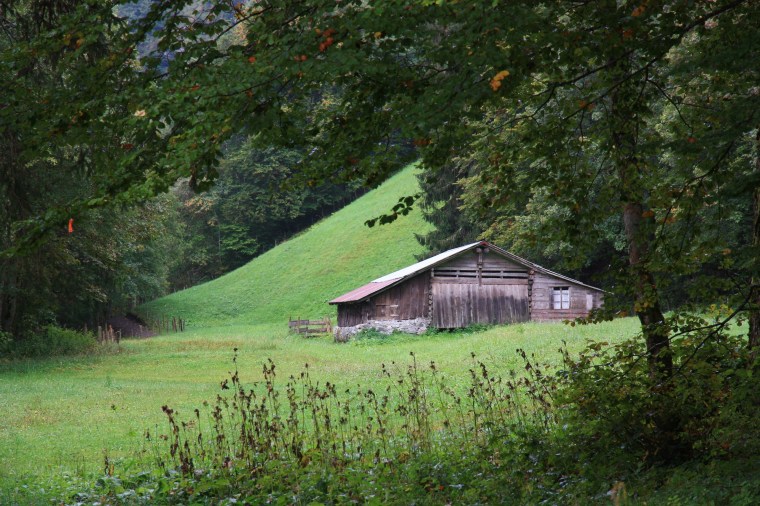
ch11

Instead I walked a different way back to Engelberg and in the hour or so taken, the sun had peeked through and delivered instant warmth. Furenalp was now probably bathed in sun but I was no longer anywhere close. An alternative route up into the hills presented itself closer into town, via the Brunni cable car.  And while the initial rise presented some hopeful sun-glazed valley views, the top was shrouded in murk. I could wait it out in the cold, or go back down and eat lunch. I was hungry and pork schnitzel, chips and salad in the Co-op restaurant sated me greater.

Trip 5: Engelberg-Furenalp

Retiring for an hour or so back at my hotel, I watched the loop of Engelberg information on the TV channel. Sunny pictures with happy families frolicking in rivers; beautiful people getting expensive spa treatments to a backdrop of dazzling snow-capped peaks; webcams showing nothing much at all. Except, hang on, Furenalp. There was a shadow, as if it was above the clouds.

Chasing the sun once more – or at least the potential for something clear – I hopped on one of the hourly shuttle buses and then the cable car. This was a less extravagant operation than Titlis. One small cabin travelling up every half hour or so, or, to be honest, just on request from the dear lady sat in the kiosk. I was the only soul, the wire shooting up towards a large rock face and into the clouds. Only, thanks to the webcam viewed now quite some time ago, there was a chance I would make it above them. The ride was something quite spectacular, rising steeply in line with the rocks, grazing pine forest and revealing hidden crevices where pools from weeping cascades formed. At some point the world disappeared and, out of nowhere, the top station emerged.

ch12It was wet, windy, cold and cloudy. There was nothing to see, apart from a closed restaurant that would be amazing on a sunny day. Determined to make something of it I walked a little. The rain had stopped and, occasionally, visibility would increase to something like 50 metres. The trails were not that well marked though, and, as the clouds billowed in and obscured any landmarks I made the decision that I did not want to be that stupid English tourist who goes missing and requires an intensive search and rescue effort. Sometimes, we must come down to be able to go up.

Trip 6: Engelberg-Brunni again

Breakfast time again. Engelberg had disappeared again. I had some of that pretzel like bread with salami, egg and cheese again. I was leaving today, eventually for Australia. But I had lots of time before my evening flight, and wondered what I could exactly do with it.

Appropriately dawdling in my room, Engelberg TV in the background, it was as I was squishing dirty pants into my luggage that the loop of webcams came on. Titlis, no. Stand and Trubsee, no. Furenalp, no. Brunni lower station, no. Brunni top station, er, maybe I guess.  After the next round of adverts with blue skies and happy people, the webcams again, and more hope. A small lake. Some shadows. Enough to take a chance…if nothing else to kill some time.

And so, for about thirty minutes I had a dose of Switzerland that I had yearned for all along. The final chair lift ride up to the top station of Brunni was a delight, the warming sun coming from my right. Long shadows of cows formed on the succulent pasture below, their occasional moos and tinkling bells the only sound. Views of peaks and, just now and again, glimpses of the top of Titlis across the other side of the still shrouded valley. I wish I could have lingered longer, but travel requirements meant I needed to leave. And the chair lift down was infinitely less delightful now, as the cold, grey cloud enveloped everything around once more.

ch14

Trip 7: Engelberg-Lucerne-Alpnachstad-Pilatus-Alpnachstad-Lucerne

So, farewell Engelberg, I am sure you are fantastic in a proper summer and provide an excellent base for so much that is around. I had one other target on my Tell Pass list and, filled with hope that the Brunni blue skies could extend as the day progressed, I returned to Lucerne. From here, it was once more onto a boat and out onto the lake, this time heading in a different direction to Alpnachstad. At Alpnachstad, the base of the steepest cogwheel train in the world, conquering gradients of up to 48% to Mount Pilatus (2,128m) – Lucerne’s mountain.

Now this experience is as much, if not more, about the journey as it is the destination; particularly today when the summit was, yawningly predictably, cloaked in the clouds. Each single carriage train is built for the job, separate compartments rising with the slope in a staggered series of steps. Looking up through the driver’s window the track rises stupendously steeply; looking down out the back and you are left wondering quite exactly how this gravity defiance all works. I assume something to do with the cogs, steadily clicking out a rhythm at a gentle, sleep-lulling pace.
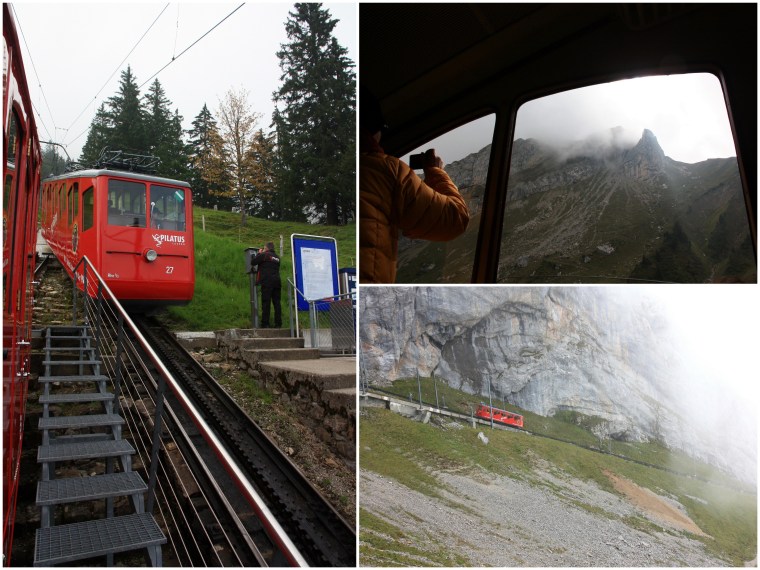
ch15

At the summit complex I found myself – not for the first time – looking at the postcards with all the stupendous views. But I wasn’t upset or dejected or even that frustrated that no such scene presented to me today. It was a shame, I would say to myself, but nonetheless I had a really enjoyable time. I mean, there’s much to like about a walk out to a viewpoint to admire the shifting fog of clouds, plenty to ponder while navigating the slippy rocks with a (thankfully fenced off) drop on either side, and ample satisfaction from a cup of coffee and chocolate brownie back in the warmth. Plus, there is still the sheer wonderment of the trip back down to come.

Trip 8: Lucerne-Zurich Airport

ch17The remaining few hours of this trip in Europe were whiled away in perhaps one of its most elegant, picturesque, and sumptuous small cities: Lucerne. It had been a conduit, hub, and pretzel provider for the past few days but now, as the sun gently began to filter through the late afternoon cloud, it offered a healthy last dose of European je ne sais quoi. Thus the time skipped by alongside waterways and through cobbled streets, admiring window boxes brim with flowers, crossing old bridges, dodging cyclists, and fleeing from specific corners where the thousands of smokers seem to gather.
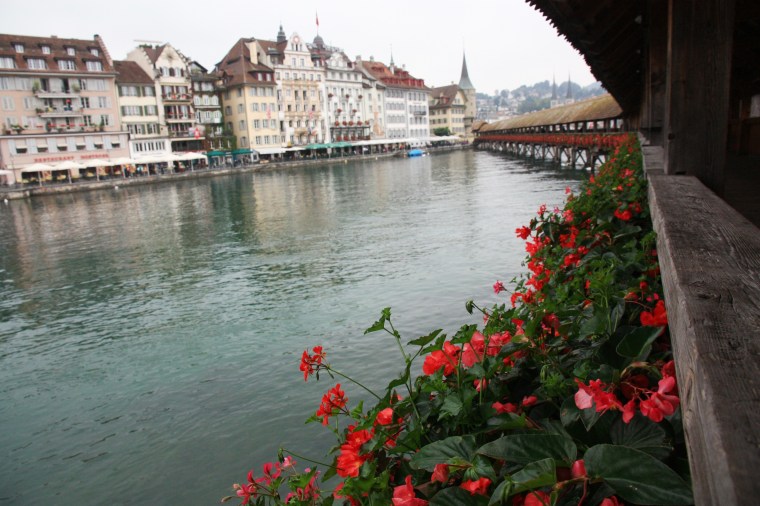
ch16

I had been in Lucerne before – in 2012, in hot sunshine – but it was just as charming, and even more comfortable to explore on this much cooler, cloudier day. Like last time, I made it up to remains of the old town wall and castle, where snatches of Lake Lucerne and distant mountains appear through the gaps in the ramparts, yonder the old rooftops and leafy trees scattering down towards the water. The top of Pilatus was still shrouded in a haze, but certainly much of the murk had lifted. Probably upon boarding the train to Zurich, the top would emerge, a final tease of a farewell to what could have been.

Somewhat lethargic and bored of weather angst, part of me was ready for it to be over. But – with an impending trip cooped up in an airplane to cover half the globe – I was also reluctant to leave. Tomorrow it may be brighter and, if not, I could always easily return to the UK where the Indians were having a summer or something, though Britain First were probably getting a bit upset that the Indians had stolen the summer and posting something with grammatically flawed menace on Facebook for people to like. A shamelessly opportunistic emigrant and immigrant, my own tomorrow was a long way off, but I knew that when it came, it would emerge with blue skies and a nice flat white. A scene from which I could happily savour the numerous journeys I had just had the fortune, the pleasure, the freedom of travel, to experience.

Europe Green Bogey Photography Walking

Hallo Italy!

Five hours on a train over the Bavarian Alps, across a thin but very precipitous sliver of Austria, and through the valleys and steep terraces of craggy northern Italy brought me to Bolzano. Or Bozen. Provincial capital of the Alto Adige. Or Sudtirol. You see, borders on a map may be crossed but language is shaped by the contours of the Alps – whether you are in them or out of them, what particular valley you may be in, or which side of the lake you butter your brezel in.

So just because we are in Italy does not mean that German is gone, nein nein nein. Which makes it a bit scheiser for the English-speaking, who are relegated to third in the language stakes and, if my experience is anything to go by, frequently caught out using a mix of all three. Par example (and yes, occasionally I also fall into French as default when any foreign language is involved): “Hallo, una gelato with two scoops, straciatella und caffe latte per favore. Danke.” Surprisingly though everything is understood and luscious ice cream is forthcoming.

dol02As a result I’m not so sure whether you are going to read German or Italian place names in this blog entry. I’m tempted to try and use Italian because they are in Italy, but I am rather fond of Bozen which sounds so pleasingly like a cross between bozo and bogan. Does the name do it justice? Well, I would have said yes at first, as I trudged in searing heat through industrial areas by the river, seeking a funicular to whizz me into the hills, with busy highways and power lines and train tracks crammed into the valley. But I missed the centre at first, an old town with gracious buildings and narrow pedestrian streets, made narrower by market stalls and glass displays for expensive shoes and handbags. Veering toward the Italian, which is naturally less bogan.

dol01

Bozen has three mountain cable car and railway combos whizzing you up into the countryside, and the first I took after that uninspiring walk was up to Colle. The top was still in the tree line but (take note other self-proclaimed lookouts of this world) some smart Alec had built a large wooden tower for viewing pleasure, providing you enjoy steps. From here there were views over Bozen and other foothills leading to the more jagged teeth of the Dolomites. And at the bottom a sunny bar for a beer which was disappointingly less German than much else.

dol03

The Dolomites were my raison d’être for stopping here really, as I had been interested in visiting for a while…I think spurred on by some pictures in a travel supplement or maybe some footage of crazy climbs in the Giro d’Italia. Bozen was a good base, with its cable cars and other transport links, but the Dolomites were a little infuriating to photograph: wrong light so very glary for most of the day, then thundery clouds bubbling up in the afternoon and difficulty lingering in spots very early or very late because of transportation options. It really needs a week to get close and intimate, preferably in June. It is no wonder that the area is a popular spot for multi-day walks, hiking from refuge to pension along the ridges and plains, getting personal with the mountains.

dol04Still, I had two full days and was very keen to make the most of them and the travel card I had bought. The first day I took another cable car from Bozen, impressively up and up over vineyard terraces and pine forests to the undulating plateau of the Renon. At the top a mountain tramway trundled through the undulating hills, past villages and chalets and through forests and fields. Plenty of walking tracks offered chance to meander and get slightly lost but find your way to another path providing balcony views of the glary Dolomites. With wild meadows and the scent of pine needles, it was nothing other than pretty and nourished enough appetite for lunch in a sunny garden sampling local cheese and bacon dumplings with salad.

It’s incredible to think of these Alpine environments being caked in metres of snow and freezing through several months of the year, and thus surprising how full of life they are. I guess it’s a shorter growing season and everything bursts forth rapidly and in generosity, a perfect manifestation of making hay while the sun shines. The steep hills of the region are decked out in rows and rows of vines, occasionally interspersed with orchards. Many look too steep to harvest by machine and I’m not quite sure how people actually make it to some of the farmsteads perched on their lofty terraces. It seems the cable car is the easiest way to view this hidden world, as I head back down into Bozen.

dol05

After a refresh of ice cream and purchasing some dinner time picnic snacks, a bus took me to somewhere in the general vicinity of the Jenesian cable car. Compared to the Renon, which was spacious and flash, this one was pure old school. Which means, by late afternoon, it is a searing glass house on a wire. It has a driver, who speaks to the top on his retro phone with a pleasing old-fashioned ringing bell, and seems happy to squash us in to see if we can all make it without passing out. The relief at the top is palpable, with shade and a beer garden obviously cashing in. In the distance the Dolomites still glare and clouds bubble up high, testament to the heat and humidity of August in Italy.
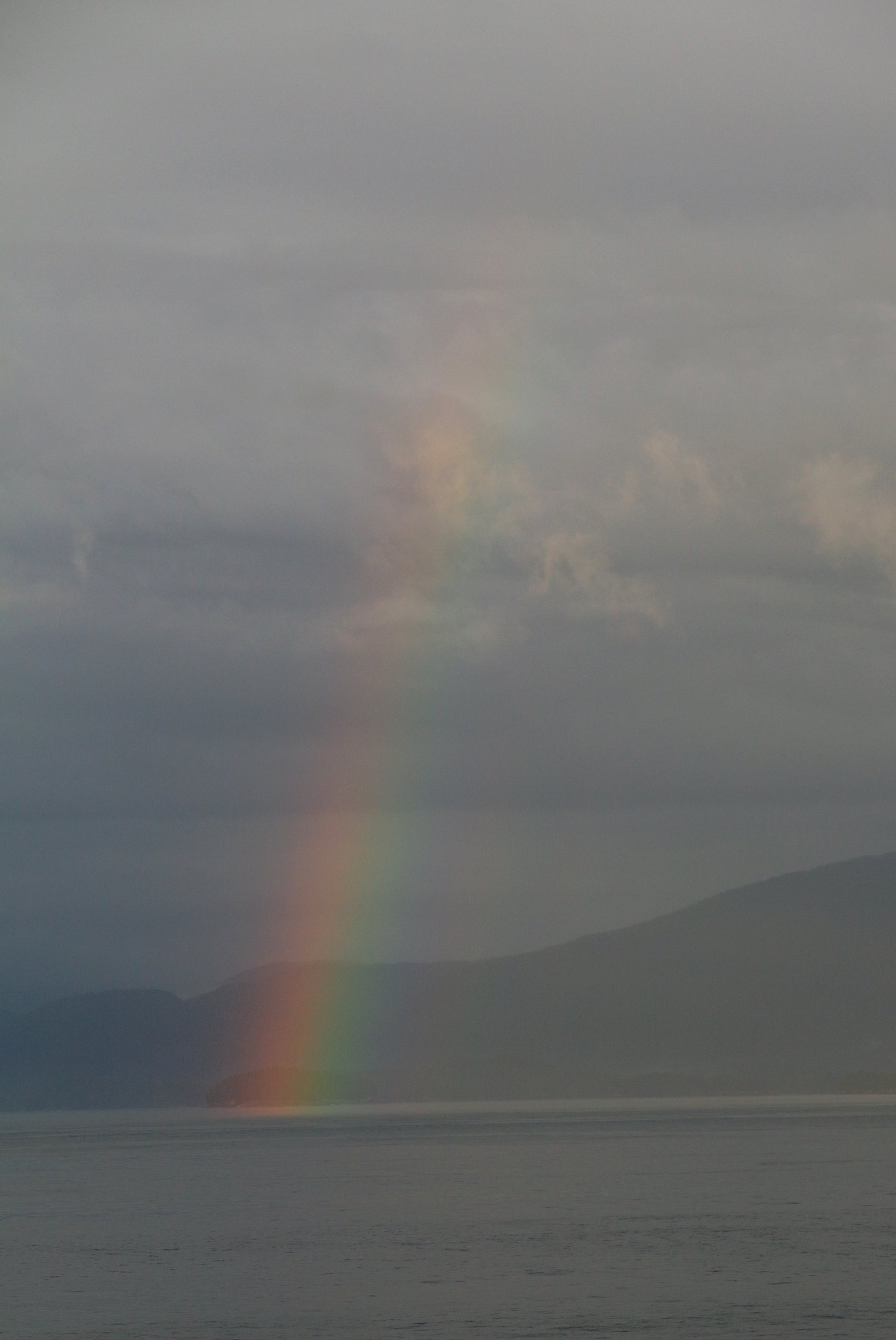
I was, as I say, keen to make the most of my travel card and, given it runs into the evening, I spent the last section of the day by taking the Renon cable car once more. This was a chance to try and get some good light for pictures and, well, stop on a bench in a forest and eat my bread rolls, cheese and salami sausages. I didn’t stay right until daylight faded, as it had been a long day and I wanted to catch the last bus to my pension, rather than walk up hill for twenty minutes. I had to conserve some energy for tomorrow.

dol06

So the second day was an opportunity to get closer to the toothy peaks of the Dolomites and indulge in some wilder, Alpine walking around the Alpe di Suisi. This, apparently, is the largest upland plateau of its type in Europe, whatever that means. I presume it means the biggest expanse of undulating meadows peppered with farmhouse chalets and wooded valleys, a sea of green lapping up to the sheer cliffs of encircling mountains.  It looks and feels obviously Alpine with the characteristic and pleasing sound of cowbells a sure sign to the ears that this is genuine high country.

dol08

My travel card allowed me to take the sad bus to the town of Suisi. I say sad bus, but it was quite a happy, breezy ride up from the valley, SAD being the name of the local transportation system. This climbed about 600 metres or so from Bozen. From Suisi, a cable car ascended a further 500 metres to Compaccio, and then it was onto a good old fashioned and open to the breeze chairlift propelling me another 400 metres up. What follows from here is an easy, good-natured ramble through the meadows and down past a flower filled hostelry and rustic farmhouses to a wooded valley. Down? Down? Prices may be down, but I want to go up. Up to the Rifugio di Bolzani sitting at around 2,500 metres. Am I lost, or will I need to climb more than I hoped?

dol07The answer was the latter and I have to say it was a bit of a struggle. Once or twice I thought about turning back, the views still wide and grand. Every step up and the view opened up further, but so did the frequency of stopping, ideally in a spot of shade from the sweltering sun. A salami sausage and snatch of pretzel gave fortitude and spurred on by the reward of eating more at the top, I made it.

dol10It’s a bit strange to come up this far and find a fully functioning guest house and restaurant, looking out on the sawtooth ridges of the Dolomites. Washing hangs drying in the breeze and people are decked out with picnics at the outdoor tables. Inside, a team of young people busy themselves cooking and serving food. Curious as to how all this happens, I note a rather archaic looking single wire cable way that must bring up wheels of cheese and kegs of beer. Alas, it does not transport people back down.

dol09

dol11That, for me, requires a weary descent of almost 1,500 metres as I plan to go back to Suisi to catch the sad bus. And so it’s down the entire climb that I made, happy that gravity is on my side but my feet and ankles and legs less content with the constant jarring and braking. Some respite takes place as I turn onto a path through a cool pine forest, but this at some point has to hit the river below and, when it does, it veers down in a torment of curving hairpins. The river and forest and beautiful, but after six hours or so, Suisi cannot come soon enough.

Perhaps with a week, at a cooler time of year, I could have taken things more leisurely. There are certainly many other places the SAD network can take you – on other cable cars and post buses into Switzerland for instance. There are great rides for bikes and cultural things to do too. Now being so distant in Australia I wonder why on earth I did not go away every other weekend when I lived in London. A Ryanair flight at 2am to an airport 3 hours out or Barcelona. Or the Wizz Air jet to Krakow. Or even a week in the Dolomites. Now, with time precious, I am falling into that Australian trap of trying to cover off Europe in a few days!

dol12Still, it’s amazing that you can be out of the Dolomites and into another region within a couple of hours. En route to Milan, I stopped off in the city of Verona for six hours. Five Euros seventy for left luggage the price to pay to see another Italian city. Proper Italian, with weisbier and streusels far behind and nothing but average pizza and pasta in every piazza.

dol13

I spent most of the morning meandering the streets of Verona, centred around Piazza Baz and its arena. The arena is a bit like a poor man’s version of the Colosseum in Rome (I imagine), and far more modern. I suspect it will look quite a sight in the splendour of an evening performance of – inevitably – Romeo and Juliet, but in the day, with set construction and cranes and limited access, I found 6 Euros entry a bit of a rip-off. Nearby gelato was also expensive, but the raspberry flavour was worth every cent.

dol14Verona is definitely a city for taking turns down random alley ways and stumbling across hidden piazzas and generally making it up as you go along. You will come across tourist trappings, such as the balcony where Juliet (who is, remember, a fictional character) was wooed by a horny young Montague. A nearby archway is bedecked in messages of love; inexplicably many of which are for One Direction. Such romantic prose as ‘Take me in any direction Harry’ or ‘I give you one erection One Direction’. How about you take long walk in one direction off very short pier?

dol16Anyway, you will also pass statues of Dante and come across courtyards and church towers and those colourful terraces with window boxes and shutters in perfect harmony. Eventually you’ll likely come across the Adige River, whose level is possibly heightened by tears shed for someone in One Direction getting a girl (or boy) friend. I presume some of these waters also come down from those Dolomites; indeed perhaps the stream I crossed before that long climb eventually finds its way here.

After many days of mountain or city walking, legs and feet are starting to wear, but one final climb is worth it. Steps and steps lead up on the other side of the river to a castle and views over Verona, a city not without charm. An Italian city where they speak Italian, a chance to be anchored in one language and culture for just a while. For tomorrow brings a train through Switzerland, where Italian becomes German becomes French, all armed with pocket knives. Grazie, Danke, Merci.

dol15

Europe Food & Drink Green Bogey Photography Walking