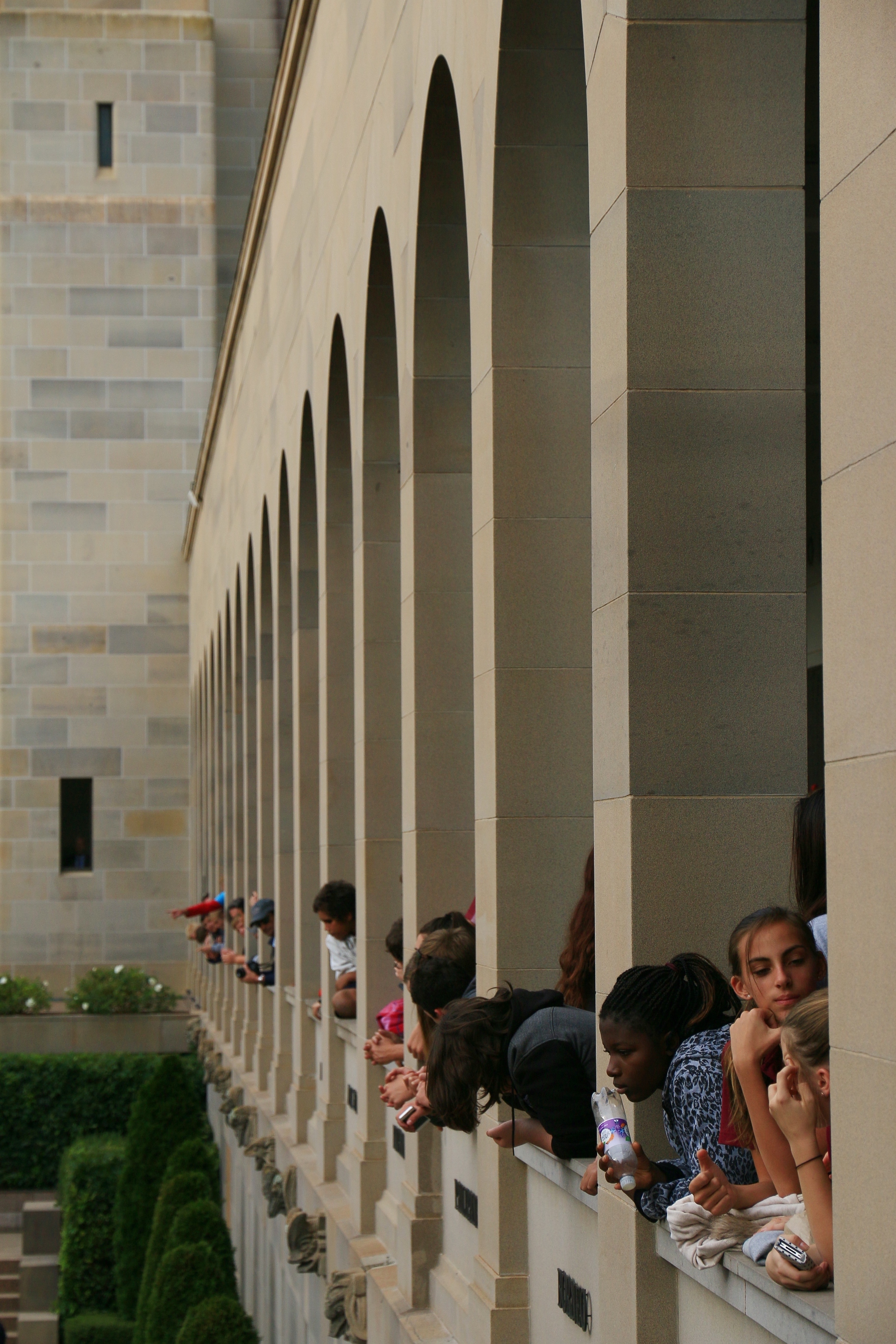
Upon the outside steps, schoolchildren gather in awkwardness and relief, escaping the restrictive solemnity and required reverence of a place venerating death. The air is filled with youthful chatter, indecipherable in a squawkish flurry of hopes, dreams and no-good insolence. It is another age, in which hashtags were yesterday’s news and that which came before unfathomably remote. Yet still the human condition presupposes that one of their names may just, despairingly, return to this spot.
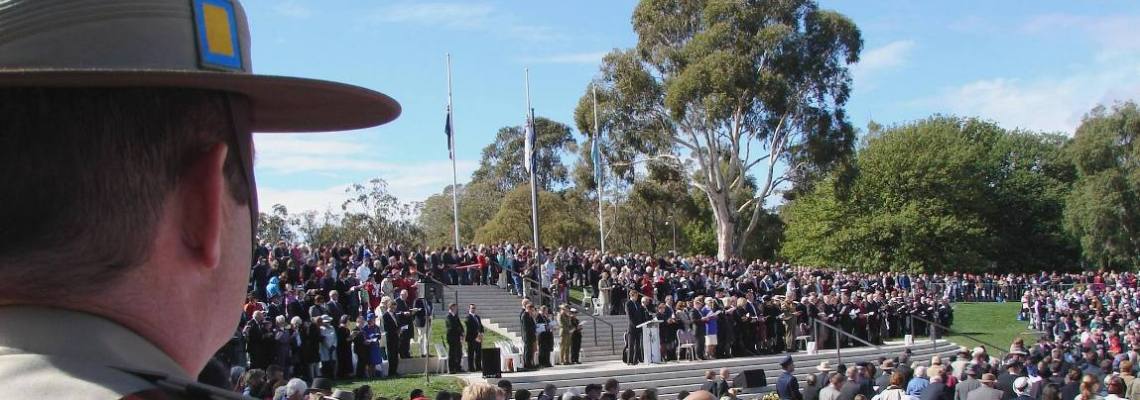
 In a gathering gloaming, reassembly occurs along the arches and steps, their backs to the names of the fallen. Arms dangling from the tedium of patience drift over the letters spelling out Korea and Timor and Gallipoli. A man speaks; a bagpipe plays in mournful strangulation. A story is told of one person’s life, the end of which is predictable only in the all too early and violent a termination. Finally, a man in uniform blares out The Last Post and one begins to wonder whether the humble bugle is ever used for anything else. As the concluding brassy notes fade into the cockatoo skies, the rumble of coach engines spark up, seemingly anxious to return their hormonal payload to Sydney and Wagga and Bairnsdale as soon as they can.
A scene like this takes place practically every day at the Australian War Memorial in Canberra, just before closing. In addition to the several hundred present – composed of tourists, locals, and a scattering of uniformed dignitaries, as well as the bundles of schoolkids fulfilling a rite of passage – the ceremony is now live streamed on the memorial’s website. Like the moment’s silence each evening at RSL clubs, it is a physical act aiming to encapsulate those immortal three words: Lest We Forget. And at the going down of the sun, after a visit loosely planned as research for this piece, I was moved, somewhat surprisingly given the desensitisation that comes with distance and time.
War commemoration is awkward. It makes us feel awkward, conflicted even. It is a world of contradictions and hypocrisy. A multi-million dollar industry in which battle sites and memorials can become numbers on a bucket list, stops on a coach tour [i]. We publicly lament the sacrifice, the loss, the needlessness, yet people are still in conflict, losing their lives as we do this. We celebrate victories and make heroes of some, of us, and villains of others, of them. We may question the purpose of daily services such as those at the War Memorial, wondering if they are put on for the tourist experience, a kind of ‘dawn-service-lite’, to ensure visitor number KPIs and funding requirements are met. We are right to question, for blind faith may lead us down the path of ignorance and subservience that has led to past wrongs. Yet it can be uncomfortable to do so, in the context of – quite justifiably – a reverence and respect for many millions of individuals who died because of war.
April in Australia (and, one assumes, New Zealand) heralds the annual peak in our fascination with war commemoration. ANZAC Day is an annual fixture in the antipodean calendar, unmoving and unstinting on the 25th April, reflecting the anniversary of the first mass landing of allied troops from down under onto the rocky shores of Gallipoli in 1915. And because we venerate the reaching of a century – from Steve Smith to the Queen Mother to a national capital – ANZAC Day 2015 is set to be more of a blockbuster event than ever.
Like Easter, one wonders if ANZAC Day has become somewhat diluted and fragmented with meaning over time: it’s a day off work, a chance to go to Bunnings or be a part of the Harvey Norman ANZAC Day price-busting sale, lest we forget. An opportunity to mow the lawn, gather the leaf litter, or watch the annual AFL match as the slow-cooked lamb melts succulently in the oven and The Last Post rings out again at the G. We may drink to excess and legally gamble on two-up, justifying this as being what the diggers would have wanted (whether they would have wanted the increase in injuries, violence and domestic abuse that this may lead to is doubtful). Nonetheless, we still do remember, and millions of us rise early in the dark or attend mid-morning parades, or even visit overseas sites that would be totally anonymous if it were not for their place as a graveyard of war.
As a sometimes alien sometimes looking in, I do not feel as connected to ANZAC Day as sometimes I feel I am supposed to be. It is not a part of my history; I was not exposed to the ANZAC legend growing up. Despite some semi-studious First World War lessons in secondary school, the Gallipoli campaign was a brief mention somewhere in a text book. From what I know, it strikes me as an absolute shambolic disaster. That this – a sorry slaughter bungled by British commanders and with no far-reaching impact on the wider war effort – is widely considered as the birthplace of modern Australia is, on paper, bewildering. Forget that this negates the presence of one of the oldest continuous cultures on earth, or the development of affluent cities and the taming [ii] of a harsh landscape, or the achievement – in 1901 – of Federation that came with white settlement. Gallipoli also bore all the hallmarks of old empire, in which young Australians (and, incidentally, many more British and Turkish men) were sacrificed in unfailing service to the motherland. A defeat; a wasteful, pointless loss in which Australians blindly followed the orders of a bunch of crusty British superiors. It does not smack strongly of independent nationhood.
It was here though that the ANZAC legend was born and this has since become institutionalised as a turning point in Australia’s view of itself and relationship with the old world. In the run up to the centenary, a surge in earnest documentaries and debates, confected dramatisations, and obscure blog entries by half-wits like me will regurgitate and nuance such arguments, questioning the role of ANZAC Day and what it means to the nation in the twenty-first century [iii]. While the bravery and actions of those in Gallipoli will not be diminished, it is pleasing – if that is the right word in such a context – to see a stronger emphasis shifting towards remembering many more Australians lost on the Western Front, in Asia and across other conflicts. ANZAC Day may well be becoming less about Gallipoli and more about everyone and everything touched by the ruinous proclivities of humankind.
——————————————-
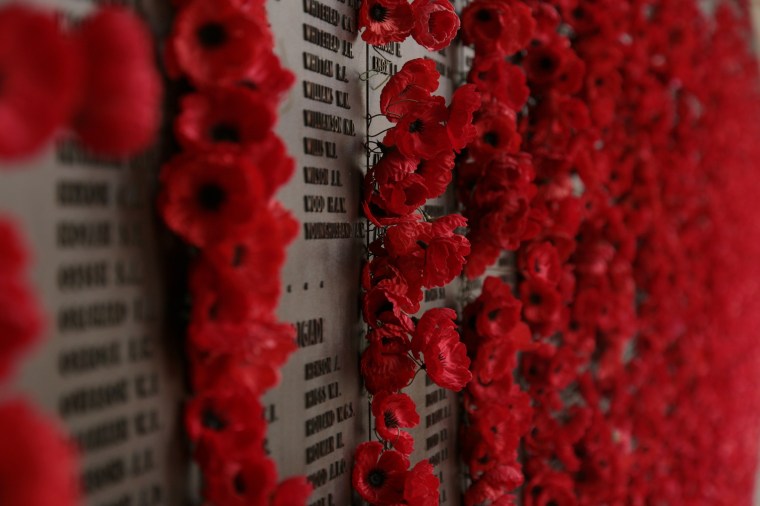
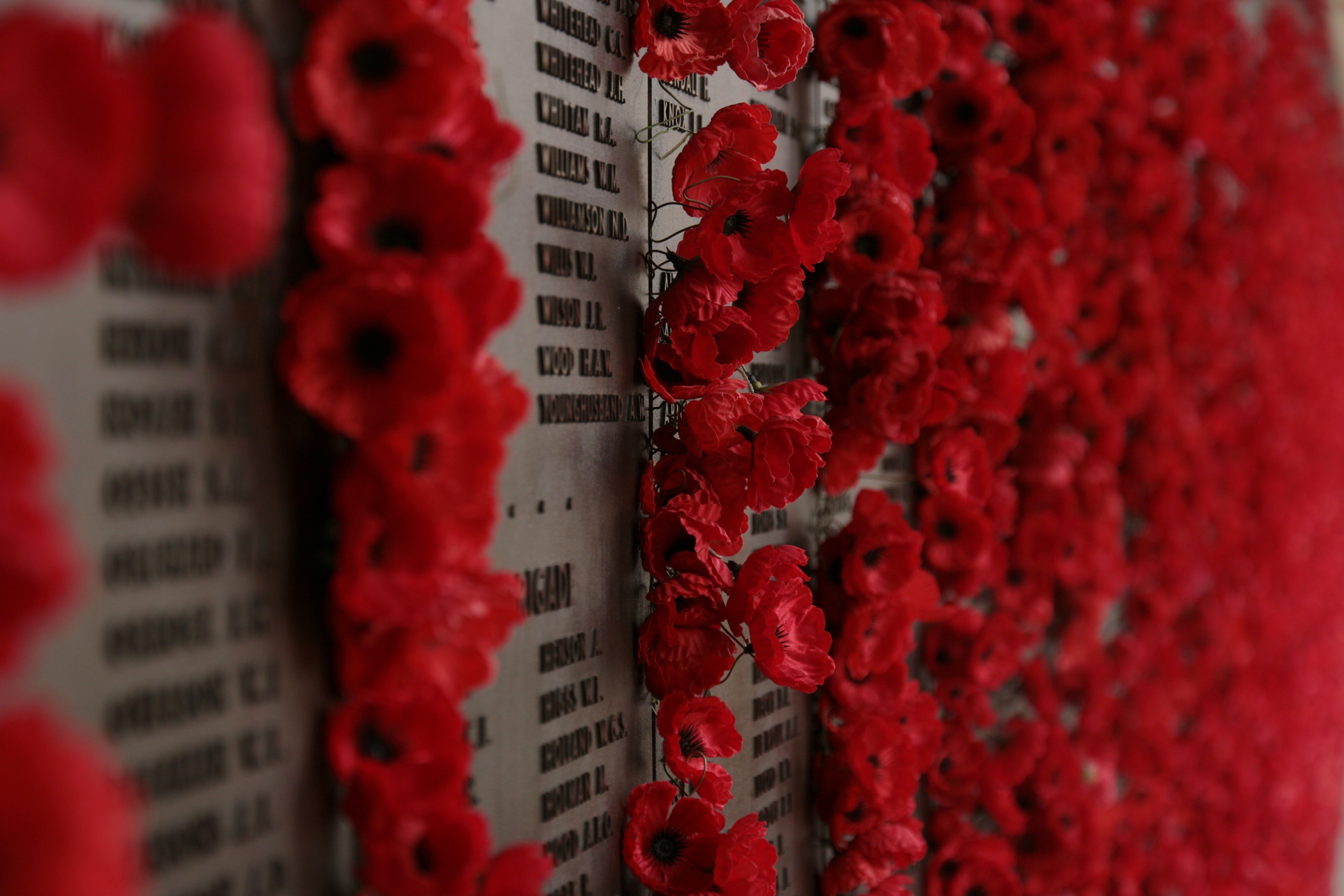
There are approximately 102,000 names embossed upon the roll of honour in the Australian War Memorial. The western colonnade contains those who were killed in the First World War (62,000), while the opposite wall of bronze tablets mark those lost in the Second World War, followed by the post-war wars in Asia and the Middle East. Some, such as Afghanistan, forlornly remain open ended. There is little space remaining for further names to be added, which at least might signify some optimism that never will a mass conflict cause so much loss of life again [iv]. The scale can be overwhelming, so much so that it can distort one’s sense of comprehension, much in the same way that it can be too much for us to conceptualise the number of stars in the universe or the number of Olympic-sized swimming pools in Sydney harbour.
Should it somehow transpire that no more Australians are killed in battle from this day forward, it would still take around 280 years for the Memorial’s daily service (assuming this continues) to tell the individual story of each one of the names on its roll of honour. Against the almost unfathomable mass of loss and sacrifice, it is perhaps the individual stories that are the most telling, the most poignant, and maybe even the most relatable. In more recent visits to the Memorial I have found myself seeking someone with my surname on the wall, placing a poppy nearby to join the clusters of red springing from all available gaps and crevices between panels. To none of these Staffords am I related (as far as I am aware), but it makes me feel slightly less guilt-ridden at being a tourist, and somehow more connected as an outsider. Reflecting on the one may resonate stronger than one hundred thousand.
All that connects us is a name:
Stafford, J.G., 22nd Battalion.
I saw you today upon that wall,
With hundreds of thousands of others to fall
In battle, in war, often in vain,
Sent far from home, you’ll always remain.
You died 59 years before I was born:
The 4th of October, 1917.
Upon Flander’s fields, dispatched in battle,
Sent up to be killed, slaughtered like cattle.
Lain down in Ypres, beyond Menin Gate,
Marked by a white cross, as all with this fate.
Your life in Australia was spent in the country:
Colac, Victoria before moving to Ouyen.
A labourer is all, constructing a wall,
Sweating with toil, tilling the soil,
Getting the call,
To fight a great war.
You were 27 years when leaving Port Melbourne:
Upon the HMAT Hororato.
A girl left in port, named Ivy Jane,
A niece or friend, or once secret flame.
When I was your age, in Australia as well,
I’d discovered a heaven, while you left for hell.
I do not know you, nor do we share blood:
But today you were there, and there I stood.
Thoughtful and thankful, looking for meaning,
You sent me away, stronger belief in,
My fortune and hope, my freedom and joy,
Your name etched a man, and I still a boy.
And, fittingly for such bad First World War poetry, an addendum courtesy of Baldrick:
Boom, boom, boom, boom,
Boom, boom, boom. [v]
——————————————-

My own experience of ANZAC Day has, thus far, embraced a range of experiences one is expected to engage in. Though I am yet to get inebriated and lose hundreds of dollars gambling, I did once add a shot or two of whiskey to a flask of hot coffee for the dawn service, justifying this as being what the diggers would have wanted of course. Plus it was treacherously cold at that time of day at that time of year, and I suspect I wasn’t the only one with a hip flask handy.
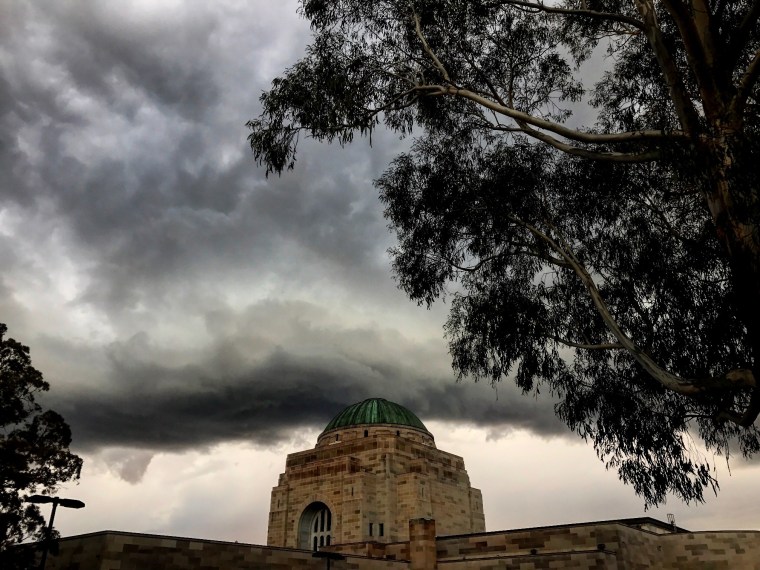
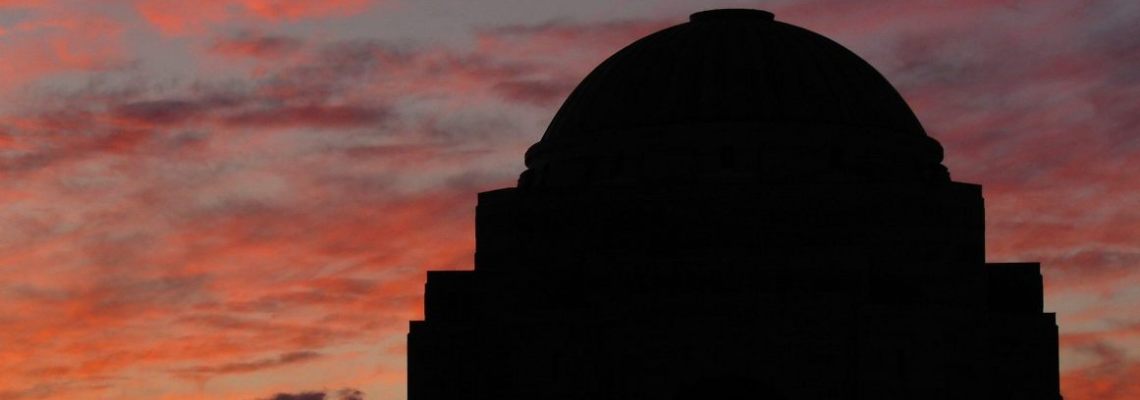
The dawn service is a memorable and genuinely moving experience. Pitch black with icy winds streaming down from the hills, there is sleepy-headed confusion at encountering hundreds of buses and thousands of people, barely visible ants streaming towards the dimly-lit dome of the Australian War Memorial. Candles flicker, readings are aired, silences are held, bugles are played. The singing of Abide With Me is drawn out with such sombreness as to lead to total gut-wrenching despondency. There is no sense of jubilation, no air of celebration. Arguments are forgotten, debates paused; for now, all that matters is remembrance and despair.
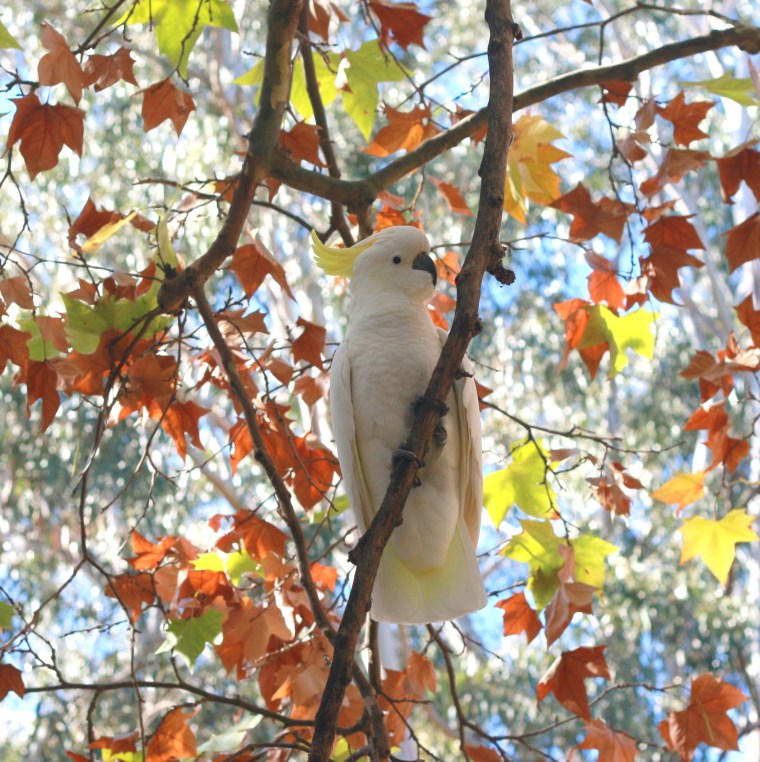
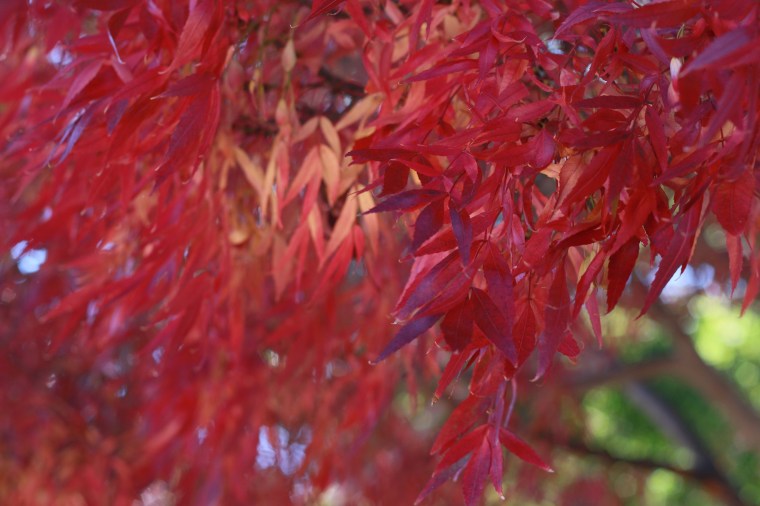
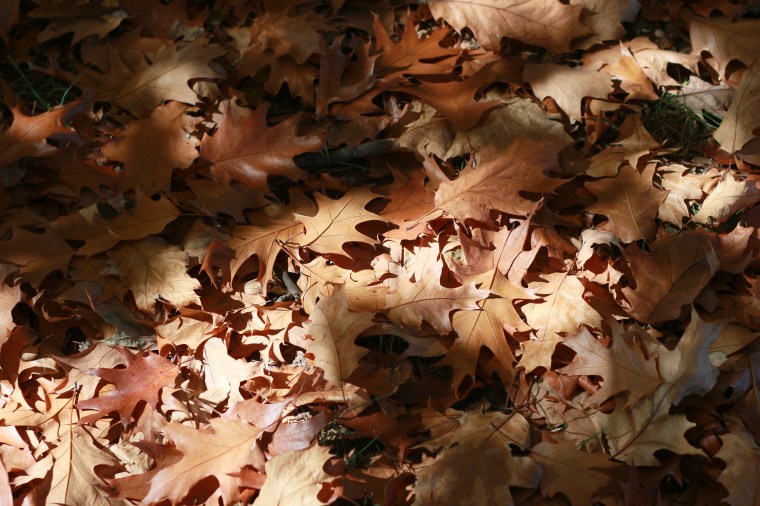
Almost imperceptibly the black of night softens and, as Advance Australia Fair concludes the service, a thin, indigo line is visible above Mount Ainslie. Cockatoos shriek in suitable reprise to the final chimes of the national anthem, pursuing the fruits of the gently flaming and fading oaks nearby. The faces of others take form – young, old, white, black, Asian. Top brass military regaled in finery mingle alongside youths still in their bedtime onesies. There is much of beauty in what modern Australia has become, and the debt of gratitude is never more apparent.
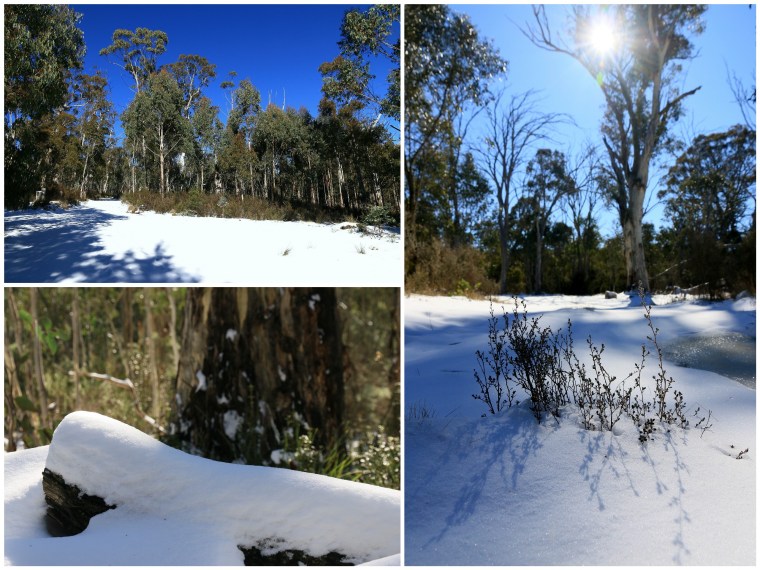
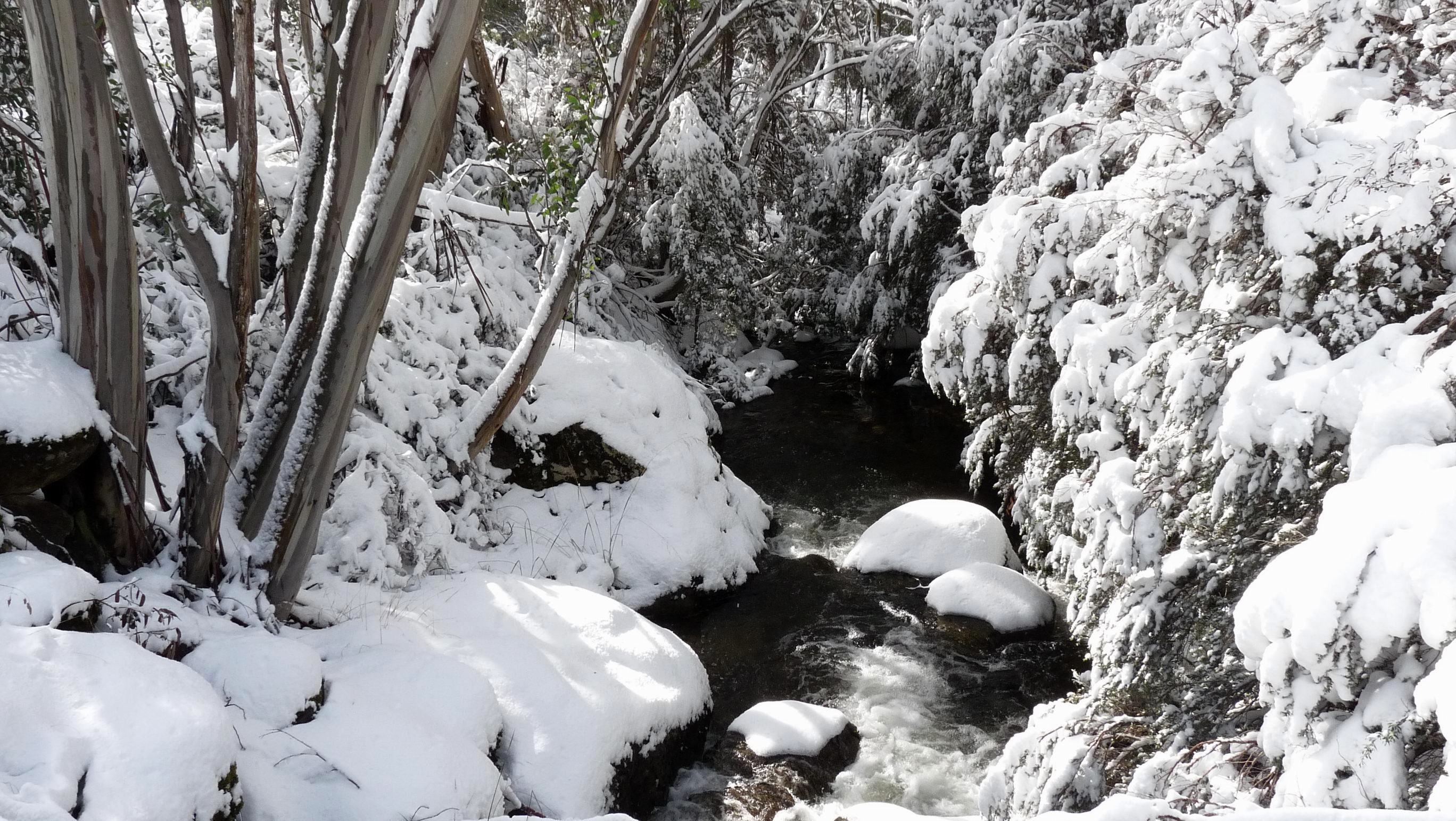
As the Australian capital glows in its autumnal splendour, its citizens and visitors are free to go back to bed, go buy a flat white, go to the pub. They may well go to the later morning ceremony, which includes a parade past various dignitaries with their own entry theme tunes [vi] and the thunderous excitement of a jet flypast. The citizens can now, officially, put on their heating (there was nothing stopping them before apart from a long-held Canberra convention that is regularly flouted). It can be pretty handy, particularly as snow is not unheard of up in the hills and mountains by the end of April. Indeed, one of the most memorable – and surprising – ANZAC Day long weekends I experienced was waking to snow in Thredbo, and enjoying a day of tramping through snowy Eucalyptus forests and warming up with hot chocolates.
All of these freedoms, all of these wonders, all of these hot chocolates are derived from the lottery-winning ticket of life that is being born in or coming to live in Australia. It was not always this easy, neither was it always just or pure or peaceful. But it is what it is, born from an ancient sea and moulded by rainbow serpents, shaped by the ANZACS, the first fleet, the pastoralists and gold diggers, the builders and scientists and mothers and cricketers, the Aborigines, the Dutch, the French, the British, the Chinese, the German. It was, and still is, and long may it continue through a journey of acceptance and evolution, something that would be worth fighting for.
[i] There have been several recent features regarding the (sometimes crass) commercialisation of ANZAC Day. For instance, see http://www.abc.net.au/news/2015-04-16/green-anzacs-lest-we-forget-to-turn-a-buck/6396176?section=ww1 and http://www.themonthly.com.au/blog/james-brown/2014/02/17/1392601420/anzacs-long-shadow-cost-our-national-obsession. Also, check out much of the profiteering here at http://anzacprofit.tumblr.com/
[ii] ‘Taming’ is far too simplistic (and restrictive) to describe white settlement of the land in Australia, but I only have one sentence to play with. One may also consider cultivating, irrigating, clearing, destroying, pillaging, ruining etc etc. I found Don Watson’s The Bush to provide a highly readable synopsis of some of the failings and achievements of settlement, with a detailed understanding of weeds to boot!
[iii] For its part, the state broadcaster – the ABC – has produced a vast resource of ANZAC related content, including much navel-gazing and probably far better researched and written analysis than that included here. See http://www.abc.net.au/news/first-world-war-centenary/
[iv] Alas there is always scope for expansion upon the current site.
[v] The German Guns, by Pte S O Baldrick. See https://www.youtube.com/watch?v=7UKpZxM-c9w
[vi] From memory, the PM gets a quirky little ditty of Waltzing Matilda, the Governor General Advance Australia Fair (or possibly Song of Australia?), any visiting royals hear God Save my mother / grandmother / aunt etc, and a New Zealand representative any song by the Finn brothers.


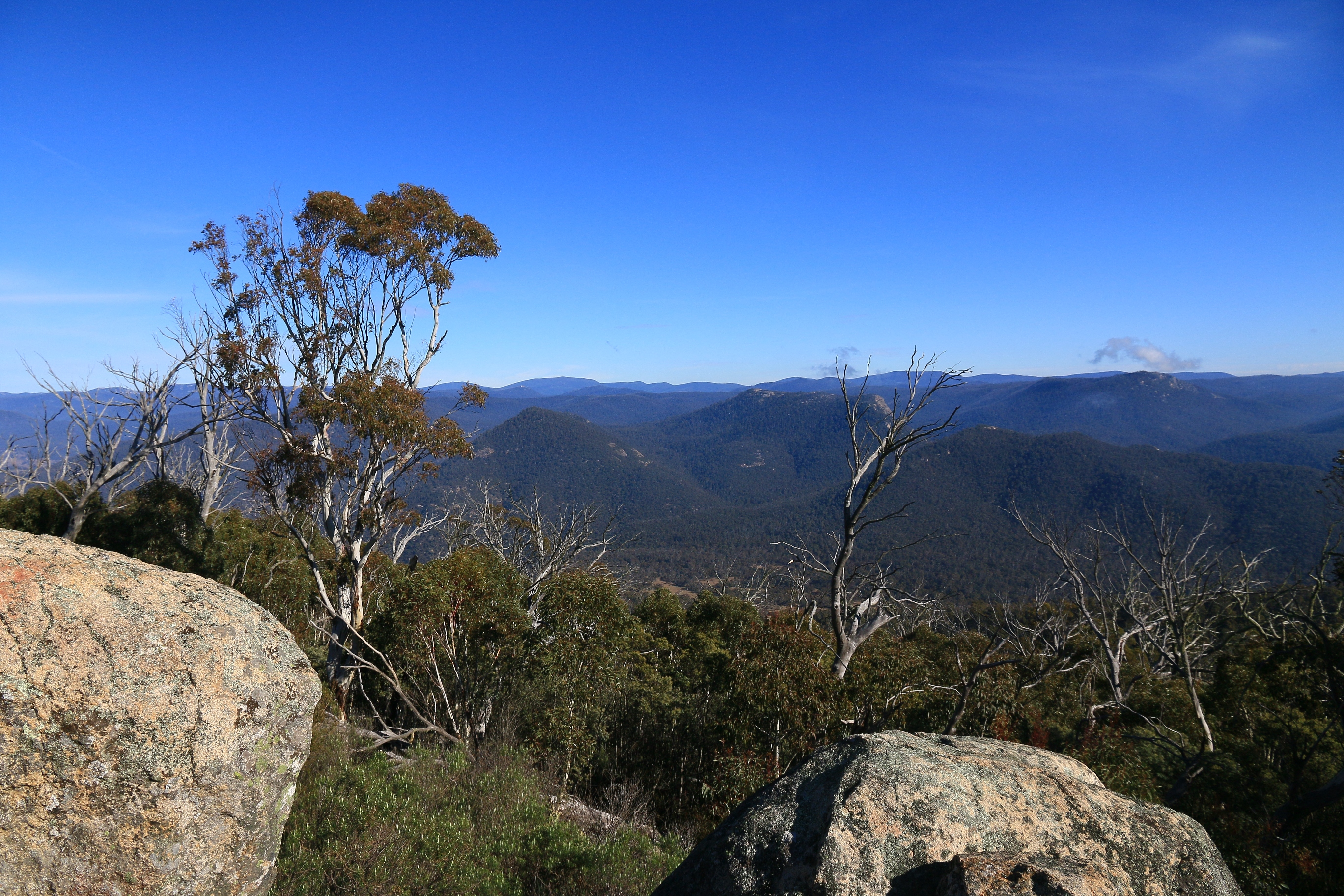
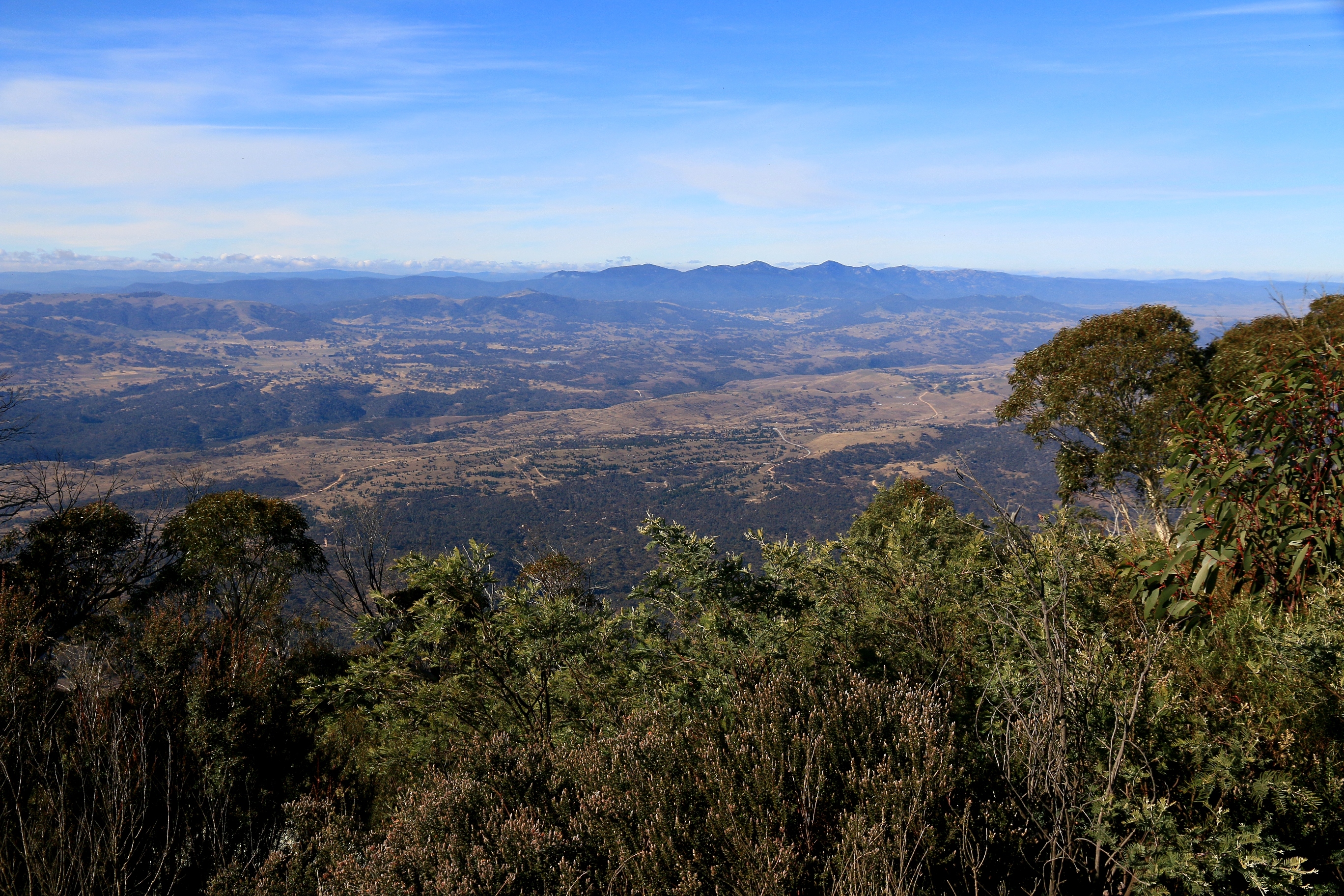
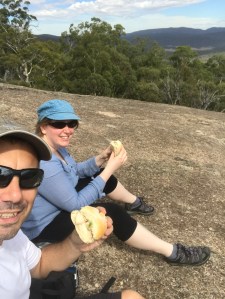 In truth, the walk up the Yerrabri Track in Namadgi National Park was only part of a bigger equation. An equation whose solution was a delicious bird roll or two. N+J*OzNP(vt)+C0les=br. It’s a concept that has evolved from very preliminary experiments at the New Years’ Test in Sydney, refined to perhaps its ultimate manifestation on the top of Mount Kosciuszko. Replicated many times since, it is now a requisite of any encounter between Jill and I. Recently, each of us have tried to outdo one another in the bird roll stakes and today, on a rocky platform overlooking peak serenity of an abundant emptiness, I may have taken the lead. For now.




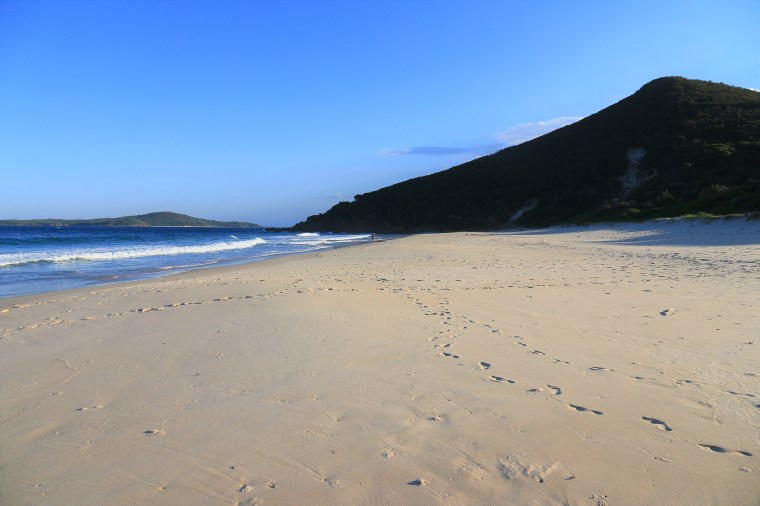


 While memories can be magnified or maligned by multiple visits, there is something special about breaking new ground. A stop around South West Rocks and Hat Head National Park provided many highlights, one of them being that this was new territory for me, Dad and the car. We all quite liked the drive alongside the Macleay River, with its green watery pastures, tiny weatherboard towns and cowbirds. We all liked a lot less the potholes around the national park campground by the beach. We were fond of the lighthouse and its views, but not so keen to traverse a rough track to some mythical walking trail. Still, if we hadn’t switched to a different walk we might have missed the sun going down. Everything works out for the best in the end.
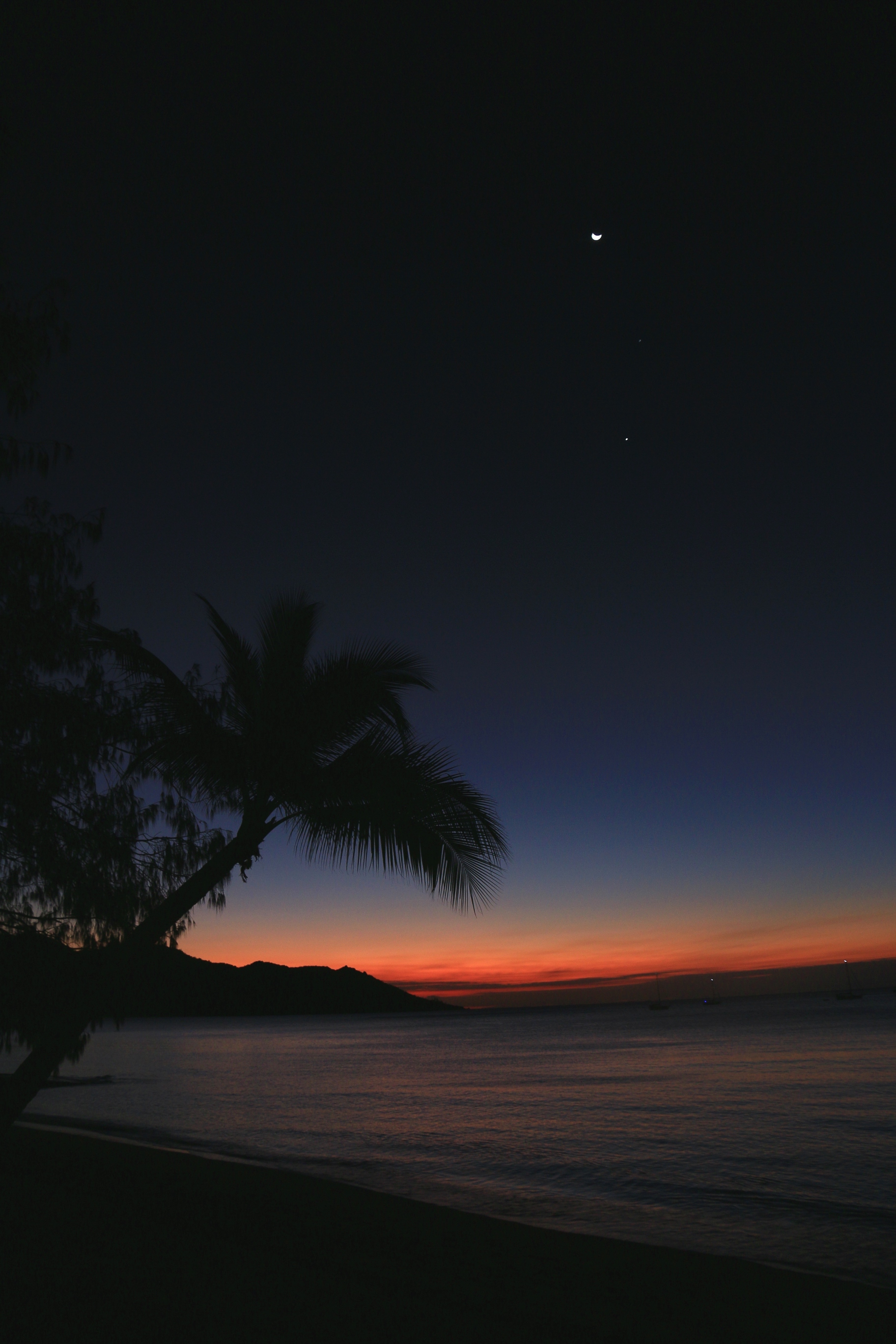
 The beach is pitch black barring the beam of light circling upon the lighthouse. The sound of waves suggest ocean somewhere vaguely nearby, a roar magnified without any other disturbance at night. The sea breeze is cooling and evaporative, seemingly keeping the blood-sucking bugs at bay. The fine sand sustains a tripod and the sky offers an infinite, ever-expanding canvas. The photos may not have turned out brilliant, but the shared experience, the learning, the new adventure was. I daresay it was even better than Eastenders. And on that bombshell, bom, bom, bom, bom-bu-bu-bu-bum.

 It’s taken a while for summer in Canberra to arrive, with the inevitable false starts and the fake summer that usually emerges for a week or so in October before retreating with startling rapidity. The variable weather conditions are largely a boon for nature which bursts into a frenzy of colour and gargantuan jungle of weeds. One minute you have a perfectly respectable outside patio area, the next it’s a (*culture alert*) frenzied sketch from Rousseau. Best to try and ignore the weeding and admire how the professionals manage things at the Botanic Gardens.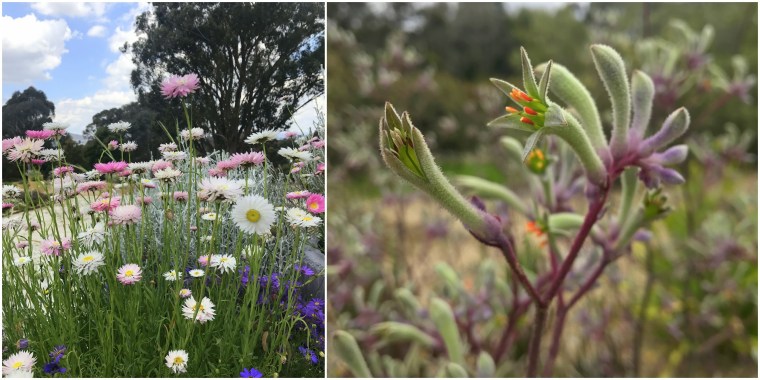
 There is a point for me in which winter in Canberra is definitely over and summer is certainly on the way. It’s that day when you decide to walk in the shade to cool down and protect, rather than seek out a warming sun and its melanoma vengeance. You know you should get your floppy hat out despite looking like a numpty in it. And largely avoid the midday sun for disproven fear that it is this that is making your hair grey and not the inevitable march of age and genetics.
 Anyway, the best times are the day’s extremities as the amount of sunshine increases. Those cool mornings when Wattlebirds wake you up at 5am and you could be tempted to a) get on your bike for a beautiful lakeside ride of virtue or b) turn on the radio in the hope that you will doze back to news of Cooper Cronk being signed by the Northern Beaches Numbats. And, at the other end, there’s those lingering light evenings, in which twilight golf is a possibility and cold beer and barbecues become a more frequent consideration.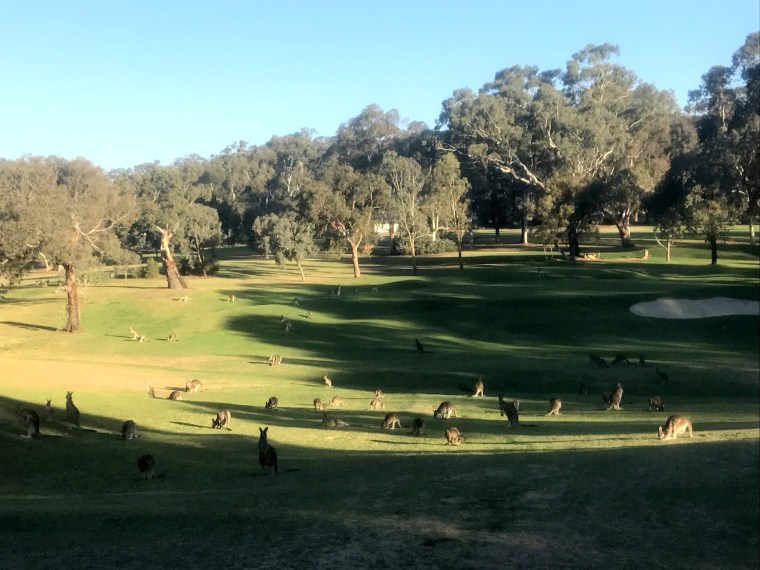
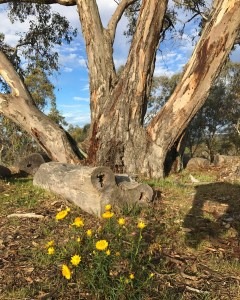 All this water, all this sunshine, all this warmth and cool change. A time for shorts and hoodies and rainbows, many rainbows. Rainbows and butterflies as summer seems to assert itself with greater authority. But still Christmas hovers as a lottery between scorching bushfires and mild drizzle; no doubt it will be 35 degrees for a classic roast or a chilly 18 for a poolside barbie with novelty oversized prawns. Only time will tell.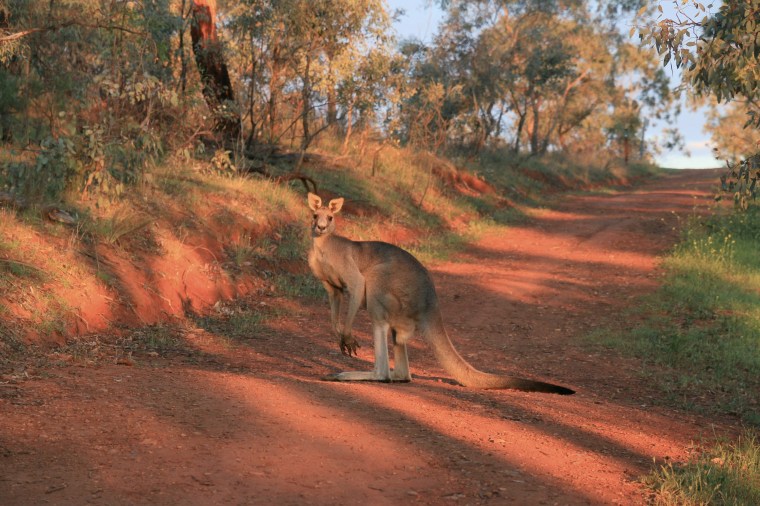


 It’s kind of a winter thing, a cross-hibernation leisure shut down enforced by financial year leftovers and inevitable doses of bugs that may or may not be flu but love to linger. Canberra has had more than its fair share of cold, but – the last week apart – it has been phenomenally dry, with big clear skies bringing about pleasant afternoons before ruining the whole mood with sharp, sadistic frosts.
 It has been pleasant enough – out of any wind, with a little time spare – for a few walks into the bush. There are Red Hill ramblings of course, but throw in a few Mount Taylor hikes, Black Mountain bush and Botanic Garden explorers, Mount Ainslie parkways, and add a random sprinkling of Cooleman Ridge countryside ambles and Urambi Hills thrills and there’s enough to keep reasonably sane and fit. Especially when the bike is gathering cobwebs.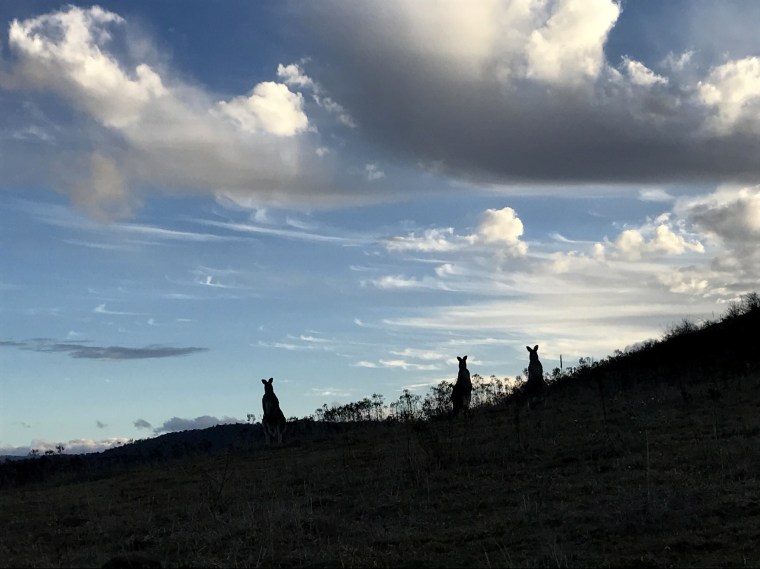


 And a few strategic recommendations for winter? Anything with gravy and a glass of red helps; get out in the warming afternoons even if this means working at night; and, in the midst of analytical bewilderment, book a flight to the UK, where the daytime temperature will probably end up being the same anyway! See you oop North….
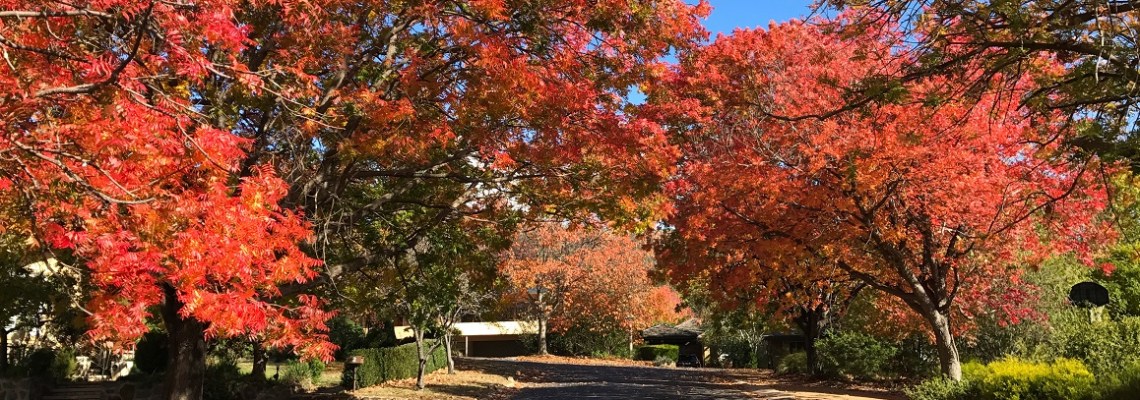
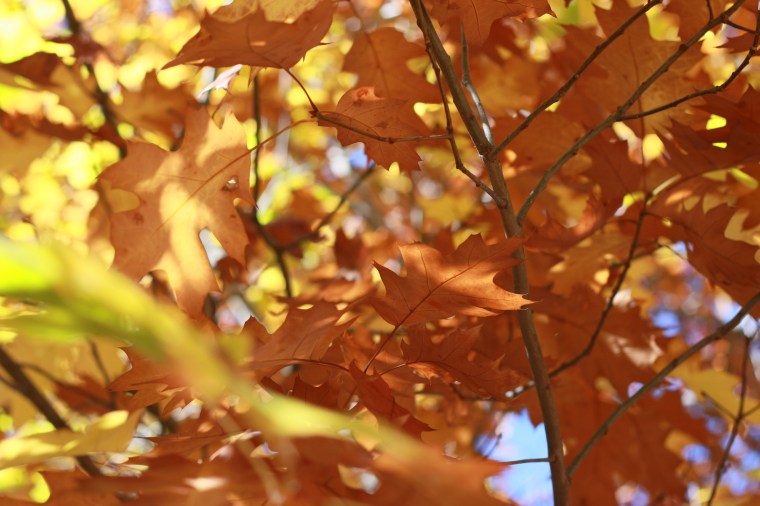
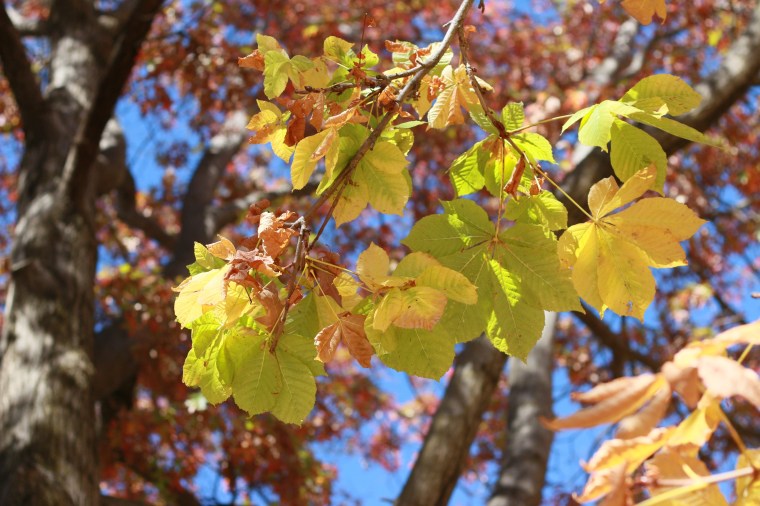
 It is a time to savour suburban walks, in the comfortable pockets of Canberra that will never be in reach. Foresight planted deciduous trees for garden suburbs for genteel homes. As temperatures drop to a level mild and amicable and still warmer than England in a hot flush, the streets now enliven, the crescents glow, the neighbourhoods flourish in a makeover both incremental and dramatic. Go on certain days and a regiment of wheelie bins will parade upon the kerb, afloat in an ocean of nature’s litter.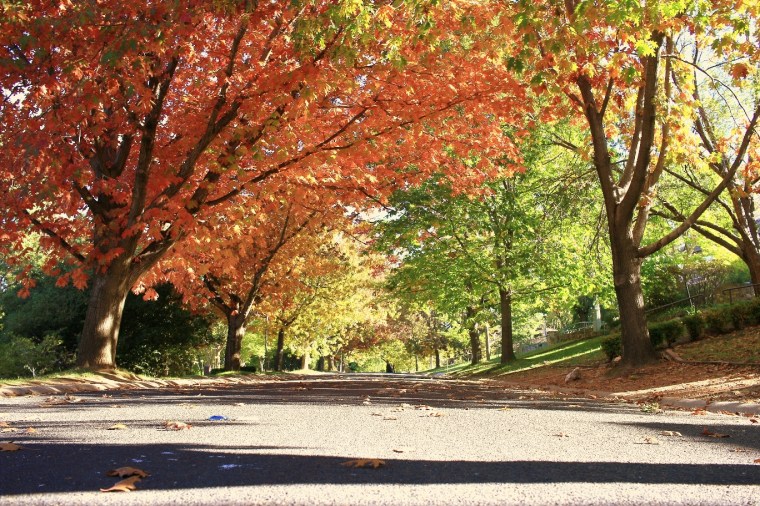
 Easter is the most perfect weekend as the warm kiss of autumn melts any eggs undiscovered by marauding imps. I don’t recall Easter egg hunts as a child; are these more a thing now, coordinated through Facebook groups and discoverable like Pikachu? Waiting until Sunday until you were permitted to make yourself sick on chocolate and then topping up with half price eggs on Monday was more my kind of thing. If I have made any progress in life, then let it be measured by cake, and I can mark the creation of a chocolate and hazelnut meringue as one of my greatest achievements.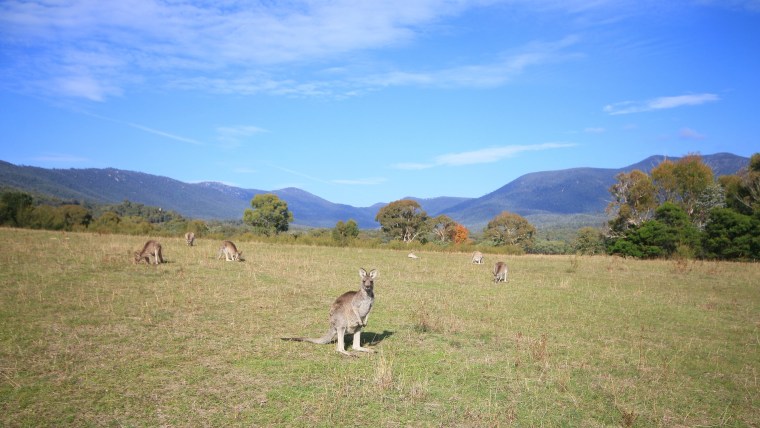
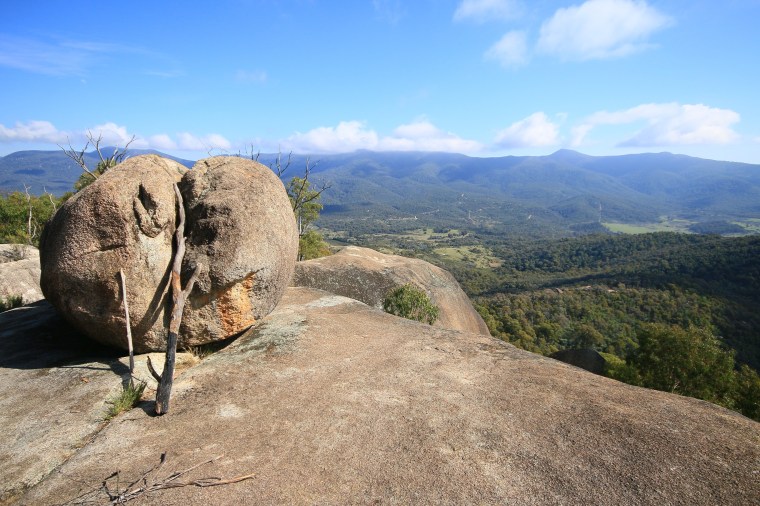
 Here there is the best of both worlds, with coffee available a little further down the road at the Moon Rock Cafe. This is attached to the Deep Space Communication Complex where – in my head at least – gentle mutterings from Professor Brian Cox are transmitted to distant worlds in the hope that it would sufficiently soothe angry aliens from undertaking imminent invasion. If you feel small atop Gibraltar Rocks, here you are infinitesimal, insignificant beyond belief. Yet at the same time, in the warm sun with caffeine and a bonus chocolate egg, your existence is undeniably amazing and incredibly fortunate.

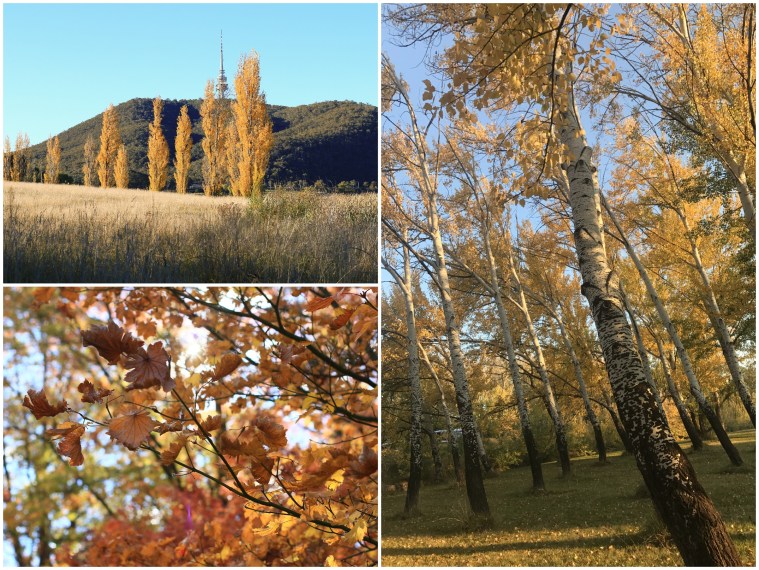
 Tucked away in a quiet corner by Lake Burley Griffin, largely forgotten apart from the odd dog walker and camera wielder, the Lindsay Pryor Arboretum is an unbridled delight. A kaleidoscope of colours adorns the different varieties of oak, elm, birch and poplar. There are no visitor centres and no playgrounds, no cafes and no sculptures. The air is calm, the light soft, the mood understated. Occasional tunnels of foliage play at being England. And you could imagine, under these boughs, a snap election might just be called.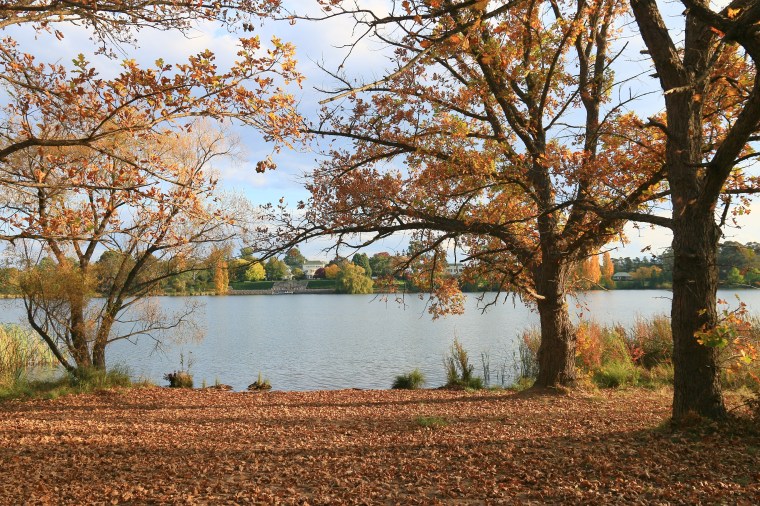
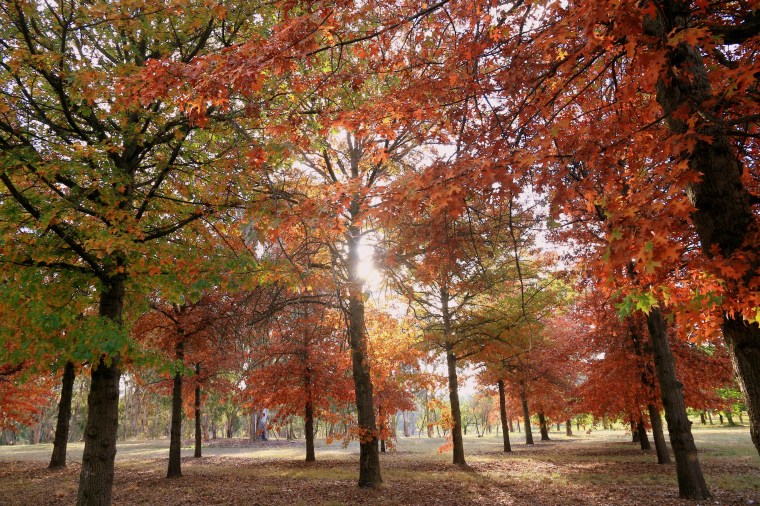

 What does one do in a hot summer which features only intermittent work? Well, trips to free air-conditioned sites of interest for a start: the cinema, the library, the gallery, the mall. Occasionally the office, mostly for a coffee and catch up. Bike rides bring a nice breeze early in the day or into the late evenings. And cooling refreshments comfort: my addiction to frozen drinks persisting (but now slowly fading), a cold beer or cider in the evenings, Dare iced coffee and occasionally something a little more extravagant.
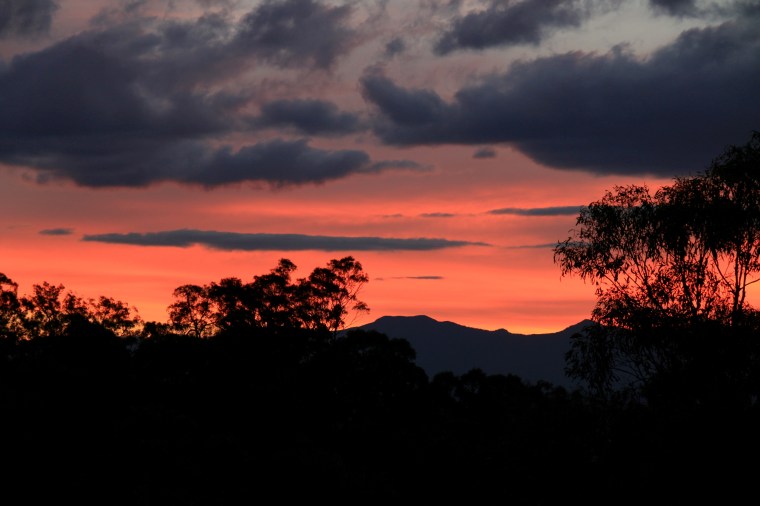
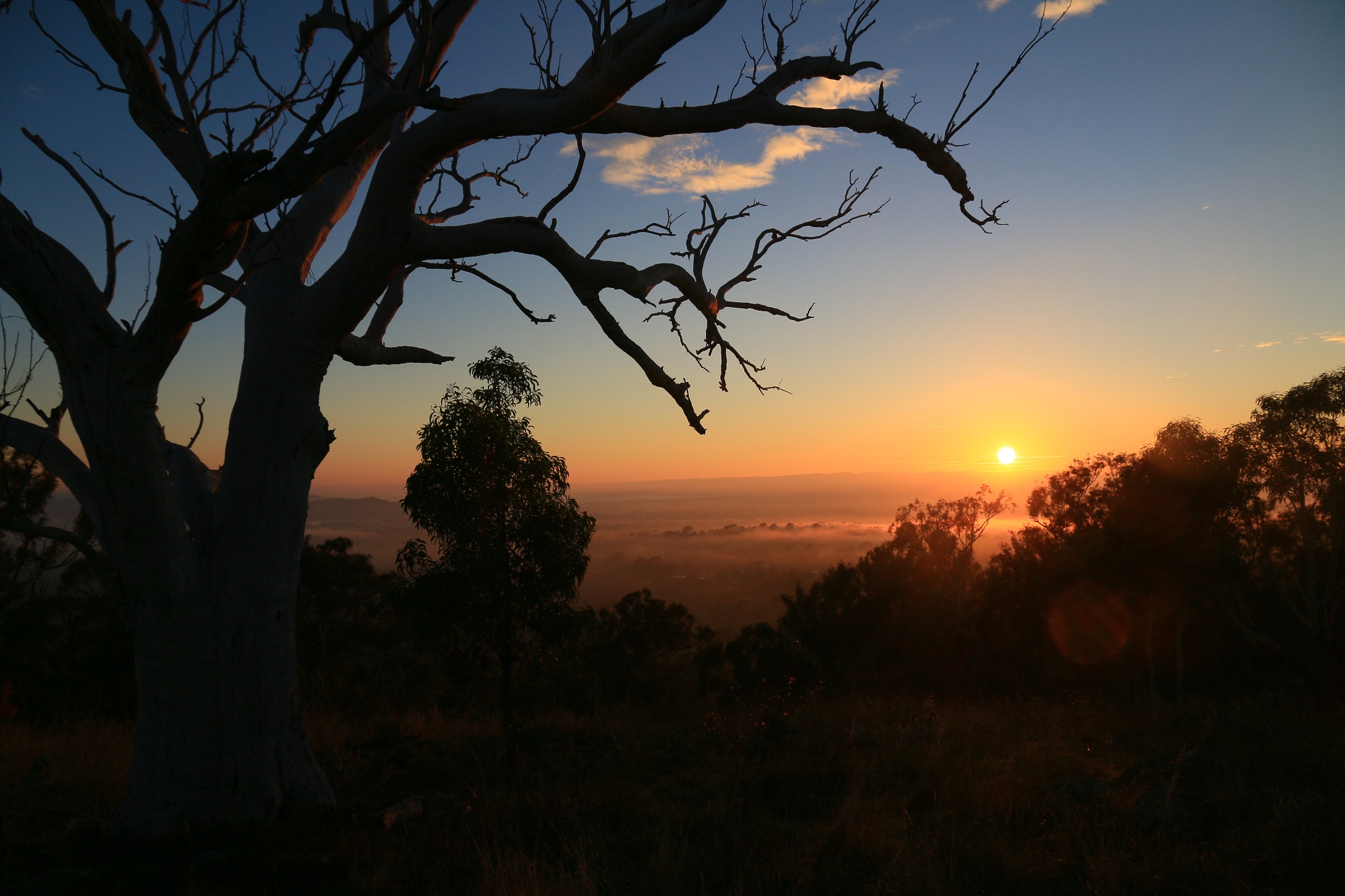
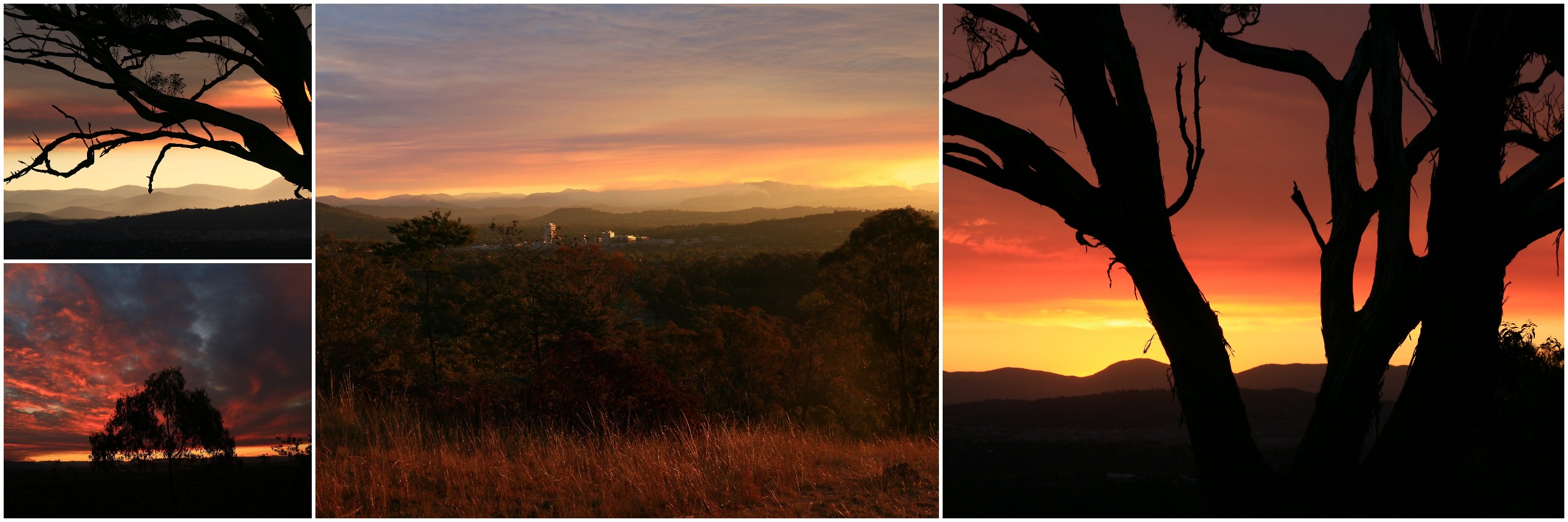
 Walks are practically a daily feature (they usually are), often on Red Hill (they usually are). Again, the early mornings or late evenings work best, the low light emphasising the sweeping golden grass and colouring the white trunks of gums a laser red. Sun sinks late over the ranges and smouldering skies are common. This is better evening entertainment than what’s on TV, as post-tennis, post-holiday reality shows make a comeback, spewing forth with abandon.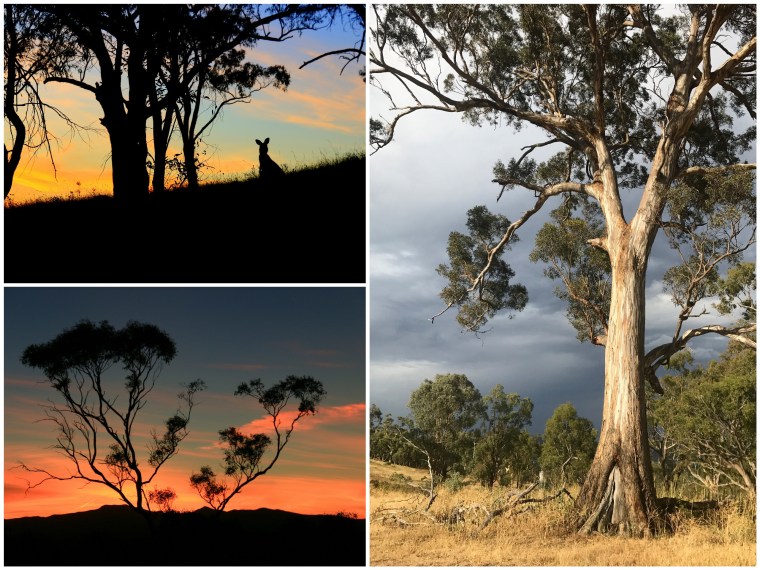
 Daytime strolls are better suited to places such as the Botanic Gardens, where shade is more forthcoming and the rainforest gully drops temperatures by five degrees. Moisture emerges here from the watering, and continues in the cafe serving a fairly average coffee. But to grab a takeaway and sit under a tree reading a book or interview transcripts is a fine way to spend an hour (and improve the experience of reading interview transcripts).
 Away from nature for a moment, summer in Canberra also promises event after event as the populace makes the most of the time before entering deep freeze. There are blockbuster exhibitions in the galleries and museums; there are fetes and swimming carnivals and cricket matches all over the suburbs; fireworks, flags and protests in equal measure adorn Australia Day; and the National Multicultural Festival brings oodles of noodles in a celebration of diversity that ought to be protected. In the spirit of inclusion even certain redheads are catered for.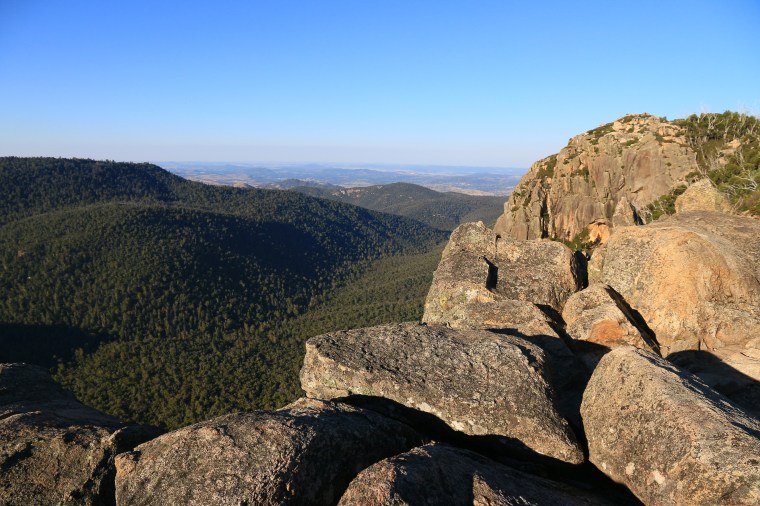
 At Burrinjuck Dam – reached via coffee stop in Yass – water levels are high and this is a natural lure for cursed boatpeople who frolic about in a flurry of jetskis and Chardonnay lunches. Away from the excess surrounding the boat ramp, quieter coves and a cutesy scattering of cottages for those dam workers heralded surprise. And a reasonably flat, empty road on which to have a pedal.
 My how this has grown since I was one of the few to trudge round on a pleasant evening a few years back snapping pictures of a handful of the capital’s illuminated buildings. Now practically every city does something similar on landmarks more well-known. But Canberra’s Enlighten seems to be ever more popular, judging by the crowds streaming from one site to another on a Saturday evening. Many are also here to queue for food in the night markets, which is entirely predictable; after several years you learn to visit midweek and come early, to guarantee delights such as a bao trifecta, Korean chilli pork fries, and deep fried ice cream.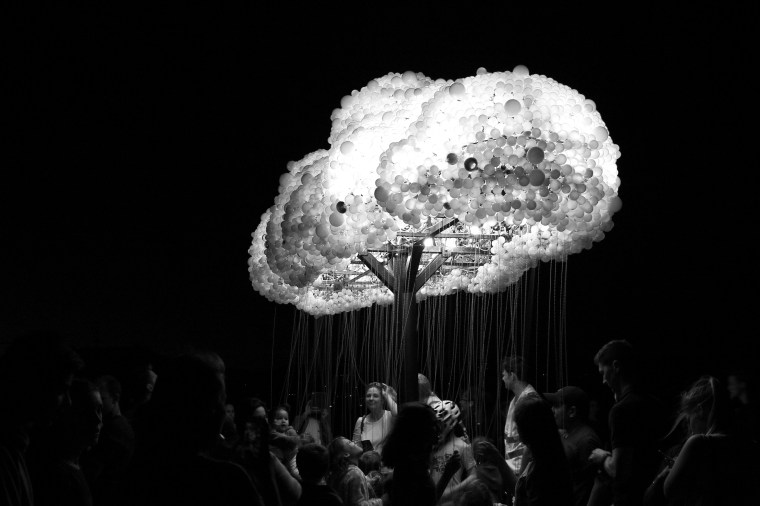














 Still, with every up there’s a down and I have lost mountain views. I have also moved into an area where there is a yappy dog. I only write about this now because I just heard it, again. I always seem to find myself in a neighbourhood with a yappy dog. I think everyone does. There seem to be yappy dogs everywhere these days, coming over here, taking our peace and quiet. They frequently pester me on Canberra nature walks too, usually roaming free because their owners don’t need to pay heed to the numerous signs regarding leads and wildlife protection and all that silly nonsense. Still, at least I can see the mountains on these walks, and the dog yapping can be tolerated with such rewards.
 Take Dairy Farmers Hill, which sits in the National Arboretum on the western fringe of Canberra. I cycled up here a few times in the past, but was usually too close to fainting to really appreciate the 360 degree panorama. Driving one evening with the comfort of air con was somewhat more agreeable. The sun dipping onto and over the Brindabellas offered a treat, while the proximate lumps of Black Mountain and Mount Ainslie received a farewell glow. There were no dogs.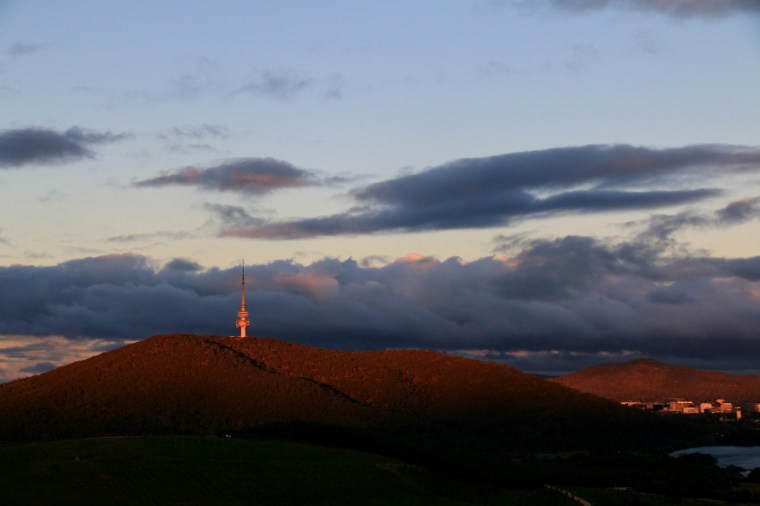
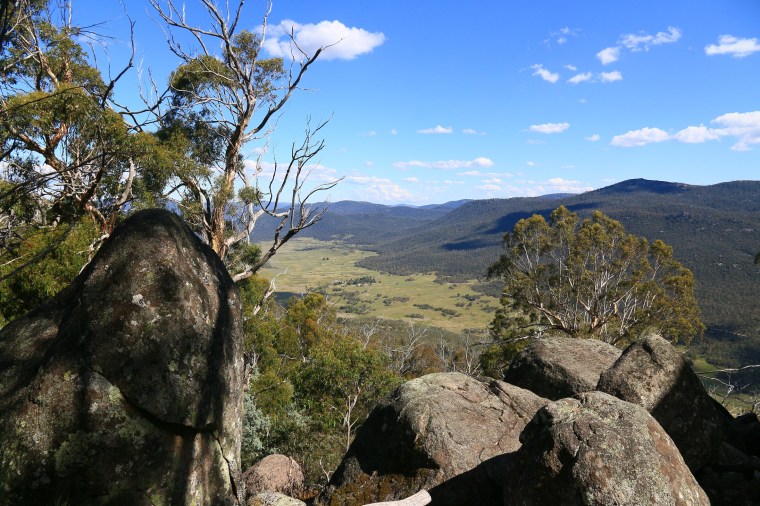
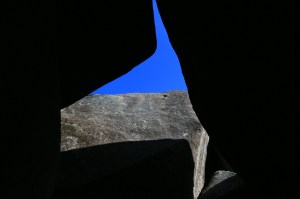 You don’t notice from afar, but these ranges are peppered with giant, rounded granite boulders stacked like clumps of frozen peas that have been left in the freezer for far too many years. These boulders congregate quite generously up on Orroral Ridge, where a series of slightly neglected tracks lead to rocks named for their resemblance to animals and people and other inanimate objects which aren’t rocks. Such is the profusion of rocks that geologists have wet dreams, climbers drool onto their harnesses, and random waifs and strays seeking mountain air delight in the summer coolness of virtual caves formed in the hollows of a cluster of boulders.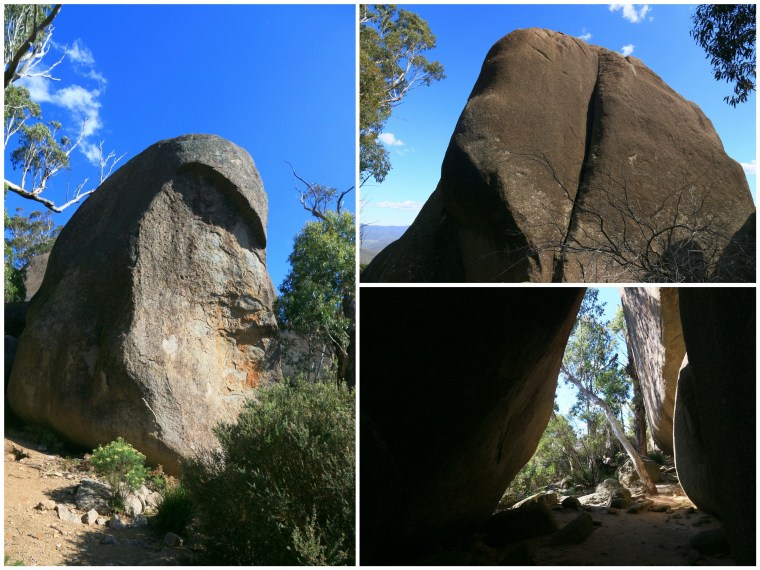
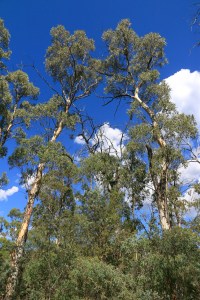 I wasn’t expecting much from this walk – in truth it was something to do in a lull while my washing dried. Plus being practically the last remaining marked trail I hadn’t been on in Namadgi I felt a little obliged to complete it. The word ‘swamp’ was hardly enticing, with images of squelchy boggy plains, rotting carcasses and festering mosquitoes. But it was actually quite a delight, rising steadily through lofty Peppermint Gums, bypassing a few more giant boulders, and meandering through button grass and boardwalks under blue skies and fluffy clouds.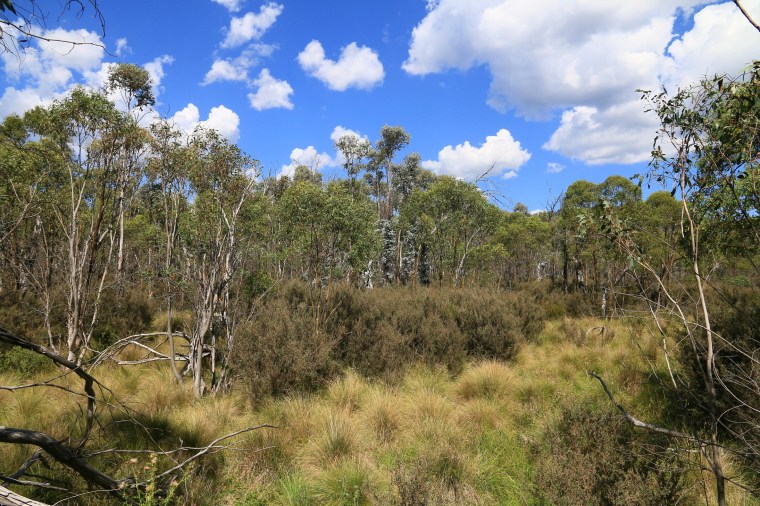
 The swamp turns out to be a fen, as the information board at the end of the walk explained. I’m not really sure of the difference, but it was fairly less swampy than I imagined. A bench here overlooked a river of vivid green grass, lapping at tall forest and rocky outcrops. Being now beyond midday it was the perfect place for a simple homemade sandwich and, once again, for all the expensive meals and gourmet plate ups*, can there be anything more satisfying than a bushwalk sandwich? I don’t think so.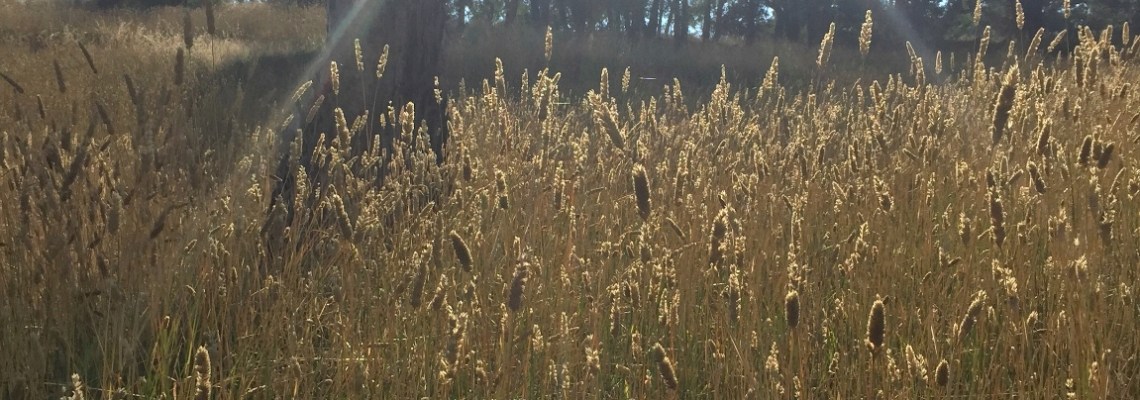
 Having now spent over nine years (with interruptions) in everyone’s favourite Australian city you would think I’d have exhausted every nook, crevice and scrubby hilltop. Forget nine years…many would say two days is sufficient, and even then you might have to drag things out with a wander around the National Archives, surely the least compelling sounding attraction of the lot (which might explain why, still, I have never been). But no, it turns out Canberra has even more suburbs and scrubby hilltops than you can ever imagine.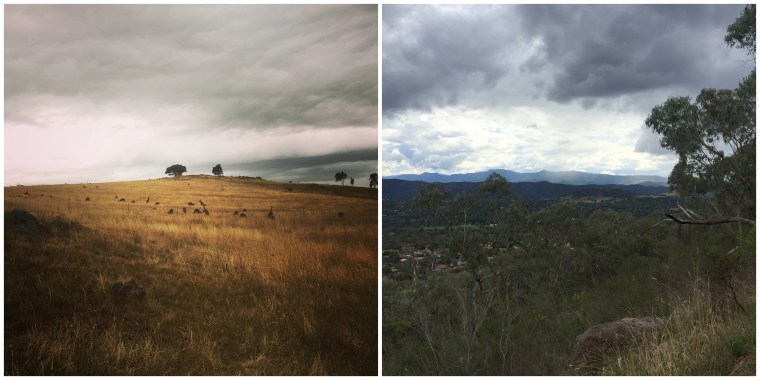
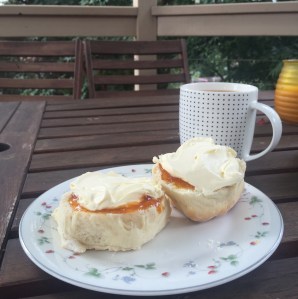 Nevertheless, it was with some contentment that I found a reasonably close reasonably decent coffee stop one Saturday morning, as part of a bike ride on the many accommodating paths in the Tuggeranong Valley. One path circumnavigates its lake, which is a poor man’s Burley-Griffin but amiable enough. Others cut through the various patches of grass set between the backs of brick houses and alongside storm drains. One route takes you up towards Oxley Hill, a reasonable but not unobtainable test of legs, and another does the long uphill drag back to Wanniassa, in which aforementioned legs turn to jelly. I may be being just a touch healthier, but with this comes justification in feasting on yet another, sadly Antipodean, cream tea.






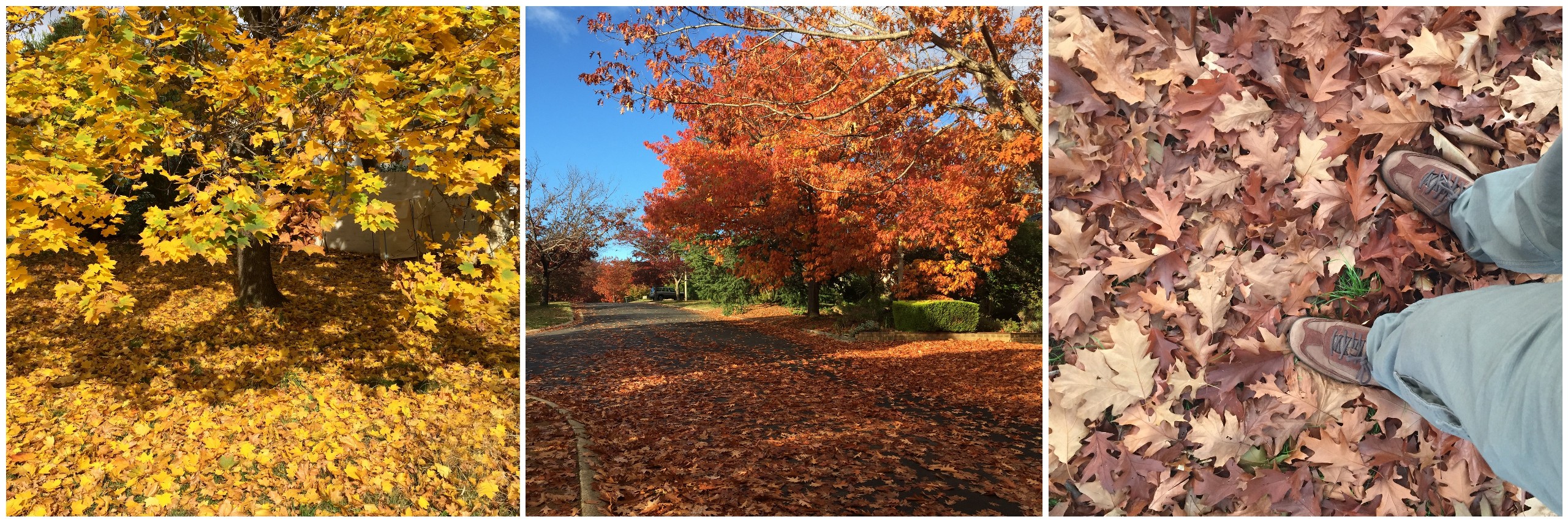





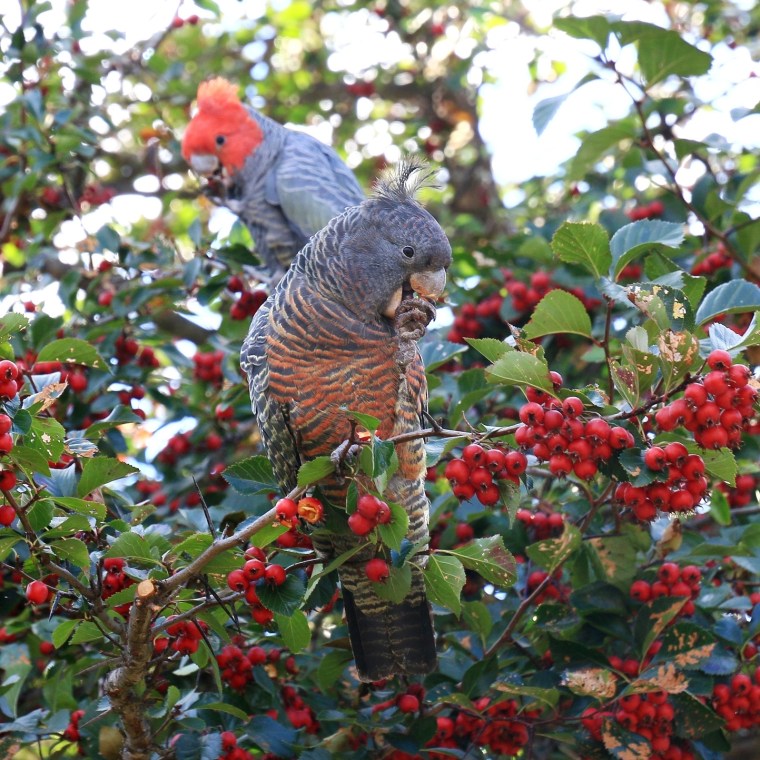
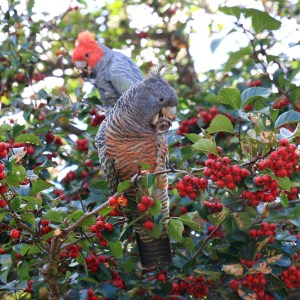 From what seemed to be shaping up to be a relatively mundane autumn – with lots of early browns and leaf losses noticeable – a week which turned from warmth and sunniness to a condition of damp mildness appeared to have fashioned a more elaborate state of affairs. And amongst this fading technicolour the birds lingered too. Foraging and flirting and feasting, the fruitful trees bedecked with gang-gangs.
 gbpilgrim