Oceans

I grew up by the sea. Not in a romanticised way, where snug cottages overlook glistening seas and fishing trawlers bob up and down in weather-worn harbours. Neither in the glamorous manner of those doing it tough in Australia, with their angular beachside houses, all windows and look-at-me decks. In fact I survived growing up without a prized sea view, but the ocean was never too far away. Close enough for seagulls to shriek down the chimney, near enough to feel the brutality of a winter’s storm. Never too distant to walk a pebbly shore and experience the space and light and air that is unique to being on the cusp of an ocean.

You could say that the sea has been in my DNA since I arrived in the world and into the salty air of Plymouth [1]. This makes it all the more surprising that I have not lived within easy reach of the waves for what is now half of my life. I went away to university in the very centre of Britain and then coped with the occasional glimpse of muddy river in London. I moved to Australia – the land of beach bums and surf rescues – and wound up in Canberra; the only capital without prime ocean frontage. I clung to windy days on Lake Burley Griffin, when waves would whip up, and consoled myself with frequent trips to various points on the stunning east coast.

The ocean seems integral to the Australian way of life. Unsurprising given most people live on the more amenable fringe of land closest to the coast, surprising given there is a whole load of land in between [2]. The oceans here – from Pacific to Indian – are oceans apart, and it takes quite some enterprise to bridge the two.

It’s mid-March down in Mallacoota, on the very southeast corner of southeast Australia in southeast Victoria where a southeast wind blows. It’s fairly sedate compared to previous days, a sea breeze in contrast to the cold blasts streaming off the ocean and bombarding the shore with downpours. Around the corner, in Ben Boyd National Park, dirt roads are churned into muddy blancmange leaving a detritus of abandoned cars. I know this because my car nearly joined them, drifting sideways like a drunken celebrity ice skater. Precariously though it made it through to the salvation of tarmac and gleefully crossed the state border to recover in Mallacoota. And what a recovery Mallacoota offered.

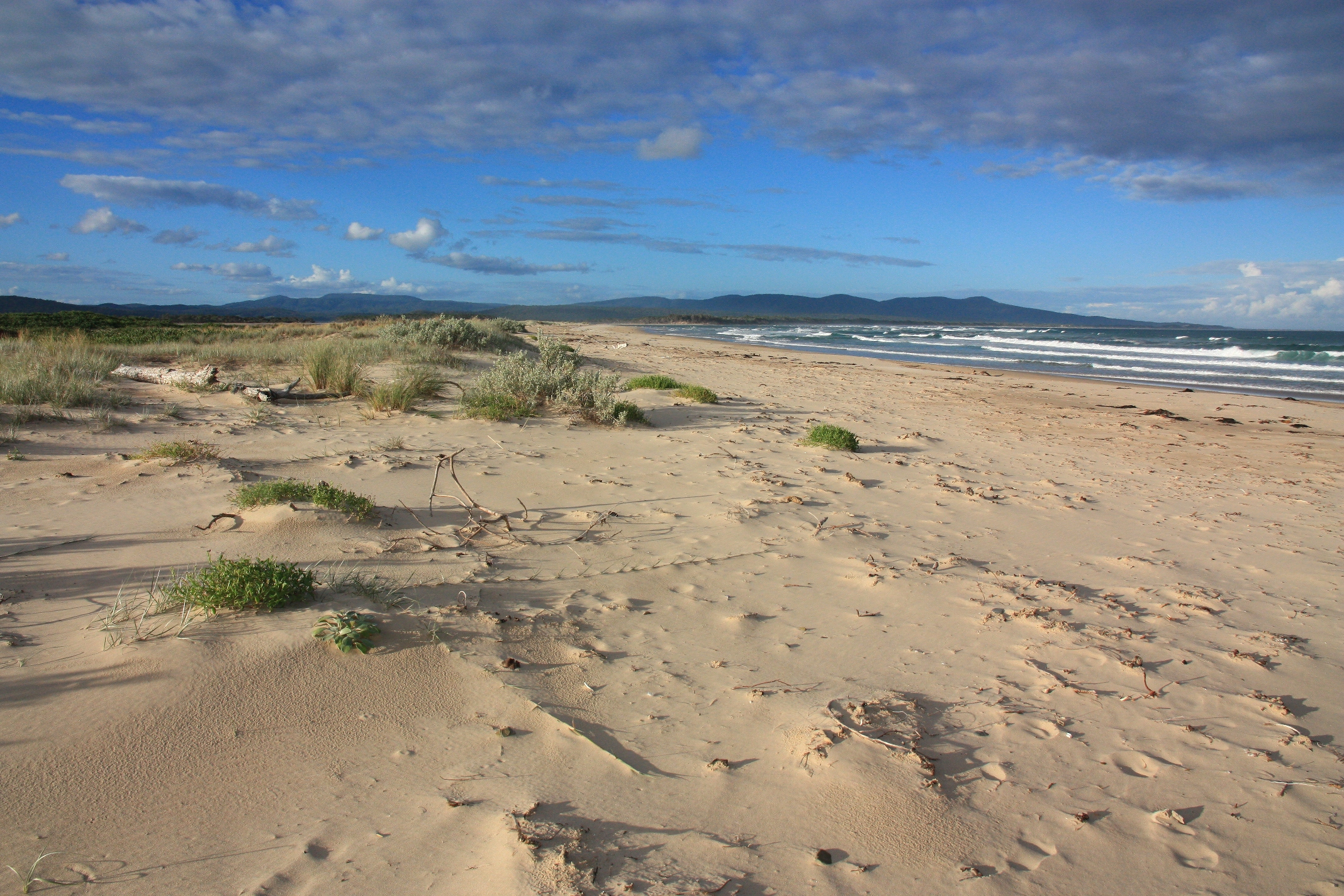
This sparse corner is both rugged and tame; the waves of the Southern Ocean and Tasman Sea conjoin and thrust onto sweeping sands while gargantuan dunes remould themselves on the breeze. Behind, protected and sheltered gleams the expansive surface of Mallacoota Inlet, spilling into creeks densely lined with Eucalypts and Tea Trees and Acacia; quietly lapping at the boardwalks and manicured front of the town. Pelicans and people flock to fish, the more intrepid cycle, run, and fly.

Out on a limb, Mallacoota really is a long way from anywhere, perhaps as wild as it gets along the most populous strip of this huge country. Possessing essentials like a pub, bakery, two small grocery stores, a bakery, hardware store, and – did I mention – bakery, it is self-sufficient, with a long day trip required for Big W and McDonalds and Flight Centre. There’s not a great deal to do, other than interact with the outdoors, to walk, run, cycle, surf, fish, or simply sit in the sun and gaze out across water. I suspect this is part of its appeal.

The constant roar of the ocean is often the only sound to shatter the peace; at least outside of peak summer holiday times when Sydney, Melbourne and Canberra converge along the shores up and down this coast. It’s a sound which may seem appealing, an obvious marker of being close to water, of arriving at the edge of the world. I think on top of this though, the ocean can sound threatening and cruel, daunting in its vastness and unrelenting, unrestrained energy. People may fantasise about going to sleep with the soothing, repetitive sound of the ocean in the background but the reality, particular when a layer of canvas is all that separates you and the outside world, is of an incessant crescendo of noise, amplified in the stillness of night.  

The noise echoes from the cliffs and trees fringing the ocean beach here, which is itself like a thousand other beaches in Australia. In that, it is nothing remarkable, even though it is, objectively, remarkable. Pristine sand and pristine waters, so clean the aroma is pungent with the abundant seaweed and crustaceans and fish. Scattered with the dog walker and fisherman and surfer and yoga practitioner, it is the spot to clear the head and mind, the place to come at the end of day to walk, fish, surf, or contort. It is the spot to feel at one with the world, humbled in insignificance as the sun lowers, the sands blow, and the waves churn out into the eternal horizon.
O_mallacoota

Beyond Mallacoota the southern coastline invariably throws up much more in the way of ocean-sculpted lands. Long beaches of ninety mile and entrances to lakes. Vast promontories and bays, becoming refined with sandcastles and beach huts and docklands and Melbourne. Westward still and curving great ocean roads meet shipwrecked coasts. Lagoons and islands of kangaroo turn upwards to Adelaide, and the waters greet peninsulas fringed with small ports and big jetties. Beyond things return to the empty simplicity of ocean and land, the land meeting ocean, a bight of irresistible force and unmovable object. Beautiful archipelagos emerge and vast sounds appear as civilisation returns, and the ocean weathers colour the corner of the southwest. A corner which turns onto another ocean and signifies the crossing of a continent.   

Some two months later and a lighthouse appears on the horizon, another lighthouse rising elegantly into a softly painted blue sky. Passing through Augusta the coastline takes on an edge-of-the-world charm, as the land narrows between two seas [3]Small bays and coves fringe the leeward side and teeter their way along to Cape Leeuwin, from where the lighthouse surveys the Indian Ocean. Next stop from here: South Africa.

In this prized corner of Western Australia the Indian Ocean is very much like the seas that have come before, knocking out a reassuring rhythm of surf and disappearing into a depth of endlessness. It’s a different ocean but the same country; many kilometres distant but not a million miles apart [4]. Windswept hills slope down and break off into the ocean, broad sands form at river mouths and creeks. Majestic forests revel in moist valleys while vines take advantage of open, sun-soaked slopes. Near this ocean, small settlements and towns still serve flat whites and offer The Australian for all the propaganda you can stomach. The same brands of coolant are available to top up a car which has done much since almost becoming bogged down in mud on the other side of the country, oceans apart.

There are of course subtle differences formed through climate and geology and mankind’s hand. A different array of deadly sharks and jellyfish may well linger in the water, ready to nibble on loonies in wetsuits embracing the epic waves. For the less adventurous, the diversity of the terroir yields different aromas in the Cabernet Sauvignon…perhaps less blackcurrant and pepper and more pomegranate and diesel (though don’t quote me on it). Tourist information signs are a different colour, though nonetheless as mysterious and confusing. And practically every town ends with the letters ‘up’, like Manjimup and Nannup and Whatsup Buttercup.

The big contrast – and a satisfying symbol embodying the accomplishment of crossing a continent – is that the sun sets into this ocean. At Yallingup, camped beside the roar of the sea for one last night, Mallacoota is reincarnate, a mirror image of sand, sea and sun. There is just chance, with the now shortened days of May, to amble on the beach as the day draws to a close; to battle through the sands and scarper from waves thrusting up the beach with great flourish; to join the smattering of dog walkers and fishermen and surfers and yoga practitioners, watching as the sun sets into this particular ocean and seals the wax on a momentous journey. A journey that has frequently mingled with the sea along its course, and astonished in scale as it has crossed from ocean to ocean.
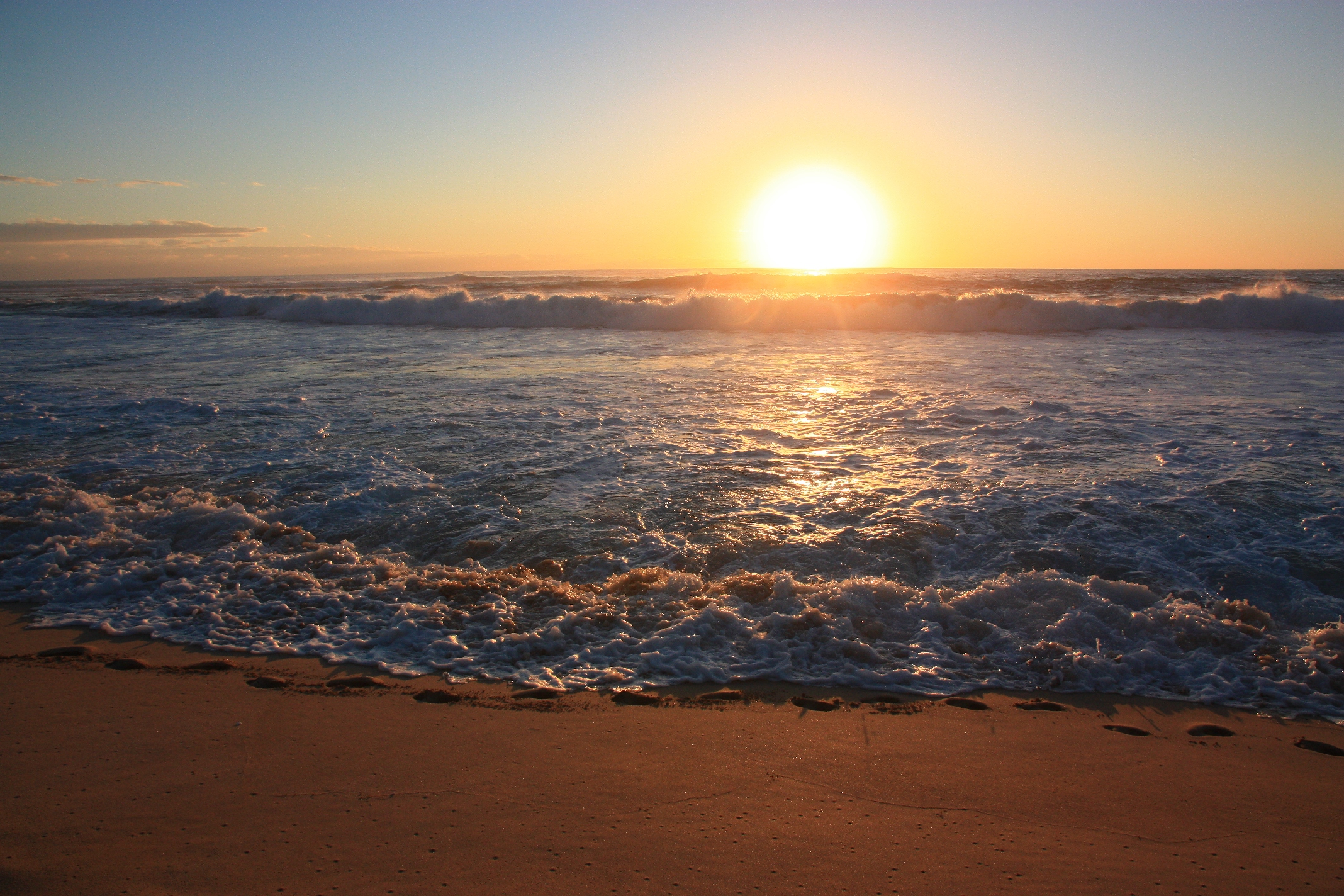
O_yallingup


[1] Which is now branded as ‘Britain’s Ocean City’ no less

[2] Is it any wonder the latest Australian Prime Minister is such a visually strident man of the seas, sometimes scarily so?

[3] A charm seemingly being addressed by the construction of a large marina for more boat-owner people…Stop the Boats!

[4] In fact, for me, 17,000 kilometres, but more like 3,500 as the seagull flies.

Links

Britain’s Ocean City: http://www.visitplymouth.co.uk/

Mallacoota visitor information: http://www.visitmallacoota.com.au/

Destination Margaret River:

http://www.westernaustralia.com/en/Destination/Margaret_River/9009633

Wasssssup in Yallingup: http://www.margaretriver.com/regions/1

Another ocean apart: http://www.youtube.com/watch?v=c_e2D2qsaso

A to Z Australia Driving Photography

Neil

Okay, this is not going to be the ultimate in self-absorbed egotism revealing the characteristics and complexities of just one soul among the seven billion on this planet. In fact, it’s not even going to be an analysis of the origins of the name Neil or its equivalents like Niall or Neenoo [1] or, as one Aunt persists in handwritten cards twice a year, Neal. Neither will I look at the many famous Neil’s of popular culture, like Mr Armstrong, Kinnock and the hippy from the Young Ones [2], or linger on the hilarious japes where people might just kneel down after you tell them your name. Instead, in this episode of Neil, I would like to consider the art of getting a picture of oneself, a tenuous link because I am called Neil and when I try to take a picture of myself I am taking a picture of Neil, geddit?

Of course, now I have come to realise that this action has come to be regarded as a ‘selfie’, which is likely to become a ‘selfs’ and then just a general mumble sounding something like ‘sufphs’ as the transformative degeneration of language continues. And I think, well why not, let the young people mess up our language; it’s only fair as we screw over the planet for them, in a period of inaction that will become known as ‘planballs abbottburger’ or something. As long as enough selfies capture the moment the rising sea submerges the Sydney Harbour Bridge everything will be OK.

Anyway, the pictures I want to write about are not really selfies in the take a snap of yourself with a shaving cut in the mirror or the pout from above with bum slightly sticking out sense [3]. They are the pictures you seek at landmarks, on holidays or in situ, usually to prove you are alive / around / doing something far more interesting than anyone else who happens to see it on Facebook. They are the pictures that break up the filmstrip capturing one hundred slightly alternate images of the Eiffel Tower, the poses scattered among five hundred mountain views of the north face of the Eiger. They are the profile pictures and the images that can go on a mother’s day card to say, “hey, look at me, here I am, you love me so much here is a picture of me!” In that respect, they are not much different from selfies.

Like most things in life, I’m generally ambivalent towards having pictures taken of my own image. I possess enough vanity to delete those in which my hair looks too grey, my teeth too crooked, and my breasts too flabby. This is a vetting process that becomes increasingly difficult as hair gets greyer, teeth rot and flab gathers. But still, a picture occasionally emerges in which I think I look quite alright…it may not make one of those stupid exclusive for hot people only dating sites, but it’ll pass and has a pretty background of hills or something. It’s wonderful what an amazingly beautiful backdrop can do to distract from an unflattering gut angle.

So, I don’t really go round seeking shots of myself all of the time. Mostly they are meeting a requirement of proving I am alive and well in a location taking lots of pictures of it. For some reason, the fact that you have one hundred and twenty six pictures of the Statue of Liberty is insufficient to prove you were there; only when you are in front of the camera, thrusting your torch arm in the air like a total pilchard, is the shoot complete and future memories can be safely set in archive.

Of course, a big part of the reason that only a very small proportion of the thousands of photos I have include Neil as a subject is that Neil is usually the artist (in an informal and non-commercial sense) and the scene is the subject. My photography is typically a subjective composition of an objective subject, with the objective being to subject the viewer to experience my subjective position from an objective standpoint. And how can you object to something as straightforward a subject as that? I like to capture the world around me from my perspective, and not so much the perspective of me around the world.

The other obvious limiting factor is that frequently I am taking pictures on my own and thus face the perennial challenge of achieving the successful selfie. A chunky DSLR is far less selfie friendly than a phone, a battle of physiology and technology and art. I find a chunky DSLR often leads to a chunky picture of me. Even a phone picture seems to bring out an extra chin, as if the strain of extending an arm and finding the button to press is all too much for the body and brain to deal with. The use of a timer can be an effective way round this, but this is subject to the hope that the camera will stay level on the rock you have balanced it on and then being able to safely scramble over a yawning gap and on to some crumbling rocks, flatten your hair, and smile in ten seconds. Plus my camera decides it will only allow a ten second time delay if you choose a burst of about 12 pictures, resulting in a comical set of identical but slightly different frames in which I get progressively bemused.

N_burst

There is an unspoken etiquette, typically in such populous spots as lookouts and famous landmarks, in which people will mutually take a photo for one another. Often being alone and with a chunky DSLR I frequently get earmarked for this high pressure task. This shot could make or break their visit; either they will look back at the time they were gorgeously posed over a breathtaking valley or recoil in the moment they looked a right munter with eyes closed around some dark grainy landscape that resembles an abandoned nuclear test site. I quite like the pressure, the chance to fiddle with someone else’s camera briefly, and be a part of their trip for a few seconds. And I don’t mind the reciprocal offers that come back, though invariably my unspoken reaction is of a picture produced that is at best ‘alright’.

Part of the reason that the picture is only ‘alright’ is how Neil ends up looking in it. Not so much in terms of hair greyness or breast flabbiness, but more in the composition and pose. I, of course, would have taken it very differently, and imagined that the big mountain would be to the left and I would feature in the bottom right corner; whereas the result is a close up of me in the middle with an overflowing bin expertly captured in the foreground.

As for the pose, well, this is the biggest dilemma. Open toothy smile, closed smirk, moody sulk? Face on, side on, backside on looking out, down, up, inside out? And what to do with those hands?  In pockets, on hips, defensive balls position as if awaiting a free kick, relaxed down the side, laid back on a wall, aloft in celebration, pointing in the middle distance? My two default poses are arms dangling down looking somewhat artificial and uncomfortable or, particularly in dramatic terrain, spread out wide and accompanied with an open-gaped mouth as if I am about to wail out a big ‘TA DA!’

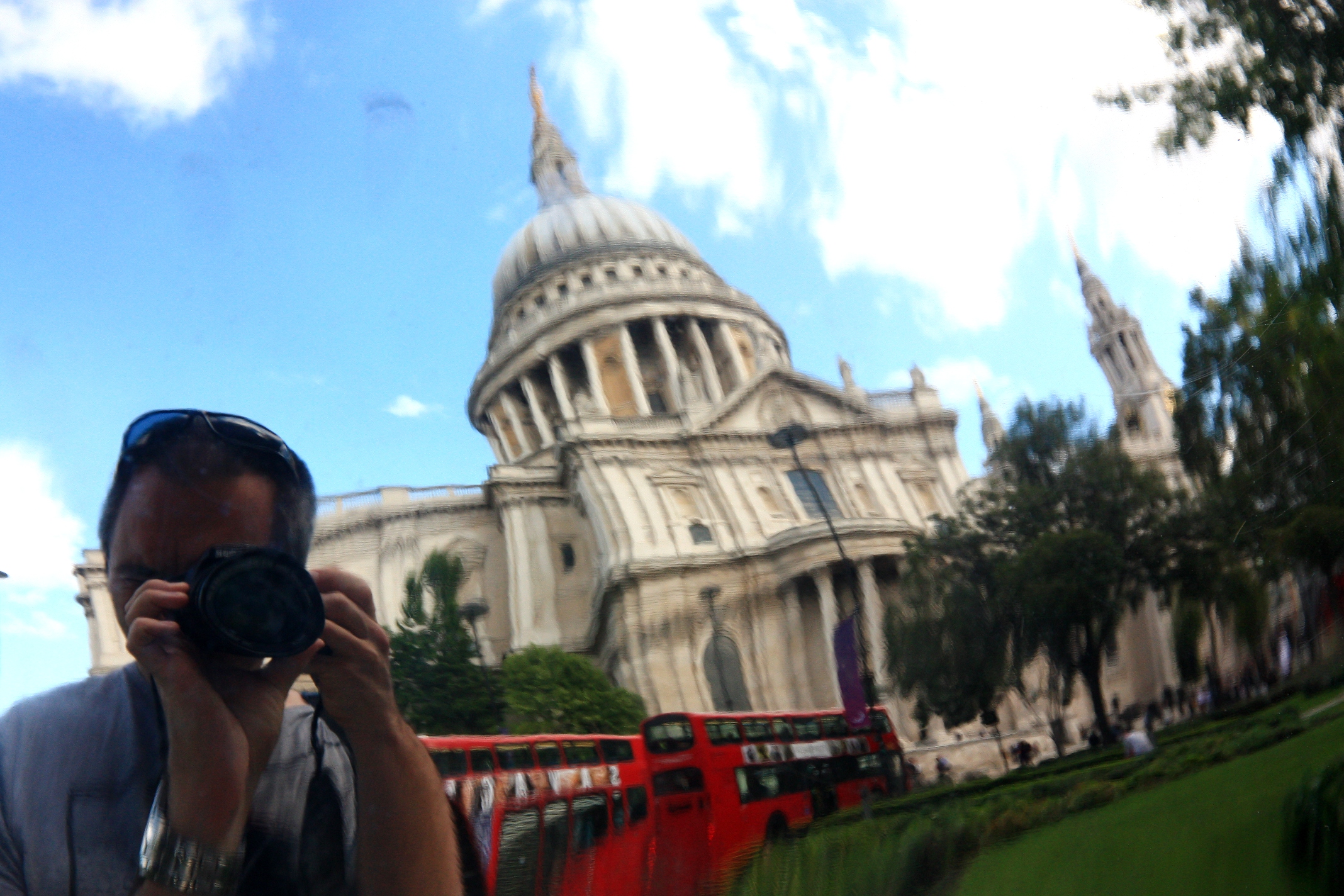
And so, by a process of elimination it turns out the best way to be able to monitor pose, determine composition and retain control over a picture of Neil is to make use of a mirror. Every accomplished selfie obsessed tweeter knows this. But unlike bathrooms and bedrooms, there is a relative dearth of mirrors at tourist sites and attractions around the world. Occasionally though it’s possible to find some random public artwork or street furniture in the right place at the right time. Like around St Paul’s Cathedral in London town, bedecked in a colourful fury of post-Olympian September sunshine. What more can you ask for than an iconic landmark soaring into blue skies as vivid red London buses swirl around its base intermingling with the green remains of summer. Suddenly the scattering of shiny balls lining the pavements nearby are less a random obstruction and more the ultimately funky selfie mirror. Real but distorted, much like London town itself.

N_selfie2

The issue remains that it’s practically impossible to take a reflected picture like this without the camera getting in the way. Heaven forbid the disaster should the flash also decide to burst forth. I’ve tried moving it from my face and to the side, with haphazard results and a much more convoluted pose. Shooting from the hip is an option, but this looks even more bizarre, bordering on the sickly perverse. In the end, I decided I quite liked a) my face hidden and b) the dominance of the camera itself. For this is how you would typically see me, around St Paul’s, slacking off on a sunny September day. This is me in the moment, doing what I love, doing what so many are doing around me. This is Neenoo, Neal, Neil.


[1] This one comes from the land of my niece

[2] Gosh, there really aren’t that many luminaries with my name hey?

[3] Both of which a former Prime Minister of Australia likely performed

Links

I’m Kevin and I’m here to help you shave: http://au.tv.yahoo.com/sunrise/soapbox/article/-/17945464/kevin-rudd-posts-shaving-selfie/

Planballs Abbottburger?: http://www.crikey.com.au/2013/09/03/direct-action-a-gross-waste-and-abbotts-right-to-cap-its-funding/

Propicfails: http://www.heavy.com/social/2013/03/the-20-worst-profile-picture-fails/

If you are really bovverred: http://snapguide.com/guides/take-good-selfies/

St Paul’s: http://www.stpauls.co.uk/

A to Z Europe Photography Society & Culture

Momentum

I do tend to like a song that builds; one that’s all tender and melancholy to begin, subtle layers of sound layered with every soft verse until they rise into a crashing crescendo of strings and vocals and guitars and tambourines and bassoons and triangles and maracas and backing singers, passing out in an epic conclusion. Well, I didn’t expect that, may be your reaction if you hadn’t listened to it a hundred times already. What could have been so dreary gradually gains pace and noise, rhythm and harmony, and comes with a climax that makes you feel good and want to cry out loud. Which you sometimes do when not in company or stopped at traffic lights.

There are many parallels to be had between music and travel. Both offer the chance of escape, an exposure to culture, and a form of enjoyment (or annoyance!). We often listen to music while we travel and we often travel while listening to music. Indeed, catch any bus or train today and see if you can spot anyone who is not attached to a small electronic device by some white wires sticking out of their ears or a pair of oversize earmuffs like they are some kind of Craig David wannabe. Craaaaaiiiiiiiig David. And like a good piece of music (i.e. not Craig David), can there be anything better than travel experiences that gather an unexpectedly irresistible momentum and culminate in an ecstatic high? Transformative moments which end with you pinching yourself to check that they really happened?

Well, picture the scene on the far south coast of New Zealand, in a picturesque swathe of countryside and coast making up The Catlins. Alas today, like many days no doubt, is grey and a constant chill wind blows off an iron sea. Mist and drizzle occasionally grips the rocky tumult of the seashore and hovers among dense, dark forests. It’s Waitangi Day, a national holiday, but there is little sign of people gathering in revelry, the area remote and sparsely inhabited. It feels as though banjo-plucking will be echoing through the rolling valleys as the van propels itself on the few remaining drops of petrol in its tank. But that would perhaps be a bit too chirpy a soundtrack for this uninspiring morning.

It’s been a few days like this now…swishing wipers down to Dunedin and braving gaps in weather to look at seals and seabirds, admiring their resolve to make a bombarded clump of grey rock their home. Home for me has mostly been the van and it smells damp. It’s also almost out of petrol now, but there is a town or two coming up. The first offers a small garage but a wonky handwritten sign tells me I would have better luck going to the next stop along. It’s only twenty kilometres, but lights, heating, radio and lead foot driving are all dispelled while the red warning light continues to taunt me. And these valiant attempts mean that the van makes it to a town with another closed petrol station.

This is the low, and there has got to be a way to climb out of it. At the other end of town from the petrol station that is also a visitor centre and shop and fishing bait store and whatever else not being offered for sale today, is a house that has a banner for ice cream beside the road. I’m not sure whether this is a shop or cafe or just someone’s shed with a few trinkets in. I didn’t see any ice cream, but then I wasn’t really looking. The owner – we shall call him Pat (because I don’t remember his name) – looks bemused when asked whether the petrol station is open. “Well, if it don’t look like it’s open I guess it’s not open”. For once, endearing Kiwi frankness not very endearing. “I’ll call Nigel”.

Whoever Nigel was he wasn’t so keen to speak to Pat, the phone line mysteriously cutting out on the first contact attempt. Things looked bleak, while my exterior has a forlorn look about it, inside I was quietly sobbing. This would not be a great place to stay for another night…and it was barely 10am. Behind his beard Pat could sense this, so he tried another call and this time successfully woke Nigel from his hungover slumber. Nigel, it turns out, could fill our car with petrol. Begrudgingly so and clearly needing another beer to kick start his day, but he gave up some liquid gold (at a commensurate price) nevertheless. Nigel and Pat, two unlikely saviours, a solid backing coming in to give thrust to this song of a day.

So it was that the van comfortably made its way to Invercargill where it could properly fill up its tank on petrol and cruise past the disproportionate amount of drive-through liquor stores which do a roaring trade [1]. M_catsInvercargill represented a line in the sand and from here the journey was west and north. Straight out of a Tolkien tale, the town of Riverton was a necessary pit stop that became late morning tea. If Pat and Nigel kick-started the van, this was the sugar comfort hit that kick-started the endorphins.

Somewhere between Riverton and Te Anau the sun emerged, weakly at first but increasing in frequency, offering a pleasant symphony of colour and warmth across the landscape. This was turning into a very different day, a day where you need to change into shorts at Te Anau itself, because it is warm and clear and sparkling. A day where you need to savour a ham sandwich beside the beautiful lake but avoid lingering too long because it can still get even better. From here, Fiordland National Park is waiting.

There is a dead end road from Te Anau, but it is no dead end of discarded breeze blocks and tumbleweed tottering in the wind. Its terminus is Milford Sound and the route to it must rank as one of the most awe-inspiring in the world. The scenery is so grand it will make Gandalf look small, as the road follows valley and plain, fringes a series of small lakes and eventually has to cut through the mountains to get down to the precipitous chasm of water that is Milford Sound.

It is a journey where you want to pull over at every available opportunity and take a dozen photos and pinch yourself again because it is so inexplicably sunny and warm and better than what could have been. Eglinton Valley is a perfect place to do this, with its broad plain of swaying gold grass tantalising you to loll around in it like you are five again. Or, as is often the case in such mountainous terrain, break out like Julie Andrews and proclaim the hills to be alive. But I can save that for a higher vantage, a reward for a walk and a lofty paradise in the late afternoon sun.

Can there be anything better to do than getting out in this environment on foot, leaving the van far behind and below. A walk. A hike. A tramp! Who would have thought it this morning? It’s a bit of a climb but sure and steady, inspiration added by being on a section of the Routeburn Track, one of New Zealand’s premier multi-day tramps. With forest at first there is little to see beyond the dark green boughs and flourishing fronds. It is cool and shady, serene and ancient. Occasional glimpses sight the road down in the valley or tops of mountains still a long way above. Then, all of a sudden, the vegetation clears and you are reaching the crescendo.

A few more steep zigzags and you emerge onto a rolling plateau – Key Summit [2] – where the hills do seem to be alive with the sound of music. Small tarns pepper the bright green grass and forests continue to spread over and along the hillsides. The late afternoon sun, still warm and pristine, highlights the pleasingly rocky Humboldt Range as it disappears north and east. The bright light battles with towering peaks that plummet to the west, down into the waters of the fiords and Tasman Sea. Far below, the van sits with half a tank of petrol, happy to rest and sit vacant and linger in memories of Nigel.

M_keysummit

It’s an immense ending to an indifferent start, a reminder that things change for the better all of the time. You may have gotten out of bed the wrong side or endured a period of drab drizzle, but the sun does always shine again.[3] And shine again it did for many more days on that trip of New Zealand – on Milford Sound the next day and into the mountains after, glistening off the amazing bays of Abel Tasman and striking dramatic light on the volcanic doom of the north island. Indeed, such is its remarkableness it doesn’t take much to gain momentum in New Zealand. Just a little bit of petrol and some good tunes along the way.


[1] They do call this region ‘The Scotland of the South’ after all.

[2] I don’t think named after New Zealand’s current Prime Minister

[3] At least for something crazy like 500 billion years or whatever Brian Cox said in some documentary, by which time we would have easily destroyed everything anyway

Links

The kitty kat Catlins: http://www.catlins.org.nz/

Amazing Fiordland: http://www.doc.govt.nz/parks-and-recreation/national-parks/fiordland/

Dirty tramp: http://www.doc.govt.nz/parks-and-recreation/tracks-and-walks/fiordland/northern-fiordland/routeburn-track/

Route to Routeburn: http://neiliogb.blogspot.it/2013/02/finding-me-marbles-christchurch-to.html

A to Z Driving Walking

Southwest bits blitz (1)

It may be a product of sustained transience but the chance to drop anchor for an undefined period in a familiar place has been of great appeal. And so here I still am – Plymouth, Devon – and only twice so far have I pined for the other side of the world. Once I was in Starbucks and had a drink that had the front to be called coffee. The other time, some dreadful nincompoop and his bumbling mates were taking over Australia, and while I was not missing the crowing and hollering, my inner nerd was bereaved of two party preferred counts, the swings, the coloured maps and the abject head-shaking of democracy where a mandate is claimed when less than half of the population vote for you and, even those who do, probably do not agree with 100% of your policies.

Still, I do intend to return to the country despite a change in the people who nominally run it but don’t really do much at all. You see, at some point here the weather will get continually miserable and the people will get more miserable and I will get miserable with the miserable weather and the miserable people. And then I can return to the land down under which is so fortunate it forgets how fortunate it is. But the people there won’t be miserable because they got what they wanted.

sw02Plymouth can be incredibly miserable but at the moment there is a prolonged ray of sunshine that transforms even the dodgy concrete alleys filled with rubbish bags into an artistic postmodern composition of urban life. The crazy drunks walking the streets become salt of the earth characters and chavved up pram pushers on the bus make for a colourful melee of handbags and hairdos. I’ve heard it said that Australia is just like Britain would be with good weather; not exactly, but the weather can do wonders for a place.

The familiar abounds but every time I return there are incremental changes to the city. Royal William Yard is an obvious one and I have been impressed by the conversion from disused naval quarters to swanky flats and waterside cafes. Devil’s Point provides the picturesque walk to burn off jam and cream filled shortbread from the bakery, and something approaching an alright cappuccino is available on occasion.  On my first visit, in warm Sunday sunshine, I had the momentary feeling that I was back in Australia such was the sparkle, the relaxed buzz, and general air of wellbeing. I even had a flat white, but this was very English.

sw01

sw05Part of the familiarity re-familiarisation process is engaging in the foodstuffs of this part of the world. The issue is, the longer I linger, the less I can justify filling my face. On day 1, cream tea on Dartmoor was ticked off and clotted cream has re-appeared on a number of other opportunities (like when I made treacle tart, yum yum!). But I have also been back to Dartmoor and not eaten cream – something that sounds like progress. Meanwhile Dartmoor continues to captivate through its moods and sweeping vistas.

sw04

sw03The Cornish pasties have bubbled to the surface like oozing hot steak juice through a pastry crust, though only infrequently. Almost every single one I have is a disappointment unless it is from Pengenna Pasties. On which note, I am pleased to have paid a visit to Bude where the queues out of the door and mass munching in the town square are a sure sign of Pengennirvana. This was the undoubted highlight of a bank holiday Monday, which was a reminder of what a bank holiday Monday is all about. Traffic queues, parking hassles, gritty sand packed with feral children and people from Wolverhampton going red in the twenty degree heat. I didn’t really enjoy Bude apart from that pasty.

By contrast another day trip in Cornwall ranks as one of the best I have had this year; a year which, I remind you, has encompassed a tour of New Zealand and a scenic meandering across Australia. A piddly train to Penzance doesn’t rank up there with the journeys but then an open top double-decker through the narrow lanes and warm sunshine of West Penwith brought a sense of adventure to the trip. And this delivered me to Porthcurno and a scene to celebrate, a landscape bejewelled in sand and seas bedecked in a stunning clarity and rare calm.

sw06

sw07This is the pointy end of Cornwall, the pointy end of Britain, and if anyone thinks Britain is a drab, miserable place, well…stick ‘em with the pointy end. This is country best explored on foot, on that magnificent coastal path, a path I followed for seven miles or so around Land’s End and on to Sennen Cove. It is stunning country and every minute was marvellous. Of course, you have to put a little asterisk here and acknowledge that the sun shining makes a world of difference. But even on dank, foggy days or, better still, stormy windswept occasions, it is a natural wonder.

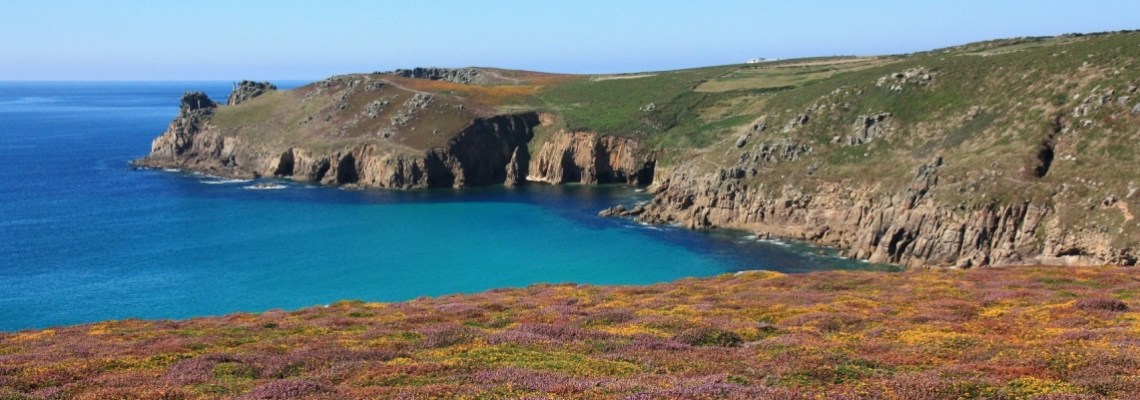
sw08The coast path along here turned out to be pretty good walking too, only dipping down to a cove and climbing arduously up again about four times, which isn’t that bad for Cornwall. A lot of the time you can just follow the cliff line, strolling upon high overlooking clusters of volcanic rock tumbling into clear blue seas, where the occasional trio of seals bob along and seabirds glide on warm air.  Around, the exposed heath is a colour of gorse and heather, a purple and gold that could quite justifiably replace the black and white of the Cornish flag.

sw09

sw11A blip of sorts pops up at Land’s End. While the coastline is appropriately craggy and exposed, the necessary touristification due to popularity takes away a bit from the surrounds. So there are eroded paths down to see grumpy farmyard animals, shops selling fudge made in Wales and tea towels made in China, arcade machines to play and One Direction posters for sale. There are doughnuts and beer and ice cream to buy. Stop. Ice cream. I’ve been walking five and a half miles. Ice cream. It’s mid afternoon. Ice cream. I deserve ice cream.

sw10

Expecting lame, rip-off ice cream I remember it quite fondly as not being particularly lame or too much of a rip off. A popular Cornish brand it had enough creaminess to see me over the last substantial hummock of the path before dropping down to Sennen Cove. I remember coming here about ten years ago, on a mild but foggy old day, the cove sheltering a fine sweep of sand intermingled with cottages and boats. It was deathly quiet then, a sure contrast to today.

Today Sennen was St. Tropez, but thankfully the beach stretches beyond the comfortable confines of the car park. Once over towels and tents and through ball games, the beach widens and empties. The sand is genuinely sandy and the water a clear shade of blue. Surfers attempt to do something in the lumps and bumps of wave that exist on this breathless day while lifesavers watch on. Yes, it is, almost, Australian.

sw12

It’s kind of funny how I look out for a touch of the Australian in Britain and when in Australia the opposite happens. I presume it’s the whole have your cake and eat it syndrome. When both do come together – like in the creamy green hills around Kangaroo Valley or the sunny, civilised sands of Cornwall – it’s something of a marvel. And while misery quotients and government philosophies reach common ground there is little to distinguish one over the other. For now.

Great Britain Green Bogey Photography Walking

Wales tales

Church Stretton. So says a sign on a railway platform midway between somewhere in the Midlands and somewhere in Wales. It has very little relevance to my whole trip apart from the fact that this railway line I have never before taken has stopped briefly in a town that looks so cosily cosseted in the Shropshire Hills that I want to remember it. And perhaps come back and stop and walk atop its hills and meander back through its vales to refresh with a pint of cider in a beer garden of an old stone pub with whitewashed walls and hanging baskets and the noise of contented sheep bleating nearby.

Cwmbran is the station sign at which I disembark, situated in the South Wales valleys and a landscape not without its own hilly charm and abundance of bleating sheep. It can also lay claim to having a supermarket on every roundabout, one of which – Morrisons – is swiftly visited for a few day’s provisions vital for picnic lunches and delicious home-cooked dinners. With me, Dad and Aunty Val, taxi driver and cook, pivotal cogs as ever in creating a fine few days.

Where there are valleys there are hills and it didn’t take long to get amongst them. A drive through a warren of lanes led Dad and I to a spot below a big hill with a Welsh name. This is where I refer to Dad’s Facebook pictures and check what on earth it was called. Twm Balwm, which means top of hill to catapult sheep at English. A short but steep walk confirmed its prominent position for attacking folk, with hazy views over the South Wales coastline, across the Bristol Channel to Somerset and Devon, and north and east back in the direction from which I had come.

Amongst this landscape much water runs and – in places – runs to dramatic effect. The next day, in a corner of the fabulous Brecon Beacons National Park, we followed the course of the Afon Mellte as it made its way from underground to plunge over several rock ledges, each as unpronounceable as the next. Anything billed as the Four Waterfalls Walk is bound to be of appeal, and the falls of (wait for it…) Sgwd Clun-gwyn, Sgwd Isaf Clun-gwyn, Sgwd y Pannwr, and Sgwd yr Eira provided a showcase of white water spectacle.

wal02

wal01From our approach at Glyn Porth the cascades increased in drama, culminating in Sgwd yr Eira, a curtain of water that has carved an overhang through which walkers can walk behind water. Sure Jesus, it’s not quite walking on water but it’s the next best thing. The sound of roaring water over your head, spray peppering clothes and camera lenses, slightly dubious slippy-looking rocks, and small dogs reluctantly getting in the way all add that exciting touch of adventure. And hopefully this adrenaline can just about get you back up the hill for a tasty sandwich and the onward march back to the car.

Considerably less exciting is a stop in a fishing shop in Pontypridd, but it wasn’t too long and Dad got a few birthday goodies so all was still well with the world! Nearby though there was more drama of the Winterfell kind, courtesy of a couple of hours in Caerphilly and its castle. This had everything a good castle should with moats and ramparts and crenulations and spiral staircases up lofty towers and banquet halls and dungeons and catapults. Parts had been restored and renovated, others remained ramshackle, which meant you could really get a sense of what it was like back when Welsh people were catapulting sheep at the English and devious plots of intermarriage and murder were being concocted over a feast of wild boar and spicy cheese on toast.

wal03

No such scheming over dinner, though the roast pork was a welcome substitute for wild boar. Extra potatoes could be justified by the walking earlier in the day, but I think so much was eaten that another walk was to be encouraged the following day. Especially after a tasty slice of cake and a passable coffee in Abergavenny in the morning, prior to a different kind of sugar high.

wal04A walk up to the Sugar Loaf involved some notable uphill drags, cutting across unruly bracken and withering woods, and striking out for the top. Up here, the slight sunniness of the valley in which we started was no more, with a windy, cool bleakness emerging with every step. The clouds were scraping the tops of the Brecon Beacons to the north, and only occasional hollows of pasture glowed with the rays of the sun. But this is high summer, and several other people were still in shorts atop the loaf.

wal05

wal06Of course, the views were far-reaching and rewarding, but it was quite nice to have gravity on your side for a while as others battled up. Down steeply at first but then a gentle descent along a ridge and through an ancient wood, emerging out into some kind of civilisation with farmhouses and tractors and manure. Unfortunately on this circular walk the car was still a fair way around the corner and it suffered (as did we) from that final, unrelenting drag.

Still, it was something of an accomplishment with which to finish this short sojourn in South Wales. Well, not quite finish, for there was a rather large trifle to try and finish back at Aunty Val’s that evening. Already it seemed that much had been achieved off my bucket list – roast, trifle, upland walking, history, trips to Morrisons – in just a couple of days. Indeed, Wales offered a well concocted taste and teaser for the crème de la crème, the emergence into a blue sky Devon. I’m sure the main will be just as good as the starter.

Great Britain Green Bogey Photography Walking

The child leg

Being of a certain age when one should probably have settled down and produced a couple of little people, there is an inevitability that my travelling visits of Europe will involve stops to see people of a similar age who have settled down and produced some little people. This is not a bad thing, perhaps with the exception of an oversaturation of Peppa Pig and the lingering of theme tunes in my head. It offers time to be welcomed into family life and reconnect with close and dear friends and family, succumb to Lego construction and bombardment from cushions. There’s opportunity to immerse yourself in those very events which provoke memories of your own childhood, like travel sickness, 5 o’clock tea times, and an insatiable demand for chocolate. And children are infinitely entertaining, affectionate, cunning, sweet, annoying, lovable, lively, dramatic, naive, and everything else in between.

bab01And so it was I arrived in Geneva and connected on a bus across the border to France to greet the newest addition to this extended family. Joy Caitlin Stafford, a niece of two months and very much living up to her name thus far. A contrast to her frenetic older brother whose dynamism and energy results in a big bundle of fun with an adorable French accent. And then of course there is my third child, named fromage.

bab03

bab02Days out are obviously a big part of being a family and you only have to think back to your own childhood to remember summer days by the seaside in the drizzle, car journeys that seem to go on forever and trips to the garden centre. While Joy is just a little young to go too far, the boys were able to escape for a couple of trips into the French Alps over the weekend, with perfect weather for perfect scenes. The first spot was in the Vallee Verte, undeniably green and lush with wild raspberries ripe for plunder. Gliders taking off from a stretch of flatter grass added a touch of drama to the day and of course much in the way of child-like excitement. Excitement which quickly dwindles on the curvy drive down the hillside, inducing nausea and stony pale-faced silence.

bab05Such drama was avoided on the second day thanks to tactical sleeping, after a decent loop walk around the ridges and hollows of the Plaine Joux. A picnic at the start was reassuringly accompanied by cow bells and glimpses of Mont Blanc’s uppermost snowy triangle. It was a beautiful day, warm and blue, with just a touch of breeze limiting the kite-flying escapism. Perfect to sit outside and eat…which means it is so busy that you have to sit inside and eat when you want to enjoy Tarte aux Myrtilles post-lunch. Still, there was enough time to stand and walk and hopefully burn off some of the calories around the Plaine Joux.

bab04

Leaving France and leaving Geneva I had a fair few hours child-free before reaching north London. Here, again, visits to friends and their offspring were on the cards, leading to trips to the park for picnic and play. Another day heralded a chance to be a little less childish with a trip into London town, looking at pictures, going to the beach, and eating ice cream. While the ice cream was delicious, the beach – Camden Beach – was everything you would expect a beach in Camden to be. Sand plonked into a large beer garden, people on deckchairs and, of course, children playing ball, rolling around and generally getting bored while the parents chug on another fluorescent cocktail under murky skies.

bab06

bab07Cocktails emerged briefly during the final visit on the child leg of this journey, spending time with a family I love very much in Lytham, northwest England. The parents, who joined me in this child-free cocktail moment on a Saturday night, offered great comfort that comes with familiarity. The children, who are full of character and life, offered a pile of cushions on my head, trips to the park, drawing activities, all mixed up with those occasional doses of unprovoked affection that are so heart-warming.

Lytham always can be relied upon for providing a bleak, wet and windy day that reaffirms the truth of it being grim up north. Seventeen degrees cannot dissuade hundreds of people from dressing up as soldiers and dancing to Vera Lynn as they seek to resurrect the war in 1940s day on Lytham Green. Do you think Hitler would have stopped for a bit of rain and a chill wind? I don’t know, why don’t you go ask him, he’s over there…?

bab08Agreeably though the next day was brighter and sunnier and much less 1940s. In fact it was fine enough for a barbecue, indeed an Australian-fashioned gas burner barbecue. I don’t know if I approve for there is something to be said for the smoky aromas of charcoal, especially when plumes of it fill your lungs. Still, I shouldn’t have worried, for the gas barbecue got very smoky and, in a ball of flame, endeavoured to blacken burgers and shrivel sausages with a marinade of burning plastic.

Pleasingly the kids were distracted, running around in the garden generally beating each other up and laughing at the same time, in that way that kids do. The barbecue was rectified and there was a full stomach on which to watch a very strange movie about bird-watching in the evening! Thus it was with a bit of sadness that I set out from Lytham the next day, in pursuit of that Snowy Owl without hindrance. The child leg at an end, and at least a few days before I am exposed to Peppa Pig again.

Europe Great Britain Green Bogey

Hallo Italy!

Five hours on a train over the Bavarian Alps, across a thin but very precipitous sliver of Austria, and through the valleys and steep terraces of craggy northern Italy brought me to Bolzano. Or Bozen. Provincial capital of the Alto Adige. Or Sudtirol. You see, borders on a map may be crossed but language is shaped by the contours of the Alps – whether you are in them or out of them, what particular valley you may be in, or which side of the lake you butter your brezel in.

So just because we are in Italy does not mean that German is gone, nein nein nein. Which makes it a bit scheiser for the English-speaking, who are relegated to third in the language stakes and, if my experience is anything to go by, frequently caught out using a mix of all three. Par example (and yes, occasionally I also fall into French as default when any foreign language is involved): “Hallo, una gelato with two scoops, straciatella und caffe latte per favore. Danke.” Surprisingly though everything is understood and luscious ice cream is forthcoming.

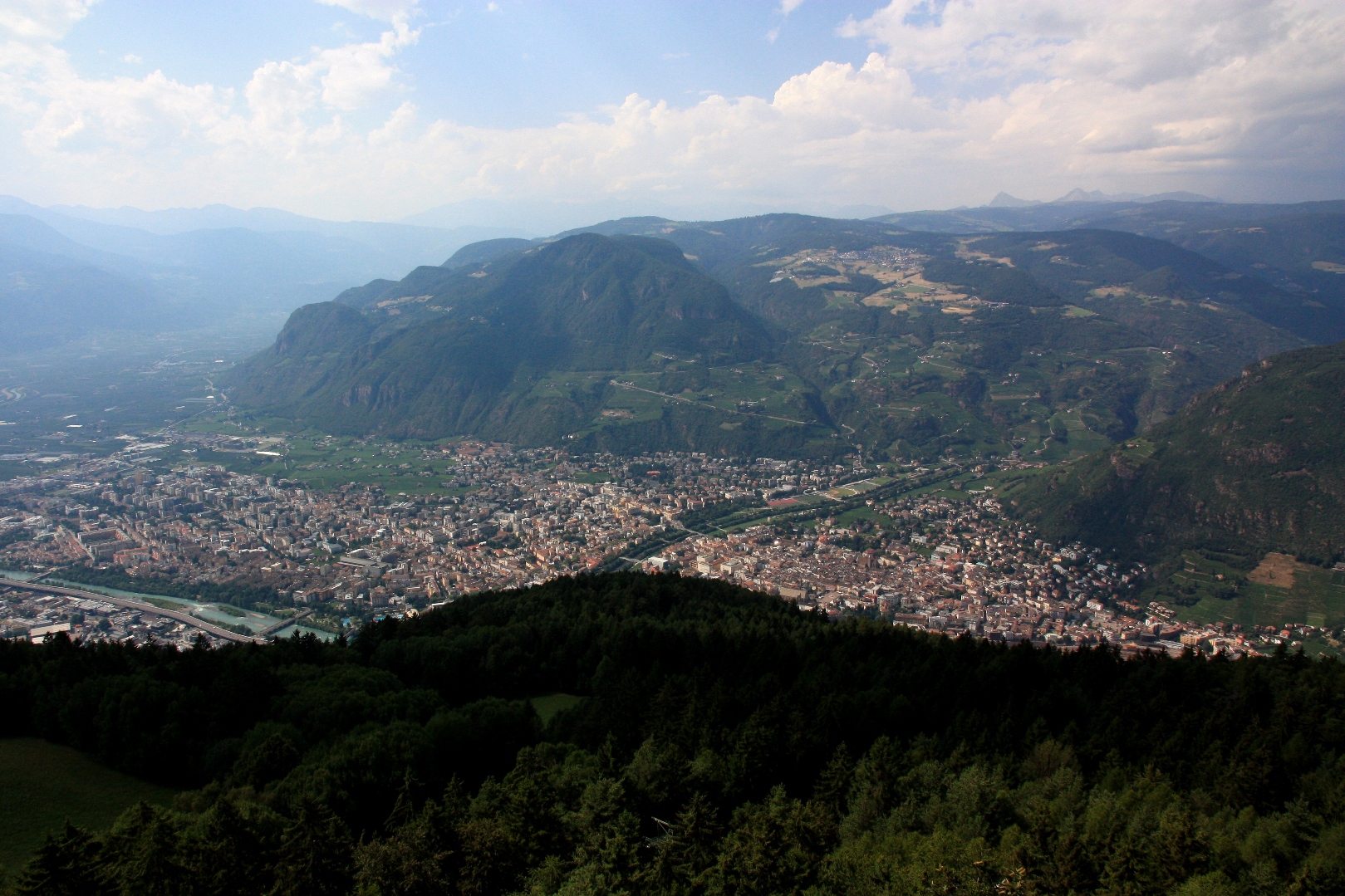
dol02As a result I’m not so sure whether you are going to read German or Italian place names in this blog entry. I’m tempted to try and use Italian because they are in Italy, but I am rather fond of Bozen which sounds so pleasingly like a cross between bozo and bogan. Does the name do it justice? Well, I would have said yes at first, as I trudged in searing heat through industrial areas by the river, seeking a funicular to whizz me into the hills, with busy highways and power lines and train tracks crammed into the valley. But I missed the centre at first, an old town with gracious buildings and narrow pedestrian streets, made narrower by market stalls and glass displays for expensive shoes and handbags. Veering toward the Italian, which is naturally less bogan.

dol01

Bozen has three mountain cable car and railway combos whizzing you up into the countryside, and the first I took after that uninspiring walk was up to Colle. The top was still in the tree line but (take note other self-proclaimed lookouts of this world) some smart Alec had built a large wooden tower for viewing pleasure, providing you enjoy steps. From here there were views over Bozen and other foothills leading to the more jagged teeth of the Dolomites. And at the bottom a sunny bar for a beer which was disappointingly less German than much else.

dol03

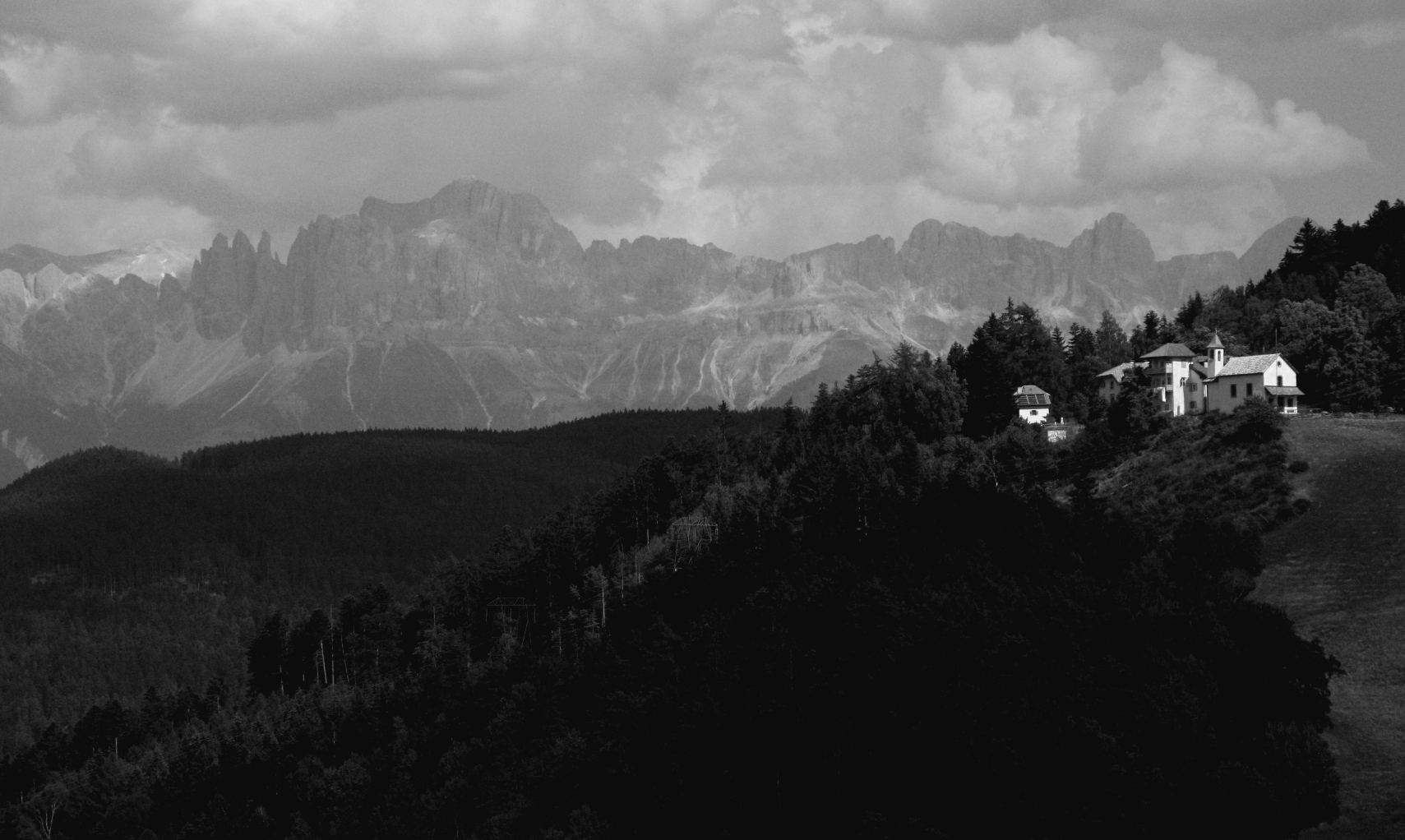
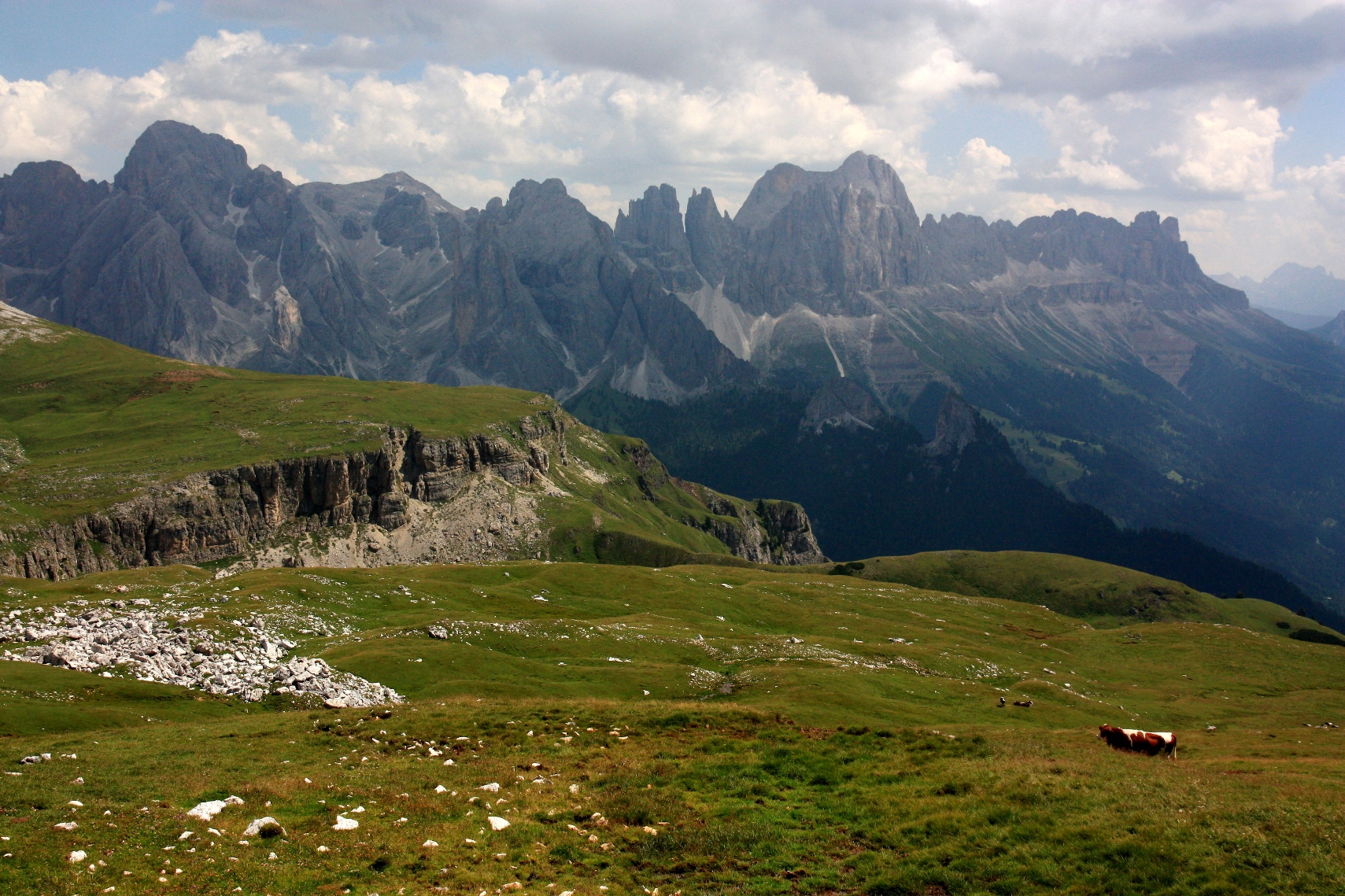
The Dolomites were my raison d’être for stopping here really, as I had been interested in visiting for a while…I think spurred on by some pictures in a travel supplement or maybe some footage of crazy climbs in the Giro d’Italia. Bozen was a good base, with its cable cars and other transport links, but the Dolomites were a little infuriating to photograph: wrong light so very glary for most of the day, then thundery clouds bubbling up in the afternoon and difficulty lingering in spots very early or very late because of transportation options. It really needs a week to get close and intimate, preferably in June. It is no wonder that the area is a popular spot for multi-day walks, hiking from refuge to pension along the ridges and plains, getting personal with the mountains.

dol04Still, I had two full days and was very keen to make the most of them and the travel card I had bought. The first day I took another cable car from Bozen, impressively up and up over vineyard terraces and pine forests to the undulating plateau of the Renon. At the top a mountain tramway trundled through the undulating hills, past villages and chalets and through forests and fields. Plenty of walking tracks offered chance to meander and get slightly lost but find your way to another path providing balcony views of the glary Dolomites. With wild meadows and the scent of pine needles, it was nothing other than pretty and nourished enough appetite for lunch in a sunny garden sampling local cheese and bacon dumplings with salad.

It’s incredible to think of these Alpine environments being caked in metres of snow and freezing through several months of the year, and thus surprising how full of life they are. I guess it’s a shorter growing season and everything bursts forth rapidly and in generosity, a perfect manifestation of making hay while the sun shines. The steep hills of the region are decked out in rows and rows of vines, occasionally interspersed with orchards. Many look too steep to harvest by machine and I’m not quite sure how people actually make it to some of the farmsteads perched on their lofty terraces. It seems the cable car is the easiest way to view this hidden world, as I head back down into Bozen.

dol05

After a refresh of ice cream and purchasing some dinner time picnic snacks, a bus took me to somewhere in the general vicinity of the Jenesian cable car. Compared to the Renon, which was spacious and flash, this one was pure old school. Which means, by late afternoon, it is a searing glass house on a wire. It has a driver, who speaks to the top on his retro phone with a pleasing old-fashioned ringing bell, and seems happy to squash us in to see if we can all make it without passing out. The relief at the top is palpable, with shade and a beer garden obviously cashing in. In the distance the Dolomites still glare and clouds bubble up high, testament to the heat and humidity of August in Italy.

I was, as I say, keen to make the most of my travel card and, given it runs into the evening, I spent the last section of the day by taking the Renon cable car once more. This was a chance to try and get some good light for pictures and, well, stop on a bench in a forest and eat my bread rolls, cheese and salami sausages. I didn’t stay right until daylight faded, as it had been a long day and I wanted to catch the last bus to my pension, rather than walk up hill for twenty minutes. I had to conserve some energy for tomorrow.

dol06

So the second day was an opportunity to get closer to the toothy peaks of the Dolomites and indulge in some wilder, Alpine walking around the Alpe di Suisi. This, apparently, is the largest upland plateau of its type in Europe, whatever that means. I presume it means the biggest expanse of undulating meadows peppered with farmhouse chalets and wooded valleys, a sea of green lapping up to the sheer cliffs of encircling mountains.  It looks and feels obviously Alpine with the characteristic and pleasing sound of cowbells a sure sign to the ears that this is genuine high country.

dol08

My travel card allowed me to take the sad bus to the town of Suisi. I say sad bus, but it was quite a happy, breezy ride up from the valley, SAD being the name of the local transportation system. This climbed about 600 metres or so from Bozen. From Suisi, a cable car ascended a further 500 metres to Compaccio, and then it was onto a good old fashioned and open to the breeze chairlift propelling me another 400 metres up. What follows from here is an easy, good-natured ramble through the meadows and down past a flower filled hostelry and rustic farmhouses to a wooded valley. Down? Down? Prices may be down, but I want to go up. Up to the Rifugio di Bolzani sitting at around 2,500 metres. Am I lost, or will I need to climb more than I hoped?
dol07The answer was the latter and I have to say it was a bit of a struggle. Once or twice I thought about turning back, the views still wide and grand. Every step up and the view opened up further, but so did the frequency of stopping, ideally in a spot of shade from the sweltering sun. A salami sausage and snatch of pretzel gave fortitude and spurred on by the reward of eating more at the top, I made it.

dol10It’s a bit strange to come up this far and find a fully functioning guest house and restaurant, looking out on the sawtooth ridges of the Dolomites. Washing hangs drying in the breeze and people are decked out with picnics at the outdoor tables. Inside, a team of young people busy themselves cooking and serving food. Curious as to how all this happens, I note a rather archaic looking single wire cable way that must bring up wheels of cheese and kegs of beer. Alas, it does not transport people back down.

dol09

dol11That, for me, requires a weary descent of almost 1,500 metres as I plan to go back to Suisi to catch the sad bus. And so it’s down the entire climb that I made, happy that gravity is on my side but my feet and ankles and legs less content with the constant jarring and braking. Some respite takes place as I turn onto a path through a cool pine forest, but this at some point has to hit the river below and, when it does, it veers down in a torment of curving hairpins. The river and forest and beautiful, but after six hours or so, Suisi cannot come soon enough.

Perhaps with a week, at a cooler time of year, I could have taken things more leisurely. There are certainly many other places the SAD network can take you – on other cable cars and post buses into Switzerland for instance. There are great rides for bikes and cultural things to do too. Now being so distant in Australia I wonder why on earth I did not go away every other weekend when I lived in London. A Ryanair flight at 2am to an airport 3 hours out or Barcelona. Or the Wizz Air jet to Krakow. Or even a week in the Dolomites. Now, with time precious, I am falling into that Australian trap of trying to cover off Europe in a few days!

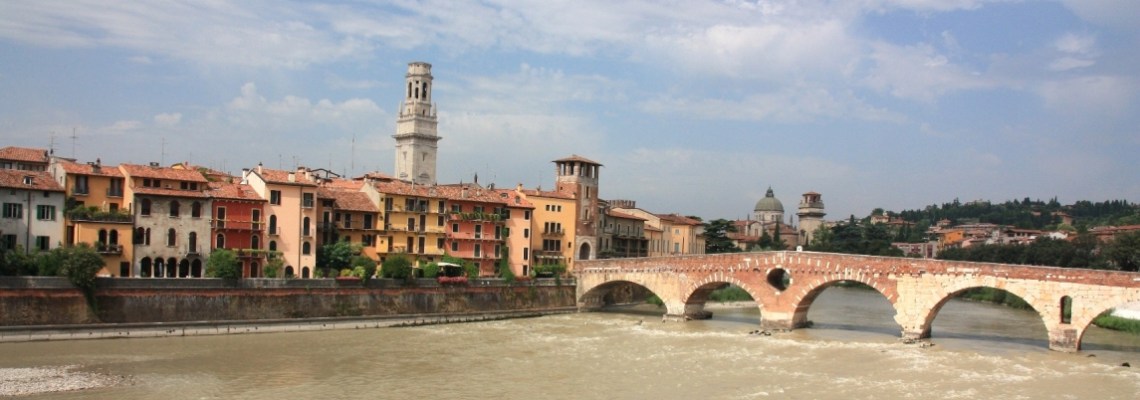
dol12Still, it’s amazing that you can be out of the Dolomites and into another region within a couple of hours. En route to Milan, I stopped off in the city of Verona for six hours. Five Euros seventy for left luggage the price to pay to see another Italian city. Proper Italian, with weisbier and streusels far behind and nothing but average pizza and pasta in every piazza.

dol13

I spent most of the morning meandering the streets of Verona, centred around Piazza Baz and its arena. The arena is a bit like a poor man’s version of the Colosseum in Rome (I imagine), and far more modern. I suspect it will look quite a sight in the splendour of an evening performance of – inevitably – Romeo and Juliet, but in the day, with set construction and cranes and limited access, I found 6 Euros entry a bit of a rip-off. Nearby gelato was also expensive, but the raspberry flavour was worth every cent.

dol14Verona is definitely a city for taking turns down random alley ways and stumbling across hidden piazzas and generally making it up as you go along. You will come across tourist trappings, such as the balcony where Juliet (who is, remember, a fictional character) was wooed by a horny young Montague. A nearby archway is bedecked in messages of love; inexplicably many of which are for One Direction. Such romantic prose as ‘Take me in any direction Harry’ or ‘I give you one erection One Direction’. How about you take long walk in one direction off very short pier?

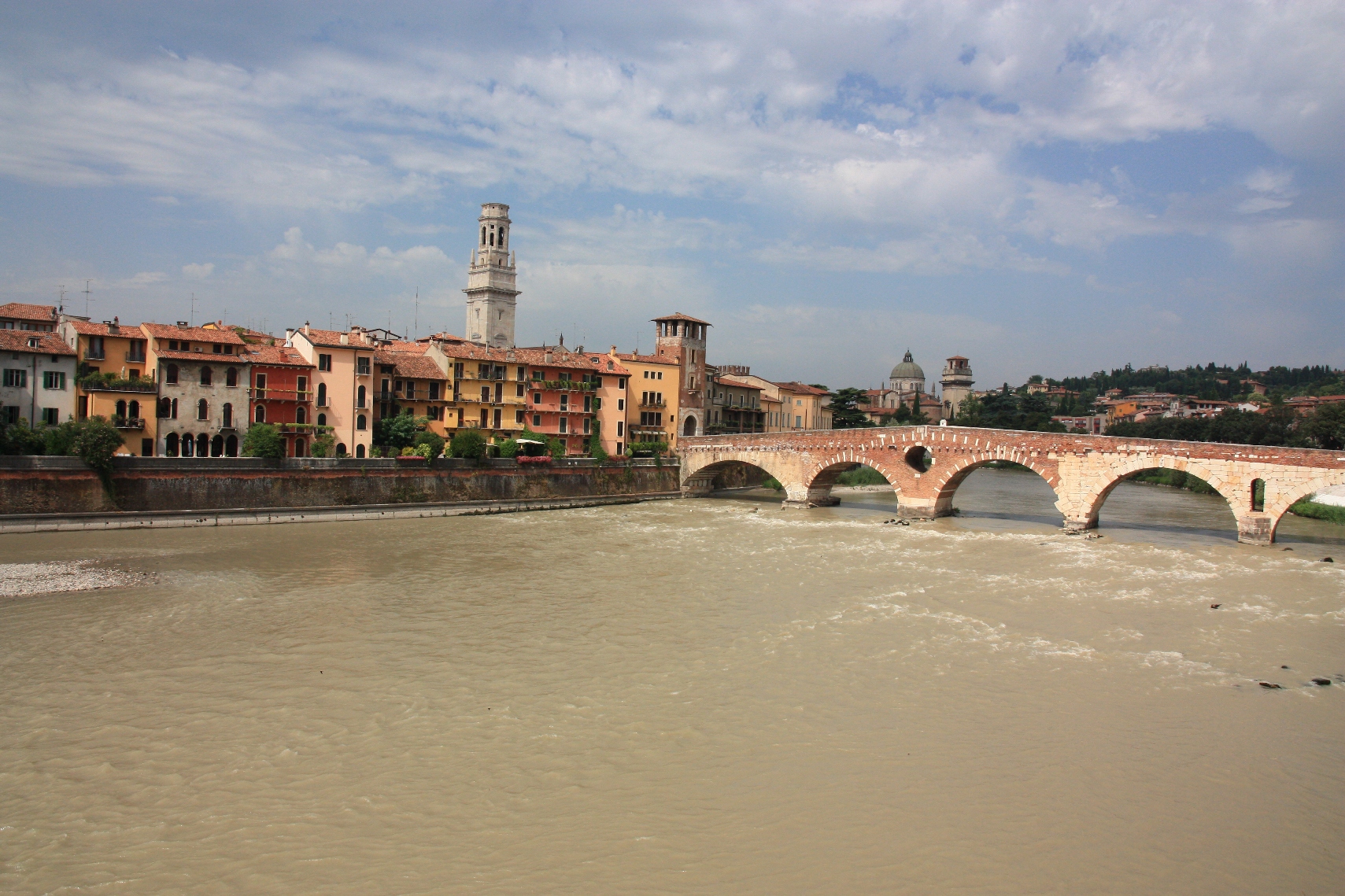
dol16Anyway, you will also pass statues of Dante and come across courtyards and church towers and those colourful terraces with window boxes and shutters in perfect harmony. Eventually you’ll likely come across the Adige River, whose level is possibly heightened by tears shed for someone in One Direction getting a girl (or boy) friend. I presume some of these waters also come down from those Dolomites; indeed perhaps the stream I crossed before that long climb eventually finds its way here.

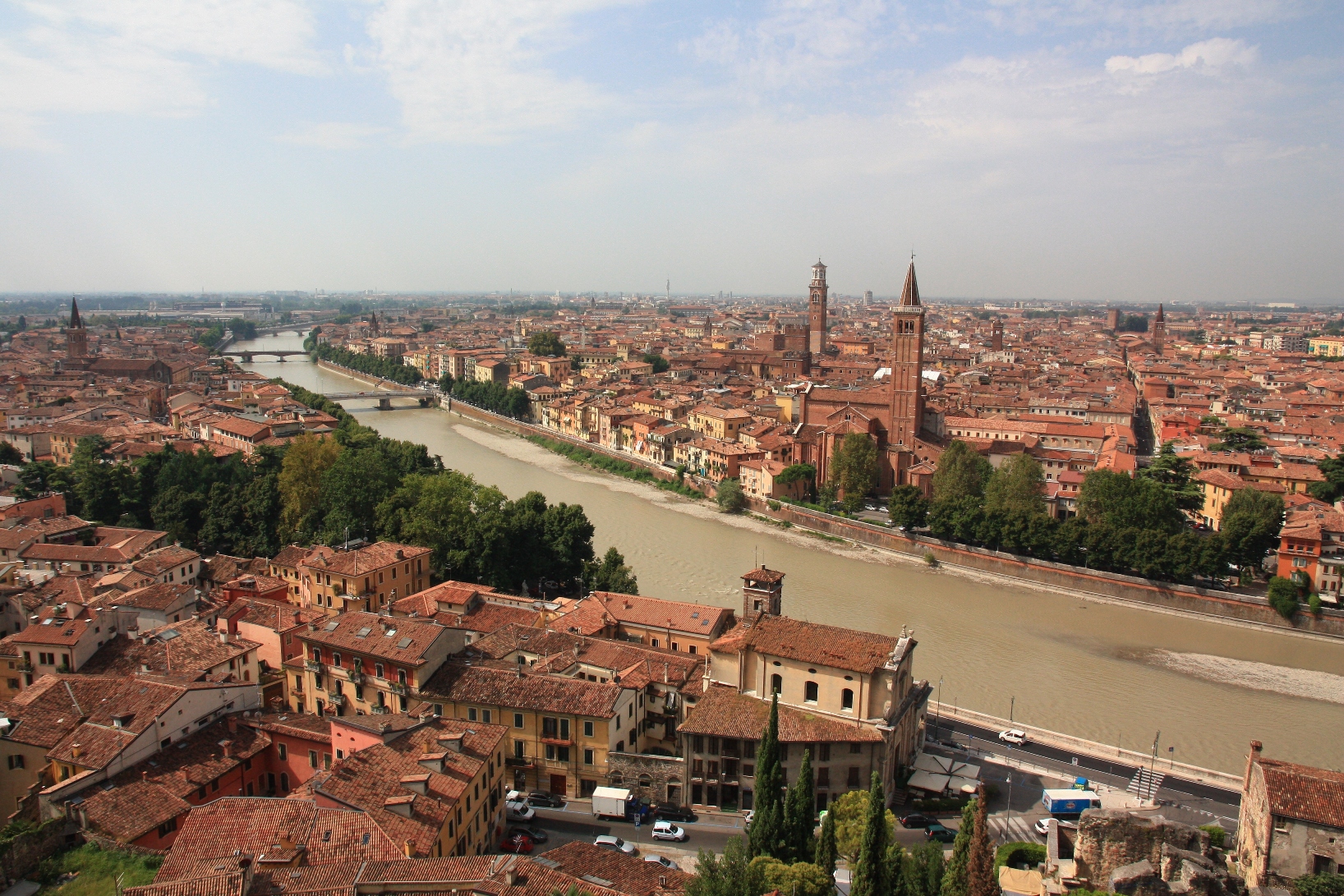
After many days of mountain or city walking, legs and feet are starting to wear, but one final climb is worth it. Steps and steps lead up on the other side of the river to a castle and views over Verona, a city not without charm. An Italian city where they speak Italian, a chance to be anchored in one language and culture for just a while. For tomorrow brings a train through Switzerland, where Italian becomes German becomes French, all armed with pocket knives. Grazie, Danke, Merci.

dol15

Europe Food & Drink Green Bogey Photography Walking

Munchen and drinking

It started with a cheese covered giant pretzel at Munich International airport, reward for clocking off another mind-numbing, leg-aching, sleep-depriving trek across the globe. Then, if you discount a few anomalies involving fruit and yogurt and water, the remainder of my time in the Bavarian capital involved a BP diet…bread, beer, pretzels, pork.

mun01Can there be anything wurst for the health than a Bavarian diet? In a way, as much as there is left that I could see and do, I am glad I am moving on after just a few days to, hopefully, something involving more vegetables and less pork. To be fair, you can obviously get other foods here, but I’ve been craving a German feast ever since I didn’t get one in the Barossa Valley. And the beer, on 30 degree days, under the shady trees of verdant parkland, is pretty much irresistible. Everyone seems to be at it, and my seven glasses over three days are but a drop in the ocean.

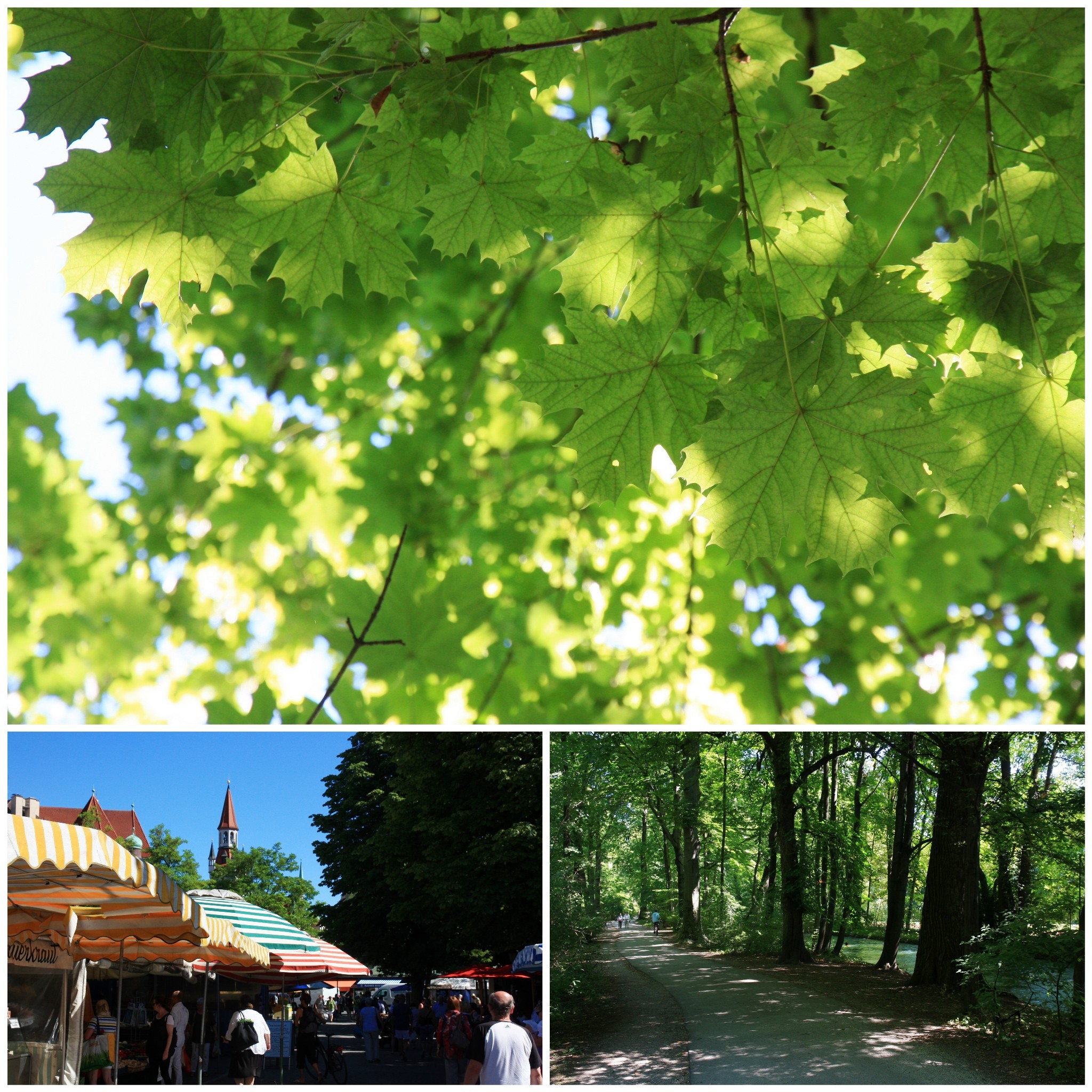
So, it was not like I was staggering around Munich in a drunken ramble. After arriving into the city, a first relaxed glass of weisbier was enough to make me amiably content in the splendour of a European summer in the Alter Botanischer Gardens. I always marvel in the trees when first arriving, the green, broad-leafed providers of cool shade that you don’t get in such a way down under. Such a simple thing, but such a delight.

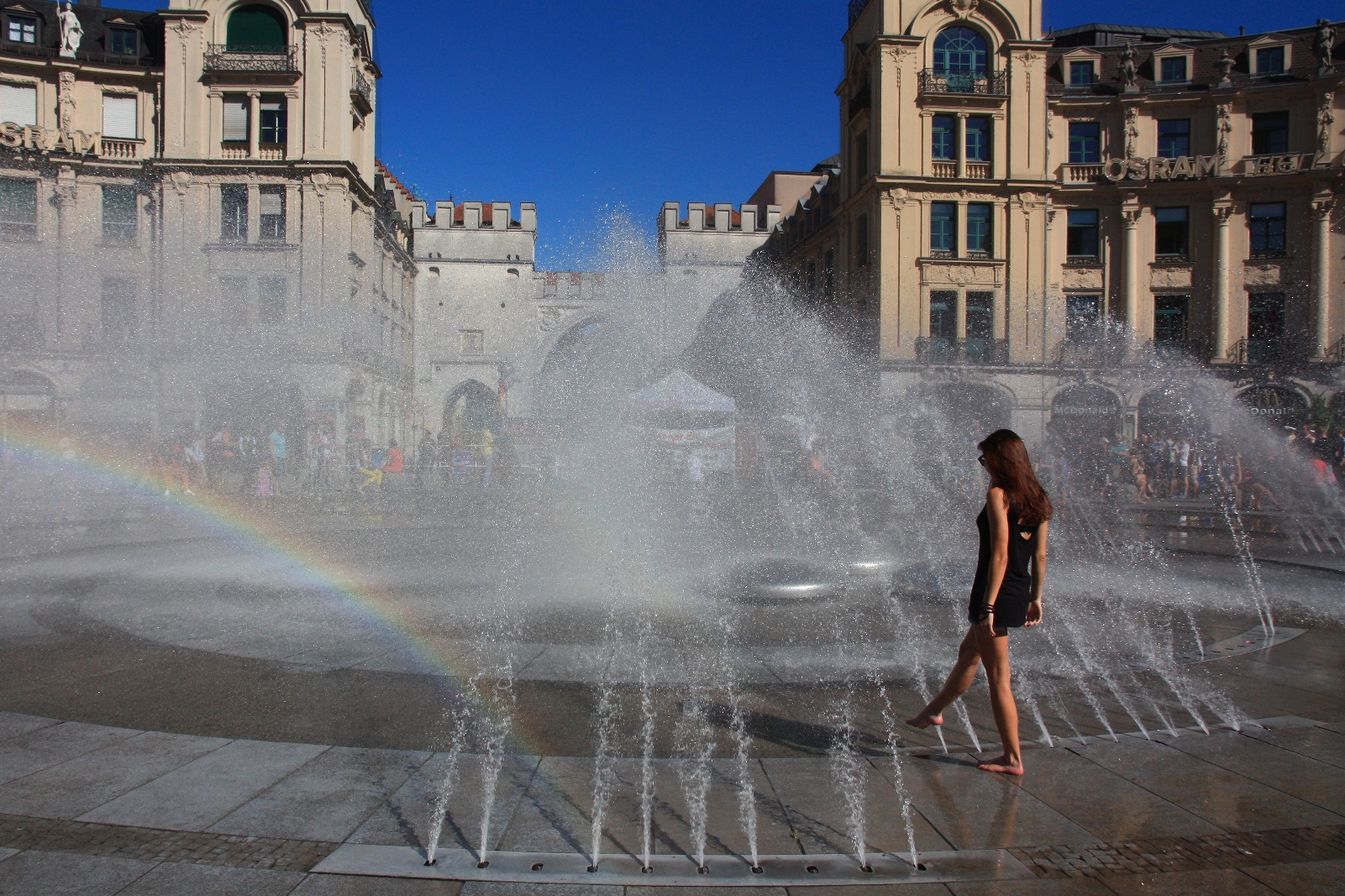
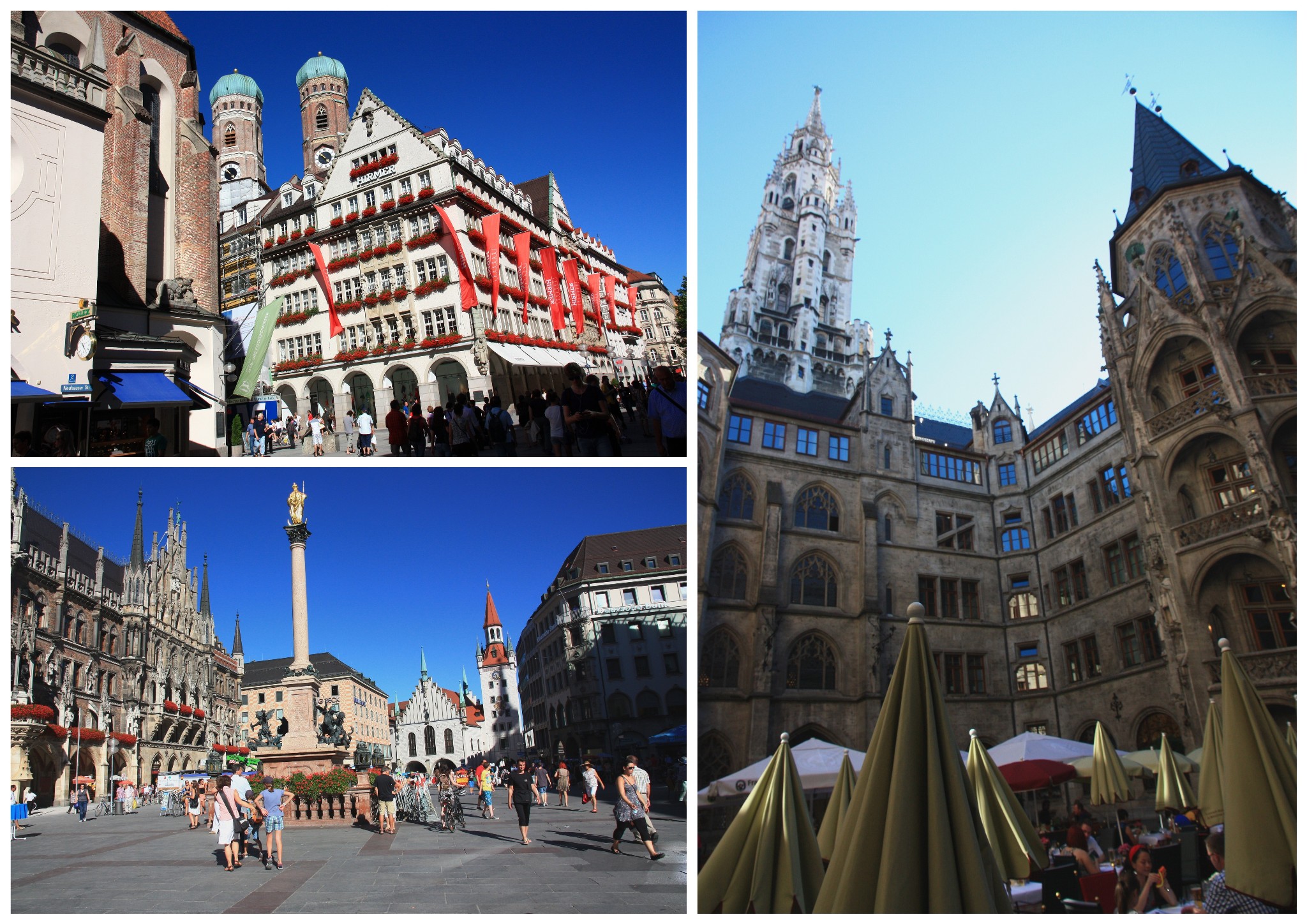
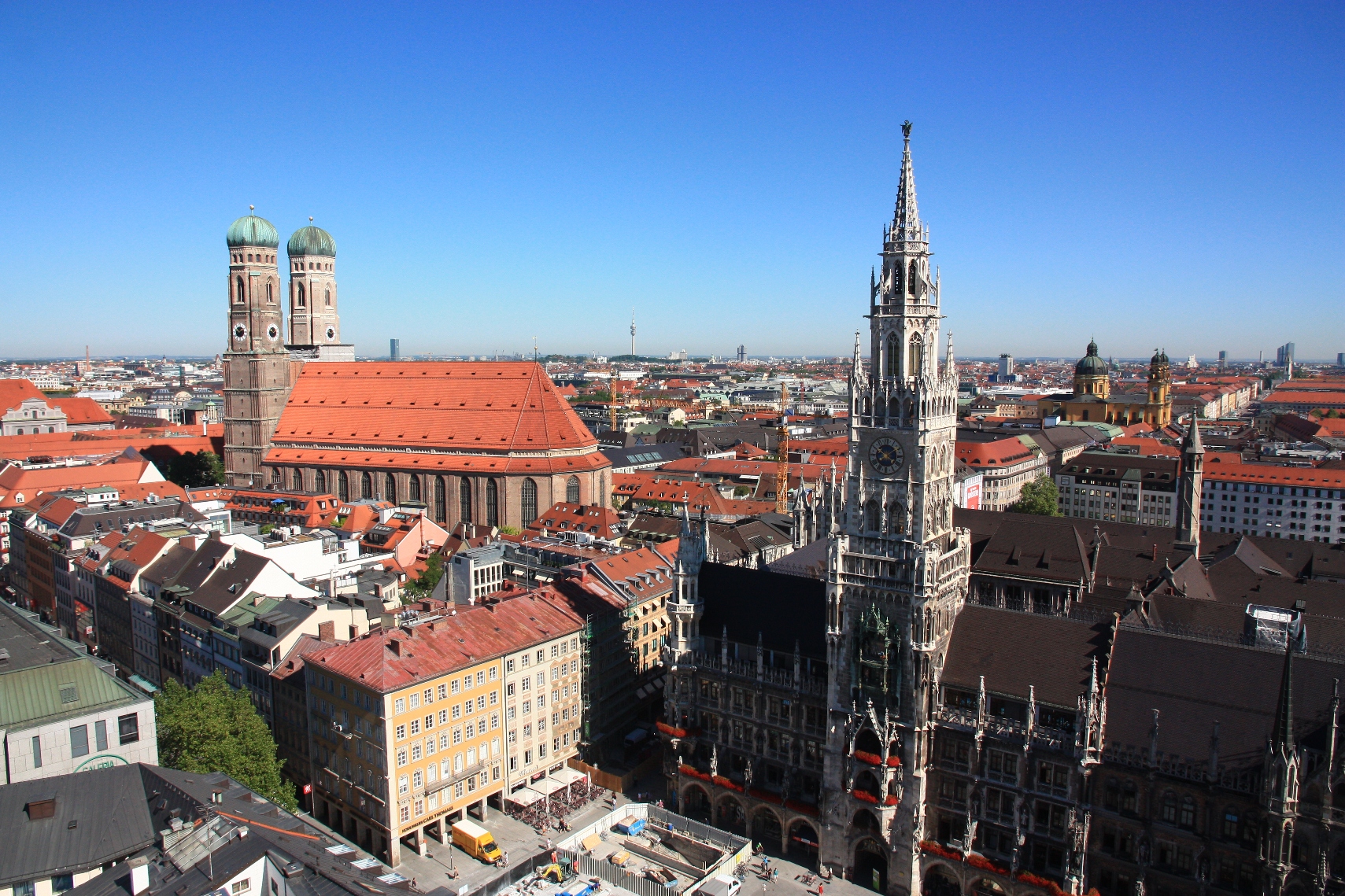
mun02Fuelled up I ambled into the Aldstadt – the old town – for the rest of the afternoon and into the early evening. This, of course, is the pedestrianised bit, full of shutters and window boxes, fountains and gargoyles, churches and cafes. So, for the place name aficionados, in kind of chronological order there was the suitably imposing Palace of Justice, the cool spray waters around the appropriately named Karlsplatz, the Michaelskirche, the double-domed Frauenkirche and the gothic fairytale towers around Marienplatz, with Neues Rathaus at its centre (and in that building’s centre, a courtyard restaurant and spot serving beer). Food and drink at the heart of the city indeed.

mun03

mun04There seemed a bit of a Friday night feel around, even though it was Thursday – that could be the beer but I can think of no better complement for a city centre.  Sunshine and people frolicking in the fountains, ice creams and beers, camera posers and classical buskers. Fruit stalls dotted around serving delicious ripe berries and stone fruits, a much better-sounding option for my own dinner than a McDonalds, Starbucks or, especially, a long thin sausage from somewhere called Esspunkt.

I ventured into and around Aldstadt the next morning, milling around the Viktualienmarkt which had all sorts of nice looking fruits and cheeses and meats and mushrooms and plants. Disconcertingly (I think), the outdoor beer garden was already fairly bustling at around 10:30. I opted for a fresh grapefruit juice, thinking that a beer would not help me up hundreds of steps to the belltower of St Peterskirche.  And clear vision was helpful to soak up the 360 degree view across the city and afar to the Alps in the south.

mun05

mun06Well, ain’t I just a saintly vision of wholesomeness, not drinking beer and going to church and all. In fact it took me until 12:20pm to be supping on a frothy lager in the middle of the giant Englischer Garden. It was hard earned, as the gardens are the size of a small English county and just as lovely and leafy.  Water runs through the park, an obvious lure to Germans to strip off and plunge into a torrent or, in one spot, kind of surf, with boards and wetsuits too. The other thing the water provides is another luscious setting for another shady waterfront beer garden. This was possibly my favourite beer moment as it accompanied a lazy browse through a copy of The Times that I picked up on my flight. All rather civilised and ever so relaxing.

By contrast, an evening visit to the Hofbrauhaus was a different kind of affair. This is the most famous and hence most touristy beer hall, so busy that I didn’t even have one. There were wenches and an oompah loompah band and off course lashings of Weisswurst and Sauerkraut, but no empty tables. So instead, I returned to the site of my first beer in the Alter Botanischer Garden and engaged in something known as currywurst. Yes, it looks as good as it sounds. Basically a sausage with chips and curry sauce. I mean, is this not perfect beer garnish?

All this conviviality is well and good, but I was keen the next day to visit Dachau. This was one of the first concentration camps created by the Nazis. Sure, it doesn’t sound like a holiday kind of thing to do, but I was due some seriousness. It’s such a huge part of the world’s history and one that should not be forgotten, especially as we seem to be eternally selfish and greedy and seemingly superior in our position to immigrants and foreigners and boatpeople and anyone who might just want to get on with the same basic rights and welfare as us even though they were not born in our country. Oh, the horror, the (lack of) humanity!  Anyway, due to engineering works and incomprehensible replacement bus services it was not accessible, so you’ll be spared anything too confronting.

I was disappointed, but happened to find myself near a site of great ostentation where rich people obviously got very rich and wanted to boast about it – Schloss Nymphemburg. Here sat a palace in the midst of a country park, with more rambling ornamental gardens, dense green woodland and meadows. It was rather lovely albeit all a bit identical to yesterday, without the added bonus of beer gardens.

mun07

A few stops away on the tram I did find a great ice cream place – my first ice cream in nearly 48 hours here. It was lush and left me wondering why it had been so long, but then I remembered…beer had taken its place and was much easier to come across.

mun09The ice cream was in some inner suburb and it was nice just to soak up a few minutes in the square watching people go about their normal Saturday chores. Just off the square was a station for the U-Bahn subway which had the bonus of being operational at least. It was quite a funky ride, through a mix of stations that are either deliberately stylised retro or just plain damn retro. So, huge coloured industrial lights, 3D metallic squares, blocks of orange and brown, sleek steel railings and trundling blue train carriages took me to the height of slightly daggy 70s urban development – the Munich 1972 Olympic Park. At its heart a concrete tower provided an overlook of the stadium and rather compact parkland setting; a tower which also did its best to look like the Telstra Tower in Canberra.

More bling was the BMW display centre around the corner which calls itself BMW World but is really just a big fancy showroom with some gizmos. There are cars that people can look at to get a hardon, motorbikes for straddling, and video racing games to demonstrate just how much of an awesome person you are. For some inexplicable reason someone roams around the centre on a motorbike doing wheelies. Meanwhile, in the corner the Rolls Royce and Minis sparkle on rotating displays, expertly placed for teary-eyed Brits to lament the decline of our great country.

mun08And so, time in Munich was coming to a close, but I couldn’t let it end on such a sour note for us Pommies could I? Turns out the same U-Bahn train stops quite close to those old Englischer Gardens (see, they love us really) and a certain shady waterfront beer garden. Here there is garnish too, like the sausage medley and potato salad and pretzel that I had. A late lunch before a rest and a later dinner of pork knuckle, washed down with another drink. This in a beer hall attached to a brewery with genuine old-fashioned serving wenches. One was even called Helga, I kid you not, and she was blonde (or peroxide covering grey I would think).

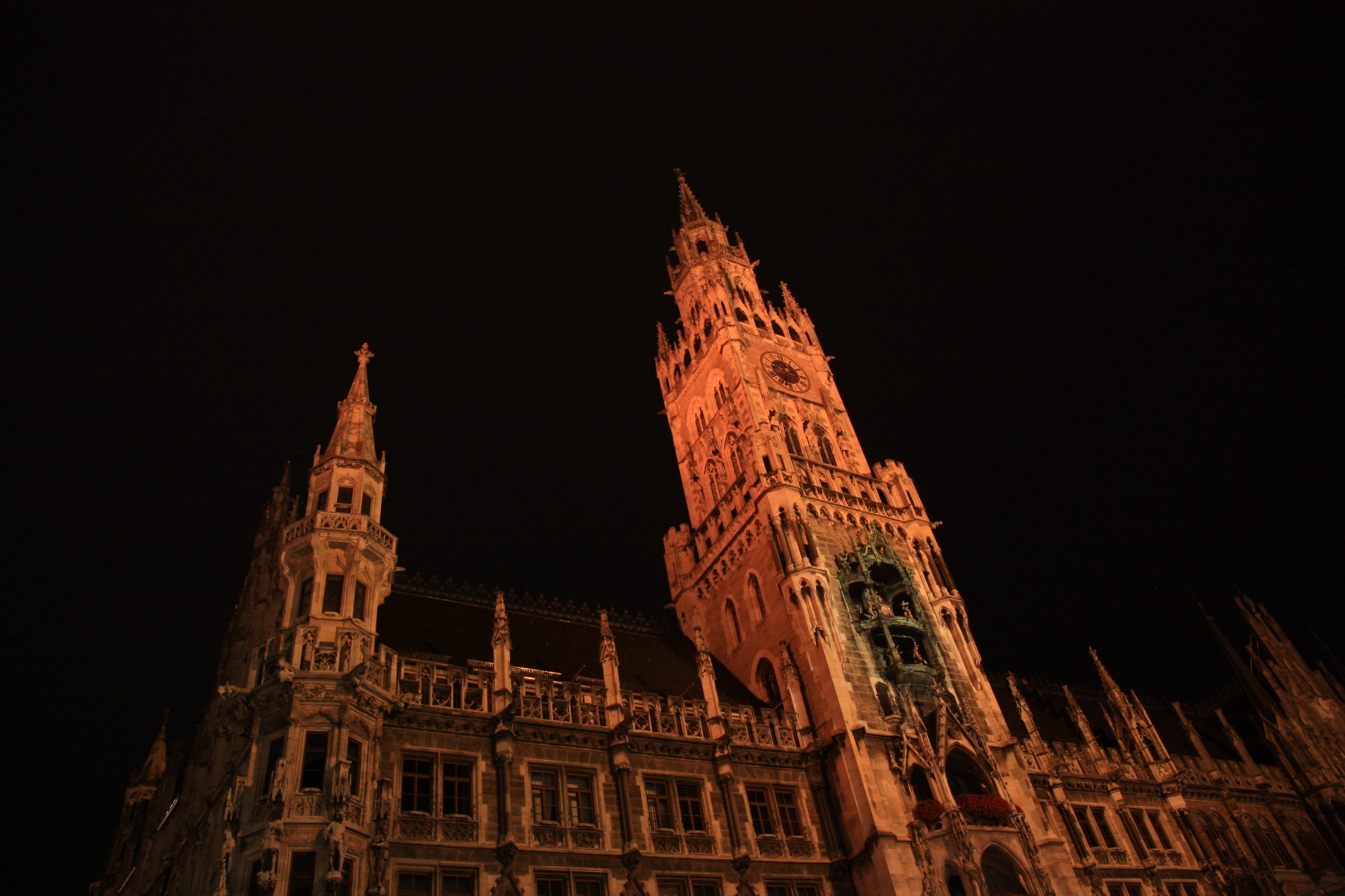
mun10I’m sure Helga would say that it’s always good to go out with a bang, and Munich obliged. Sampling the Aldstadt at night, parts lit up like a fairytale, others dark and dingy like another Grimm fairytale, lightning streaked across the sky. The rumbling intensified and rain began to fall in huge droplets, more forks of lightning shattering down as if they were almost going to hit the towers of Marienplatz like it was 1955 and we had to get back to the year 1985 or something, but only with the help of a bit of rock and roll. People dodged the rain, sheltering under alcoves and colonnades, disappearing into subways, lingering in shops. Hard as nails beer-toting chain-smoking German bikers were suddenly shrieking like girlies. And through this all I embraced a bit of rain, cooling and refreshing and hopefully just cleansing a little bit of the BP from my body.

Europe Food & Drink Green Bogey

Lost

L_florence0

It must have been the third time I had come across the unassuming facade of a small church, white columns illuminated at night in a dim yellow glow and reaching up to a plain second level with modest belltower on top. It appeared at the junction of a darkened alley and small cobblestone road, wedged in among terraces of apartment blocks and surrounded by a few parked cars and more parked mopeds. It was an unspectacular scene in a city such as Florence, and clearly there were very few tourists who had ventured down this particular street. Yet somehow I had ended up here three times, seeking a way out of the tangle of alleys and streets to the solace of my hotel bed.

It had all started off so well, arriving in the city centre on an impressively fast train from Milan, just in time for lunch off the giant square of Piazza Signoria. Around the corner, my budget hotel room sat behind a huge wooden door and up five flights of stairs but it was amenable and comfortable, albeit with what is likely the world’s smallest shower. Freshly showered, I loved walking down those stairs and out of that door into a tiny alley that funnelled onto the grand piazza, with decadent statues and imposing arcades around the fortress-like towers of the Palazzo Vecchio. From here and down alongside the Uffizi Gallery, with its never-ending queues, I came out onto the River Arno, and to my right, the ramshackle arrangement of buildings that line the Ponte Vecchio drew me along.

Things seemed to worsen with the onset of a thunderstorm and though I hastily and successfully retraced my steps, the atmospherics had changed. Rather than cleansing and refreshing, the rain left a residue of water, channelling the hot summer dirt of a city into pools and leaving a gritty film across its cobblestones. The darkness of clouds and the howl of winds created a doomsday of Dantean proportions, where it seemed only a matter of time before arches would crash to the ground and the earth would open up and swallow the array of sculptures congregating in every square. And out of this darkness came a new hell, an army of revitalised mosquitoes, hungry and thirsty for blood.

It was into this post-apocalyptic environment that I returned after dark, only to find I may have been over-egging the scene, as the rain had passed, the lights were still on and people had returned to the streets in pursuit of a heavenly combination of food, music, art, and animated conversation. I was ready for a quieter night and content just to seek a bite to eat; any music, art or animated conversation would be a secondary outcome. A modest goal, but one with just enough vagueness to prove my undoing.

I don’t get lost very often. I mean proper lost, like I don’t know where the hell I am or where I am supposed to go. Typically I have this in-built radar that can orient my position, the direction in which to head, and the way to get there. Even a few minor diversions and detours generally become easily rectified. But on this night indecisiveness about what to eat and the setting in which to do it said hello to the labyrinthine streets and alleys of Florence to prove a frustrating concoction. My complacency to not take a map or read where to eat first or to just settle for the first option compounded this. And while there was an initial sense of excitement and discovery about losing yourself in the city, by the end I was footsore and sweaty and hungry and mosquito-bitten.

Now, I can hear you saying that surely there are many places to eat in Florence. I can hear you loud and clear. Indeed, if I was to head left or right, north or south, I would be guaranteed some pizza or a bowl of pasta or a juicy hunk of Bistecca alla Fiorentina. The issue was finding somewhere that most closely resembled the idealised image I had in my head, the concept that best met my needs: quiet but with bustle, tucked away in some quaint little alley but not far from the main tourist drags, a place that was reasonably priced and, importantly, a spot where you wouldn’t feel too much of a loser for being there on your own while others dined on spaghetti like a couple of trampy dogs in a cartoon. Significantly, the fact that I wasn’t in a pasta or pizza mood didn’t help one bit.

The night now turns into a blur, one street looking like the next, rows of mopeds cluttering the kerbs, buildings tightly clumped next to and on top of each other. Amongst them the occasional grander building decorated with neat columns and fancy cornice work would be memorable landmarks from which to navigate, but here they are ten a penny. Each of these streets seems to flush out onto a small piazza, where five others shoot off, like the legs of some grubby Italian insect. The disorientation is palpable, only occasional guidance provided by the giant glowing beacon of the Duomo, which is never in the direction in which you thought it should logically be. The river is somewhere, and eventually I come across it, and can backtrack along its banks to my hotel room. For dinner, two hours later, some takeaway tagliatelle from the tacky restaurant five doors down.

For the rest of my stay in Florence I decided to take a map in my back pocket. It turns out you can still embrace the pleasures of ambling aimlessly around the streets while having a destination in mind (and occasionally checking a map to ensure you are on course). The glimpses of Duomo on the first night cemented my desire to explore this centrepiece further. Towering over the rest of the city it should be fairly easy to find, though the constricted density of the streets mean you can approach the square in which it sits without a sighting until the very last moment. Where a laneway takes a sudden jolt to the left or right, as if it had wholly shifted five metres in an earthquake, a glimpse of the Duomo almost magically emerges in the gap of air between window shutters and washing.

Having located the huge cathedral without incident, further steps took me on a breathtaking climb to the top of its belltower. And while my heart rate slowed and breathing recovered, I was taken away by the expansive view over the city. From this godly vantage you can understand how easy it is to lose yourself in the melange of terracotta roofs and earthy brickwork. Streets appear to disappear, with only major thoroughfares visible, radiating out from the larger piazzas in perfectly straight slices. There is a strident hum of business thrust upwards from those streets and I can see the tops of heads clustering and flowing in all directions, some of which are no doubt getting lost.

L_florence1

From this height I can also see beyond the packed cityscape that jams its way along to the north bank of the Arno. Across the other side, hills rise and buildings begin to scatter, marking a more gentrified, palatial part of town. This is where the rich people would have gathered and set down their extravagance in showy mansions and gilded villas and trigonometric gardens. Here there is the perfect opportunity to lose yourself in a different type of Florence, a manicured Florence that is perched on the doorstep of the Tuscan countryside.

Across this side of the river the behemoth of Palazzo Pitti is eclipsed by the grandiose Boboli Gardens which spread from its back door. A route into the gardens was typically not the easiest to find, an indistinct hole in a brick wall leading me into a rambling paradise of manicured lawns and fountain embellished ponds, unkempt meadows and leafy woods. The gardens are a great place in which to lose oneself, to take a breather from the manic buzz of life to the north of the Arno. In fact, you may emerge atop a hill and forget you are in Florence altogether, casting an eye south and east over rambling olive groves and cypress pine perforated by the odd beige and sienna villa. A Tuscan landscape with the pomp of a city behind it.

The ticket to Boboli Gardens also includes entry to another, smaller breathing space nearby: Bardini Gardens. I don’t think so many people make it here which, to me, makes it even better. I am not sure why fewer visitors come here. It’s certainly less grand than Boboli and if you are pushed for time I suppose you may skip the opportunity, wary of garden fatigue. Naturally it’s not very well signposted so some people may get lost on the way and give up. I almost did the same, but retraced my steps, took a different turn which did not seem logical and then found the entrance which just looked like the front door of a posh house.

Within, the gardens are less manicured, woody and leafier and dotted with an assortment of faded terracotta pots and crumbling walls. It’s more difficult to get lost, which on this trip is starting to sound like a blessing. A main path zigzags its way back down to river level, stopping off on the way at a weatherworn terrace offering some of the best views of the city. Those infamous city streets, a crammed conglomerate of buildings whose blanket of roofs is penetrated by the spires, towers and domes of all the major sights, glowing in the afternoon sun. Those streets into which you again spill and navigate with increasing mastery. No need for a map again, happily lost.

L_florence2

A to Z Europe Food & Drink Walking

Kangaroo country

Nothing can be quintessentially more Australian than the sight of a man in a cork hat and grubby white singlet riding a kangaroo to work. Apart from a man on a kangaroo in a cork hat and grubby white singlet hopping over lethal spiders and snakes while fleeing a bushfire with a rescued koala, only to get to the safety of the beach and discovering a shark infested bay peppered with box jellyfish, causing a bunch of boofheads to gingerly enter the water in thongs to retrieve their cricket ball with one hand because the other is grasping onto a stubby of VB like it is the last bottle of insipid but undoubtedly cold beer in the world.

Of course, all of that is nonsense [1], lest I be sued by VB which is a popular and well-loved beer in certain areas and so well-loved it appears on the shirts of the Australian cricket team, which perhaps speaks for itself in so many ways. What is undeniable is that the kangaroo is an icon, so much so that it appears on the national airline and encourages you to buy home grown products. If you ask someone overseas to mention the three things that come to mind when they think of Australia, they will most likely say beaches, kangaroos, and punitive policies for people fleeing persecution and seeking asylum, dressed up as a concern for their safety and not really about winning votes from a cluster of the population who have an underlying xenophobia stemming from their own challenges in paying the mortgage on a home which is unnecessarily big for their needs and encountering traffic on the way to Kmart, thus displacing the blame for this onto others who are widely vilified and helpless to stand up for themselves [2]. Still, we have nice beaches and lots of open space for kangaroos, so it’s worth defending right?

The kangaroo was here long before the first boat people arrived to overrun the country and its culture. A popular myth is that ‘kangaroo’ meant something like ‘I don’t know’ or ‘I don’t understand’ when Cook, Banks et al enquired of local Aboriginals what on earth this peculiar creature was. Like all good myths it has subsequently been debunked [3] but you can understand why it still does the rounds. It’s a convenient story that encapsulates the sense of the bizarre, the other-worldly, the weirdness of the flora and fauna that was encountered by the first boat people. A befuddlement that continues to this day as more people spill, primarily, out of international airport terminals and come face to face with Australia.

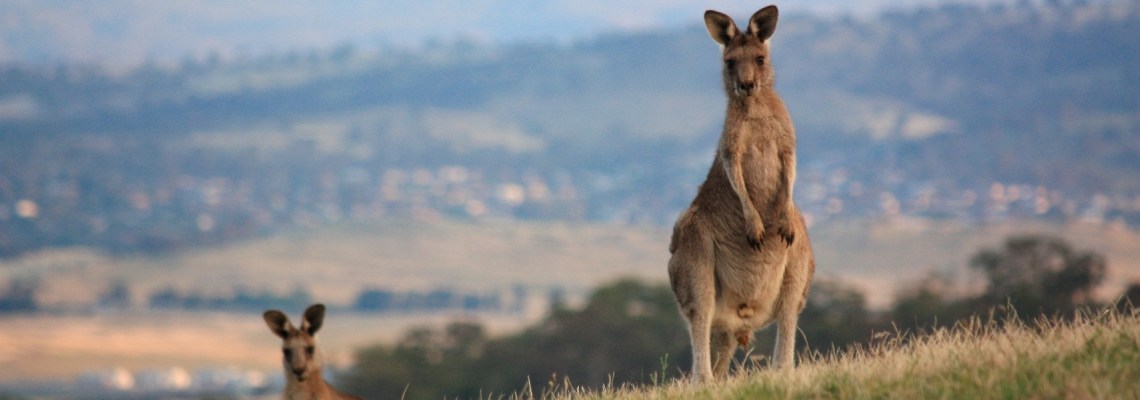
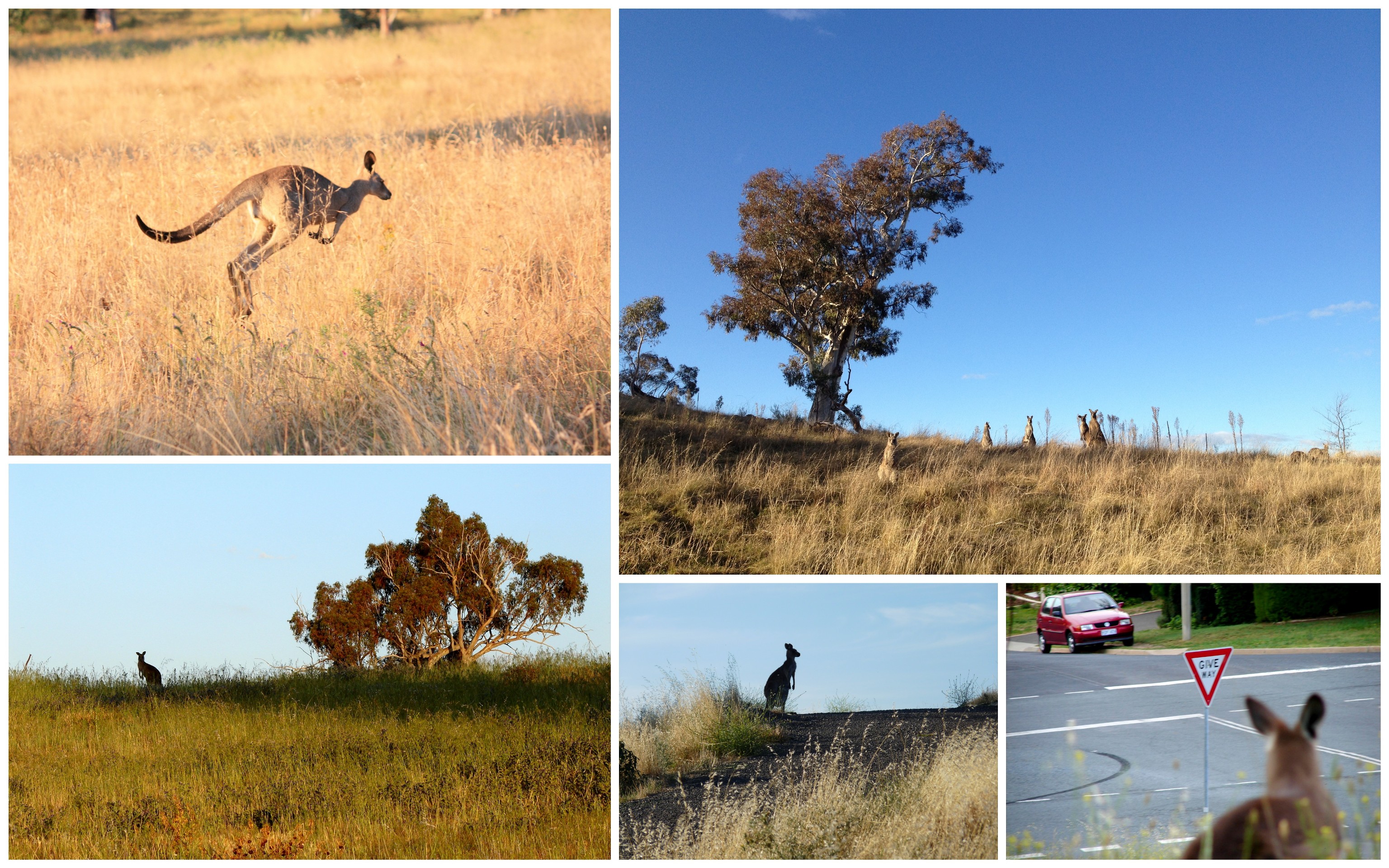
Initially you could be forgiven for thinking that Australia is a sunnier, newer, even happier [4] version of the UK, with a US touch of the gargantuan about it. But what sets it apart as wholly unique, exquisitely exotic is its flora and fauna. The kangaroo, perhaps in conjunction with wily white Eucalypt trees and shrieking cockatoos, is the readily available, easily accessible face of the Australian bush, and a long, long way from distant, familiar lands. Perhaps that is why, even after seven years, the sight of a kangaroo bounding out of the trees and across golden grasslands brings a smile to my face and, still, a sense of wonder.

I cannot write about these experiences and this topic without covering time on Red Hill, Canberra. I may have written about this place before. I came across it three days into arrival in Australia, fighting a fight against deep afternoon jetlag driven sleep. Determined not to fall into a coma and then awake all night, I set out along charming suburban streets on one of those beautiful, clear, warming late winter afternoons. It could have almost been an old English summer. Gradually climbing in altitude and property price, the streets ended abruptly as the very richest backed their way onto the grassland and steeply rising bush of Red Hill Reserve. Without intricate knowledge of paths and trails I headed straight up, short and steep to the lookout cafe. Here I viewed Canberra from high for the first time, had a coffee and saw a handful of Eastern Grey Kangaroos milling about without much of a care in the world (much like myself really).

Since that day I almost always saw kangaroos at Red Hill, particularly as I was wont to wander there of an evening. Huge mobs would gather in the grassier patches at the bottom while others would linger along the ridge up high. Mothers and their kids would eye me with suspicion or, perhaps, familiarity. A stand-off ensued, one waiting for the other to move on. But I often emerged the victor in these early days, because I would have my camera with me, and everyone knows that as soon as you bring your camera up to your eye to take a picture of some wildlife, the wildlife flees.

K_kangaroos

Certainly it was hard to restrain myself from taking a picture every time I saw a kangaroo. It was a natural reaction because back then it was all so extraordinary and therefore entirely warranted. Increasing familiarity has restrained my picture-taking compulsion since. In fact, I don’t tend to take my camera up Red Hill anymore…hell…I don’t even go up Red Hill anymore, since I am presently 3,000 kilometres west and it is a trifle inconvenient. However, frequently armed with camera elsewhere a kangaroo or dozen have popped into view. They emerge within the context of a wider landscape, as natural as, well, a man in a cork hat and grubby white singlet. They undoubtedly add something to the mood, grounding the scene in something that is so very obviously Australian. And thus, still, so very exciting.

————————————————-

Kosciuszko National Park is one of Australia’s great national parks, taking in vast swathes of upland country and river valleys in New South Wales. In winter the highest parts are caked in snow, in summer all parts are swathed in flies. It’s a fairly unique environment for Australia, which is mostly dry, brown and flat. Termed alpine, it is not so in the sense of being blessed with gigantic peaks and glaciers; instead ridges and clumpy mounts offer a scene more akin to the rounded peaks of northern and western Britain [5]. It is an ecosystem that is all-encompassing, from rare possums and miniature toads in the boggy bare stretches high up, to common wombats and kangaroos and all of their derivatives [6] in the bush and plains further down. 

Kosciuszko is not so far from Canberra but on one occasion, having spent some time working in the town of Albury, I approached it from the west. It was a long weekend of high country meandering, through the northeast of Victoria and into New South Wales before crossing the Main Range and ploughing on more familiar roads back to Canberra. Approaching the end of March the landscape was in a state of transition, from the dry, warm summer to freezing cold winter nights and winds and rains and occasional snows. The hairpin drive up Mount Buffalo – the closest thing Australia has to an Alpe d’Huez – came with freezing fog that cleared to warm sunshine. The valley town of Bright was commencing its ascent into blushing autumn saturation and wood-fired air. And the trudge along an endless ridge towards Mount Feathertop was blanketed in cloud, a stark contrast to the clear fresh vale below.

Crossing into New South Wales and finally into Kosciuszko National Park, there is eventually a sense that these are proper mountains and not big hills, as the highest points of the Main Range, glowing in the sun above the tree line, rise up more dramatically from this western vantage. The road on this side twists and turns along a narrowing river valley, the dense green bushland plummeting down the hillsides occasionally broken by huge pipes belonging to the mammoth Snowy River Hydro scheme. At some point the road rises and crosses the range at the evocatively named Dead Horse Gap, but before this tortuous ascent, there is respite at Geehi Flats.

Geehi Flats appears like some hidden valley idyll, where the opaque water of the Swampy Plains River broadens and a swathe of grassland punctures the dark green tangle of gum trees. A spacious area along the river offers rustic camp spots and opportunity to amble. At the northern end a couple of old wooden huts testify to exploration and discovery and, now abandoned, the harsh realities of surviving in the high country [7]. Within this clearing the afternoon sunshine illuminates the rise up to the Main Range and onwards to the white cotton wool clouds hovering above. And as I stare at the serenity, a large Eastern Grey kangaroo stares back. Suddenly I feel like the intruder.

K_kossyroo

On the face of it, it is nothing remarkable…a sighting of an animal that I have seen hundreds of times before and so common in an area where it is protected to thrive. But in the landscape, in the setting, in the primitive high country context it feels very special, like I am the first white man to see it and it is the first kangaroo to see a white man. It is so amazed that it even lingers while I take a photo. It’s a chunky unit, but it is meagre within the scale of the whole, minor against the vast wildness of the scene. Yet here it sits entirely natural, a perfect foreground marker within the larger composition of my vista. What lies before me is Australia and I am reminded at how fortunate I am to be a part of it. Still a land of untapped discovery, of boundless space and unknown potential, it is something to cherish, to protect, and to share. And while the kangaroo is perhaps the pinnacle of the adaptive powers of evolution, as Australians we can still be much, much better than this.
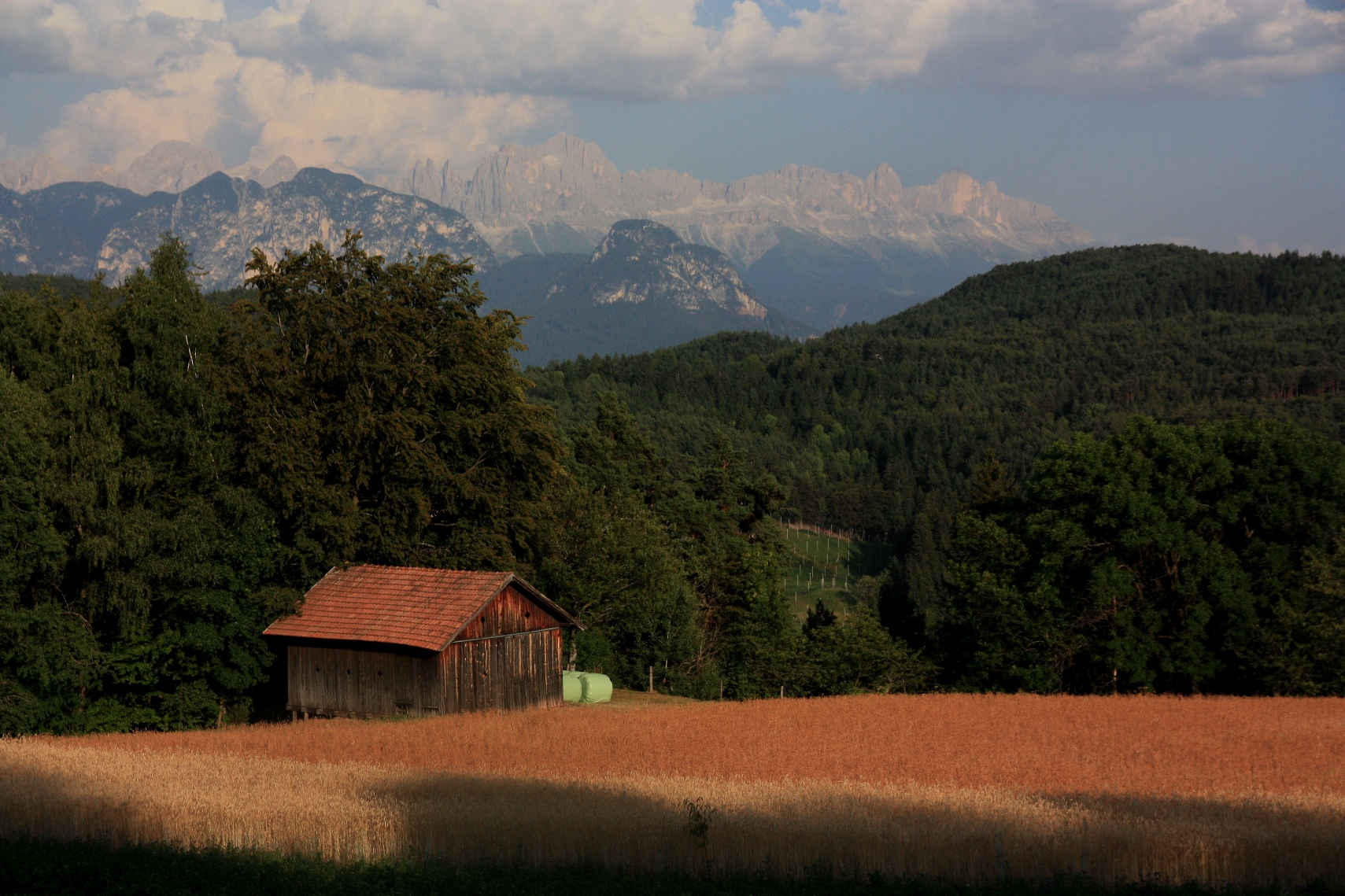
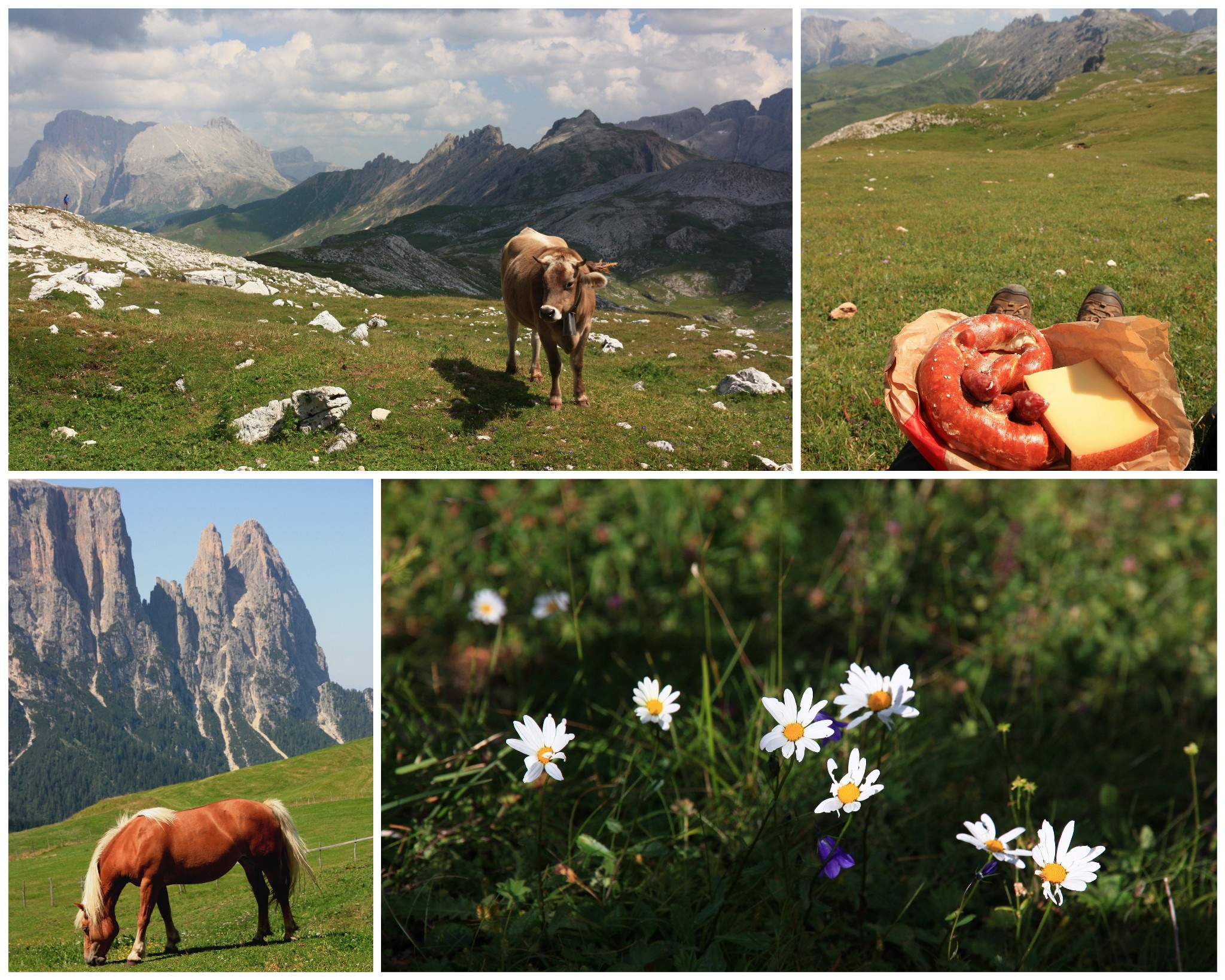

[1] Clearly we only ride kangaroos around on the weekends for leisure, duh. Else the ute wouldn’t get much use.

[2] See http://www.guardian.co.uk/world/2013/jul/22/captain-rudd-australia-depths-shame for just one well-written, reasoned commentary on Australian Government approaches to ‘boat people’.

[3] Not by the team at Mythbusters I hasten to add, but by (and I quote Wikipedia) linguist John B. Haviland in his research with the Guugu Yimithirr people.

[4] I am unsure about this at the current time of writing, with a UK heatwave and cricket team in the ascendancy.

[5] However, rising above 2000 metres it is far higher than anything in Britain, a boast many Australians like to boast about.

[6] By which I mean the whole raft of hopping marsupial type things like wallabies, wallaroos, euros, jackeroos, jillaroos, brucearoos, kangabies, roosabies, poosaloosaroos etc etc

[7] Like camping overnight, when the warm daytime temperature plummets quite dramatically and uncomfortably

Links

All you ever needed to know: http://en.wikipedia.org/wiki/Kangaroo

Everyone’s favourite: http://www.youtube.com/watch?v=uRQnrY5V-rY

Walk the hill: http://www.tams.act.gov.au/__data/assets/pdf_file/0010/390592/cnpmapredhill.pdf

Kosciuszko National Park:

http://www.environment.nsw.gov.au/nationalparks/parkhome.aspx?id=n0018

Hi, country: http://neiliogb.blogspot.com.au/2012/03/hi-country.html

Stop the votes: http://www.amnesty.org.au/refugees/comments/24019/

A to Z Australia Driving Photography Society & Culture Walking

Journeys

If I was Alain de Botton I would have a superbly incisive sentence about journeys with which to begin this piece. Nothing like ‘a journey is the means by which one moves from A to B, whereby A is the current position and B the intended or end position’. [1] Of course, it could become more scholarly when we propose that A equals birth and B equals death, or less so when A is North Finchley and B is Golders Green. Both can apply, for as well as being like a box of chocolates, surely life is one big journey with lots of little trips, some of them circular, others there and back again, over hills, down dales, up side streets and along back alleys. And we are all passengers on the choo-choo train of happiness that is life.

Like everyone on this planet I have been on thousands of trips within my bigger life journey, many of them unremarkable, others slightly more interesting. It would be impossible to relate them all, almost as impossible as discussing 27 trillion topics at a rate of one topic a day (over a four day working week) for one hour [2]. But I’d like, in this potentially rambling expedition of words, to give you a flavour of the mundane and the spectacular that is involved with a journey.

When I think of mundane journeys my mind instantly arrives in London and a world of commuting. I was not unique in this regard, obvious when I was to look around at the number of people squished onto one carriage of a Northern Line underground train doing the same thing. I’m not sure so many people were travelling from Finchley Central to Hanger Lane via Tottenham Court Road, but odds are there was someone else enduring this madness. It was a long trip, there and back again taking around two and a half hours out of my day. The plus sides were the opportunities to read, complete the Sudoku in Metro, and stare in the middle distance trying to avoid eye contact with anyone whatsoever (as etiquette dictates).

Often by Archway I was bored and ready to get off, to breathe the, ahem, fresh air of inner North London. I had stared at the underground map and memorised the order of stations countless times already. I knew when the very proper automated voice was about to utter something informative like ‘the next station is Tottenham Court Road, change here for the Central Line’. And, when she did, I knew where to get off so I would have the shortest route to make the connecting Central Line train, and to position myself on the platform where I would stand the highest chance of getting a seat. On this train, things livened up again after Shepherd’s Bush, where the underground would go overground and you would learn whether you had made the right choice to leave the umbrella at home today. Or not. [3]

It is a journey that sounds rather boring and often it was. But that glosses over the sheer diversity every day: different people getting stuck in the doors in a last minute dash to board (and thus not to have the indignation of waiting 2 minutes for the next train); cancellations and shutdowns due to adverse weather [4]; automated announcements enlivened by a surprisingly witty retort from a bored driver who happens not to be on strike for a change; the occasional good (or bad) fortune that you might bump into someone you might know; and the quest of listening to music before an era of noise-cancelling headphones.

In truth, the tube is anarchy masquerading as mass transit and it becomes a riot at the stations. I love the labyrinthine network of tunnels where people stride purposefully in different directions (or bumble along and get in the way when you want to stride purposefully yourself). I love the adventure of seeking some mysterious portal and having to cut through an endless flow of suits and briefcases to plunge into it and down a spiral staircase to a cavernous tunnel where an archaic train might or might not turn up. I love watching people run frantically for the train, and like it even more when they miss it. I love it when people don’t stand clear of the doors to let people off, simply because I can tut in moralistic superiority. And I love the rumble of a train approaching, and the warm or cold air it thrusts before it like in some soot-laden Dickensian wind tunnel.

It sounds like I love the underground but it’s more a rollercoaster romance. At first, the novelty of using the tube and living the big city dream makes it seem fresh and exciting. After a while, it’s more of a routine, with good and bad days. Before too long, familiarity begins to breed contempt, accentuated by something unfortunate like the Central Line being closed for track work for months on end. Sick of this, you begin to dally with others…alternatives like the admittedly dreadful amalgamation of two buses navigating the North Circular and interchanging at Brent Cross. Bizarre combinations of bus, overland train, walk, bus just to mix things up. But you end up coming back and, with a little distance and history, appreciate the marvel of the underground that still somehow manages to work today.

If we are talking about transport systems that work there is an inevitability that the word Switzerland will come up. Through the power of language I can try and take you on a journey to Switzerland, using multiple forms of transport to get to one particular high point. It actually starts in Slovenia and its capital city Ljubljana, which boasts a fine old town surrounded by the best in 60s socialist tower block architecture. View both from the castle if you can, and go on a boat trip along the river if you fancy a sedate snooze.

A hire car out of here and a circumnavigation of ring roads takes me to the airport, a place that is small but nicely formed. Airports are fun places hey. I used to quite like airports when a holiday was involved, as it was the first chapter of a vacation, a place where anticipation could bubble and good moods spread. Maybe I’m more desensitised nowadays; a touch middle class blasé about it, scarred by 5:30am flights out of foggy Canberra and transit walks at god knows what hour through Bangkok en route to London. Going off on another sidetrack, am I the only irritating global jetsetter who struggles to distinguish between Bangkok and Singapore and Hong Kong and Kuala Lumpur international airports? Perhaps it’s the jetlag haze but they are all so marvellously big and white with shiny glass and sweeping curves and tropical house plants and long, long travelators peppered with pharmacies and electronics shops.

Anyway, Ljubljana International Airport is not like that. But it does have a flight that leaves fairly early for Zurich. Here begins a procession of train journeys that operate to the minute and connect with each other in perfect unison, a process that has probably been described once or twice as being like clockwork. The timings even allow sufficient chance at the station to grab a giant, salt-spotted, shiny pretzel with melted Raclette cheese oozing into its folds and crevices. And then forever I was in love with Pretzel King.

With pretzel relief, an hour or so passes quickly along the pleasant green valleys and slightly industrious-looking towns on the way to Bern, where an eight minute transfer across the platform puts me on a train heading to Interlaken. Now the hills loom higher and rocky peaks approach in the distance, while the valley alongside narrows and begins to fill with deep turquoise lakes. Interlaken sits between a couple of these lakes (hence its name [5]), and awaiting here is a smaller and older proud red train that is somehow going to find a route through the land mass that rises to the south.

It does so of course along a valley, this particular one the Lauterbrunnen Valley. But a mere crevice in the massive massifs of Jungfrau, Monch, Eiger and Schilthorn, its sheer walls provide countless opportunities for waterfalls to plummet fast and furious, even in September. The only way up these is to walk along the few accessible folds, or connect across the street to a cable car, which is still part of my one way ticket from departure to destination. With each metre in ascent, the cable car provides an increasing sense of the scale of the land, as the higher valleys and mountain plateaus open up, dotted with clusters of wooden chalets, spewing with bright green fields and dark coniferous forest. And all the time, huge peaks dominate their way up into a white meringue of snow and clouds.

Atop the cable car there is somehow another single track line that has been built along a plateau, and a one carriage train awaits. It starts to seem a bit bizarre dragging my luggage on wheels as day trippers and sightseers jostle for prime window positions. Where on earth am I going? The train seems to know, and it chugs its way intermittently through forest and meadow, revealing snatches of the three mountain sentinels capped by Jungfrau now to the east, terminating where I terminate, in the small mountain village of Muerren. Finally it seems Swiss public transport can take me no further, and the sound of my luggage wheels as they negotiate the narrow roads and concrete pavements inform the whole village of my arrival.

You venture all this way, on this wonderful journey, and it comes as a little surprise to be greeted by a cheerful British woman with a well-to-do clipped accent and general air of welcoming bonhomie [6] who is to put you up in a quaint loft room, provide you wifi, and feed you ample breakfasts over the next few mornings. She also offers tips for extending this particular journey on this particular day, so remarkable that it is to end with a flourish.

There is one final train ride, this time upon a smart funicular rising up several hundred metres to Allmendhubel, primarily just a nice spot for a small pension to provide food and drinks and gaze out at the panorama. Those several hundred metres upward are handy though, saving legwork for a wonderful, looping descent back to Muerren, dipping into and out of a couple of smaller valleys, as the omnipresent peaks impose closer and closer. Out of their large shadow in the warming afternoon sun bask the grassy green valleys, dotted with wildflowers, small wooden chalets and happy cows, offering a soundtrack of cowbells essential to any Swiss idyll. As I stop and stare and have the urge to throw my arms up in wonder and sing The Hills are Alive with the Sound of Music, I remember that a bag of bacon Frazzles has accompanied me on this journey today. Puffed up with altitude, a gift from Britain via Ljubljana, they are munched to supreme satisfaction.

J_swiss

Trains, planes, automobiles. But some of the very best journeys can only be capped off by foot…and a bag of crisps.


[1] Such insight reminds me of Sir Ian McKellen’s secret to acting as outlined to Andy Millman (Ricky Gervais) in an episode of Extras. See http://www.wimp.com/goodactor/

[2] For details of such madness, see http://www.hamishandandy.com/topics/

[3] Moral of the story: NEVER leave the umbrella at home

[4] Any of: flooding rain, ice, snow, wind, too much sun, drizzle, fog

[5] Just goes to show, it’s not just the Australians who have a penchant for place names that state the bleeding obvious.

[6] The surprise not being a cheerful Brit, but just that it was a Brit.

Links

London Underground: http://www.tfl.gov.uk/modalpages/2625.aspx

Mind the Gap: http://www.youtube.com/watch?v=OxJKvYBNgo8

Ljubljana: http://www.visitljubljana.com/

Swiss trains, the catchy multilingual SBB CFF FFS: http://www.sbb.ch/en/home.html

Muerren or Murren, it’s all the same: http://www.myswitzerland.com/en/muerren.html

If you’re frazzled: http://www.britishsupermarketworldwide.com/acatalog/Smiths-Frazzles-Crispy-Bacon-Corn-Snacksx48-BOX.html

A to Z Europe Photography Society & Culture Walking

Icefields

Despite being composed of perishing frozen particles there seems to be an inherent allure to the presence of snow and ice. I wonder if Eskimos feel the same way.

Maybe this romantic view is nourished in temperate climes, where snow falls are but an irregular memory of childhood. Something scarce is prized, and I can sombrely recall that when winter rain sweeps in to Plymouth, turning to snow pretty much everywhere but Plymouth, it delivers a fresh pile of disappointment. In Australia, no such disappointment because there really is no such expectation, with only the tiniest, highest pockets of land periodically subject to frozen weather. Still, at least they are generally reliable.

Away from Australia (and Plymouth) I have had the fortune to brace myself for arctic conditions, ghost through flurries of snow, and marvel at sweeping icefields, like a crow from atop a very big wall. Even just across the ditch, in New Zealand, one can appreciate the aesthetic value added by the white stuff, which has carved out its valleys and shaped its lofty mountain spires; peaks on which snow and ice still perches precariously and sweeps down graciously until it feeds into crystal clear rivers of melt water. Ninety-nine percent water and one percent fish, so it is said.

Such attractions are not without peril however, particularly if you decide to sled bungee flying fox BASE jump black raft off them. And because of their allure, they are incredibly popular, the two west coast glaciers – Fox and Franz Josef – a mandatory stop for coach tours, campervans and Apex International drivers everywhere. Indeed, in high season the walk to see the crumbly, dirty dust-coated moraine of Fox Glacier is an orderly procession of ages and nations. The old and overweight defy impending heart attack. Chinese and Japanese and Korean visitors dutifully file their way along for picture stops, wrapped up against the cold. British visitors do the same, basking in shorts. Youngsters scramble without fear over rocks and creeks, and Aussies stride nonchalantly along in thongs. Somehow here the grandeur and spectacle of the landscape becomes a little diminished.

Crowds bustle about just as much on a beautifully clear summer’s morning in Chamonix, France. Here, in an ever narrowing valley at the foot of Mont Blanc, glaciers creep down towards the pine forests bordering the town. The mechanic shrills of souvenir marmots cut through the Gallic hubbub, as people wait for lifts to take them to precipitous heights. Indeed, the Téléphérique de l’Aiguille du Midi takes them up some 2,807 metres in 20 minutes. It’s an alarming rise that leaves you a little breathless, literally and then metaphorically once you are confronted with the dazzling ice world around. Up here the crowds seem less intrusive, limited as they are through access, muted by an oxygen depleted sense of drunkenness, and made minuscule by the perspective of being near four kilometres above sea level; most of the Alps seem to be on view, stretching across three countries in a series of rocky turrets and icy hollows. A rare, and staggering, European wilderness.

 I_alps

Anyone would think I don’t like people given my desire to experience such places without being part of an inevitable tourist procession. Well, let me say that first I quite like some people and secondly I cherish the chance to share some of these places with them. In fact, some of the more memorable moments of life are the random conversations you have with random strangers in random places. Like waiting with like-minded photo seekers for cloud to never clear from mountain tops in the Cascade Mountains, or trying to translate the feverish sighting of marmots from Italian to French to English to a Japanese visitor heading down a mountain railway in Switzerland. It turns out most people are just like you and me, the common bond of the experience overshadowing any differences at that point in time. A smile is a smile in any language.

In fact I’m not immune to being part of a bigger tour group…sometimes it is nice to let someone else take control and just go with the flow, especially when having decisions to make equals indecisiveness. Plus longer tours over days and weeks provide a fascinating ethnographic experience [1]. At the start individuals unbeknown to one another mutter polite greetings and eye one another with caution. A few break the ice with time-honoured inquisitions of where do you come from and where have you been. Barriers break on the first good walk or, more likely, the first few beers. By the end of the night you are BFFs with Darlo from Wonthaggi and within a week you cannot imagine not being with this same group of people, getting on this same bus, stopping at viewpoints, eating meals and sharing a beer or two practically every day. Yeah, cliques may form and these may or may not include the rejection of people initially embraced as BFFs, but the group dynamic remains in a fluidly socially cohesive melting pot of fluctuating hormones and alcohol.

And this, my friends, is an encapsulation of a Contiki tour, albeit a description that is unlikely to be used by their marketing department. For those not in the know, a Contiki tour is a particularly popular way to see the world for 18-35 year olds, especially Australians who have 14 days to see every country in Europe [2]. With a core populace of 18-35 year old Australians there tends to be a significant emphasis on end-of-day drinking, but not without a range of energetic activities and processional sightseeing stops in the day. The relevance of a Contiki tour, and justification for my written meandering, is that I did one once. It was in Canada, with the blue and white bus traversing an incredible stretch of road called the Icefields Parkway. Finally, back on topic.

The Icefields Parkway links the Canadian Rocky Mountain towns of Jasper and Banff. I would love to go back since I cannot recall every instant and every stop, this before the days of blogging and digital photography. And I would love to have my own wheels and take my own time this time around. I seem to remember that along this road, around every corner, there is a panoramic view which you wouldn’t find out of place in a Rocky Mountains 2002 calendar. Bulky grey mountains laced with white rise up from all angles, as glaciers stream downwards, melting into rapids and falls and filling the most incredible blue green lakes. Huge swathes of fragrant pine forest fringe the lakes and valleys, a dark cover for elk and moose and bear.

It turns out the easiest way to spot a bear is to look for the cars and caravans parked beside the side of the road and the coaches slowing to a crawl. Once closer, a telltale sign is the sight of someone with a very big lens snooping around the undergrowth, fringed by other enthusiastic amateurs decorated with silver compact zoom cameras and, I guess now, iPads and iPhones and Surfaces and Robots. No-one seems to figure that the bear might just be interested in the hands and arms and torsos holding these devices, so long as you can get a good shot to post on your wall [3]. The other approach to spotting bears is to have a really nice picnic in a wicker basket and hang about in a national park with an uptight ranger. By contrast, moose spotting is much easier given they are generally roaming loose aboot hooses.

Apart from bears, other highlights of the Icefields Parkway are fluid, from the glaciers to waterfalls and rapids and lakes. During my trip, a ride on the Athabasca Glacier on some huge wheeled contraption afforded an opportunity to walk on ice and clear the head. The wonder of glacial till (or flour) culminates at Peyto Lake, with its incredible colour and picture postcard viewpoint. More subdued but serene is Lake Louise, with a fine grand hotel and gardens at one end, and wilderness beyond, with the seemingly impenetrable Lefroy Glacier a barrier to further exploration. And dotted along the road, at turn-ins and parking stops, are any number of rivers and falls and forests for bears to lurk within.

 Canadian Rockies

(Picture credits here go to my brother. I think I had an old film camera and do not have any pictures in electronic format)

The end of the spectacular Icefields Parkway trip came at Banff, another well-kept resort kind of town. Here, the Contiki tour pulled out all the stops, with a three night layover in some rather charming mountain style lodges. Of course these provided a good opportunity for house parties and sleepovers, but it was nice to wander a little down the street and run into random elk crossing the road. There were also some optional extras – probably sky diving and white water slaloming but I just went on the day trip to Calgary. My abiding memory of Calgary was the raised walkways linking buildings and malls so that people can avoid the metres of snow piled up below over the long winter months. You see snow may be alluring, but I guess it would be a real pain in the arse to live with for half of the year.

The Icefields Parkway was just one part of the trip in Western Canada but probably the most spectacular. I came to realise that Canada and Canadians were rather special and this endures today in friendships, a love of maple syrup and fondness for movies starring John Candy. I wish I could remember more about it, but time hazes memories and written records are scarce. I think back to Canada and it was the first time, apart from those snows that only seem to entrance childhood, that I witnessed the astounding impression that ice can make. It’s perhaps no wonder I have been drawn back, to the Alps of France and Switzerland and peaks and lakes of Slovenia, the High Sierras of California and Cascade Mountains of Washington, the upside down Alps of New Zealand and even the rounded Snowy Mountains of Australia. I am quite happy to enjoy the pleasures of a beach and the proximity of the coast, but what invigorates me, what takes my breath away, are mountains. Mountains that are even better served with ice.


[1] Excuse my sociologically geographical anthropological research terminology that I used once when I did some stuff like about something

[2] Today: breakfast in Paris with a coffee and chocolate stop in Belgium, before reaching Amsterdam for some lunch / clogs / drugs / rooting, and then onto Berlin to buy some wall and drink oversize tankards of frothy beer with serving wenches. Optional sky dive over Denmark.

[3] I’m entirely culpable of this, though I tend to favour pictures of cakes which are typically a lot safer.

Links

NZ glacier country: http://www.glaciercountry.co.nz/

New Zealand highs: http://neiliogb.blogspot.com.au/2013/02/on-high-ground-te-anau-to-franz-josef.html

Aiguille du Midi: http://www.chamonix.net/english/sightseeing/aiguille_du_midi.htm

Le Massif Massif: http://neiliogb.blogspot.com.au/2008/08/fromage-foray.html

Life is a Highway: http://www.contiki.com/

Entrancing on ice: http://www.icefieldsparkway.ca/

Smarter than average: http://www.youtube.com/watch?v=DPbLJnbRTF8

A to Z Driving Europe Food & Drink Photography USA & Canada Walking

Home

Home is where the heart is, only pieces of my heart are scattered in so many places. The largest two chunks are undoubtedly at polar opposites of the planet, making for an interesting tug of the figurative heart strings. Like Beefy v Border and Scones v Lamingtons, it’s an Ashes battle simmering under the surface, slowly plodding away like Geoffrey Boycott completing a 962 ball century. One piece of heart is high with cholesterol, saturated with pasties and clotted cream, the other is growing all the time and falling in and out of love with a feisty sunburnt youngster.

In any discussion of academic stature it is customary to define the matter at hand and, in this case, what we mean of as ‘home’. Often this begins, rather lazily, using an Oxford English Dictionary definition which, since it comes from Oxford, probably describes home as a detached mansion encompassing at least two wings and ample space to shoot peasants. It’s true that a ‘home’ typically does involve some arrangement of bricks and mortar (or for me at the moment swag and car), but I prefer to take my lead from The Castle. An Australian cinematic classic based on a surprisingly true story, this argues the case that a home is not merely a structure but a place embodying love and shared memories, a place where prized personal treasures make it straight to the pool room.

Home is also a marker of identity, and I guess that is why so many people become indebted so that they can live in a desirable postcode, have a double garage, and possess more rooms than they could ever possibly need. The type of people in Escape to the Country who are looking for a detached period property with land for stables and a separate craft studio, six bedrooms and three reception rooms, proximity to the shops and a village pub but not next to anyone or beside any road whatsoever, with views of sheep studded fields and blue skies only. All so that one person can face a two hour commute to London and thus hardly see the house whatsoever because they have to pay off the mortgage, while the other one does a bit of art and can grow some turnips.

I’ve never really got into the whole home is my castle thing or sought to mortgage the rest of my life to pay off a bank for some bricks and mortar. I still don’t know if that’s foolhardy or not. I do occasionally have those ‘if only’ moments that come with the clarity of hindsight and sometimes wish I had made the commitment to buy something before house prices skyrocketed. But I was young and, er, foolhardy. And besides, where would I be right now if I had made such a call. In some overpriced box room flat in a zone 4 suburb of London? Or sitting in a national park in South Australia with swag ownership to boast about?

Regardless of present location there are two cities that I call home if anyone asks: Plymouth, Devon, England and Canberra, the capital city of Australia. I would say I live in Canberra and so my home is there [1], but I was born and raised in Plymouth and that is my home city. I support Plymouth Argyle but keep an eye on the ACT Brumbies and Canberra Raiders. I drift into Westcountry bumpkinism with rising Australian intonation. I think one is captivatingly beautiful while the other is beautifully captivating. Usually I feel like I belong to both, validated by dual citizenship which has me at once a British Plymothian and an Australian Canberran. At other times though it can feel like I am a stranger in both, simply because I cannot commit to one or the other. In Australia there has always been this sense of impermanence, even though I have been there for six years; with England, I am absent and afar, now looking in from the outside.

Reassuringly in spite of this Plymouth will always be home. I was born in Plymouth, in a hospital that no longer exists. I remember little of my childhood outside of Plymouth, even though we moved about a bit when I was very young. From about the time I was five we ended back in Plymouth for good, eventually being granted a council house that was supposedly in the leafy and refined sounding Beacon Park but was practically on the edge of the less salubrious sounding and indeed less salubrious Swilly. I wasn’t out of there until university, but attachments remain strong with the house, the people, the city and the area.

So, what can I tell you about Plymouth that maybe isn’t just about me and my rather uneventful upbringing? It’s a city of over a quarter of a million people, many of whom live in identikit post-war council houses that sweep up and down all of the hills that pop up across the area; hills that make walking to and from school a test of stamina, especially after an afternoon of double history following a lunchtime kick about. The city is historic, although much of this got blitzed by Germans and sadly resulted in a mostly depressing 60s concrete city centre. The Barbican houses ye olde bittes, where seadog scallywags like Drake and Hawkins planned the next places to discover and pillage. Today, the Barbican can be rather fetching on a warm day, boats bobbing on the sun glazed water, the smell of frying onions from Cap’n Jaspers floating on the breeze, and seagulls annoying the hell out of everyone, including the French exchange students looking both perplexed and bored and annoying the hell out of everyone else.

Further around from the Barbican sits Plymouth’s piece de resistance, one of the reasons it exists: Plymouth Sound. I am very likely biased but I think it is hard to come across an aspect more pleasing than that from the Hoe Promenade, a swathe of green, green grass punctuated with memorials and statues and the perfectly red and white striped lighthouse of Smeaton’s Tower. Here you can stand high above the natural harbour which pans out in front, sheltered by the hefty green shoulders of Staddon Heights to one side and the Rame Peninsula to the other. Channelling its way from the Sound, the River Tamar cuts a swathe to the west, lined with the detritus of the naval dockyard and funked up council flats, a reminder that this is a gritty city with its fair share of wonderful city things like declining industry and poverty and indifferent town planning.

H_plymouth

Softening this view, across the other side of the river, is Mount Edgecumbe and its country park, a verdant paradise of manicured gardens and dense woodland clinging to the slopes that rise up and bound forever onwards into Cornwall. I love how you can see Cornwall so easily from here, the juxtaposition from industrial cityscape to idyllic creaminess all so obvious. But it’s there, just across the water and easy to reach [2]. This is illustrative of Plymouth’s natural advantage, with the wondrousness of the Devonian and Cornish landscape just minutes away, from the rickety tors of Dartmoor, to the rolling green fields of the South Hams, across to the snug coves and fishing villages of the South Cornwall coast and up onwards to the pounding seas and plunging coastline of the north. If anyone, wrongly or rightly, ever accuses Plymouth of being a hole there is no escaping from its sublime surroundings.

So this is my home, but I haven’t really mentioned what makes it so homely. For me there is close cherished family in Plymouth and, so far away, I do miss them now and again, though I cannot quite tear myself away from another home to put that right. Like most family relationships there is something to be said for small doses and periodic visits, tending to make these more cherished and enjoyable, without breeding contempt and complacency that so often come with familiarity. Besides, when I pay visits home I get my washing done, all fresh and soft the way only Mum can get it. I doubt if I could bank on that happening if I was there all the time.

Plymouth is also homely because it is so familiar, yet this itself is a double-edged sword. I know how to get the bus into town, I somehow still recognise the face of the woman serving me milk in the corner shop, and I’m savvy enough not to be either excited or offended by someone calling me their lover or handsome. However because I am not there all the time, because I have formed attachment with another home, it also feels that sometimes I am a stranger, spurned for running off with a younger model. I don’t know what’s happening in Eastenders. I never knew that the bus company changed its name. I didn’t hear that the Prime Minister visited, looked like a total knob end and ate a pastie with some of the local chaps.

You see, that’s the price I pay for calling Canberra home as well. You can’t have your cake and eat it, can you? I never really understood that saying. I mean, I buy a cake (quite often in fact) so I have said cake. I then, usually quite quickly, eat aforementioned cake. Sometimes I have a larger cake that I eat just a morsel of, in which case I definitely have some cake in the house at the same time as eating it. Perhaps I should say a rolling stone gathers no moss instead, but is that a good or a bad thing? Okay, cool I’m a rolling stone who gathers no moss, unlike those stupid static stones with all that spongy green stuff around them. But actually are they the lucky ones, with their cosy layer of moss and security of tenure?

Pleasingly Canberra happens to have stones, and some moss, and plenty of places selling cake. I call it home primarily because I have made it so over the past six years or so. Whereas Plymouth is my home by birthright, Canberra is my home by way of where I live, at least until recently. I’m now travelling around Australia a little, but still have possessions and people of note in Canberra and when some grey nomad at a campground asks where I am from I say “Canberra”. They then look at me odd and launch into a tirade about carbon taxis and published servants or something. Nah, not really, they’re usually rather lovely or at worse aloof. Anyway, I am proud to call Canberra my home because I think it’s just a great place to live.

Canberra is rather beautiful in my eyes. I came here from London, another place I would have called home at one stage. Some people, usually Australians not in Canberra, look at me googly eyed when I tell them that. You left London and came to Canberra? Not Sydney or Melbourne, those wannabe global cities of urbane cool that aspire to be London? But it was the contrast from London that Canberra gave me and for which I fell. I could walk to work, with galahs and rosellas lining the streets as the sun hovered above. I could make new friends and acquaintances over sublime coffee (and occasionally cake). I could fall in love with the setting, its bushland hills and big glassy lake and peppering of interesting national institutions befitting a modern capital.

My favourite place here, and almost anywhere at all, is Red Hill Nature Reserve, a swathe of hilly bushland that offers a microcosm of Canberran life: mobs of kangaroos and golden grassland, multicoloured birds and majestic gum trees, a landscape dotted with runners and amblers and dog walkers and occasionally the plain curious tourist who has made it up this way. The views offer the opportunity to grasp the surroundings: a sunset over the rugged Brindabella Ranges shining golden hues over the lake and among the branches of the leafiest suburbs, stretching their way up to the fringes of other, bush clad hills and mountains. This place offers me exercise and solace, escape and invigoration, contentment and photographic opportunities. It is more than just a hill.

H_canberra

It can become very easy to be drawn in by Canberra. I intended to stay for a year and I’ve made six. I’m not sure how much longer I’ll be able to call Canberra home, but my time there will always be a part of me. It is an easy, comfortable place, perhaps too comfortable, but go around Australia and see the gargantuan caravans being towed by monstrous 4×4 trucks driven by silver haired nomads and you’ll see that comfortable is clearly something to aspire to. And isn’t homeliness all about being in a place in which you feel comfortable?

So, comfort, familiarity, connections and at least some sense of belonging make up a home, as well as a few of those bricks and mortar to be encased in. Plymouth and Canberra both give me that. But regardless of where, I think the individual plays a huge role in making a home what it is – taking the opportunities there, seeing beauty in all its shiny sights and dirty corners, connecting with people when you can. For instance, even my swag is starting to feel homely, the way I slot my water in one corner and a book by the pillow, and the configuration of zips and hooks and pockets. Yes I guess I am a rolling stone, but I’m still picking up bits of moss along the way, moss that accumulates and forms strong and lasting attachment from birth to end. Homes.


[1] Or lived. Currently my postal address and electoral registration is in Canberra, but I write this from a car in South Australia!

[2] Actually, unless you get the pedestrian ferry across, this particular piece of Cornwall takes some getting to. Think river crossings, winding roads around winding creeks, single lanes hemmed in by giant hedgerows and perilous descents towards water. Like most of Cornwall then.

Links

Straight to the pool room: http://www.youtube.com/watch?v=TM-GVRvsZrA

Britain’s Ocean City: http://www.visitplymouth.co.uk/

Hearty fare me hearties: http://www.capn-jaspers.co.uk/

The Janner textbook: http://www.chavtowns.co.uk/2005/02/plymouth-the-janner-textbook/

The nation’s capital: http://www.visitcanberra.com.au/

A to Z Australia Great Britain Society & Culture

Golfing

There must be an age in the life of every male in which you suddenly find it desirable to slash a thin stick of metal at a small ball in every which direction over the rambling grounds of manicured parkland. It can happen as a nipper, inspired by fantastical feats of sporting idols. It often hits in the thirties, a way to keep active in an agreeably sedate way and escape from life’s chores, e.g. wife, children, shopping, shopping with the wife and children. And then of course, it goes hand in hand with retirement, like a golden handshake of expensive Big Berthas and disastrous Pringle pullovers.

I quite like the appeal of golf right now, being in my mid thirties with a penchant for early retirement. It’s something that has been around since my teens when, like many teens, I was more active with a naive hopefulness that I may one day be the next champion striding the fairways with a fluorescent green cap and stripy pants. This activity tailed off at university and never really resurrected itself, with only sporadic bursts of wanton destruction around eighteen holes since. But I still have clubs, lots of balls and one of those Michael Jackson type gloves with grubby marks buried away at the bottom of a comedy sized golf bag.

I think I was introduced to the world of golf by my brother, as often happens when one has an older brother. Initially this was via Golfer’s Delight or some other weekly supplement that you collect the parts for and put into one big binder over 684 weeks. You know, the things usually advertised after Christmas like Diesel Tanks and Artillery Transport of Europe and Super Crotchet Life. Anyway, as well as profiles of top golfers and top courses it had tips on how to be a great swinger and expertly control your balls [1].

Other media increased exposure to golf. On the TV there was of course the joy of hearing Peter Alliss rambling on and on about old Bertie Wallopsworth of Surrey Heath Golf Club having his 120th birthday Texas Scramble [2], while somewhere in the background a golf tournament was taking place. Then there was the thrill of getting Sky Sports hooked up in some dodgy arrangement and watching the US tour on a Sunday evening, full of whoops and hollers, fluoro greens and sour old hacks commenting on the state of young people today. It often also included as accompaniment a whole bag of cheap peanuts from the corner shop and / or a genuinely king-sized Mars Bar. Then, when print and TV couldn’t fulfil this exposure there were even computer games – memories of Links 386 where a computerised ‘you’re the man’ or ‘too much club’ was a marker of progress; and some Jack Nicklaus golf course design game with the world’s most disturbing theme music.

G_golf1In the real world my first set (or mini set) of golf clubs came from Argos [3]. This allowed me, post birthday, to escape to Central Park in the long summer evenings to probably annoy my brother and his new found golfing friends, one of whom I’m sure was shaping up to be a first rate psychopath in the quality of his hissy fits and club throwing. Avoiding the ageing course attendant with his black teeth and ever-present eau de cigar, we would sneak on the course, make up our own holes by combining bits of one with the other and generally play until you couldn’t see the drug pushers hanging around the toilets anymore. It was not the fantasy plastic world of golf thrust upon me from the television [4].

Upgrades came when I got to play on a proper grown up course, with proper clubs and something called etiquette, which as far as I could tell generally meant wearing your school trousers and tucking a collared shirt into them. Perched on the southern edge of Dartmoor and more often than not sitting in the clouds, Wrangaton was a sleeping beast of a course, with sheep and rock for fairways and gorse for rough. The wind often howled, meaning while one hole could be reached with a gentle tap of the ball, another took seven days and a team of Sherpa’s to conquer. It had, in between the bogs and bracken, some stupendous views over Devon, lain out below the ninth tee in a typically creamy pattern of green hills and vales.

At the other end of the country, Scotland is reputedly the home of golf, I assume because only such a sport could be devised over several long hard nights of Glenfiddich. My own golfing development continued with a few summer holidays north across the border with my brother and Dad. This included one or two trips to watch The Open Championship, followed by some very unsuccessful attempts to emulate the professionals via ScotGolf , a competition of my brother’s devising which was devised in such a way to make my brother end up the winner every time! To be fair, he was the most accomplished golfer, clearly from his time collecting and scrutinising Golfer’s Delight or whatever it was. And it wasn’t all playing with balls and holes. There were uncharacteristically scorching days to bake on the fine sandy beaches of Ayrshire and swelter on the peaks of Arran. There were tourist days to potter about loveable Edinburgh and eat cakes of great upstanding from Fisher and Donaldson in St Andrews. And there were winding scenic drives to make my brother feel travelsick and Dad and I to feel payback for the drubbing we got in ScotGolf.

Now if I was a golfer of some note I would be able to regale and bore you with tales of my best rounds of golf, finest shots and superb holes. In truth I cannot remember so much of distinction, especially in those younger years. I do recall holing a putt approximately the length of the Great Wall of China on another uncharacteristically scorching day in Edinburgh. On the same trip I remember spraying my ball right, over some bushes and, unbeknown to me, onto the next tee where a couple of old wee lassies were hitting off. I very nearly ended up sending one of those old dears to the fairways in the sky, saved only by the rim of her vivid pink visor deflecting the ball. Back in Devon I also remember hitting a sheep on the arse at Wrangaton and pretty much doing the same on some heifer dawdling at Central Park pitch and putt. As I say, I was not a golfer of some note.

G_golf2

As I have matured and my game has got even more sporadic I like to think I am less bothered about how well I play, content to be outdoors and enjoying the surroundings in the company of others [5]. I have come to realise that, on the whole, golf courses are rather beautiful things. Indeed, it is rare that you get so many acres lovingly dedicated to different types of grass and trees, shrubs and undergrowth, ponds and brooks. And they can be wild and rugged spots, your individual journey plotted purely by how wayward you hit the ball, typically finding untamed jungle with every slice and secret fairy dells with every hook. Plus, when you finally get there, the greens have those stripy patterns that every lawn yearns for, and there are even bits of beach to build sandcastles in, though I’m not sure this is in the Old Thomas Botheringirls-Willynilly handbook of golfing etiquette and manners.

In Australia I have been lucky enough to hit a little ball around a few such charming spots. In the lee of Red Hill, Federal Golf Club is truly archetypal with its graceful white gum trees and kangaroos lining the fairways. Such is the proliferation of native flora and fauna that it is not uncommon to be stared down by a mob of twenty to thirty eastern greys that have set up camp between your ball and the green. It really makes you focus on hitting the next shot in the air. On the positive side, I do have the local wildlife to thank for assistance on one occasion – petulant cockatoos ripping up the greens and nudging my ball just a little closer to the hole for a pleasing par putt.

Red Hill

Elsewhere, down on the NSW coast at Narooma I have had the thrill of playing over the sea and along the very rim of towering cliffs as a whale and its calf splash around a little out to sea. It’s that kind of memory, and a few half-decent shots mixed in with it, that draw me back to wistfully ponder that I should be doing this more often. When you are wistful and ponderous you tend to forget the rubbish, such as horizontal rain and five putt greens, uncomfortable trousers and cap hair, as well as the price you pay for the privilege. Instead you think about the regular exercise, time in the outdoors with nature, a good walk bettered with the focus of getting a little ball into an equally little hole on a not very little stretch of land; and you begin to think that you may just be following your brother to the greens not for the first time in your life.


[1] I’m sorry. Golf is like that isn’t it? You cannot write about swinging and balls and holes and wood and birdies without falling into smutty innuendo.

[2] And that doesn’t involve one old man and six curvy Texan cowgirls.

[3] Good old Argos, I really do miss its omnipresent usefulness.

[4] An early valuable lesson to never trust television. Yes, even Eastenders is make-believe.

[5] That is not to say I will play a round of golf without swearing less than 50 times.

Golfing Links (haha)

What a king sized Mars Bar used to look like: http://imghumour.com/categories/trucks/view/definitely-a-king-size-mars-bar

Pitch and putt and throw clubs in a huff: http://www.visitplymouth.co.uk/things-to-do/pitch-and-putt-central-park-p1417363

Wrangaton Golf Club: http://www.wrangatongolfclub.co.uk/pages.php/index.html

Och aye yum: http://www.fisheranddonaldson.com/Site/Welcome.html

Federal Golf Club: http://www.fgc.com.au/welcome/index.mhtml

Narooma Golf Club: http://www.naroomagolf.com.au/

A to Z Australia Europe Society & Culture Uncategorized USA & Canada

Fairytales

Once upon a time there lived a curious fellow with salt and pepper hair and ten year old T-shirts that had faded in the sun but, he thought, had not quite worn enough to really justify throwing away. He was somewhat transient in nature, rarely settling in one place for too long, and got a little restless when forced to stay on one spot, like a golden retriever longing to chase a stick thrown just over the horizon. This state was not helped by a chronic inability to make long term plans or grown up decisions. Rather than seeing this as a failing however, he decided to positively embrace it by going on little trips and adventures to take in new worlds and experiences, and to document it in his own haphazard way.

It would be fair to say that he had a tendency to be cynical and sceptical about things as he went around. There was no pot of gold at the end of the rainbow or yellow brick road taking you there. Fairytales were the realm of fantasy, moralistic feel good stories that had been endlessly rehashed for commercial TV and cinema. Actually, he did have a certain fondness towards Beauty and the Geek, not that he would admit this of course. He liked the Beauty’s naive charm and hot legs, and perhaps envied the Geek for a short moment. Plus Shrek was okay, up to a point.

So it was with wide-eyed amazement that on one of his little escapades he found himself in some kind of fairytale world. The day hadn’t really started that way, as he lugged his bags on the number 82 bus from Finchley to Golders Green, and hopped aboard a coach to take him to an airport in Essex of all places. The coach did have free wifi and the airport a good deal on soup and a sandwich, but this was hardly up there in the land of fairytales. The plane too – sturdy, reliable, no fuss – was agreeable enough, and the flight offered views of mountainous realms and lakeside charms. And it was somewhere amongst these mountains that the plane touched down, and the new land of Slovenia awaited him.

He was welcomed with a hire car and a motorway, not quite a yellow brick road, but proficient enough to carry him hastily to this fairytale world; a world where a lake of turquoise and opal and jade blended into one glassy whole, and from which rose a tear shaped island, decorated with a single church tower; a tower whose bell echoed across the water and permeated the leafy forest shore, no doubt prompting a few tired leaves to float to the ground as each wave of sound shuddered against the branches. On the water, row boats sliced silkily through its calm, each carrying a Prince Charming and their Princess, or a gaggle of ugly sisters, towards the island. High above perched atop a rocky crag a castle brooded, keeping watch on the lake and island, and resisting the weight of mountains behind it.

Lake Bled

Lake Bled was to be his home for a couple of nights and he lived his own fairytale in his own happy way. He filled up on breakfast beside the windowsill, overlooking the world as it came to life and humans began to entangle themselves with the landscape. He walked the perimeter of the lake on a cloudy, drizzly morning, even more captivated by the sombre cloak the elements had thrown over the land, and the solace of that bell on that church tower on that island. He had a coffee beside its shore and was pleased of the quality and friendliness with which it was provided, for very little pleased him more. Later on some local sausages and wine, plus a quest to find Bled Cake, satisfied him still further.

F_VintgarThe fairytale landscape appeared to spread beyond the lakeside and, despite the inevitable persistence that comes with drizzle, he became captivated by a seemingly timeless and hidden gorge, carved out many eons before. The green waters of Vintgar Gorge had a mystical property, as the river sliced its way through, around, and under rock while tree roots and branches clung precariously to the narrowing and steepening sides of the valley. An ancient wooden walkway hovered above the river, as hundreds of trout waited for something, or someone, to fall in. Around the next corner there probably lurked a dragon, while hidden above the cliff a fair maiden waited, longingly hoping for a handsome man to pull on her matted locks of golden hair.

The following day it was time for him to put on another clean but old T-shirt and leave this fairytale enclave and move further across the realm. This was none the less enchanting, from snow kissed mountains to tumbling icy blue rivers, passing by the clusters of old cities and towns with their ornate facades and steeple fringed skylines. And then rather circuitously down to another lake, Bohinj, which presented a more pastoral scene of Heidi milking cows while Julie Andrews and some kids wailed from the peaks above.

Here, among the narrow streets of a village peppered with wooden chalets also lay a sense of darker, gothic folk tales embossed in the burnished beams. Like the story of a curious fellow climbing a mountain, persisting upwards through rough hunting trails and never giving up, never turning back. And for this effort, encountering just a sparse plateau inhabited by rabid dogs and crooked nose peasants, while back in the valley sat a welcoming, sunny village with flowery meadows and bales of hay. The moral of this tale: what you find around you at the bottom of the mountain can be better than that which sits at the top. And, always stick to well marked and mapped out trails.

A good fairytale is nothing without a happy ending and for this the man returned to the magical surroundings of Lake Bled, unable to resist its allure, despite his prior dislike of fairytales. After the frustrating climb of the previous day he wanted to use his efforts more productively and reach a pinnacle, a place from which he could look down on the land like a giant upon a beanstalk. It was a good job he was wearing another old T-shirt for it was a steep and sweaty climb in the late afternoon sunshine. However, upon reaching the first point at which he could cast his eye below, the sun had disappeared behind a mountain, or had possibly been put in shadow by the billionaire owner of a nuclear power plant, and the scene was dull and flat. But by time he reached the very top of Osojnica viewpoint, the sun emerged again and all was illuminated below. Persistence and patience pays off.

F_Bled2

The church on the lake was still there, with rowboats milling about and the bell ringing out to all around. The castle looked less broody and imposing, as it sat below his vantage, and was dwarfed by the rise of mountains behind it. The lake took on deeper blue hues from where he stood, projecting a sheen like candle wax. And the sun remained for just a few more minutes as he documented the experience in his own haphazard way.

While it is still too early to tell whether he lived happily ever after, the fellow had again a deep appreciation for his circumstances and the opportunities that came his way. Thankfully he didn’t quite lose his cynicism, for that was an essential part of his character, but he did appreciate that fairytales of a sort were happening all the time. They may not be the fantasy stories of dashing princes who looked a bit gay and demure princesses who were secretly hot; or yarns about ogres and dragons and talking donkeys. But he did see that there was wondrousness all around, on this real land in places both near and far, far away. The world is our fairytale and we make our own stories in it. And he continued to make his story every day, always trying to admire and appreciate the land around him as he did so.

Links

Bled tourist information: http://www.bled.si/en/

Live in a fairytale on a budget at Pension Pletna: http://www.pletna.com/en

Vintgar Gorge: http://www.bled.si/en/default.asp?id=466

Bohinj tourist information: http://www.bohinj.si/en

Not so sleeping beauties or shrinking violets: http://au.tv.yahoo.com/beauty-and-the-geek-australia/

I’m a believer: http://www.youtube.com/watch?v=gUyu5prWjTE

A to Z Europe Food & Drink Photography Society & Culture Walking