Oceans

I grew up by the sea. Not in a romanticised way, where snug cottages overlook glistening seas and fishing trawlers bob up and down in weather-worn harbours. Neither in the glamorous manner of those doing it tough in Australia, with their angular beachside houses, all windows and look-at-me decks. In fact I survived growing up without a prized sea view, but the ocean was never too far away. Close enough for seagulls to shriek down the chimney, near enough to feel the brutality of a winter’s storm. Never too distant to walk a pebbly shore and experience the space and light and air that is unique to being on the cusp of an ocean.

You could say that the sea has been in my DNA since I arrived in the world and into the salty air of Plymouth [1]. This makes it all the more surprising that I have not lived within easy reach of the waves for what is now half of my life. I went away to university in the very centre of Britain and then coped with the occasional glimpse of muddy river in London. I moved to Australia – the land of beach bums and surf rescues – and wound up in Canberra; the only capital without prime ocean frontage. I clung to windy days on Lake Burley Griffin, when waves would whip up, and consoled myself with frequent trips to various points on the stunning east coast.

The ocean seems integral to the Australian way of life. Unsurprising given most people live on the more amenable fringe of land closest to the coast, surprising given there is a whole load of land in between [2]. The oceans here – from Pacific to Indian – are oceans apart, and it takes quite some enterprise to bridge the two.

It’s mid-March down in Mallacoota, on the very southeast corner of southeast Australia in southeast Victoria where a southeast wind blows. It’s fairly sedate compared to previous days, a sea breeze in contrast to the cold blasts streaming off the ocean and bombarding the shore with downpours. Around the corner, in Ben Boyd National Park, dirt roads are churned into muddy blancmange leaving a detritus of abandoned cars. I know this because my car nearly joined them, drifting sideways like a drunken celebrity ice skater. Precariously though it made it through to the salvation of tarmac and gleefully crossed the state border to recover in Mallacoota. And what a recovery Mallacoota offered.

This sparse corner is both rugged and tame; the waves of the Southern Ocean and Tasman Sea conjoin and thrust onto sweeping sands while gargantuan dunes remould themselves on the breeze. Behind, protected and sheltered gleams the expansive surface of Mallacoota Inlet, spilling into creeks densely lined with Eucalypts and Tea Trees and Acacia; quietly lapping at the boardwalks and manicured front of the town. Pelicans and people flock to fish, the more intrepid cycle, run, and fly.

Out on a limb, Mallacoota really is a long way from anywhere, perhaps as wild as it gets along the most populous strip of this huge country. Possessing essentials like a pub, bakery, two small grocery stores, a bakery, hardware store, and – did I mention – bakery, it is self-sufficient, with a long day trip required for Big W and McDonalds and Flight Centre. There’s not a great deal to do, other than interact with the outdoors, to walk, run, cycle, surf, fish, or simply sit in the sun and gaze out across water. I suspect this is part of its appeal.

The constant roar of the ocean is often the only sound to shatter the peace; at least outside of peak summer holiday times when Sydney, Melbourne and Canberra converge along the shores up and down this coast. It’s a sound which may seem appealing, an obvious marker of being close to water, of arriving at the edge of the world. I think on top of this though, the ocean can sound threatening and cruel, daunting in its vastness and unrelenting, unrestrained energy. People may fantasise about going to sleep with the soothing, repetitive sound of the ocean in the background but the reality, particular when a layer of canvas is all that separates you and the outside world, is of an incessant crescendo of noise, amplified in the stillness of night.  

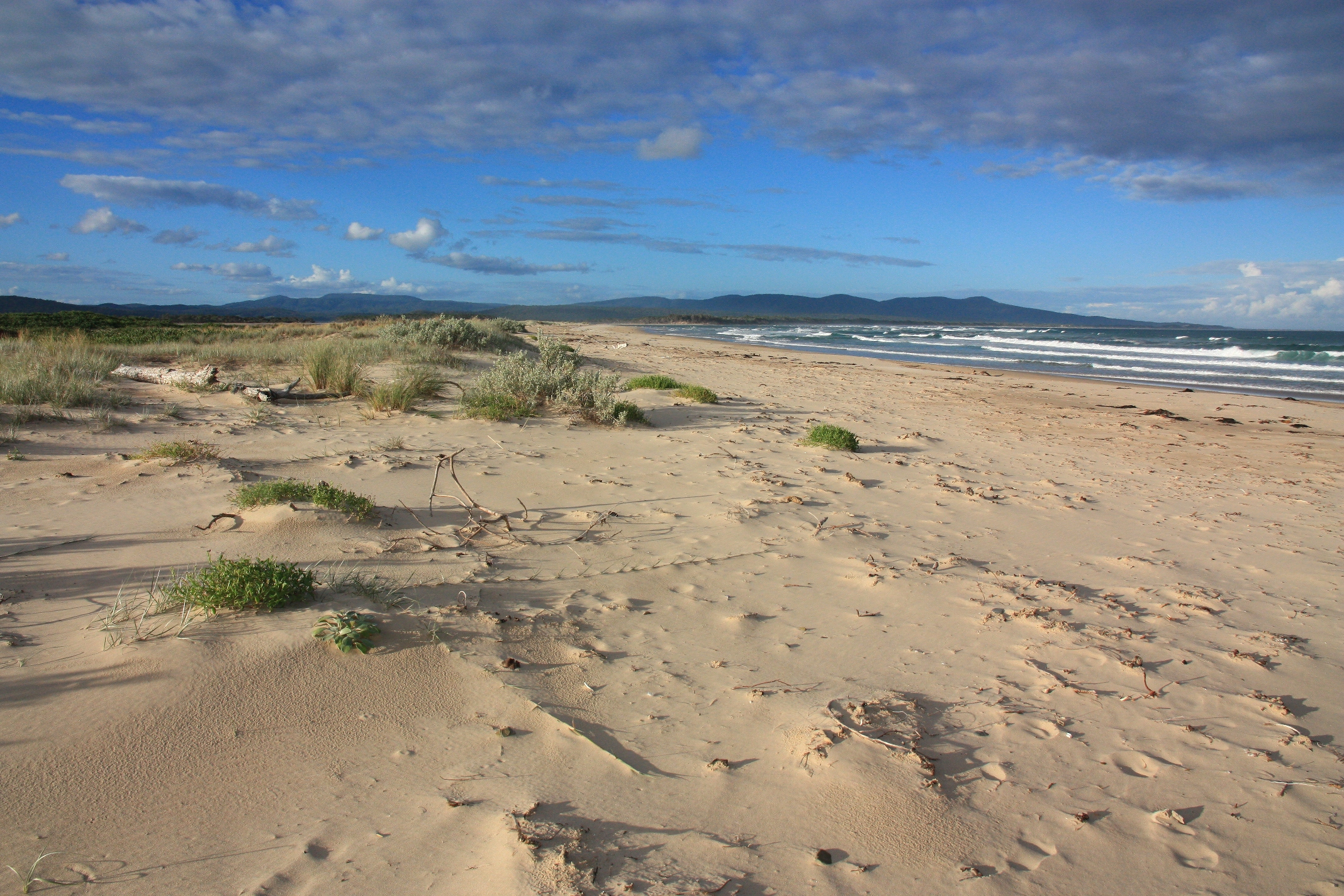
The noise echoes from the cliffs and trees fringing the ocean beach here, which is itself like a thousand other beaches in Australia. In that, it is nothing remarkable, even though it is, objectively, remarkable. Pristine sand and pristine waters, so clean the aroma is pungent with the abundant seaweed and crustaceans and fish. Scattered with the dog walker and fisherman and surfer and yoga practitioner, it is the spot to clear the head and mind, the place to come at the end of day to walk, fish, surf, or contort. It is the spot to feel at one with the world, humbled in insignificance as the sun lowers, the sands blow, and the waves churn out into the eternal horizon.
O_mallacoota

Beyond Mallacoota the southern coastline invariably throws up much more in the way of ocean-sculpted lands. Long beaches of ninety mile and entrances to lakes. Vast promontories and bays, becoming refined with sandcastles and beach huts and docklands and Melbourne. Westward still and curving great ocean roads meet shipwrecked coasts. Lagoons and islands of kangaroo turn upwards to Adelaide, and the waters greet peninsulas fringed with small ports and big jetties. Beyond things return to the empty simplicity of ocean and land, the land meeting ocean, a bight of irresistible force and unmovable object. Beautiful archipelagos emerge and vast sounds appear as civilisation returns, and the ocean weathers colour the corner of the southwest. A corner which turns onto another ocean and signifies the crossing of a continent.   

Some two months later and a lighthouse appears on the horizon, another lighthouse rising elegantly into a softly painted blue sky. Passing through Augusta the coastline takes on an edge-of-the-world charm, as the land narrows between two seas [3]Small bays and coves fringe the leeward side and teeter their way along to Cape Leeuwin, from where the lighthouse surveys the Indian Ocean. Next stop from here: South Africa.

In this prized corner of Western Australia the Indian Ocean is very much like the seas that have come before, knocking out a reassuring rhythm of surf and disappearing into a depth of endlessness. It’s a different ocean but the same country; many kilometres distant but not a million miles apart [4]. Windswept hills slope down and break off into the ocean, broad sands form at river mouths and creeks. Majestic forests revel in moist valleys while vines take advantage of open, sun-soaked slopes. Near this ocean, small settlements and towns still serve flat whites and offer The Australian for all the propaganda you can stomach. The same brands of coolant are available to top up a car which has done much since almost becoming bogged down in mud on the other side of the country, oceans apart.

There are of course subtle differences formed through climate and geology and mankind’s hand. A different array of deadly sharks and jellyfish may well linger in the water, ready to nibble on loonies in wetsuits embracing the epic waves. For the less adventurous, the diversity of the terroir yields different aromas in the Cabernet Sauvignon…perhaps less blackcurrant and pepper and more pomegranate and diesel (though don’t quote me on it). Tourist information signs are a different colour, though nonetheless as mysterious and confusing. And practically every town ends with the letters ‘up’, like Manjimup and Nannup and Whatsup Buttercup.

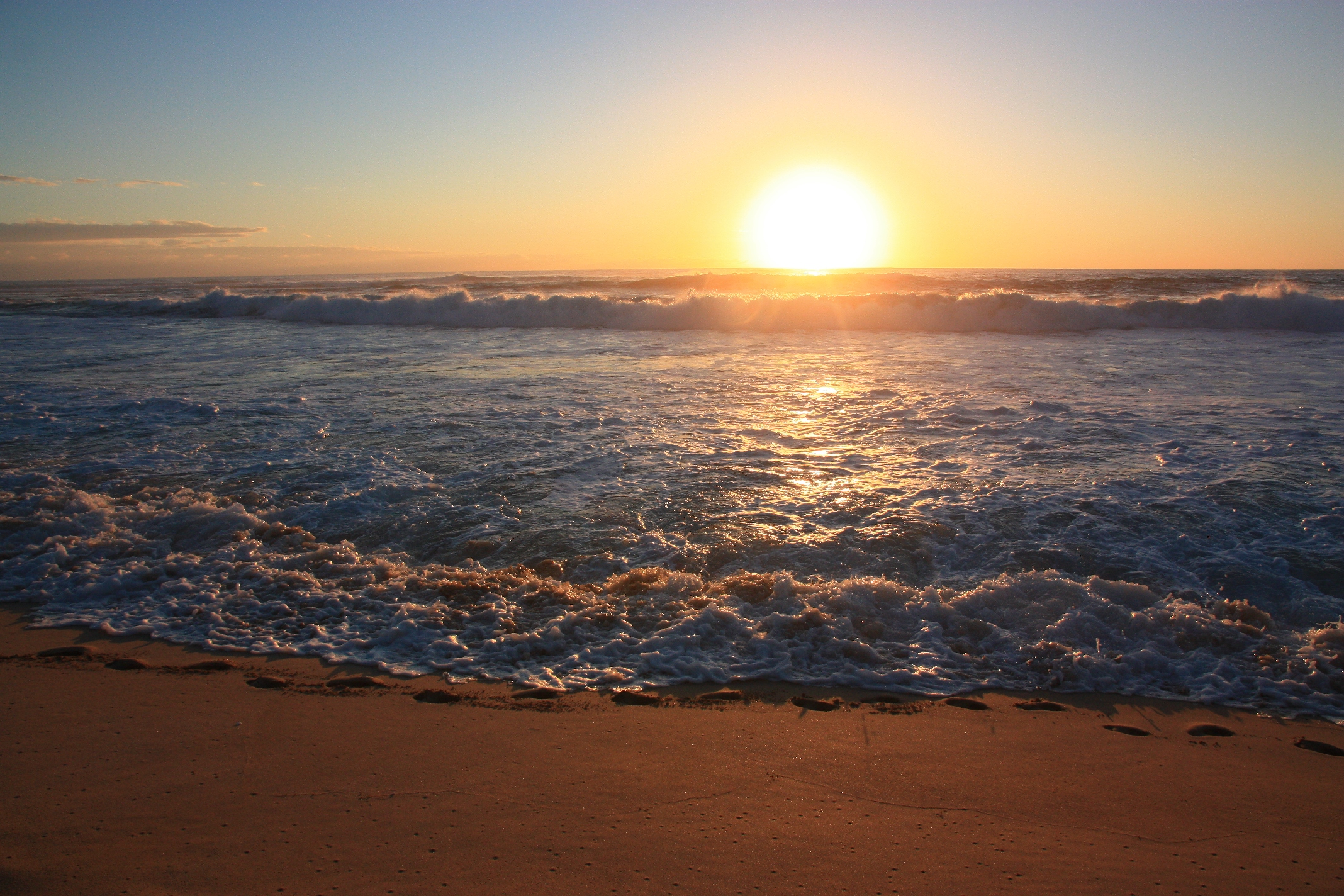
The big contrast – and a satisfying symbol embodying the accomplishment of crossing a continent – is that the sun sets into this ocean. At Yallingup, camped beside the roar of the sea for one last night, Mallacoota is reincarnate, a mirror image of sand, sea and sun. There is just chance, with the now shortened days of May, to amble on the beach as the day draws to a close; to battle through the sands and scarper from waves thrusting up the beach with great flourish; to join the smattering of dog walkers and fishermen and surfers and yoga practitioners, watching as the sun sets into this particular ocean and seals the wax on a momentous journey. A journey that has frequently mingled with the sea along its course, and astonished in scale as it has crossed from ocean to ocean.
O_yallingup


[1] Which is now branded as ‘Britain’s Ocean City’ no less

[2] Is it any wonder the latest Australian Prime Minister is such a visually strident man of the seas, sometimes scarily so?

[3] A charm seemingly being addressed by the construction of a large marina for more boat-owner people…Stop the Boats!

[4] In fact, for me, 17,000 kilometres, but more like 3,500 as the seagull flies.

Links

Britain’s Ocean City: http://www.visitplymouth.co.uk/

Mallacoota visitor information: http://www.visitmallacoota.com.au/

Destination Margaret River:

http://www.westernaustralia.com/en/Destination/Margaret_River/9009633

Wasssssup in Yallingup: http://www.margaretriver.com/regions/1

Another ocean apart: http://www.youtube.com/watch?v=c_e2D2qsaso
A to Z Australia Driving Photography

Kangaroo country

Nothing can be quintessentially more Australian than the sight of a man in a cork hat and grubby white singlet riding a kangaroo to work. Apart from a man on a kangaroo in a cork hat and grubby white singlet hopping over lethal spiders and snakes while fleeing a bushfire with a rescued koala, only to get to the safety of the beach and discovering a shark infested bay peppered with box jellyfish, causing a bunch of boofheads to gingerly enter the water in thongs to retrieve their cricket ball with one hand because the other is grasping onto a stubby of VB like it is the last bottle of insipid but undoubtedly cold beer in the world.

Of course, all of that is nonsense [1], lest I be sued by VB which is a popular and well-loved beer in certain areas and so well-loved it appears on the shirts of the Australian cricket team, which perhaps speaks for itself in so many ways. What is undeniable is that the kangaroo is an icon, so much so that it appears on the national airline and encourages you to buy home grown products. If you ask someone overseas to mention the three things that come to mind when they think of Australia, they will most likely say beaches, kangaroos, and punitive policies for people fleeing persecution and seeking asylum, dressed up as a concern for their safety and not really about winning votes from a cluster of the population who have an underlying xenophobia stemming from their own challenges in paying the mortgage on a home which is unnecessarily big for their needs and encountering traffic on the way to Kmart, thus displacing the blame for this onto others who are widely vilified and helpless to stand up for themselves [2]. Still, we have nice beaches and lots of open space for kangaroos, so it’s worth defending right?

The kangaroo was here long before the first boat people arrived to overrun the country and its culture. A popular myth is that ‘kangaroo’ meant something like ‘I don’t know’ or ‘I don’t understand’ when Cook, Banks et al enquired of local Aboriginals what on earth this peculiar creature was. Like all good myths it has subsequently been debunked [3] but you can understand why it still does the rounds. It’s a convenient story that encapsulates the sense of the bizarre, the other-worldly, the weirdness of the flora and fauna that was encountered by the first boat people. A befuddlement that continues to this day as more people spill, primarily, out of international airport terminals and come face to face with Australia.

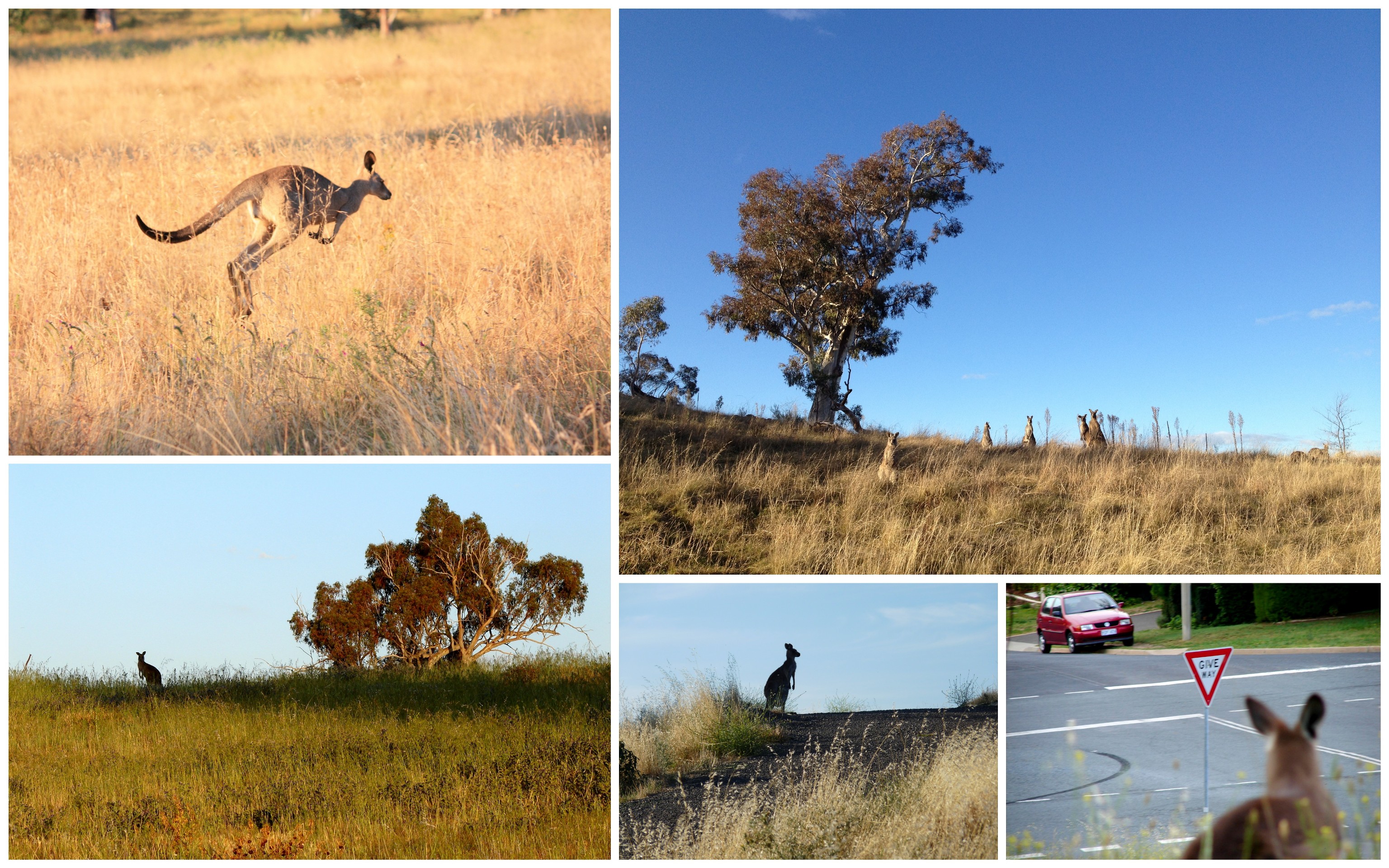
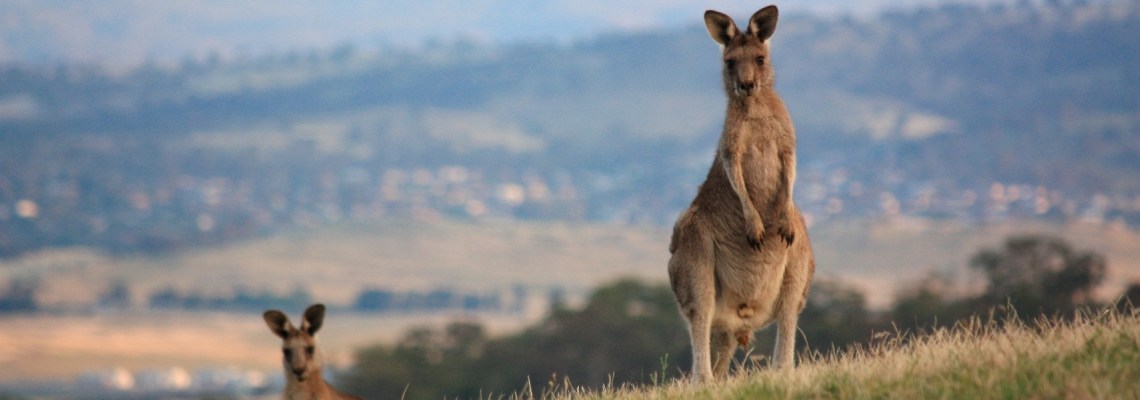
Initially you could be forgiven for thinking that Australia is a sunnier, newer, even happier [4] version of the UK, with a US touch of the gargantuan about it. But what sets it apart as wholly unique, exquisitely exotic is its flora and fauna. The kangaroo, perhaps in conjunction with wily white Eucalypt trees and shrieking cockatoos, is the readily available, easily accessible face of the Australian bush, and a long, long way from distant, familiar lands. Perhaps that is why, even after seven years, the sight of a kangaroo bounding out of the trees and across golden grasslands brings a smile to my face and, still, a sense of wonder.

I cannot write about these experiences and this topic without covering time on Red Hill, Canberra. I may have written about this place before. I came across it three days into arrival in Australia, fighting a fight against deep afternoon jetlag driven sleep. Determined not to fall into a coma and then awake all night, I set out along charming suburban streets on one of those beautiful, clear, warming late winter afternoons. It could have almost been an old English summer. Gradually climbing in altitude and property price, the streets ended abruptly as the very richest backed their way onto the grassland and steeply rising bush of Red Hill Reserve. Without intricate knowledge of paths and trails I headed straight up, short and steep to the lookout cafe. Here I viewed Canberra from high for the first time, had a coffee and saw a handful of Eastern Grey Kangaroos milling about without much of a care in the world (much like myself really).

Since that day I almost always saw kangaroos at Red Hill, particularly as I was wont to wander there of an evening. Huge mobs would gather in the grassier patches at the bottom while others would linger along the ridge up high. Mothers and their kids would eye me with suspicion or, perhaps, familiarity. A stand-off ensued, one waiting for the other to move on. But I often emerged the victor in these early days, because I would have my camera with me, and everyone knows that as soon as you bring your camera up to your eye to take a picture of some wildlife, the wildlife flees.

K_kangaroos

Certainly it was hard to restrain myself from taking a picture every time I saw a kangaroo. It was a natural reaction because back then it was all so extraordinary and therefore entirely warranted. Increasing familiarity has restrained my picture-taking compulsion since. In fact, I don’t tend to take my camera up Red Hill anymore…hell…I don’t even go up Red Hill anymore, since I am presently 3,000 kilometres west and it is a trifle inconvenient. However, frequently armed with camera elsewhere a kangaroo or dozen have popped into view. They emerge within the context of a wider landscape, as natural as, well, a man in a cork hat and grubby white singlet. They undoubtedly add something to the mood, grounding the scene in something that is so very obviously Australian. And thus, still, so very exciting.

————————————————-

Kosciuszko National Park is one of Australia’s great national parks, taking in vast swathes of upland country and river valleys in New South Wales. In winter the highest parts are caked in snow, in summer all parts are swathed in flies. It’s a fairly unique environment for Australia, which is mostly dry, brown and flat. Termed alpine, it is not so in the sense of being blessed with gigantic peaks and glaciers; instead ridges and clumpy mounts offer a scene more akin to the rounded peaks of northern and western Britain [5]. It is an ecosystem that is all-encompassing, from rare possums and miniature toads in the boggy bare stretches high up, to common wombats and kangaroos and all of their derivatives [6] in the bush and plains further down. 

Kosciuszko is not so far from Canberra but on one occasion, having spent some time working in the town of Albury, I approached it from the west. It was a long weekend of high country meandering, through the northeast of Victoria and into New South Wales before crossing the Main Range and ploughing on more familiar roads back to Canberra. Approaching the end of March the landscape was in a state of transition, from the dry, warm summer to freezing cold winter nights and winds and rains and occasional snows. The hairpin drive up Mount Buffalo – the closest thing Australia has to an Alpe d’Huez – came with freezing fog that cleared to warm sunshine. The valley town of Bright was commencing its ascent into blushing autumn saturation and wood-fired air. And the trudge along an endless ridge towards Mount Feathertop was blanketed in cloud, a stark contrast to the clear fresh vale below.

Crossing into New South Wales and finally into Kosciuszko National Park, there is eventually a sense that these are proper mountains and not big hills, as the highest points of the Main Range, glowing in the sun above the tree line, rise up more dramatically from this western vantage. The road on this side twists and turns along a narrowing river valley, the dense green bushland plummeting down the hillsides occasionally broken by huge pipes belonging to the mammoth Snowy River Hydro scheme. At some point the road rises and crosses the range at the evocatively named Dead Horse Gap, but before this tortuous ascent, there is respite at Geehi Flats.

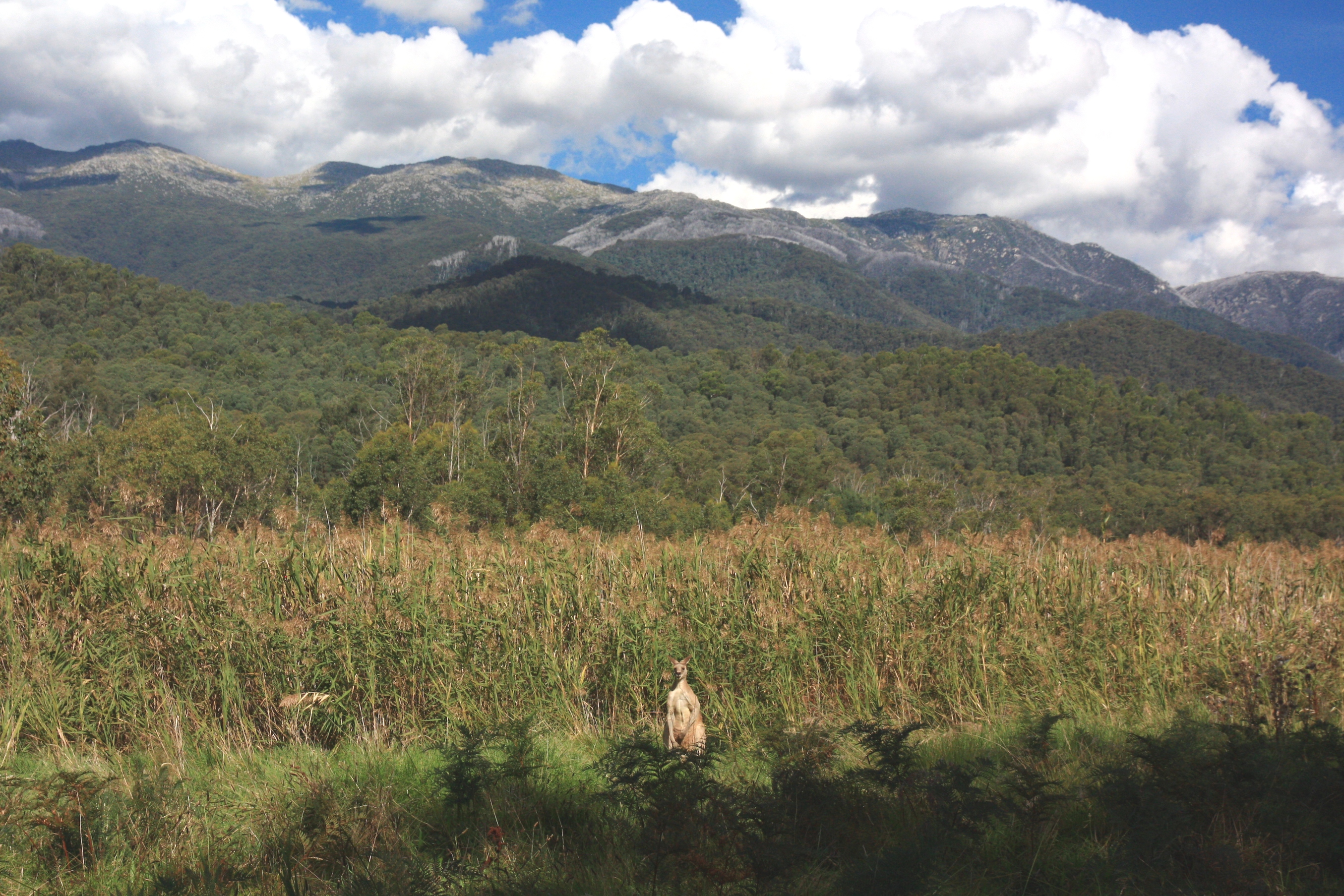
Geehi Flats appears like some hidden valley idyll, where the opaque water of the Swampy Plains River broadens and a swathe of grassland punctures the dark green tangle of gum trees. A spacious area along the river offers rustic camp spots and opportunity to amble. At the northern end a couple of old wooden huts testify to exploration and discovery and, now abandoned, the harsh realities of surviving in the high country [7]. Within this clearing the afternoon sunshine illuminates the rise up to the Main Range and onwards to the white cotton wool clouds hovering above. And as I stare at the serenity, a large Eastern Grey kangaroo stares back. Suddenly I feel like the intruder.

K_kossyroo

On the face of it, it is nothing remarkable…a sighting of an animal that I have seen hundreds of times before and so common in an area where it is protected to thrive. But in the landscape, in the setting, in the primitive high country context it feels very special, like I am the first white man to see it and it is the first kangaroo to see a white man. It is so amazed that it even lingers while I take a photo. It’s a chunky unit, but it is meagre within the scale of the whole, minor against the vast wildness of the scene. Yet here it sits entirely natural, a perfect foreground marker within the larger composition of my vista. What lies before me is Australia and I am reminded at how fortunate I am to be a part of it. Still a land of untapped discovery, of boundless space and unknown potential, it is something to cherish, to protect, and to share. And while the kangaroo is perhaps the pinnacle of the adaptive powers of evolution, as Australians we can still be much, much better than this.


[1] Clearly we only ride kangaroos around on the weekends for leisure, duh. Else the ute wouldn’t get much use.

[2] See http://www.guardian.co.uk/world/2013/jul/22/captain-rudd-australia-depths-shame for just one well-written, reasoned commentary on Australian Government approaches to ‘boat people’.

[3] Not by the team at Mythbusters I hasten to add, but by (and I quote Wikipedia) linguist John B. Haviland in his research with the Guugu Yimithirr people.

[4] I am unsure about this at the current time of writing, with a UK heatwave and cricket team in the ascendancy.

[5] However, rising above 2000 metres it is far higher than anything in Britain, a boast many Australians like to boast about.

[6] By which I mean the whole raft of hopping marsupial type things like wallabies, wallaroos, euros, jackeroos, jillaroos, brucearoos, kangabies, roosabies, poosaloosaroos etc etc

[7] Like camping overnight, when the warm daytime temperature plummets quite dramatically and uncomfortably

Links

All you ever needed to know: http://en.wikipedia.org/wiki/Kangaroo

Everyone’s favourite: http://www.youtube.com/watch?v=uRQnrY5V-rY

Walk the hill: http://www.tams.act.gov.au/__data/assets/pdf_file/0010/390592/cnpmapredhill.pdf

Kosciuszko National Park:

http://www.environment.nsw.gov.au/nationalparks/parkhome.aspx?id=n0018

Hi, country: http://neiliogb.blogspot.com.au/2012/03/hi-country.html

Stop the votes: http://www.amnesty.org.au/refugees/comments/24019/

A to Z Australia Driving Photography Society & Culture Walking

Beery

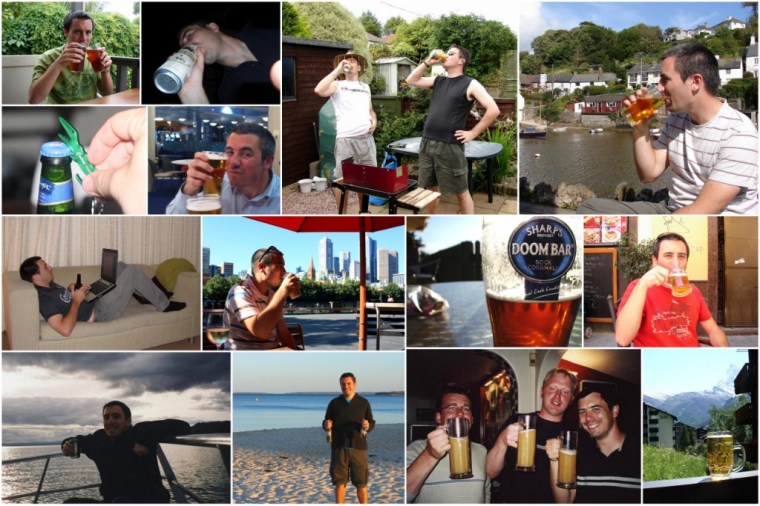
As an Anglo-Australian male in his thirties it is inevitable that beer has accompanied me on many occasions on the road and at home. At such times when one needs to know, like a doctor’s interrogation or unethically intrusive job interview, I’d declare myself one of these ‘social drinker’ types. From what I can tell, a social drinker is someone who grabs a beer or two when the mood fancies – to celebrate, relax, or navigate slightly awkward moments – or just when it’s the only thing cold in the fridge and you just can’t be arsed to scrape ice out of the freezer. Very occasionally the charming delight that you become after such social drinking turns sour (usually thanks to the beer being ‘off’ or some such), and imbalance and language difficulties can ensue.

The sage philosopher, Homer [1], remarked of beer as a “temporary solution,” in easing the challenging realities of existence. This temporary solution is also uncannily permanent around the world in which we travel, providing a readily available, relatively cheap source of comfort and joy. Though naturally something of a haze, I can look back on my life and recall a number of places and experiences that have been enhanced by beer or, broadening the spectrum a little, a good glass of wine or a tangy local cider or a holiday water style G&T. Often the drink is the icing on the cake, the encapsulation of a special moment. At other times it’s invariably been an antiseptic, painkiller or narcotic.

 B_beer montage

A proven value of beer when travelling is in how it can transform the first shy mumblings of disparate individuals on a tour group into one animated tribe. While the first day of such trips may have been spent quietly on the bus in little cliques of friendship pairs, the second day is typically dominated by shared tales of what scandal befell Jared and Janelle, and frequent hilarious stops for Lance to chunder like the man he is from down under. Meanwhile the tour guide acts like this has never happened before and this group is – based on the escapades of the previous night – simply the most awesome ever [2]. Multiply this all by several days and nights and you are left with a teary, hollow feeling that you will never be as one again when the trip is over and that Lance’s chunder is now but a trickle down some distant highway. This may sound like a young persons’ rite of passage, but I daresay the same happens on more senior and old at heart tours, just replace ‘beer’ with ‘wine’ and ‘chunder’ with ‘incontinence’.

Unless you happen to spend a large part of your time meandering in the Middle East, beer is an international language, demonstrated by the fact that almost every country has its own version. Within countries, different regions produce their own local brew and it can be a strong marker of local identity. Obviously one of the joys of travel is sampling local food and drink and I’ll always look to a local beer if I can, unless I have already discovered its similarity to the secretion of a small flying insect, or “gnat’s piss” as it is sometimes described. The trick for the traveller is to know the local beer sensitivities, so as not to order some nancy fruity lager with low carbohydrates in the North East of England or the culturally offensive XXXX from Queensland in anywhere but Queensland [3].

Moving from England to Australia in 2006 I have gradually come to learn the sensitivities of what must be two of the most rampant beer swilling nations. My biggest faux pas was when fresh off the boat and still subject to irritants like Shane Warne. Tasked with getting some beers in for Friday work drinks I grabbed a crate of stubbies from the local Bottle-O [4] only to be chided for their warmth. The stubbies felt pretty cold but that was in fact ambient air-conditioning temperature and not arctic freezer temperature, which was how the locals preferred it. And now, after six years or so, that’s how I like it, perhaps because it’s the only way to subvert the lack of taste.

Beer has been part of my cultural integration and a means to become accepted as a bona fide Australian. A barbecue with awful slimy sausages does not feel right without a beer in hand, cloaked in a tacky stubby holder. Mercifully, even those who were subject to my warm stubbies have become good friends, and I have since shared drinks with them fresh out of the chillers of a 7-11 in Hong Kong, wandering party streets with beer in hand, inevitable ending up in Maccers at night’s end. This was one of those experiences where the beer must have been ‘off’, since a malaise lingered for the rest of my stay there.

Australian beer consumption seems natural in the outdoors, huddled around a barbecue, the droning of cricket commentators in the background. It’s also a good accompaniment beside the sea, tasting even better after an active day of exploring and coasting. One such memory stands out when I was in the Margaret River region of Western Australia. Here, after a blissful drive south from Perth, the day’s end saw me at Prevelly, a low key settlement on the coast, popular for surfing or just hanging out like a surfer. The headland here is actually called Surfer’s Point, and this particular evening it was jam packed with people of a dreadlocked and slightly skanky looking nature, plus their groupies. Inexplicably, many were clambering over the rocks with what looked like ironing boards to bob up and down in the water at prime shark feeding time. Others were returning from the water, getting changed with very little discretion around their beat up vans. There wasn’t just the one full moon that night.

Positioned the other side of the headland was another cove where the Margaret River itself came to a halt against the sand. With a sandy beach, sun disappearing over the ocean, full moon rising over the river, ambient temperature and vibe and one beer lugged several kilometres in the pocket of my shorts, the scene was set. Twisting the bottle top of my beer and nirvana was within sight. Apart from the fact that the bottle top wouldn’t twist off. It was one of those fancy boutique beers requiring a bottle opener. I could have cried.

In such circumstances one finds oneself thinking what Bear Grylls would do? But given I neither had a film crew nor nearby hotel in which I was actually staying, I was forced to reassess and consider what would MacGyver do? The answer lay in the use of keys, a wooden stick from an ice lolly, a bit of rock and willpower. After ten minutes it finally opened, the first gassy hiss like the sound of 80,000 fans at the MCG cheering. It was now slightly warm but I obviously didn’t mind and the beer went down like the sun and the mood climbed like the moon.

B_marg2 B_marg1

While offering spectacular outdoor beer moments like this, Australia has generally disappointed in its indoor drinking environment. Pubs are often bland behemoths with tacky decor and goddam awful pokies, an attached bistro offering an array of equally dull and not as cheap as it should be food. As a result, I love returning to the UK to duck into any one of its dark and dingy drinking holes and remember an archetypal rainy day in London a few years back where, killing time before meeting friends, the only answer was to pop into a random hostelry, drink a couple of warming ales and write postcards. Perversely, pubs in the UK tend to have better beer gardens too, perhaps a result of the local obsession with hanging baskets and, well, opportunities to drink away the misery on every street corner.

An English speciality is the country pub, often offering a roaring fireside, wooden tables and outdoor hanging baskets. Beers range from generic chemical concoctions to the occasional guest ale brewed in the local cowshed. It’ll be called something like Olde Spotted Dick or Malted Slipperypipe. To soak it up you can sample a menu ranging from cheesy garlic bread to cheesy lasagne to cheesy chips and perhaps even cheesy peas [5]. There will be an aroma of stale beer mixed with cow dung. And you’ll generally be made to feel welcome because everyone in there has been inebriated since 1972 and cannot be bothered anymore.

One very lovely country pub moment that I remember was in the equally lovely Lake District in northwest England. For a country as small and crammed as England it is remarkable how much of it has an alluring pastoral air and sense of light and space. In this regard, the Lake District is an absolute gem. On a surprisingly sunny and warm late summer’s day, with the farmers making hay and the sheep bleating contentedly, a small pub along the country lanes of Langdale offered up not a beer but a beautifully of-the-moment cider. Despite repeated attempts, that first cider on that first night could not be beaten. It was the official start of the holiday, the ‘we have arrived’ moment and perfectly set up a week of discovery and delight.

B_lakes

Would such moments have been the same without alcohol? One would like to think so, purely to reassure oneself that they are not dependent on booze. But in reality I don’t think a glass of lemonade would have cut it. Good beers (and ciders) emerge at the end of good days; they are both rewards and tonics. They can lift a moment from average to good, good to exceptional. And they trigger associated memories of time and place. They are the beer goggles that help us to look back on moments with a rose-tinted air. Sure, let us not overdo it, but let us also not dismiss beer as just another vice. Remember kids, drink responsibly, and if you can’t, best to head off on a Contiki tour with Lance.


[1] J Simpson, not the ancient Greek dude

[2] To argue against this point, see https://gbpilgrim.com/2012/12/15/a/

[3] With the wonders of marketing however it is very acceptable to have the ‘Australian’ Fosters in England, but do not drink it (if you even find it) in Australia!

[4] Translated, for those of you who speak English, as ‘I purchased a 24 pack of beer bottles from the beer shop / off licence / liquor store’

A to Z Australia Food & Drink Great Britain Society & Culture

Awesome!

Well what a jolly upbeat place to start, no doubt setting the scene for the boundless enthusiasm that lies ahead. So, in order to put an immediate dampener on things, let me tell you some problems with this word and its application in the world of travel.  For far too long, far too many people, myself included, have liberally used a simple ‘awesome’ to reflect or describe an experience which, while probably very good, perhaps exhilarating, maybe fun depending on company, was technically not inspiring of our awe. Akin to Australian misogynists trolling their way through the hate media in 2012, overuse has diluted its impact. Awesome is no longer quite as awesome.

And who should we blame for such degradation of our language? Well, as every reasoned, fact-based opinion piece would purport, young people and social media of course! I suppose while we are thinking along such lines then we might also point the finger at any combination of immigrants, foreigners, boatpeople, sandpeople, wookies, orcs and trolls. Bloggers, who may fit in any or all of the above categories, are no doubt entirely culpable.

Of course, this is all assuming that we have to blame someone or something, which tends to be the way these days, rather than accept that things change for better or worse and that language is merely an extension of our natural evolution. Besides, I also think we could rule out young people in the blame game, simply because “awesome” sounds so 1990s. A bit like “cool’. Which naturally brings me on to New Zealand.

Nowhere, simply nowhere, have I heard the word “awesome” used to describe so many mundane things…

How were your fish and chips? Awesome, thanks. Cool [1]

How did you sleep last night? Not bad thanks. Awesome

What do you think of the Hobbit movie? Yeah absolutely awesome Peter Jacksons a legend bro

It may be because New Zealanders – who I truly believe are one of the nicest, warmest peoples on this planet – are naturally happy and optimistic souls (the counterargument, typically from boorish Aussies, would be that they are easily pleased). The irony of this is that New Zealand probably contains the most genuinely awesome sights and experiences per capita of anywhere in the world. Yes, experiencing a silent, dawn reflection on the glass water of Milford Sound probably is awesome; the extent to which your lamb chop is seasoned really shouldn’t be.

I am willing to cede that awesomeness is entirely subjective. Perhaps, indeed, a well seasoned lamb chop (which is important) could be awesome when one finds oneself ravenously craving salty meatiness. Thus in travel we will all come across different things that we find awesome. Not just incredible sights but experiences and emotions that pop up in the right place at the right time. The combination of physical place and emotional connection is often the most magical. One can trigger the other. For me, a physicality that is almost impossible to fathom and epic in scale is usually awesome [2]. It is something that is rightly awe-inspiring and as such generates an emotional reaction. Emotions ranging from bewilderment to wonderment. A sense of one’s own time and place in a grander narrative.

Awesome travel experiences should be impossible to fully convey through words and pictures. Which, with a sense of inevitability, I shall now attempt to do, reflecting on two very different environments. One is man-made, the other crafted by the hand of nature.

————————————————–

A_New York

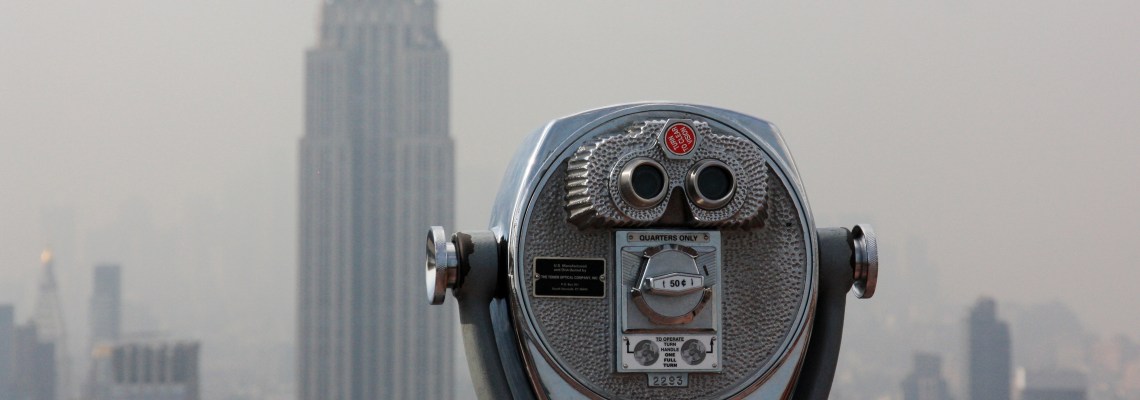
When it comes to epic environments of a man-made scale I’d argue it would be hard to look beyond New York City and the landscape of Manhattan Island in particular. Everyone should visit and everyone should easily find an awesome moment. There is incredulity attached to the place, simply in how a muddy island has evolved over little more than two centuries to become, and I plagiarise, one hell of a town. A testament to human survival, endeavour, ingenuity and skill. A reflection too on human frailty, failings and fears. This may be how far we, as humanity, have come, both in good and bad ways.

Even from atop the very highest buildings the city is impossible to fathom (remember this being a key requisite of my definition of awesomeness). At my time of visit (2011), the Empire State Building represented the highest point in the city and the experience from the 86th floor around dusk was incredible. Each city block a melding of concrete, steel and glass, bubbling upwards like the most majestic capitalist stalagmites. Each block ringed by a dotted artwork of moving yellow taxis, police cars, black and white suits, turning to streams of candescent red and yellow as darkness falls. This scene replicated and nuanced many times over, forming a feast for the eyes of gargantuan proportions.

There is more to this experience than the visual epic. The sound is at one singular and plural; a constant background hum punctuated by sirens wailing, drills whirring, concrete blocks piling, delivery vans unloading. For all I can make out, the mutterings of individual conversations and transactions rise up – “Get me a bagel schmuck”, “Siphon residual profits into offshore hedge fund now”, “Aw gee, that’s so awesome” – and meld together to form an indistinct, indecipherable story. Yet it is also a soundtrack that is – comparative to the streets below – soft and mellow, calming and reassuring, like a doctor with a good bedside manner, telling you it’s only a cold and will go away in a couple of days.

Without wishing to sound entirely blasphemous or indeed egotistical, it is possibly the closest you can physically feel to playing God. Here I am, overlooking the chaotic order the ant like humans have made. They seem to have done pretty well, but I’m not quite so sure where they are heading with all of this. Still, if it mostly keeps them out of trouble then I’ll let them get on with it, for now. I do wonder if their structures and movements and lights flickering on as darkness approaches are a brazen act of defiance to the nature I have created. But I’ll just make sure the sun goes down and comes up again, throw in some random weather and inevitable seasons. And let them see what they can do about that – ha!

I think it’s this realisation that you are both atop a pinnacle of human endeavour yet still at the mercy of the world around you that makes the top of the Empire State Building genuinely awesome. Coming at dusk accentuates this feeling, the changing colours reminding you that not even humankind can change the revolution of our planet and relationship to other bodies within the solar system (yet!). Despite what we have achieved, parading in such an obvious fashion below you, we cannot completely change the world. And that is a merciful thought. It adds to the relief at being so high, up away from the city, taking a breather from the millions below, yet remaining connected to them. And, gee, it’s a tonic for a great view.

————————————————–

A_bluemtns

Great views abound in the Blue Mountains of New South Wales in Australia. Before I go any further here I should reiterate the guide book lines: they are not actually mountains and they are not really blue, unless Bernard Manning has been resurrected in the wattle to yell out random profanities. Don’t expect high alpine drama of ragged granite shards and snow-capped peaks here. And, despite its very real wilderness, don’t be thinking you’ll be entirely escaping the clutches of mankind, given the most common way to see the place is along the not-so-Great Western Highway, with typically nondescript towns and Sydney style traffic. However, what is really awesome is the fact that you can walk down the streets of several of these towns and come to a rather abrupt halt. Or you could, should you really want to, carry on and topple many hundreds of metres down to join millions of Eucalyptus trees sweeping their way through valleys, tucking up like broccoli textured blankets against sheer sandstone cliffs, sheltering crazy birds and possums and snakes and spiders. A world before we were here.

Even though it may seem about as far away from New York City as the former planet Pluto, there are parallels between the two, conveniently suggesting common threads exist in my take on awesomeness. Sandstone pinnacles thrust upwards like the Empire State Building. Down below, a tree-filled pattern of regular irregularity. Sounds drift up, only, this time, the sirens are the echoes of bellbirds and the cackles of kookaburras and cockatoos. You are once more God-like, and with a sense of befuddlement at the sheer comprehension of what is set out below.

Out there remains wilderness, all still remarkably close to a sprawling city of over four million people. The ‘mountains’ remain an effective barrier to the seemingly endless sprawl, with shoots of Sydney forced south and north to new suburbs promising ample land and countryside but without really being in Sydney at all. The suburbs are unwittingly following the route of a few cows that escaped around 200 years earlier in search of pasture; cows that eventually found their way around the mountains, unlike the intrepid explorers who thought they could just head west in a straight line, endlessly naming everything that got in their way after themselves. Can we deduce that cows are smarter than many 18th century British colonial dandies? Surely not.

From the small towns that emerged once the explorers had stumbled across the mountains (only with the essential assistance of the local Aborigines) there are many vantage points to peer out into the void of the Grose Valley (to the north) and Jamison Valley (to the south) [3]. Some of these lookouts are grand, glamorous affairs, with safety rails and public toilets, information placards and tame rosellas. Echo Point in Katoomba is the most obvious yet still it offers a dramatically photogenic vista. You may find it awesome.

For the record, I find Sublime Point, further along to the east offers greater potential for an awesome experience. It’s harder to reach and thus you are more likely to experience it on your own, just you and the world for company. You are especially likely to have it to yourself at 6am in June, the wind piercing the bones and shaping bleary-eyed hallucinations of the valley mist into a soft, warming duvet. It is elemental, timeless and boundless. And as the first laser beams of sun hit the sandstone and the birdsong strikes upwards from within the mist, it is sublime, it is awesome.


[1] Everything that is awesome is also cool. Some things that are cool may not be awesome.

[2] Perhaps “epic” is in fact the modern day “awesome”, particularly since it requires fewer characters in a tweet.

[3] Further west there is the Megalong Valley, since tamed and given over to farming shortly after someone came up with its inspired choice of name.

Links

Speak like a New Zealander: http://www.statravel.com.au/new-zealand-language.htm

The Empire State Building: http://www.esbnyc.com/

Me and NYC: http://neiliogb.blogspot.com.au/2011/10/spreading-news.html

Bernard John Manning: http://www.bernardmanning.com/

Destination NSW – Blue Mountains: http://www.visitnsw.com/destinations/blue-mountains?gclid=CMzA4_uUmbQCFcohpQodCiYA-g

Crossing the Mountains: http://www.sl.nsw.gov.au/discover_collections/history_nation/exploration/blue_mountains/index.html

Sublime times: http://neiliogb.blogspot.com.au/2011/06/sublime-points.html

A to Z Australia Photography Society & Culture USA & Canada

Big, big things

Encounters with the ‘big things’ around Australia. It’s amazing what can be achieved with concrete, plaster and a desperation to attract weary roadside travellers…

Australia Driving Galleries