Whether it’s an epic global adventure or – more likely – random meanderings close to home, travel is an integral and frequently joyous feature of many of our lives. But we travel not only in relation to our immediate geography, we travel too in our mind and soul. We travel on that most mystifying and blessed journey that is life. And, like the laboured 09:00 from London Paddington, my life journey has called in – notably delayed – at a rather significant station.
Which is all to say I got married. So let’s call this station Bath rather than Bristol Parkway, for there is elegance and grace and it is a far nicer place to be. Plus I’m hopeful there will be more stops along the journey, all the way to my final Penzance (and then perhaps onto that renowned land of the undead, the Scilly Isles).
One of the lovely things about this Bath station is the convergence of fellow travellers from journeys past. Reunion and reacquaintance with others a cut above those relationships you form with strangers on the same carriage on the same train at the same time on the Northern Line from Finchley Central every weekday morning.
And so from this metaphorical Bath to a literal Canberra. It’s a fair leap, one almost mirrored in real life by Dad who arrived with time spare to stalk butterflies and ice cream parlours in between a wedding. We picked a good time of year for it, when Canberra’s skies are filled with decorations natural and man made, and the weather is plenty warm enough for hokey pokey.
I particularly enjoyed a walk with Dad to Square Rock immediately after the wedding fever had died down. Not only was it one of those rare spots he had never been to, it was also nourishing to cleanse myself of run sheets and entrance music files and stickers on glasses and lines in Mandarin and fingers crossed about the weather and forgotten bouquets and the pile of photos to sort out.
Space, clear air, nature and snacks on rocks. Though, with a ring on my finger, wedding memories were never far away. I was thinking the rocky outcrop would make a good spot for a proposal, champagne corks shooting into the yonder. But once is enough, thank you very much.
———————————-
From a romantic spot with Dad to a “honeymoon” with Dad. I use the quotation marks (and can mime the associated comical gesture should you wish) deliberately. For if I was to pick a honeymoon venue it would probably not be the Gold Coast. And yes it’s unlikely I’d take my Dad. Coincidence just did its whole chance occurrence of simultaneous events thing where cheap flights booked long ago met a weekend after a wedding.
There were many positives about the Gold Coast, enough to balance out the humid showers and traffic lights and bogan tendencies to etch cocks and balls in the sand. We had a super view from our apartment, only dwarfed into insignificance once atop Q1 for a buffet breakfast. Within a thong’s throw of the beach, the water was lovely to wade through, and residual sand could be washed off in our pool just across the road.
From the balcony, night markets were spotted and explored, a trail of stalls selling healing crystals or imploring you to hold a lizard for twenty bucks or to commission a really bad caricature for more. And food options lay out in excess, from Japanese to Thai to McDonalds and Messina. Gelato fans, new and old, converge.
The sprawl of the Gold Coast can make it seem hard to escape. And, like casinos in Vegas, that may well be the intention. Burleigh Heads National Park offers mini respite, in that at least it is not another high rise or souvenir shop. But this isthmus of bushland is, on a Sunday morning, undeniably popular with people in tight pants exercising, people who you suspect might use the words “media-based wellness inspirator” when asked what they do for a living.
Still, away from the curated coast path there are some pretty butterflies if you look close enough. Like everyone, enjoying relief in a lofty opening up out of the humid jungle. But also, like everyone, seemingly desperate to keep on the move.
I find the real gold of the Gold Coast is actually inland an hour, significantly less gold, more green and certainly not coast. You can still espy the sea and the skyscrapers from the Springbrook plateau, but in between lays verdant, dramatic, primeval rainforest.
Today, it’s significantly cooler and punctuated by cotton wool pockets of vapour drifting above the trees. Water is a major aspect of life up here, including a recent Cyclone Alfred inspired 1146mm in 7 days. It’s surprising the roads are – with a little repair ongoing – still open. And not at all surprising that the waterfalls are full crescendo. An idyllic honeymoon spot. An adventure invigorating. A location not immune to influencers but with enough space and spectacle to spare. A few miles and a million years from the Gold Coast.
———————————-
From a land of water to a land of water, unfortunately timed for the final weekend of Dad’s visit and our disjointed sort-of-honeymoon. We were heading to Tathra on the far south coast of New South Wales. Compared to the Gold Coast it’s like going from The Prodigy at a rave to Enya in a spa. I would use more contemporary pop culture references but I’m getting old. Besides, Tathra has a mid nineties vibe, a time when presidents played jazz and unhinged dictatorish ones were being prophesised in The Simpsons.
Despite portents of doom, the weather wasn’t exactly terrible when we arrived. Sure, take a raincoat to walk to the pub but do so with hood down. Then up. Then down again. And, as the last remnants of daylight savings endure, sit outside but make sure you are close enough to the walls to be under the veranda, just in case.
The next morning started with promise too, in that I don’t think it was raining much. But arrangements to meet down on the wharf were changed in the space of thirty seconds. Let’s try coffee inside and see if things pick up. Then let’s have some lunch and see if things pick up. How about after afternoon tea… maybe things will pick up then? But you surely know the rain has set in when the monopoly board is unleashed and you take comfort in a jam and cream lamington.
Thankfully these are good indoor Sundays, when hearty food and drink is matched by cheery company and chat. When cats retreat to bedrooms and paper planes rain down from the indoor skies. A time and place where it only costs $400 to buy land on Sydney Harbour and then, almost inevitably, end up in jail. Hoping to break free as the wind and the rain lashes at forty five degrees.
It was almost dusk when things did marginally pick up. And me, my Dad and my wife managed that kind of walk which was invigorating and refreshing and all the more enjoyable because of the wildness of the weather. Sure, let’s hope none of those branches sway any further than a few metres, and watch out for the newly formed rivulet trails. But check out those waves and those sounds and the clouds blowing through to dump more rain on the hills.
This weather all sounds very British. Which, by good narrative fortune and by way of Bermagui and Batemans Bay takes us back to that figurative Bath. Most of the passengers who came together are now on their way, the final one set for the 1540 to London. Balloons have deflated and cards are packed away. On the platform, two solo travellers have united, ready to embark on the next leg as one. Stand clear of the closing doors. Bristol Parkway, and far better places, await.
Something didn’t sit right with me. Trying to get to sleep in a single bed on creaking, turn-of-the-century floorboards. Below, a bar serving the last of the whooping and hollering, the cackling shriek of a drunk Australian lady all the more painful when you know you need rest. Mind ticking over like the cycle of a misaligned wheel.
The remnants of merriment below had cowboy vibes. With Gucci trimmings. Equally at home in Fortitude Valley as downtown Linville, partying like they are 1999. On a night in 2023 when Australia received what to me at least felt a simple, unremarkable request from a broad representation of its first peoples for them to actually matter and said “yeah nah we’re alright thanks”. Whooping and hollering – as innocent as it may have been – struck a dissonant chord. And I edged closer to sleep with doubts about what it meant to be crossing country the next day.
The Brisbane Valley Rail Trail (Part II) traverses Waka Waka Country and Yuggera Country – or at least I think as much based on the little I can glean from local council pages. Today proclaimed as the longest continual recreational trail in Australia (if not the southern hemisphere), it intermittently welcomes people on bikes and horses and feet to roughly follow the course of a disused railway line from Yarraman – deep in the electorate of Maranoa – to the fringes of Ipswich. A manifestation of intrusion and industry and inevitable decline once quick riches had been cut down, torn, eradicated and washed from the earth.
In a sign of hope and rejuvenation the old rail line is now transformed into a place where people can come together on a shared journey, even if some of the newer locals remain deeply conspiratorial. Avid readers may realise this is my second time along it (and with my back now going through all sorts of agony it’ll probably be the last). From a pair of lone rangers we doubled in size as a group of four. Not quite MAMILS but only really lacking the Lycra. Starting off on brand by getting confused over where to start.
In many ways the first 20 kilometres is the hardest, adjusting to seats and handlebars and pedals and pace and the actual realisation of exercise. Things are a little undulating and already hot, and the approach to Blackbutt seems to drag on forever. But eventually bakery rejuvenation occurs, some tuning and top ups ensue, and we are full steam ahead.
The run to Linville is mostly bliss if a little jarring in places. Forest creeps in on both sides and the gradient works in your favour too. The breeze of momentum keeps you cool and a slice from Blackbutt survives well enough to sugar-rush the journey east. Beaming white in the afternoon sun, the Linville Hotel is a very beacon of balustrades and cold beer. The store next door a welcome purveyor of ice cream.
After a little recovery, day all too soon turns into night because Queensland doesn’t bother with daylight saving (probably because it is seen as another way the government are trying to control you with 5G vaccines or whatever). As much as I try, I cannot find the ideal beer to accompany a local steak and a background band mostly playing the entire catalogue of Crowded House. Only at the end, as encore way past their bedtime, do they strike up Farnham’s Voice. I cannot tell if this is a brave call, a lost opportunity, or a musical smirk.
Linville is in a pretty position among rugged hills, folded and contorted and topped with natural Australiana. Just beyond a few of the folds you’ll find Kilcoy, where in 1842 flour was laced with strychnine and given to a large group of Aboriginal people by two shepherds at a squatters station. Reports – like many of the time – are vague and swept under the carpet. At least sixty Aboriginal people were killed. A death pudding massacre.
I share this clearly not for entertainment or as a segue into some cycling incident but merely to share it, to acknowledge and make it known. I had no idea, freewheeling downhill, what happened among those hills until I got back home and decided to look into the Aboriginal origins and history of the country I had just crossed. Where the squatters came first, farms and forestry followed, towns and people sprung up and eventually a rail line was constructed. Large swathes of land were stripped of trees, including the unique Bunya Pine, which only now exists in small pockets to the west. Worse, the land was largely stripped of its inhabitants, sent to missions if not a fate more terminal.
The second day of pedalling through the present and the past is more open and exposed, the cursed removal of trees a bane to modern day cyclists exposed to the searing sun. Already the land looks a bit sick and brown from the latest evolution of drought. There are few animals, other than the occasional cluster of cows hunkering down under a lone tree or dilapidated shed.
There are also a few magpies and – miraculously – they are leaving me alone while going for the other mamils in my crew. This is wonderful, so much so that I whizz on and almost decapitate a snake that I didn’t even see until after I passed it. I feel somewhat blessed and incredibly fortunate in hindsight. It’s like they knew or something.
The towns – or what pass for towns – tick off at fairly regular intervals. Early on there is Moore with its three cafes, of which one only seems to be open and doing a good trade in weirdness and antipathy. It was here I discovered a publication called The Light which from a brief glance before I felt the urge to use it for toilet paper proclaims to shine a light on all things the establishment don’t want you to know. Likely bankrolled by such establishment figures as Rinehart, Hanson, Palmer and co.
Next along from Moore, after one of the bigger climbs of the trail is Harlin, which appears little more than a pub and a servo. Still, giant bottles of knock-off Gatorade are welcome, as is the cooling 90 metres of the Yimbun tunnel a little further on. It’s a good place to pause, adjust padding and apply sunscreen before persevering with more open, baked-earth riding to Toogoolawah.
You know Toogoolawah is – in relative terms – big because it has a choice of two pubs for lunch as well as a sprinkle of cafes. Closer to the highway you can even find some homemade fudge and maybe decent coffee but the old rail line has other places in mind. With a local recommendation we decamp outside a pub and have a hearty lunch in the shade. Pizza topped with so much topping it takes a while to discover the base. Welcome and delicious, but I am wondering how all that salami, olives, capsicum, tomato, feta, mozzarella, parsley and bread, pepped up by a lemonade, is going to sit.
There was a bit of gas departing Toogoolawah, an uphill grind but one that I quite enjoyed. Dropping into a nice low gear and spinning gently, consistently, without any real rush to get anywhere. Bare country eventually cedes to a line of boundary eucalypts that accompany us to a cutting where the railway peaks, and it’s downhill from there. Suddenly speed is a thing again, the ruts and stones bouncier, gripping on to handlebars that much tighter, the air flow providing welcome ventilation. In hindsight it feels like this all the way to Esk, but there was definitely still pedalling involved.
I was a little concerned about getting to Esk around 3pm, just as everything was no doubt closing. But a new addition along the BVRT, a very BVRT business in fact, was kicking on into a Sunday arvo session. Brisbane Valley Roasters no doubt attracts the hairy mamil with single origin roasts and cold brews and almond milk. There are bike racks and large wooden benches and probably some of those fake succulents you get from IKEA. After such high dose rustic rural, you may temporarily feel an inner Melbourne vibe, or at least central Tuggeranong.
But then Esk happens. For some reason today all the staff appear to be about 14. There are no lightly bearded hipsters or man buns dosing double shots and feathering foam. I opt for an iced coffee anyway, given the heat outside which is now well into the thirties. A solo performer mistunes his guitar and is gearing up for some gently grating entertainment, supported by a handful of friends and family. A lady from out of town accosts us and talks about love and secret hideaways up on the Darling Downs and how hard she has worked all her life and that young people don’t know what hard work looks like and they should stop buying avocados or something. I fear 5G radiation PayPal vaccines might be next. Still, at least it’s not sitting, working, sweating on a bike.
I assumed all the young people of Esk were working at Brisbane Valley Roasters that day, but it turns out there are even more of them in the IGA. I suppose as well as providing cheap labour for hard-working business owners it’s something for young people to do other than vape. And they’re all rather friendly in the IGA, even as Jason – by now high on morphine or something – rambles on about (and looks like) the Esk Yowie while I am trying to buy some reduced price tabbouleh from the girl behind the deli counter. Young people are nothing if not resilient in the face of the weirdness they encounter.
Dinner turns out to be an IGA affair since the pub is closed and the Thai is also – due to unforeseen events – closed. We stock up on food, too much food, for breakfast as well. Thinking, quite rightly, that nowhere will be open at five in the morning. And also thinking, quite wrongly, that we could eat two apple crumble cakes reduced to 99 cents, along with several pots of yogurt, cereal bars, a tree of bananas and a two kilo bag of rolled oats at five in the morning.
It is an uncivilised hour to rise but the final day is also the biggest and longest. And some of us have a train, and plane, to catch. While initially confronting, the early hour is by far the best on the bike. The light glowing soft, the air calm and cool and infused with that dewy, earthy fragrance of something akin to dried straw and peppermint. The trail is subdued too, enclosed by forest pretty much for the whole 20 kilometres to Coominya.
The last of the bananas disappears at Coominya, meaning I force myself to buy a chocolate éclair from the bakery at Lowood, a little further down the line. Brisbane feels closer now, the river widening, water to rinse off the humidity, feed the production of insipid beer, pressure wash four million Toyota Hiluxes. Yet after Fernvale and its supposed amazing pies, there is little to interrupt until reaching the very edge of Ipswich.
In the bush and scrub around here, 12 Aboriginal people were killed in 1843 when they were pursued by a vigilante group of soldiers, settlers and stockmen, seeking reprisal following the battle of ‘One Tree Hill.’ We all cruise on by unknowing and unthinking. An ignorance that is all too common, all too often the easiest option, the path of least resistance. Because if you don’t know you won’t actually feel impelled to reconcile.
Wulkuraka – an Aboriginal word meaning either red flowering gum or plenty of kookaburras. I see neither today, but they are assuredly there somewhere. Holding on, adapting, waiting to burst forth and laugh. May well they laugh at a troupe of four sweaty middle aged men trying to cross a finish line in tandem, the youngest with a wheelie. Having crossed country where, despite it all, there is embedded in the earth and the sky a profound resilience. Something which can never be washed away, tunnelled through or eroded. A line much older, deeper and enduring. Always.
There’s a folksy Australian song that rattles off numerous place names in rapid succession. You know the one, something like Tumbarumba Cootamundra Gooloogong Corryong Arawang Wee Waa etc etc. Macca will play it on his weird Sunday morning radio show, Australia All Over, in which Tony from Mungallala will tell us about the weather in western Queensland before an out-of-tune ukulele solo and some tips from Brenda of Bendigo on making a mint courtesy of franking credits while decimating the countryside in a f*ck off caravan. I sometimes tune in to keep my finger on the pulse.
I bring this to mind only because I feel like I have been living through that song during the first quarter of 2023. A less catchy but almost as infinite Phillip, Wallaroo, Grenfell, Crestwood, Queanbeyan, Nirimba, Lyons, Duffy. Like all good journeys it seems the final destination will also take me back to the beginning, a grande boucle finishing in Phillip. A few hundred metres from my old apartment. Just a matter of selling my soul to a hopefully solvent bank and one or two handshakes away.
Ah, handshakes eh. Remember how they were the norm? And then how a raccoon dog got sick and people thought we would never shake hands again, bewildering the Australian Liberal Party leader. And then we pretended the raccoon dog thing had gone and we went back to shaking hands again as well as not talking to our neighbours and not pickling vegetables and not walking an hour every single day? I tell you, I could live without those pesky handshakes.
For the sake of a good story I like to think it was a soul-selling handshake with a mortgage broker that not only meant my Australia All Over tour was destined to end but gave me the added bonus of COVID-19 on top of hundreds of thousands of dollars of debt. Most people get a little cashback or a year of insurance with their mortgage. I got an illness that shattered my delusion at being one of the invincibles.
Frankly, this sucked given I was somewhere between Queanbeyan and Nirimba at the time and continued to see the Cs and Ts in Lyons and Duffy. And what of it? I can’t say it was ever too serious for me but it drags on like an episode of Vera and is just as sure to make me feel sleepy. It also has impeccable timing at emerging just at the time when I thought I might have a break away from everything.
Nirimba is also known as a part of Caloundra which is also known as a part of the Sunshine Coast which is also known as a part of Queensland. Needing a few weeks of fill-in accommodation why not spend a little of it on the Sunny Coast instead of, say, Queanbeyan? With the offer put out there, why not seek some payback for those domestique duties back in the rail trail days? Why not celebrate Canberra Day with that time worn custom of fleeing Canberra? I mean, it’s not like anything could go wrong.
Indeed, apart from the terrible option of a Red Rooster dinner off the G’day Bruce Highway, things started off fairly well. A dawn start down by the beach with coffee and a brekkie wrap. Yes, it was a bit dull – the Sunshine Coast doing its usual thing of lacking sunshine – and, yes, it was a bit too early given the backwardness of the time zone, but there were good, healthy, fresh air vibes. In the water, surfers lay as bait for sharks while landlubbers strode with purpose along the boardwalk before settling down to read about rugby players in the Courier Mail. Happy Valley life.
Later in the morning the activewear extravaganza continued as I took a mountain bike along the smooth bike paths of new suburbia and found an island of remnant forest. As islands go it was more of the Drake variety than, say, Greenland, a small reminder of how abundant this ecosystem once was before bulldozers and progress. Just a koala-less snippet enough to take a sexy bike photo and at least pretend this was deep in the heart of the wilderness. Before popping to the IGA.
Perhaps this was the turning point. On the way back, laden with sweet potatoes and a cauliflower, the gloom that had threatened all morning decided to unleash its saturating dampness. It wasn’t especially cold nor especially refreshing but a chore that made the short ride back bitter and infuriating. The only solace coming in brief moments imagining I was some Wouter Van Aert whizzing through the lanes of Flanders. And remembering that there was also an apple turnover being transported in my backpack.
What made me sick? Mortgage brokers, rain, apple turnovers, red roosters, plane flights or, perhaps in keeping with such things, a work planning day? I will never know but on Saturday things started to emerge. Unfortunately this came after a good two hours hard labour on a building site, sweeping up all sorts of dust while musing on the ostentatiousness of so much floor space. A smoko Beefy’s pie and slice of carrot cake wasn’t the only thing irritating my throat.
Do you know how many times I have shoved a swab up my nose and sometimes down my throat and watched as a bit of fluid rises up a small strip of paper on a cheap white plastic thing ironically made in China? You know that moment where the march upward reaches the T and you start to vision a line forming, convinced this time is the time, yet it proceeds up to C without a second thought? Well, the answer is I don’t know how many times that has happened to me, but at least plenty. In some ways it was a relief to finally see that T line glow bright and true, for at least there is a clear reason for how I am feeling. In other ways, my dreams of superhero status were dashed and I was stuck homeless and hopeless in Queensland.
I will not bore you with descriptions of too much sickness as surely we’ve all had enough of that to last a lifetime. In the end it was a blessing to be in Queensland yet also I longed for my own retreat, my own place of solace, my own bed, my own home. The blessing was that I had friends care for me and look out for me and even vacate their own home. I had a bedroom and a bathroom and a dose of warm, humid air when I wanted relief from air conditioning. I had Netflix and a domestique making me coffee, and two generous doggies to pat. I had taste and smell and, mostly, an appetite. Even if gathering treats from the IGA by bike was out of the question for a few days.
If only the home was closer to the beach. I would have gone on soothing strolls away from people, feeling the salty warmth of the ocean on my feet and shutting my eyes to absorb the rhythms of the surf. As it was I had the Dinosaur park and display homes to scrutinise, a sporting oval with distant views to the Glasshouse Mountains and, occasionally, the company of the dogs who will go absolutely bananas at the sense of any other dog in the neighbourhood. By day five, a trip to McDonalds was starting to sound like the most exciting thing to do, if I could make it.
But fast forward several days and it is back to the early morning beachside vibes of Happy Valley. This time, the morning sun is rising, shimmering off the mirror-like sinews of Pumicestone Passage. Surfers stroll down the steps with vigour into a golden glow. The water is gentle and soothing and delightfully warm. The air is still and the day is already on its way to becoming hot. I breathe it in as best I can, this bounteousness of ocean air. Just with a little regret at what could have been.
Now I enter the post-COVID era, superpowers extinguished. Really, how on earth did I last this long? It caps off what has been quite a rubbish start to 2023. All those place names might sound jaunty and adventuresome in a folk song but everyone could do with a place to hang their hat. A place to call their own. A place to mull over kitchen benchtop resurfacing and vinyl tiles and a new vanity. A place to put pictures on the wall, my pictures on a wall! Let the homeowner era finally begin*.
Two weeks on holiday normally wouldn’t be such a strange thing. But it seems a pretty big deal these days. In the world BC, holidays would involve a month crisscrossing the UK in search of friends, family, scones and ales. Plus a European side trip featuring alps of snow and mountains of cheese. One day I’ll make it home again.
However, over the years I’ve come to think of home as more than a singular physicality. There are homes and, following the big bike ride, I needed to somehow find my way from Point B – Caloundra in Queensland – to Point A – Home, Canberra.
It had been a hectic holiday really, and I had visions of a couple of days nestled beside the ocean in some mild clime with good coffee. Perhaps a pool to soothe aching muscles. And a regular ice cream jaunt in the afternoon before taking in the final golden light of sundown. Alas, the weather forecast didn’t look especially conducive to this fantasy so – once again – I opted for the John Denver approach to travelling home.
Still, this wasn’t before at least taking in the sand and water on the Sunshine Coast. It was a brief foray, in between heavy showers and ocean chop at Alexandra Headland. Nearby, the Sunshine Plaza didn’t really offer a brighter disposition but eventually I located some much sought after rocky road. For later.
Faring Jason well with the understanding that we will one day again reunite for rail trail cycling magnificence, I fired up the four wheels and headed west. The road home was all smooth to start, taking me back – as it happened – into a land previously criss-crossed on two wheels. The second time around offered an opportunity to right some wrongs.
The first was pausing to marvel at the Kilcoy Yowie, which I had failed to note when we drove through here on the way to start our bike ride. It’s just, well, I cannot really explain. Further on, once more in Blackbutt, I called into the bakery where I scored a coffee and was confronted with the kind of display that causes indecisive cake-lovers like me to break out in a cold sweat. I think I went for sticky date fudge slice when pressed.
After the kilometre zero of Yarraman, the road led on towards Kingaroy. The extent of my knowledge about Kingaroy is absolute peanuts. Which is pretty spot on, given the area is famed for the cultivation of kernels. When in Kingaroy, Go Nuts is not the motto on the town sign, but you should at least stop by the Peanut Van. And if you want a taste of the manic, pop to the local Woolworths.
I was stocking up for the return to camping with a laser-like focus on making it as minimal effort as possible. Banana for breakfast. Packet soup for dinner, with a carrot and five frozen gyoza to add some bulk. Tent popped up, cooking by torchlight would never be so satisfying, and soup proved perfect in the cold.
At altitude in Bunya Mountains National Park it was surprising how cold things were, given I was still in Queensland. The Bunya Mountains rise up distinctly from the surrounding plains, a wild island among the productive downs. It is very much an island of biodiversity, illustrated by the large swathes of unique Bunya Pine. These giant, Monkey Puzzle type trees only grow naturally here and in a few smaller, dispersed pockets further north.
The trees yield massive cones which offered good tucker for Aboriginal Australians. When I see one in the small visitor centre, I am relieved my walking for the day has finished. Not only do you need to be wary of snakes, spiders, ticks, and stinging trees, but giant bloody cones falling on your noggin as well.
I absorbed the Bunya Mountains with a nice loop walk through dense forest, following lush gullies and creeks and occasionally peering out of the woods to see Queensland below. The gentle chirping of birds was a constant, but the dappled light and dark undergrowth made it impossible to sight any of the blighters. The forest had the becalmed air and melody of one of those meditation soundtracks cobbled together on Spotify by a bearded man wearing loose flowery pants.
Not that this led to a relaxing night. While I managed to get fairly snug, gusts of wind provoked regular rattling of canvas. With fitful rest, I rose early the next morning to discover my head in the clouds. With patience, this would rise and fall in swirls, chinks in the gloom revealing a sunny day unfolding for the Darling Downs.
Gravity would propel my car that way, rapidly plunging from the Bunya Mountains towards Dalby, where the day was indeed sunny. Dalby seems every bit a forgettable town, neither obviously appalling nor exceptionally outstanding. This is perfectly encapsulated by the popularity of a Coffee Club and Brumby’s Bakery on the high street.
Out of Dalby, large cotton fields once again spilled out towards the horizon. It is one of the regrets of the trip that I never managed to find a spot where I could brake abruptly and take a photo of them. Instead, here’s a metal yabbie at Moonie next to tennis courts and much sought after public toilets.
Moonie was little more than a junction on the way to Goondiwindi, a border town receiving attention over the past year for its checkpoints ensuring Queenslanders are kept safe from nasty viruses prior to a state election. As a border town it possesses all the essentials, retaining the chain store vibe of Dalby for passers-by who simply yearn for a bit of predictability. For lunch I grabbed some takeaway from Red Rooster, before a fuel stop and then a frozen coke from McDonalds to take me into New South Wales.
Crossing the border, one step closer to home. Yet still a million miles away. It certainly felt that way once my frozen coke had run out and I found myself on a bumpy road through endless fields of grain. The road – between Boggabilla and Warialda – was doing few favours to my left shoulder and arm, which had now developed post-cycling strain and pain.
In my ideal version of today I was reaching Bingara by two, allowing time for a relaxing nap before a potter around. But I’ve continued to underestimate Australia and the quest of driving across it. It was pretty much four when I checked into a motel – cheap, basic but welcoming in a countrified beige blanket kind of way. And not camping. One of the two double beds still looked good for a nap.
I vaguely remember passing through Bingara on another trip back from Queensland, the town now an intersection with the past. That time around I had come through Inverell and Myall Creek on my way to Narrabri and the Warrumbungles. Again attempting to cover a million miles in a day, I didn’t even stop here, but remember it conveyed a surprising rustic charm.
In the remaining light of day I therefore walked down to the Gwydir River and back into town where clusters of tradie and caravanning couples were gathering for Friday night dinner outside the pub. Along the high street, trees turned auburn signalled the passage of time and place that had gone on since I left home. And with the sun dipping over the hills, there was a tangible chill in the air. And plenty of chilli on my pizza.
Bingara enjoys a fine setting, nestled in a valley backed by rolling ranges. It’s technically in New England and feels that little bit closer to civilisation, if civilisation is Tamworth. I took in the surrounds from a lookout high upon one of many hills, wondering if I could see my destination. But that was still a long way off.
The road between Bingara and Narrabri must surely rank as a hidden gem. In between the two towns, the crazy volcanic landscape of Mount Kaputar National Park infiltrates, regularly revealing golden panoramas and rugged lumps thrust upward from the horizon. It’s one of those landscapes that makes you want to stop at regular intervals, eating yet again into your estimated journey time.
With a lunch date in the diary, I didn’t really have time to pause. I was in two minds whether to stop at Sawn Rocks, but being only a few hundred metres walk from the car park I figured I could squeeze such spectacle in. This is one of Australia’s best ‘organ-pipe’ rock formations, created in geological tumult and chaos. An experience I’m sure my car was feeling for the rest of the day.
I am not going to profess to taking it any faster than 110kph of course as I progressed towards Narrabri. The sacrifice for Sawn Rocks was no coffee in Narrabri and no wee in Wee Waa. By time I reached the small settlement of Pilliga I was more than ready to pause for some brief relief.
Pilliga is – shock horror – in the heart of The Pilliga, a vast, largely flat plain of sprawling dry forest and sandy soil. At one point – and I may have been hallucinating by that stage – I passed three camels. There was no chance to stop, and I’m not entirely sure if they were on a large farm or simply roaming wild. But the fact that you can easily imagine them roaming wild here says everything about the type of environment you are in.
Talking of wildlife, did I expect to find myself in Coonamble again? Well, yes, but I never expected I would be so ecstatic at reaching the place. Oh, there’s that spot I got chased by rabid dogs. Over there, the only café open on Sunday. There’s the river, languid and brown. The supermarket with the chemical mice killer aroma. The partly constructed public toilets embroiled in drama. And the home just out of town where I can again feel at home.
My plans were vague and uncertain and once pork belly was mentioned for dinner I knew this would be my spot for the night. Before dinner, lunch, a mere 45 minutes out of town. The Armatree Hotel is the best pub in town, the only pub in town, practically the only building in town. It has character and authenticity soaking through the wooden floorboards, corrugated iron bar, and XXXX on tap. Out back, the outback. And a beer garden, lively with get togethers and celebration of another week fulfilled.
I like the fact that I can come away from the Armatree Hotel having chatted to an old codger in a ten gallon cowboy hat while we both emptied the contents of our bladders. “Great place out here, hey”. Sure is mate, sure is.
After a restorative night, it finally was time for a homecoming. Coonamble to Canberra in one hit is a pretty lengthy affair but once through Dubbo (and a much-needed stop for coffee), the drive was pretty enjoyable. The weather had closed in and rain was falling as I reached Molong, giving the place an added autumnal melancholy. All across the Central West, trees were exploding crimson and gold in small towns like Cudal and on toward Cowra.
The rain had stopped and things were brighter by time I reached fairly familiar territory in Cowra. Not so long to go now. Just need a final country coffee to push me on, eclipsed by a delicious treat…because I am still on holiday after all. Just about. Down the road, Boorowa. Then Yass. Murrumbateman. Hall. And at last, home.
The last time I heard the word ‘gooch’ as incessantly, an English batsman was stroking the Indians all over Lords. That was 1990. I also remember a reoccurrence when the same player was famously dismissed for handling the ball. Today, gently rising out of Toogoolawah, two hours west of Brisbane, gooch and ball handling were once again all the rage.
A stop was called for by my good friend and biking companion, Jason. Problems in the perineum that would culminate in what will only be known as the ‘Lowood Incident’. As improvised comfort was applied and jiggled, I started to contemplate whether we would need to radio in the rescue chopper.
But waiting patiently I was enjoying the break. It had been a decent upward grind after lunch. The sun was warm and glowing gold the long grass of summer. Small eucalypts lined the route, interspersed with westward views over gently undulating farmland. My bike was coping well. Despite almost falling asleep over a burger, I was coping okay. This was brilliant.
I had never heard of the Brisbane Valley Rail Trail until Jason mentioned it virtually every time we spoke over the phone. I don’t know if it was one of those things you just say, never really expecting anything to eventuate. But one day I just thought sure, why not. Or words to that effect. And this whole trip was basically arranged around it.
We took a leisurely three days to cover the 161 kilometre route by bike, retracing a rail line that commenced construction in 1884 and was finally made redundant in 1991. Today, it has been transformed into the longest recreational rail trail in Australia for use by walkers, horses and – mostly – bikes. While I never succumbed, Lycra and gooch cures are never far away.
Day 1: Yarraman – Linville (42 kms)
It took the best part of two hours to drive from Caloundra to the start line (thanks Fiona!). Over rainforest-lined passes, high above fields of mist, past bakeries that are worth making a note of for later, we reached Yarraman to face the unknown. Yes, riding a bike is like riding a bike but riding a bike on a three day bike ride is another matter.
Yarraman was still fairly quiet, though the people we did encounter were keen for a natter. Being ANZAC Day, a small dawn service had been and gone, and one old guy offered reminisces about days gone by in this small neck of the woods. He had taken the train many moons ago when joining the air force. Thus a brief history of the operation of the Brisbane Valley Line ensued. The conversation culminated with him contemplating riding the line once more, e-bike assisted of course.
We passed up the opportunity to indulge in coffee and bakery items at Yarraman, instead pursuing these goals in Blackbutt once at least a few calories had been discharged. And so the exercise commenced just out of town beside the old rail station, highly visible remnants of the line that pop up in practically every settlement along the way. Blue skies, still air, a fairly smooth dirt track accompanied by that first shot of endorphin from anticipation of what may lay ahead.
And so, we rode through avenues of low eucalyptus, alongside green pasture dotted with spiky xanthorrhoea, and through a number of rockier cuttings keeping things relatively flat. Earlier in Yarraman, the old fella rambled on about the bridges on the rail line and wondered if they were still standing. The answer quickly became clear and that answer was – for the most part – no. After cruising with only gentle effort, the downs and ups of gullylife often come as a bit of a jolt to the system.
The vibe along the trail was congenial and we passed a few other cyclists with friendly g’days and broad smiles. A few times the trail briefly transported me to a nice summer’s day in southern England, a passing resemblance nurtured by fields of corn and tunnels of trees. The idyll was quickly shaken by the gullies, the gravel, and the sound of Chinooks and Apaches putting on a flypast specifically for us.
It had taken well over an hour to get to Blackbutt which was – after the trail thus far – a veritable feast of civilisation. People were assembling for the 11am memorial service, many with padded butts and bulging Lycra. This naturally resulted in high demand for coffee. So high, in fact, that the cafe we had chosen failed to deliver it.
It seems churlish to bemoan the absence of coffee in the context of wartime remembrance, but I cannot deny how deflated I felt. One of the attractions to this ride – probably even the number one thing impelling me forward – was the frequent prospect of stopping for coffee and cake. How leisurely, how civilised, how conforming to popular stereotypes of butt-padded middle aged manliness.
But the parade passed and wreaths were laid without a hot mug of country flat white. As they do, Last Posts, Abide With Me, and sombre silence touched the right note. The special guest speaker spent a good few minutes talking to the point that his time to talk had been controversially curtailed (I can only imagine the political machinations going on in Blackbutt RSL). Meanwhile, someone posting video of the service to the local Facebook page bemoaned the fact that everyone else was using up the local 4G and quite possibly catching coronavirus from the rays.
You don’t get these quirks at the Australian War Memorial and that is why the ANZAC service in Blackbutt was such a memorable event. Above all, it radiated with the warmth of smalltown community: flags half-mast against the backdrop of XXXX signs on the pub; the high street closed off as trucks carrying cattle detour behind the small memorial; a procession featuring schoolkids, scouts, guides, old troopers and the Country Women’s Association, all waving to family members lining the route. Meanwhile some lucky butt-padded cyclists sup on their coffee.
No offence to New Zealand, but we snuck out of Blackbutt as the ceremony was nearing an end with its national anthem. I was keen to get moving before the rush of people re-joined the trail. We also had to reach the pub before it closed for the day.
Fortunately, most of the trail to Linville was downhill, through Benarkin State Forest. This induced a little adrenaline, gathering speed and negotiating clean lines and avoiding small rocks. My back end decided it wanted to head sideways on a few occasions, but speed and gravity and not particularly flash bike-handling skills kept things upright. Almost as satisfying as staying in one piece was the sight of pedallers grinding their way up towards Blackbutt and being thankful that this was not you.
Eventually the forest opens out and the landscape presents itself as rugged and unkempt. In fact, it’s probably the most enclosed part of the whole trail, where you truly feel like you are carving your way through a steep-sided valley. As the hills part, farmland again emerges, shacks appear, caravans gather for extended coronavirus holidays, and in front of you, shining like a temple, is the Linville Hotel.
The first thing that was obvious about the Linville Hotel was that the tradition of sitting around drinking on ANZAC Day was very much alive and well. Out the front, a multicoloured arrangement of frames and wheels gathered in what looked like one almighty tangle. Motorbikes glimmered in the sun. Classic cars posed with their rooftops down. City folk had come for the drive. Or the pedal.
The Linville Hotel proved every bit the Australian country pub and a little more. Chicken Schnitzel lunch was accompanied by local brews. Wooden verandas and wonky floorboards looked out over sleek parasols and hipster guitarists. Old signs mingled with largely ignored QR codes. Upstairs, rooms provided accommodation and already the century old balustrade was subject to Lycra decoupage.
Closing at three, the pub transformed into a peaceful oasis, one in which I envisioned a post-shower nap that never materialised. Jason, naturally, had no problems. I instead popped out and explored the town, taking all of five minutes. It struck me that Linville would struggle to get passing trade if it were not for the rail trail. That, and the free camping area densely populated with COVID nomads.
So, the first day of the BVRT had been safely negotiated and all was well with the bike, the bike rack, the butt padding, and the humans. Until that pounding headache and fatigue and rush down to the toilet block to empty the mish-mashed contents of my stomach. In a dramatic turn of events, would I make it through only one day? Would we need to call in the medics? Would I ever get a goddam coffee on this trail?
Day 2: Linville – Esk (52 kms)
I guess the header gives it away. I survived. In fact I somehow prospered. This was the best of days: no rush to get anywhere, me, my bike, my mate, the sun, a massive coffee, and some other foodstuffs thrown in and not thrown up.
The day commenced with a rising sun over a patchwork of mist from the top floor of the Linville Hotel. The sun kissed its first light on the Lycra bunting, dangling like the dismembered ghosts of cyclists past. Gradually the shadowy figures disappeared as small groups set off. We were the second last to go, just an e-bike left charging for those who have the power to linger.
It was a good start, especially as the first stop – Moore – was only seven kilometres down the road. I say road, but of course I mean trail, which continued to be decorated by avenues of eucalyptus and interrupted by deep gullies.
Moore appears even smaller than Linville yet boasts three places offering coffee. Wary of yesterday, I pray we choose the right one. In the end, the coffee comes, which is an improvement at least. It’s one of the biggest cups of coffee I’ve ever had in Australia, more akin to the stupid sizes you get as standard in those awful chains in the UK. In its gigantic bucket, the coffee took an age to cool down, but at least a second breakfast sausage roll kept me replenished.
After Moore, the landscape opens up considerably; wide fields undulate gently towards more prominent ranges while patches of forest become fewer and farther between. The trail even takes in some steeper rises which I’m sure weren’t part of the original railway line. Like the train in Dumbo – I think I can I think I can – I am elated with my first KOM achievement.
Another notable rise appears on the outskirts of Harlin, the next town of sorts along the way. Again I am pleased that I make it but also pleased to see some seats and a shelter at the top. It’s a bustling hive of activity as wheels spin, chains are cleaned, and flasks of tea are drunk. A gathering of older riders have made it all the way from Bundaberg or Rockhampton or somewhere like that (I forget), this now their eighteenth day on a bike. I don’t quite feel as smug having managed to overtake a couple of them on the way up.
We seem to play tag with this group for the rest of the ride. The trail’s kind of like that. All the time, in cafes and pubs, on picnic tables and in parks, you see people you think you have probably seen before but often can’t quite remember. Typically exchanges involve the matter of where you have come from and where you are going, intended bakery stops, occasional technical bike talk that goes over my head, and – increasingly – saddle sore. You leave it all out on the trail.
In these entanglements I figure we are perhaps a little more memorable to others. I say we but I mean Jason, masterfully contoured within his Boomtime bodysuit; I’m just that nondescript guy accompanying the big unit. Sometimes setting tempo on a gradual rise, other times trying to keep up on flowing descents. Organising accommodation and strategising food stops. Encouraging progress to the next town for running remediation. Hang on…I sound like a bloody domestique!
After Harlin I find myself pacing us past a rider and on towards a landmark. A damp dark hole doesn’t sound like much of a tourist attraction, but this is Yimbun Railway Tunnel, constructed in 1910. It’s the only tunnel on the entire length of the trail and I am pleased to see it, given my initial horror approaching what looked like an unscalable hill. Stops for photos and cooees are all the rage.
On the other side we progressed onward to Toogoolawah where it was most definitely time for some lunch. Our hilltop friends from earlier were encamped at a couple of shady picnic tables feasting on the provisions they had carried. Travelling light, we sought out a business that would feed us. This proved harder than one might expect – being a public holiday, the town was almost desolate. Salvation was once again in the form of the pub, and a pretty decent burger.
It was at the pub that I struggled to stay awake and was uncertain how I would manage to start out all over again. Rooms in the inn certainly had an appeal. I was also being bothered by an energy company desperately trying to cling onto my business after taking my money for many years without the slightest pretence of customer service. This is largely irrelevant and uninteresting until it got to the point where I was pleased to get back on the bike to escape a world of 4G.
Back to the simple life where it was just you, a bike, and a mate bringing things to a halt in an attempt to increase comfort. The trail rose steadily from Toogoolawah for quite some time before a delightful plunge down the other side. With time pushing on, the afternoon presented the countryside in a warm, attractive light. By the time we reached Esk, there wasn’t so much left.
Usually you’d think 52kms would only take a gentle three hours. But factor in gravel, gully crossings, stops to take pictures of cows, the time required to wait for a ridiculous sized mug of coffee and then drink it, distractions with energy sales sharks, and – progressively – pauses for gooch care, and you have a full day out.
It’s more tiring than you think too. Which may explain why I called Jason a moron outside the IGA for just assuming it would be open forever. We joked about it afterwards, ate mediocre food at the local pub and capped things off with mugs of ice cream in a motel room. I’m sure this is exactly how riders experience the Tour de France. Especially the domestiques.
Day 3: Esk – Wulkuraka (67 kms)
Okay, this may sound like I had lost by mind but there were times on the third day where I literally felt like an express train. No, more like one of those old clapped-out British Rail stopping services between Basingstoke and London Waterloo with the heavy slam shut doors. There was something about the slow acceleration, easing away and eventually building to a steady pace as we progressed through the trees between Esk and Coominya. Once on the blessed descent from Mount Hallen, speeds were probably matching those of the 8:07am to Woking.
We had departed Esk early as we – literally – had a real train to catch. The sun was only just rising above the horizon and it was more than fresh. But the plus side of this was the wonderful golden light over fields of grassy tussock, dewy spider webs, and the splendid nose-clearing aroma of gum trees embracing the day.
The section from Esk to Coominya is the longest without any civilisation and a large part of it cuts through the bush. By time you reach Coominya, you are more than ready for a coffee and treat. But good luck with that. Google Maps told me of a place called the Blue Teapot Café but unless I got my map-reading wrong (which is extremely unlikely), it appeared to be a petrol station / tackle shop / muffler supplier / chiko roll purveyor. They did have reduced price Cadbury Twirls though, more disintegrate than melt in the mouth.
Fortunately, Lowood is an entirely different proposition and just a further 12 kilometres on. We once more came across our old friends from Rockaberg and the going was pretty good on a well-groomed, mostly flat section. With the D’Aguilar Range rising up on the eastern horizon, there was a sense that Brisbane wasn’t too far away. Just over those hills.
Perhaps it was all to do with timing, but Lowood proved the liveliest town along the trail. There was of course a bakery, but we went upmarket and sat down in the local café instead. Across the road, a well-tended park and amenities offered comfort and convenience for the weary rider. A water bubbler provided a refill while I waited for Jason to do whatever he was doing.
Lowood also brings you closer to the Brisbane River as it feeds out of Lake Wivenhoe. You never really ride next to it, but at least there are a few glimpses here and there, just to remind you that – oh yeah – this is the Brisbane Valley Rail Trail. Compared to life at the other end, the landscape is much more open and there is feeling of settlement and civilisation accumulating. Indeed, the next town – Fernvale – is only a further eight kilometres.
I had heard several times – in those exchanges between BVRT veterans – that the Fernvale Bakery had some seriously good pies. So continuing our poor food choices we decided to have brunch instead. It was okay, but nothing to write home in a blog about. Hanging like a shadow over the experience, too, was the sense that we needed to get moving to catch that train.
Further delays around the public toilets in Fernvale allowed me to catch up with another rider who recognised us. Apparently, he was on the table opposite at the pub in Esk. He had been carrying everything – camping gear and all – on his back and was very much looking forward to the end. I felt fortunate to have stayed in proper rooms and for buying a $16 bike rack from Kmart. The best investment ever, cheaper than an underwhelming brunch.
Nonetheless we were all at that point where the end couldn’t come soon enough. It was a further 23kms from Fernvale to Wulkuraka and much of the novelty and thrill had worn off. Some of the track was quite sandy and while it never reared up like an Alpe d’Huez, there was this endless perception of drag. At one point, some naughty trail bikes came at us from the other direction and you knew suburban Ipswich must be close.
A sign indicating 5.2km to Wulkuraka rears out of smooth white concrete. The bike trail has become a modern, formed bike path and it’s the shot in the arm needed. We reach speeds previously unfathomable, picking up slipstream until the interruptions of traffic islands and a final little upward thrust. The penultimate hundred metres navigates the pavement alongside a row of compact townhouses. Ticker tape, fireworks, applauding admirers fail to materialise. There’s not even a sign.
Still, we have made it. We made it! I had my doubts at times. But I think there were so many things to keep us going. The green and pleasant countryside, which is never going to take your breath away but comforts like a mild June day along the lanes of Southern England. The towns and businesses, feeding us and watering us and giving us a mixed bag of dining experiences that could do better. The public amenities and tiny stores offering hope and comfort to ease accumulating ailments. The many other riders, offering this amazing feeling of camaraderie and shared experience.
And, of course, mateship made it one of the most memorable trips ever. The big unit. The boomtime body-suited, gooch-afflicted, cow-whispering Jason. You were there at the end, still batting strong and keeping me going. For every one of the 161 kilometres, the 2,300 metres up and the 2,600 down, it was an absolute pleasure to have you by my side. Or ten metres behind, making adjustments.
I had entered the point of no return. Doors closing behind me, confronted by a depleted selection of pre-cooked yellow food. A smoky, greasy vapour emanated from behind the counter. Around one of the square Formica tables, a trio of young people huddled around a carton of chips.
I had rolled into Injune desperate for a pick-me-up to push me on to the end of the road. For coffee this was the last outpost. And like a rabbit in headlights I was now captive. I had to order. Miraculously, I spotted a handwritten note on one of those fluorescent orange stars. Iced latte for $5.50. Coffee, ice, and milk which surely wouldn’t turn into a complete hash. Relief. A safer proposition than the risk of first degree burns.
Happily – should you find yourself in the situation – you’ll find iced latte and a pack of 39 cent custard creams from Aldi a winning combination on the Carnarvon Highway between Injune and Rolleston. It propels you into a more interesting landscape with plateaus rising up to the east and west. The road, finally, allows a speed limit of 110kph. And then you turn off, to fulfil a few goals and dreams.
I remember when Carnarvon National Park first piqued my interest. It was in a Qantas magazine, back when flying was more of a thing. I was probably on the last plane out of Sydney after some stupid meeting, feasting on two crackers and a vomit-coloured dip. A double-page photograph of intricately textured sandstone, a dark narrow fissure, vibrant green ferns, and the dizzying perspective provided by a human figure felt a long way away.
It’s a credit to that Qantas magazine that they managed to condense Carnarvon National Park into a few glossy pages. It’s also a credit to the professional photographers who managed to fit it all in. The vast, monotone plains in the surrounding landscape truly situate this as an oasis. The solitude required to get there leads to stimulus galore.
Hyper-stimulation first emerges a few kilometres outside the park. People and Hiluxes amass, caravans are adorned with satellite dishes, trailers, awnings and everything including the kitchen sink. There may even be – in the middle of Queensland – a large boat or two. Instantly I know this is not my type of campground. But there is little other choice and I set up home for two nights, conscious of beady eyes judging my unfolding canvas.
Many of the people I talk to are here for a week, maybe two. They can afford to spend whole days sitting in a fold-up chair playing candy crush. I have one complete day to head into the gorge, go as far as I can, and turn back again. One whole day that is immense in so many ways.
My phone tells me it was a 41,397 step kind of day, taking me along 29.1 kilometres. It was a day that started around six in the morning, when I parked up near the visitor centre. There was an orderly-looking campground here but for some reason it is only open during school holidays. Still, I took advantage of one of the many tables to make a cuppa and eat some breakfast, free from the guilt of disturbing the old folk getting their beauty sleep.
The walk starts with a sign of things to come: a crossing of Carnarvon Creek via a series of stepping stones. The first crossing is easy, reassuring everyone who finds themselves on this path to strike out further into the wilderness. Others later on require a bit more planning and a touch of blind faith. But don’t let this put you off. Just grab a big stick and think of the reward.
The gorge is said to extend for 30 kilometres, but the day walk goes as far as Big Bend, where there is a carry-in campground for those intrepid enough to explore further. Along the way, nature has created a series of incredible rock features, shady pools, and slot canyons, while original inhabitants have left their own mark. It is these spectacles – reached via shortish detours from the main trail – that create a natural itinerary to the walk, numbered like stops on a coach tour. Only here, self-propulsion is the required vehicle, and the only souvenir stands are those that assemble within your mind. And do they sure etch their way into it…
Moss Garden
Reaching the first stop seems to take forever, but I think that comes down to an eagerness to get there. It’s akin to sitting in the back of the car as a child, heading for a day at the beach. The side track also requires a little creek crossing and climbing of steps, penetrating into a small, fern-filled gully.
What can I say about the Moss Garden? It’s mossy and moist, fed by a narrow creek spilling into several clear pools. It’s the kind of garden that might be constructed at some expense in a billionaire megalomaniac’s estate, funded by worker exploitation and home shopping. Or constructed in the airport of some oil rich emirate to show off to the world. But nothing contrived here, just thousands and thousands of years of nature. Water, rock, vegetation. Gathering in blissful harmony.
Amphitheatre
If the Moss Garden was beautiful in a serene kind of way, the Amphitheatre is, fittingly, all head-shaking drama. I think this is the setting for that double-page spread in the Qantas magazine many years back and you would need to be a professional photographer with a mega-wide angle lens and tripod and hours of patience waiting for the right light to come anywhere close to evoking the feeling of being in this place.
At first, you wouldn’t expect much. Nothing to see here. But walking towards giant luminous sandstone walls you notice a small doorway at their foot. And a series of metal steps up to the entrance. It is a crack perhaps little more than a metre, a corridor into a cavernous courtyard of wonder. Above, a small window to the sky, afoot a delicate display of vibrant ferns. It cries out for a massive “COOEE!” but somehow feels too reverential for that. A handful of people, myself included, just sit and soak it all in.
Art Gallery
The National Gallery of Australia is much more accessible and has a better café than the Art Gallery in Carnarvon Gorge. But you won’t find a 62 metre natural sandstone wall featuring over 2,000 engravings, ochre stencils, and free-hand paintings. The stencilling is considered to be some of the finest and most-sophisticated of its kind in their world.
This sacred spot serves a reminder that this is the land of the Bidjara and Karingbal People, and you are lucky enough to be here for a fleeting moment in time.
Cathedral Cave
Many people culminate their walk at the Art Gallery fulfilled, turning around and heading back home for an afternoon rest. The next stop up the gorge is four kilometres distant, and the track grading increases a notch on the scale. There are more stones to traverse and one creek crossing in particular requires a degree in trigonometry and dose of good fortune.
I’m glad I pushed on though, for this section is perhaps the most scenic. The main trail sticks closer to the rocky course of Carnarvon Creek, and sheer-sided multicoloured outcrops begin to press in on both sides. Palms and ferns and eucalyptus gather in the valley, nurturing colourful butterfly and chirpy birds, while emerald pools attract fast-moving dragonfly.
As a destination, Cathedral Cave undoubtedly has a spiritual quality, hosting further displays of Aboriginal art. It also possesses that echoey ambience formed from the hollow of a massive rock overhang. A chamber of secrets. Peaceful and shady, the benches situated opposite the walls encourage lingering. A rest before the return journey.
Boowinda Gorge
But don’t turn around! After Cathedral Cave, it’s a kilometre or so on to the end of the trail at Big Bend, but I neither had the energy nor the desire to visit a camping area. Just 200 metres on from Cathedral Cave, however, another dry creek cuts in from the west. At first, it’s nothing special, just an unending collection of large pebbles that make walking a little more taxing. But pursue further and you enter Boowinda Gorge.
This I found the most staggering spectacle of the day. I can’t really explain. Nature has formed something that engineering genius and billions of dollars would struggle to replicate. Curving walls, pebble paths, ferns and trees flourishing where chinks of light again emerge. And I had it all to myself.
————————–
I’m all for saving the best to last, especially when it comes to roast dinners. But what goes up must come down and, as much as I tried to conjure up a helicopter taxi from Big Bend, the return journey needed to be undertaken. On the plus side, things were still incredibly scenic the second time around, stepping stone confidence was sky-high, and I had a few Aldi custard creams to perk me up when needed.
There was also Wards Canyon, one of the stops between the Amphitheatre and Art Gallery which I had saved for the journey home. As lovely as this was – think more small cascades and rocky walled gullies – I can’t help but think my impression was overshadowed by weariness and the wonders that had gone before. It also took a bit of a climb and used up the last custard cream.
To get back to the car, I started to concentrate more on the little things. Some of the butterflies that would never settle. The blur of small birds flitting between shrubs. The red and blue dragonflies hovering above water. The people passing me by, saying G’day and inquiring just how much further it was to so and so. Push on, I encouraged, and don’t miss Boowinda Gorge.
In all honesty though, the last hour turned into a bit of a drag. There were a surprising number of steps and undulations that I didn’t notice in my excited state on the way out. The light was now brighter, the heat of the day well and truly upon us. Creek crossings were less an adventure, more a chore. My feet hurt.
Towards the end I was pretty much walking at the same pace as a man a hundred metres in front of me. It came as no great surprise when he let out a thank feck kind of “yahoo” upon sighting the visitor centre. I didn’t need empathy training to totally get it.
And so my walk in Carnarvon Gorge, years in the making, had reached its conclusion. I felt happy and fulfilled and in desperate need of a shower, cup of tea, slice of Christmas cake and a nap. Unfortunately, Takarakka ‘Bush Resort’ had other ideas. I returned to find I had neighbours, sat outside their caravan under the awning, playing candy crush and listening to the radio. Other neighbours were setting up with a clink of a camp kitchen here and a thud of a mallet there. Four-by-fours rocked up every few minutes, engines idling as they checked in at reception. The shower, tea and cake were divine. The nap non-existent.
At least I slept well that night. Very well, for tenting. Still, I was awake before sunrise so made a bit of noise and headed up a track to a nearby hill. A few other people were there, including a dad with a wide-awake baby and a couple of what I would say are younger boomers. The sunrise was – fleetingly – dramatic, while the younger boomers were lovely.
We chatted for a good while. They had arrived yesterday and were staying for a week. I was off to 1770 today. I passed on my tips and wished them a wonderful stay. They wished me well for my big bike ride. We parted, me feeling a little more favourable towards caravanning boomers, and them possibly thinking he is never going to manage that bike ride. Maybe.
Keen to get moving, and also keen to avoid the amenities block that was always dirty whenever I had to use it, I passed up the opportunity of a shower and hit the road. Yet instead of turning left, back to the highway, I veered right. I had come so far and something was bugging me. This had been years in the making, and when would I ever be here again?
When I arrived in Carnarvon National Park on Tuesday afternoon, I used the last of the daylight to explore a short walking trail along Mickey Creek. It was a simple and – in hindsight – relatively undramatic stroll. But that is only until the formed trail ends.
A bag left on a rock signalled I wouldn’t be the only one transitioning from a gentle amble to a rock-hopping adventure. Beyond the stones and the ferns, an entrance led into a narrowing gap. Walls closing in, the sound of ‘oohs’ and ‘ahs’ travelling down the chasm encouraged further exploration.
There was only really one spot that was a little challenging – in that I might get my feet wet. But I could do it. And so could my sunrise friends who I met again on the way out. So much better than just sitting outside your caravan playing candy crush. We both agreed, and I felt envious of the wondrous discoveries that still awaited them.
Farewell friends, and farewell finally this most magnificent oasis.
————————–
That could have been a good ending, but the road never ends. Neither does this blog post but all I can say if you are labouring is just imagine living and breathing it as opposed to a mere skim-read in your PJs.
After endeavours at Carnarvon, I planned a bit of R&R on the Queensland coast, 550km away. Worryingly I was desperate for a coffee by time I reached Rolleston, only a hundred clicks in. Even more worryingly, Rolleston didn’t look up to much. But beside the public toilets in a park, a cute caravan had popped up selling coffee and a few light snacks. The owner was charming and chatty, and I really really really wanted her coffee to be good. But scalding hot country ways are always difficult to cast off.
There is little to note between Rolleston and Biloela. The road, almost arrow straight, offers frequent car stopping bays and I realise these are essentially unofficial toilet stops as I recycle my coffee in a hedge. The highlight of this section of the road should really be the town of Banana, in Banana Shire. Yet, there is no comedy sized fibro banana or Banana World Theme Park incorporating Mango Village. A large sign erected for losers like me actually informs the world that Banana was named after a big bullock. Surrounded by coalfields, this is peak QLD.
Sadly, the only thing I knew of Biloela was the Australian Government’s really tough posturing to lock up a couple with two young children who were seeking asylum here. They now sit festering on an offshore island. The #hometobilo movement made me feel warm towards Biloela. The family in question had become part of the community, and the community part of them. They simply want their community back.
I didn’t find out much more about Biloela in my brief stop there. It didn’t seem the most appealing place, but then it is far more appealing than – say – a war zone or dictatorship inclined to ethnic-cleansing. Petrol was cheaper here, and I was surprised at the quality of coffee and a slice from the bakery – this is more like it. Road trip essentials.
Almost as Australian-sounding as locking up dark-skinned people seeking protection is the Bruce Highway. For me, it was a bit of a milestone, a sign that I had reached the Queensland coast. But like most highways along the east coast, the ocean is still miles away. And, hitting the highway south of Gladstone, the Towns of Agnes Water and Seventeen-Seventy were still 90 minutes away.
A sign that I was pretty much over the drive came when I didn’t even stop for a ‘big crab’ at Miriam Vale. It wasn’t that big, looking more like an elaborate shop sign than anything. And I don’t really like crab, stemming I think from my brother taunting me with crab claws as a kid. The same can be said for peanut butter, but I did at least stab his hand with a fork when he tried to steal some of my chips.
————————–
1770 clearly stands out from the crowd just by being a number. That was some good marketing by Lieutenant Cook and Joe Banks when they decided to make their second stop in Australia at this spot; I think Joe had seen some plants that took his fancy. If you look on the map, you will see a marker for the 1770 toilets, which you can only hope have been updated since they visited.
Confusingly 1770 has the postcode of 4667. So – in a remarkable turnaround for Australian abbreviation – it is often spelled out as Seventeen-Seventy. It also typically gets lumped together with its southern neighbour, Agnes Water. And I was staying on a campground between the two. Let me tell you the joy of driving past tents and awnings and trailers to take up home in a cabin with a double bed and kitchen and bathroom. The closest I will ever get to feeling all North Shore Sydney.
And so, with good rest, I had a lovely day in the Towns of Agnes Water and Seventeen-Seventy. In preparation for what is to come, I decided to explore it by bike. There were beaches and lookouts and a lovely coffee in some lovely gardens, embellished with sweet baklava. It was the best coffee in a long while, a clear indication this is a coastal location on the up.
Beyond the coffee stop, I was delighted by the Paperbark Forest Boardwalk. It wasn’t especially long but well worth the additional cycle up a small incline. Among the stands of paperbark, butterflies frequently floated and birds sang with joy. A nice way to get off the two wheels and stretch the legs.
Being beside the coast I had long targeted fish and chips during my stay here, which I gorged on beside the water on the wharf in 1770. Gorging again. The downside to this was that it required an uphill climb back to my cabin and a post-lunch nap. Later in the day, I returned to 1770 by car, and walked out to the headland, hopeful, like many others, that sundown would put on a decent show.
Now Saturday morning, I had been travelling for little over a week. I’d be leaving the ocean today and in memory of this I felt that getting a takeaway coffee first thing and sipping it on the beach would be a perfect moment. Situated next to a waterfront campground, the coffee took an age but when it came it was everything I had hoped for. Order and civilisation were being restored.
And so, next up Caloundra and then the Brisbane Valley Rail Trail. Heading south, I briefly paused in Bundaberg, picking up some provisions and a gift for my cycling buddy, Jason. Never would a $16 bike rack from Kmart prove so popular.
My final stop was in Childers, one last pause before hitting the elongated development of the Sunshine Coast. I had arrived, it would seem, in a town of coffee extremism. Ten minutes out of town, billboards implored me to stop at The Drunk Bean or Insane Caffeine. Nine hundred kilometres after Injune, the sound of coffee insanity appealed. It had largely been madness the whole way.
You’d have to be slightly crazy to drive six hours just to visit the Gilgandra Rural Museum. Yet craziness is exactly the vibe. Assembled outside, various mechanical contraptions seek to separate wheat from chaff or draw water from the ground or power the transistor radio of old Sheepwash Charley of Dunedoo. Among the pioneering relics, random two-dimensional figures play out a scene which probably didn’t make the final cut of the original Ned Kelly movie. All the while, the incredible Man on the Thunder Box remains impassive.
I didn’t travel six hours for the Gilgandra Rural Museum, but paused for one final stop before setting out for Coonamble. For me, Gilgandra signified a final outpost of familiarity if not necessarily civilisation. Along the way, more gentrified country towns like Boorowa and Cowra and Molong had breezed on by. A stop in Wellington illuminated both the charm and economic fragility of life in a country town, while the major centre of Dubbo came with all the drawn out trappings of tractor dealerships, coffee clubs and chequered fashion wear.
It was after Dubbo that I first encountered a finger or two. A single raised pinky from fellow drivers attempting to overcome the boredom of the Newell Highway. They obviously hadn’t stopped at the Gilgandra Rural Museum for there was little cheer or energy in their movements. More an obliging duty to signify they are alive and to acknowledge the presence of other lifeforms.
It is never clear when, where or why the finger zone starts or ends. Remoteness plays a key role, but then some areas of barren desolation barely provoke a twitch. This confuses me to the extent that some people get the finger, others get a V sign, others a full hand and, when I have faced enough rejection for one day, the rest receive absolutely nothing. One of the worst feelings in the world is being too late to acknowledge a cheerfully waving man in an akubra as he whizzes by south, just because you have been spurned one too many a time.
Another hour of this kept me mildly entertained as I broke new ground on the Castlereagh Highway. Occasionally the road’s namesake river snaked nearby, sandy with pools of water nurturing gum trees and fields of weedy yellow flowers. Corrugated metal galahs counted down the approach to Gulargambone, while a fence emblazoned with a big G’DAY greeted me as I left town. Late in the day, Coonamble embraced me with fiery skies and the smell of mice disinfectant.
I had come to Coonamble as part of a bigger trip on my way to Queensland. And while there was distraction in its artistic water tower and a sense of disappointment in its Nickname Hall of Fame (not even being so bad to be good), the main purpose of the stopover was to visit old – and young – friends.
And so good food, company, and row row row your boat was the main order of events, delivered in abundance. I did sample hot coffee from both local cafes and discovered the intricacies of a remote town of 2,000 people where everyone knows everyone else’s business.
One late afternoon I even went for a little bike ride, which was quite delightful at first, cruising along flat countryside lanes and discovering a peaceful spot by the river. Then I ended up in town and got chased quite aggressively by the obligatory roaming hounds. The full Coonamble experience.
One of the plus points to Coonamble is its proximity (at least in regional Australia terms) to Warrumbungle National Park. A jumble of volcanic lumps and spires rise up prominently from the flat surrounds, tantalising from afar in every direction. A dirt road takes us to a spectacular reveal of this massif from the west, before becoming more deeply immersed into the heart of the park.
I’ve done longer, signature hikes here before but with little Henry enjoying shooing flies in a backpack we take on a shorter walk to Tara Cave. Still, it’s a delight featuring a small creek crossing and burgeoning bushland, rising up to reach an interesting shelter with signs of tool-sharpening from many centuries before David Bowie put on some red shoes and danced. And being in the north west of the park, a balcony view reveals the splendid panorama of this wonderful land.
On the other side of the Warrumbungles is the town of Coonabarabran. I discover this is known locally as ‘Coona’, even by the Coonamble locals who might also claim that moniker. Coona is a pleasant enough place, with an extravagantly decorated and tasty Chinese restaurant and – the piece de resistance – a Woolworths. Coming from Coonamble, there is something utopian about entering a supermarket with fresh produce and aisle upon aisle of comforting familiarity. Like a child in a candy shop. Or Francois in a fromagerie.
And so, a final fresh dinner on Sunday night and another fine breakfast the following morning sets me up for the journey ahead. It’s a long and lonely road, and I feel a touch flat about leaving a world of comfort and companionship. After an hour or so, Walgett appears, which is hardly the kind of place to lift a funk. Fuel, toilet, and a crossing of the Barwon River at least interrupt the journey.
The river is fascinating in its own way – still partly in flood thanks to storms several weeks ago in an area many hundreds of kilometres distant. Waters progress at the rate of Australia’s vaccine roll out, gradually collecting into wide channels and floodplains, seeping slowly through the interior. Eventually these waters will meet the Darling, which will meet the Murray and then find their way to enter the Southern Ocean southeast of Adelaide. They are taking a far more leisurely trip than me.
After the Barwon, the landscape alternates between wide flat expanses of saltbush and clusters of hardy eucalyptus forming around further pools of floodwater. Emu sightings are becoming commonplace and as I near Lightning Ridge, the most astounding sighting yet: an emu comprised of steel girders, car parts and a whole VW Beetle. Stanley the Emu is – according to Tripadvisor – only number 8 of 17 things to do in Lightning Ridge. I clearly need to take the short detour to visit this place.
Lightning Ridge is not just a flashy name but offers some genuine drawcards. There are artesian bore baths and a house made of bottles and – probably the best of the lot – a gallery featuring Australian classics from John Murray. I almost buy a signed print of a rich red sky over a dusty outback road to remember my trip by, but figure it is far too early in the trip. Damage from dust or mice or man-eating snakes would probably become its fate.
A spot of fossicking may provide some funding for such works of art though. Lightning Ridge is best known for its opals, which have been heavily mined and continue to be sought after today. All around town, deposits of rock form in small mounds and people still come to set up a home among the pickings. Corrugated metal and rust are a predominant theme which, set into a glaring white earth and fierce sky, offer a certain Mad Max vibe.
Seriously hoping Mel Gibson is not out in town harassing people I decide it’s time to move on and head north. Well into uncharted territory, even finger waves become few and far between on the way to the Queensland border. In the middle of nowhere, a giant billboard featuring smug people on an idyllic white beach blares “WELCOME TO QUEENSLAND”. A few kilometres further on in Hebel, a ramshackle pub bedecked with golden signs for the insipid state beer confirms the change.
It feels like Queenslanders are – in this part at least – not so much into the finger waves. Perhaps they notice my ACT plates and are suspicious of southerners with their lattes and COVID-19 outbreaks. Gradually the barren landscape around the border appears to become more tamed, more cultivated. Cattle studs, sheep farms, giant silos. I notice fluffy white patches lining the side of the road and correctly deduce the presence of cotton farms. All I really know about cotton is that it is very water-intensive and seems at odds with the land I have come through. But that’s utter Balonne.
I’m not exactly sure how you pronounce Balonne, but it is the big river of the area, part of that same system which will end up in the seas off South Australia. I initially encounter it in the town of St. George, the first place of any size in my progress north. The river lends St. George a somewhat graceful air and no doubt a certain prosperity from cotton and other crops. It’s the kind of spot – at four in the afternoon – that would be perfect as a stop for the night, but I haven’t really made any plans. I decide a cup of tea and slice of Christmas cake will be enough to spur me on for another hour to camp.
Thus I arrive in Surat as the daylight fades. While escaping ferocious heat is a benefit of travelling at this time of year, the downside is the early sinking of the sun. I decide setting up the tent in the dark would be too much of a palaver, so organise my car so that I can sleep in the back. A process which also involved much palaver. But somehow, after 550km on the road, I manage a reasonable, comfortable night of sleep.
As the morning light emerges, I am pleased with my choice of accommodation. The free camping spot in Surat is spacious and shady, next to the river and includes the luxury of a well-kept toilet block with clean, running water. I think havens like this are a good idea for tiny towns in which you probably wouldn’t stop otherwise. Especially for those weary travellers who are in need of a coffee.
Crossing the Balonne again I walk over towards town and follow the course of the river through well-kept parkland with well-kept barbecues and well-kept playgrounds. I am starting to notice just about everything in Surat is well-kept. There is a clear civic pride and welcoming air around the place that you wouldn’t really imagine by just looking at it on the map.
The main street – which is also the Carnarvon Highway – boasts a swanky looking grocery store, a pub and motel, a small museum, a few civic buildings, and a number of bottle trees. I noticed a few of these last night on the drive up and they are impressive specimens which conjure up a touch of African exoticism.
There is also a café doubling up as providore-cum-giftware shop. It’s still before nine in the morning but the sticky date and walnut cake looks too good to pass up, and I feel obliged to support the local economy given the free accommodation. That is, once I finally download ‘Check In QLD’ to add to the growing array of pandemic-related apps cluttering my phone.
I was keen to linger with coffee and cake until nine to poke my head into the museum opposite. This appeared from the outside to boast a little bit of everything. And indeed there was everything from old bottles and wool specimens to bushrangers and drovers around a campfire. A supplementary aquarium contained species from the Balonne and an adjacent art gallery was crammed full of work from one person which can most generously be described as eclectic.
The centrepiece however – and main claim to Surat – is being the setting for the last ever regular service of a Cobb & Co stagecoach in 1924. While life in an old Subaru can seem a little uncomfortable, these coach rides were another matter altogether. Passengers were able to pay handsomely for the privilege of freeing bogged wheels, clambering in tight spaces to shelter from storms, delivering post, opening and closing gates, and occasionally wading through flooded creeks and streams.
Such ardours meant the journeys were slow, and changing stations popped up along the way for a swap out of horses, crew, packages, and people. Cups of tea and plates of scones might have been arranged or accommodation for the night provided if it was getting late. Kind of like a nicer version of a Travelodge on the M42.
While the form of transport might have evolved over the years, it felt like Surat – this most unexpected of well-kept towns – was still engaged in such a modus operandi. Allowing weary travellers like me to take stock and convalesce, to rest heads and bodies, to receive generous nourishment. And most critically, to recover our worn out pinkies so that we can suitably venture out once more into the finger zone.
As 2020 dawned without a sunrise in many parts of Australia, what chance that optimism associated with a new year? When the predominance is on the very present disappearing into a sickly haze ten metres in front of you, grating at your throat and chiselling at your eyes. When you know this is far from the worst of it and the days to come portend further peril. When a centre of power is cloaked in the symbolism of failure and irrelevance, an absurdity as potent as the sight of fireworks trivialising a harbour city.
The good news is that things have quietened down a touch. There have been drops of rain. In places, there simply isn’t that much fuel left to burn. For regions where recovery has commenced there is an uplifting wholesomeness on display in the generosity of the human spirit. Some roads have re-opened and goodwill is flooding in. With any luck, we may look upon January 4th as the culmination of this elongated calamity. Though it is far too early to rest and relax.
The hideousness of the outdoors on January 5th proved enough to cancel a trip away to Wollongong, a small inconvenience compared to the carnage faced by so many. It seems flippant to bemoan absent holidays and ruined plans. Subsequently needing supplies for dinner that day, I cannot say for sure if the watering of my eyes in the supermarket was from the smoke infiltrating the shopping centre, the heaviness in my heart, or the absence of discounted Christmas crumbly fudge from Yorkshire.
In that supermarket I resolved to get away, to breathe, to experience life without the preoccupation of fire and smoke. In this I am one of the lucky ones, one of the climate refugees who has the resources to adapt and mitigate. As with everything it seems it is those who suffer the most who will suffer the most and I feel guilt at my relative luck and privilege. It is with a similar sentiment that I approach the task of writing about frolics in the sun, in the clear air, with friends and other animals. Getaways in the state of Queensland, earlier touched by fire but by now in its own detached bubble.
I never thought the obvious place you’d go to escape the apocalypse would be Brisbane, especially Brisbane in summer. It just goes to show the terrible state of affairs we are in. I don’t mind Brisbane, but it’s not in my top ten, unless it’s my top ten list of places to escape the apocalypse, naturally. A little extra humidity is a small price to pay for clean air.
Indeed, there was a pleasantness about the place, still fairly quiet as people loll through their summer holidays, zooming up to the coast in their Hiluxes packed with fishing rods and eskies, often trailed by flashy boats. It’s a conspicuous consumption of Australiana that begins to tire in context, a dissonance that exacerbates the sense of that Queensland bubble. People show concern, but empathy is harder to summon.
I did Brisbane things in Brisbane, such as pretending to be sophisticated at a few of the galleries, crashing down to earth with sugary iced drinks for a dollar, cycling on one of those godawful city bikes along death trap rush hour cycleways, and bobbing upon the water aboard trashy ferries championing local sporting sides.
One of the joys of my rambling was an early morning potter around Roma Street Parklands, where what seemed like a revelation materialised: an abundance of green interspersed with the vibrant, exotic colours of nature bursting into bloom. Throughout the park – and across the city – the late withering of purple jacarandas was eclipsed by the bright red bursts emanating from the ubiquitous Poinciana trees. Pockets of wonder among the humdrum. Life going on.
Another minor revelation within the city came from stumbling across new development under and around the Story Bridge. As much as it tries, this will never be that other Australian bridge, but they have done a splendid job of transforming the area beneath it into an enclave of approachable eateries, beery pit stops and picnic points. It seems every reputable town these days needs its own brewery and burgers, mimicking – once again – the pioneering zeitgeist of – yes really – Canberra.
Tiring a little of the city and its newfound zeitgeist I escaped one morning to the coast. Well, Moreton Bay at least, which is far from a windswept ocean of pummelling surf and fine white sand. Accessible by train, the bayside suburbs of Sandgate and Shorncliffe possess a certain gentility, a more relaxed atmosphere akin to a seaside town of the 1950s. Esplanades and jetties fringe the tidal flats, children construct sandcastles in between a hotchpotch of dogs mingling on the beach, and old codgers creep down to the water’s edge to stare out into the infinity of life.
Capping this off would have been traditional fish and chips, but it seems Queensland (from my random sample of three) is very fond of crumbed fish and – of course – thinner fries over chunky chips. Malt vinegar proved a salvation to at least conjure up an essence of other times and places.
Better beaches line the Sunshine Coast, and it was pleasing to have a brief interlude further north courtesy of old friend Jason and his gas-guzzling ute. It only seemed fair recompense for making me do an early morning Parkrun – my first – along Southbank and the Botanic Gardens in Brisbane. I’m not convinced the short but steep climb up to Wild Horse Mountain was the best warm down, but the panorama peppered with Glass House Mountains was worth it.
This was a new perspective; inexplicably a lookout I had passed many times on the G’day Bruce Highway but one I had never actually paused to explore. Looking down upon masses of plantation forest intermingled with clutches of natural bush, perspectives had also altered: yes, this is welcome, this is beautiful but there lingers a nagging question mark, a sense of inevitability that one day this will be eaten by flames as well. Such is the preoccupation.
A stop at Beefy’s pie shop did little to dampen such thoughts for, as I devoured a giant wagon wheel with an iced coffee, all I could picture was our esteemed leader chomping down on a pie sporting a Beefy’s cap on one of his vacuous How Good Is tours. What a fucking moron.
The Sunshine Coast seems to be becoming more and more emblematic of the rampant quest for growth and consumption, perhaps to the detriment of everything else. More habitats cleared, more congestion-busting infrastructure necessary, more polluted waterways, more How Good is Beefy’s at more shopping malls that you need to drive to. Change happens and people need to live somewhere, but do they really need to live in a six bedroom home with a cinema, a rumpus room and a three-car garage? Among cleared bushland that resembles tinder waiting to explode? There has to be a better way.
It was a relief to come across one spot that – as of yet – did not seem over-developed. Testament that Australia still has a lot of space, which is both its blessing and its curse. Mudjimba Beach wildly stretching up towards Coolum and beyond. Under cool and cloudy skies. The Lucky Country still riding its luck.
Back in Brisbane I extended my stay a little while longer in the hope that when it came time to go home the air would be clearer. Why leave the bubble when you didn’t really need to? And I reckon Millie the dog was grateful for my company.
Together, we explored the land of the Quiet Australian, treading newly built pavements, discovering plots of land awaiting a six bedroom home, lounging in the garden questioning how the Quiet Australians next door can be so goddam noisy. Some of us sniffed butts and peed on lampposts. Others caught buses and sought coffee at the mall. There was a lot of cloud and a little rain. And hope on the grapevine that this would extend south.
My final evening on this Queensland trip took Millie and I down the road, past yappy dogs behind six foot fences, to the suburban fringe. A landscape penetrated by channels and creeks infiltrating from Moreton Bay. Puddles forming into larger areas of wetland feasted upon by cattle egrets and masked lapwings. Signs promoting new land releases. And the most incredible, alien swathe of green.
Imagine such abundance, such feast. Imagine rain for days and weeks. If you’re reading this in the UK imagination is probably not necessary. But imagine creeks flowing after years and dust turning to mud. Picture dead brown and yellow earth transforming to green. Imagine the life, the rejuvenation, the hope. Those first drops of rain may not immediately solve all the woes, heal all the scars, quell all the flames. But they offer hope. Hope that didn’t come as usual with the turning of the year but may now, finally, hopefully, offer a future.
————————————————
A postscript
My previous blog post involving a trip to East Gippsland and Far South East NSW took place immediately before much of this area was decimated by fire. It seems a bit surreal now to think I went here for relief and probably experienced places that may never be the same again or – at the very least – will take decades to recover. I probably chatted to people who evacuated in panic, bought coffee from shops now cut off, and feasted on fish and chips on a wharf where people were braced to jump into water as last resort survival.
Cape Conran, Marlo and Orbost were threatened and at times cut off. Some outlying areas around Orbost experienced fire and some homes in rural localities were lost.
In NSW, Eden was threatened in major flare ups and expansion of fire grounds on January 4th. The fires that had burnt through Mallacoota spread north and east into Ben Boyd National Park and reached Twofold Bay. Residents of Eden were told to evacuate to Merimbula or Bega, though some sheltered by the wharf where I enjoyed amazing fish and chips around a week earlier. The fire destroyed outlying properties and ignited a fire at a woodchip mill but – thus far – has not breached the main township.
Fires from Victoria also have spread north towards Bombala and into South East Forests National Park. Presently they have not reached the Waratah Gully campground and its resident kookaburras nor have they spilled down Myanba Gorge. The fire ground presently appears around 2kms south of the walking track for Pheasants Peak and around 4km from the campground.
I think a general principle of Australian exploration is the further north you go, the quirkier things get. For quirkier you could substitute odder, weirder, crazier, madder than a dozen cuts snakes lurking in the stinging trees waiting for a cassowary. It may be a result of the liberty that comes with increasing distance from the tyranny of inner city elites developing their secret mind-controlling pharmaceuticals to add to our underground water reserves. Or it could just be the balmy weather and barmy environment. Where pretty much everything wants to eat you.
I wouldn’t say Townsville is the capital of Crazytown, but there are certain idiosyncrasies to observe. Perhaps most obviously in the calibre of politicians representing the region, generally observed wearing big hats and force-feeding coal to their grandchildren, insistent that it is the future, it is it is. It is very easy to imagine Friday night here Cold War Steve style, all hi-vis hypermasculinity and gutter-strewn carnage at the foot of the concrete sugar shaker. My taxi driver confirmed as much as he took me to the airport, to pick up a hire car.
I had never been on the strip of land between Townsville and Cairns, and with a few days tagged on to a work trip I was heading up the coast towards Mission Beach. It’s an interesting enough drive with a decent selection of diversions along the way. It’s also a journey of transition from the golden dry tropics to the verdant abundance of the wet.
A little north of Townsville up the Strewth Highway, the blend of dry grassland and tropical rainforest manifests in Paluma Range National Park, with each climbing, narrow turn up the mountain road darkening as undergrowth thickens. Little Crystal Creek is on the cusp of a landscape in change, and a pretty place to pause. Higher up around Paluma, rainforest walks promise at views and deliver in sweatiness, though it’s still a long way from being as bad as it gets in high summer.
It seems a bit ridiculous to talk of a summer in a place that is almost consistently between 26 and 30 degrees year round. Seasons are more marked by a change in humidity, from clear, arid winter days to muggy, stormy summer oppression. You can also throw in the odd cyclone, with the last big, big one – Yasi – hitting the coast around Mission Beach in 2011.
Continuing north up the highway approaching Cardwell, it is hard to picture today. But an enduring image from that storm is the pile of fancy yachts stacked upon one another at Hinchinbrook Marina. Three-quarters of buildings in Cardwell were damaged and the banana crop so tied to this part of the world was devastated. The rugged, pristine environment of Hinchinbrook Island tantalises today. But you wouldn’t have wanted to camp there back then.
Cardwell seems a quiet kind of place, a pit top where the Bruce Highway finally meets the sea. Post-Yasi, a medium sized big crab has been resurrected on the top of a café. As you do. It’s competition along the highway with the Frosty Mango where I have already stopped and the Big Golden Gumboot of Tully in which I am destined to head.
Finally, a turn off at Tully leads towards Mission Beach, which somewhat confusingly is a cluster of villages and bays along a stretch of coast twenty kilometres or so. We’re in a region known as the Cassowary Coast and they sure do emphasise the cassowary part of that nomenclature. Official and unofficial road signs alert you to the presence of this giant flightless bird, warnings that seem worthy given they are dwindling in numbers and most susceptible to road accidents. Some people might fear the cassowary for its strong hook-like claw, but you’ll generally find the ubiquitous Toyota Hilux is more lethal in so many ways.
Of course, being in cassowary country makes you – as they say – naturally cass-o-wary. Walking in dense rainforest at Lacey Creek it’s all a bit like encountering snakes…part of you would be thrilled to see one and to try to take a blurry picture, but part of you would be pooping your pants. Every rustle and fleeting shadow pricks the senses, only for it to be caused by an unseen gecko or another bush turkey.
Down by the sea at Bingil Bay, there is always the chance of a crocodile or a lethal jellyfish to spot instead. Though the hosts at my B&B warned me the crocs are only in the creeks, I’m not so sure about stepping too far into that ocean. I mean, the creeks enter the sea, right. What goes in must come out. And with plenty of mangroves in which to lurk, I can just picture myself sunbaking right there if I was a saltwater crocodile. So, I move briskly on, along a fine, shady boardwalk towards the hub that is North Mission Beach. Where a cold beer with a view is the better means of cooling down, I reckon.
Refreshed and now feeling in holiday mood, there was definitely justification in an afternoon siesta, before working up a sweat again climbing Bicton Hill in Clump Mountain National Park. If cassowaries and crocs weren’t enough, the start of this trail warned of stinging trees, which boast attractive heart shaped leaves and plump purple fruit. The cunning bastards.
The sign at the bottom of the track also warns that this isn’t a walk for everyone, indicating heart-attack potential. But it’s not that bad, just a leafier, slightly deadlier version of Mount Ainslie with views out toward a far-less manicured landscape.
With all this adventure and threat, one of the nice, homely touches of my B&B was the opportunity for drinks on the veranda at six o’clock. With only a few rooms it was cosy and relaxing, a chance to share the escapades of the day with those from further afield. Of course, being a naturalised Australian I was quickly assigned an authority on matters such as swooping birds, the diet of the cassowary, drought and bushfires, the hiding places of redback spiders, the pros and cons of Townsville, and…well…Brexit. I do suppose the Netherlands and Switzerland – especially Switzerland – seem very genteel by comparison.
At the B&B I was also frequently lobbied to try out the Kennedy Walking Track commencing at South Mission Beach. And so, on Sunday morning I decided to give it a go before the drive back to Townsville. And what a great recommendation to take up before eventually returning to the landlocked eucalypt land of four seasons back south. Yay for palm trees and golden sands, mangroves and croccy creeks, and that milky aquamarine sea. Another world in the same country.
I have to say I do think the beaches of the south coast of New South Wales are in many ways better. They are typically finer and sandier and, well, you can generally paddle without as great a fear of being lunch and / or lacerated to death. But then there is just that air to the tropics, a mood and a light and colours so vivid. And palm trees and ferns and – up here – rainforest tumbling down to the sea. Like I say, another world in the same country.
Talking of other worlds, I eventually made it back to Townsville via the largest potato scallops and smallest bites of fish in Ingham. A little early for my flight back, I remembered spotting a huge TV tower on top of a peak just to the west of town when I came to land at the same airport, and duly discovered there was a road to the top. From the summit of Mount Stuart, this possible Crazytown doesn’t seem too mad, distant as I am from its Sunday hangover.
Perhaps madder is the scene inland, where the maddest of mad dogs can flourish. A scene dry and dusty and rugged and foreboding. A world devoid of much, exposed to a harsh, searing heat and unforgiving glare; perhaps you can see why many are happy enough to dig it up. The maddest thing though is that this world can suck you in, can draw you to it, can make you want to step one more foot into its fringe. It might even tempt you to buy a wide brimmed hat and some sturdy RM Williams boots. If only you didn’t have a flight to catch back to sanity.
It is a fact truer than anything to have ever come out of the British Prime Minister’s mouth that I will always take up an opportunity to work in Brisbane in July. While the locals may gripe about the icy depths of winter where overnight it might just slip below double digits and require a good for humanity coal fire, I’ve packed two pairs of shorts. And just the one jumper.
And a raincoat. For it is even truer that Queensland is far from beautiful one day, perfect the next; a dubious marketing slogan dreamt up by mediocrities that continues apace in the supposed Sunshine Coast, a place frequently sodden by epic downpours and possessing a clammy mildew befitting the swampy subtropics. Saturday here was so damp that the highlight was a doughnut, and even that wasn’t much of a highlight, more a triumph of social marketing style over substance.
Queensland: pissing down one day, sweaty the next. The sweatiness emerging on Sunday as the sun makes an appearance, triggering rising heat and rampant moisture. Liquid particles are lifted by ocean gusts, filtered ineffectually through the thrum of air conditioning to congregate in damp surf club carpets. Puddles among snake-infested flood plain linger, waiting for passing birds and passing property developers to drain. The ubiquitous HiLux secretes fluids while idling outside Red Rooster, as a leftover billboard of some redneck running for parliament gazes down approvingly. Just thank the lord or some other unelected deity that it is not yet high summer.
Indeed, the sweatiness is relatively tolerable this time of year and is alleviated by the pleasure of wearing shorts in midwinter. As dark clouds sweep north to reveal a sky of blue, there is an hour of pleasant sunshine on the coast, a welcome companion on a bare-legged walk along the beach and promenade to Mooloolaba. I rest at Alex Heads watching sandcastles being built and surfers being demolished, and sharks being hidden just out of site. Probably. It’s not even a whole day let alone an entirety of existence, but for a few moments it seems that things are beautiful, tending towards perfect.
Somewhat annoyingly the sunshine was a sign of an improving pattern of weather as I returned to Brisbane and the prospect of work. On the plus side, there was a bit of downtime and a later flight back to Canberra on the warmest day of the week, giving me the opportunity to don shorts once again, while all around me wore coats. And then there was the hotel I was staying in, which was rather fine with its rooftop pool and terrace overlooking the ever rising city and the ever flowing brown of the Brisbane River.
Actually, the hotel was somewhat funky and felt more like a spot for special treat bogan holidays and shadowy foreign gambling syndicates fast-tracked by Border Force than a place where weary businesspeople rest their weary heads. In my room there was a wine fridge, the TV was in the mirror (what?!), and there were a series of illuminated switches that operated a configuration of lights that I never was able to master. Switches that glow in the dark and give a sense of Chernobyl as you try to sleep. Only the lift was more luminescent, alternating between being in a Daft Punk video and a fish tank of the Barrier Reef before it got bleached.
Walking out of the lift and onto the street was a sure way to ease a headache, especially as outside it was warm and sunny and just oozing that relaxed vibe that comes with a level of warmth and sunniness. Think how England feels when the misery of flooding rain and gloom dissipates for a freakish sunny day, golden and mild after months of despair and before the impending furnace of yet another unseasonal heat plume from the African colonies. A bit like that.
The Brisbane River acts as something of a waymarker wandering the city, guiding you along South Bank and its gardens and galleries, channelling you across to the north with angular bridges and sweeping curves. Disappearing as you cut across the CBD with its blocks of one-way-street and chirruping pedestrian crossings, before emerging again in an amalgam of mangroves at the terminus of the Botanic Gardens.
Back across the river, the cliffs of Kangaroo Point provide fine city views as well as clichéd place name delight for international visitors to post. Some people abseil down the cliffs, others look up from the riverside path below. All try to avoid getting run over by yet another dork on one of the city’s electric scooters. Most sit and wait and contemplate what it would be like to be on a scooter, as the sun goes down on another day in Queensland.
And for me, as darkness descends, it is back to the light. The florid light of that lift going up to the many lights that I cannot figure out how to arrange in my hotel room, the switches for which will light up at night as a constant reminder that they have won. Along the way, the lights of the city flicker on, as the temperature drops below twenty.
After a few days here I rummage in my bag for that one jumper. It’s starting to get a tad cool, just a little off being perfectly comfortable. I could survive without it, but I did pack it after all, and it would be a shame to carry it all this way and not put it to use. For the first time in Brisbane, I seem to fit in. Now all I need is a scooter to carry me off into the night, towards the light.
There are qualidays and there are qualidays. One can involve a dull drive to Wagga to hang out in a beige-infested meeting room, the other can take you to Far North Queensland in June. In June. When frostiness infiltrates the Australian Capital Territory with much the same frequency as declarations of mostly sunny skies and twenty-seven degrees in Cairns. Okay, maybe around eighteen degrees at dawn, but pleasant enough to embrace the Esplanade and marvel. I could have turned around there and then and been content with this trip.
However, when in Far North Queensland in June it would be rude not to tack on a few extra days in which shorts and sandals can make a comeback. And so suitably attired, I slowly drove north from Cairns towards Port Douglas, stopping along the way for bouts of note-writing and email attending; coffee and lunch, on beachside benches and surrounded by sand and palm trees. Trinity Beach proved a quiet little delight among Cairns’ Northern Beaches, while Palm Cove turned out to be a popular spot where people come to jaunt in chilled-back decadence. As long as they can find a place to park.
From here the road becomes a scenic gem, hugging the shoreline between the tropical seas and steep-sided rainforest. Sandy coves and mangrove mudflats compete for attention with the jagged green tops marking the northern outpost of the Great Dividing Range, as omnipresent as the prospect of a saltwater crocodile possibly being in that creek you just passed. Let’s not linger long for snapshots.
Nearing Port Douglas, fields of sugar cane squeeze their way into the flatlands between sea and slope. More than human high, much awaits harvest and eventual transformation into cakes which will probably end up in my mouth. Occasionally, narrow gauge cane trains can be sighted fulfilling this prophecy, carriages packed with shredded green stalks, trundling at snail’s pace on the first stages of this complex journey.
Coming here from Canberra is more than about a change in the weather, but a transformation in the very essence of my surroundings. In some ways, driving through this scene feels more of a shock to the system than making the switch from Australia to Europe. A more alien land in the very same country. Not that I’m complaining as this totally tropical vibe sustains through a Port Douglas dusk.
Some interesting facts about Port Douglas that I learned: the original settlement – already dwindling thanks to a railway connection between Cairns and the prosperous tablelands – got practically wiped out in a cyclone in 1911 and was essentially a ghost town until the late 1970s. Then someone saw an opportunity, silver boats quickly whisked people to the Great Barrier Reef and became the omnipresent Quicksilver operation, a resort popped up with the largest pool in the southern hemisphere and became a Sheraton and – from there – the rest was history. Today, the town retains its resort-heavy heritage but seems to have diversified to the extent that it attracts everyone from the scuzziest backpacker to the most ostentatious billionaire boatperson.
Somewhere along the lower end of that continuum I found myself strolling along the main street early on a Saturday heading to Four Mile Beach. You see, while Cairns may have a railway and a fabulous sunrise, it doesn’t have a beach in the centre of town, let alone a stretch of whiteish sand littered with coconuts reaching towards pristine rainforest ranges. Often on a Saturday morning I find myself ticking off a little exercise around the bushland suburbia of Woden; this weekend things were a little different striding along a beach and a climbing up to Flagstaff Hill. Either way, I was suitably self-satisfied.
Self-satisfaction continued with the excitement of finishing off some more work with a coffee and World Cup highlights by lunchtime. I celebrated this fact by booking myself on a late afternoon cruise, in which I was hoping to see a nice sunset but really hoping much, much more to see a croc. Three crocs later, the sunset was pleasant enough but – as was to be the fate for the rest of this trip – no Cairns. But the crocs were beauties, at more than arm’s length.
One final enjoyable aspect of this sunset croc cruise down Dickson Inlet was the complimentary cold beer provided upon departure. A warm breeze, a fading sun, sardonic commentary, three mother fucking crocodiles that would eat your arms off and a Great Northern. Can there be anything more quintessentially Australian? At this rate, I was getting pumped for the Socceroos. Crocs v Frogs, surely no contest.
Pre-game, the one beer lured me to another back at the marina and this was actually far, far better. The rise in small, local breweries is truly one of the blessings of our age, a price worth paying for excessive beardiness and an inevitably jingly jangly smug git with a guitar singing a pared back rendition of something by Bruno Mars. So if you find yourself in Port Douglas, I can recommend the Doug’s Courage at Hemingway’s Brewery, at a safe distance from croc-infested waters and beard-ridden singers.
Sunday came after the frogs somehow defeated the crocs and things were a little subdued in the streets of Port Douglas that morning…I suspect less to do with soccerballing disappointment and more to do with the efforts of Hemingway’s and others. It was eerily quiet as I checked out the weekly Port Douglas markets which were everything I expected, unfortunately. Seriously lacking in terms of food temptation and offering more than enough tie-dyed hippy shit and rainforest possum poo face balm or whatever. I’m full of incredulity, get me out of here.
What better jungle to escape to than that around Mossman Gorge, within the World Heritage Daintree Rainforest. This is special land, iconic even. Southerners shivering in the cold will have a spark ignited in their eyes upon mention of the Daintree. There are more dramatic gorges, there are more scenic forests, there are more powerful rivers. But there probably isn’t a spirit, an essence, an unfathomable sanctity that can make even tie-dyed hippy-shit haters like me get a little carried away. In the Australian soul, the Daintree is up there with Uluru.
I find rainforests a contradiction of exquisite beauty and foreboding dread. They are amazing, living things, jam-packed with anything and everything that can claim a foothold in a spare millimetre of earth or air. Ferns eclipse ferns, trees envelop trees, fungus flourishes among decaying hollows, leaves expand to gargantuan heights. Older than the dinosaurs, unchanged in mass but everchanging in make-up. It’s this density, this proliferation of life that can begin to overwhelm; the moody subdued light, the lack of a sky, the oppressive air, the constant soundtrack of insects waiting to bite you. The competing sound of the Mossman River is a salvation, an opening, a way out. As are its creeks and pools which proffer sublime sanctuary among the jungle.
Leaving the rainforest content, I spent the rest of my time ambling and chilling around Port Douglas and – to be honest – was ready to leave as Monday morning came around. Not because I was desperate to wear four layers of clothing and scrape ice from my car, but I feel I had ‘done’ Port Douglas to death, several times over. It’s not the largest place and time and again I found myself ambling along Four Mile Beach, or heading to the wharf, or seeking out ice cream. Such a challenge to endure!
I took one final coffee and stroll on the beach before embarking on the drive back south, which had a fair share of roadworks interspersed with spectacular scenery. Pausing around Ellis Beach, in this snatch of tropical palm-fringed cliché, it was again hard to fathom that I would be in a different world, in the same country, in a few hours. My poor shorts would be tucked away out of sight again.
This contrast was highlighted by a final, bonus-because-something-else-got-cancelled detour to Cairns Botanic Gardens. Again, so much green, so much life and proliferation of alien, oversized plants, saturated with texture and patterns and colours and shine. It surprised me that I had never been to the excellent botanic gardens here, for such places are a frequent haunt of mine during both holidays and qualidays. Places where you can quickly capture the essence of a region through its unique flora. Places within the middle of a nondescript town or city that can mark it as different, as exotic. And nowhere seems quite as different, as exotic as the warming airs and flourishing lands of Far North Queensland in June.
Queensland. Beautiful one day, perfect the next. So they say. Which just goes to show how much you can trust those unscrupulous Queenslanders! Full of holes and overexaggerated boastfulness, it’s a kind of fake showiness that you’d associated with a white shoe laden Gold Coast property developer. And while it’s a catch cry urging the rest of Australia and the world to visit, I suspect there’s a bit of self-reflective reassurance going on, trying to quell lingering self-doubt about whether this really is some kind of chosen land.
Anyway, lest I offend several friends, family, prospective employers and the rest of their state, Queensland can be beautiful and at times might be equated with some form of perfection. However, the humidity is frequently disgusting and – on this occasion at least – the marooaaans easily trounced the blues in the rainfall stakes. Meanwhile, the growth of South East Queensland is rapidly turning the area into one very long Gold Coast-Brisbane-Sunshine Coast conglomeration where it seems obligatory to buy an oversized property and a Toyota Hilux. Here, the only koala left is a giant fake blue mascot sitting around watching far too many swimming events.
Thankfully, Queensland is big and there is still space to escape for koalas and tourists alike. Indeed there are, not too far away, spots that remain beautiful which can provide some near perfect moments…
How many waterfalls in Springbrook National Park?
There are a couple of incredible things about Springbrook National Park. The first is just how close it is to the Gold Coast, which is visible from several vantage points along the plateau. This offers a stark depiction of contrast; among fragrant gums and chirping birds, rolling wilderness journeys to meet suburban sprawl and the jagged teeth of waterfront high rise. Like a pristine glacier delivering its scruffy jumble of terminal moraine.
The second incredible thing is just how many waterfalls plunge off the escarpment here, to the extent that you might just encounter a touch of waterfall fatigue. This can especially be the case if you have travelled up the Waterfall Way and stopped off at Natural Bridge after crossing into Queensland via the beautiful back road. Then there’s lookouts at Purling Brook Falls and Goomoolahra Falls and that’s before you’ve even started walking down a little below the cliff edge.
What other falls could we possible fall for? Well, how about a pair of falls that together plunge into a tropical pool that you can also walk behind? This has to be the waterfall sightseers nirvana? Surely, these Twin Falls represent the climatic conclusion of our waterfall odyssey, a place in which it was easy to linger and fill up a memory card in awe. A place that you’re a bit reluctant to leave, thoughts tempered only by the prospect of some more waterfalls further along the track. And a view or two back to the Gold Coast.
A golden hour on the Noosa Everglades
The Queensland rain was setting in the further north that Dad and I travelled. Among other delights, this heralded the joy of packing up wet camping gear which was barely drying out in the car as we steered through torrential downpours towards Noosaville. Queensland was far from beautiful, and very far from perfect for embarking on a cruise up the Noosa River and paddle upon the Everglades.
I think if miracles exist then we had one, for there was around one hour of dry, relatively sunny weather on that day which had seemed totally implausible earlier on. An hour that coincided with our allotted time in a canoe, gently zig-zagging with the meanders of the water towards Harry’s Hut. While the surrounds were a bit samey and somewhat nondescript (in a jungly, swampy wilderness kind of way), it was an hour of calm, of peace, of harmony with the environment. And above all, recognition of sheer bloody luck.
For as the snags were sizzled and steaks seared, another downpour heralded a return to the norm. And the less fortunate group of backpackers on the tour (some of whom seemed to be mouthier and more deserving of a drenching) were allotted our canoes for the return trip. It turns out that passing them under the cover of the cruise boat was – in itself – a moment that I’ll remember for a while too!
Destination reached in Cooloola Cove
After a week of traversing a tiny part of Australia there was relief in reaching Cooloola Cove: a spot to dry everything out and discover covers for ride on lawnmowers; a chance to check the car and change tyres; a soft bed under a proper roof; and, above all, the welcome and comfort from family armed with cheese and wine and no tiramisu.
These were relatively sedate days that were much needed, still dodging showers on land that was new to my feet. And perhaps it was Inskip Point – where the storm clouds just kept out to sea – that offered the greatest bliss on our tour of the area.
Just a hefty stone’s throw from the tip of Fraser Island, the soft sand delights the toes more than it does tyres. The rugged natural detritus of storms and tides offers a little intrigue and entertainment. The comings and goings of the ferry – and the potential for vehicles to get bogged down on Fraser – offer even more. Dark shadows intersperse with brilliant sunshine, grey waters become blue, brown sands less brown. Fatigue becomes contentment, and moments to remember form. Moments that are beautiful, even perfect. Damn you Queensland!
It’s entirely natural to reminisce about holidays, to #tbt, to revel in the sights and sounds granted by being at leisure. And once home, to miss the adventures, the freedom, the thrill of discovering new places and experiencing a certain degree of randomness along the way. Casting my mind back to January – and a road trip return home – such rose-tinted sentiment is tangible, readily available to grasp.
There seems to be an added dimension of fond reminiscence surrounding this trip though. It was as if it took place in a different age, before the world got a real dumb deal; a time when things were not quite as barking mad, when there was still some value placed on logic and reason and fact, when the majestic pinnacles of the Warrumbungles were less likely to be obliterated in a twitterstorm. Thank goodness I got to see them – and more – on the return to Canberra…
Farewell pineapple paradise
A couple of days on the Sunshine Coast had delivered only intermittent milky doses of sunshine, with homely patches of drizzle persisting throughout my final morning. An obvious light in the dark was the Big Pineapple on the outskirts of Nambour. A possible former plaything of an ex PM and Treasurer of Australia, I felt this was a perfect way to say goodbye to the Sunshine Coast and a suitably symbolic start of another long drive through the heart of Australia.
South of here, along the Steve Irwin Way, are the crikey strewth craggy lumps of the Glasshouse Mountains. I had hoped perhaps to go for a walk, but a dense shower and the constraints of time put a scupper on that. Instead a brief stop at a lookout to watch the cloud graze the jagged edges of rock, and a scurry to the car as it moved overhead and deposited its load was the order of the day.
I decided to circumnavigate Brisbane, heading inland through Woodford, Kilcoy and loosely following the valley of the Brisbane River. Here, it was an insignificant trickle compared to the wide brown water beating a course through the city. At Esk the summer made a splendid return, providing the setting for an exemplary chicken sandwich-making lunch stop.
I was heading towards the New South Wales border and had entered a region promisingly labelled the Scenic Rim. Curious as to how much this was tourism marketing exaggeration, it didn’t take long to ascertain that, for once, this was not fake news. Distant views of extinct volcanic peaks became closer, the green and fertile landscape opening up as the car climbed the curving ribbon of highway to cross the divide. At its apex, Main Range National Park offered one final taste – on a brief jaunt – of the majestic rainforest that had been a significant feature of my trip.
Beyond the rainforest, the road ambled down a valley through what appeared to be a rich vein of farmland. This continued to Warwick, which was a pleasant, well-heeled kind of place, suggesting the surrounding farmland does indeed possess significant richness. From here orchards and vineyards cluster around Stanthorpe, at the heart of the Granite Belt.
Pausing at Stanthorpe the rain had returned and I made use of mobile coverage to assess the likelihood of getting soaked while camping. It was touch and go but I opted to camp a little south in Girraween National Park. This was unlike a Queensland in any of the brochures…cool, cloudy, a little dank. Clusters of giant boulders dotted the landscape, sitting within short and stubby forest and forming natural terrain for pools of water to form.
Here, in Queensland, just a few miles from the state border was a striking replica of Namadgi National Park in the ACT. Weather and all. The granite boulders a symbol of home, the coolness a familiar relief. But – pinching myself – the reality was of another thousand clicks to go, and the impending ordeal of losing an hour tomorrow.
The road
I was definitely the first person to leave the campground the next morning, cognisant of a long day ahead and jumping forward an hour into New South Wales. A lonely road led to Glen Innes, the only memory of which I have is of waiting ages for a coffee and then discovering, driving out of town, that they had decided to put sugar in it. This clouded my opinion of Glen Innes, and driving through the next town of Inverell, I wish I had stopped there instead.
I was back on little used country roads, cutting a smooth swathe through fields of wheat and passing over desolate ranges coated in eucalyptus. I was making a surge to Narrabri, hoping to get there as quickly as possible for lunch. But lunch came quite late (and, inevitably, in KFC), after a few diversions slowed my progress.
Crossing a bridge into Myall Creek, the name registered in my head for some reason. Maybe it was in A Country Practice or had a Big Thing or was the birthplace of some famous Aussie cricketer who sent English wickets cartwheeling towards the Nursery End? If only. Sadly, heartbreakingly, it was the scene of slaughter, as white invaders massacred 28 Aboriginal men, women and children who were camping peacefully on the Myall Creek cattle station in 1838. Even more sadly, grotesquely, such occurrences were not rare. What distinguished this was that for the first time – the only time – white men were arrested, charged, and hanged for the murder of Aborigines.
Today, it is a quiet place of solitude and reflection. The chirping of birdsong persists despite searing heat and baked earth. A simple, memorial walk exists, a swirling red path providing points of information and remembrance. There is talk of healing, of coming together of ancestors, of deep remorse and some kind of hope. A hope that, eventually, love does trump hate.
Myall Creek seems a long way from anywhere. The nearest town of Bingara has a sleepy charm; it’s the kind of place I could be tempted to sup an ice cold schooner in the pub, surely the beating heart of the town. But I head on, closer to the incredible peaks and volcanic plugs of Mount Kaputar National Park. I have a fondness for this spot, which effectively heralded the happy start of an epic trip in 2013. Back then it became a surprisingly good replacement for the Warrumbungles, which had been decimated by bushfire. But now, four years later, I could finally cruise past Mount Kaputar and see how much nature had recovered.
In the bungles, the mighty Warrumbungles
Entering Warrumbungle National Park, it was pretty clear that a fire had ravaged the area; blackened trunks of trees lined the steep slopes and the road produced a patchy, lumpy ride where the tarmac had no doubt melted. Up one of the hills, some of the buildings of Siding Spring Observatory had suffered damage but the telescopes survived. Well, thank goodness for that…we can still scope out future worlds to inhabit when Fake Lord Emperor Pussy Grabber destroys this one.
But this land is a resilient land. Just under four years and further into the heart of the Warrumbungles, the green explosion of new growth is abundant. I was looking forward to exploring it more in the morning. For now, time to make my bed in the delightful surrounds of Camp Blackman and enjoy the added attraction of running water and hot showers.
I was the first person up the next morning again. This was deliberate and well worth it, for I was embarking on a pretty long walk and it would be hot. Returning to the car park towards the end of that walk I passed numerous people coming the other way. Of course I said hello, g’day, howzitgahn but my mind was saying things like good luck you fools, shouldn’t have been so lazy this morning should ya.
With benefit of doubt perhaps they were not doing the entire Breadknife and Grand High Tops walk. Maybe they were just doing the first part, which was gentle and followed the course of a mostly dry creek bed. This would be a rather fine walk in itself, for it is such an elemental, earthy landscape in which to linger. I wasn’t expecting such enchantment here, such homage to the rugged environments further inland, closer to the desert. There was a bit of Flinders Ranges crossed with The Grampians about this place. Two of my favourite ever spots blended into one.
The other benefit of starting early was to witness the early rays of sun graze the hilltops and glow through the tree trunks and branches of the bush. I think the angle of an early sun also helped to illuminate some of the spider webs formed between shrubs on either side of the path, requiring a little stooping and contortion to avoid. Being a pioneer has its downsides and I guess if I was later in the day many of these webs would have been smashed by hapless walkers that had come before.
Inevitably after a couple of kilometres the track climbed, with a steep but nicely constructed path giving way to endless metal steps. This was taking me up towards the Breadknife, so named because of its sheer sided slopes and thin pointed summit thrust into the sky like a scene from Crocodile Dundee in which Mick shows some New York Hoodlum a proper knife. Up close, you couldn’t really see it, but, eventually, when the trees fade away and the rocky floor of the Grand High Tops themselves are underfoot, the knife is there, just one of many rocky crags and rounded lumps rising up from an incredible sea of green.
“Call that a knife?” was the current expression that was going through my head as I sat and ate some cold bacon sandwiches premade from the night before. I didn’t say this out loud, because two other hikers soon joined me in admiring the view. Distant to the west, beyond the sweep of green was a flat, yellow expanse that would extend to – well – Perth? Behind, further rocky mounds and eucalypt forest reached to the horizon; a horizon I would be heading towards later in the day.
But first, descent. It wasn’t too bad, apart from a few larger rocky steps somewhat deformed and eroded into that gravelly stuff that is treacherous underfoot. Luckily I stayed upright, apart from the numerous times ducking under spider webs again, some of them occupied by things which are probably perfectly fine but Australian and therefore potentially deadly. Such was the profusion of webs in the shadow of the Breadknife, I grabbed a stick and waved it up and down in front of me. For a moment I felt like Harry Potter, but this particular wand had a success rate of something like 25%.
The largest, ugliest, potentially deadliest spider sat low over the path, guarding the final section of the loop back to the metal steps. I started to take a photo of it and it looked at me as if it didn’t really like being in pictures. So I stopped. Wary, I assessed any alternative routes but to the left of me, a scrubby, rocky drop and to the right a cliff face. There was nothing for it but to crouch as low as possible, scramble quickly underneath and avoid looking up.
Further down the trail I encountered a young lady throwing rocks at another occupied web. It was one I must have ducked under a couple of hours earlier. She looked terrified and said as much. In trying to comfort and reassure, I told her it was probably the last of them and moved promptly on. She scarpered under the web to continue her walk while I went to look at a deadly snake. Pausing at a little wooden bridge over the dry creek, a beautiful Red-bellied black meandered along the rocks beneath. It was quite mesmerising, until it disappeared out of sight, when it became a snake that I couldn’t see and therefore significantly less appealing.
Come to Warrumbungle National Park, to experience an epic, timeless Australian landscape and to appreciate its friendly animals. Actually, do come. I loved this place more than anywhere else on my trip. Good campgrounds, great walks, beautiful country. And only six solid hours from Canberra…so I may return!
Old country for no men
A couple of hours and I was back in more familiar country. Dubbo is one of my token regional research towns and I had a sense of déjà vu checking into a motel with a plastic cow on a pole out front. But still, a motel, with refurbished rooms, air-conditioning and a king-sized bed. After my morning adventures, what better way to appreciate this scenario than nap.
I was still a little weary as the evening emerged, so randomly stumbled upon the comfort and cooling refuge of the local cinema. Star Wars and a natural blue raspberry Slush Puppie in a cinema in Dubbo. It was like it was 1985 again.
The next morning, after obligatory buffet breakfast, I set off on the final stretch of road home. It was a day in which there was little of note. As a commemoration of all things road trip I made a spontaneous stop at a place called Peak Hill. Here I went on a little walk along the perimeter of a big hole in the ground, previously mined for gold. While gold sounds glamorous, it was a hot and dusty walk with countless flies trying to go up my nose and the pervasive smell of urine in the air.
South of here, Parkes had a more pleasant aroma, decent coffee, and was positively bustling with the prospect of Elvis coming to town. Or thousands of Elvises (or Elvi?) all dressed up for the annual festival, starting in a few days. If ever you needed an encapsulation of randomness this was it. Seeking quirky Elvis sights, many shops were filled with posters for upcoming Elvis impersonation gigs, and a couple of murals were dotted about the town. One, I was informed by a very enthusiastic lady, lit up at night and projected videos and played songs out loud and everything. I should come back tonight she said. I got my coffee and moved on.
From here, more familiar names like Canowindra, Cowra and Boorowa passed by. All surrounded by a gentle landscape of golden wheat fields and occasional strips of bushland. It was a placid, smooth, easy ride where the only real highlight was the prospect of falling asleep at the wheel and creating a massive fireball visible for miles around. A frozen coke kept me going to join the Hume Highway and bypass Yass. The Hume Highway! Yass! This is practically home.
Of the 4,232 kilometres covered on this trip to Queensland and back there were around 50 more to go. Past Poacher’s Pantry where a pre-Christmas lunch lingered in the memory; across the state border and back into capital territory; a roundabout and empty dual carriageway through bush towards home. The city of Canberra is here somewhere, but I could still be out on the open road, in the middle of nowhere. Suburbia and never-ending apartment construction does finally emerge. There are supermarkets in which to replenish supplies, and, crucially, stock up on hot cross buns for Easter.
It is January 9th and with a cup of tea and hot cross bun I am relaxing at home. It is always nice to be home for sure. The ready availability of a bed and shower are not to be underestimated. However, there is that slight disappointment in the air of a good trip finished. With summer still in full swing and the prospect of extensive work minimal, there are still days ahead which could be holiday-like. But they will be comparatively static, comfortable, predictable. Well, at least until January 20th 2017.
——————-
If you really enjoyed this endless waffle or have more time to kill while you should be working or doing something far more productive, check out the other two parts of my Christmas and New Year trilogy. Like Star Wars, only less something something something dark side.
Happy 2017! We made it, and what a year it promises to be. Among the highlights there’s the spectacle of a new President making Americans grate again, the joy of figuring out what the bleedin eck you are actually going to do now Great Britain, and the potential for Plymouth Argyle Football Club to slip from a promotion spot into play off misery. In spite of this I’m sure there are plenty of good things to look forward to though, like Plymouth Argyle winning promotion. And cheese. Cheese will still feature. It will also be the hottest year in history, so get your swimmers and thongs on people. The world will turn into an eternal Queensland. And wouldn’t that be just, well, bananas.
To Vegas
In Part 2 of my holiday travels (Part 1 is here), we return to Lismore where I slept the night in a proper bed and once again cherished the presence of a shower. I sorted out my car just a little, grabbed a coffee and then went to see a great big prawn. As you do. The prawn is in Ballina, and so is the ocean. Not that they put the prawn next to the ocean; no, it’s more at home in the Bunnings car park, warily eyeing off the sausage sizzle. Nothing could be more Australian and it brings a tear to my eye.
Fortunately, Ballina also had an English presence to prevent me from transforming into a drongo with a mullet, singlet and ute. Caroline joined me for this part of the trip and onto Brisbane for the New Year. The first impromptu stop was Thursday Island Plantation just out of town and I can’t imagine too many drongos head this way for a tea tree fix.
Pausing briefly around the border towns of Tweed Heads and Coolangatta, I decided to head around much of the Gold Coast and enjoy the lumpy patch of verdant paradise that is the hinterland. We crossed the border back into NSW and changed time zone heading up and down to Murwillumbah. Surrounded by fields of sugar cane, half of this year’s yield was in my iced soft drink from KFC in the town. After which we zoomed onwards and upwards.
Cresting the road it was back into Queensland and – just a little further on – Natural Bridge. I think I came here a couple of years back and forgot my camera. It was quieter and cooler then, and there were fewer tools with mullets and singlets walking down slippery steps in thongs. Oh well, it is the summer holidays I guess. And the falls do tend to appease any minor irritants.
From here it was down to Nerang and back on the main road. A main road with motorway services and everything…surely worth a stop for Anglo-Australian comparison. And fuel, to take us past the suburbs, across the river, and into the midst of the city of Brisbane.
Here is New Year
We were staying in a rather pleasant apartment in the CBD, with a bit of river view that was to come in handy for New Year’s Eve. The river was a frequent feature of our ambling, crossing over to South Bank, strolling alongside the Botanic Gardens, heading over to the air-conditioned awesomeness of GOMA. You could see its brown waters from the top of Mount Coot-tha, and you could encounter them at close quarters on the CityCat ferry, travelling under the Story Bridge to New Farm. In fact the river was almost as pervasive as Max Brenner; Caroline keen to get a fix or two before heading back to England, and I happy to tag along.
Much of this was familiar ground and, to be honest, is far more pleasurable to experience in the less humid yet still low to mid-twenties winter; that period of the year when locals laughably wear scarves and eat soup! Yet at the end of December, sweatiness was unavoidable, flowing down backs and probably finding its way into the Brisbane River. Dripping en masse during New Year’s Eve fireworks, watched in a family friendly manner at 8:30 along the riverbank and, more comfortably, from the balcony at midnight.
New year, new places. Starting with a drive to the shores of Moreton Bay at Cleveland. And then on a ferry for a pleasant ride to North Stradbroke Island. Or, to make things simpler, Straddie.
Ah, island life. A time to kick back and relax. Or wade in stagnant pools with hundreds of kids, or queue endlessly for ice cream, or take a big f*ck off truck onto the sand and ruin the wild ambience. This is what was happening all around, but we still managed to kick back and relax a little at Point Lookout. Before queuing for ice lollies in the world’s most humid shop.
Straddie is another one of those places that would be even better in winter, when the holiday masses are at school and the humidity is less fearsome. It certainly has spectacular ocean beaches and striking coastal scenery, some of it possibly still untouched by every four-wheel drive in Queensland.
A taste of what this would be like came at the end of the day, with the sun lowering, a breeze providing relief and a quiet satisfaction milling about the beach near Amity Point. In slanted sunlight kissing sand golden, you could innocently wade in the water happy, only to discover dolphins surfacing mere metres away. Before disappearing as abruptly, leaving only fond memories and countless blurry pictures of ocean on your camera.
If it goes on like this, maybe 2017 won’t be so bad after all.
Tuesday Night Fever
Did you know the Bee Gees from the Isle of Man and Manchester who probably spent most of their life in the USA are Australian? Yes it’s true, and they spent some of their formative years in the bay side suburb of Redcliffe. In places, you can see the English likeness, with an elegant pier and a waterfront walkway for genteel promenading. The weather today, too, is akin to a drizzly summer’s day in Bournemouth and, like England, there are hardy people bathing in the lido. Despite being quite cooler, sweatiness lingers.
Still, this drizzle is nothing compared to the deluge the previous evening. Sat contentedly eating some Japanese food in the city, we were somewhat oblivious to the torrent of rain that had decided to unleash itself on Brisbane. Only emerging did we witness instant rivers flowing down the mall and citizens racing precariously across streets in their unsuitably thonged feet. We made it back to the apartment, but even with the protection of umbrellas there was considerable dampness.
So as grey as it was today in Redcliffe, at least you could walk outside without fear of being drowned. And there are always the Bee Gees to brighten things up. It seems the canny council in Redcliffe has recognised the potential cash cow of this association by constructing The Bee Gees Way. Linking two streets, it captures people walking from the car park to the scattering of restaurants by the seafront. More than a woman walked by the pictures, words and videos telling you of their time in Australia and beyond. I guess your willingness to trek out to Redcliffe to see this display may depend on how deep your love is for the hairy triumvirate. I can take or leave them, but I found The Bee Gees Way curiously distracting.
For Caroline, on her last night in Australia, could it get any better? Well, maybe if the World Darts Championships Final from the Ally Pally was on when we got back to the apartment. But – inexplicably – provincial basketball appeared. Alas, we’ll have to make do with a final visit to Max Brenner for some chocolate indulgence to round out the trip.
Sometime Sunny Coast
A leaden morning farewelled Caroline at Brisbane Airport and it was time for me to chase the drizzle up the coast. I thought about stopping and having a walk somewhere within the Glasshouse Mountains, but you could barely see the things. Randomly I drove to Bribie Island, just for something to do, taking in the Floridian waterways and pausing for a coffee at Woorim Beach. In the grey it was more Skegness than Sunshine State.
Arriving in Buderim, I made the best of the weather and tried to have a nap. While it was of limited success, the rest refreshed enough for a walk in Buderim Forest Park. Here, the dampness had the effect of illuminating the tangles of rainforest, a grey backdrop to semi-tropical vibrancy. Glistening boardwalks peppered with fallen russet leaves; lustred green foliage and ferns dusted silver with water; and bubbling cascades and falls given impetus by the weather.
I was only going to stay the one night on the Sunshine Coast, but my weather-induced weariness and the prospect of heading back to the swag tempted me to linger for one more. The extra day was drier, and the sunshine even emerged on occasion. This made the walk up to the top of Mount Coolum somewhat more hellish, but I felt like I had achieved something and could spend the rest of the day eating and being lazy.
Given this was as far north as I would come, and I was about to head back inland, I felt the need to indulge in a ceremonial wade in the ocean. Mooloolaba granted me this wish, the ocean cleansing my feet and ankles and even my legs. That was perfectly sufficient; beyond that, bigger waves and potential sharks. I had done what everyone does in Queensland in the summer holidays. Now I could leave and commence my less conventional trip back home.
Ah work. It pays the bills. And sometimes it allows you to wake up on the Gold Coast on a Friday morning after a heavy night of taxable labour; to gaze over the cluster of Sim City towers toward an undulating Pacific, where a reluctant sun tentatively heralds the start of the day. It proffers one of those buffet breakfasts that demand an unfeasible stack of bacon, and impels a walk along the shoreline, barefoot in sand, into the agreeable caress of the ocean.
Fairly or not, the Gold Coast has its critics, but let me tell you, having grown up on a council estate in Southwest England where highlights of childhood involve watching the lamppost out on the street flailing in lashing gales and horizontal rain, there is a lot to be said for an ambient climate and carefree air. And while I would never wish to have grown up here instead (yes, really), I do not mind being on the Gold Coast the morning after the night before, thank you very much. And with that happy thought and a rinse off of sand, I promptly escaped to Brisbane.
On this occasion Brisbane was a mere stopover to the less golden but sunnier coast up north. A weekend in a masterly constructed holiday home nestled into the hills of Buderim, surrounded by the morning cacophony of birds and the silent industry of bees. A weekend to spend with an old friend – Jason – and a new one – Cheryl – embarking on surf club breakfasts and Bear Grylls Ultimate Survival Jungle hikes. First up: the Sunshine Coast Hinterland, where we hopefully won’t be required to drink our own urine for show.
Coming from a Canberra dried out all yellow and brown (and anxious for the survival prospects of my plants while away), the Hinterland was a relative Devon. Rarely do I encounter such undeniable lushness in Australia, lovingly arranged into tumbling green fields and succulent gardens. Stretching along the ridgeline of the Blackall Range, towns like Mapleton and Montville ooze weekender charm, overburdened with incense but – on the upside – generously populated with cake.
This comfortable civility dissipates quickly once away from the main road; national parks host waterfalls and rock pools and scenic views over jungle. Tracks weave through palms and strangler figs and giant feathery ferns. Snakes and spiders probably hide. While the crowds loiter all the way down to pools and falls at Kondalilla National Park, beyond the swimming spots, the jungle is almost all yours. Yours and a couple of fellow pioneers, hoping to steer clear of Drop Bears and survive on rations of emergency salt and vinegar crisps and deodorant. We made it, and went to eat cake to celebrate.
In the jungle, the blue skies are shielded, the sun only penetrating the perforated layers in the treetop canopy. Blue sky is always there, but it’s often not on display. I think that is some kind of metaphor, strategically placed. With the afternoon progressing, the expanse of Southeast Queensland was happily basking under blue skies again, with the phenomenal Glass House Mountains piercing the air. From here, at Mary Cairncross Reserve, they are tantalisingly alluring, and you wonder which one you may well be able to climb, next time around.
For now it is the dash to sunset, made more complicated by the stupid habit the Earth has of tilting on its axis. Like the transition from single storey beach shack to glass fronted condominium, Mooloolaba is now the place to see and be seen. The sun dipping in the direction of soon to be repossessed fibreglass dinosaurs coats the gentle bay in the warmest, golden light. People gather under the branches of trees, upon manicured grass and cosily crammed into picnic tables and benches. Corks pop, sausages sizzle, children run carefree in that manically possessed way that they sometimes do. Strollers amble, runners pound and kayakers paddle out as shark bait. It is relaxed and serene and I wonder again whether the people around me realise just how lucky they are.
The return of the sun the next day prompted the usual screeching, warbling, cackling and occasionally tuneful singing of the Buderim birdlife. It is a struggle to sleep in and I was more than ready to escape down the road into Buderim Forest Park for some early morning exercise. While others decided to jog, I was content enough to engage in spells of brisk walking punctuated by abrupt stops for Instasnaps. A kilometre in, the falls came as a surprise. I mean, I knew they were there, but I wasn’t actually expecting much to be falling. And while it was hardly a deluge, there was something aesthetically pleasing about Buderim Falls that was absent at Kondalilla yesterday.
After the falls three burly locals passed me heading in the other direction back to the bottom car park. Eventually, I decided to chase them, conscious that they were driving me out of here. Visions of headlines in the Buderim Slacker materialised: ‘Pommie Found after 8 Days Ravaged by Drop Bears by Man Walking his Pet Lizard’. And so it was that for the first time in a long time I – what do they call it – jogged. Trail running no less (sounds more adventurous hey) and I actually quite liked it. I mean, I would choose to cycle over run any day, but at least with this you had the fun of negotiating occasional boulders and creeks and the omnipresent likelihood of spraining an ankle. Obviously it was all in vain, but thankfully three burly locals have a habit of cruising Buderim looking for wayward tourists and returned to pick me up.
Feeling virtuous I was quite happy to find that the breakfast provided at Maroochydore Surf Club was in buffet form. Layers of rubbery bacon ensued (if only these surf clubs could invest as much on food and service as they do pokies and glass windows), but this provided ample fuel to go rather more upmarket at Noosa.
Now, I have some doubts that the Noosa tourist board would declare their little haven the ‘Jewel of the Sunshine Coast’. Not because it is nothing other than a sparkling, glistening, extravagantly expensive diamond; but purely because of a wish to disassociate with the working families, plebs and bogans cropping up south of here. Indeed, they might want to start closing the gates and patrolling the waterways in paramilitary costumes and a trumped up sense of importance. Like some kind of Border Force or something.
You see, the tourist board have been so successful that Noosa is brimming at the seams on a warm, sunny Sunday lunchtime, jammed with locals and foreigners alike. Parking is in the lap of the gods, but boy, have they got some of the prettiest parking spots around. The beach is – well – busy for an Australian beach, but admittedly it is a rather pretty beach. And even the national park, which shelters Noosa from encroachment from the south, is bustling with a steady stream of backpackers, families, joggers, and adventurers most of whom are, of course, exceedingly pretty. It is, undoubtedly, a very pretty place, and a requisite on a two day drop bear bushwalk adventure beach and waterfall honey monster tour.
Like all of the most accomplished tours though, the best is saved for last. No tour is complete without a visit to a twee little spot providing lovingly crafted local produce and quirkily endearing owners. Honey Bear Honey of Buderim is not yet on the tourist itinerary, but with a bit more blue sky and a 10% cut it could well be. Look, I’m even promoting it on this blog for goodness sake, reaching tens of thousands of people (if I am lucky). So I implore you to come see the bees, taste the honey.
Finally, a sugary buzz was no doubt helpful in another last minute scramble to watch the Sunshine Coast sun depart, at which point this area is known as the Moonshine Coast, clear as day on the streets of Caloundra. I’ve been up this way a few times and so am practically a local, but had never been to ‘Clown Town’ before. I guess it’s a bit like Mooloolaba, in that everyone gathers around five in the evening beside the water, on the grass, along the benches waiting in anticipation for the deafening high pitched screaming of thousands of rainbow lorikeets in the Norfolk Pines.
Some might go on to watch the sun disappear, over the apartments and occasional jagged plugs of the Glass House Mountains. Many linger in the warm air, sedated by sparkling wine and a sense of being the luckiest people on this planet; making the most of it all before heading back to work; living each day as if it is your last. Sensible, because, in this splendid corner of Queensland, you never know when a Drop Bear might strike.

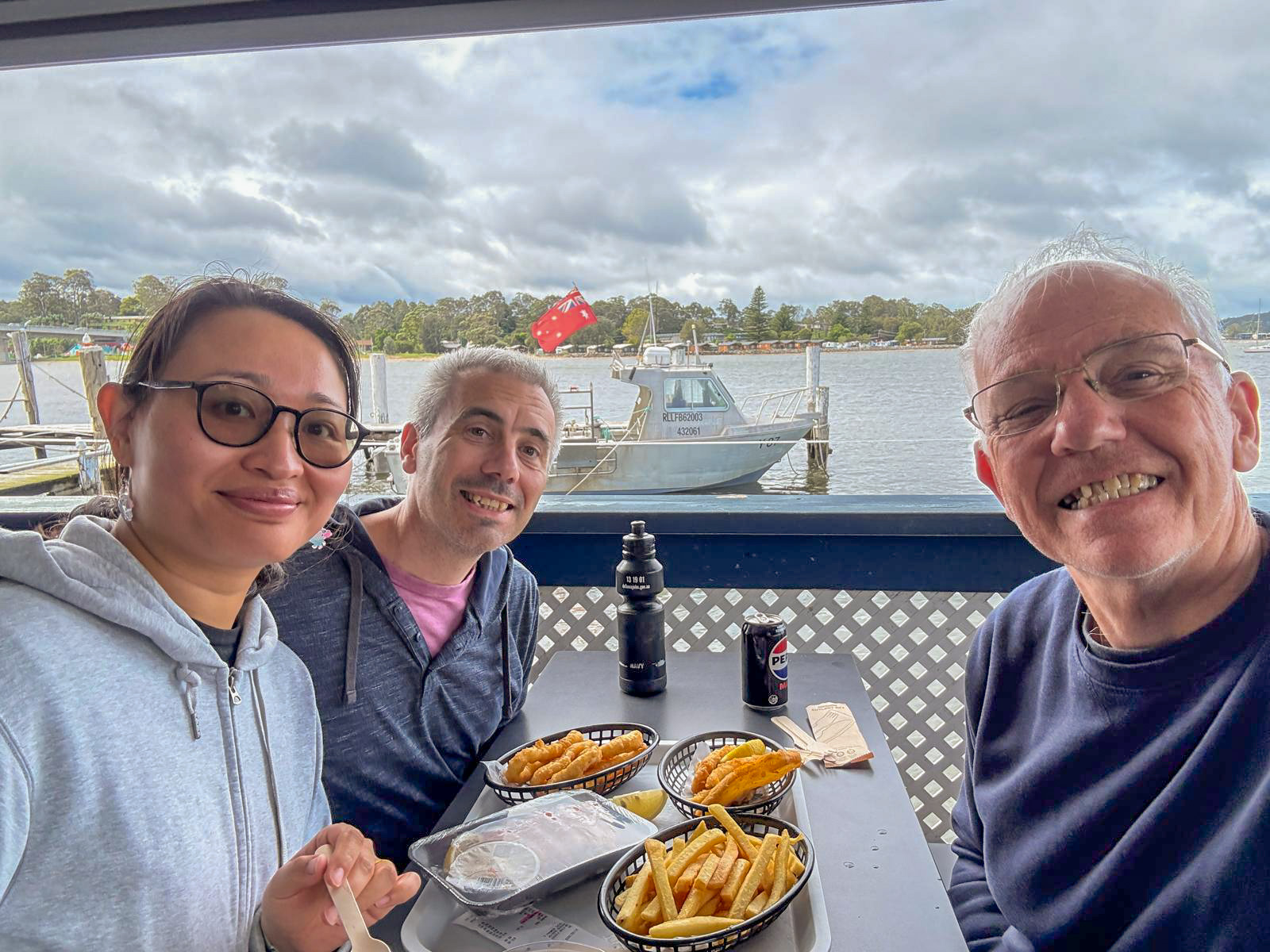

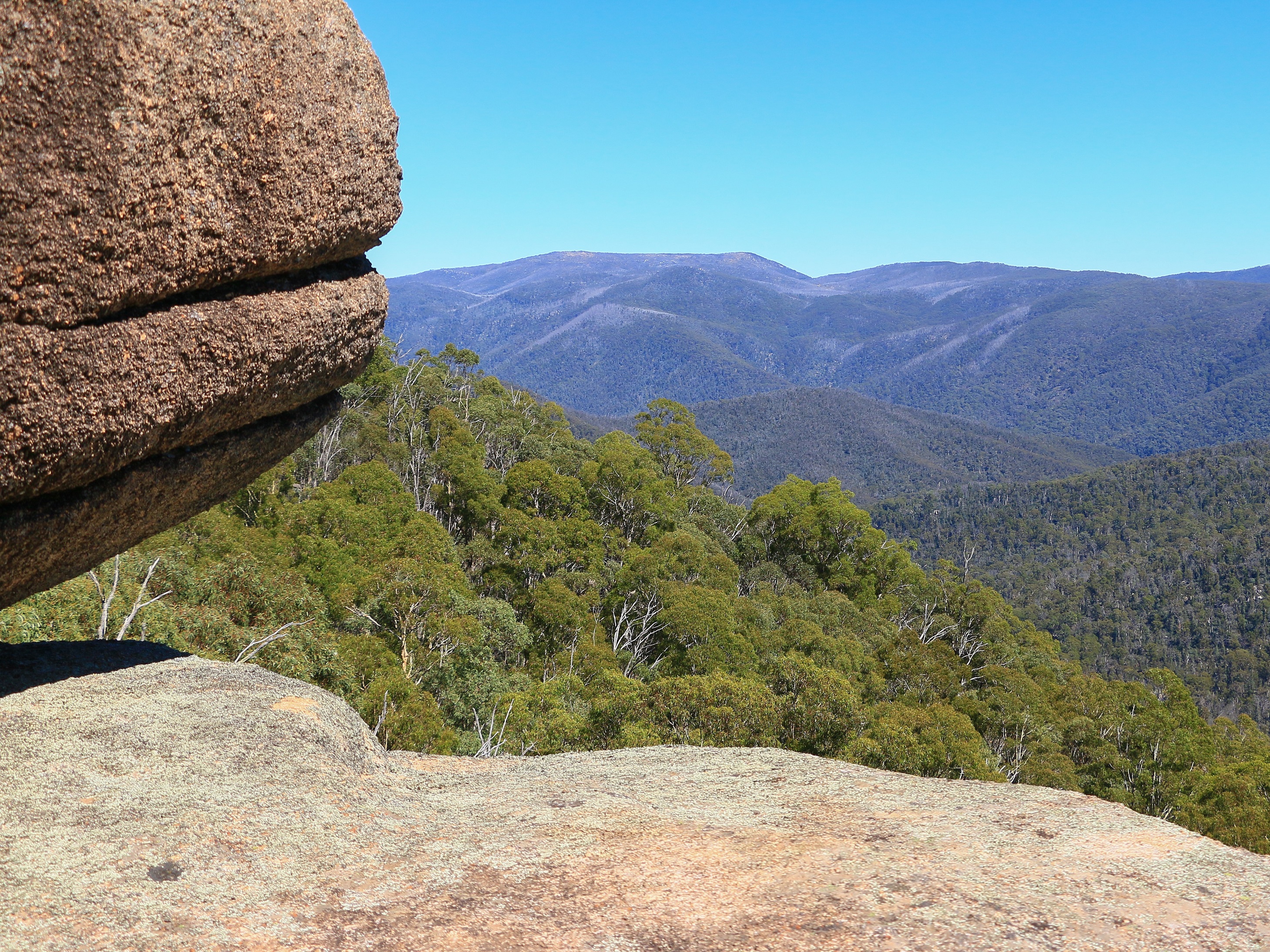


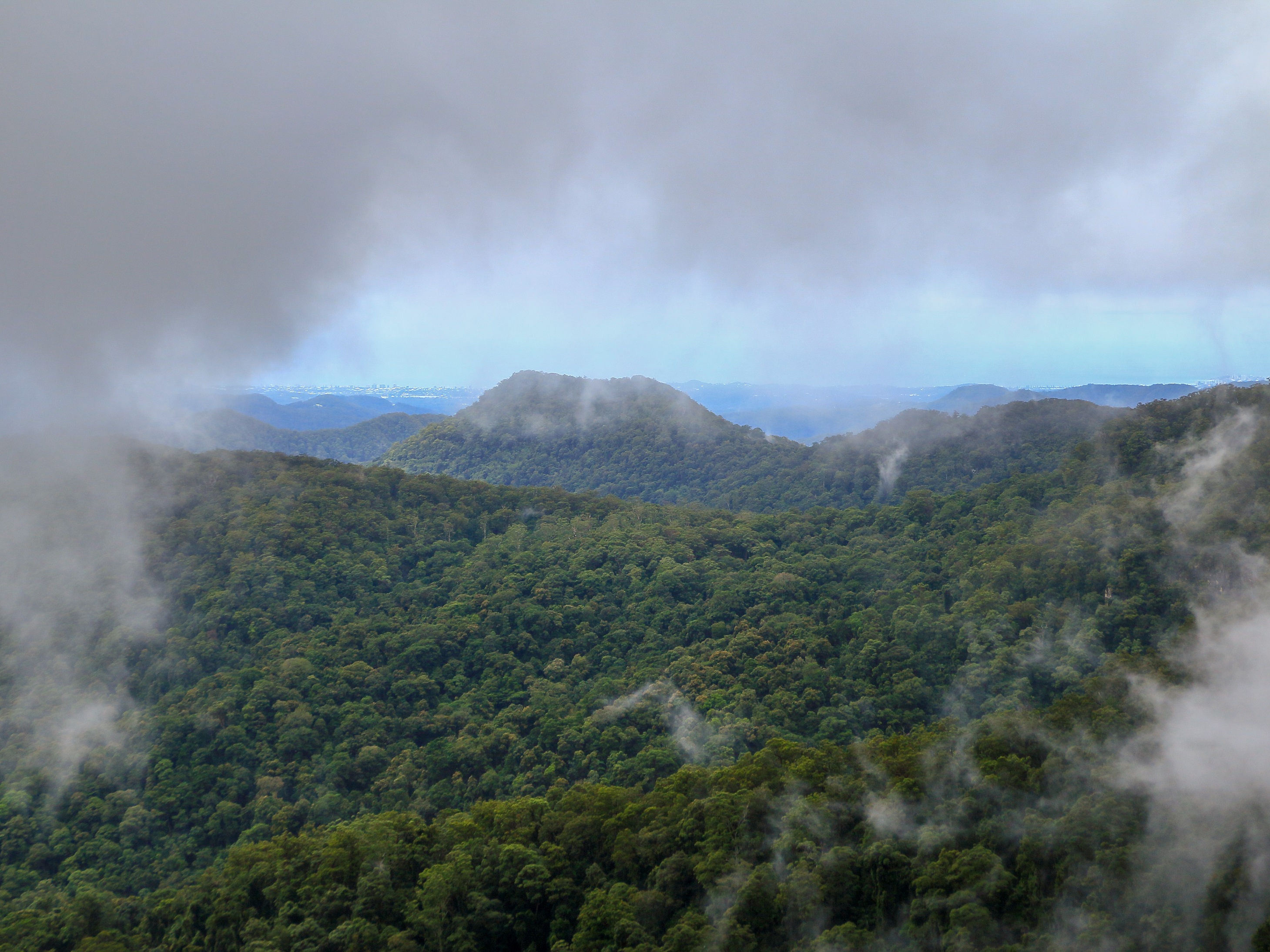
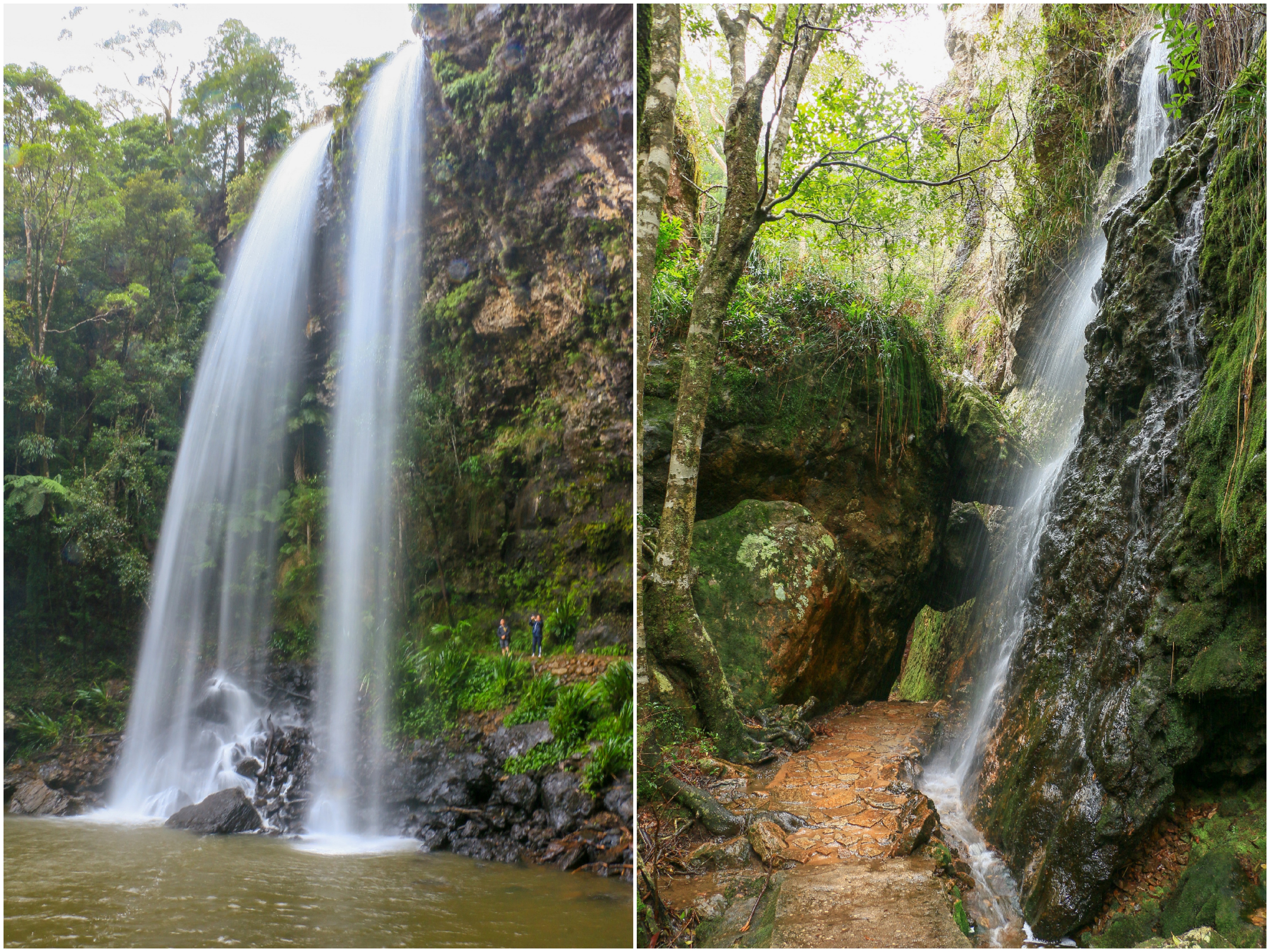


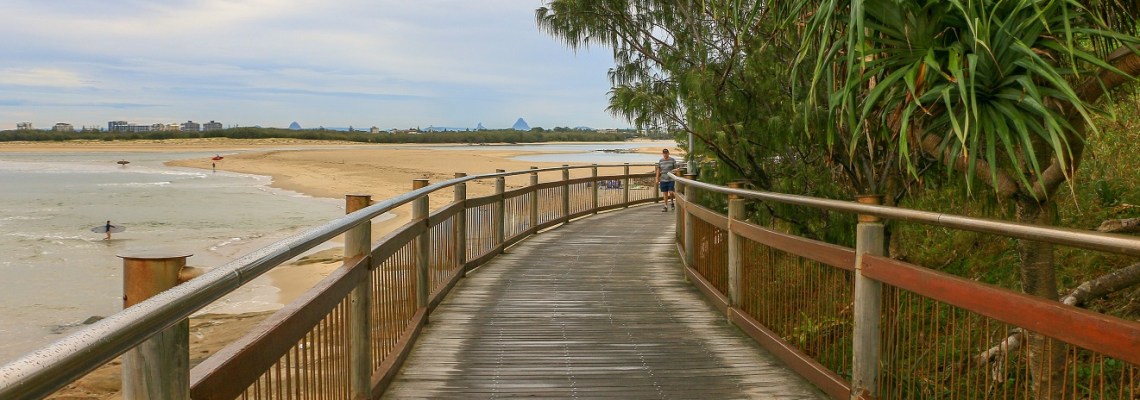


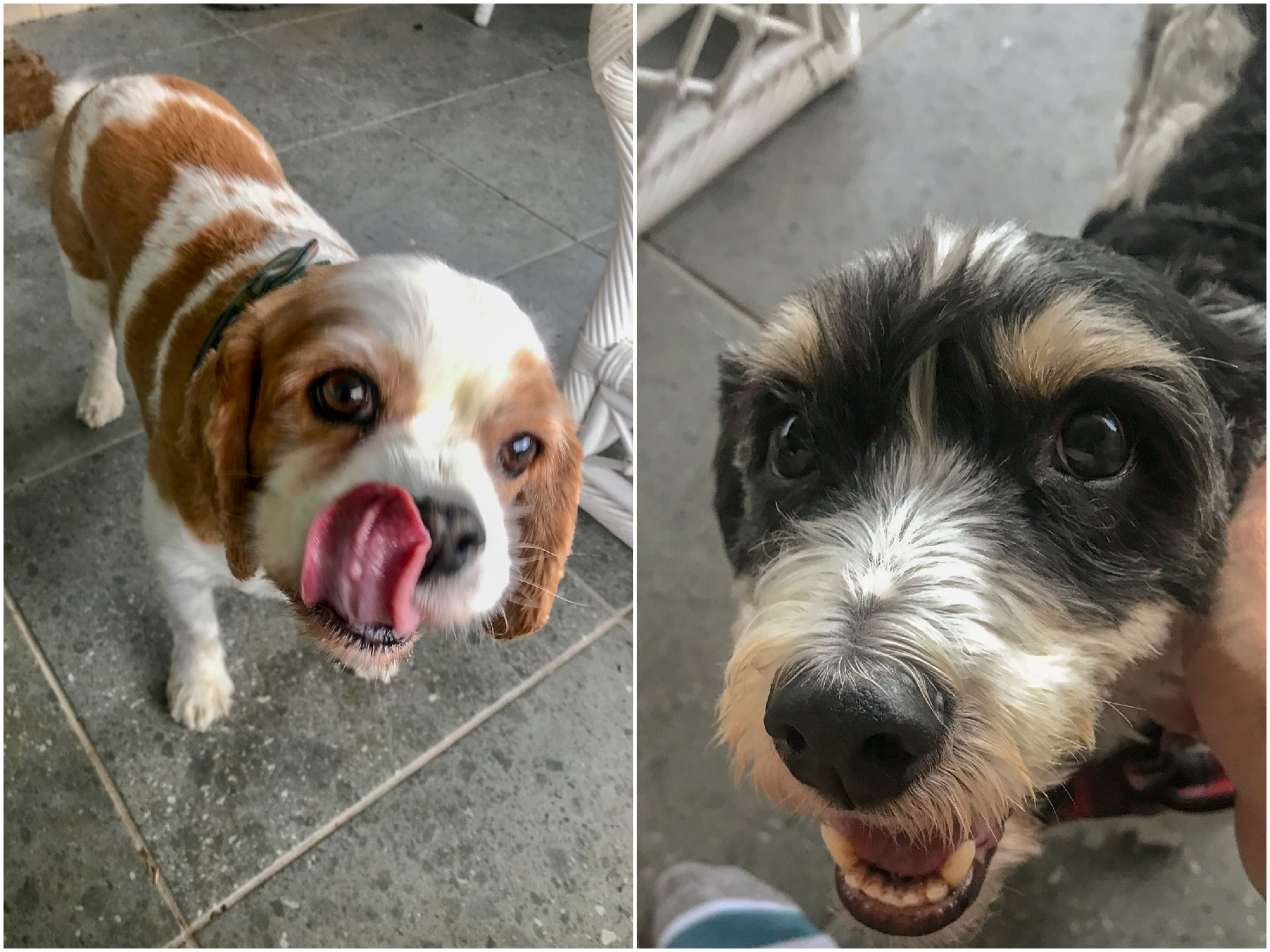

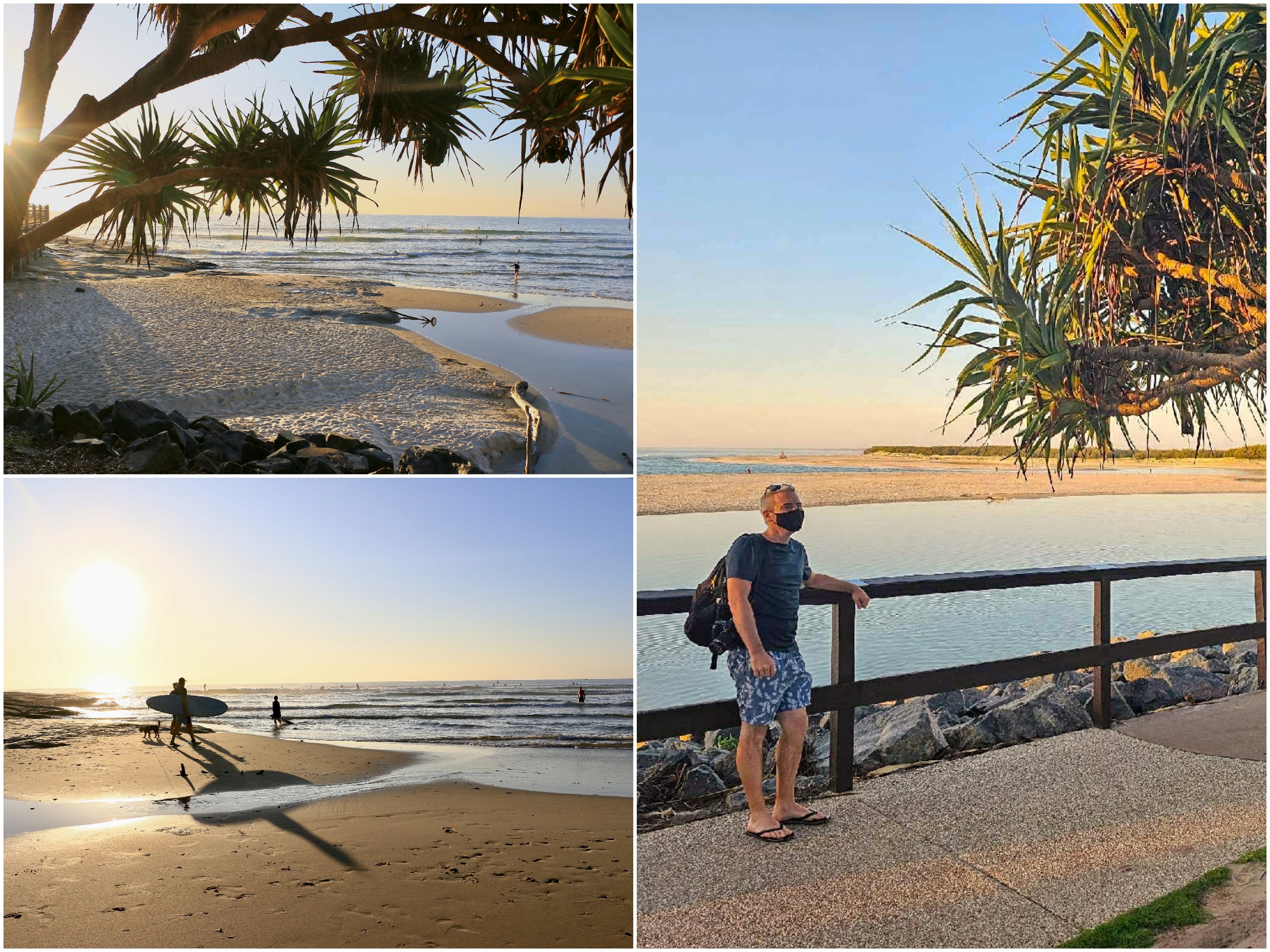


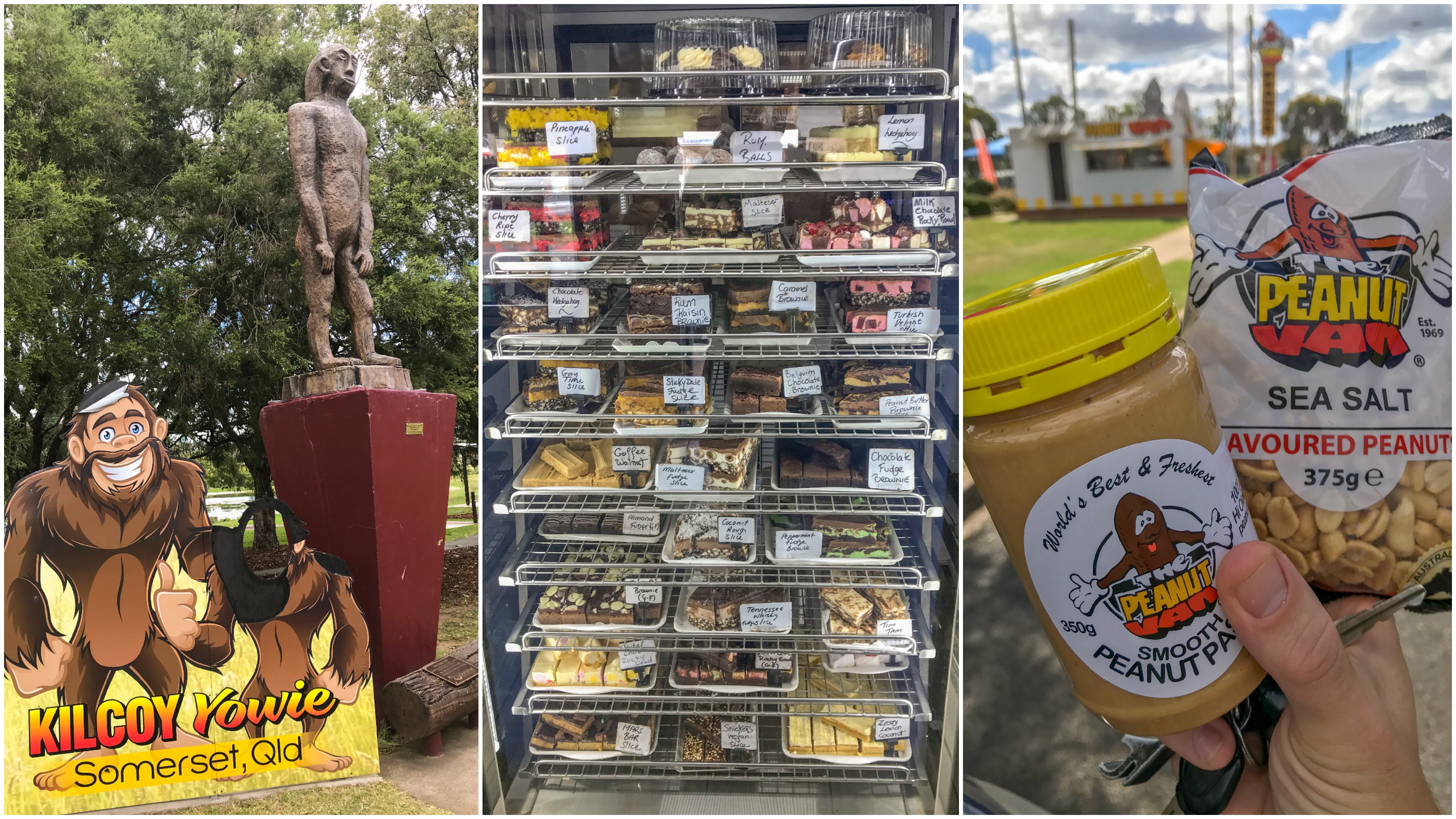


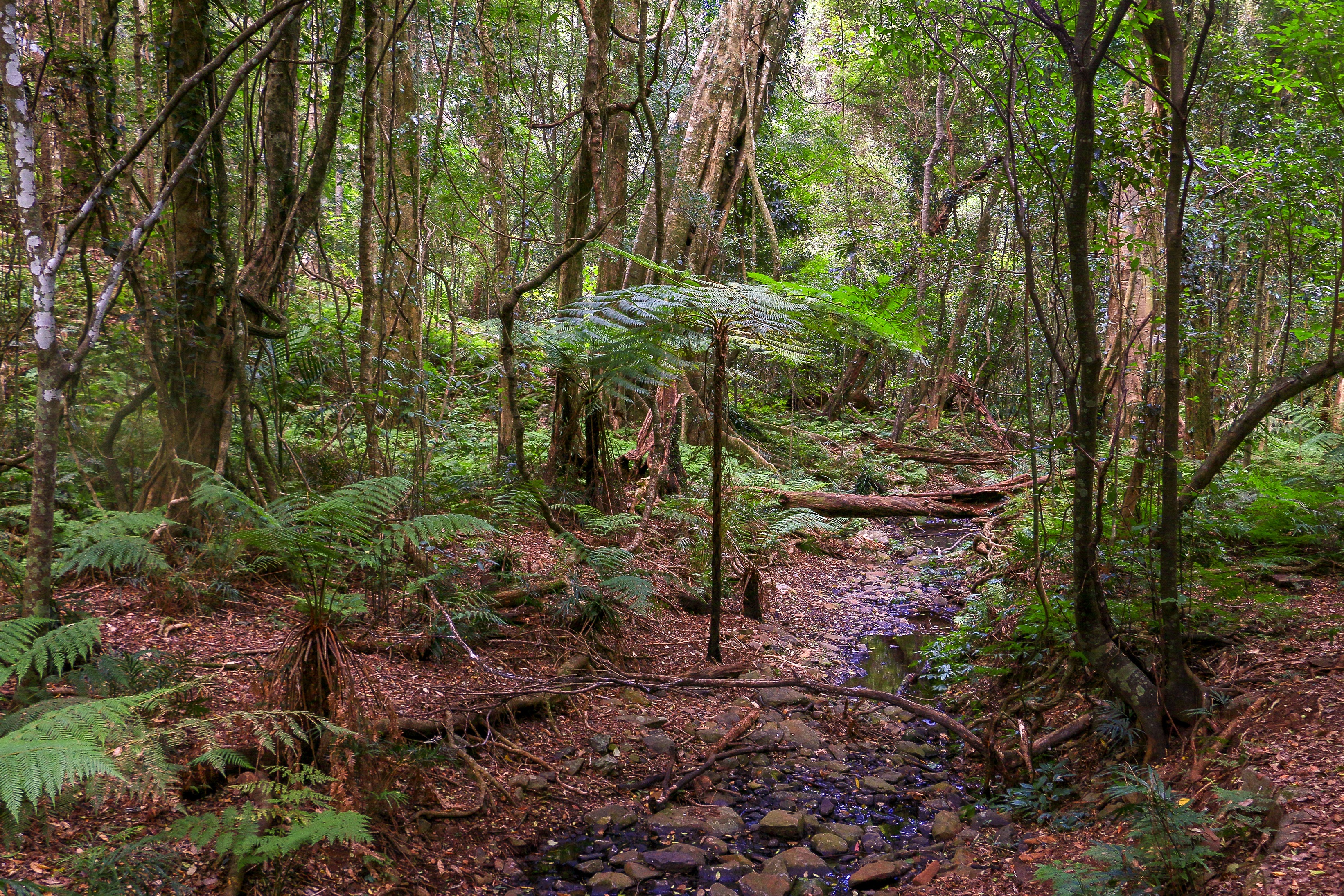
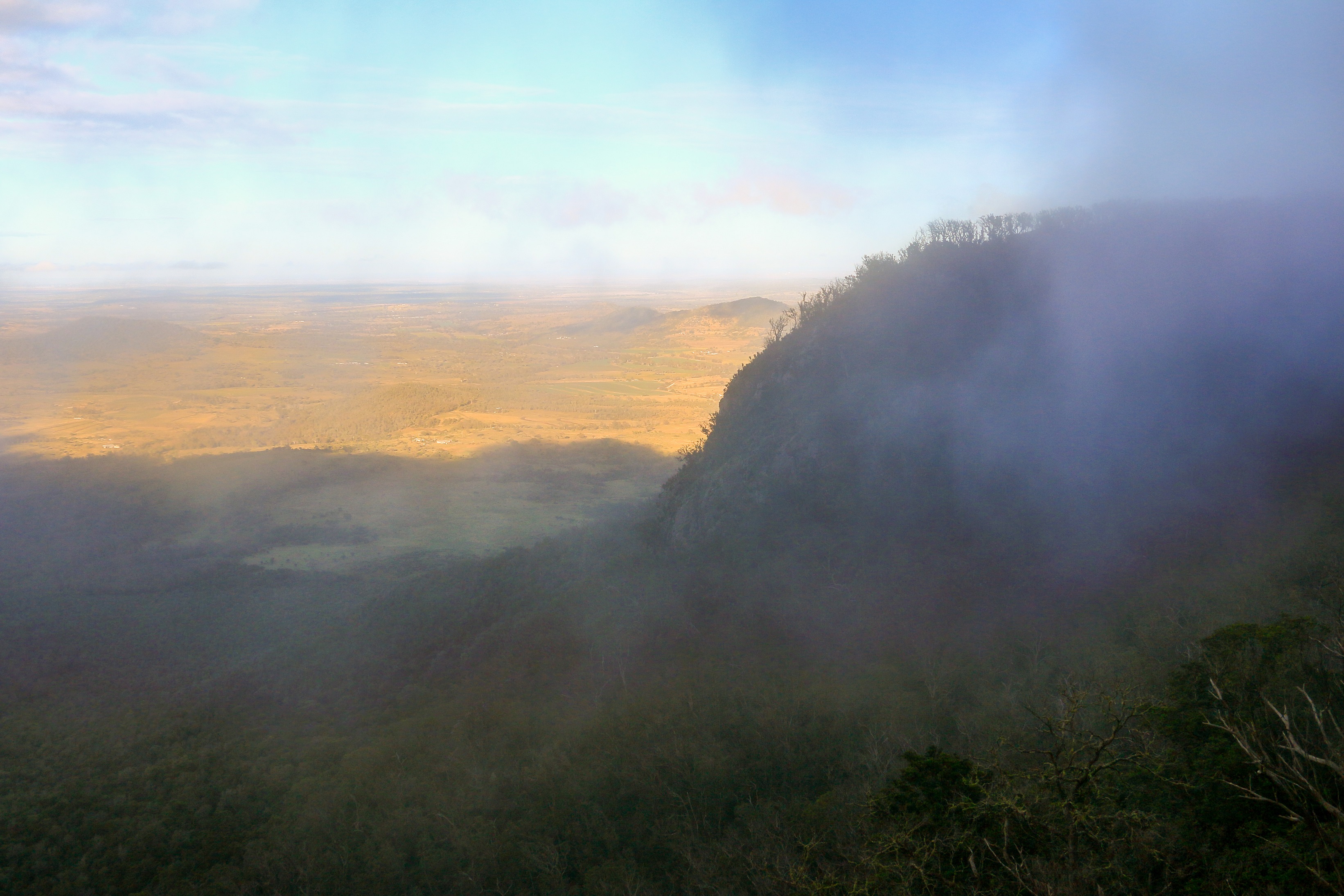


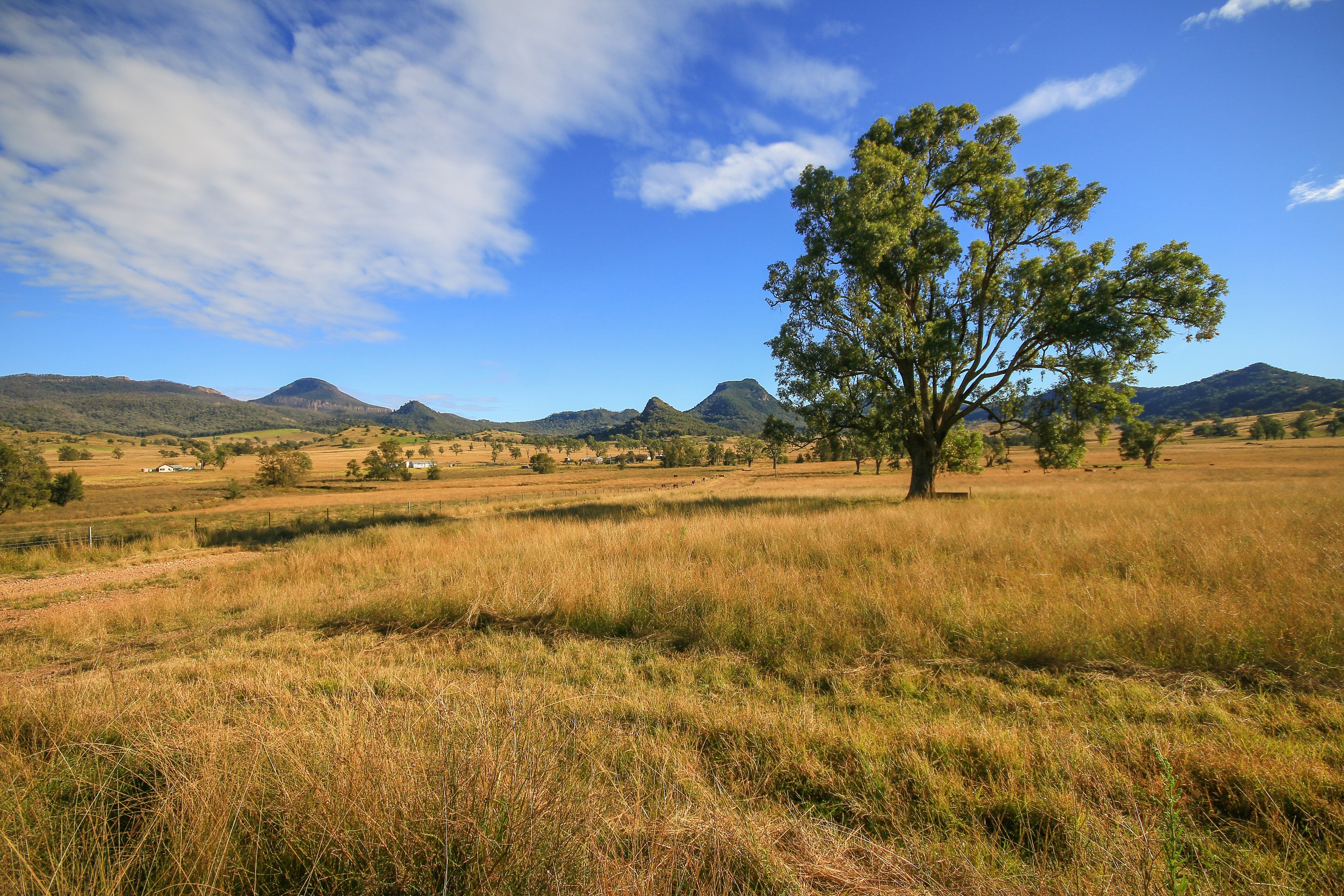


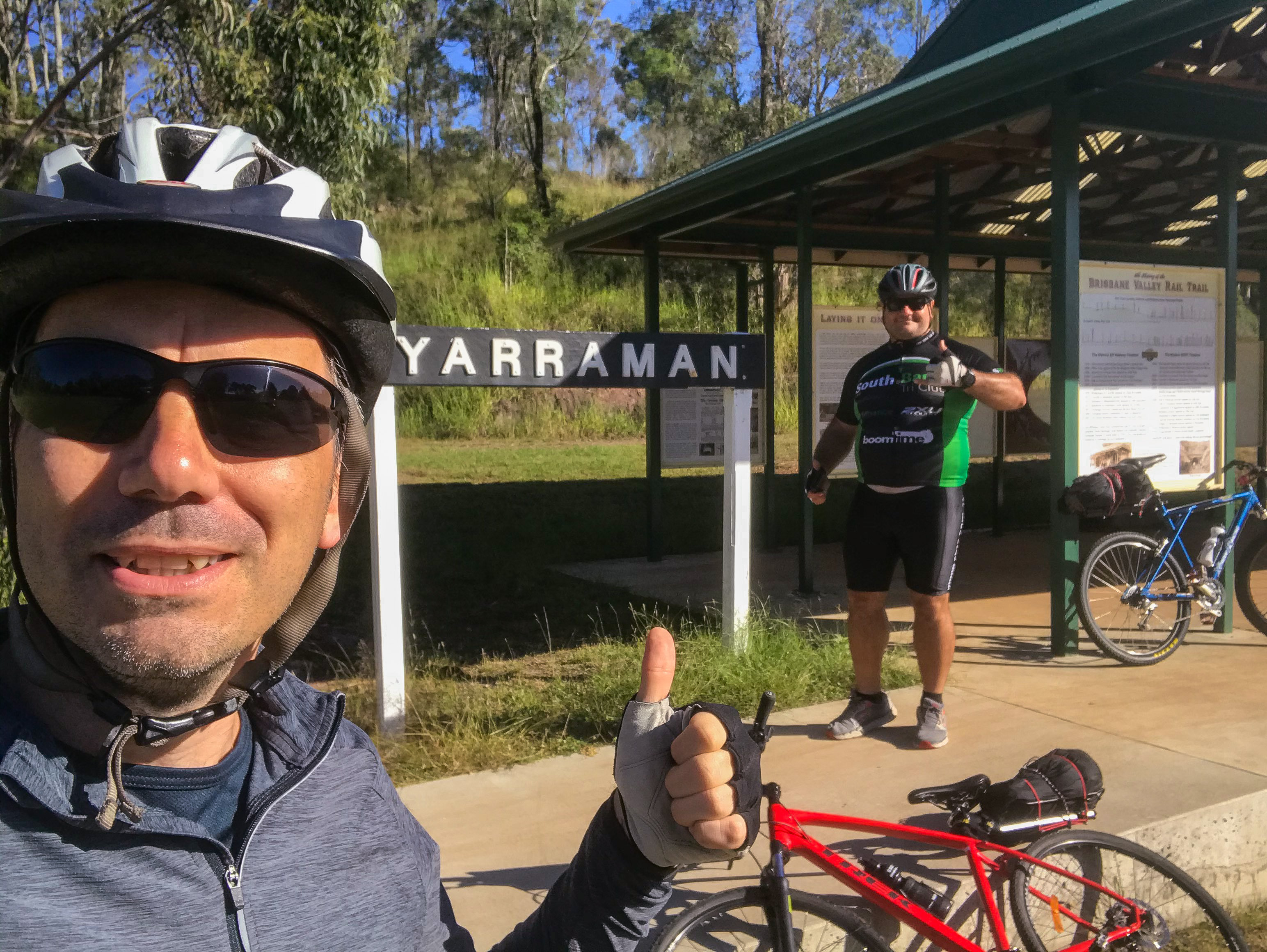

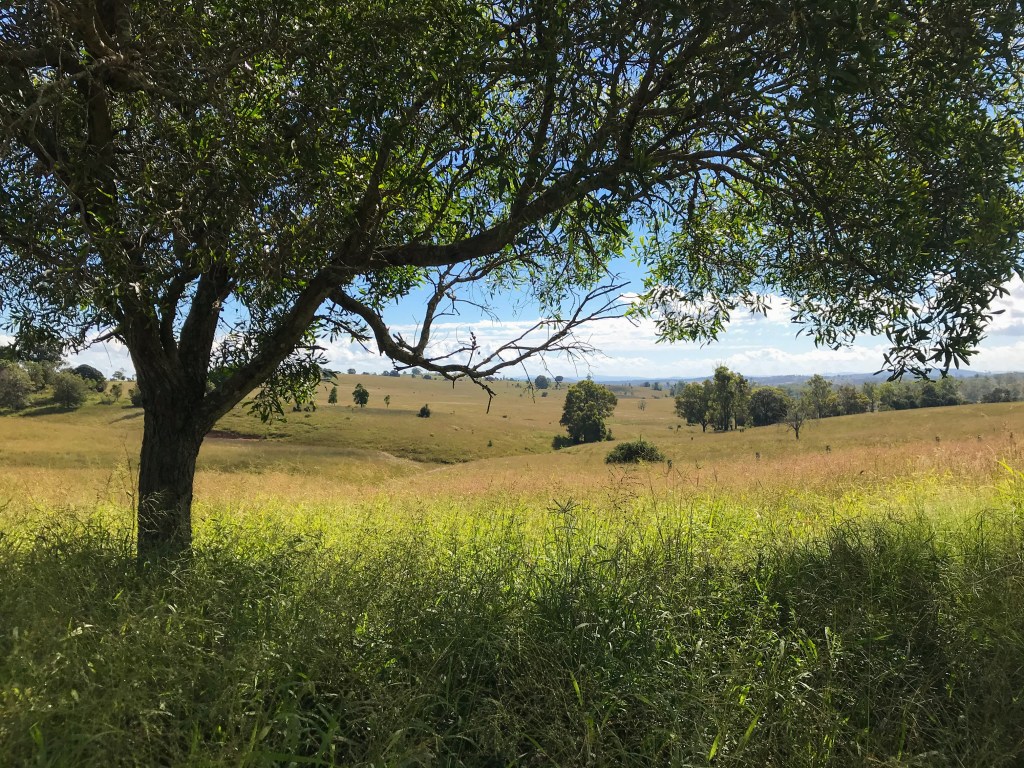


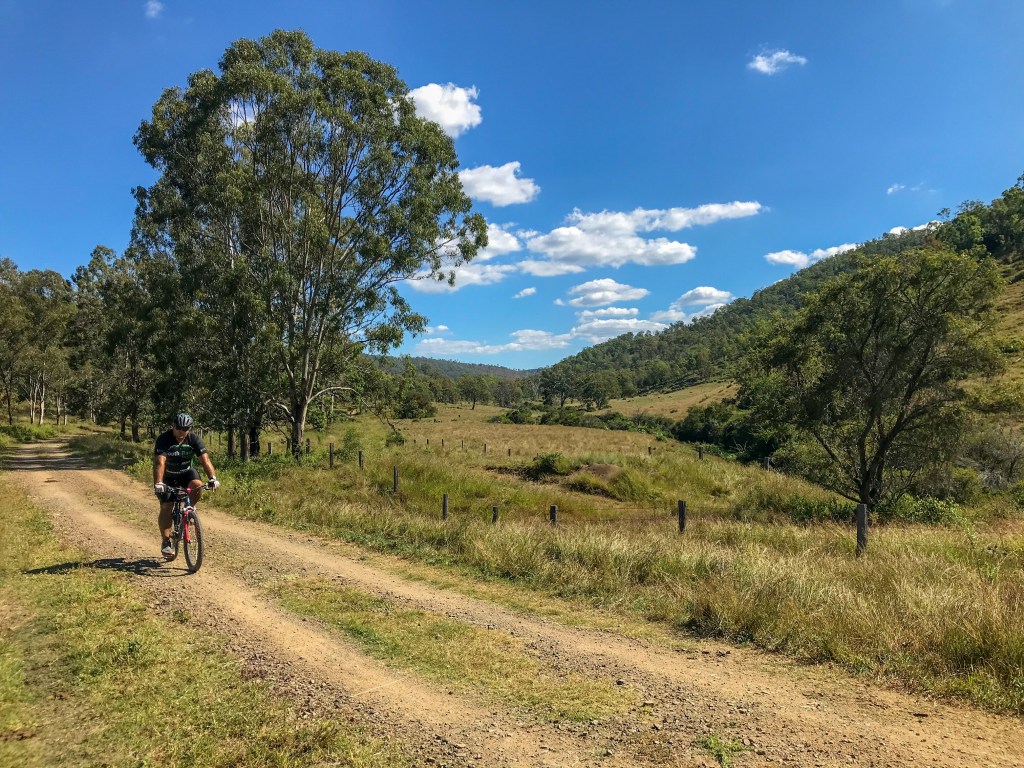
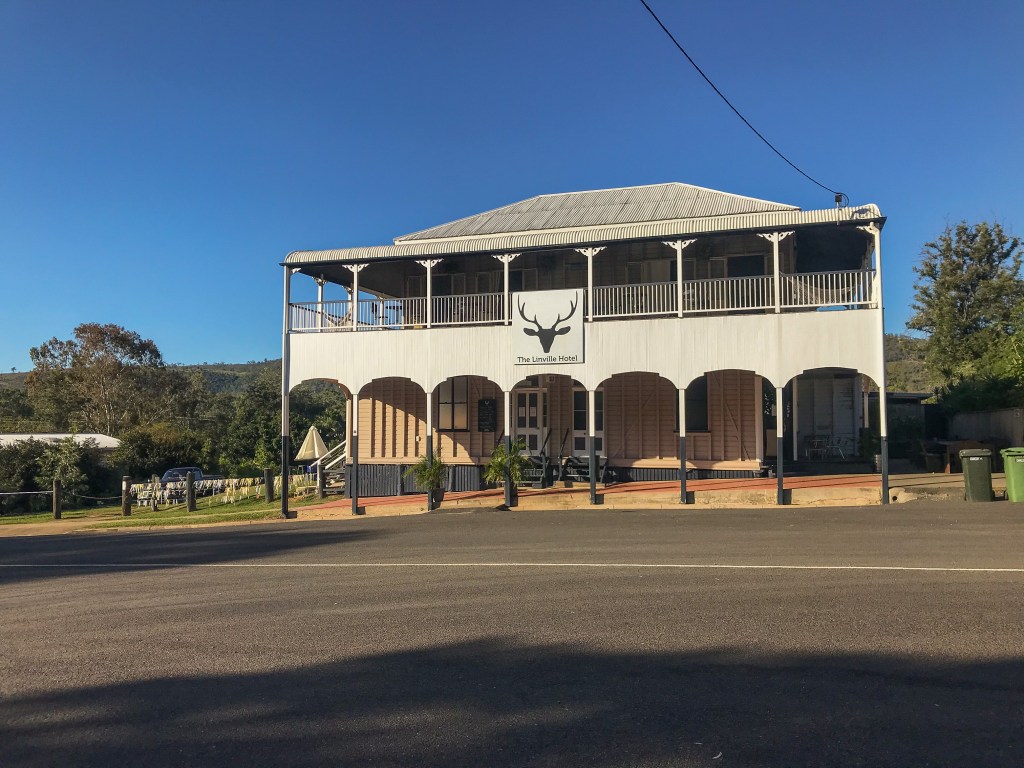
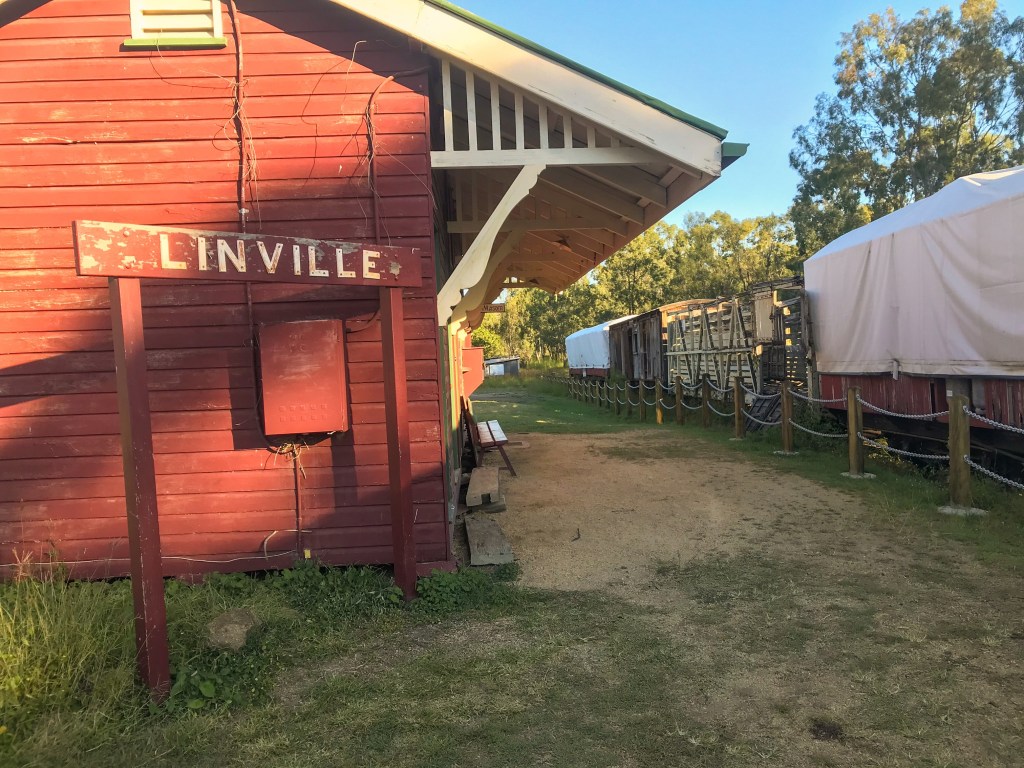
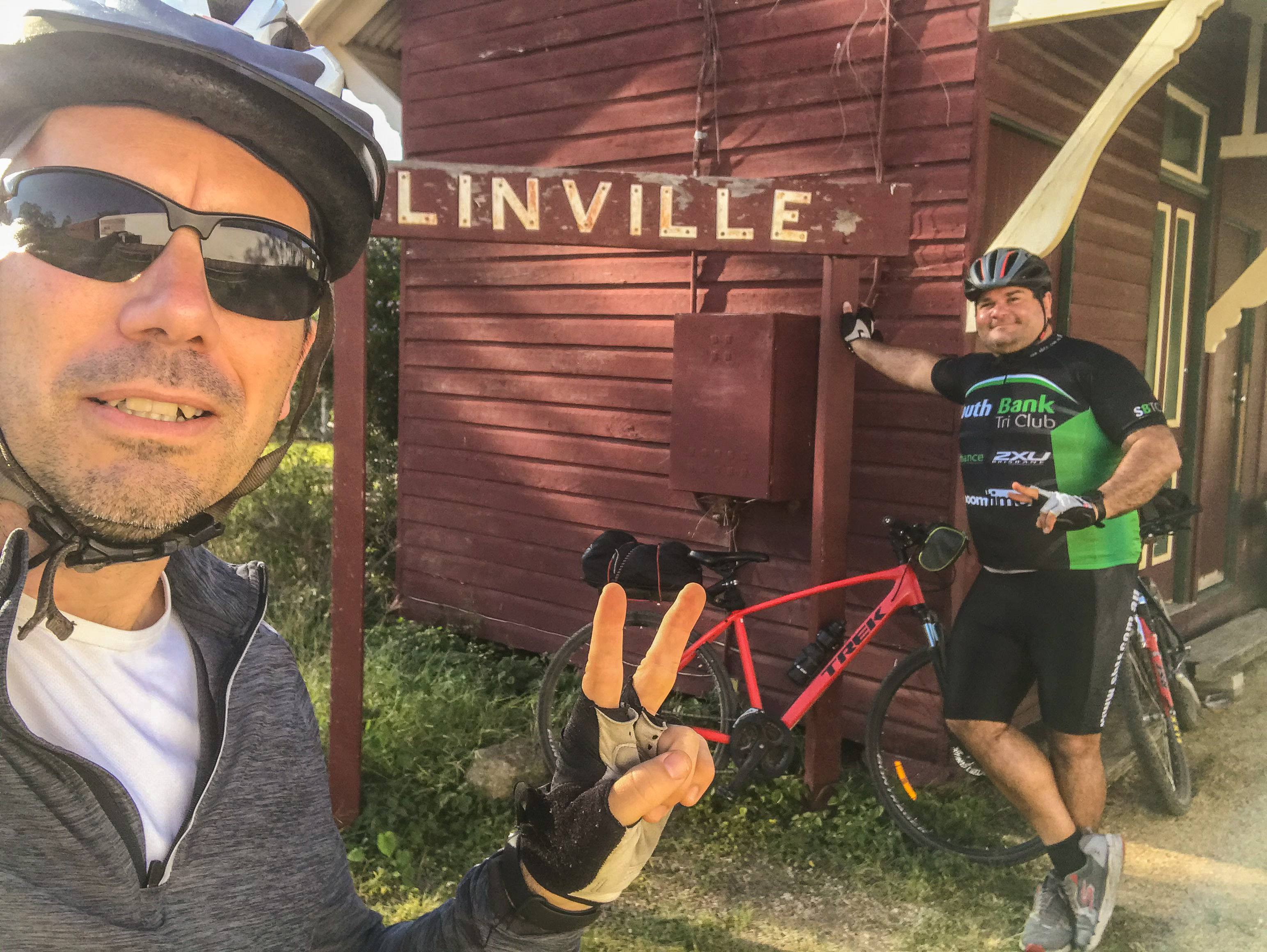


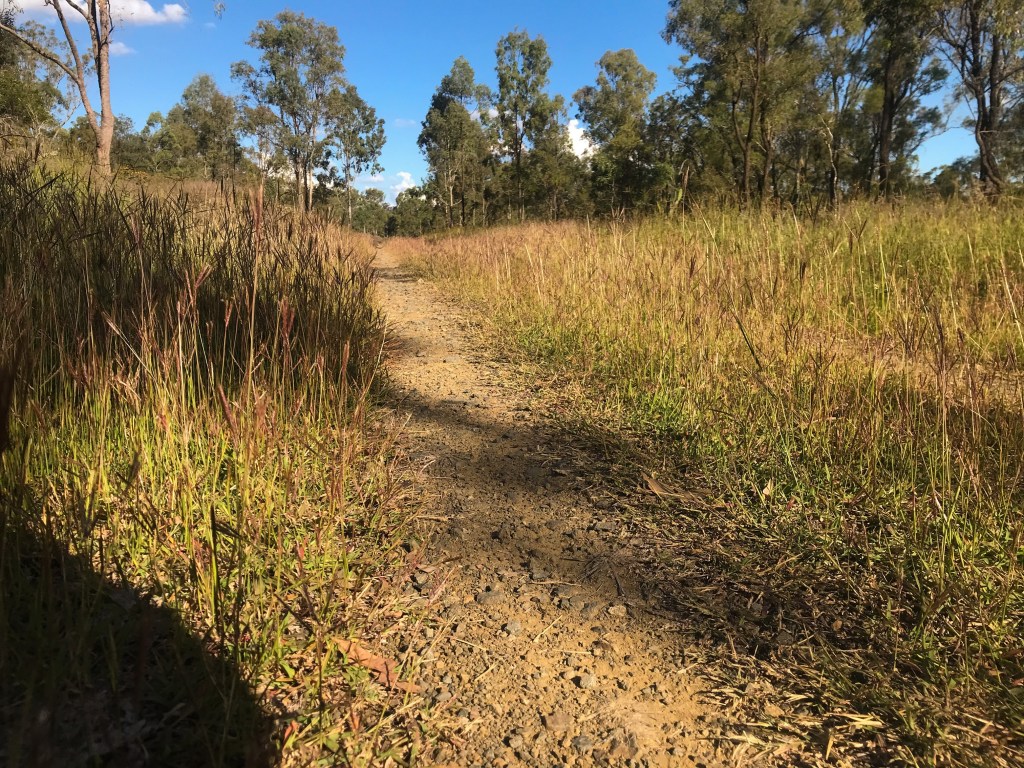


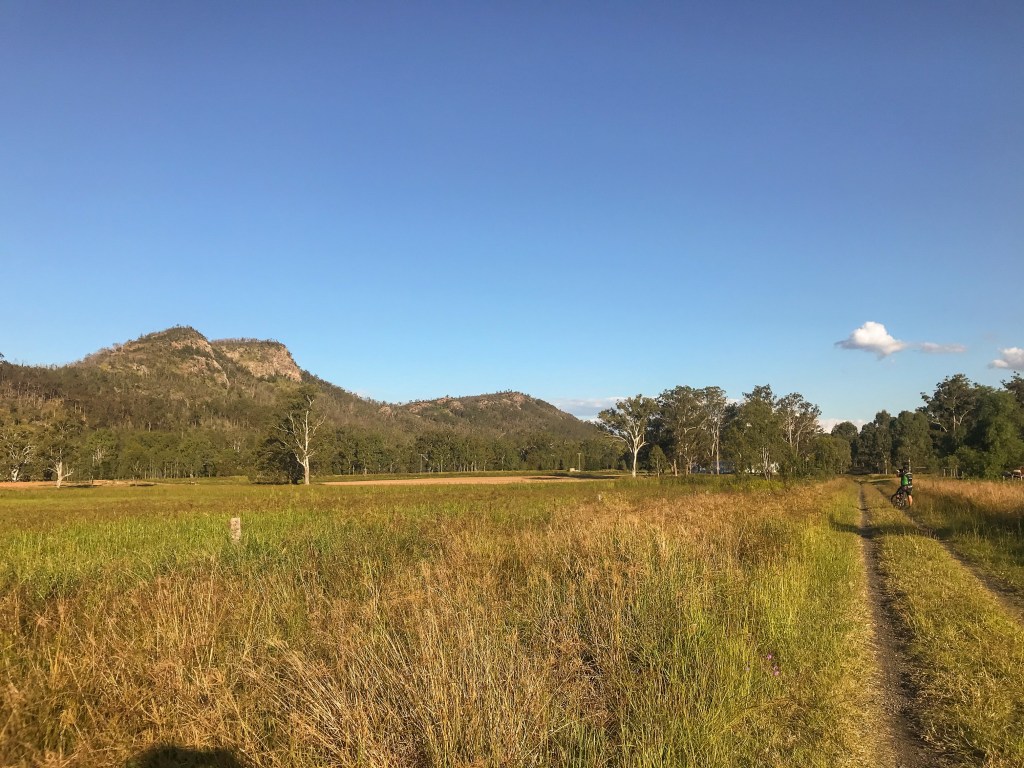

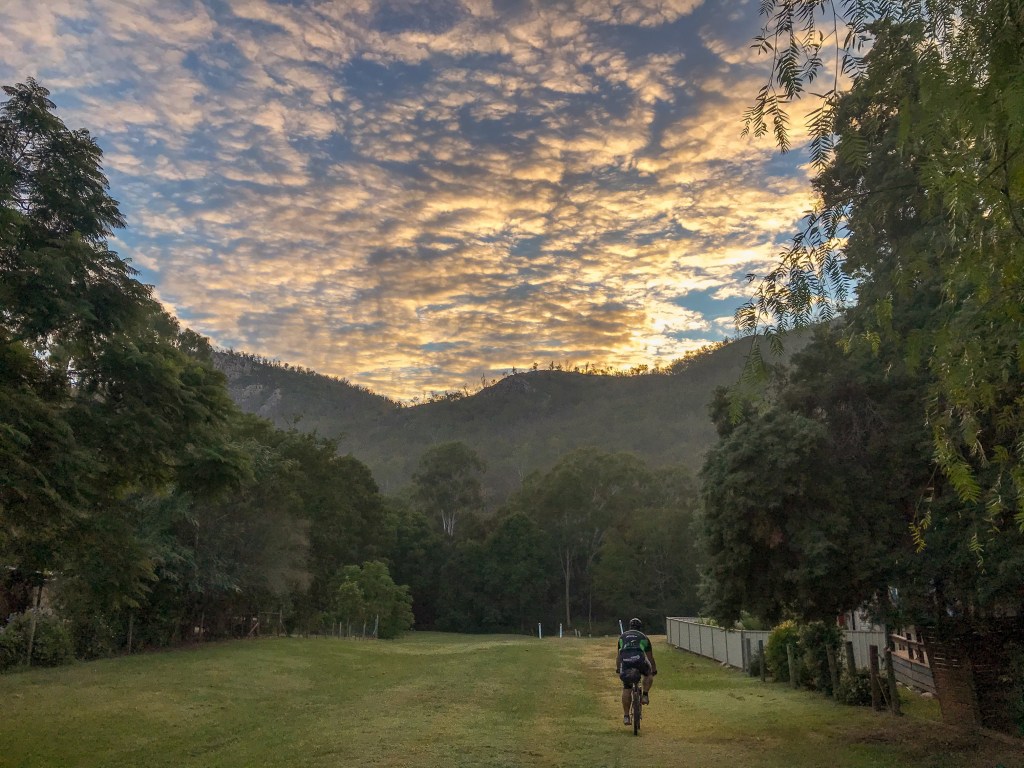
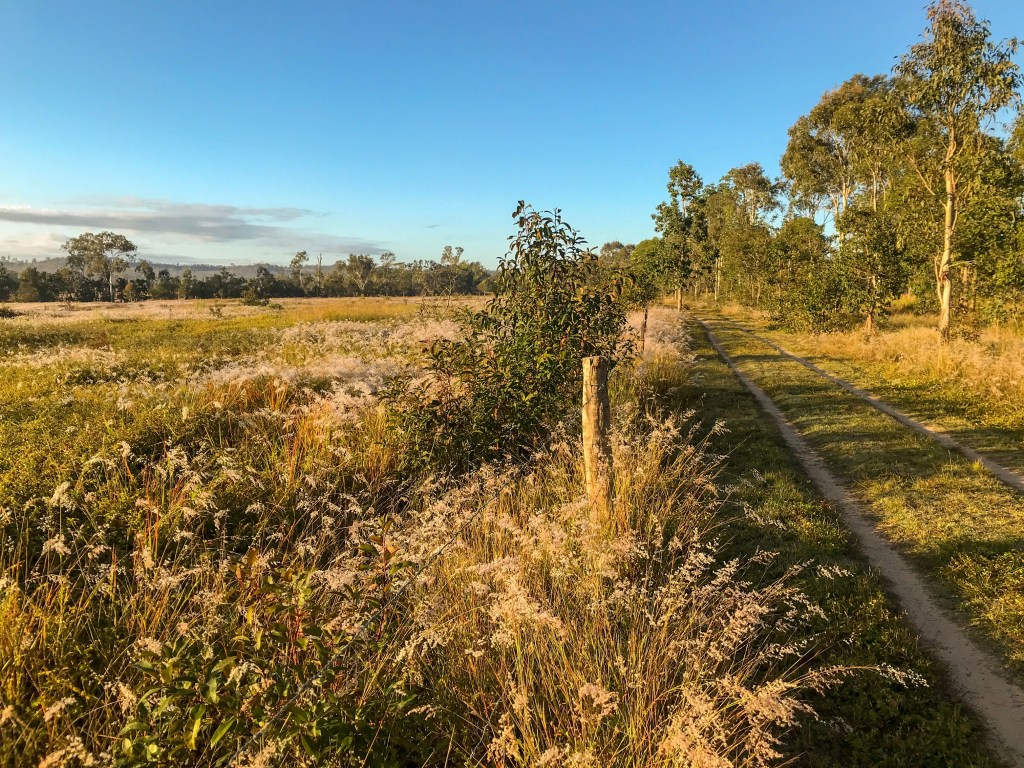

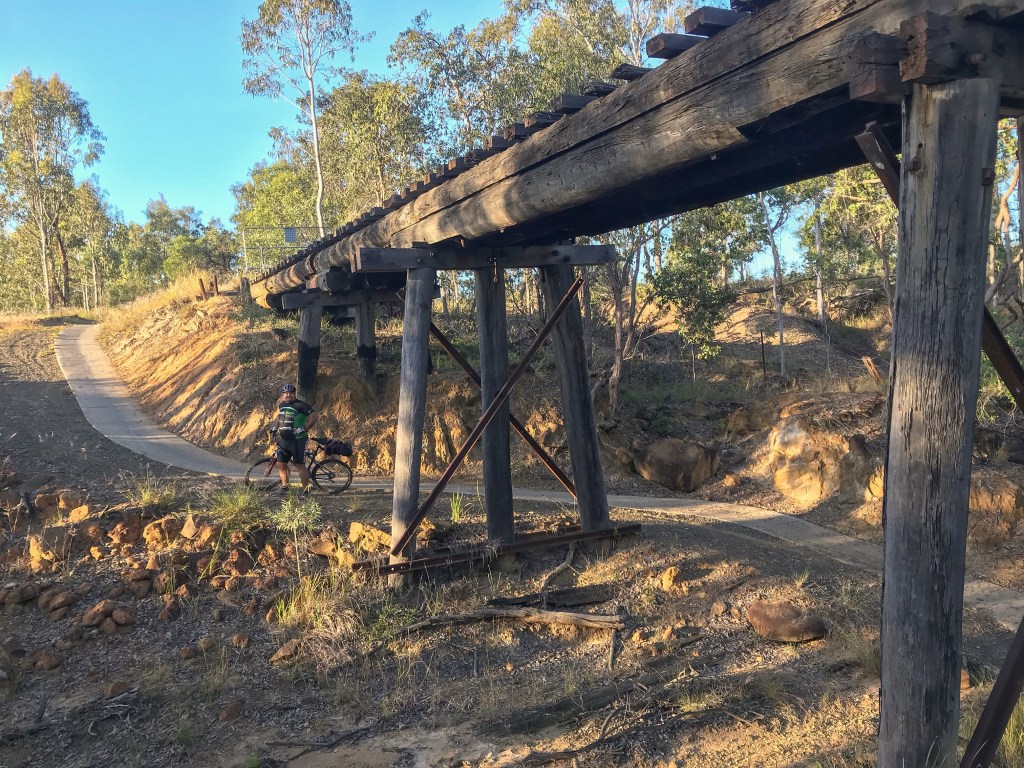
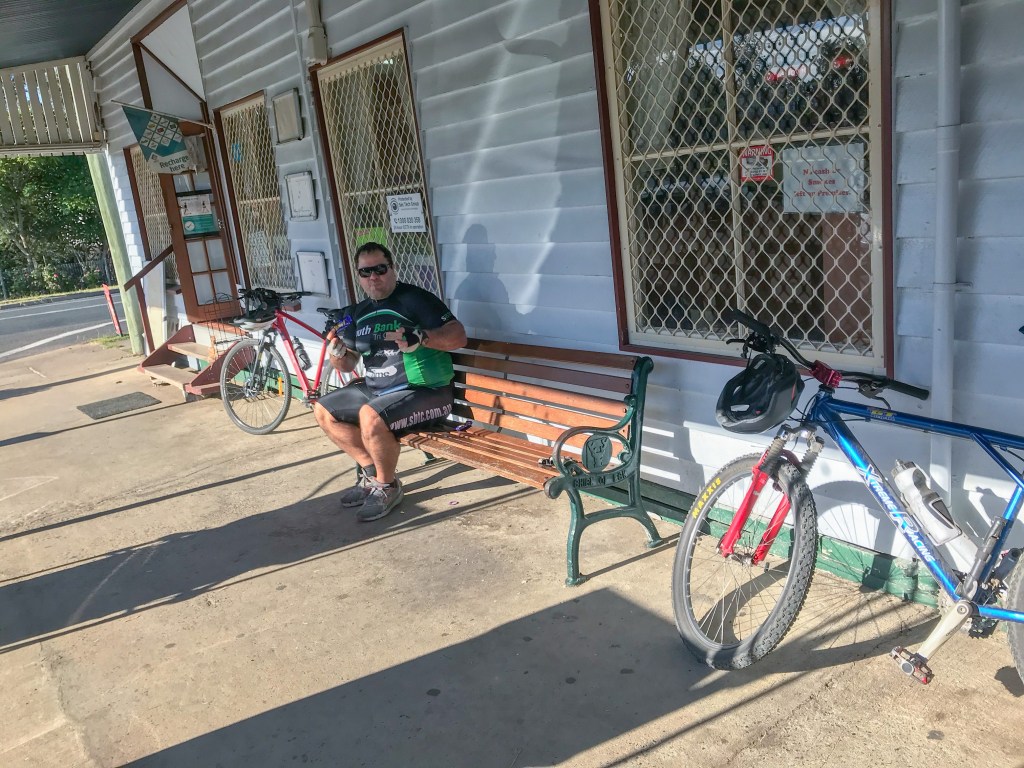


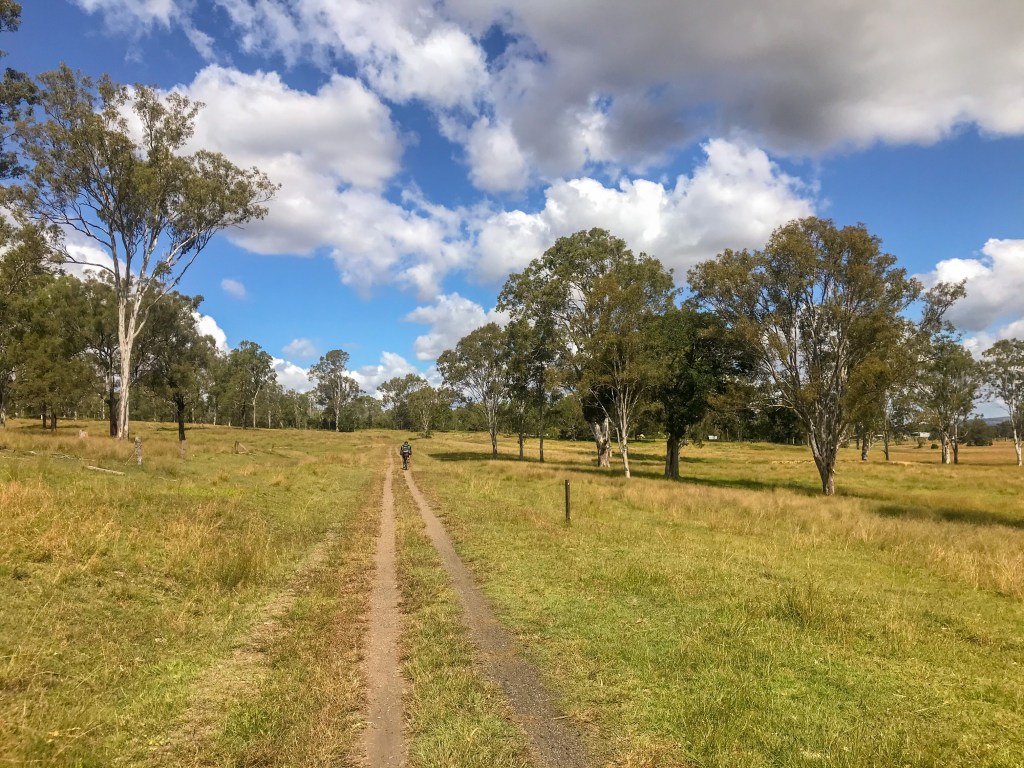

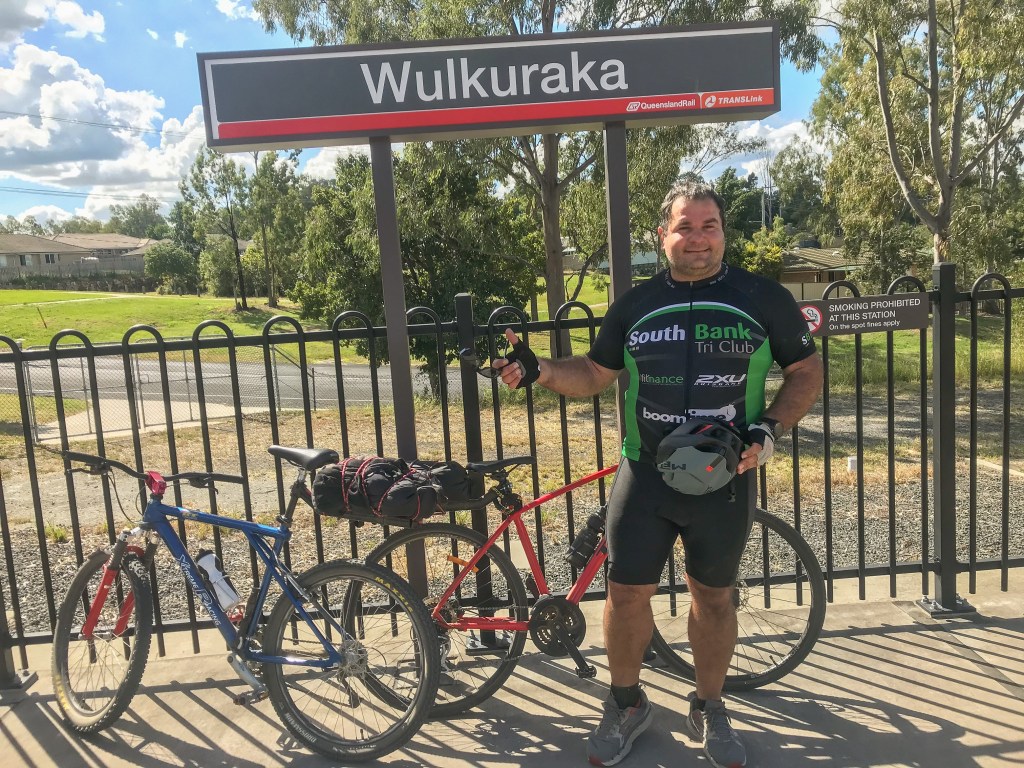

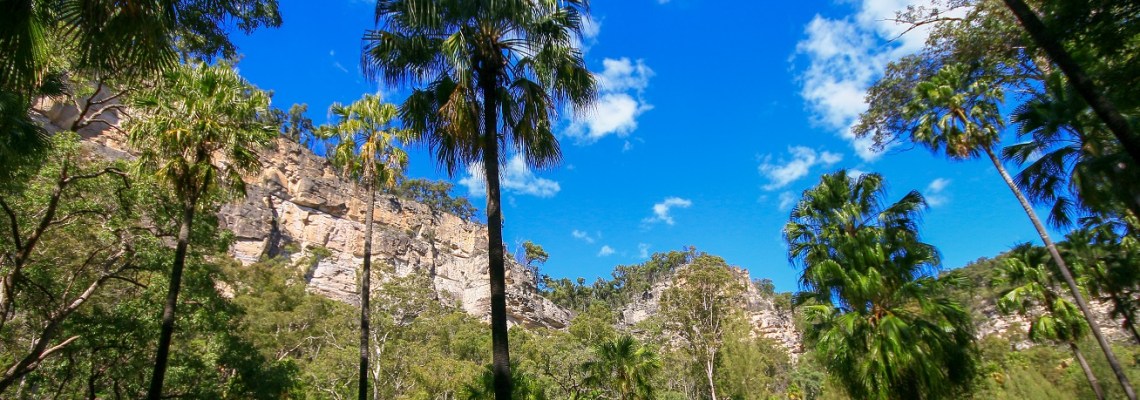

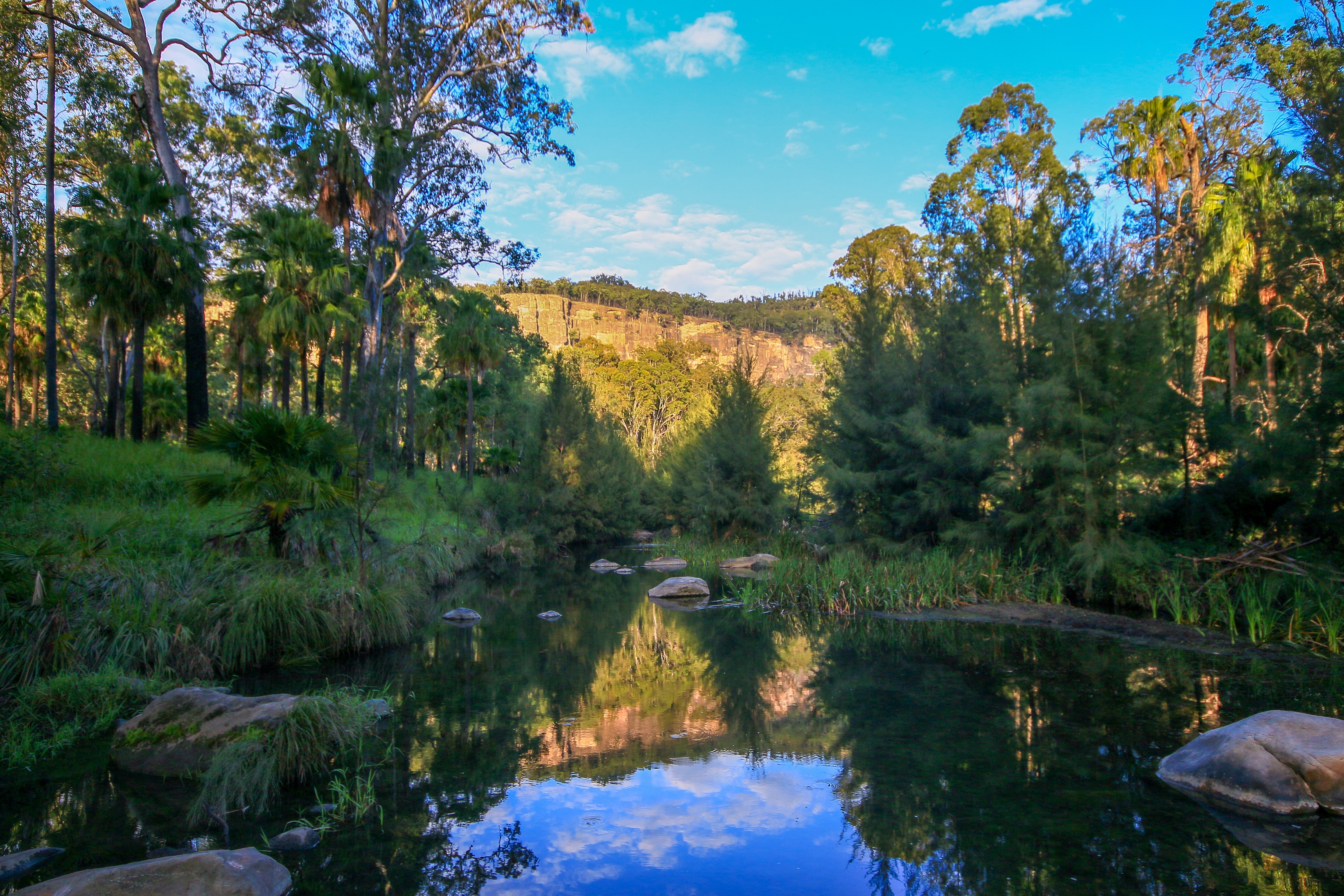


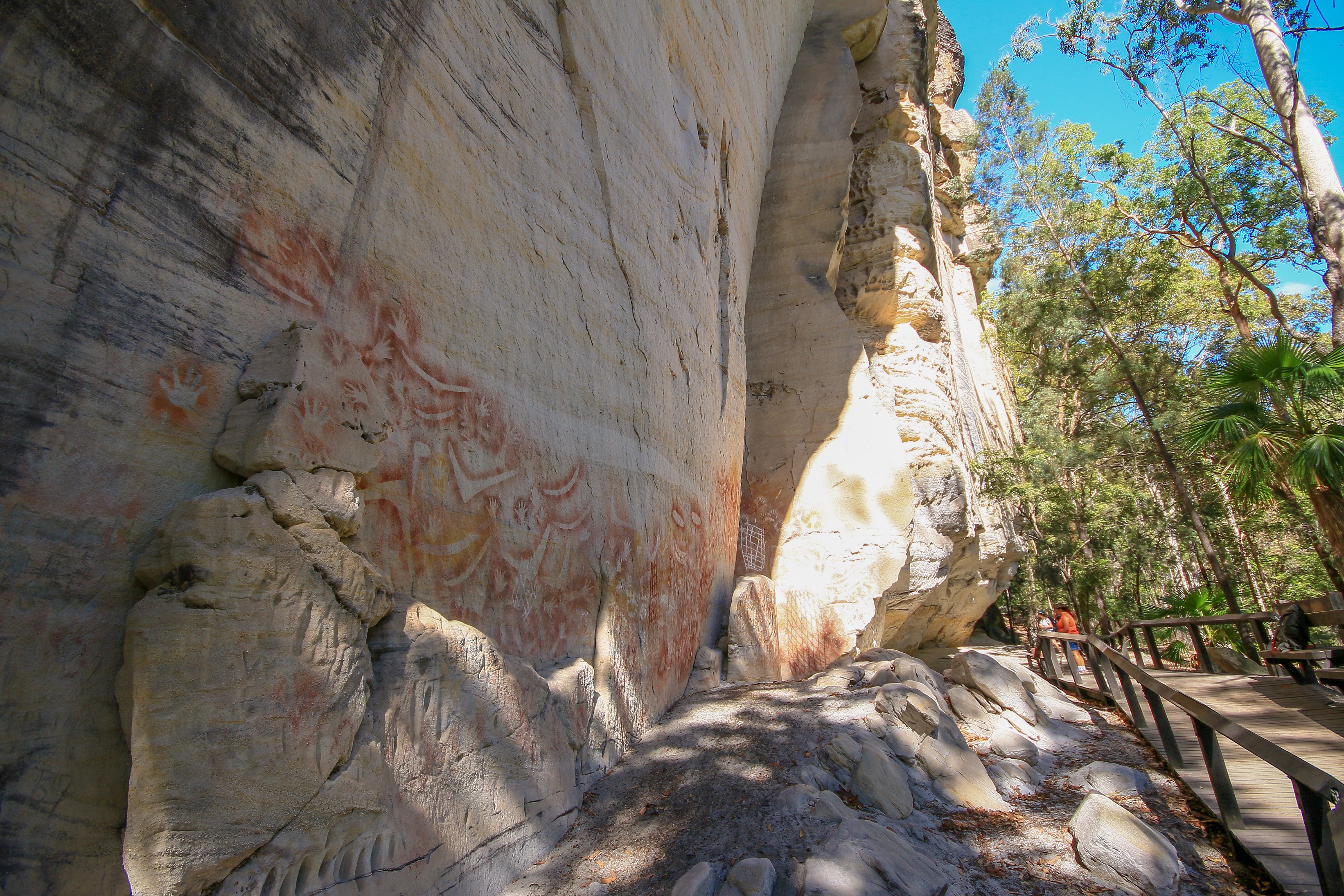
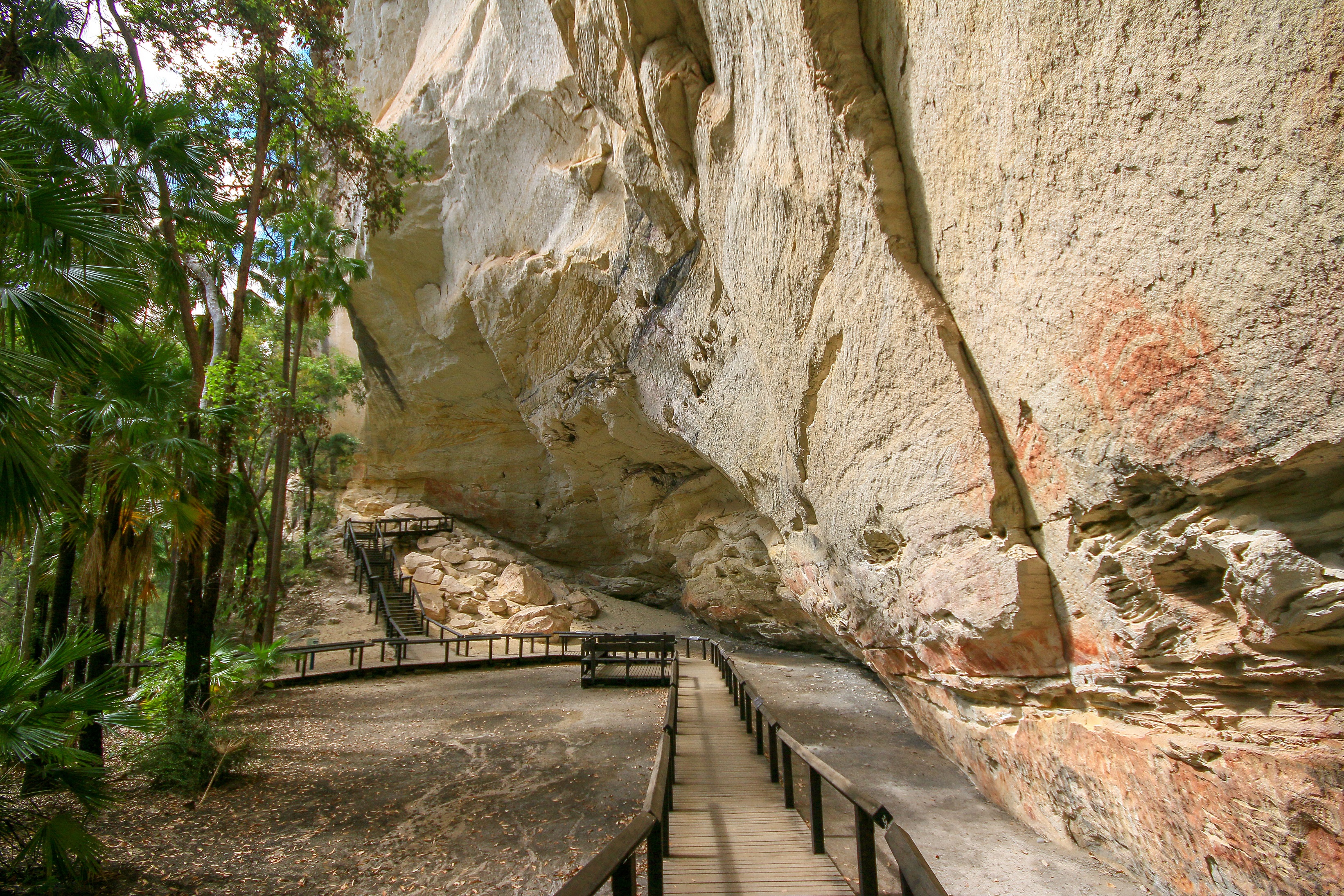


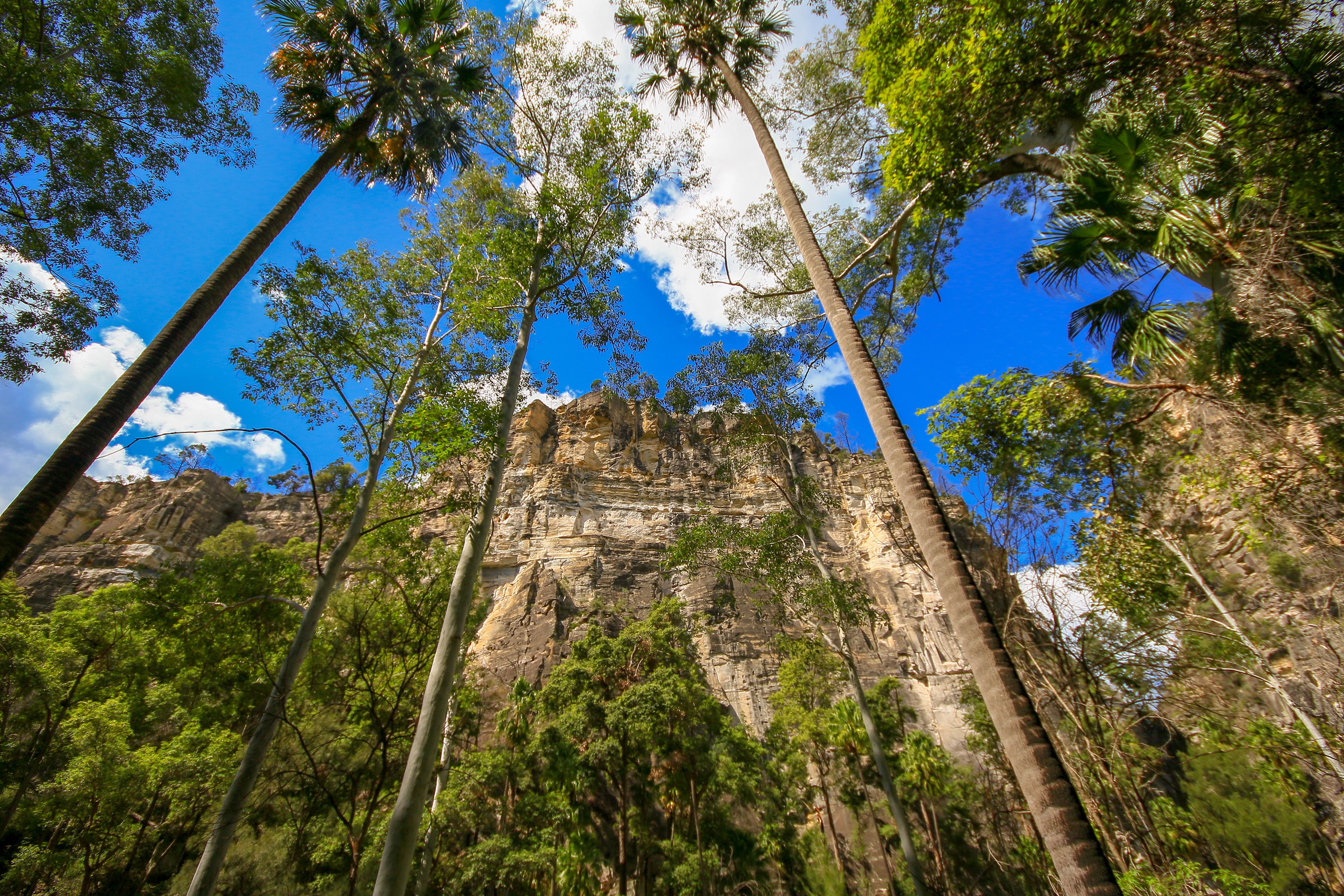
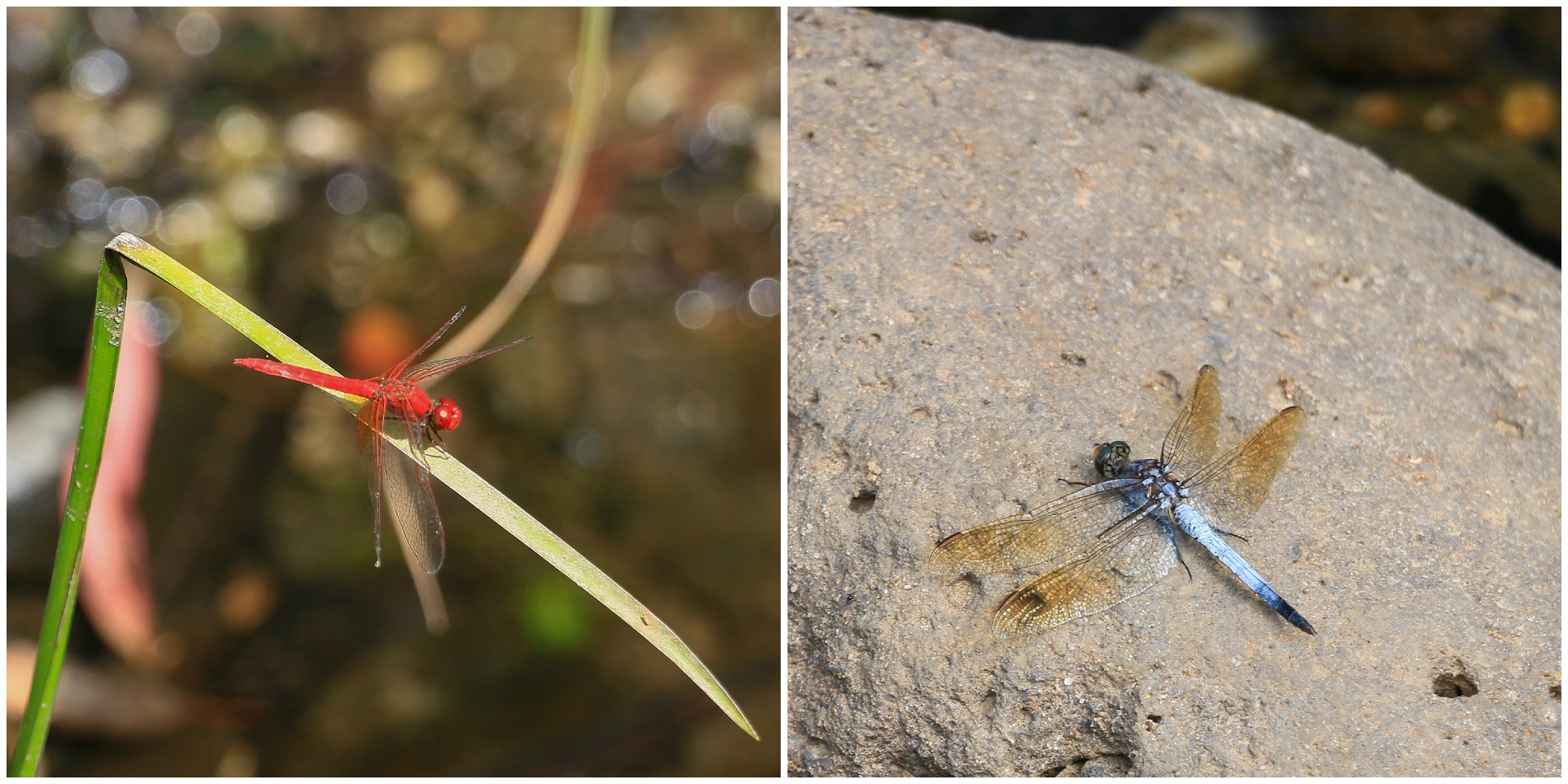
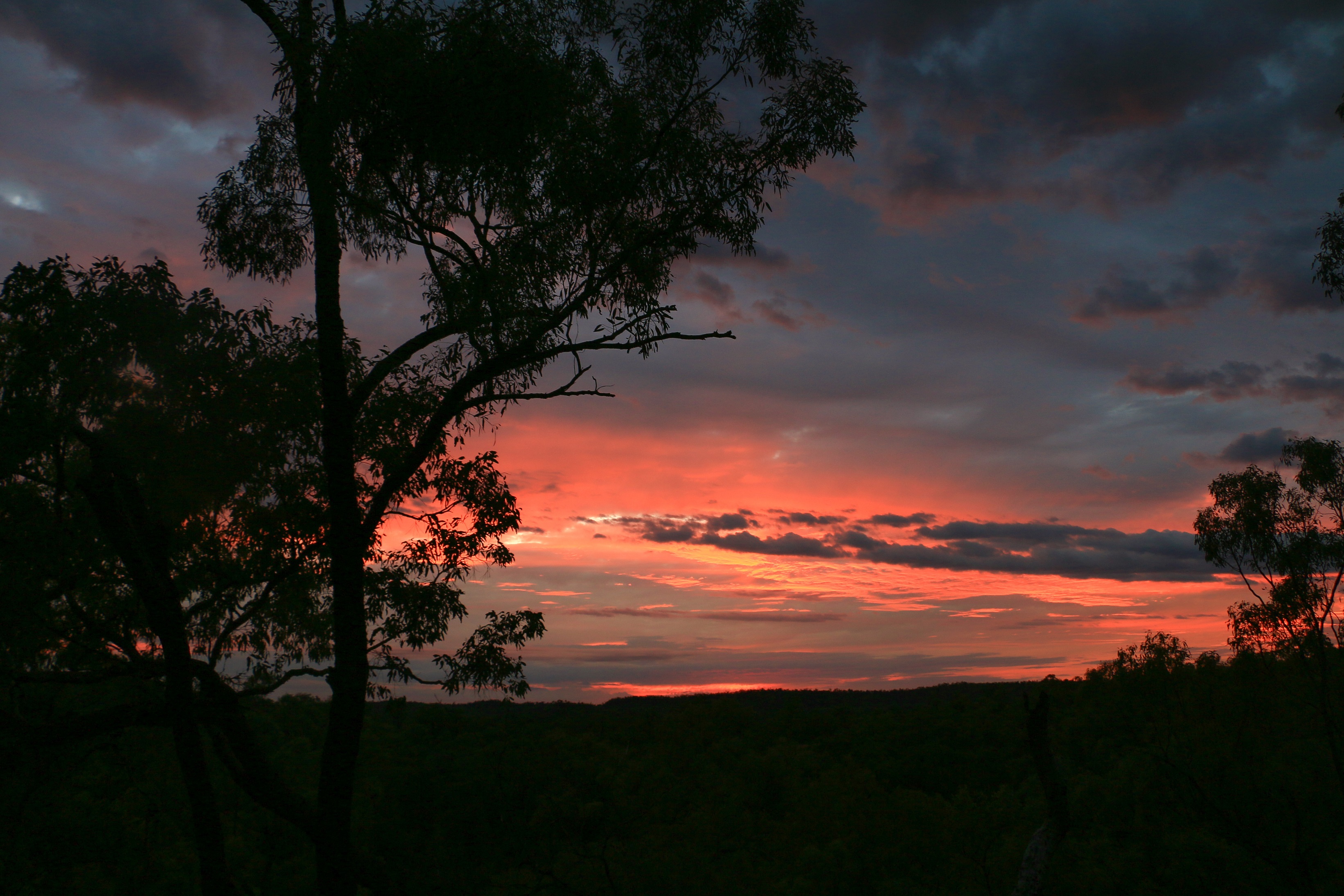
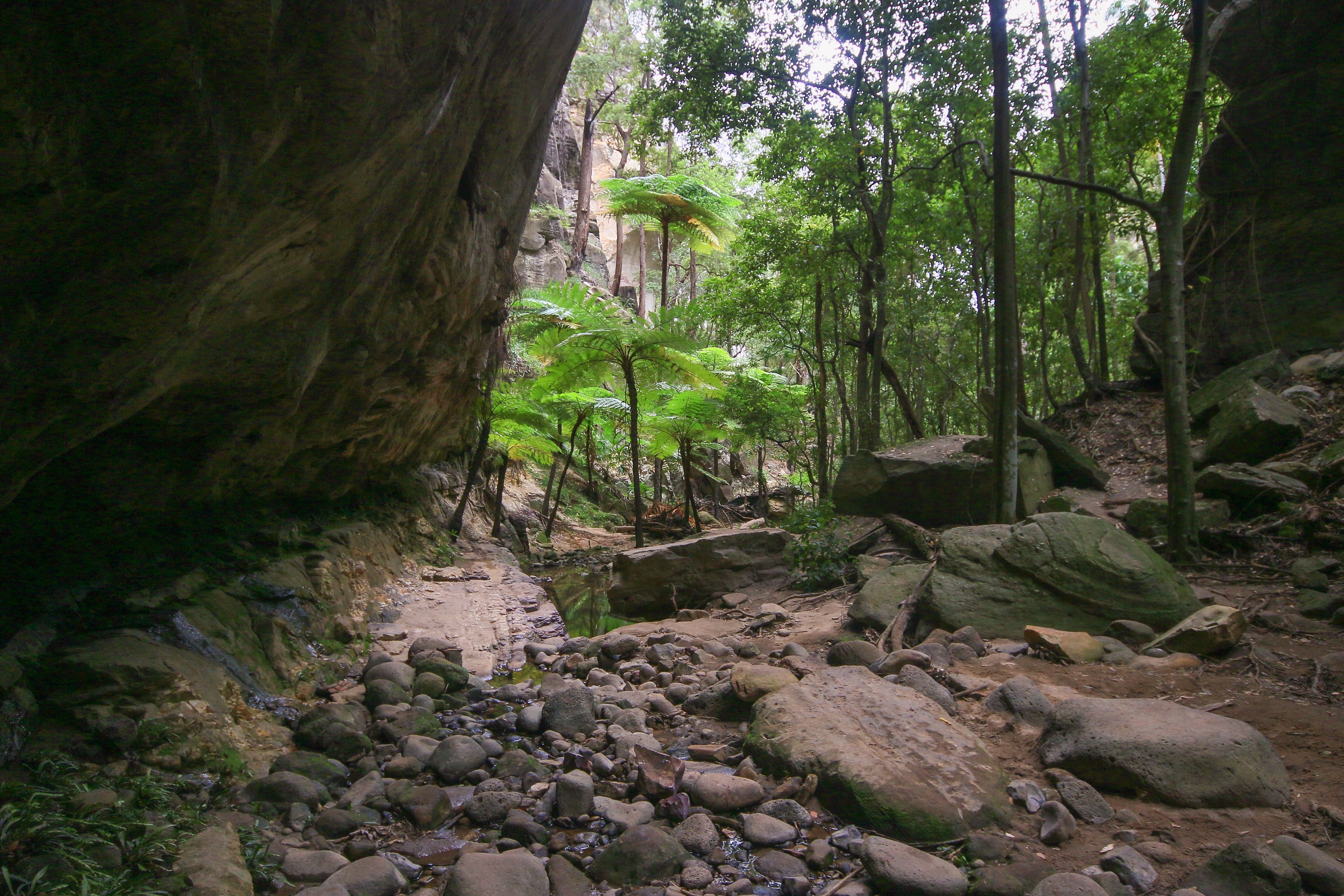
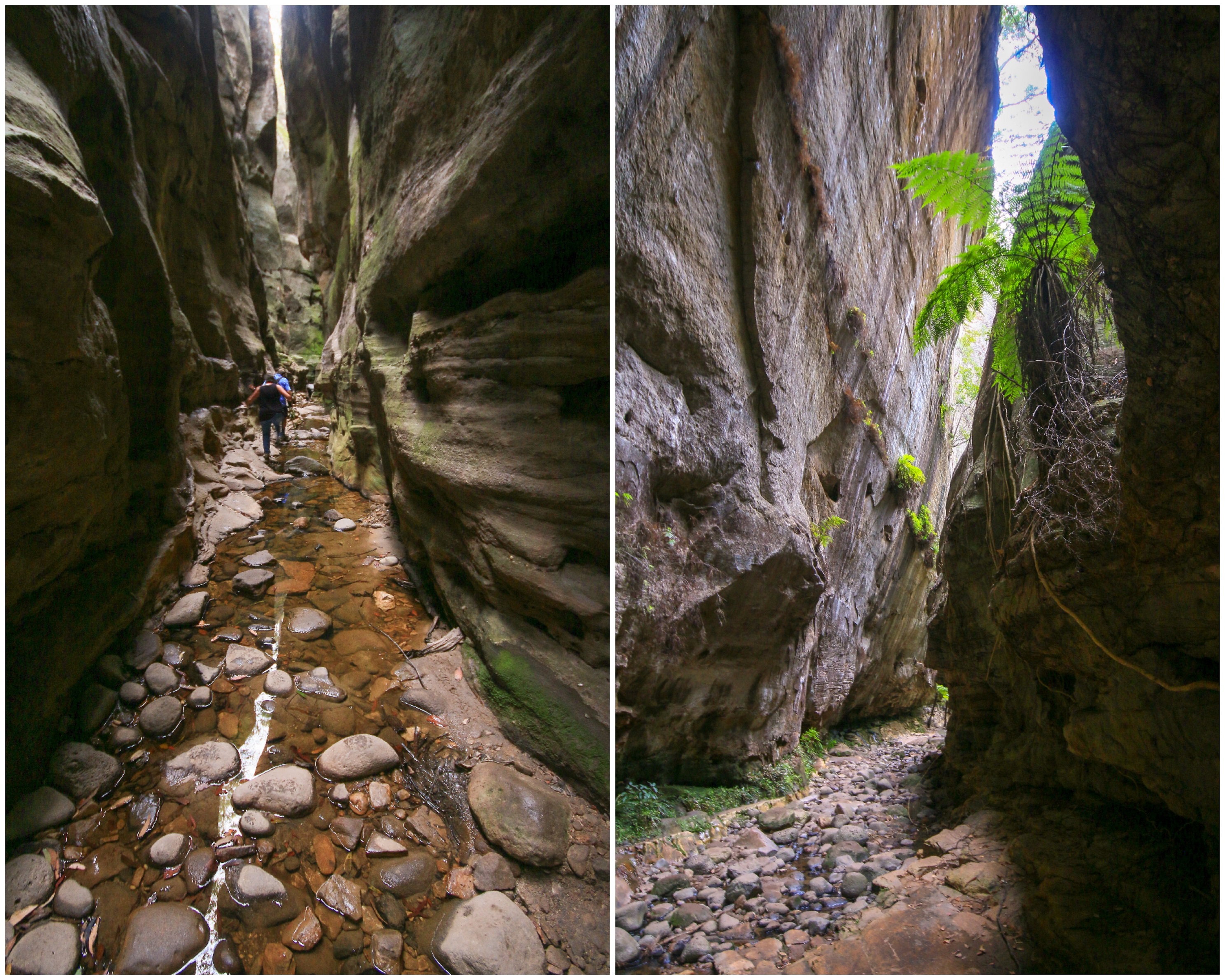
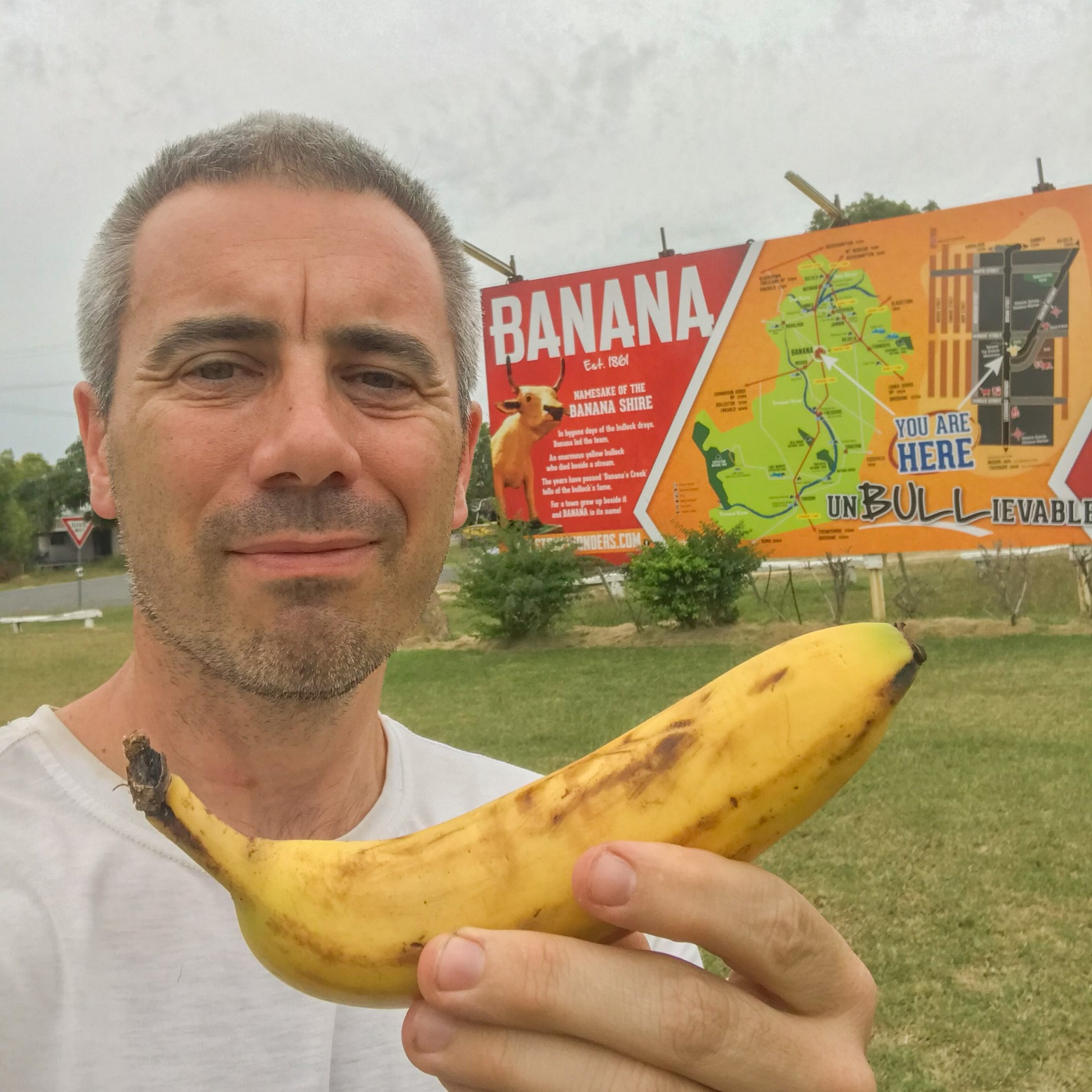


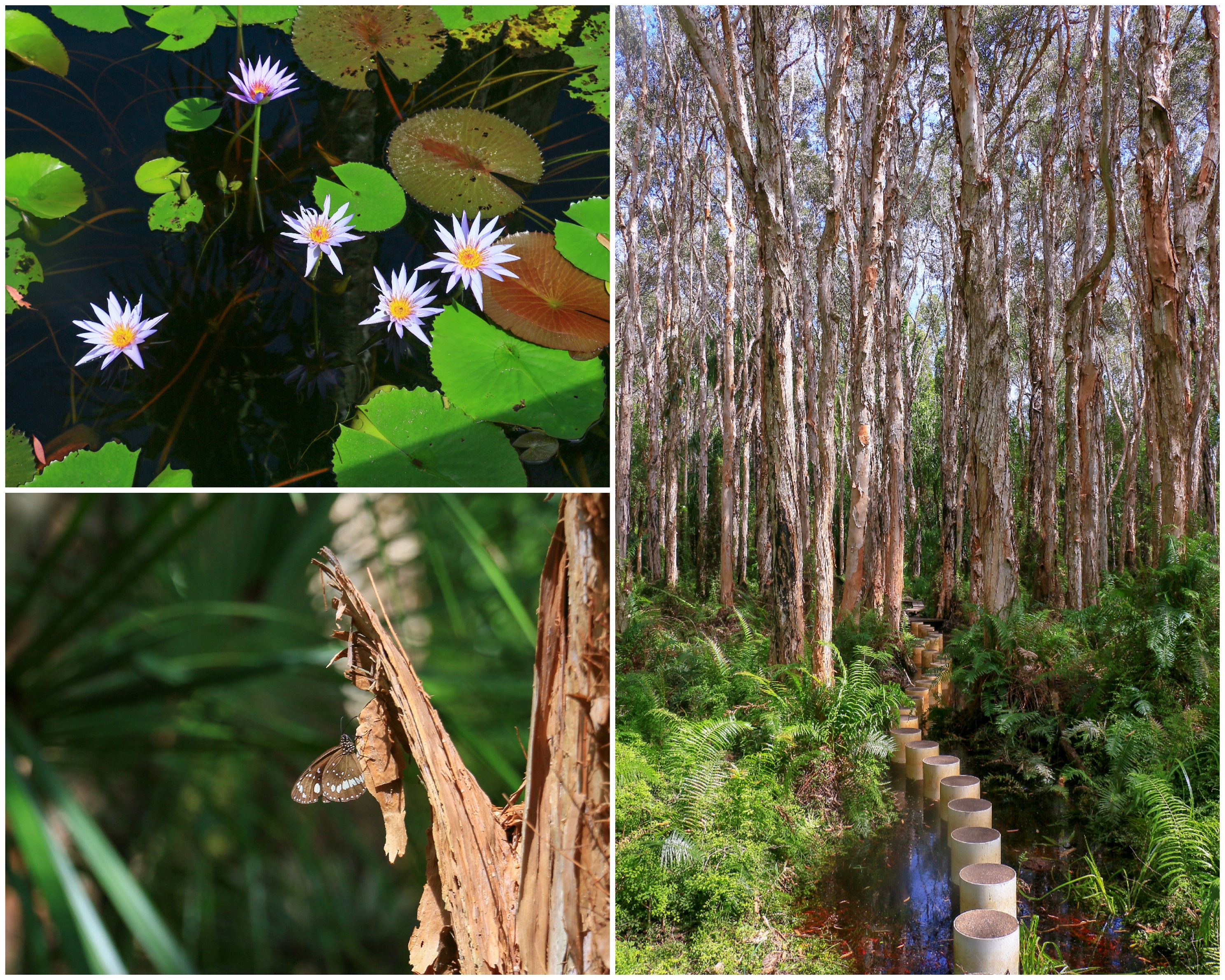

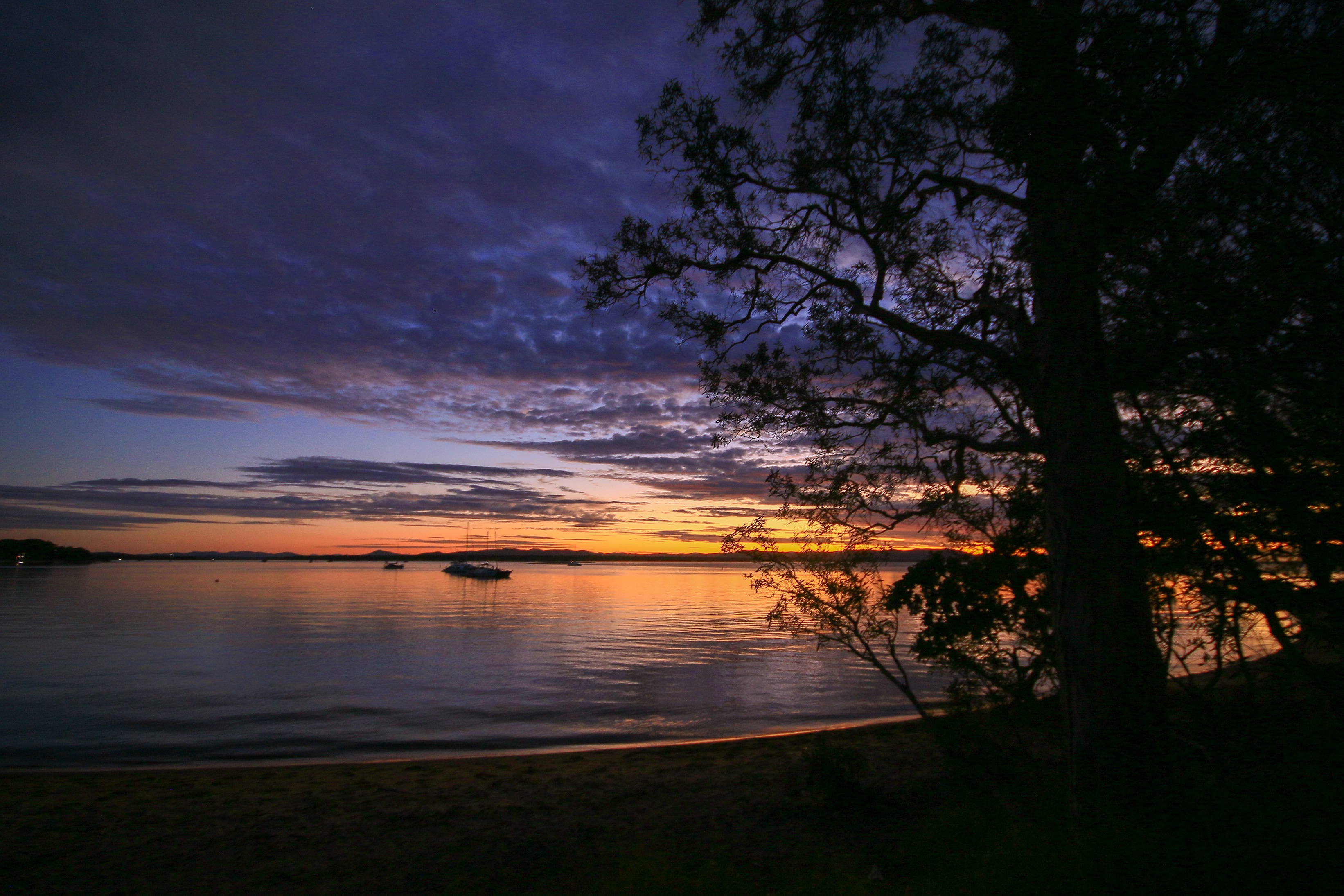


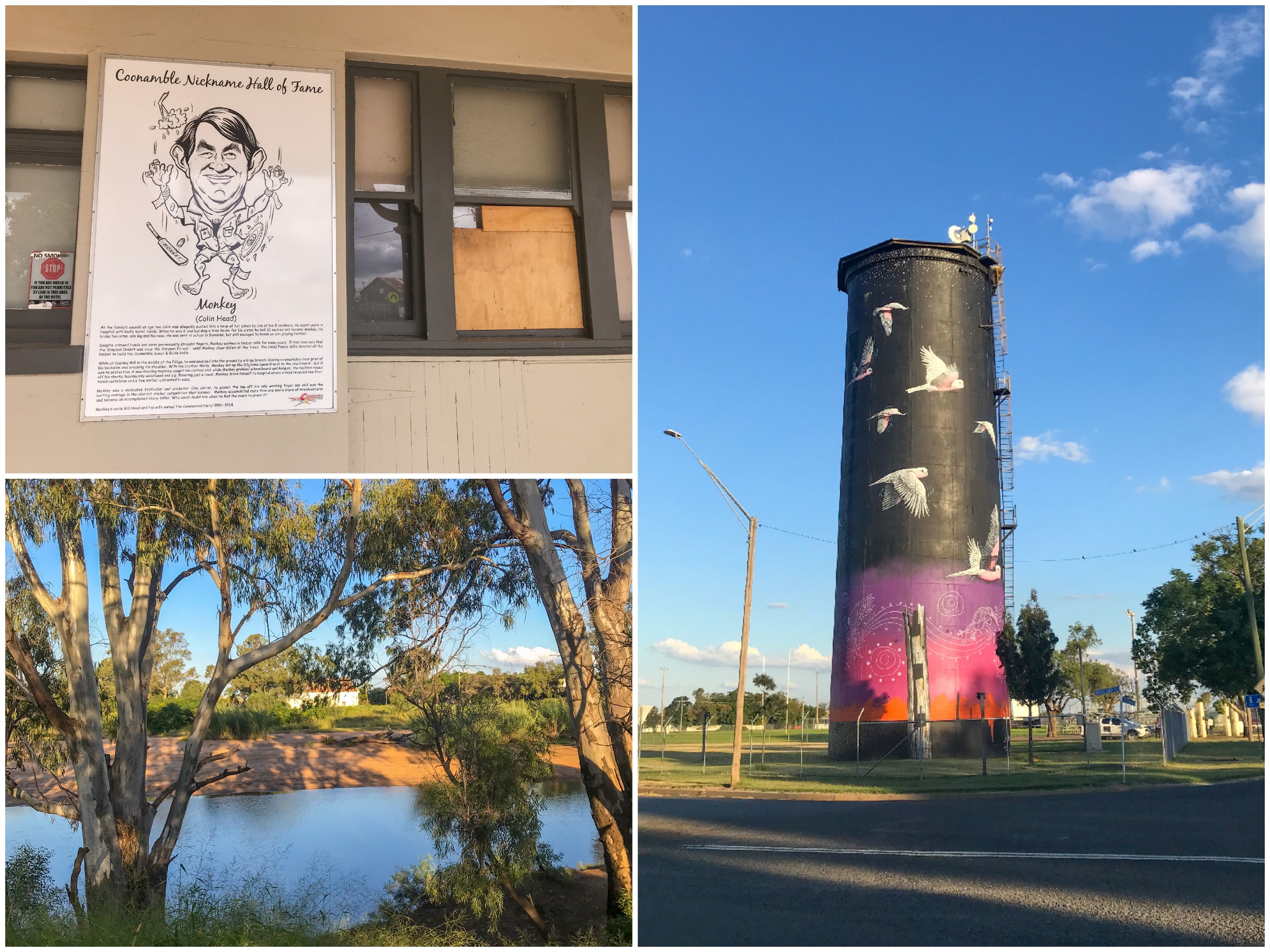


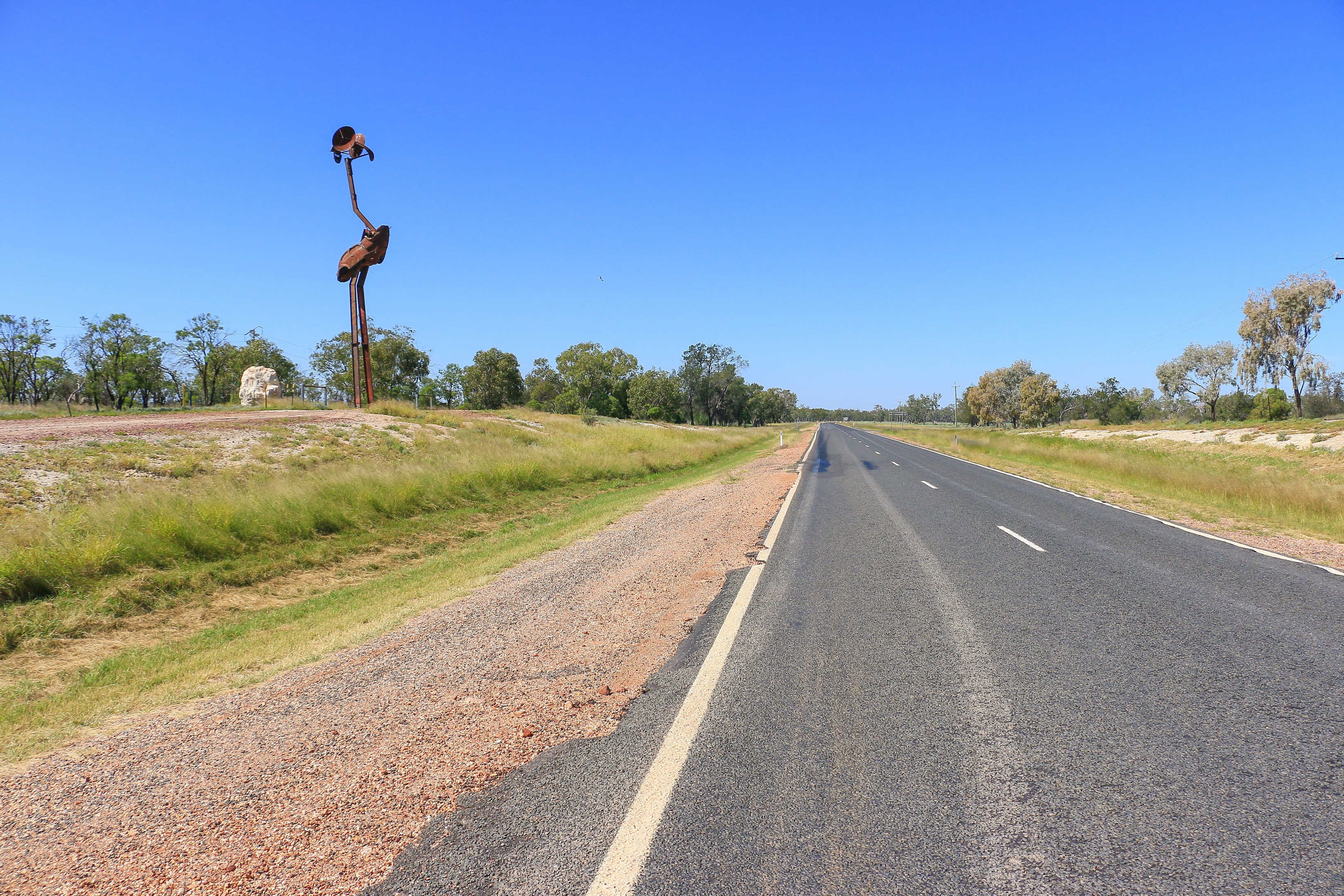

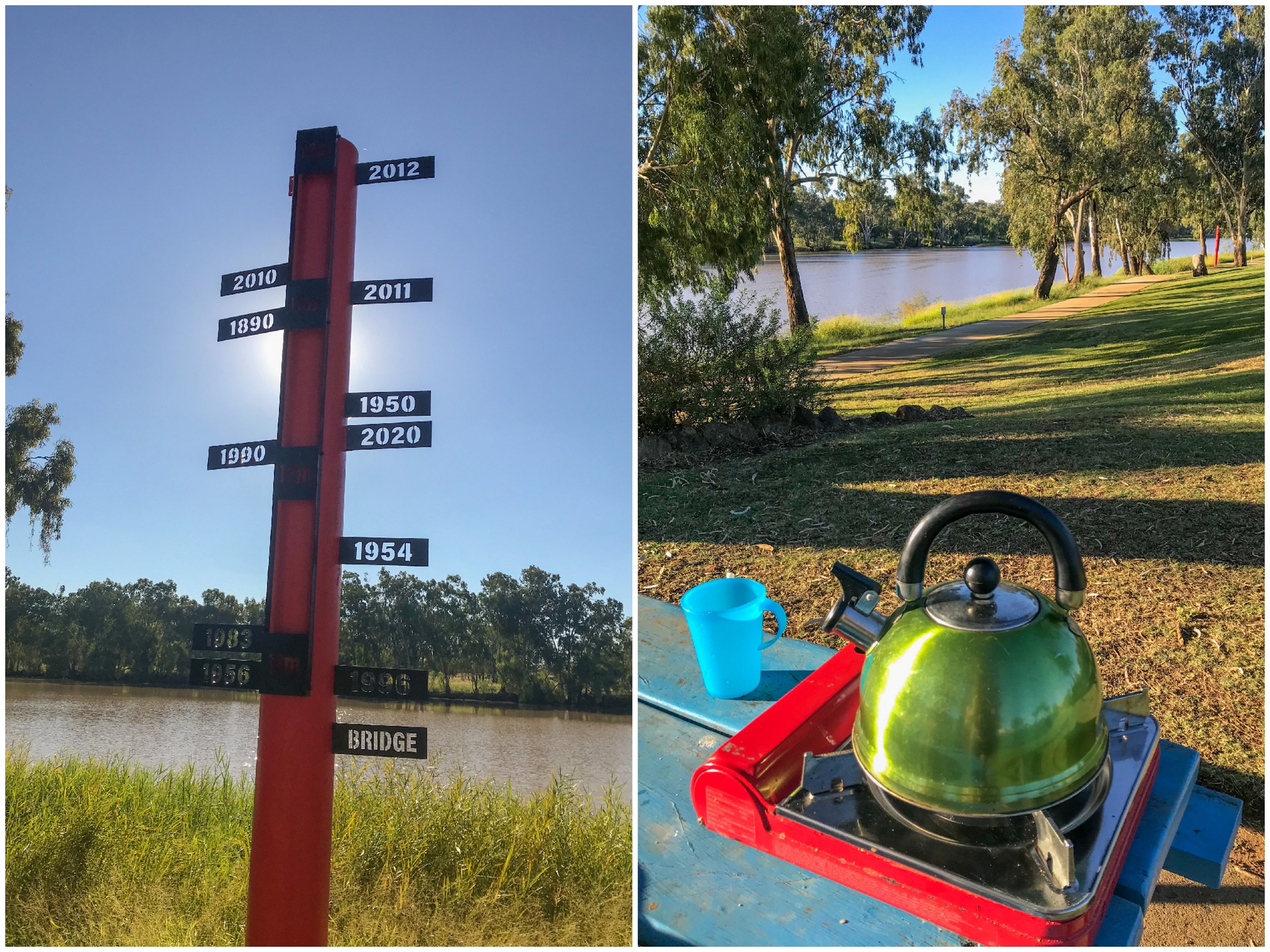

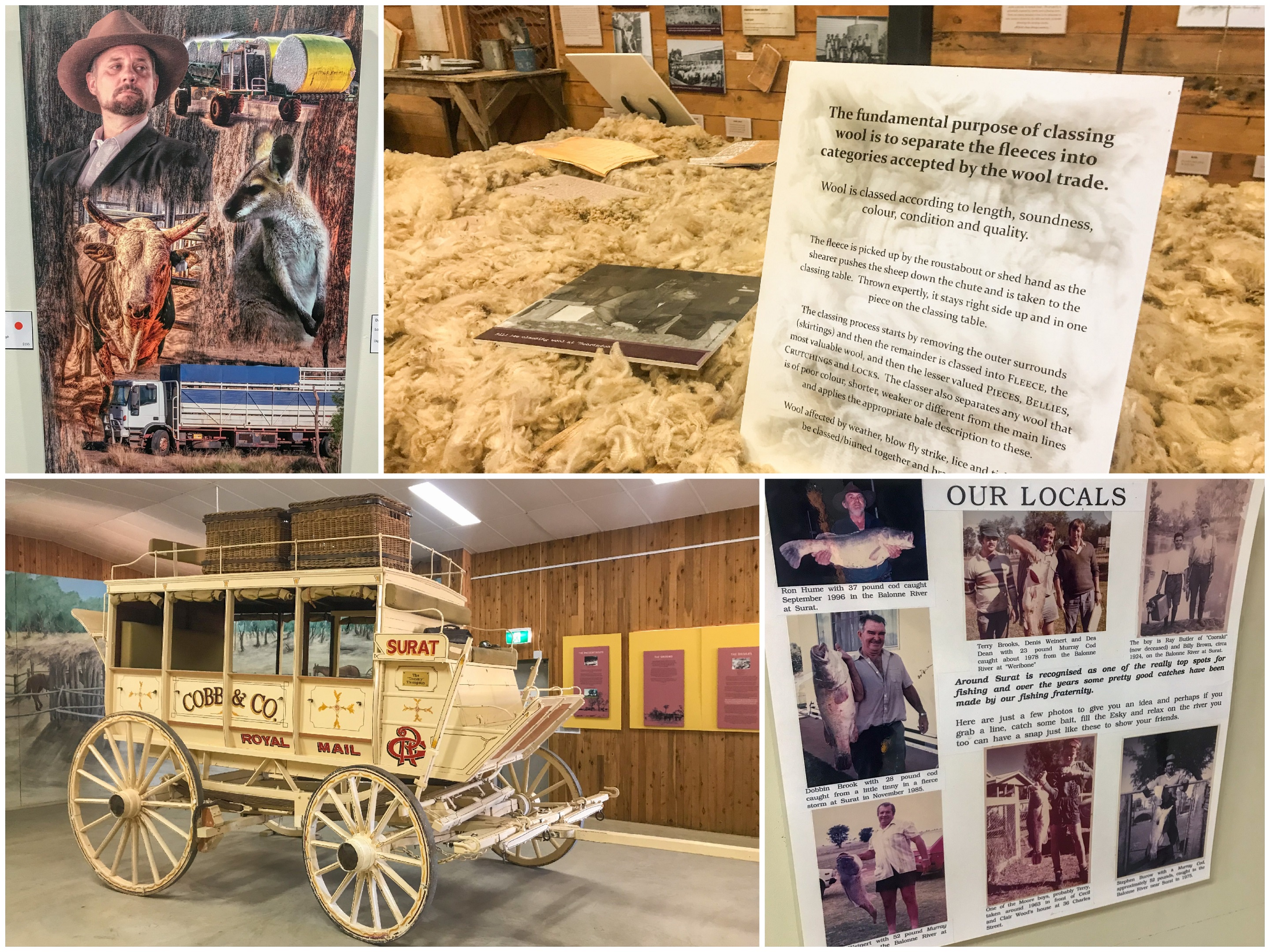
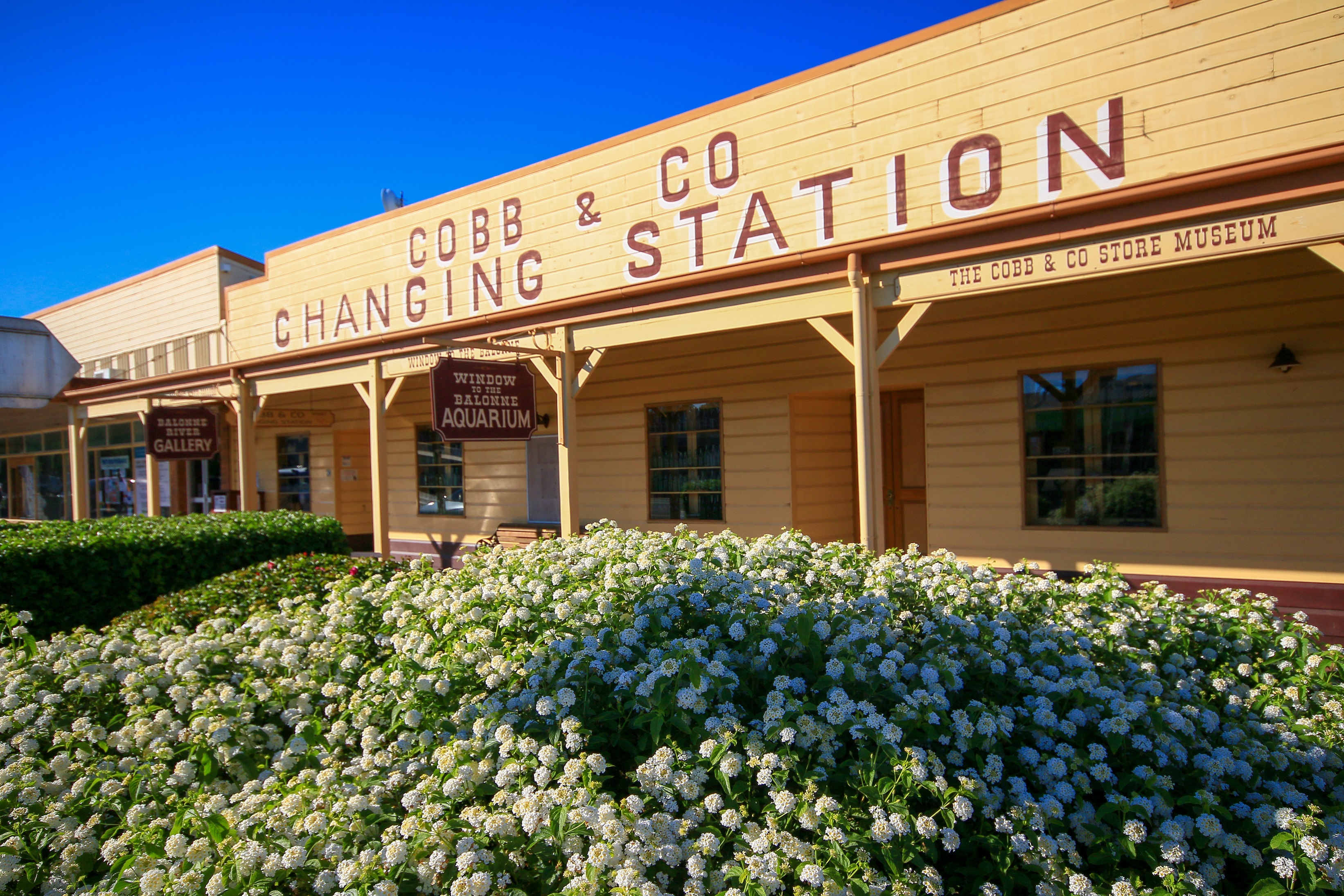
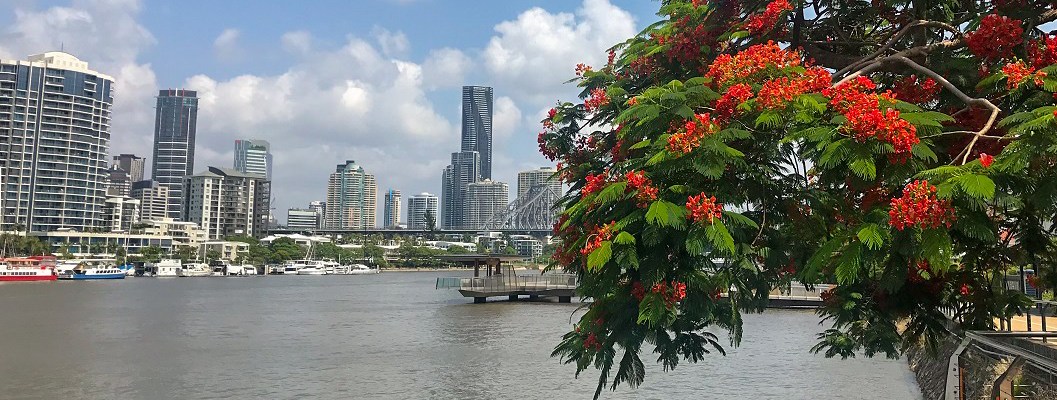


 I did Brisbane things in Brisbane, such as pretending to be sophisticated at a few of the galleries, crashing down to earth with sugary iced drinks for a dollar, cycling on one of those godawful city bikes along death trap rush hour cycleways, and bobbing upon the water aboard trashy ferries championing local sporting sides.


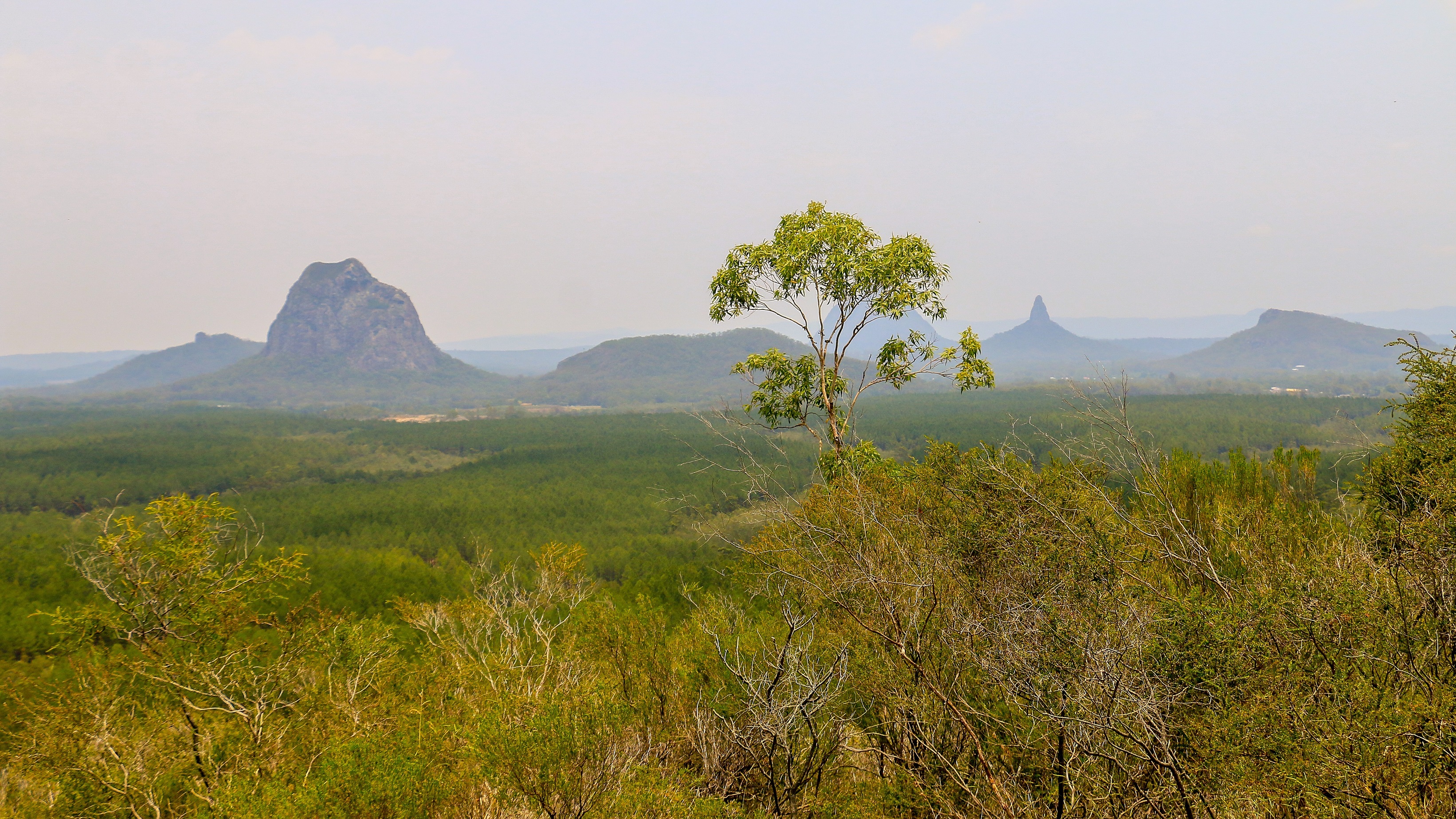

 Together, we explored the land of the Quiet Australian, treading newly built pavements, discovering plots of land awaiting a six bedroom home, lounging in the garden questioning how the Quiet Australians next door can be so goddam noisy. Some of us sniffed butts and peed on lampposts. Others caught buses and sought coffee at the mall. There was a lot of cloud and a little rain. And hope on the grapevine that this would extend south.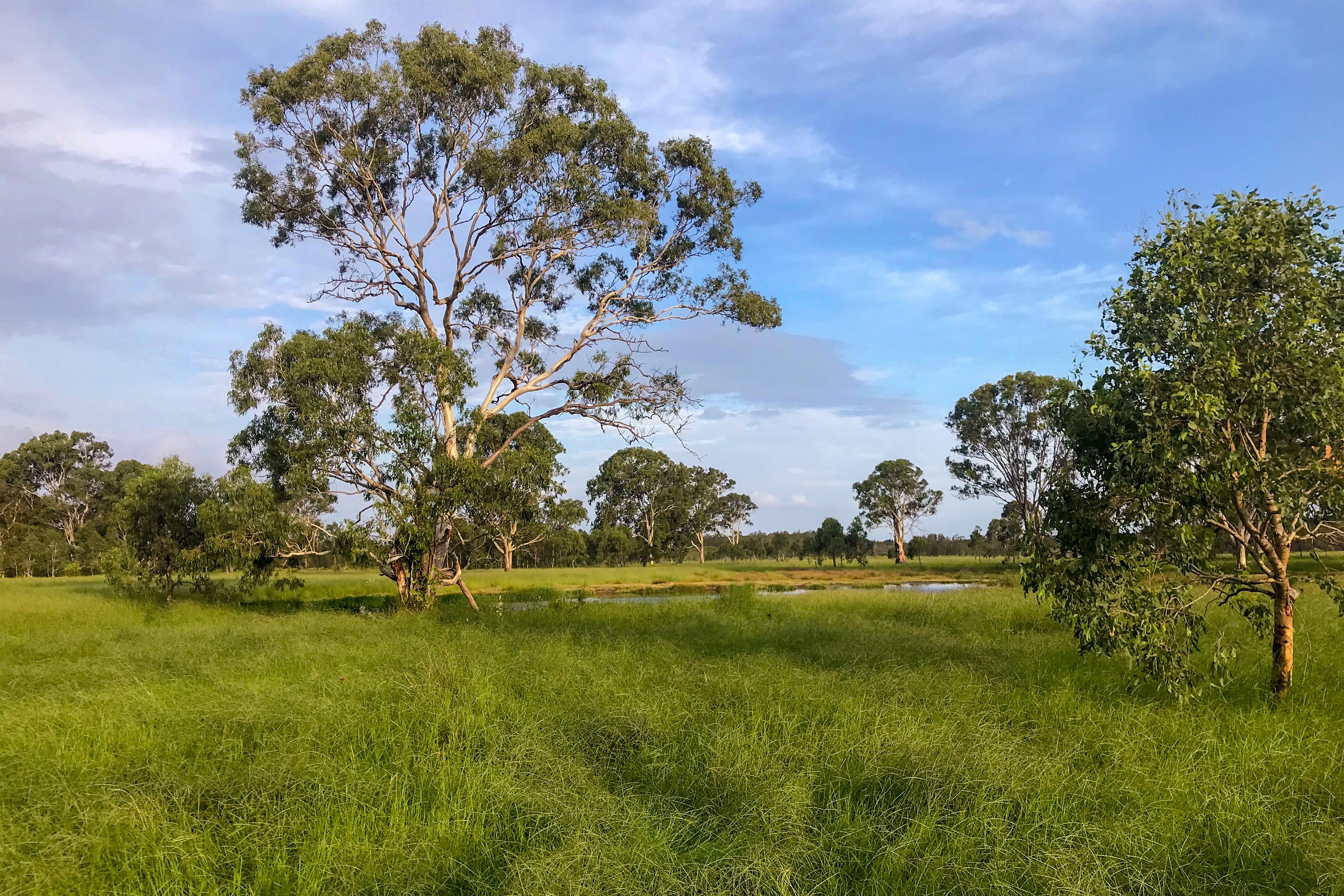
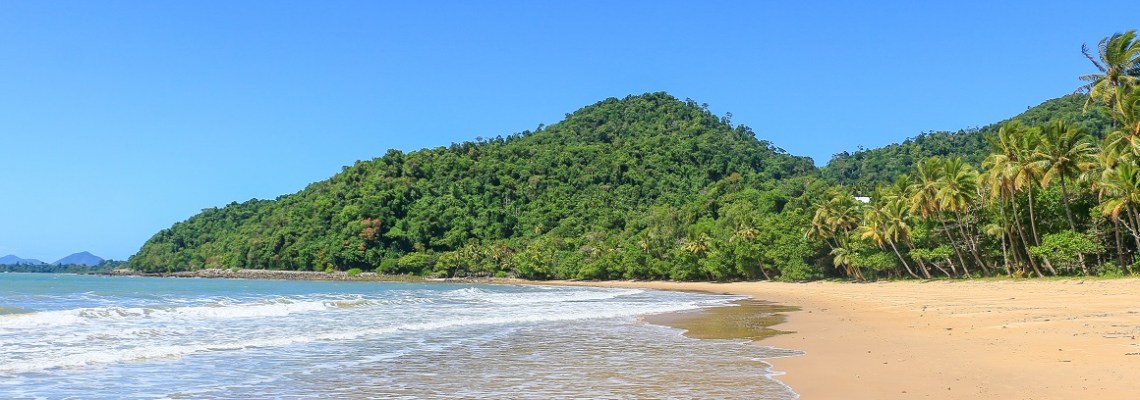


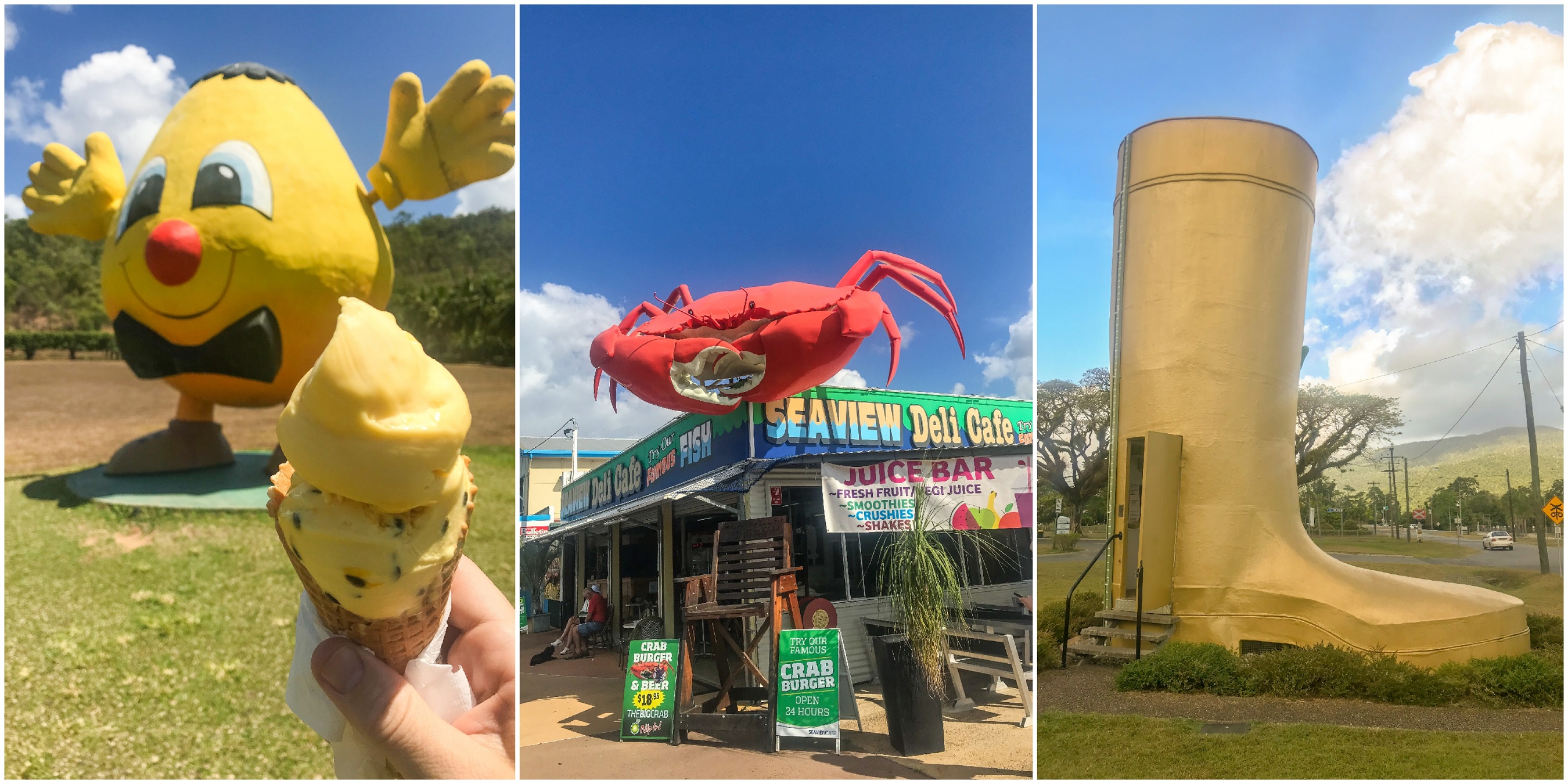


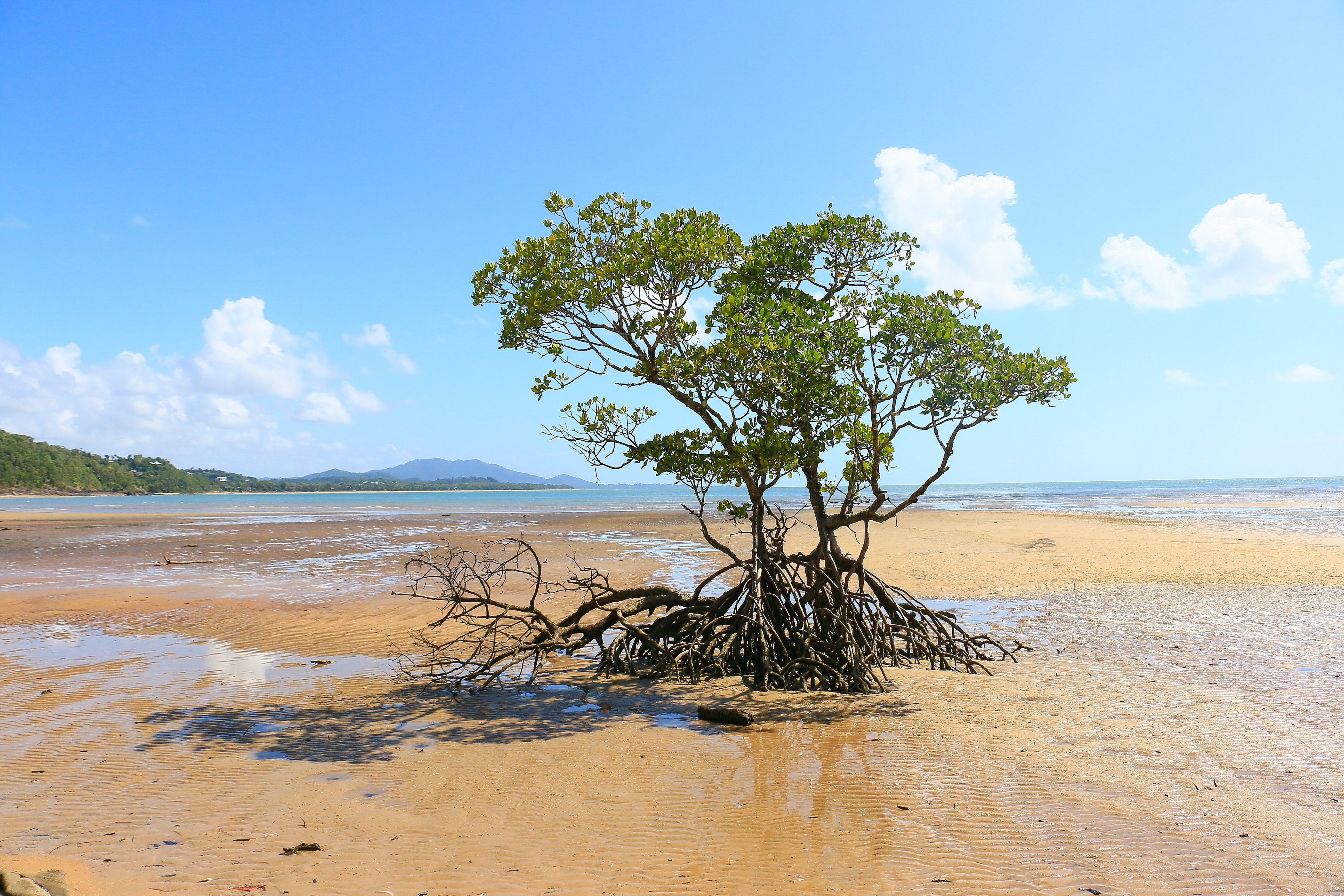


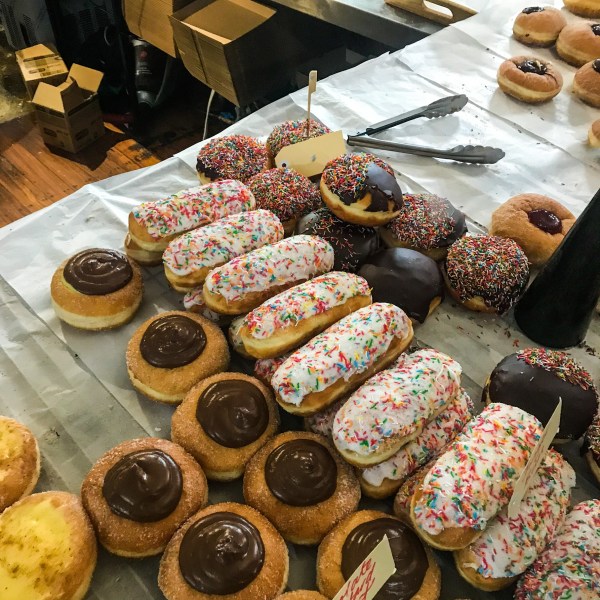 And a raincoat. For it is even truer that Queensland is far from beautiful one day, perfect the next; a dubious marketing slogan dreamt up by mediocrities that continues apace in the supposed Sunshine Coast, a place frequently sodden by epic downpours and possessing a clammy mildew befitting the swampy subtropics. Saturday here was so damp that the highlight was a doughnut, and even that wasn’t much of a highlight, more a triumph of social marketing style over substance.
 Queensland: pissing down one day, sweaty the next. The sweatiness emerging on Sunday as the sun makes an appearance, triggering rising heat and rampant moisture. Liquid particles are lifted by ocean gusts, filtered ineffectually through the thrum of air conditioning to congregate in damp surf club carpets. Puddles among snake-infested flood plain linger, waiting for passing birds and passing property developers to drain. The ubiquitous HiLux secretes fluids while idling outside Red Rooster, as a leftover billboard of some redneck running for parliament gazes down approvingly. Just thank the lord or some other unelected deity that it is not yet high summer.


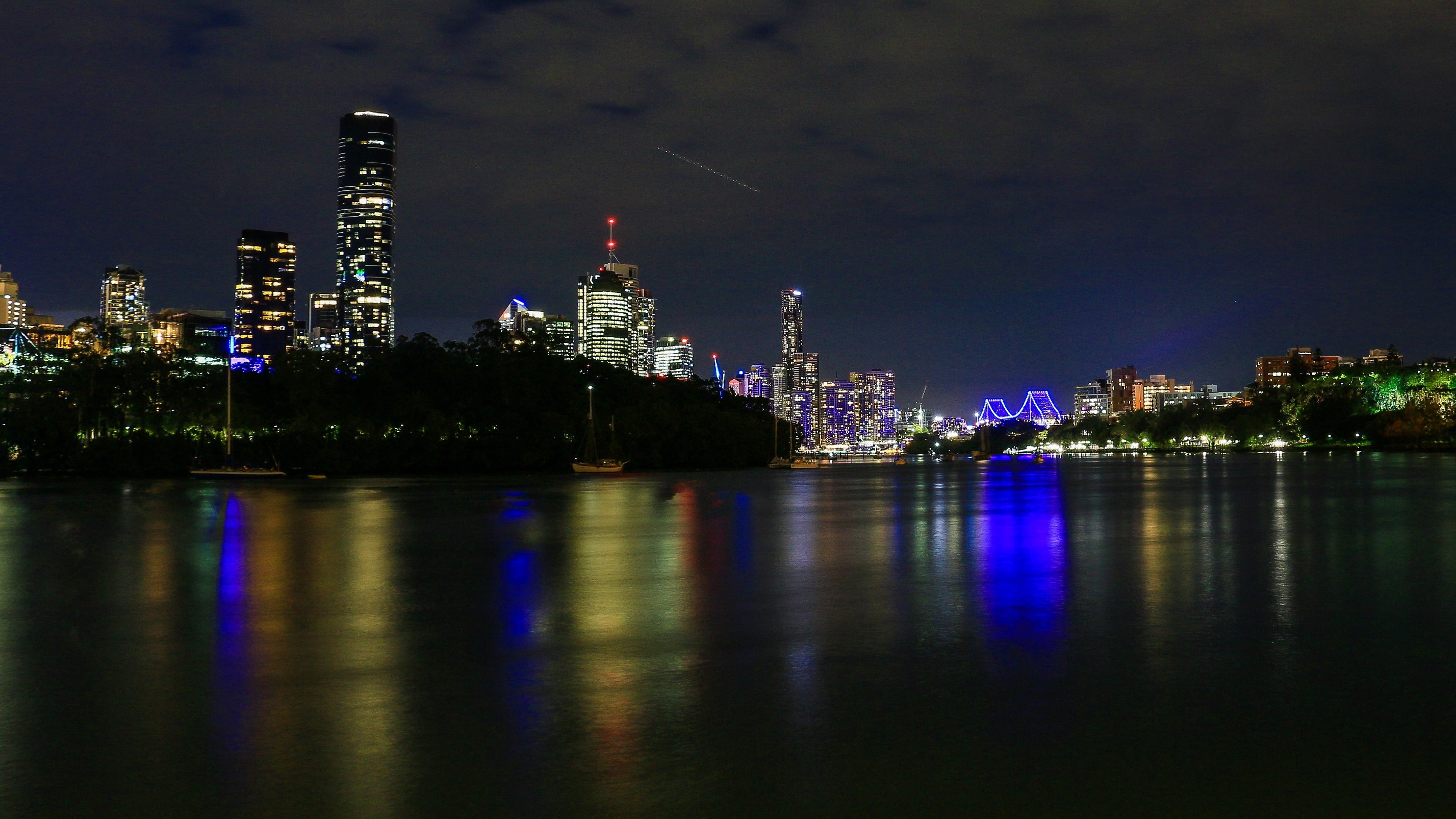

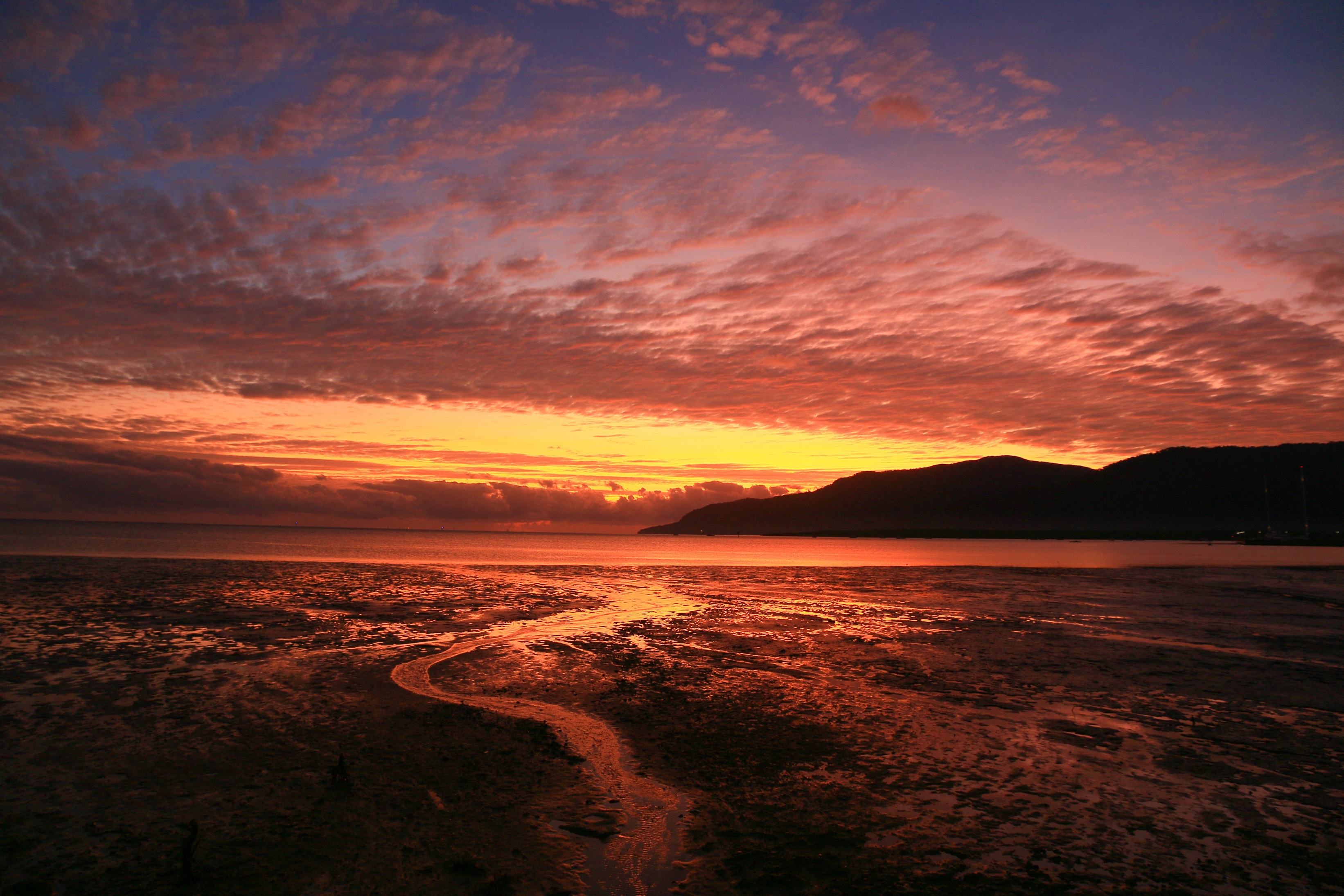
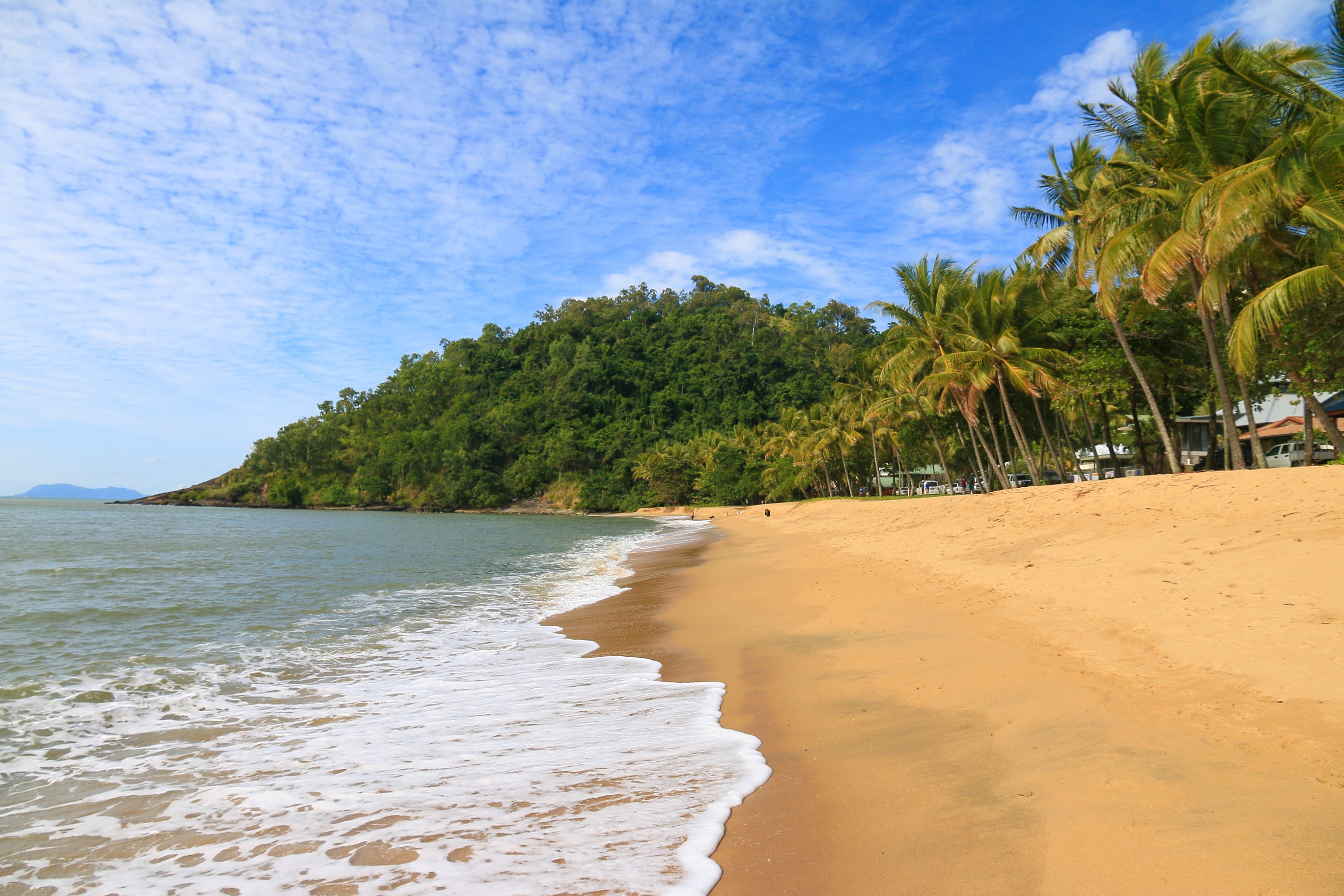
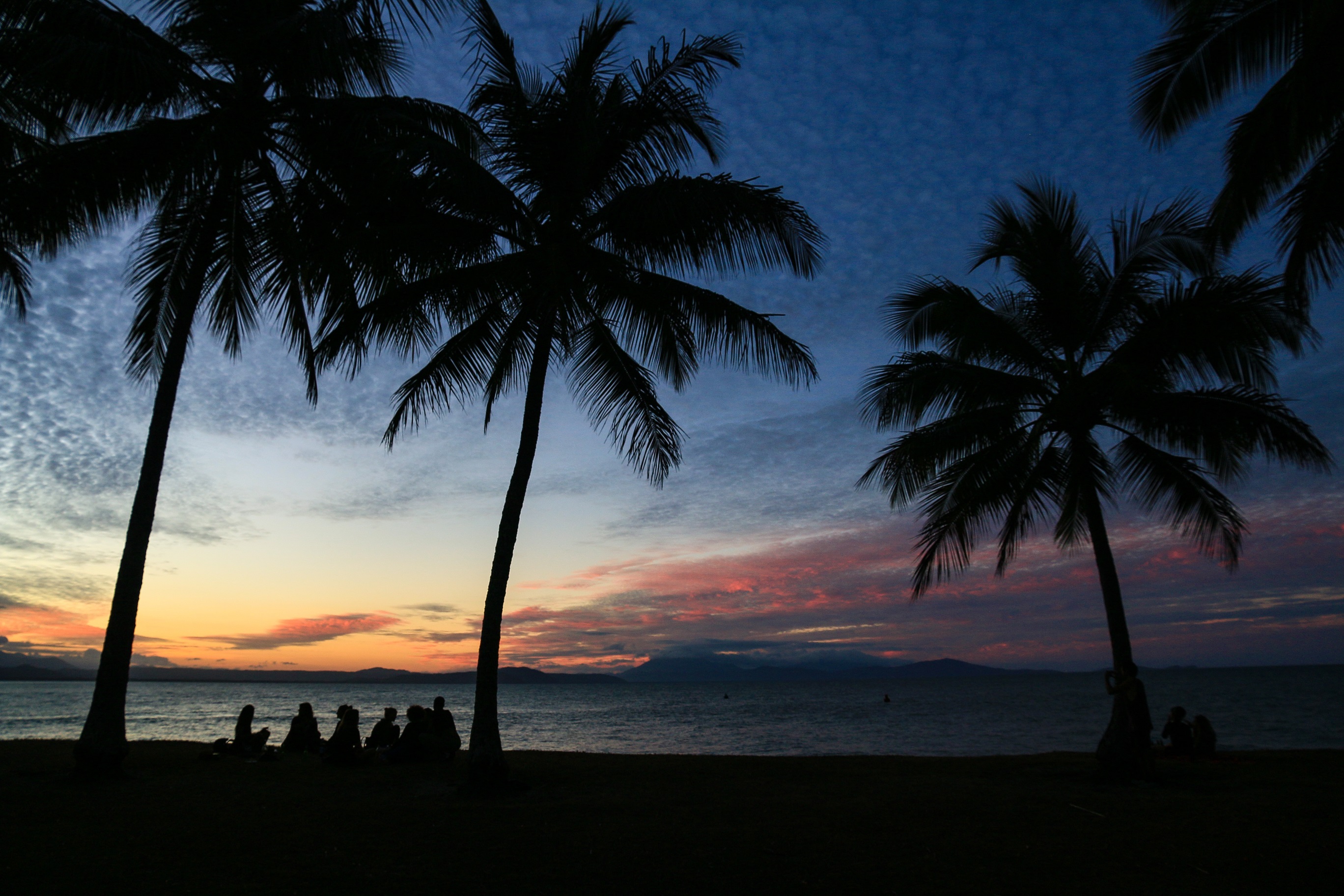
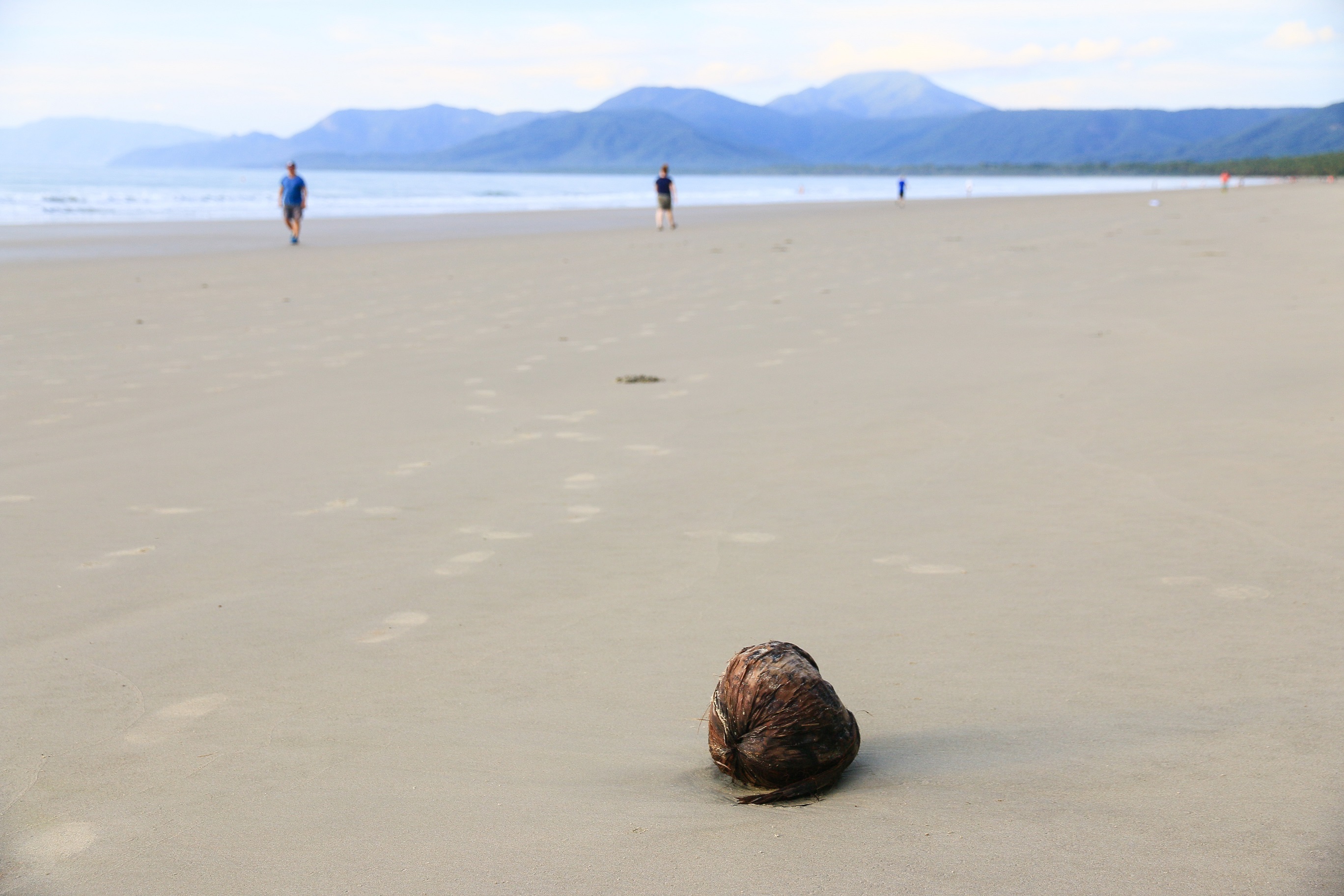
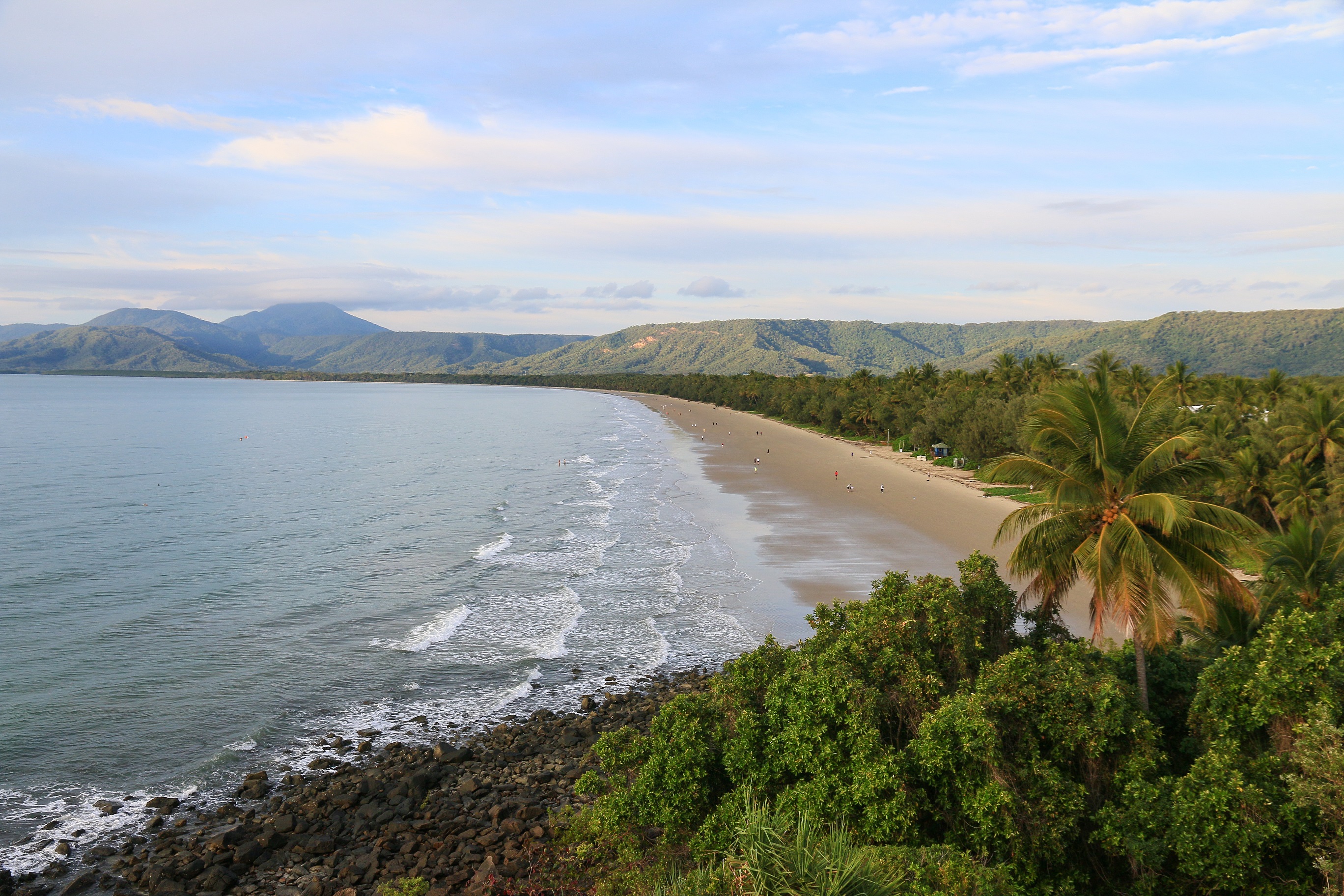

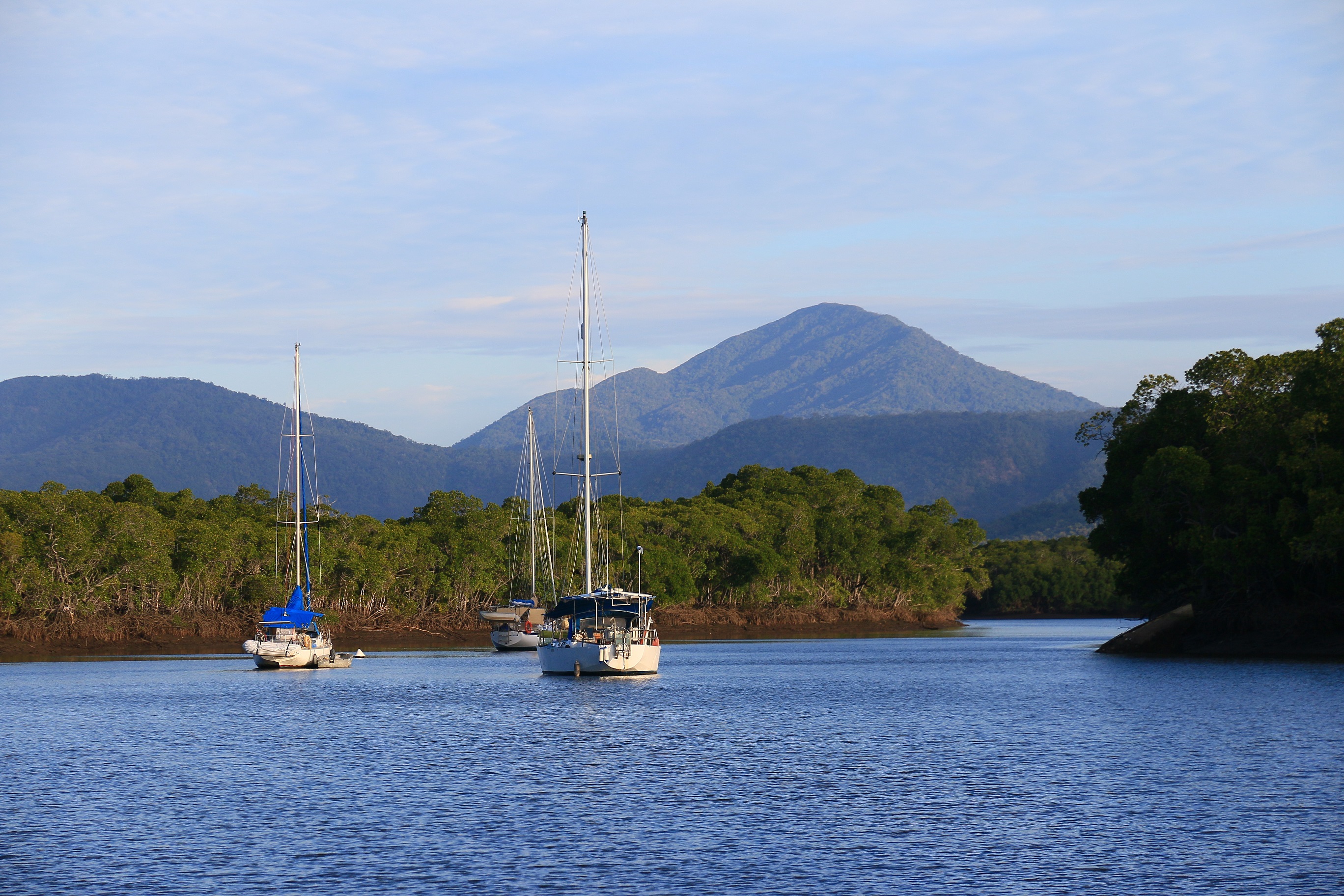
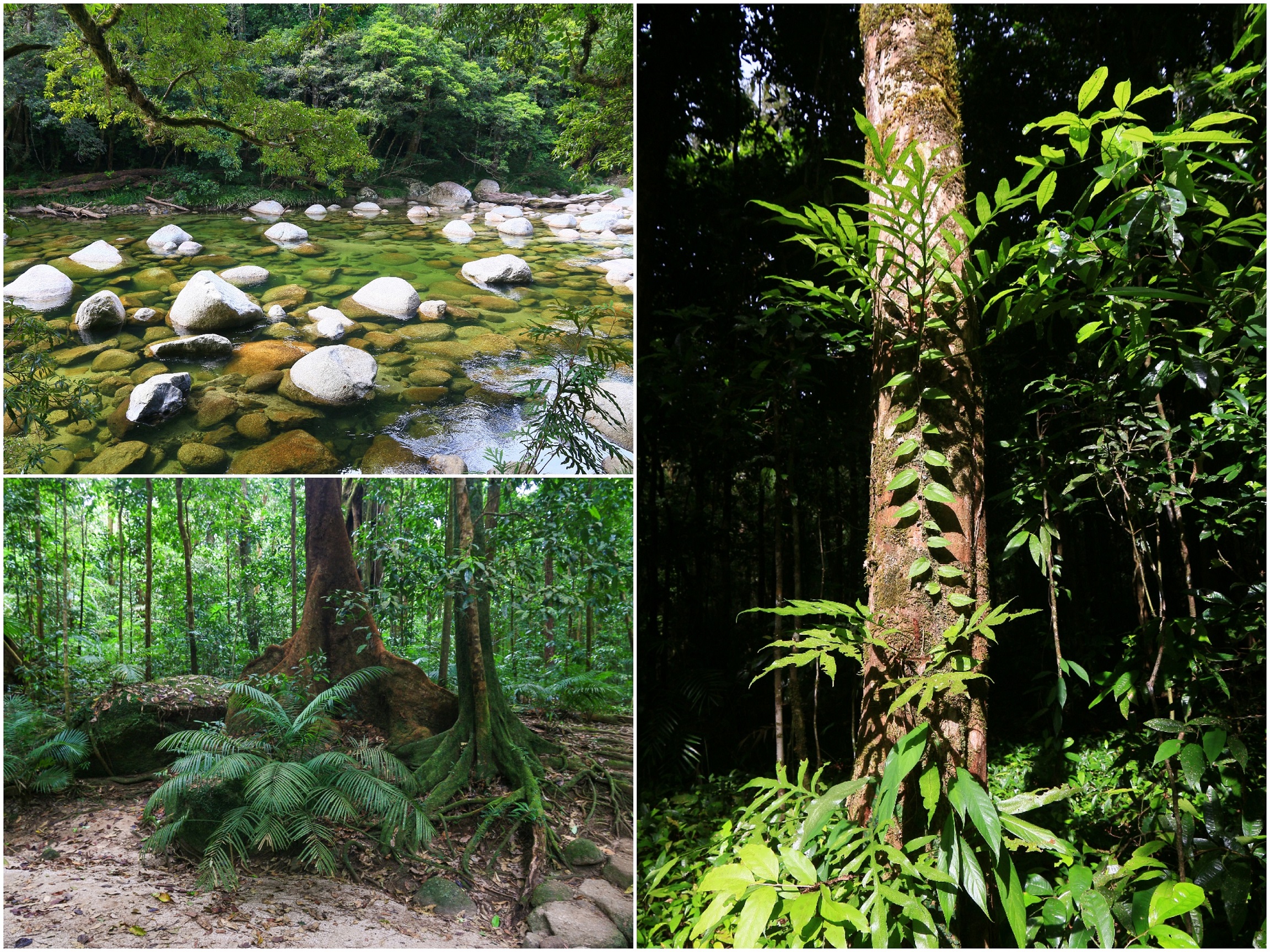

 I took one final coffee and stroll on the beach before embarking on the drive back south, which had a fair share of roadworks interspersed with spectacular scenery. Pausing around Ellis Beach, in this snatch of tropical palm-fringed cliché, it was again hard to fathom that I would be in a different world, in the same country, in a few hours. My poor shorts would be tucked away out of sight again.
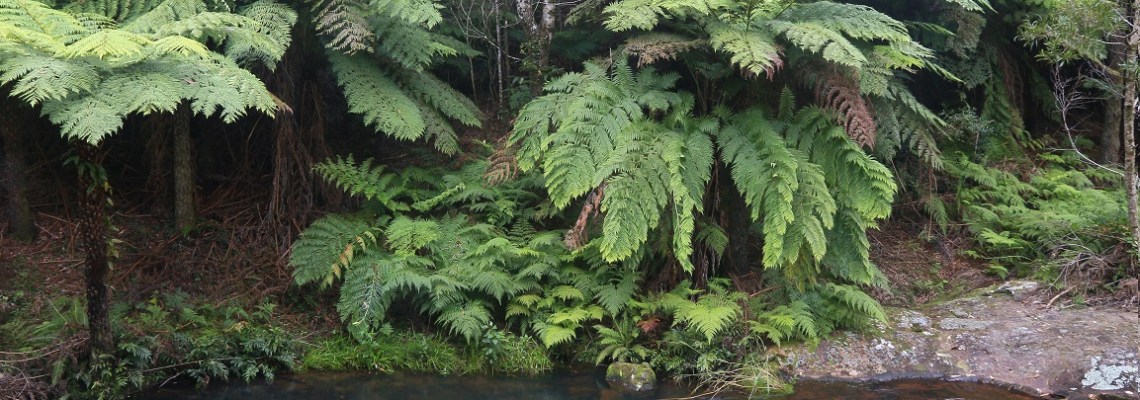
 Anyway, lest I offend several friends, family, prospective employers and the rest of their state, Queensland can be beautiful and at times might be equated with some form of perfection. However, the humidity is frequently disgusting and – on this occasion at least – the marooaaans easily trounced the blues in the rainfall stakes. Meanwhile, the growth of South East Queensland is rapidly turning the area into one very long Gold Coast-Brisbane-Sunshine Coast conglomeration where it seems obligatory to buy an oversized property and a Toyota Hilux. Here, the only koala left is a giant fake blue mascot sitting around watching far too many swimming events.

 I think if miracles exist then we had one, for there was around one hour of dry, relatively sunny weather on that day which had seemed totally implausible earlier on. An hour that coincided with our allotted time in a canoe, gently zig-zagging with the meanders of the water towards Harry’s Hut. While the surrounds were a bit samey and somewhat nondescript (in a jungly, swampy wilderness kind of way), it was an hour of calm, of peace, of harmony with the environment. And above all, recognition of sheer bloody luck.
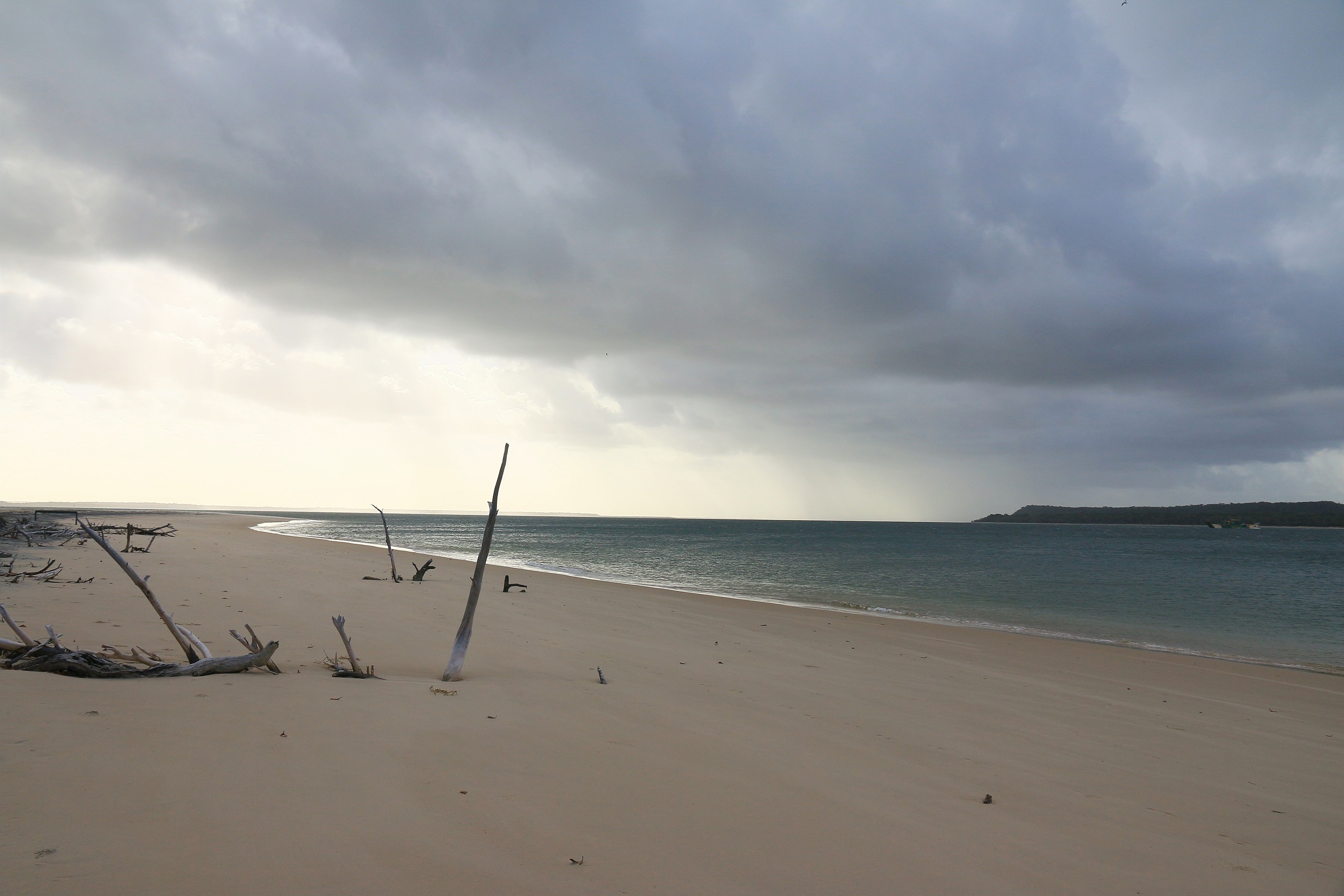
 Just a hefty stone’s throw from the tip of Fraser Island, the soft sand delights the toes more than it does tyres. The rugged natural detritus of storms and tides offers a little intrigue and entertainment. The comings and goings of the ferry – and the potential for vehicles to get bogged down on Fraser – offer even more. Dark shadows intersperse with brilliant sunshine, grey waters become blue, brown sands less brown. Fatigue becomes contentment, and moments to remember form. Moments that are beautiful, even perfect. Damn you Queensland!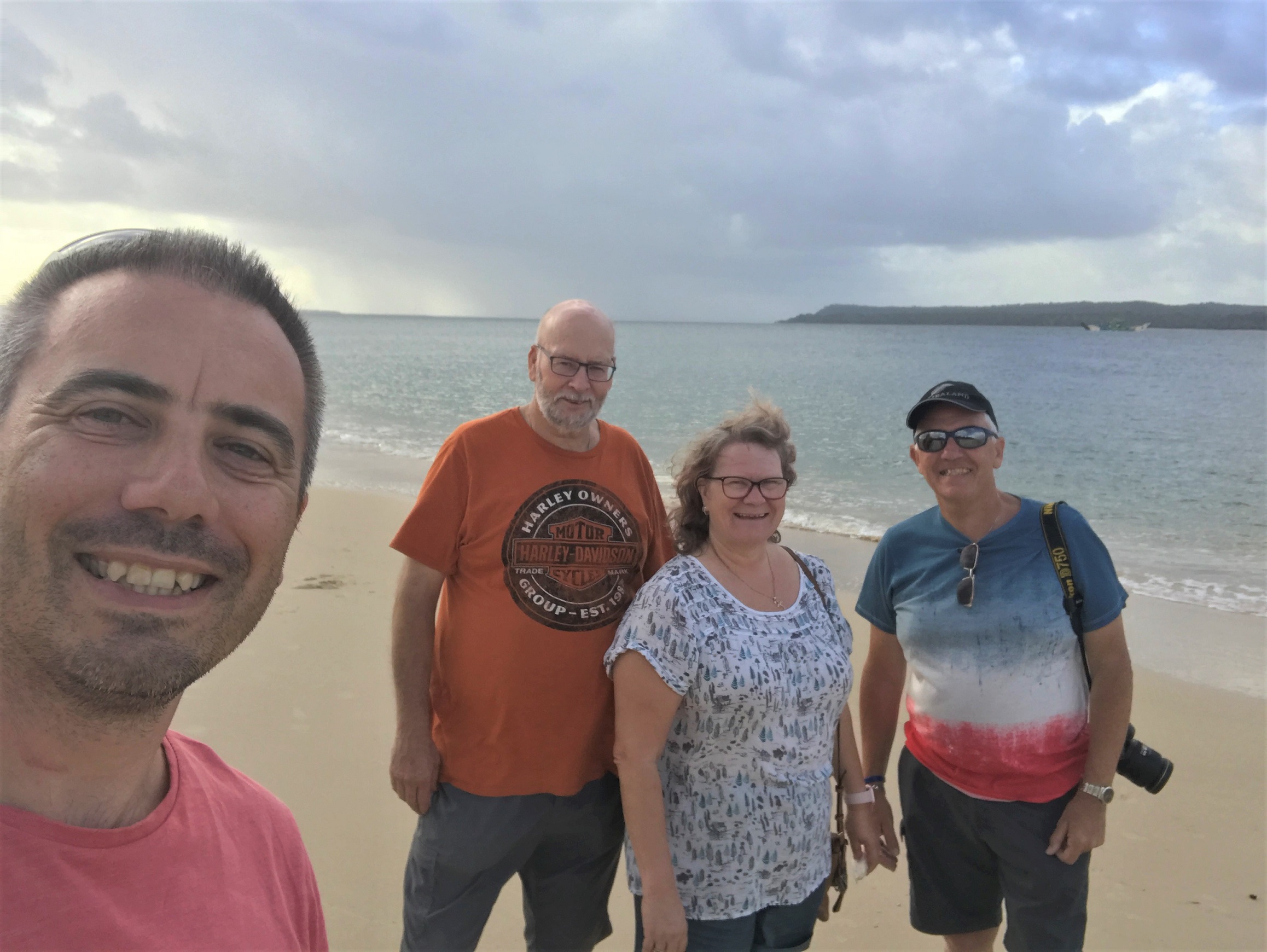
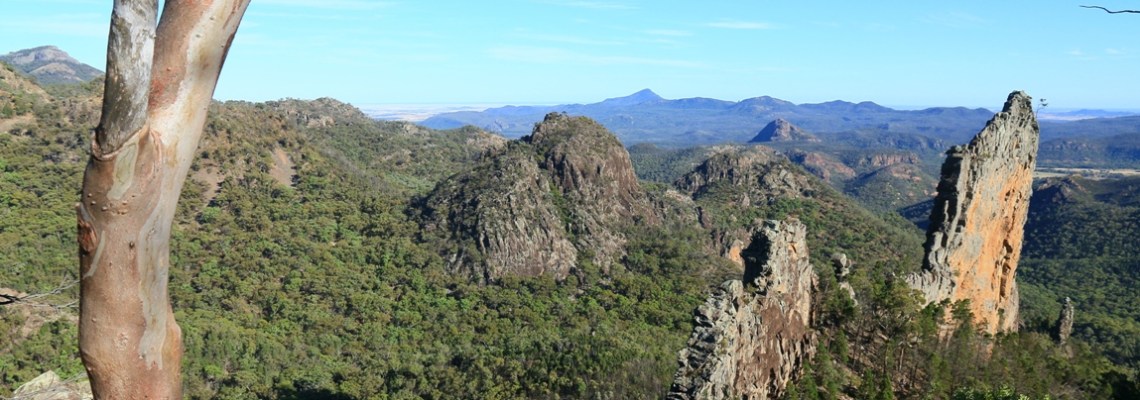
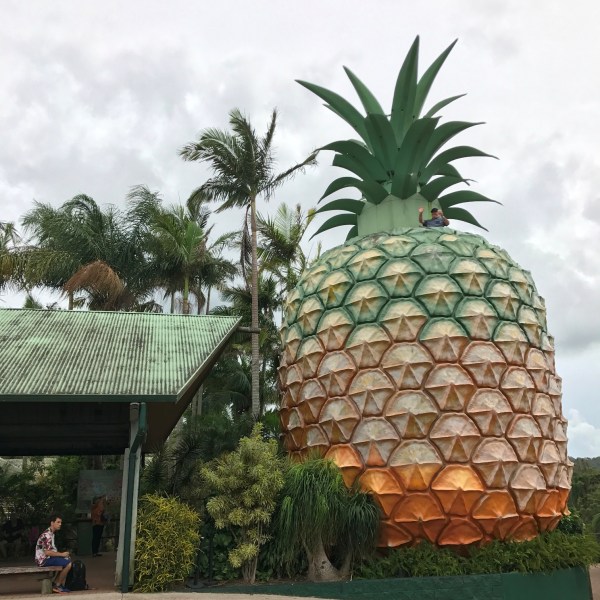 A couple of days on the Sunshine Coast had delivered only intermittent milky doses of sunshine, with homely patches of drizzle persisting throughout my final morning. An obvious light in the dark was the Big Pineapple on the outskirts of Nambour. A possible former plaything of an ex PM and Treasurer of Australia, I felt this was a perfect way to say goodbye to the Sunshine Coast and a suitably symbolic start of another long drive through the heart of Australia.

 Pausing at Stanthorpe the rain had returned and I made use of mobile coverage to assess the likelihood of getting soaked while camping. It was touch and go but I opted to camp a little south in Girraween National Park. This was unlike a Queensland in any of the brochures…cool, cloudy, a little dank. Clusters of giant boulders dotted the landscape, sitting within short and stubby forest and forming natural terrain for pools of water to form.
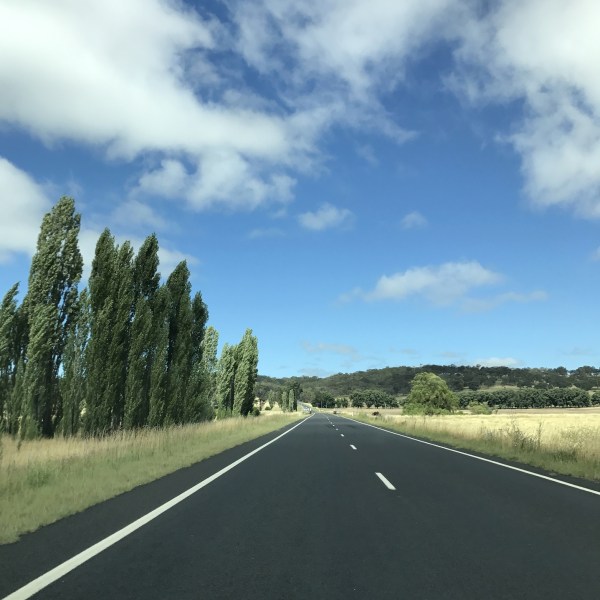 I was definitely the first person to leave the campground the next morning, cognisant of a long day ahead and jumping forward an hour into New South Wales. A lonely road led to Glen Innes, the only memory of which I have is of waiting ages for a coffee and then discovering, driving out of town, that they had decided to put sugar in it. This clouded my opinion of Glen Innes, and driving through the next town of Inverell, I wish I had stopped there instead.
 Today, it is a quiet place of solitude and reflection. The chirping of birdsong persists despite searing heat and baked earth. A simple, memorial walk exists, a swirling red path providing points of information and remembrance. There is talk of healing, of coming together of ancestors, of deep remorse and some kind of hope. A hope that, eventually, love does trump hate.
 Entering Warrumbungle National Park, it was pretty clear that a fire had ravaged the area; blackened trunks of trees lined the steep slopes and the road produced a patchy, lumpy ride where the tarmac had no doubt melted. Up one of the hills, some of the buildings of Siding Spring Observatory had suffered damage but the telescopes survived. Well, thank goodness for that…we can still scope out future worlds to inhabit when Fake Lord Emperor Pussy Grabber destroys this one.
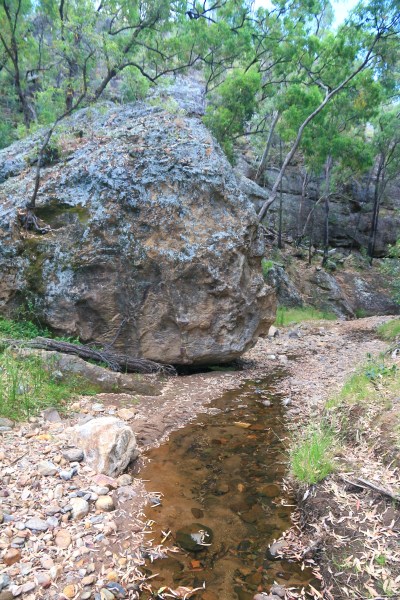 With benefit of doubt perhaps they were not doing the entire Breadknife and Grand High Tops walk. Maybe they were just doing the first part, which was gentle and followed the course of a mostly dry creek bed. This would be a rather fine walk in itself, for it is such an elemental, earthy landscape in which to linger. I wasn’t expecting such enchantment here, such homage to the rugged environments further inland, closer to the desert. There was a bit of Flinders Ranges crossed with The Grampians about this place. Two of my favourite ever spots blended into one.
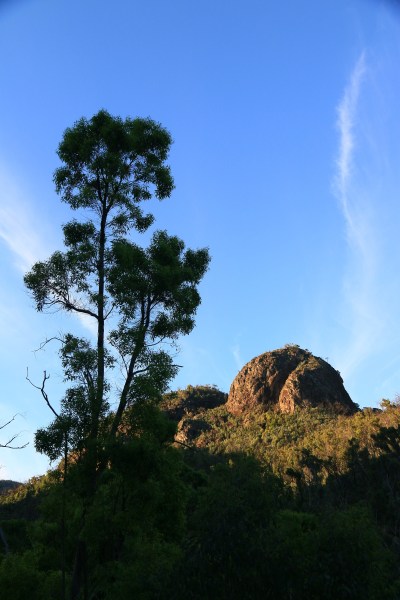 The other benefit of starting early was to witness the early rays of sun graze the hilltops and glow through the tree trunks and branches of the bush. I think the angle of an early sun also helped to illuminate some of the spider webs formed between shrubs on either side of the path, requiring a little stooping and contortion to avoid. Being a pioneer has its downsides and I guess if I was later in the day many of these webs would have been smashed by hapless walkers that had come before.
 Inevitably after a couple of kilometres the track climbed, with a steep but nicely constructed path giving way to endless metal steps. This was taking me up towards the Breadknife, so named because of its sheer sided slopes and thin pointed summit thrust into the sky like a scene from Crocodile Dundee in which Mick shows some New York Hoodlum a proper knife. Up close, you couldn’t really see it, but, eventually, when the trees fade away and the rocky floor of the Grand High Tops themselves are underfoot, the knife is there, just one of many rocky crags and rounded lumps rising up from an incredible sea of green.
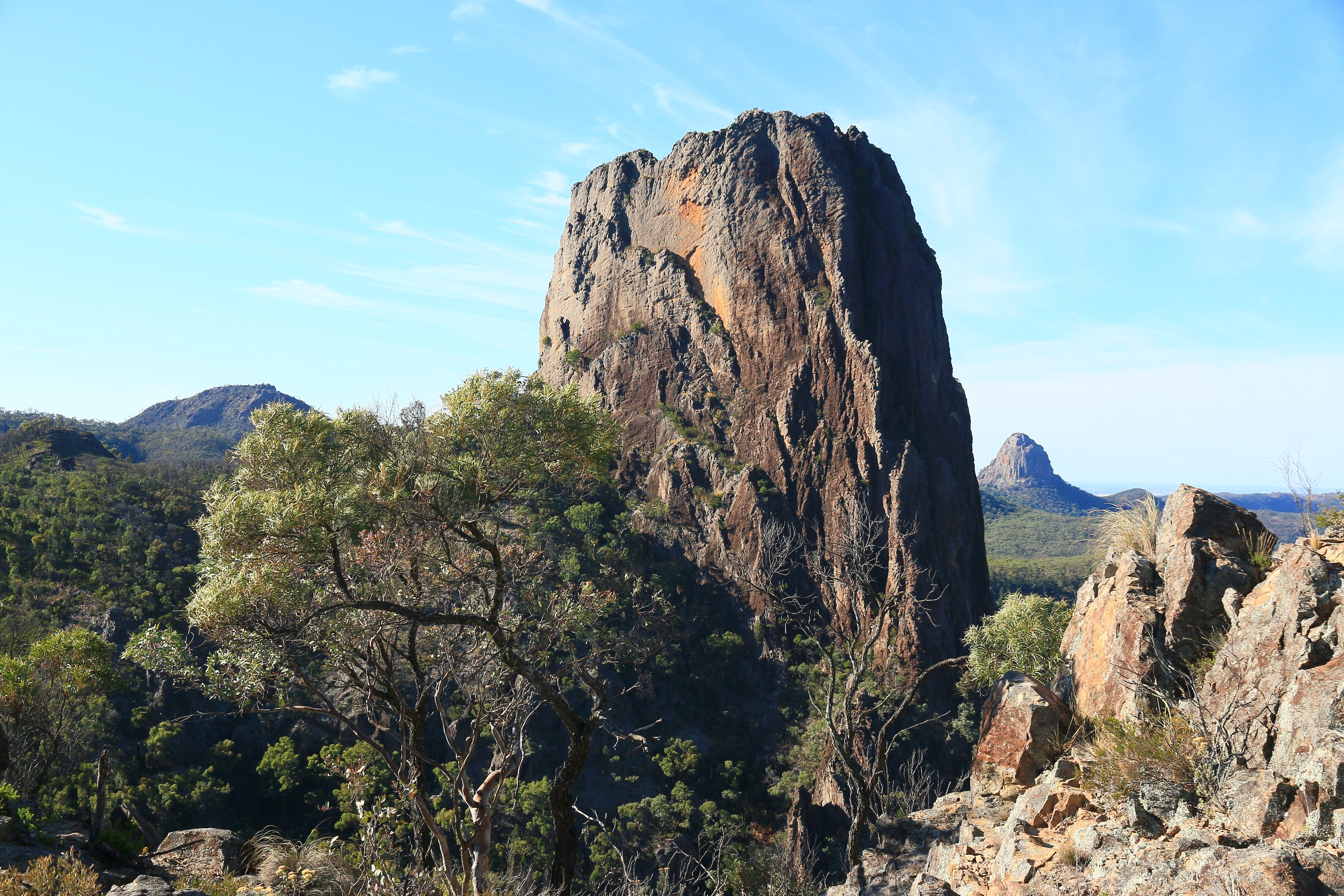
 Further down the trail I encountered a young lady throwing rocks at another occupied web. It was one I must have ducked under a couple of hours earlier. She looked terrified and said as much. In trying to comfort and reassure, I told her it was probably the last of them and moved promptly on. She scarpered under the web to continue her walk while I went to look at a deadly snake. Pausing at a little wooden bridge over the dry creek, a beautiful Red-bellied black meandered along the rocks beneath. It was quite mesmerising, until it disappeared out of sight, when it became a snake that I couldn’t see and therefore significantly less appealing.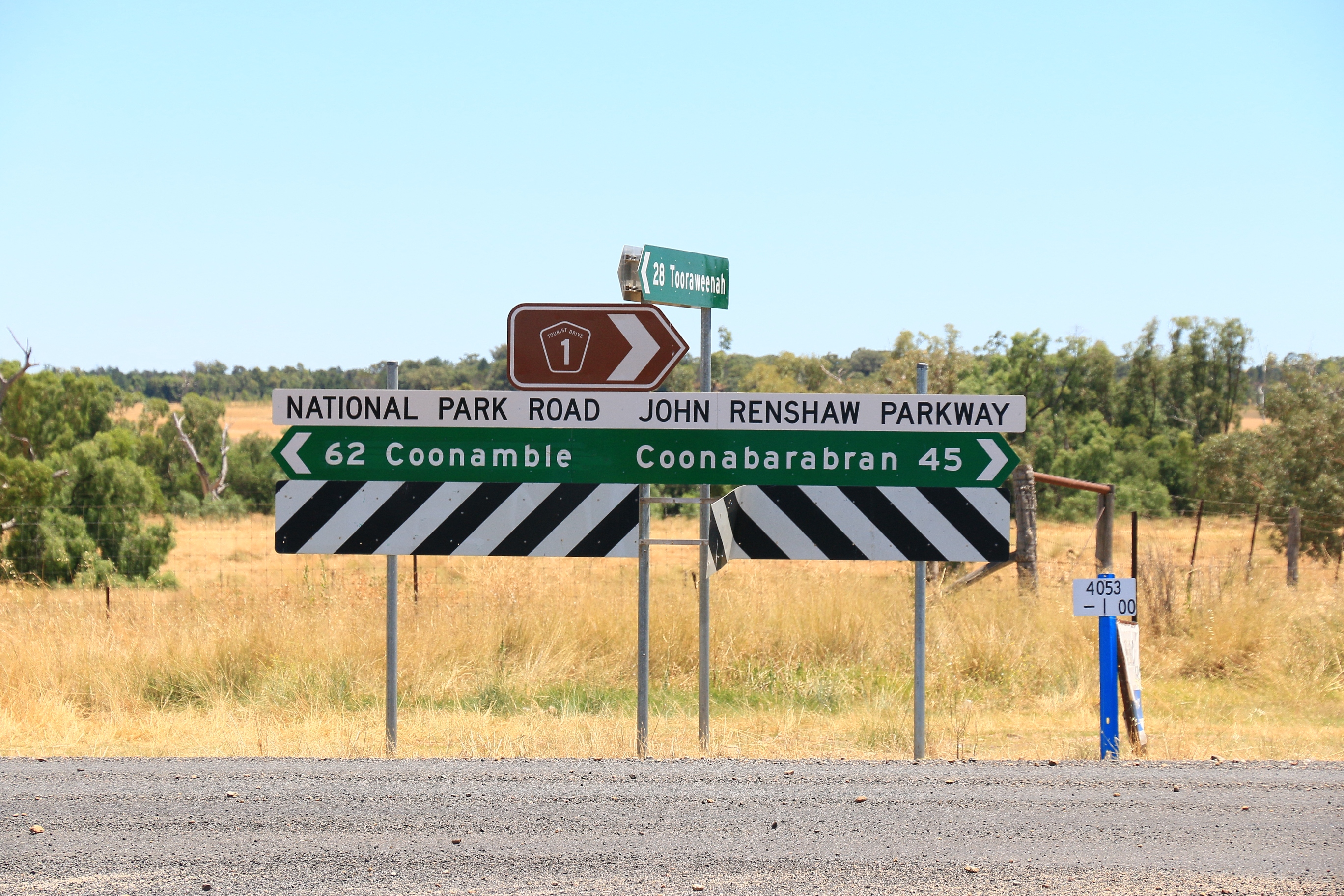
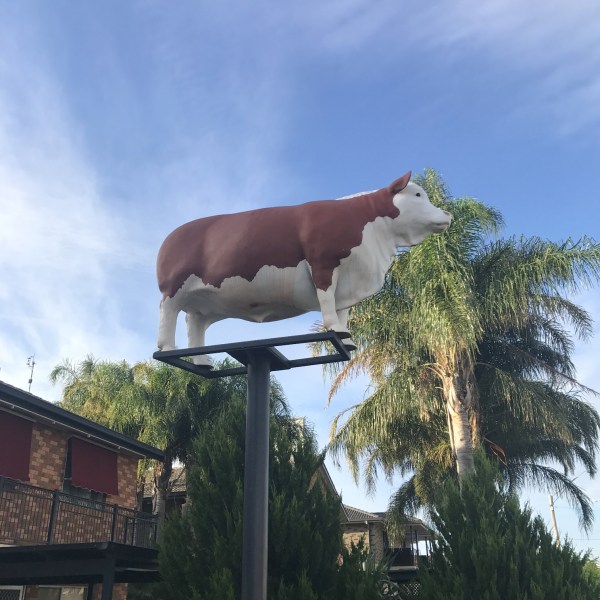 A couple of hours and I was back in more familiar country. Dubbo is one of my token regional research towns and I had a sense of déjà vu checking into a motel with a plastic cow on a pole out front. But still, a motel, with refurbished rooms, air-conditioning and a king-sized bed. After my morning adventures, what better way to appreciate this scenario than nap.
 The next morning, after obligatory buffet breakfast, I set off on the final stretch of road home. It was a day in which there was little of note. As a commemoration of all things road trip I made a spontaneous stop at a place called Peak Hill. Here I went on a little walk along the perimeter of a big hole in the ground, previously mined for gold. While gold sounds glamorous, it was a hot and dusty walk with countless flies trying to go up my nose and the pervasive smell of urine in the air.
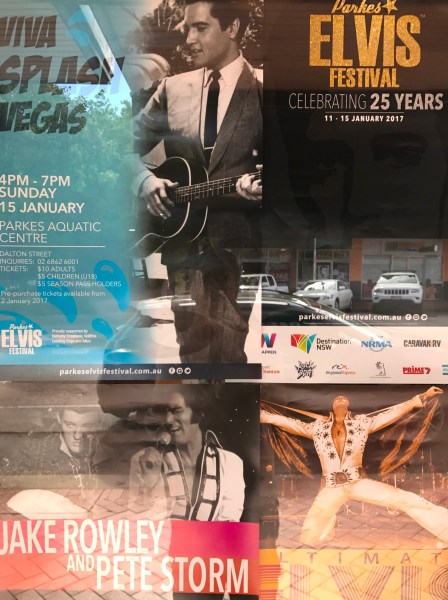 South of here, Parkes had a more pleasant aroma, decent coffee, and was positively bustling with the prospect of Elvis coming to town. Or thousands of Elvises (or Elvi?) all dressed up for the annual festival, starting in a few days. If ever you needed an encapsulation of randomness this was it. Seeking quirky Elvis sights, many shops were filled with posters for upcoming Elvis impersonation gigs, and a couple of murals were dotted about the town. One, I was informed by a very enthusiastic lady, lit up at night and projected videos and played songs out loud and everything. I should come back tonight she said. I got my coffee and moved on.
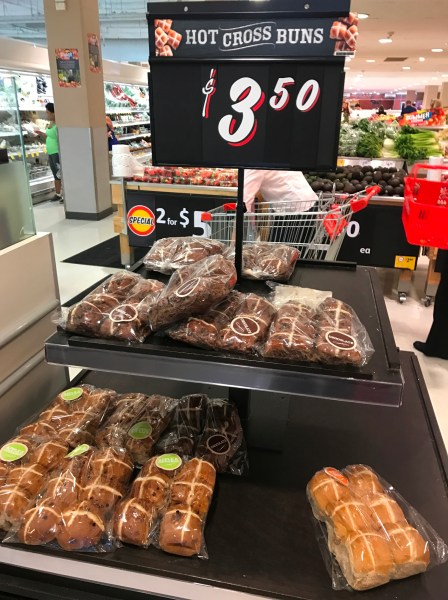 Of the 4,232 kilometres covered on this trip to Queensland and back there were around 50 more to go. Past Poacher’s Pantry where a pre-Christmas lunch lingered in the memory; across the state border and back into capital territory; a roundabout and empty dual carriageway through bush towards home. The city of Canberra is here somewhere, but I could still be out on the open road, in the middle of nowhere. Suburbia and never-ending apartment construction does finally emerge. There are supermarkets in which to replenish supplies, and, crucially, stock up on hot cross buns for Easter.
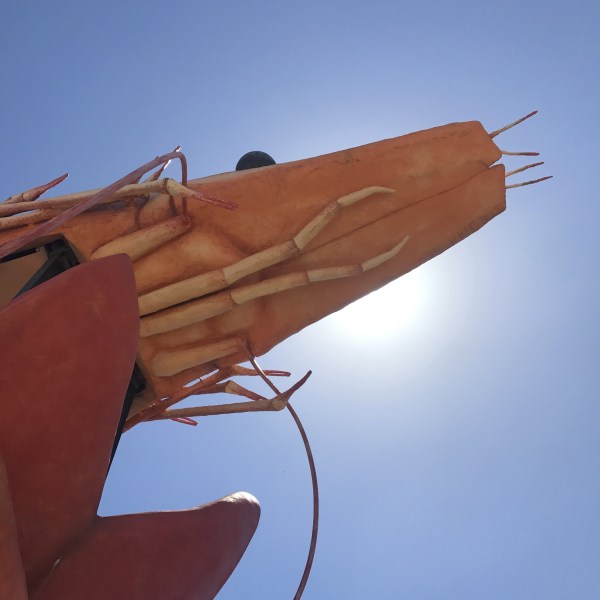 In Part 2 of my holiday travels (
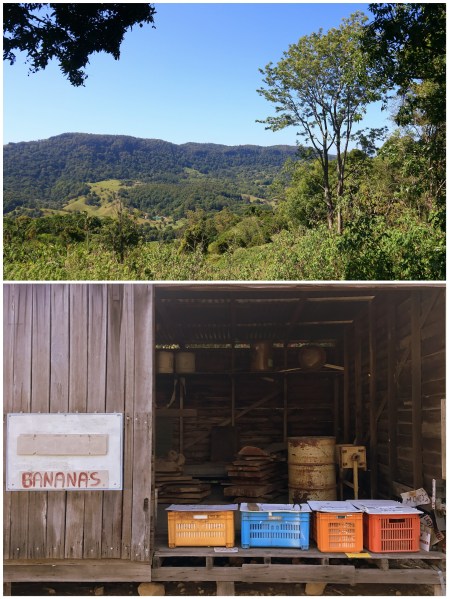 Pausing briefly around the border towns of Tweed Heads and Coolangatta, I decided to head around much of the Gold Coast and enjoy the lumpy patch of verdant paradise that is the hinterland. We crossed the border back into NSW and changed time zone heading up and down to Murwillumbah. Surrounded by fields of sugar cane, half of this year’s yield was in my iced soft drink from KFC in the town. After which we zoomed onwards and upwards.
 We were staying in a rather pleasant apartment in the CBD, with a bit of river view that was to come in handy for New Year’s Eve. The river was a frequent feature of our ambling, crossing over to South Bank, strolling alongside the Botanic Gardens, heading over to the air-conditioned awesomeness of GOMA. You could see its brown waters from the top of Mount Coot-tha, and you could encounter them at close quarters on the CityCat ferry, travelling under the Story Bridge to New Farm. In fact the river was almost as pervasive as Max Brenner; Caroline keen to get a fix or two before heading back to England, and I happy to tag along.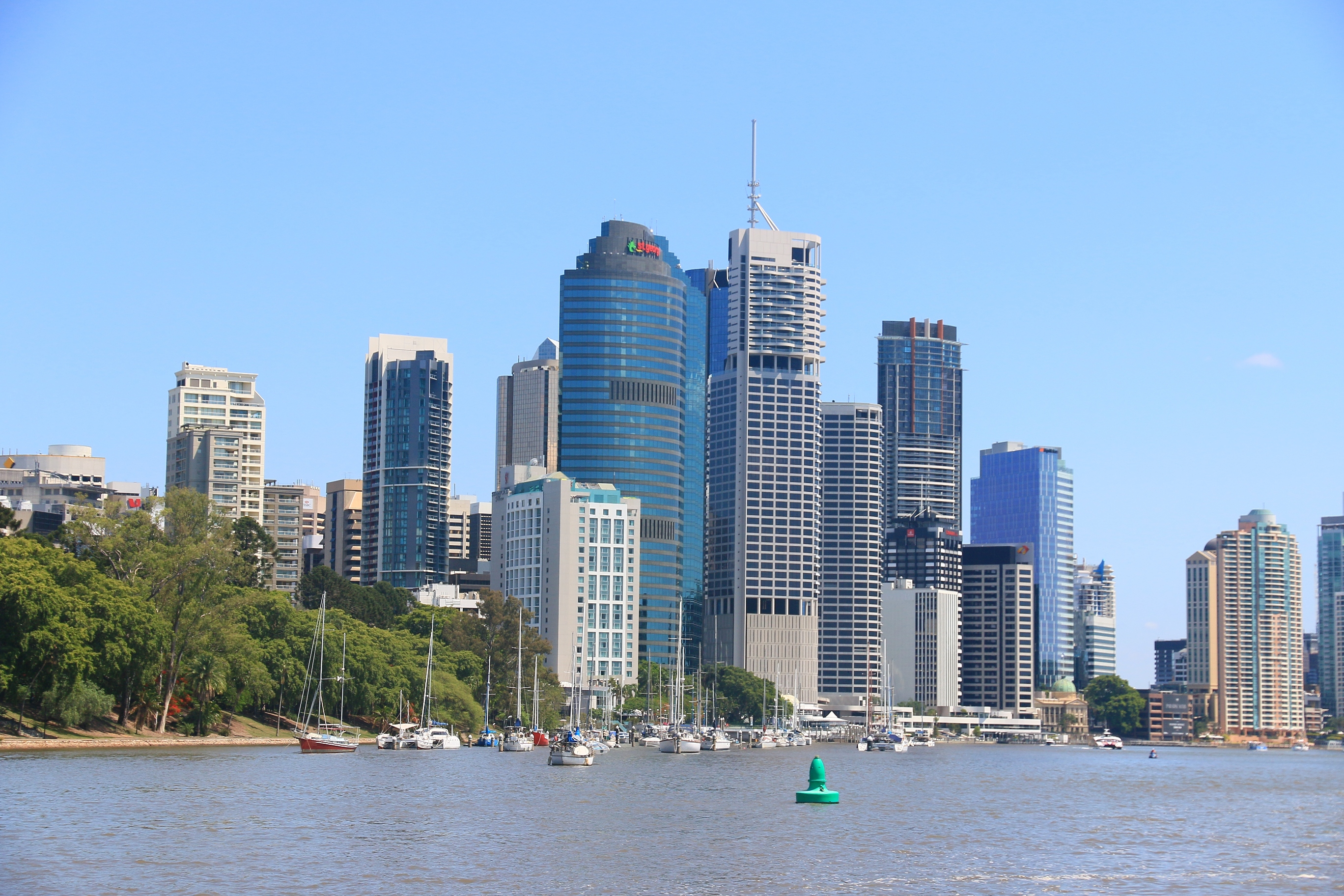


 Ah, island life. A time to kick back and relax. Or wade in stagnant pools with hundreds of kids, or queue endlessly for ice cream, or take a big f*ck off truck onto the sand and ruin the wild ambience. This is what was happening all around, but we still managed to kick back and relax a little at Point Lookout. Before queuing for ice lollies in the world’s most humid shop.
 A taste of what this would be like came at the end of the day, with the sun lowering, a breeze providing relief and a quiet satisfaction milling about the beach near Amity Point. In slanted sunlight kissing sand golden, you could innocently wade in the water happy, only to discover dolphins surfacing mere metres away. Before disappearing as abruptly, leaving only fond memories and countless blurry pictures of ocean on your camera.
 Still, this drizzle is nothing compared to the deluge the previous evening. Sat contentedly eating some Japanese food in the city, we were somewhat oblivious to the torrent of rain that had decided to unleash itself on Brisbane. Only emerging did we witness instant rivers flowing down the mall and citizens racing precariously across streets in their unsuitably thonged feet. We made it back to the apartment, but even with the protection of umbrellas there was considerable dampness.
 So as grey as it was today in Redcliffe, at least you could walk outside without fear of being drowned. And there are always the Bee Gees to brighten things up. It seems the canny council in Redcliffe has recognised the potential cash cow of this association by constructing The Bee Gees Way. Linking two streets, it captures people walking from the car park to the scattering of restaurants by the seafront. More than a woman walked by the pictures, words and videos telling you of their time in Australia and beyond. I guess your willingness to trek out to Redcliffe to see this display may depend on how deep your love is for the hairy triumvirate. I can take or leave them, but I found The Bee Gees Way curiously distracting.
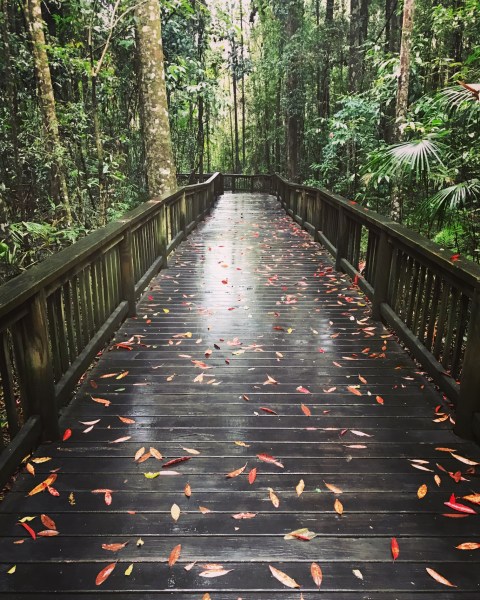 Arriving in Buderim, I made the best of the weather and tried to have a nap. While it was of limited success, the rest refreshed enough for a walk in Buderim Forest Park. Here, the dampness had the effect of illuminating the tangles of rainforest, a grey backdrop to semi-tropical vibrancy. Glistening boardwalks peppered with fallen russet leaves; lustred green foliage and ferns dusted silver with water; and bubbling cascades and falls given impetus by the weather.
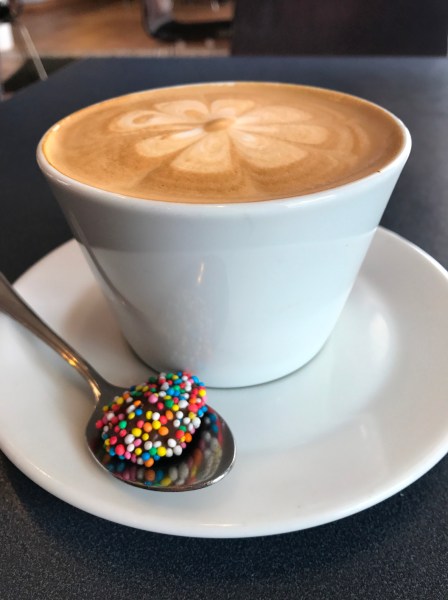 I was only going to stay the one night on the Sunshine Coast, but my weather-induced weariness and the prospect of heading back to the swag tempted me to linger for one more. The extra day was drier, and the sunshine even emerged on occasion. This made the walk up to the top of Mount Coolum somewhat more hellish, but I felt like I had achieved something and could spend the rest of the day eating and being lazy.
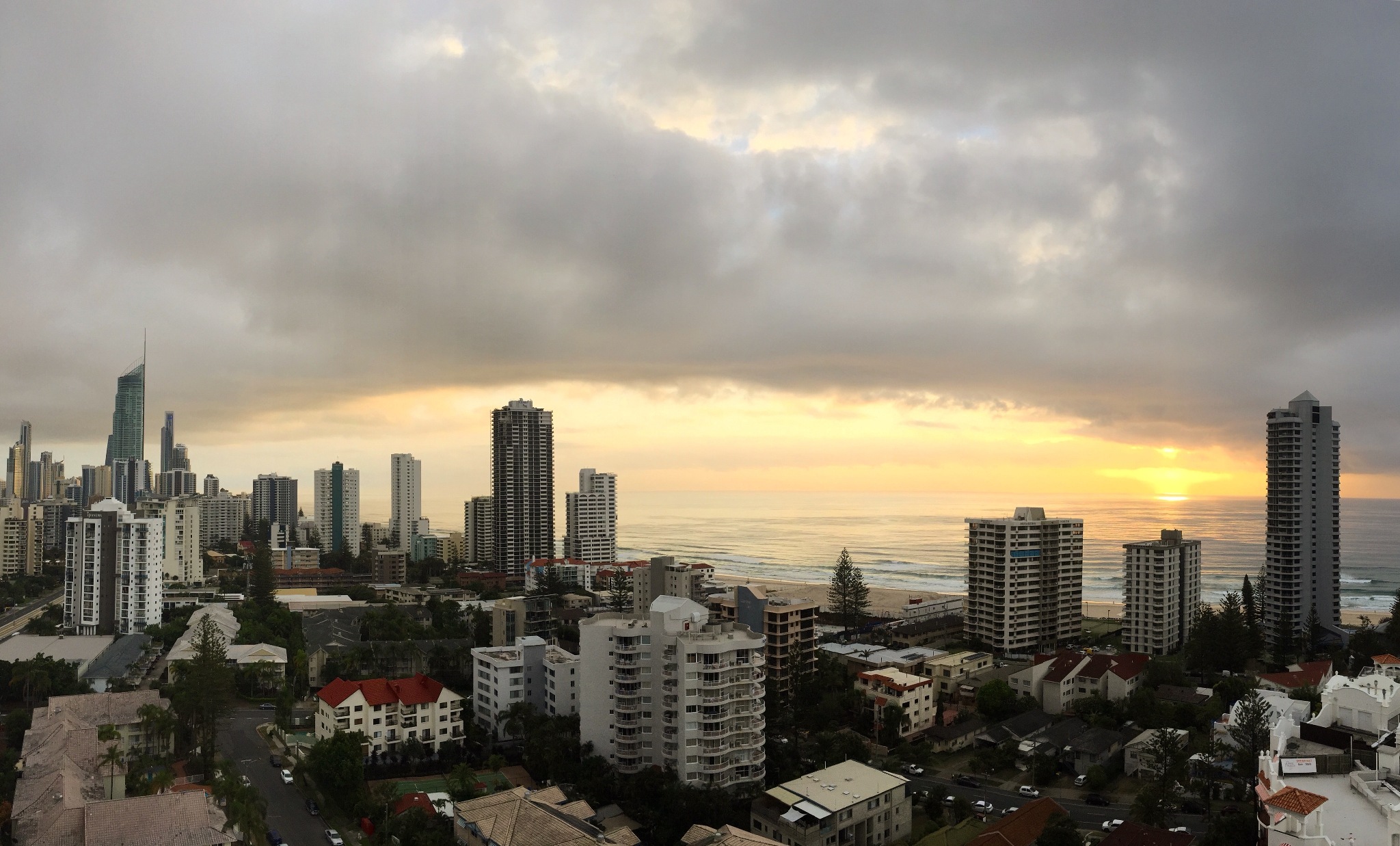

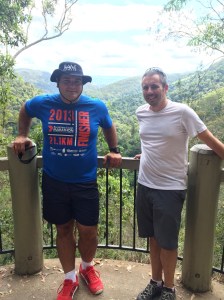 This comfortable civility dissipates quickly once away from the main road; national parks host waterfalls and rock pools and scenic views over jungle. Tracks weave through palms and strangler figs and giant feathery ferns. Snakes and spiders probably hide. While the crowds loiter all the way down to pools and falls at Kondalilla National Park, beyond the swimming spots, the jungle is almost all yours. Yours and a couple of fellow pioneers, hoping to steer clear of Drop Bears and survive on rations of emergency salt and vinegar crisps and deodorant. We made it, and went to eat cake to celebrate.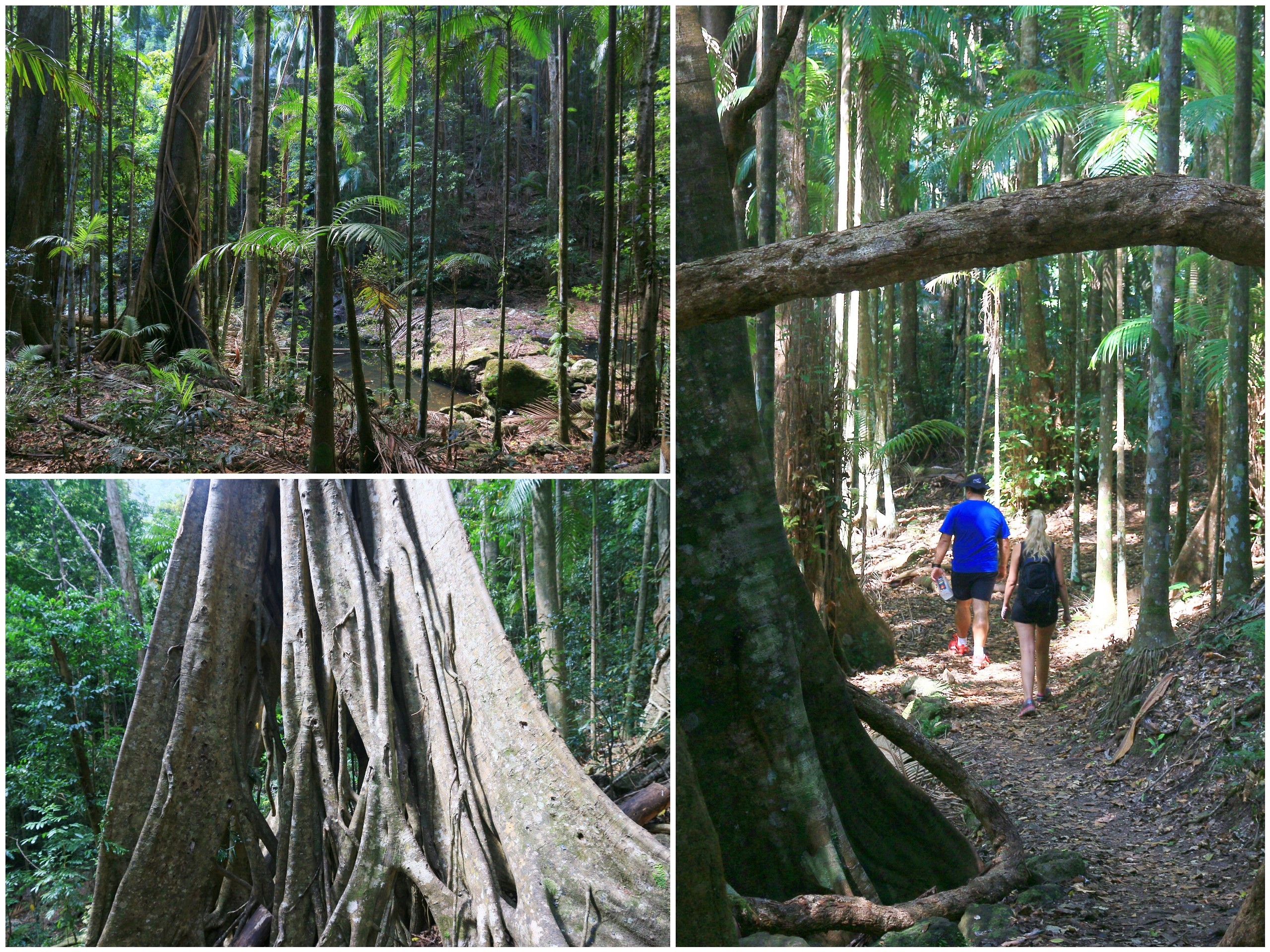
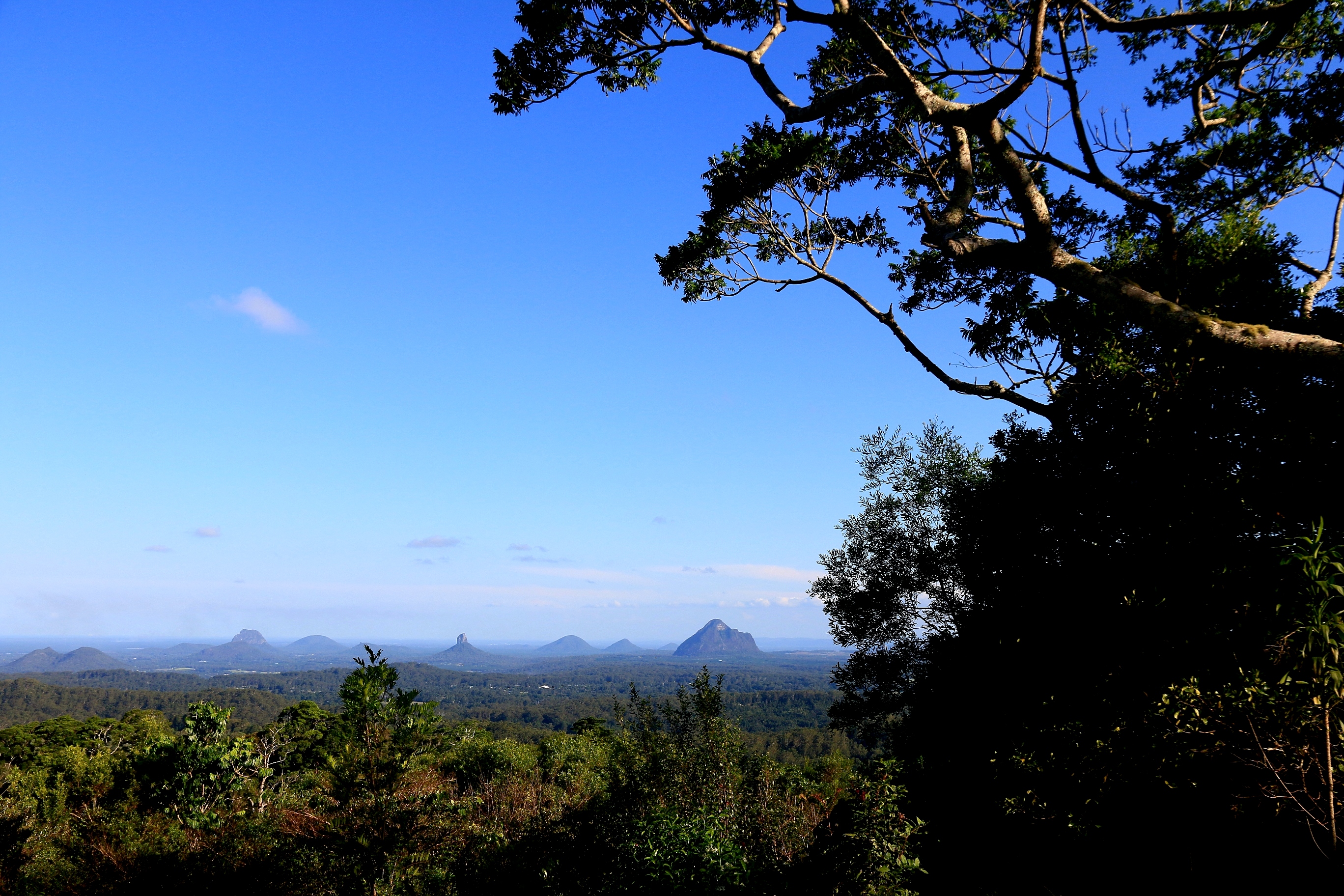
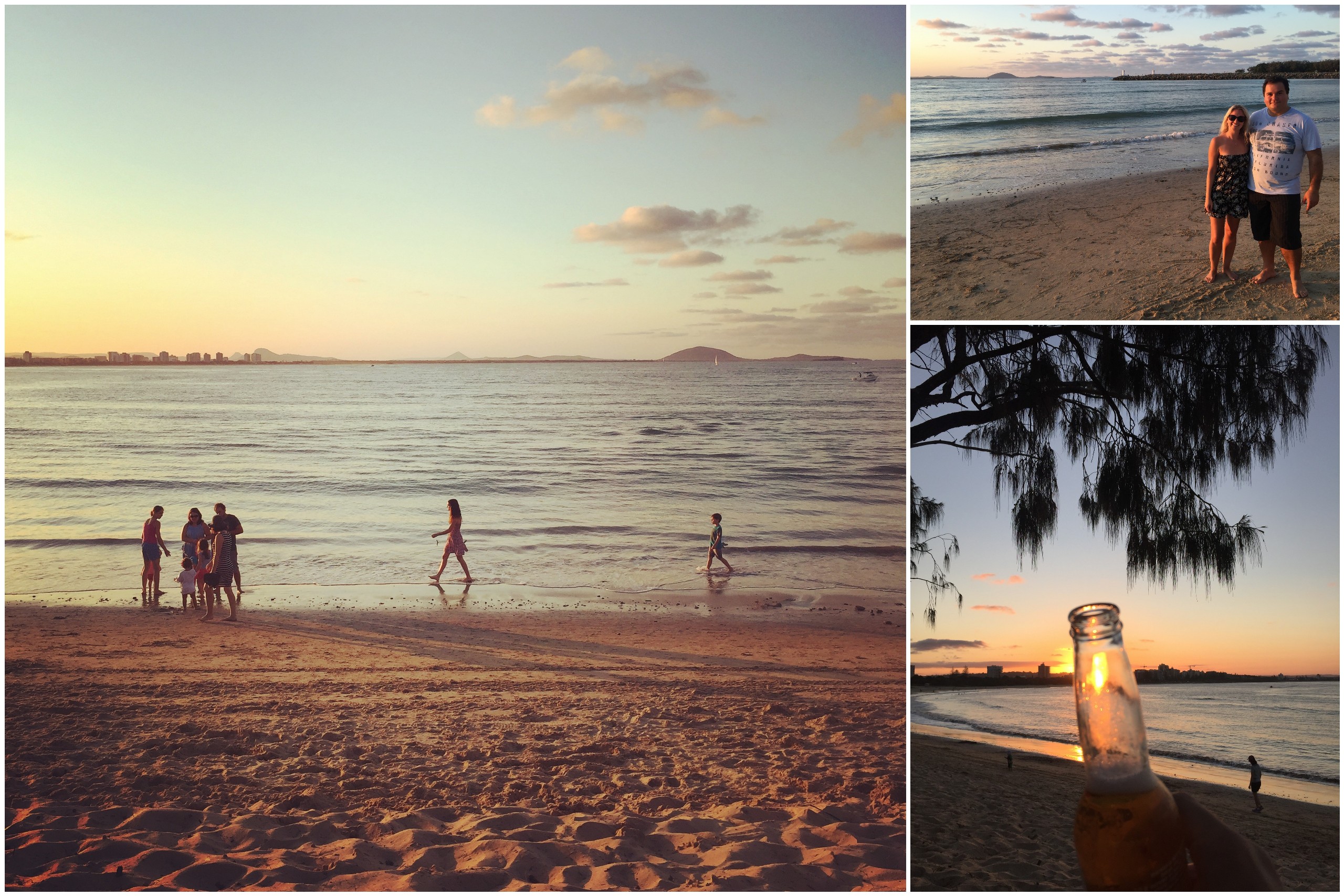
 The return of the sun the next day prompted the usual screeching, warbling, cackling and occasionally tuneful singing of the Buderim birdlife. It is a struggle to sleep in and I was more than ready to escape down the road into Buderim Forest Park for some early morning exercise. While others decided to jog, I was content enough to engage in spells of brisk walking punctuated by abrupt stops for Instasnaps. A kilometre in, the falls came as a surprise. I mean, I knew they were there, but I wasn’t actually expecting much to be falling. And while it was hardly a deluge, there was something aesthetically pleasing about Buderim Falls that was absent at Kondalilla yesterday.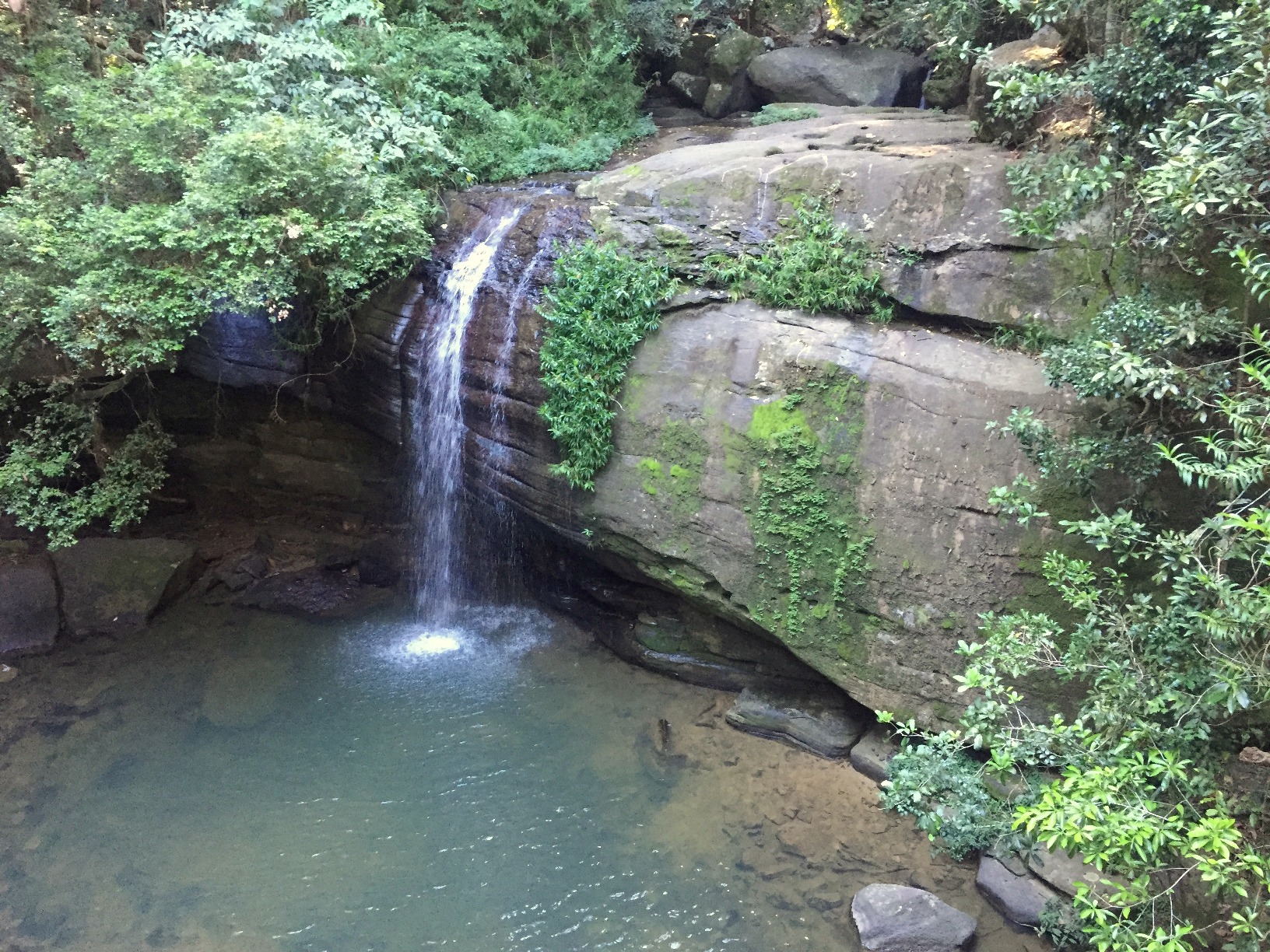
 You see, the tourist board have been so successful that Noosa is brimming at the seams on a warm, sunny Sunday lunchtime, jammed with locals and foreigners alike. Parking is in the lap of the gods, but boy, have they got some of the prettiest parking spots around. The beach is – well – busy for an Australian beach, but admittedly it is a rather pretty beach. And even the national park, which shelters Noosa from encroachment from the south, is bustling with a steady stream of backpackers, families, joggers, and adventurers most of whom are, of course, exceedingly pretty. It is, undoubtedly, a very pretty place, and a requisite on a two day drop bear bushwalk adventure beach and waterfall honey monster tour.
 Like all of the most accomplished tours though, the best is saved for last. No tour is complete without a visit to a twee little spot providing lovingly crafted local produce and quirkily endearing owners. Honey Bear Honey of Buderim is not yet on the tourist itinerary, but with a bit more blue sky and a 10% cut it could well be. Look, I’m even promoting it on this blog for goodness sake, reaching tens of
  Some might go on to watch the sun disappear, over the apartments and occasional jagged plugs of the Glass House Mountains. Many linger in the warm air, sedated by sparkling wine and a sense of being the luckiest people on this planet; making the most of it all before heading back to work; living each day as if it is your last. Sensible, because, in this splendid corner of Queensland, you never know when a Drop Bear might strike.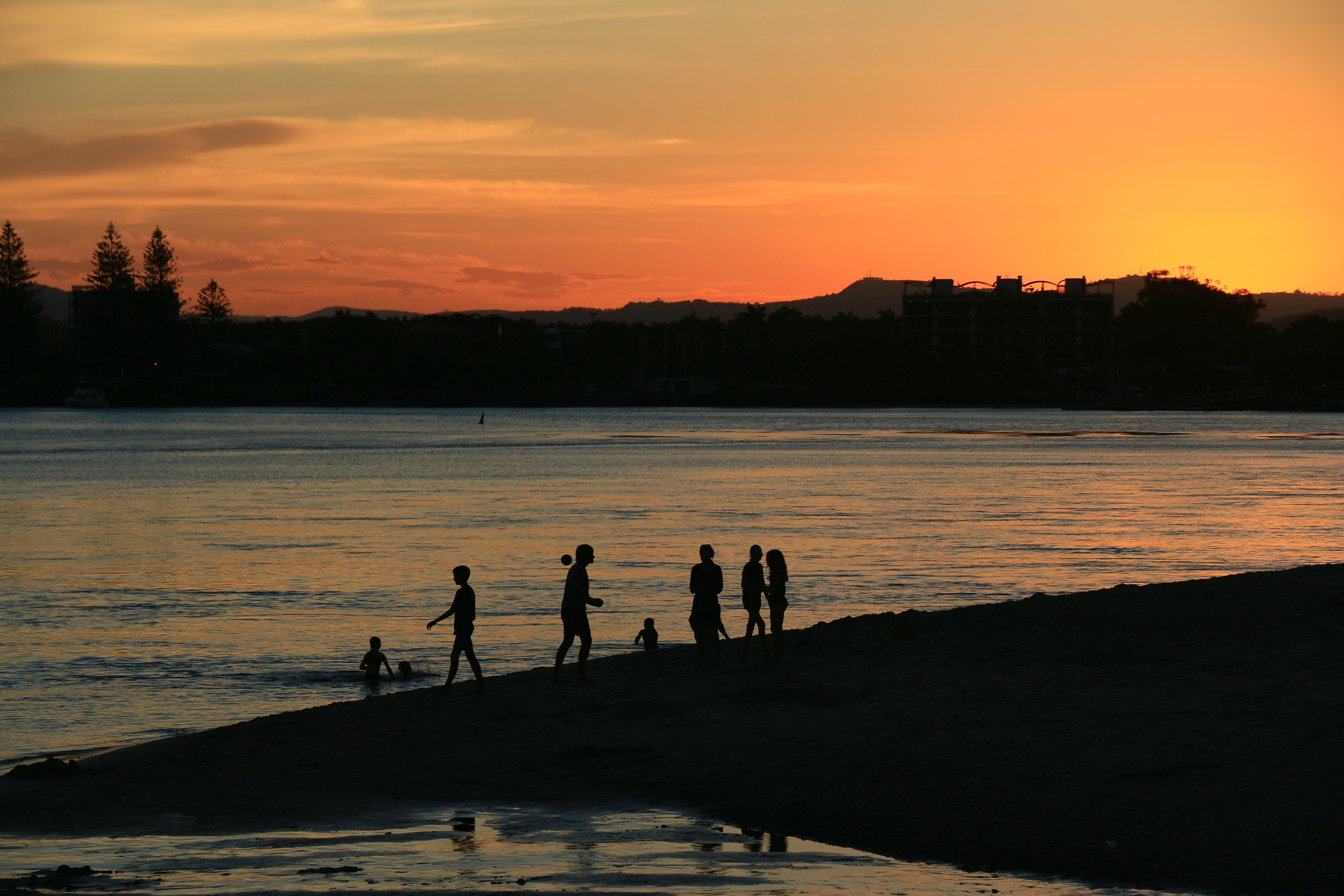
 gbpilgrim