Kangaroo country

Nothing can be quintessentially more Australian than the sight of a man in a cork hat and grubby white singlet riding a kangaroo to work. Apart from a man on a kangaroo in a cork hat and grubby white singlet hopping over lethal spiders and snakes while fleeing a bushfire with a rescued koala, only to get to the safety of the beach and discovering a shark infested bay peppered with box jellyfish, causing a bunch of boofheads to gingerly enter the water in thongs to retrieve their cricket ball with one hand because the other is grasping onto a stubby of VB like it is the last bottle of insipid but undoubtedly cold beer in the world.

Of course, all of that is nonsense [1], lest I be sued by VB which is a popular and well-loved beer in certain areas and so well-loved it appears on the shirts of the Australian cricket team, which perhaps speaks for itself in so many ways. What is undeniable is that the kangaroo is an icon, so much so that it appears on the national airline and encourages you to buy home grown products. If you ask someone overseas to mention the three things that come to mind when they think of Australia, they will most likely say beaches, kangaroos, and punitive policies for people fleeing persecution and seeking asylum, dressed up as a concern for their safety and not really about winning votes from a cluster of the population who have an underlying xenophobia stemming from their own challenges in paying the mortgage on a home which is unnecessarily big for their needs and encountering traffic on the way to Kmart, thus displacing the blame for this onto others who are widely vilified and helpless to stand up for themselves [2]. Still, we have nice beaches and lots of open space for kangaroos, so it’s worth defending right?

The kangaroo was here long before the first boat people arrived to overrun the country and its culture. A popular myth is that ‘kangaroo’ meant something like ‘I don’t know’ or ‘I don’t understand’ when Cook, Banks et al enquired of local Aboriginals what on earth this peculiar creature was. Like all good myths it has subsequently been debunked [3] but you can understand why it still does the rounds. It’s a convenient story that encapsulates the sense of the bizarre, the other-worldly, the weirdness of the flora and fauna that was encountered by the first boat people. A befuddlement that continues to this day as more people spill, primarily, out of international airport terminals and come face to face with Australia.

Initially you could be forgiven for thinking that Australia is a sunnier, newer, even happier [4] version of the UK, with a US touch of the gargantuan about it. But what sets it apart as wholly unique, exquisitely exotic is its flora and fauna. The kangaroo, perhaps in conjunction with wily white Eucalypt trees and shrieking cockatoos, is the readily available, easily accessible face of the Australian bush, and a long, long way from distant, familiar lands. Perhaps that is why, even after seven years, the sight of a kangaroo bounding out of the trees and across golden grasslands brings a smile to my face and, still, a sense of wonder.

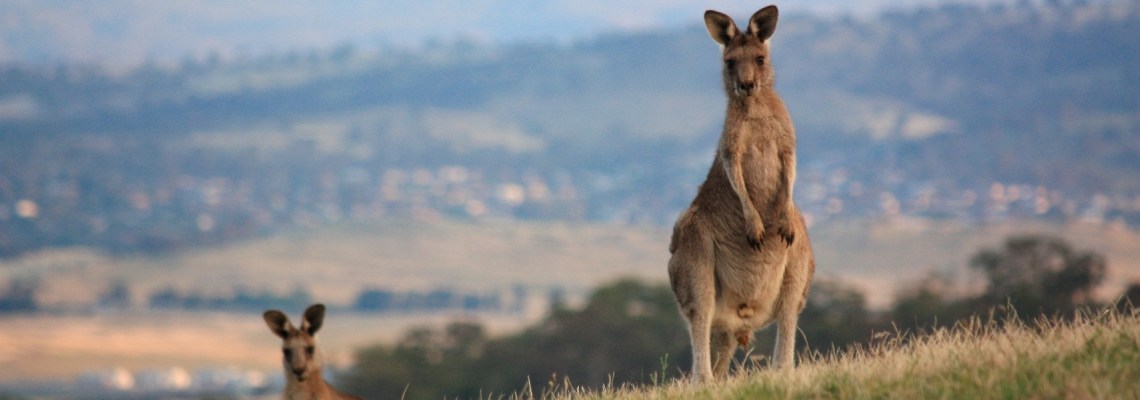
I cannot write about these experiences and this topic without covering time on Red Hill, Canberra. I may have written about this place before. I came across it three days into arrival in Australia, fighting a fight against deep afternoon jetlag driven sleep. Determined not to fall into a coma and then awake all night, I set out along charming suburban streets on one of those beautiful, clear, warming late winter afternoons. It could have almost been an old English summer. Gradually climbing in altitude and property price, the streets ended abruptly as the very richest backed their way onto the grassland and steeply rising bush of Red Hill Reserve. Without intricate knowledge of paths and trails I headed straight up, short and steep to the lookout cafe. Here I viewed Canberra from high for the first time, had a coffee and saw a handful of Eastern Grey Kangaroos milling about without much of a care in the world (much like myself really).

Since that day I almost always saw kangaroos at Red Hill, particularly as I was wont to wander there of an evening. Huge mobs would gather in the grassier patches at the bottom while others would linger along the ridge up high. Mothers and their kids would eye me with suspicion or, perhaps, familiarity. A stand-off ensued, one waiting for the other to move on. But I often emerged the victor in these early days, because I would have my camera with me, and everyone knows that as soon as you bring your camera up to your eye to take a picture of some wildlife, the wildlife flees.
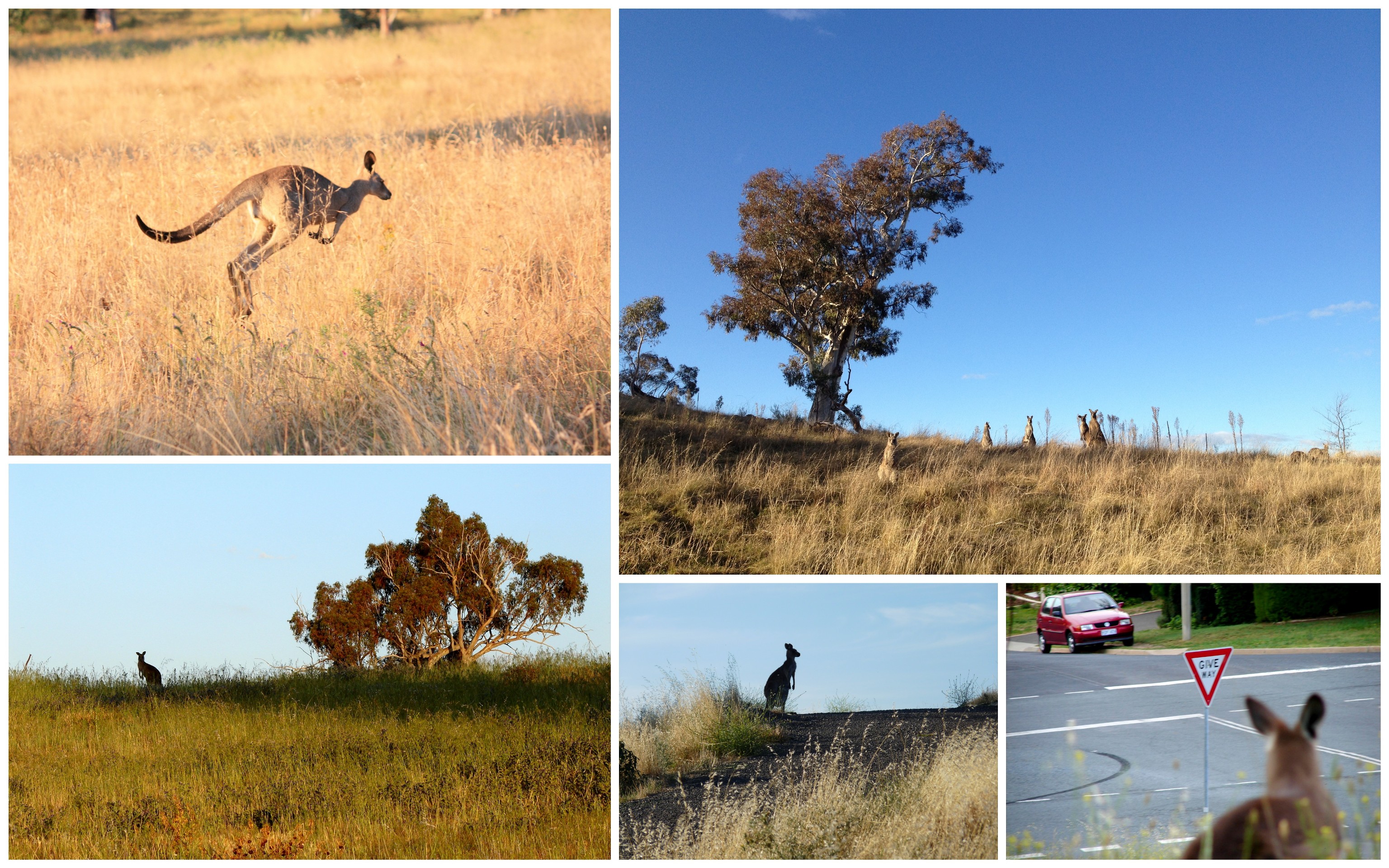
K_kangaroos

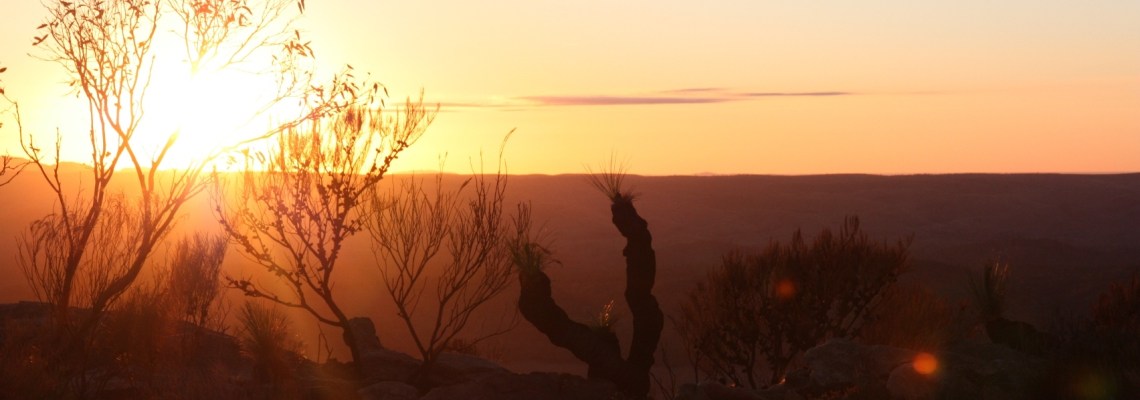
Certainly it was hard to restrain myself from taking a picture every time I saw a kangaroo. It was a natural reaction because back then it was all so extraordinary and therefore entirely warranted. Increasing familiarity has restrained my picture-taking compulsion since. In fact, I don’t tend to take my camera up Red Hill anymore…hell…I don’t even go up Red Hill anymore, since I am presently 3,000 kilometres west and it is a trifle inconvenient. However, frequently armed with camera elsewhere a kangaroo or dozen have popped into view. They emerge within the context of a wider landscape, as natural as, well, a man in a cork hat and grubby white singlet. They undoubtedly add something to the mood, grounding the scene in something that is so very obviously Australian. And thus, still, so very exciting.

————————————————-

Kosciuszko National Park is one of Australia’s great national parks, taking in vast swathes of upland country and river valleys in New South Wales. In winter the highest parts are caked in snow, in summer all parts are swathed in flies. It’s a fairly unique environment for Australia, which is mostly dry, brown and flat. Termed alpine, it is not so in the sense of being blessed with gigantic peaks and glaciers; instead ridges and clumpy mounts offer a scene more akin to the rounded peaks of northern and western Britain [5]. It is an ecosystem that is all-encompassing, from rare possums and miniature toads in the boggy bare stretches high up, to common wombats and kangaroos and all of their derivatives [6] in the bush and plains further down. 

Kosciuszko is not so far from Canberra but on one occasion, having spent some time working in the town of Albury, I approached it from the west. It was a long weekend of high country meandering, through the northeast of Victoria and into New South Wales before crossing the Main Range and ploughing on more familiar roads back to Canberra. Approaching the end of March the landscape was in a state of transition, from the dry, warm summer to freezing cold winter nights and winds and rains and occasional snows. The hairpin drive up Mount Buffalo – the closest thing Australia has to an Alpe d’Huez – came with freezing fog that cleared to warm sunshine. The valley town of Bright was commencing its ascent into blushing autumn saturation and wood-fired air. And the trudge along an endless ridge towards Mount Feathertop was blanketed in cloud, a stark contrast to the clear fresh vale below.

Crossing into New South Wales and finally into Kosciuszko National Park, there is eventually a sense that these are proper mountains and not big hills, as the highest points of the Main Range, glowing in the sun above the tree line, rise up more dramatically from this western vantage. The road on this side twists and turns along a narrowing river valley, the dense green bushland plummeting down the hillsides occasionally broken by huge pipes belonging to the mammoth Snowy River Hydro scheme. At some point the road rises and crosses the range at the evocatively named Dead Horse Gap, but before this tortuous ascent, there is respite at Geehi Flats.

Geehi Flats appears like some hidden valley idyll, where the opaque water of the Swampy Plains River broadens and a swathe of grassland punctures the dark green tangle of gum trees. A spacious area along the river offers rustic camp spots and opportunity to amble. At the northern end a couple of old wooden huts testify to exploration and discovery and, now abandoned, the harsh realities of surviving in the high country [7]. Within this clearing the afternoon sunshine illuminates the rise up to the Main Range and onwards to the white cotton wool clouds hovering above. And as I stare at the serenity, a large Eastern Grey kangaroo stares back. Suddenly I feel like the intruder.
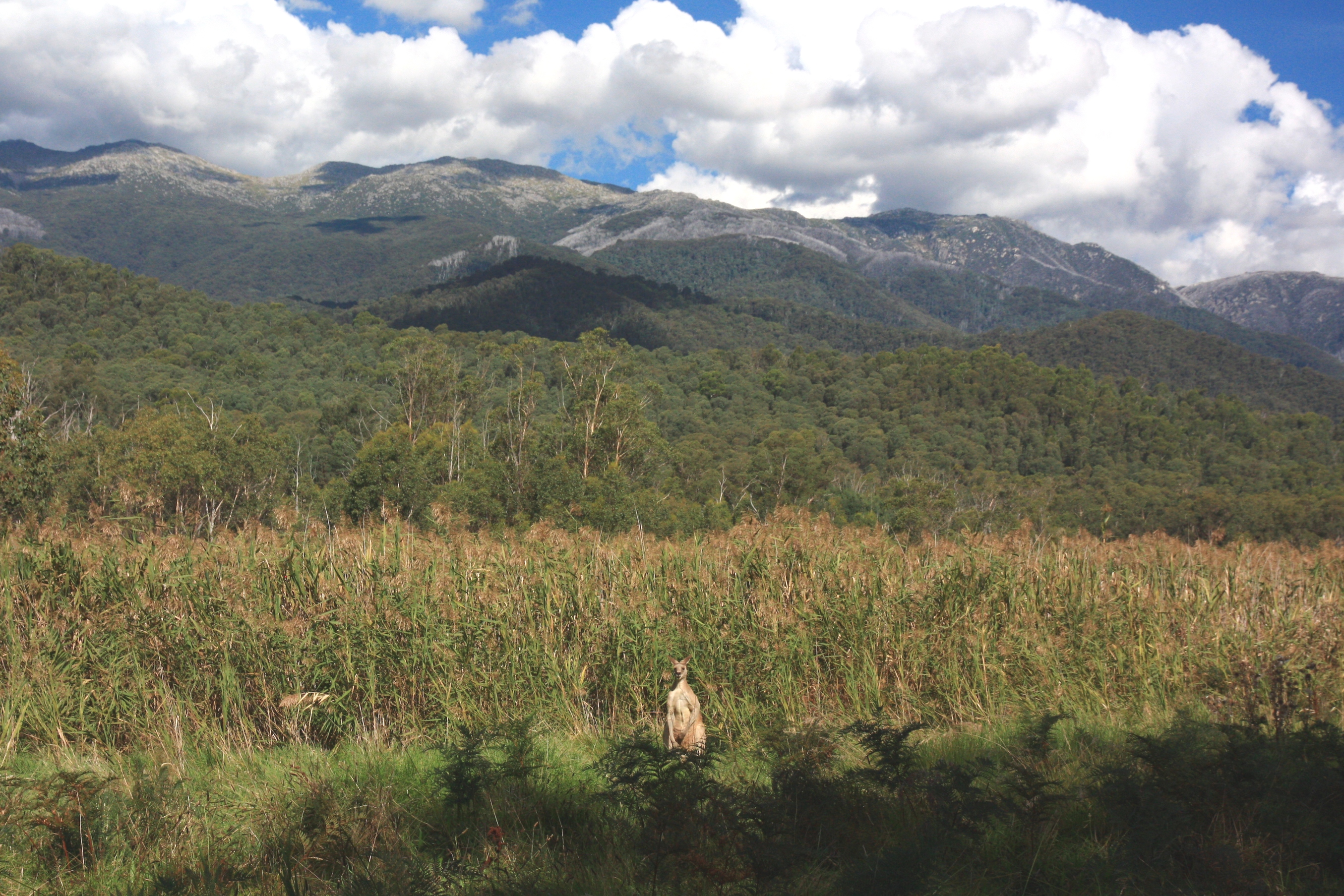
K_kossyroo

On the face of it, it is nothing remarkable…a sighting of an animal that I have seen hundreds of times before and so common in an area where it is protected to thrive. But in the landscape, in the setting, in the primitive high country context it feels very special, like I am the first white man to see it and it is the first kangaroo to see a white man. It is so amazed that it even lingers while I take a photo. It’s a chunky unit, but it is meagre within the scale of the whole, minor against the vast wildness of the scene. Yet here it sits entirely natural, a perfect foreground marker within the larger composition of my vista. What lies before me is Australia and I am reminded at how fortunate I am to be a part of it. Still a land of untapped discovery, of boundless space and unknown potential, it is something to cherish, to protect, and to share. And while the kangaroo is perhaps the pinnacle of the adaptive powers of evolution, as Australians we can still be much, much better than this.


[1] Clearly we only ride kangaroos around on the weekends for leisure, duh. Else the ute wouldn’t get much use.

[2] See http://www.guardian.co.uk/world/2013/jul/22/captain-rudd-australia-depths-shame for just one well-written, reasoned commentary on Australian Government approaches to ‘boat people’.

[3] Not by the team at Mythbusters I hasten to add, but by (and I quote Wikipedia) linguist John B. Haviland in his research with the Guugu Yimithirr people.

[4] I am unsure about this at the current time of writing, with a UK heatwave and cricket team in the ascendancy.

[5] However, rising above 2000 metres it is far higher than anything in Britain, a boast many Australians like to boast about.

[6] By which I mean the whole raft of hopping marsupial type things like wallabies, wallaroos, euros, jackeroos, jillaroos, brucearoos, kangabies, roosabies, poosaloosaroos etc etc

[7] Like camping overnight, when the warm daytime temperature plummets quite dramatically and uncomfortably

Links

All you ever needed to know: http://en.wikipedia.org/wiki/Kangaroo

Everyone’s favourite: http://www.youtube.com/watch?v=uRQnrY5V-rY

Walk the hill: http://www.tams.act.gov.au/__data/assets/pdf_file/0010/390592/cnpmapredhill.pdf

Kosciuszko National Park:

http://www.environment.nsw.gov.au/nationalparks/parkhome.aspx?id=n0018

Hi, country: http://neiliogb.blogspot.com.au/2012/03/hi-country.html

Stop the votes: http://www.amnesty.org.au/refugees/comments/24019/
A to Z Australia Driving Photography Society & Culture Walking

Icefields

Despite being composed of perishing frozen particles there seems to be an inherent allure to the presence of snow and ice. I wonder if Eskimos feel the same way.

Maybe this romantic view is nourished in temperate climes, where snow falls are but an irregular memory of childhood. Something scarce is prized, and I can sombrely recall that when winter rain sweeps in to Plymouth, turning to snow pretty much everywhere but Plymouth, it delivers a fresh pile of disappointment. In Australia, no such disappointment because there really is no such expectation, with only the tiniest, highest pockets of land periodically subject to frozen weather. Still, at least they are generally reliable.

Away from Australia (and Plymouth) I have had the fortune to brace myself for arctic conditions, ghost through flurries of snow, and marvel at sweeping icefields, like a crow from atop a very big wall. Even just across the ditch, in New Zealand, one can appreciate the aesthetic value added by the white stuff, which has carved out its valleys and shaped its lofty mountain spires; peaks on which snow and ice still perches precariously and sweeps down graciously until it feeds into crystal clear rivers of melt water. Ninety-nine percent water and one percent fish, so it is said.

Such attractions are not without peril however, particularly if you decide to sled bungee flying fox BASE jump black raft off them. And because of their allure, they are incredibly popular, the two west coast glaciers – Fox and Franz Josef – a mandatory stop for coach tours, campervans and Apex International drivers everywhere. Indeed, in high season the walk to see the crumbly, dirty dust-coated moraine of Fox Glacier is an orderly procession of ages and nations. The old and overweight defy impending heart attack. Chinese and Japanese and Korean visitors dutifully file their way along for picture stops, wrapped up against the cold. British visitors do the same, basking in shorts. Youngsters scramble without fear over rocks and creeks, and Aussies stride nonchalantly along in thongs. Somehow here the grandeur and spectacle of the landscape becomes a little diminished.

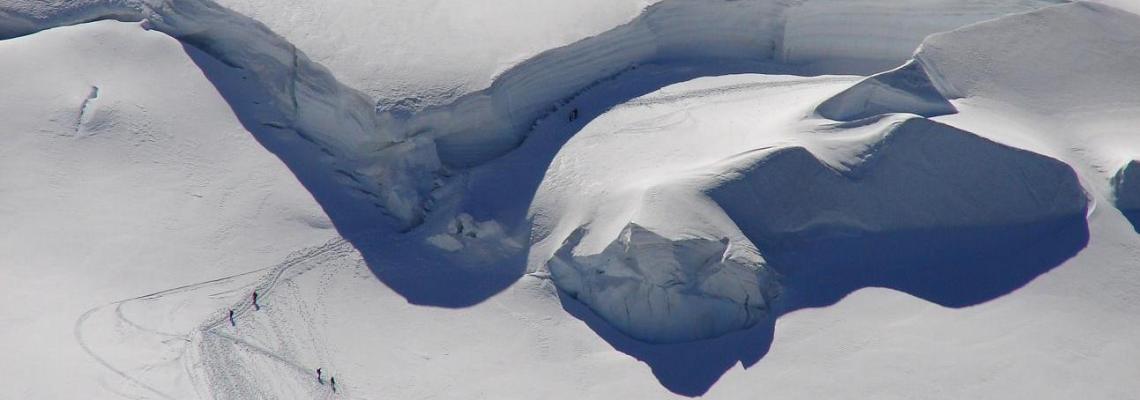
Crowds bustle about just as much on a beautifully clear summer’s morning in Chamonix, France. Here, in an ever narrowing valley at the foot of Mont Blanc, glaciers creep down towards the pine forests bordering the town. The mechanic shrills of souvenir marmots cut through the Gallic hubbub, as people wait for lifts to take them to precipitous heights. Indeed, the Téléphérique de l’Aiguille du Midi takes them up some 2,807 metres in 20 minutes. It’s an alarming rise that leaves you a little breathless, literally and then metaphorically once you are confronted with the dazzling ice world around. Up here the crowds seem less intrusive, limited as they are through access, muted by an oxygen depleted sense of drunkenness, and made minuscule by the perspective of being near four kilometres above sea level; most of the Alps seem to be on view, stretching across three countries in a series of rocky turrets and icy hollows. A rare, and staggering, European wilderness.

 I_alps

Anyone would think I don’t like people given my desire to experience such places without being part of an inevitable tourist procession. Well, let me say that first I quite like some people and secondly I cherish the chance to share some of these places with them. In fact, some of the more memorable moments of life are the random conversations you have with random strangers in random places. Like waiting with like-minded photo seekers for cloud to never clear from mountain tops in the Cascade Mountains, or trying to translate the feverish sighting of marmots from Italian to French to English to a Japanese visitor heading down a mountain railway in Switzerland. It turns out most people are just like you and me, the common bond of the experience overshadowing any differences at that point in time. A smile is a smile in any language.

In fact I’m not immune to being part of a bigger tour group…sometimes it is nice to let someone else take control and just go with the flow, especially when having decisions to make equals indecisiveness. Plus longer tours over days and weeks provide a fascinating ethnographic experience [1]. At the start individuals unbeknown to one another mutter polite greetings and eye one another with caution. A few break the ice with time-honoured inquisitions of where do you come from and where have you been. Barriers break on the first good walk or, more likely, the first few beers. By the end of the night you are BFFs with Darlo from Wonthaggi and within a week you cannot imagine not being with this same group of people, getting on this same bus, stopping at viewpoints, eating meals and sharing a beer or two practically every day. Yeah, cliques may form and these may or may not include the rejection of people initially embraced as BFFs, but the group dynamic remains in a fluidly socially cohesive melting pot of fluctuating hormones and alcohol.

And this, my friends, is an encapsulation of a Contiki tour, albeit a description that is unlikely to be used by their marketing department. For those not in the know, a Contiki tour is a particularly popular way to see the world for 18-35 year olds, especially Australians who have 14 days to see every country in Europe [2]. With a core populace of 18-35 year old Australians there tends to be a significant emphasis on end-of-day drinking, but not without a range of energetic activities and processional sightseeing stops in the day. The relevance of a Contiki tour, and justification for my written meandering, is that I did one once. It was in Canada, with the blue and white bus traversing an incredible stretch of road called the Icefields Parkway. Finally, back on topic.

The Icefields Parkway links the Canadian Rocky Mountain towns of Jasper and Banff. I would love to go back since I cannot recall every instant and every stop, this before the days of blogging and digital photography. And I would love to have my own wheels and take my own time this time around. I seem to remember that along this road, around every corner, there is a panoramic view which you wouldn’t find out of place in a Rocky Mountains 2002 calendar. Bulky grey mountains laced with white rise up from all angles, as glaciers stream downwards, melting into rapids and falls and filling the most incredible blue green lakes. Huge swathes of fragrant pine forest fringe the lakes and valleys, a dark cover for elk and moose and bear.

It turns out the easiest way to spot a bear is to look for the cars and caravans parked beside the side of the road and the coaches slowing to a crawl. Once closer, a telltale sign is the sight of someone with a very big lens snooping around the undergrowth, fringed by other enthusiastic amateurs decorated with silver compact zoom cameras and, I guess now, iPads and iPhones and Surfaces and Robots. No-one seems to figure that the bear might just be interested in the hands and arms and torsos holding these devices, so long as you can get a good shot to post on your wall [3]. The other approach to spotting bears is to have a really nice picnic in a wicker basket and hang about in a national park with an uptight ranger. By contrast, moose spotting is much easier given they are generally roaming loose aboot hooses.

Apart from bears, other highlights of the Icefields Parkway are fluid, from the glaciers to waterfalls and rapids and lakes. During my trip, a ride on the Athabasca Glacier on some huge wheeled contraption afforded an opportunity to walk on ice and clear the head. The wonder of glacial till (or flour) culminates at Peyto Lake, with its incredible colour and picture postcard viewpoint. More subdued but serene is Lake Louise, with a fine grand hotel and gardens at one end, and wilderness beyond, with the seemingly impenetrable Lefroy Glacier a barrier to further exploration. And dotted along the road, at turn-ins and parking stops, are any number of rivers and falls and forests for bears to lurk within.

 Canadian Rockies

(Picture credits here go to my brother. I think I had an old film camera and do not have any pictures in electronic format)

The end of the spectacular Icefields Parkway trip came at Banff, another well-kept resort kind of town. Here, the Contiki tour pulled out all the stops, with a three night layover in some rather charming mountain style lodges. Of course these provided a good opportunity for house parties and sleepovers, but it was nice to wander a little down the street and run into random elk crossing the road. There were also some optional extras – probably sky diving and white water slaloming but I just went on the day trip to Calgary. My abiding memory of Calgary was the raised walkways linking buildings and malls so that people can avoid the metres of snow piled up below over the long winter months. You see snow may be alluring, but I guess it would be a real pain in the arse to live with for half of the year.

The Icefields Parkway was just one part of the trip in Western Canada but probably the most spectacular. I came to realise that Canada and Canadians were rather special and this endures today in friendships, a love of maple syrup and fondness for movies starring John Candy. I wish I could remember more about it, but time hazes memories and written records are scarce. I think back to Canada and it was the first time, apart from those snows that only seem to entrance childhood, that I witnessed the astounding impression that ice can make. It’s perhaps no wonder I have been drawn back, to the Alps of France and Switzerland and peaks and lakes of Slovenia, the High Sierras of California and Cascade Mountains of Washington, the upside down Alps of New Zealand and even the rounded Snowy Mountains of Australia. I am quite happy to enjoy the pleasures of a beach and the proximity of the coast, but what invigorates me, what takes my breath away, are mountains. Mountains that are even better served with ice.


[1] Excuse my sociologically geographical anthropological research terminology that I used once when I did some stuff like about something

[2] Today: breakfast in Paris with a coffee and chocolate stop in Belgium, before reaching Amsterdam for some lunch / clogs / drugs / rooting, and then onto Berlin to buy some wall and drink oversize tankards of frothy beer with serving wenches. Optional sky dive over Denmark.

[3] I’m entirely culpable of this, though I tend to favour pictures of cakes which are typically a lot safer.

Links

NZ glacier country: http://www.glaciercountry.co.nz/

New Zealand highs: http://neiliogb.blogspot.com.au/2013/02/on-high-ground-te-anau-to-franz-josef.html

Aiguille du Midi: http://www.chamonix.net/english/sightseeing/aiguille_du_midi.htm

Le Massif Massif: http://neiliogb.blogspot.com.au/2008/08/fromage-foray.html

Life is a Highway: http://www.contiki.com/

Entrancing on ice: http://www.icefieldsparkway.ca/

Smarter than average: http://www.youtube.com/watch?v=DPbLJnbRTF8

A to Z Driving Europe Food & Drink Photography USA & Canada Walking

Elements

The problem with travelling around the Pacific Northwest, at any time of year, is the range of gear you need to have on hand ‘just in case’. October especially is the most transformational of months, where one summer day can cling on with a happy warmth and calm, only to be usurped the following dawn by the approach of tempestuous rain fronts delivering the first mountain snows. Shorts and sunhats become wellies and waterproofs.

The joy of travelling around the Pacific Northwest, at any time of year, is the range of weather and landscapes you can enjoy. There appear a seemingly endless combination of elements to experience, even in a compacted space and time. There may be clear calm days on the placid sounds around the San Juan Islands, only a distant whale shattering the glassy surface of water. Further down the coast, chilling winds and squally storms may be thrashing at the sweeping Oregon beaches, delivering driftwood with the salty foam, and sandblasting stooped figures that mingle amongst the shores. Rainforests are shrouded in misty cloud, soaking up like a sponge the contents of the Pacific Ocean, while woodlands of toilet fresh pine offer up sunny glades of grazing deer and dappled riverbanks. Rising up, alpine lakes and meadows of flowers glow in the sun, shadowed by the sky-scraping volcanic peaks of the Cascades, whose heights can quickly draw clouds like a magnet and absorb massive dumps of snow. Beyond their reach, barren desert lands carved with rocky canyons and dusty plateaus stretch away into the east.

E_pumpkinIt was rain that was on the cards one early October morning in Sammamish, a pleasant surburban satellite town east of Seattle. Thoughts of Halloween were emerging, as pumpkins peppered manicured gardens and witches brooms disturbed the wholesome air. The previous day’s joyously warm sunshine was rapidly fading and indoor activity was sensible, hence I headed towards Paine Field, where some of man’s achievements can be marvelled at in the Boeing factory [1]. Here, colossal sheds and colossal gift shops house incredible components and machines and plastic cups with curly straws. Huge underground service channels burrow their way through the complex, sheltered from the fickle elements that are a part of life in Washington State.

A short plane ride or, in my case, a circuitous journey west of here lies the Olympic Peninsula. If Paine Field provides an impressive depiction of what can be done by humans, the Olympic Peninsula is a reminder that nature is equally as showy. At its southerly end, the state capital Olympia has that gracious, fading air of autumn. Grey clouds hover but rain abates; instead leaves fall from the sky like paper planes zigzagging silently on the breeze, congregating into quivering puddles of red, green and yellow. Trench coats and trilbies are not out of place around the parliament, a domed building so reminiscent of capitol hills across the land. Despite being the capital of Washington, it feels like a town on the fringes, out of the way and barely featuring on the national consciousness. An outpost from Seattle and a staging post for the wilderness to the north.

Daylight seems to have barely greeted us as it disappears in the evening, and a night stop close to Lake Quinault beckons. A composite of faded green shades cloaked in mist, raindrops rippling on the water, people and animals in temporary hibernation. A pleasant riverside motel appears somewhat more foreboding in this atmosphere, but it is a refuge in which to shelter under blankets and be thankful that you have a roof over your head and pizza around the corner. A roof that amplifies every raindrop that sweeps in throughout the night, thrown around by the wind and launched onto surfaces with incessant force.

The next day begins no better, as water continues to permeate deep dark spruce forests and transform walking tracks into haphazardly sculpted rivulets. The car now is the refuge, pushing through one final heavy squall on its way to the coast. Here, things are clearer, the wind whipping clouds at great speed away from the sun. But dampness remains the theme, mighty waves of the Pacific driving up the sand and coating endless piles of driftwood with a tidal surge. My feet, caught up between a rock and a hard place, are not escapable from the water at Second Beach, but the sun is now warming and consoling, and a change of shoes is but a short trek away. The end of the world feel at La Push is now contradicted by the bright and breezy elements around.

E_pacific

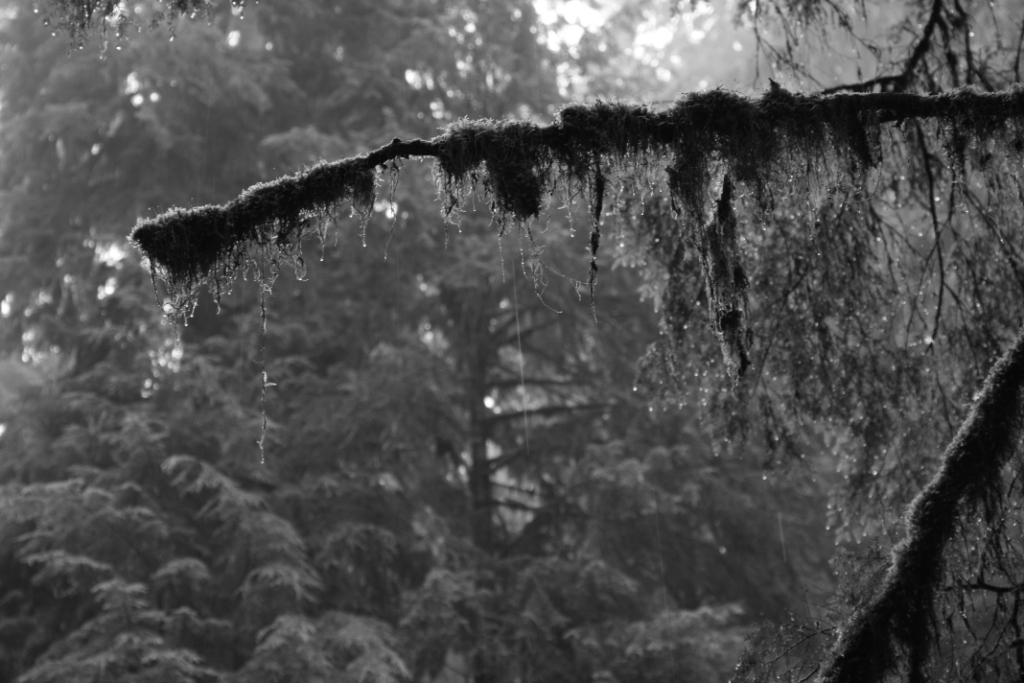
Back inland, the light fades and mists once more mingle in between trees. The Hoh Rainforest is a rainforest by name and a rainy forest by nature. I did not see any Hohs. I would imagine it would feel unnatural here on a dry and sunny day. Sponges of moss stifle trees and grow bloated with water. Beards hang down from their branches, and the trees take on a life of their own, like some terrifying monster from a Scooby Doo cartoon [2]. The air has an edge of intimidation to it, a slight feeling that you are trespassing on a very ancient, primeval world. You should take a few photos and leave things be. Otherwise the trees may come and get you.

Hoh rainforest     E_hoh1

Contrast elevates the small town of Port Angeles to a thriving metropolis. Traffic lights and a small city block, supermarkets and docks, a place to feel comfortable for the night. And awaken to a dry start where the sun rises from the east, illuminating Vancouver Island across the Strait. The rising sun does not take long to be swallowed up by a leaden sky, and rainbows form somewhere between the US and Canada, like some symbolic hand-holding hippy statement of peace and free trade. Mountains behind me reach into the clouds, their height cannot be fathomed as they vanish into the sky. But there is a road you can follow that will take you there to find out.

On days of dubious looking weather, Hurricane Ridge does not sound the most appealing place in the world by name alone. But rising from sea level to 5000 feet certainly offers an uplifting experience and one in which you finally come head to head with the elements that have been your friend and foe on the peninsula. Of course, the change in altitude also brings change in vegetation and landscape; mildly undulating pine valleys become steeper and barer, clinging to rocky cliff tops and giving way to alpine meadows. Just after 4000 feet, as life becomes sparser and bleaker, so too does the weather and it is not long, as you climb at a steady gradient, before the car roof kisses the bottom of cloud, and then disappears into it altogether. One less Toyota Prius on view to the world.

I imagine the views from here are tremendous, the ecosystem rare and unique and blessed, a pinnacle within a peninsula so raggedly variedly beautiful. But the elements have indeed been fickle and today, as days deepen into October, there is one final affront: snow. A whiteout of gentle proportions that is at least recompense for the murky vista. A scene from Christmas come two months early, dusted icing covering fir trees, icicles forming at their edges, the satisfying crunch of virgin snow underfoot.

E_hurricaneridge

A visitor’s centre offers shelter from the cold and all the amusement that a 3D contour map and short video film can provide. Which is, for me, actually quite a lot of amusement. The map a chance to at least imagine what it might look like outside, and which peaks lie in which direction. The film a chance to see what it looks like outside, on a far superior summer’s day, where marmots prance amongst the flowers and lucky tourists come to admire the peaks in all directions. But today no magical transformation upon leaving the small cinema, a transformation that had happened a couple of weeks earlier in similar circumstances around Mount St Helens, when the landscape emerged out of the clouds as the curtains wound back to reveal a ravaged peak. Here still nothing.

It did not take long to descend to be in the clear again, but the very tops of mountains stubbornly refused to separate themselves from the layer of cloud. With typically grudging optimism I gave it one more shot, ascended again, and was amazed that things had improved. You could now see about 20 metres into the distance rather than 10. But this was an improvement, and a trend was setting in. Suddenly you could sense cloud formation and movement rather than a uniform whiteness. Elements were changing again. And while the vista did not exactly become cinematographic, gaps formed and meadows appeared, snow started to fade and drip from trees, peaks became visible through the windows of clarity. It was enough to send you off back to Seattle content, pleased that the elements had at least offered up some compromise.

Of course the next day was beautifully sunny again and, from downtown Seattle, across Puget Sound, the mountains of the Olympic Peninsula shone bright. This was not the first dalliance with mountain sightings that had come back to taunt me the next day: Mount Baker, Mount Rainier, Mount Hood and, now, Mount Olympus all giving up little in my presence but shining out from further afield. There was warmth back in the air and the need to discard of a sweater. The elements were once again dictating the terms in this corner of the world. Setting moods and scenes and sartorial choices. Making every hour of every day different. Shaping the variation, colouring the land, enriching the environment. And continuing to make packing a conundrum for those who have the good fortune to visit it.


[1] Where some of the first Dreamliners were coming towards the end of the production line. I had nothing to do with it.

Links

Olympic Peninsula Info: http://www.olympicpeninsula.org/

Olympic National Park: http://www.nps.gov/olym/index.htm

Hoh Rainforest: http://www.nps.gov/olym/planyourvisit/visiting-the-hoh.htm

Quiluete Nation La Push: http://www.quileutenation.org/

Hurricane Ridge webcam: http://www.nps.gov/olym/photosmultimedia/hurricane-ridge-webcam.htm

Specific Pacific Northwest Blogfest:

http://neiliogb.blogspot.com.au/2011/10/specific-pacific-northwest-blogfest.html

A to Z Driving Photography USA & Canada Walking

Dawn

The dark cloak of night was yet to loosen itself from the town of Santander as I crept up from a creaky bed onto the creaky floorboards of a creaky guesthouse. Desperately trying not to disturb sleeping parents next door – clearly not helped by the creakiness of this particular guesthouse – I gathered the only set of keys and my camera and set out to surreptitiously escape the building and head towards the sea. If you cannot sleep, why not watch the world wake up.

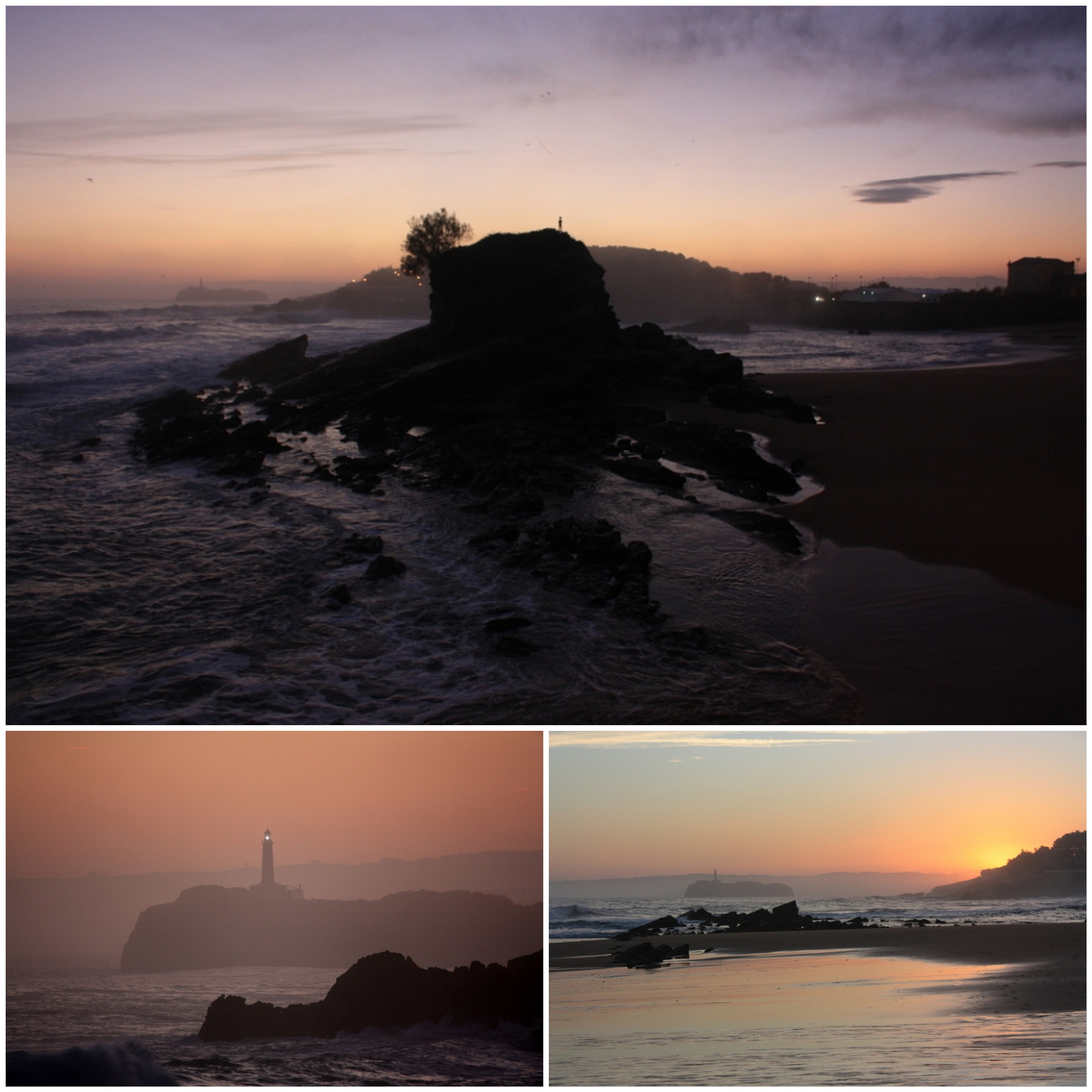
Emerging into the refreshingly cool and breezy air – a pleasant change from the pungent heat of a Spanish summer – the sea was barely visible, merely a rhythmic thrash of water hitting the shore somewhere distant. To the east, the sky was only just beginning to soften to indigo, the change marked by the silhouettes of gulls rising in the distance, their shrills increasing in tempo and building in volume. Elsewhere, further occasional signs of life…eager fishermen setting out, unseen shutters rolling up, street sweepers marking a clean slate. The final blinking of a distant lighthouse extinguished as the horizon turns deep blue and a thin strip of orange light flashes across that steadfast line between sea and sky.

Now, a red sidelight flickers across the whitecaps of surf, as rocky outcrops transform from black and white to heavily contrasted greys and greens. With light, sand becomes copper, every little rock and patch of seaweed casting a long shadow across the grainy canvas. Footprints are embossed alongside the water’s edge, as the first joggers, amblers, dog walkers and sleepless tourists break the surface. More gulls gather on the beach, more shutters are heard rising; more vehicles make their way along the coast road in a subdued early morning hush. The sun glides quickly higher into the sky and the moment is gone – for another day.

D_Santander

The world may now be awake but the parents still seem to be snoring. It was a long drive the previous day, from south to north across Spain. Through the dusty nothingness of the interior and over the greener, damper northern ranges, we reached Santander after dark and pretty much flopped out in our hastily picked guesthouse. I was surprised to awaken and watch the light introduce a different Spain, with surf cleansing the broad golden sands and scouring craggy rock platforms in between. A verdant headland of cypress pine and she-oak marked the entrance to a snaking, shallow estuary [1], peppered with sandy coves and treacherous currents. Beyond, the backdrop of forested mountains, lined at their base by popular coastal towns and expensive waterfront properties. For one moment I thought I had woken up on the south coast of New South Wales again.

D_Santander2

I shared some of this world in full daylight with Mum, heading off for a little walk once everyone had arisen and dressed and drunk several cups of tea before checking out. They hadn’t even realised I had been out in the morning, such was my obvious stealth and their obvious talent at sleeping in. Outside, we found that the headland was indeed a pleasant spot, the array of trees now offering useful shade for the sun spanning overhead. In fact it would have been a good spot for a little doze, especially if you happened to have been up and out when it was still dark that morning [2]. However, we had a ferry to queue for to take us through to the following dawn.

In between one whole revolution of the earth there was still some time to fill. This involved a lot of sitting around. First for coffee and some local food that I cannot remember other than it being deep fried and delicious. Then, once over the international barrier and beyond the spell of the salty streets of Santander, the most mind-numbing wait to board the ferry, sat in a car in the heat of the day while the Spanish operators have a siesta or go on strike or something. And further, once finally on the ferry, the futile task of finding something to do, other than sit down and have a drink.

To be fair there were at least, oh, 3o minutes worth of exciting ferry activities: walking the upper deck via a maze of secret stairwells; perusing every item in detail in the gift shop and working out whether it is cheaper to buy in Euros or Pounds; wondering do they actually sell those giant M&M characters and comedy oversize Toblerone bars anywhere else; and, importantly, noting the location of every toilet accessible once rolling about in the Bay of Biscay. So it turns out that the sitting down with a drink option is by far the best, a chance to farewell the Spanish sun that I greeted many, many hours ago.

I should note that, amusement-wise, there was also the excitement of the little cabin we had booked for the overnight trip. Here, an air of childlike wonder in discovering clever folding beds and storage spaces, incredulity at how they managed to fit a toilet and sink and shower in a tiny cupboard, bemusement with ever so miniscule space-saving gadgets and fittings. And, despite effectively being a pimped up prison cell, an astonishing sense of light and space. It’s like the Tardis, only marginally less scientific and with fewer smartass actors and delightfully ridiculous storylines.

To be honest, I could have done with an interruption from Daleks, perhaps emerging literally out of the woodwork, stealthily disguised as the bin and composite parts of the sink unit. At least I think their grating warnings of impending extermination may have woken up Mum and Dad and given me a break from their snoring symphony. So in sync that when one stops the other starts, building to a wave of crescendos where all components of the orchestra are at full blast, ending with a huge crash of drums and cymbals. Then just a brief intermission before the next number. Their melody in tune with the rocking and rolling of the sea, a sea which mercifully calms midway through the night, unlike the music.

With no natural light and a regular swaying movement the cabin proved quite disorientating on the senses but somehow with all this going on I believe I did sleep (and probably bolstered the orchestra in the process). And with that came morning, or at least the clock said it was approaching morning for all that you could tell inside. A trip out on deck confirmed this, while the temperature confirmed that we had definitely left Spain and were approaching England. Another day, another dawn, this one inevitably shrouded in grey on the eastern horizon, but a clear softening in the light marking the transition from one state to the other. The period of transition which makes dawn so special, so magical, so hopeful [3].

With reassuring inevitability the sun eventually emerged above the solid brush of low cloud and timed itself with a majestic arrival into Plymouth Sound. The pleasing site of land, and not just any old land but my land, inching nearer and becoming a reality at Rame Head, its patchwork of bracken and gorse a khaki camouflage rising out of the blue sea. To the east, rays of sun glowing godlike through clouds over Mountbatten, angling towards the west and lighting up the cosy cove of Cawsand. And directly ahead, a glimmer of red and white standing erect on the foreshore, a beacon to Janners worldwide: Smeaton’s Tower.

D_Rame Head D_Plymouth Hoe

A perfect combination of movement and light heralded me into the arms of Plymouth, the ferry gliding serenely through the water, the low projection of light colouring and highlighting the ultimate goal. Rather like some kind of tractor beam from an alien spaceship, dragging me towards it, resistance futile and probing likely. It was the first time I had been back in a little while and arriving by sea in the first sunlight of the day made it seem like some exciting new place, exotic and far away [4]. The anticipation building as the port came closer and closer. The freshness in the air added to a sense of rejuvenation. It truly was a new dawn, a new day, and I was feeling good.

Can there be any better time of the day than dawn? Sunset is an obvious rival, with both dawn and dusk offering subtle changes that equate to a dramatic whole. The inevitability of both being a reminder that humans remain immaterial, the world carries on spinning, regardless of what we do. Wherever you are, whatever you are up to, there will be a dawn and a dusk, in which the skies will transform, clouds will burn like flame, and light will glow and fade on the landscape. Dawn is extra special in that it requires a little extra effort, rising at unnatural hours, skipping breakfast, embracing the cold. Anyone can see a sunset. Only the committed or narcoleptic may see a dawn. And for this effort you will often be rewarded with peace, solitude, tranquility, a calmness which exacerbates the spirit of rejuvenation and hope that emerges with a new dawn.


[1] I may be factually incorrect with the tree types, but don’t quote me on it

[2] I believe, looking back at Google Maps, this headland is the Peninsula y Palacio de La Magdalena

[3] I hope my friend Dawn happens to read this, for surely there are significant brownie points available.

[4] In fact, when ashore I noted the rather peculiar, distinct language of the local population. Then joined in.

Links

Santander Tourist Information: http://www.spain.info/en/ven/otros-destinos/santander.html

Palacio de La Magdalena: http://www.centenariopalaciomagdalena.com/es/

Brittany Ferries: http://www.brittanyferries.com/

Smeaton’s Tower: http://www.plymouth.gov.uk/homepage/creativityandculture/museums/museumsmeatonstower.htm

Driving me in Spain: http://neiliogb.blogspot.com.au/2010/10/youre-driving-me-in-spain.html

A to Z Driving Europe Great Britain Photography

Big, big things

Encounters with the ‘big things’ around Australia. It’s amazing what can be achieved with concrete, plaster and a desperation to attract weary roadside travellers…

Australia Driving Galleries