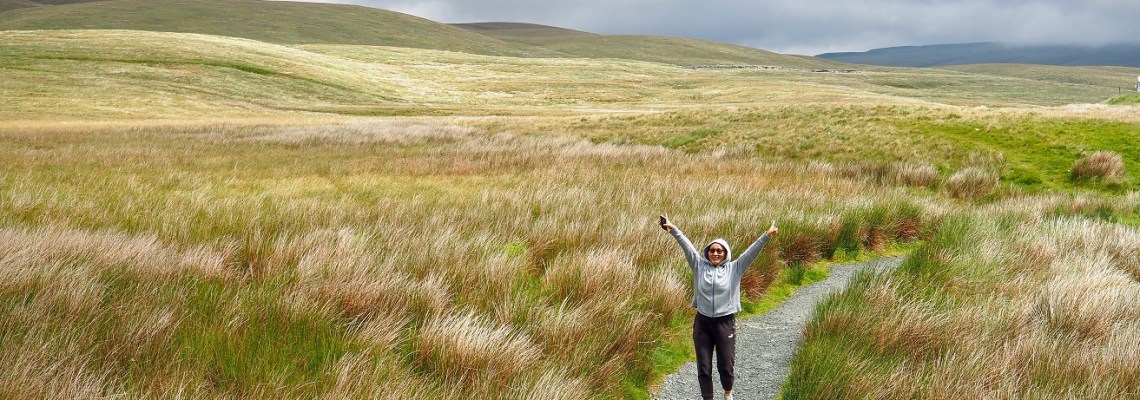
A person with arms raised in the middle of nowhere

Cracking

There is nothing more British than an opening sentence about the weather. And nothing more British than weather which has you sweltering in a London backyard with charcoal aromas one day and freezing your arse off in a tumbledown seaside resort the next.

Britain doesn’t quite have the same climate regions as Australia – think tropical and desert and temperate and alpine. But it does have the North, a land where train stations are always freezing, hotpots and brews keep wildlings sated and 18 degrees is positively balmy. It’s a different kind of eet, reet?

Imagine all you had to look forward to was a summer holiday in Blackpool. In a Travelodge. Next to the Pleasure Beach. To be sure, there are enough rollercoasters to fill a week and enough fish and chip and donut combos to fill an obesity clinic. In a fleeting visit, we managed two hours of rides and an escape for pub grub with a dear friend.

A brown sea next to a promenade

The drive south along the promenade is a journey of transitions. From the grimy Bleasdalesque terraces and windswept tackorama of Blackpool South, things pick up towards St. Annes, yet giant sand dudes are still dotted with empty cans of Monster. Onward, the understated main street of Ansdell is almost the sweet spot. Go any further and you are into Lytham w*nker territory.

While this journey offered a 15 minute encapsulation of the British class system, Wallace and Gromit’s Thrill-O-Matic offered four minutes of fun and silliness. Which is far more satisfying on a holiday. And set the wheels in motion for A Most Notable Detour.

Green fields, dry stone walls, and dark barren hills

We were off to The Lake District by way of Wensleydale. The many positives of this included leaving the M6 to plunge into fine, single track countryside and encountering roadside services far superior to a Costa and Greggs. Crossing from Lancashire into Yorkshire, that most happy of road trip staples popped up in Ingleton – an independent and delicious bakery – boosting moods for the climb up into the Yorkshire Dales.

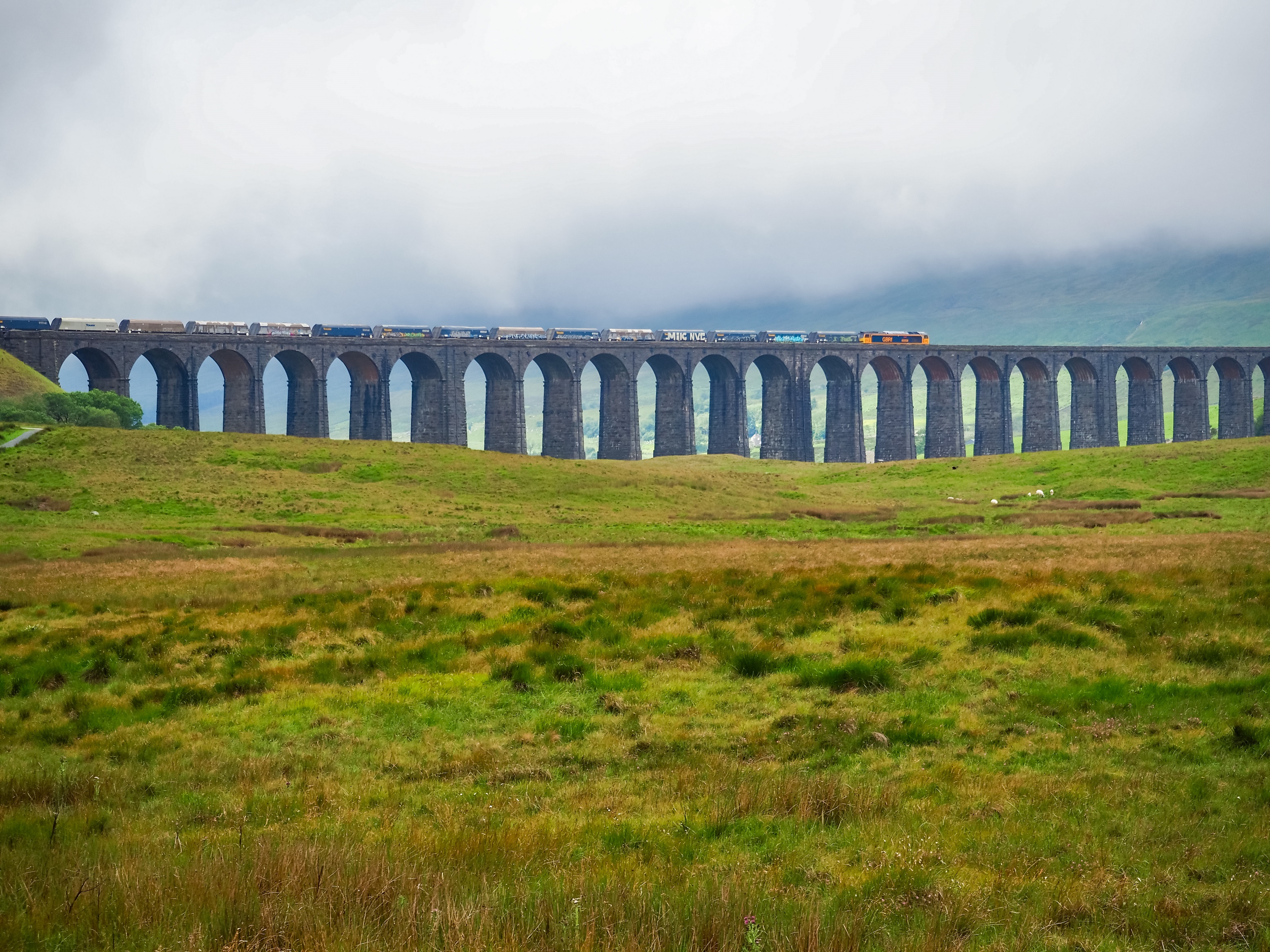
In a scene oft to be repeated over coming days, I felt as though I was driving across a Postman Pat landscape. Drystone walls and dotted sheep lace the valleys, yielding to desolate brown-green hilltops and low cloud. At Ribblehead, the model train set comes to life with its standout viaduct and the 12:07 to Carlisle inching its way into the mist. It is bleak and summery cold and definitively Yorkshire. Mustn’t grumble.

A wide viaduct with a train crossing into low clouds

The scenery as we overlook Hawes is a bit more of the cosier Yorkshire Tea variety. Things seem brighter and less foreboding, a sanctuary from the moors where you foresee being welcomed with a strong brew and fruit bun. As a result, Hawes is bustling and parking is tricky. But many are not here for tea or fruit buns. Instead, cheese. Served with extra cheese.

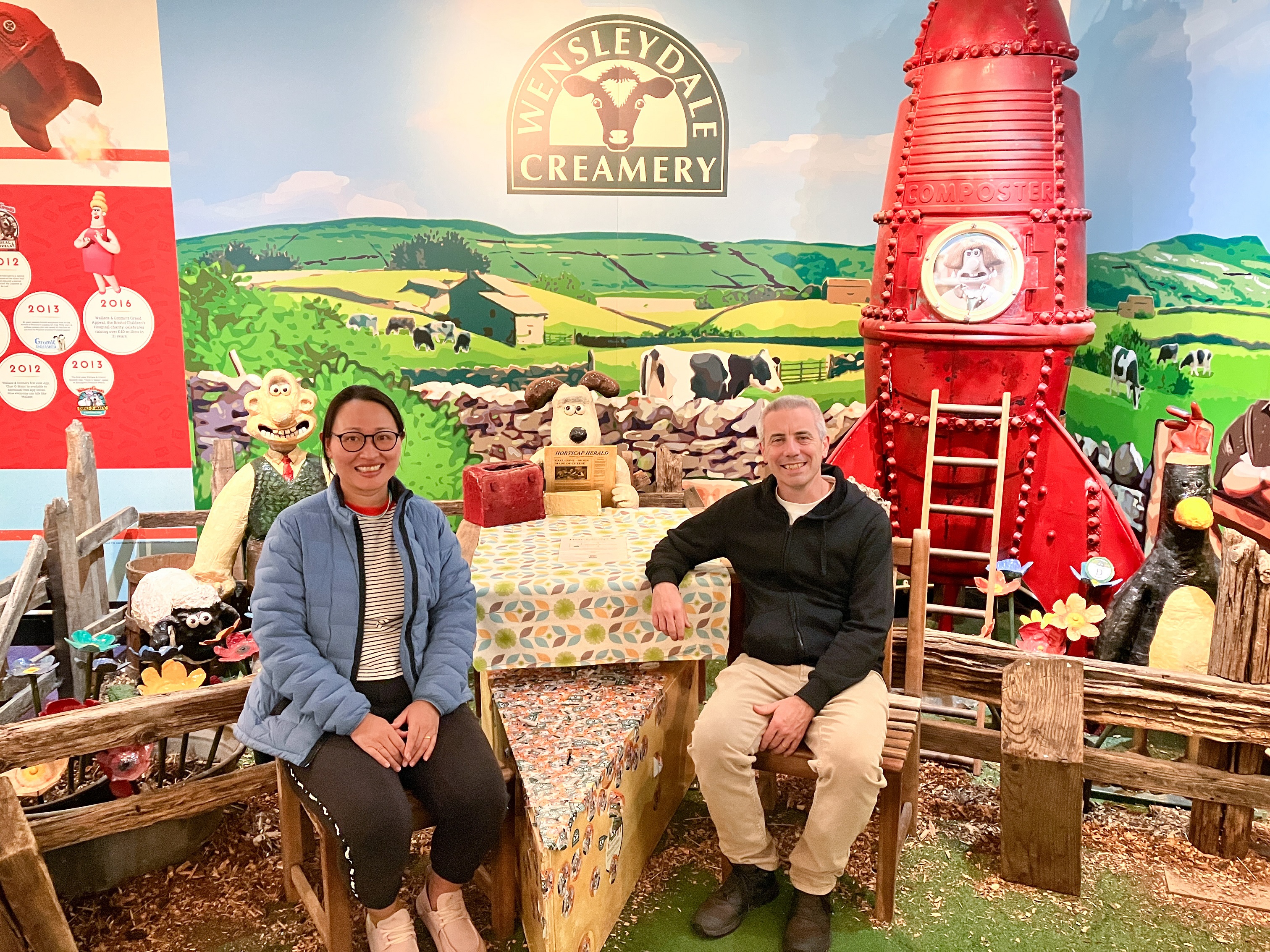
Hawes equates to Wensleydale which is inextricably linked to Wallace and Gromit. They don’t labour the point but it is quite likely that a couple of gurning plasticine figures saved this creamery from extinction. Cranberries can only go so far.
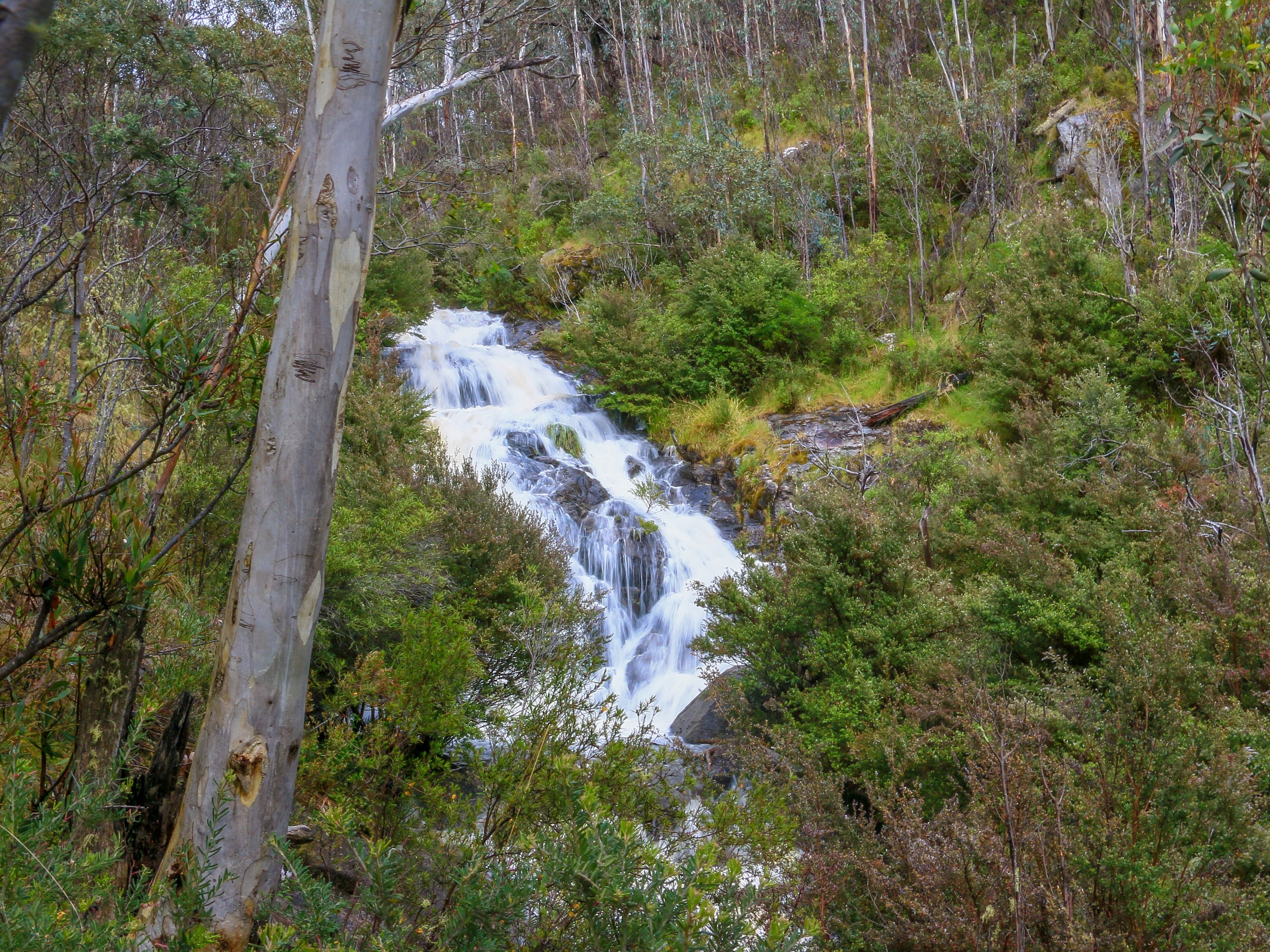
Several gurning plasticine fools

We wouldn’t be here today if I hadn’t introduced Avery to Vengeance Most Fowl. I was pleased to find cheese without fruit though, and enjoyed the light-hearted cheese-making demonstration and learning about the history of the industry in this area. Two words: French Monks. As it so often is. The road to heaven is obviously lined with fine wine and pungent cheese.

The road to Cumbria is a slow and winding one but breathtaking in a downbeat, overcast kind of way. We reach the M6 again and briefly take it south, bypassing Kendal and reaching the hills above Windermere. The skies are looking more cheery and it is a relief late in the day, after a sublime pub pie laced with cheese, to wander not at all lonely in breaking cloud.

A walker in the fields with sheep and a small village in the background

…………………………………

It is inevitable that lyrical waxing flows with many a visit to the Lake District. It is the crumpled lay of the land that arranges itself into lofty fells and sinuous valleys. It is the patchwork necklaces of stone walls marshalling flecks of sheep. It is the wooded glades and butterflied meadows, the babbling brooks and glassy meres. It is an old cottage and a pub and a church spire.

High mountains above a narrow green valley dotted with cows

It is probably not a gargantuan coach causing mayhem on The Struggle. I mean, the clue’s in the name and if that’s not enough a sign impishly advises of 25% gradients. Perhaps the coach was doing what we were doing though, escaping the parking lot that was the A591 between Bowness and Ambleside, detouring via Kirkstone Pass. It was a pleasant detour with some wonderful views to pass the time as a coach inches its way past opposing vehicles.

Eschewing Ambleside we amble along concrete in Grasmere, hotfooting it to famed gingerbread and an interminable wait for a coffee. The UK coffee update 2025 is much the same – avoid dreadful chains and it’s a coin toss between acceptability and dreadfulness. Though I am finding the creaminess of oat milk can mask some of the bitterest tears.

Someone in the cafe remarks it is busy today because the weather is good. I can only assume because it is not raining. We pace back to the car under cool, leaden skies and decide in such jovial weather there’s nothing better than being out on the water. Derwent Water in fact, layered and wrapped in coats, sheltering under flimsy caps, refreshing spray cooling the only bare bit of skin peeping out.

But it is hard to look away, particularly at the mountains in the distance, one protrusion piercing the cloud and flooding its upper reaches in sunshine. Perhaps there is a surprise in store after all, though not at Surprise View which is entirely as telegraphed. It’s a fine outlook over Derwent Water and beyond and a good spot to eat a lunch involving Co-op crisps and caramelised onion infused Wensleydale. Cracking.

A lady looking out over a large lake

With two W&G days in a row I thought we were having a break, only to be more surprised than the surprise at Surprise View to pass a cyclist wearing a Lycra jersey emblazoned with the face of Gromit. There was a fair chance the cyclist was gurning like Wallace too, embarking on the climb up to Honister Pass. With clouds parting, here was the Lake District providing elevated beauty and drama all the way down to Buttermere.

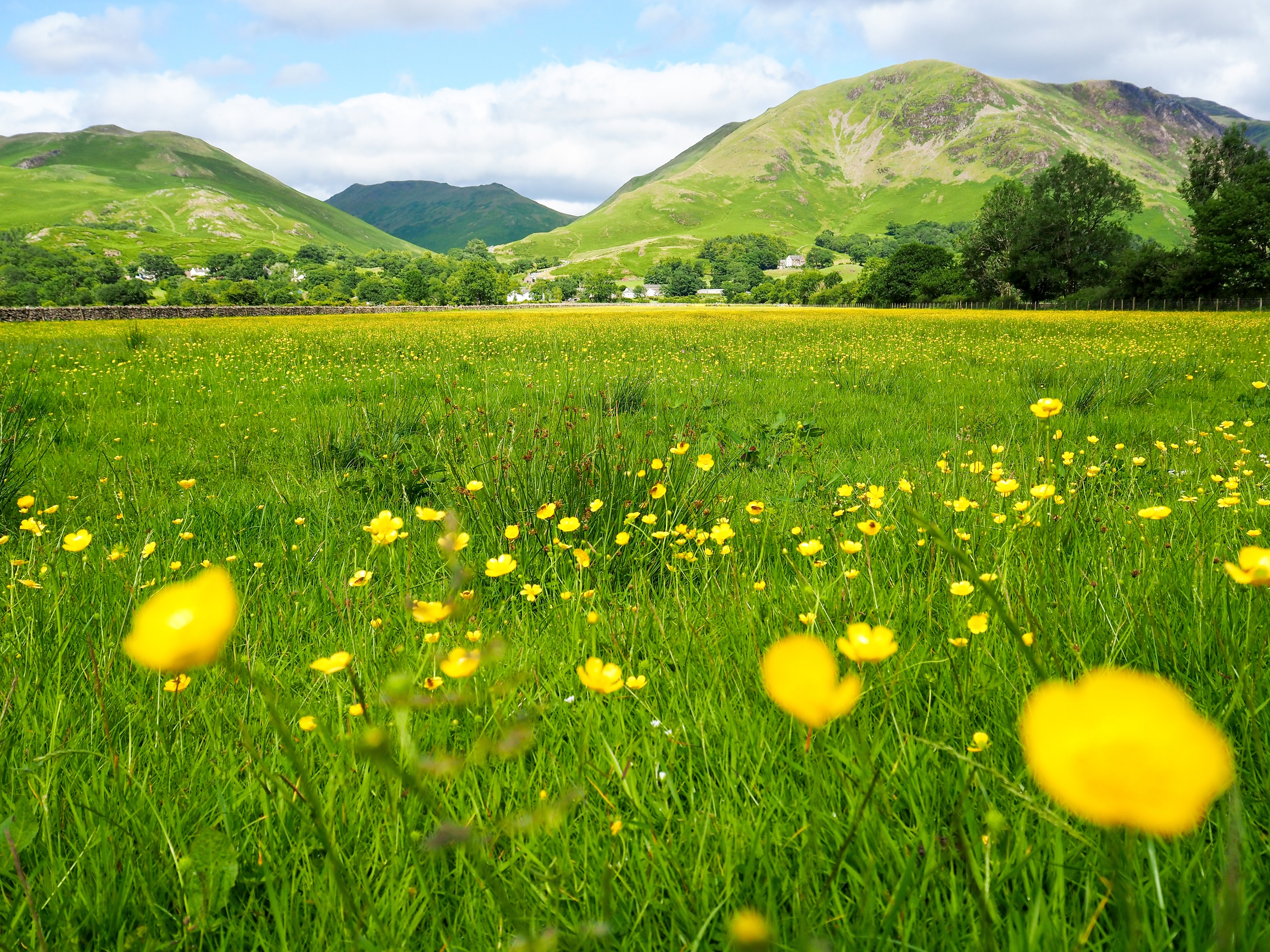
Sometimes a name can overpromise but Buttermere is every bit the delight it sounds. Water smooth as a knife, meadows plump with buttercups and bees and butterflies, cows cheerily chewing away, transforming green grass into ice cream and cakes and tea and – as Avery was subjected to – dire coffee. The cosiness of the place is heightened by the wild heights all around, deflecting the clouds to form a golden paradise. There is even that Buttermere tree.

A lone tree sticking out of a lake with mountains in the background

Ice cream, butterflies and bees

A field of buttercups in the sunshine with green mountains in the background

It would have been appealing to stay overnight here but it is overly popular and overly small. Queues for the bus suggested some may be in for an unintended night; we took solace in the hire car and an out-of-the-way B&B a little further north. This took us through more glorious scenery fringing Crummock Water before bravely praying for no oncoming tractors among the lanes around Brackenthwaite and Thwackwaite. Splendidly Northern names if a little lisp unfriendly.

On nearby place names, it is fairly obvious that Cockermouth is going to be pronounced Cockermuth. But there is something about Cockermouth that makes one forget and – to the despair of locals – often results in both a hard ‘Cock’ coming out with a hard ‘Mouth’. And accompanying tittering.

Before things get too hot to handle let’s go to the reality of Cockermouth: Sainsbury’s in the drizzle. While a Sainsbury’s was a welcome sight (and sign of civilisation), the drizzle was not. It was a dampness that persisted overnight and into the next morning, on which we returned into town to post a pack of biscuits. I never expected sending a pack of biscuits would take longer than an hour and require more security questions than entry into the West Wing. But at least it passed time for the drizzle to lighten and the cloud to lift.

Plunging back down into Loweswater there was an optimism returning with the reemergence of hills and languid liquid shores. With some urgency to get out into it all, we devoured a Sainos meal deal for lunch and headed for the hills.

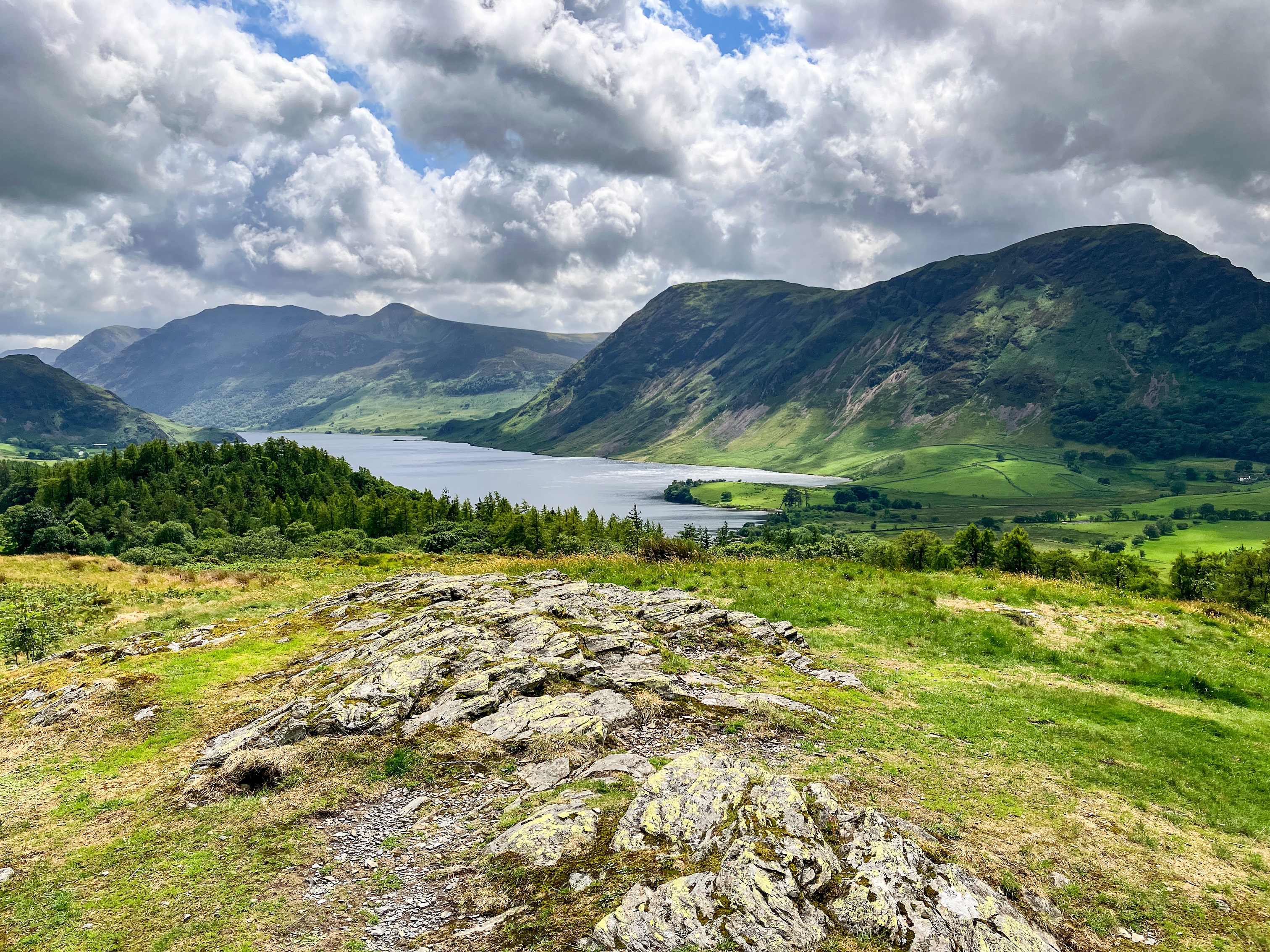
A view from a summit of a sweeping lake surrounded by rugged high hills

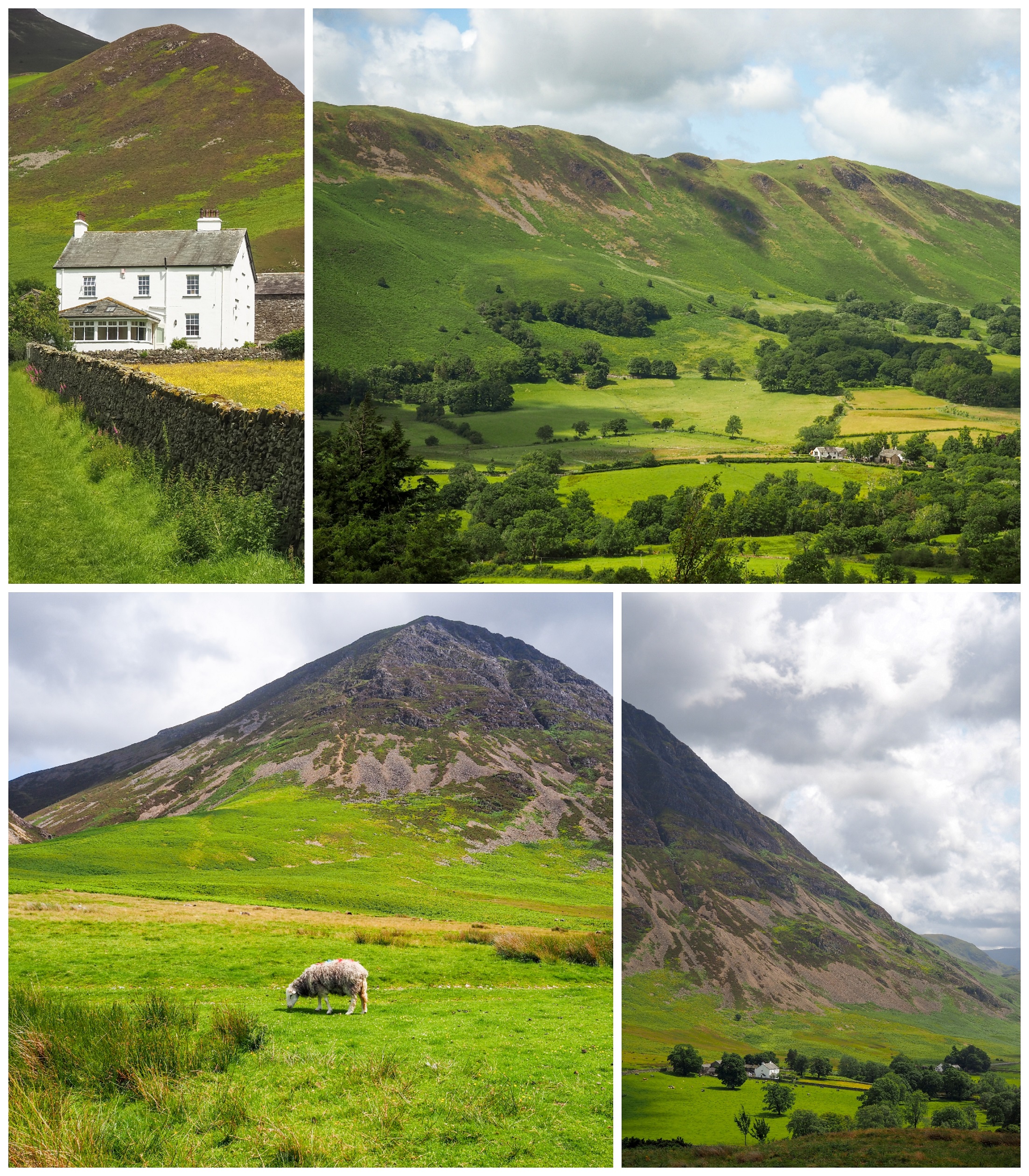
Pastoral scenes of farmhouses, fields and hills

While this wasn’t really the day for high moors and ridgetops we managed to get above the canopy at Brackenthwaite Hows for some lovely, quintessential Lake District vistas. South of us the sun was sparkling off Crummock Water, bisecting the steep-sided fells of Grasmoor and Mellbreak. Scattered amongst this drama, seemingly in miniature, occasional farmhouses fringed with cows and sheep. A serene scene abruptly punctuated by RAF jets flying a hundred metres overhead. Both breathtaking and almost pant pooping.

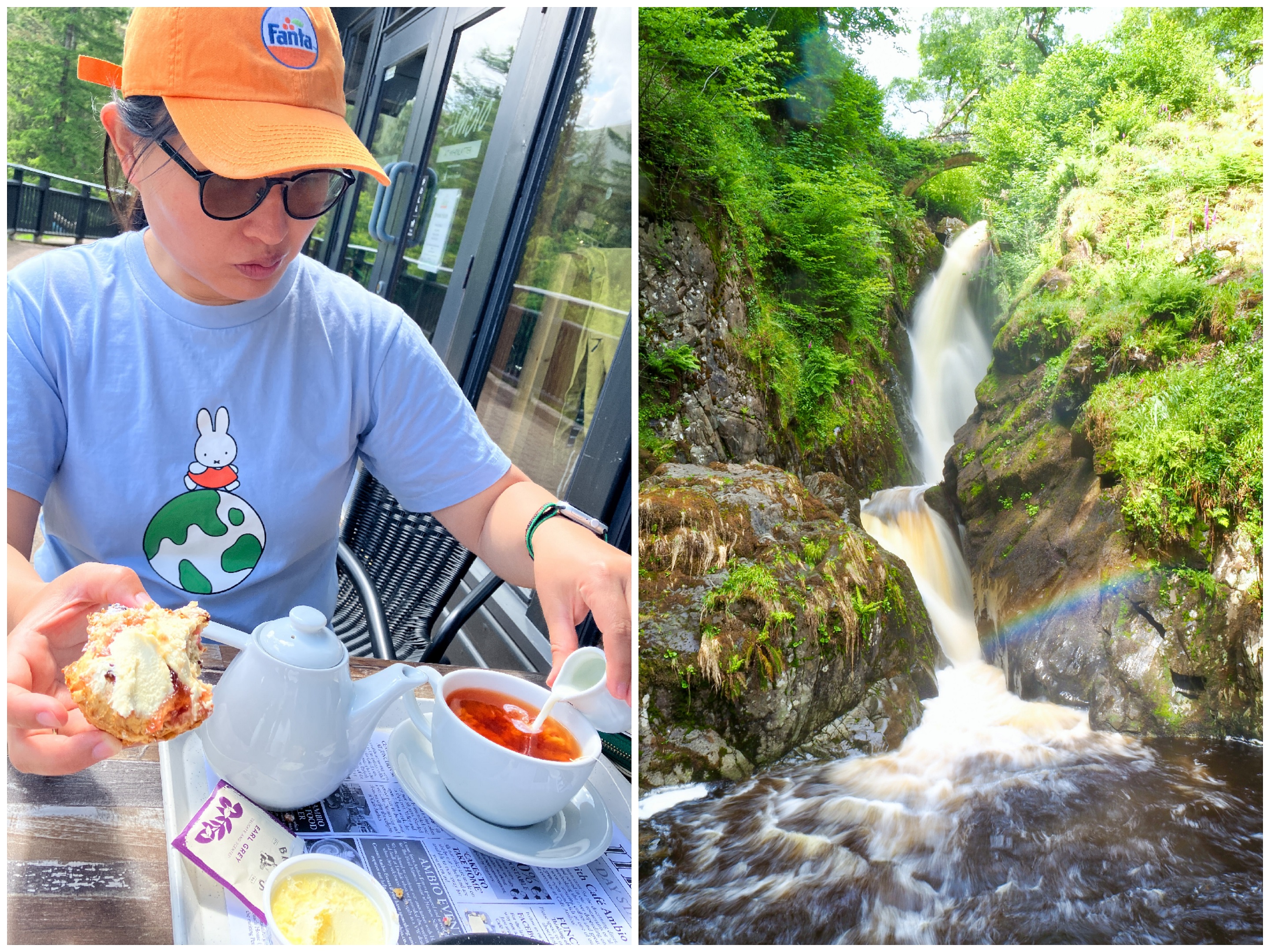
There was much to get confused about when talking about the air force and Aira Force but we made it there in the end. This was via a spontaneous tea stop – which always makes for a good stop – at Whinlatter Forest. And while I wouldn’t call it the full-on cream tea it would have been rude not to opt for the scone and jam and cream, with a cup of tea, safe in the knowledge that greater greatness awaits.

Tea, scones and a waterfall

By the time we reached Aira Force it was late afternoon (only another 7 hours of daylight remaining folks). A good time to arrive given some of the crowds had dissipated and a subsidised National Trust parking spot was easy to find. The woodland and the falls were undeniably lovely, even if my lovelier wife went on to utilise this spot to both puerile and hilarious effect.

I come from a land down chunder

We had come this way, beside the shores of Ullswater, to locate a mysterious field on the top of a hill for a spot of serious dogging. I think that’s the term they use. No, wait, shepherding. Ironically, as we drove up a small lane, the Skoda was doing its own piece of shepherding as three dumb ewes tottered before us. Greeting us beside a gate, a farmer’s son looked bemused. Ah, city folk.

Upon this hill it was blustery and cool, and we had to layer up in everything we had. But it was a charming and enlightening hour or so, greeting an array of border collies (surely the best type of dog) and a friendly, attention-seeking Old English Sheepdog. The dogs were lined up roughly in age and a demonstration ensued of different skills and instincts, supported by Come Bys and Aways and remarkable variations of whistling. There was talk of farming and nature and the intertwining of the two, of thousands of hens eggs a day and farm shops and the bond between one man and his dogs. All the while, the sheep looked dumb and all I could focus on going round my head was Kaleb and I Can’t Stand Sheep.

Sheepdogs, farmer, sheep

After sweltering in balmy London not so long ago, it was fair to say we were freezing by the end of the sheepdog demonstration. I couldn’t feel my feet and my ears felt like two flattened crumpets that had got lost down the freezer two years ago. But this was a wonderful place and wonderful time, and there was a cosy pub not too far down the road to cap off our final night. Further down the road the M6, Preston, Wales, Plymouth. Some Equally Notable Detours yet to come.

A road winding down into a valley from a high mountain pass
Driving Food & Drink Great Britain Green Bogey Photography Walking
Balloons rising over a lake with a row boat gliding across the water

Surprise!

Whether it’s an epic global adventure or – more likely – random meanderings close to home, travel is an integral and frequently joyous feature of many of our lives. But we travel not only in relation to our immediate geography, we travel too in our mind and soul. We travel on that most mystifying and blessed journey that is life. And, like the laboured 09:00 from London Paddington, my life journey has called in – notably delayed – at a rather significant station.

Which is all to say I got married. So let’s call this station Bath rather than Bristol Parkway, for there is elegance and grace and it is a far nicer place to be. Plus I’m hopeful there will be more stops along the journey, all the way to my final Penzance (and then perhaps onto that renowned land of the undead, the Scilly Isles).

One of the lovely things about this Bath station is the convergence of fellow travellers from journeys past. Reunion and reacquaintance with others a cut above those relationships you form with strangers on the same carriage on the same train at the same time on the Northern Line from Finchley Central every weekday morning.

And so from this metaphorical Bath to a literal Canberra. It’s a fair leap, one almost mirrored in real life by Dad who arrived with time spare to stalk butterflies and ice cream parlours in between a wedding. We picked a good time of year for it, when Canberra’s skies are filled with decorations natural and man made, and the weather is plenty warm enough for hokey pokey.

Hot air balloons hovering over a lake

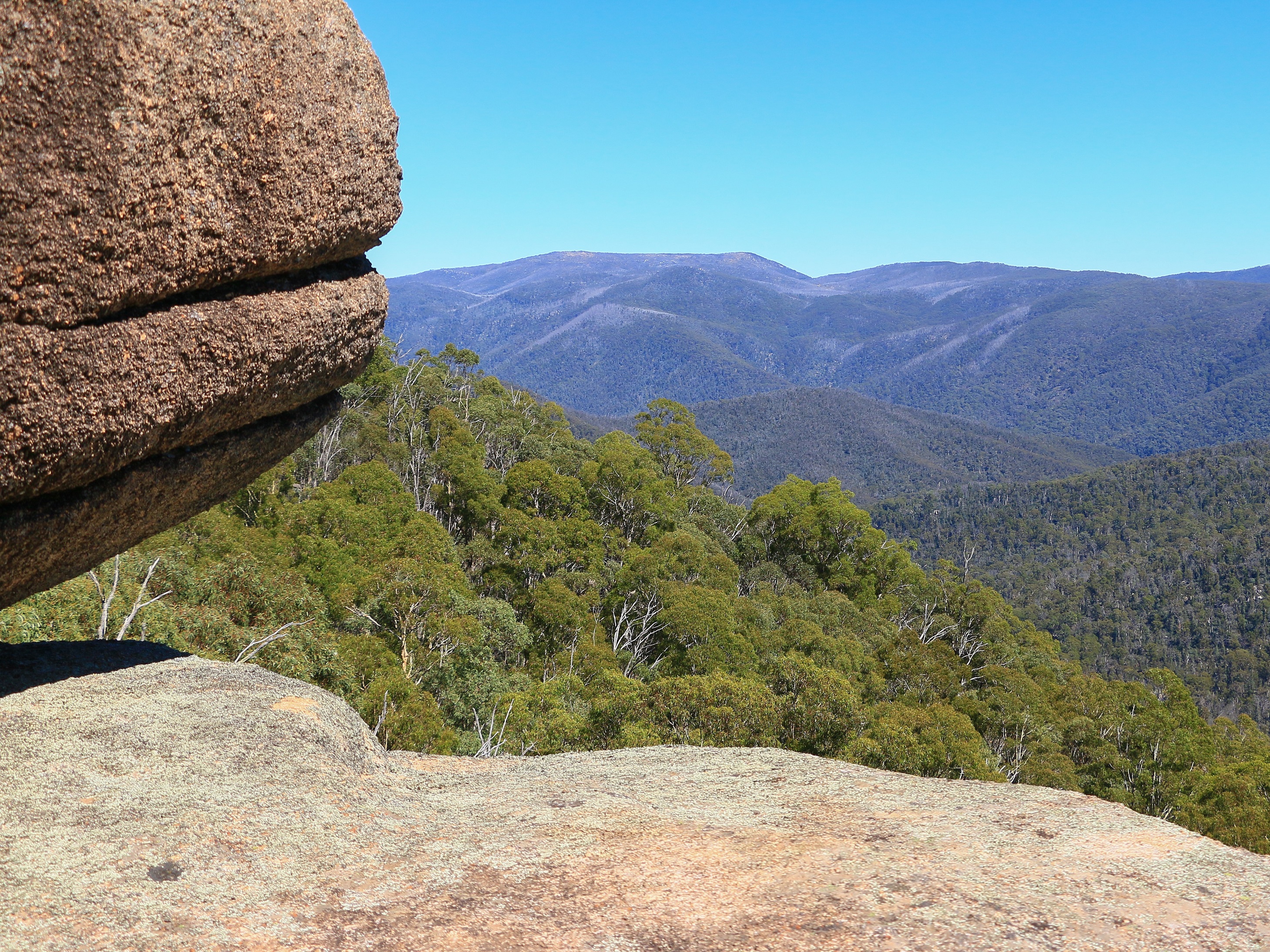
I particularly enjoyed a walk with Dad to Square Rock immediately after the wedding fever had died down. Not only was it one of those rare spots he had never been to, it was also nourishing to cleanse myself of run sheets and entrance music files and stickers on glasses and lines in Mandarin and fingers crossed about the weather and forgotten bouquets and the pile of photos to sort out.

A view over mountains and forest from a rocky outcrop

Space, clear air, nature and snacks on rocks. Though, with a ring on my finger, wedding memories were never far away. I was thinking the rocky outcrop would make a good spot for a proposal, champagne corks shooting into the yonder. But once is enough, thank you very much.

———————————-

From a romantic spot with Dad to a “honeymoon” with Dad. I use the quotation marks (and can mime the associated comical gesture should you wish) deliberately. For if I was to pick a honeymoon venue it would probably not be the Gold Coast. And yes it’s unlikely I’d take my Dad. Coincidence just did its whole chance occurrence of simultaneous events thing where cheap flights booked long ago met a weekend after a wedding.

view of a beach and blue green sea, with some artful cock and balls etched into the sand

Storm clouds approaching a beach

There were many positives about the Gold Coast, enough to balance out the humid showers and traffic lights and bogan tendencies to etch cocks and balls in the sand. We had a super view from our apartment, only dwarfed into insignificance once atop Q1 for a buffet breakfast. Within a thong’s throw of the beach, the water was lovely to wade through, and residual sand could be washed off in our pool just across the road.

From the balcony, night markets were spotted and explored, a trail of stalls selling healing crystals or imploring you to hold a lizard for twenty bucks or to commission a really bad caricature for more. And food options lay out in excess, from Japanese to Thai to McDonalds and Messina. Gelato fans, new and old, converge.

A group of people eating ice cream

The sprawl of the Gold Coast can make it seem hard to escape. And, like casinos in Vegas, that may well be the intention. Burleigh Heads National Park offers mini respite, in that at least it is not another high rise or souvenir shop. But this isthmus of bushland is, on a Sunday morning, undeniably popular with people in tight pants exercising, people who you suspect might use the words “media-based wellness inspirator” when asked what they do for a living.
A lizard sitting on a rock in the forest

Still, away from the curated coast path there are some pretty butterflies if you look close enough. Like everyone, enjoying relief in a lofty opening up out of the humid jungle. But also, like everyone, seemingly desperate to keep on the move.

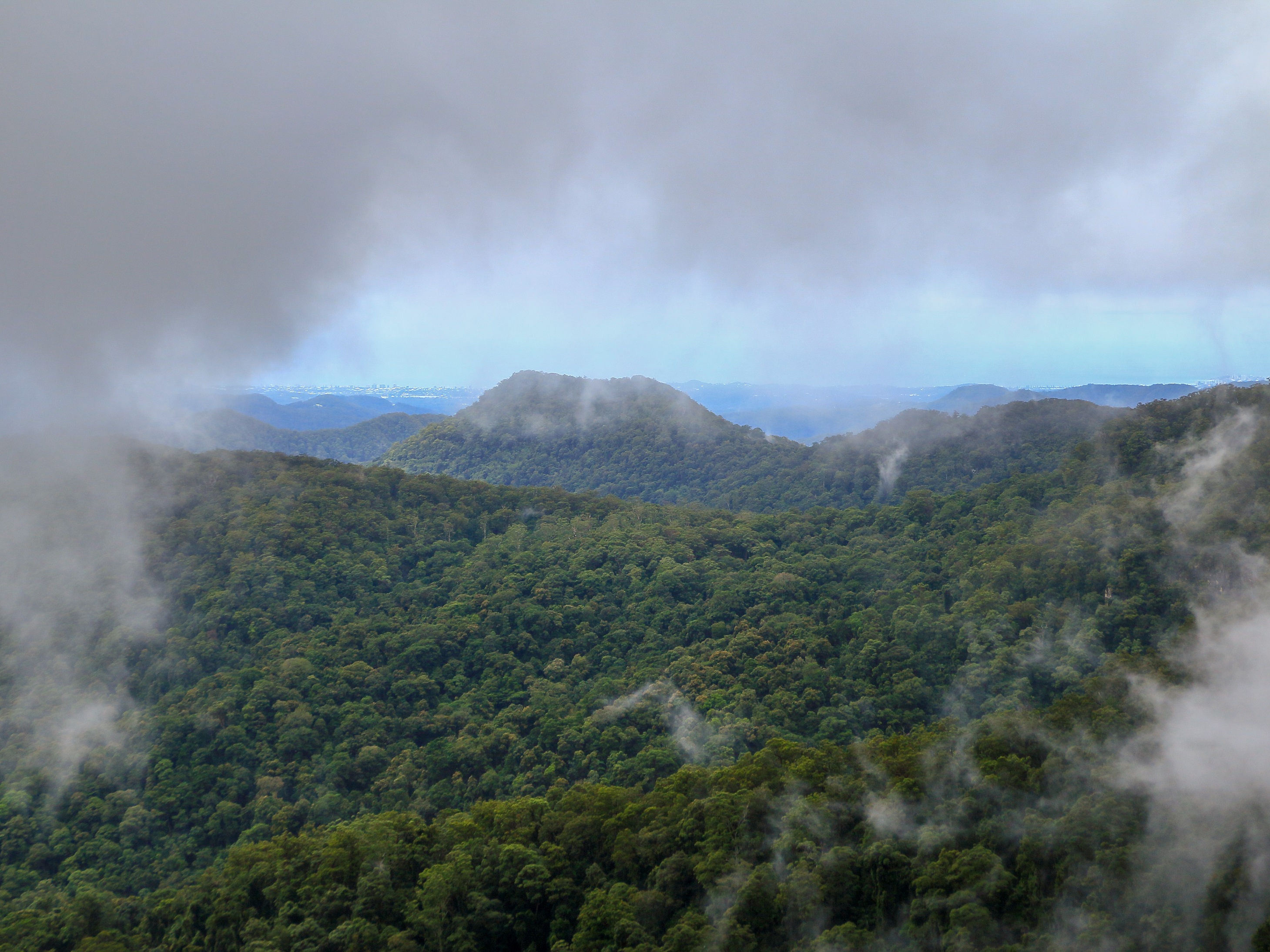
I find the real gold of the Gold Coast is actually inland an hour, significantly less gold, more green and certainly not coast. You can still espy the sea and the skyscrapers from the Springbrook plateau, but in between lays verdant, dramatic, primeval rainforest.

Mist rising from a forested valley

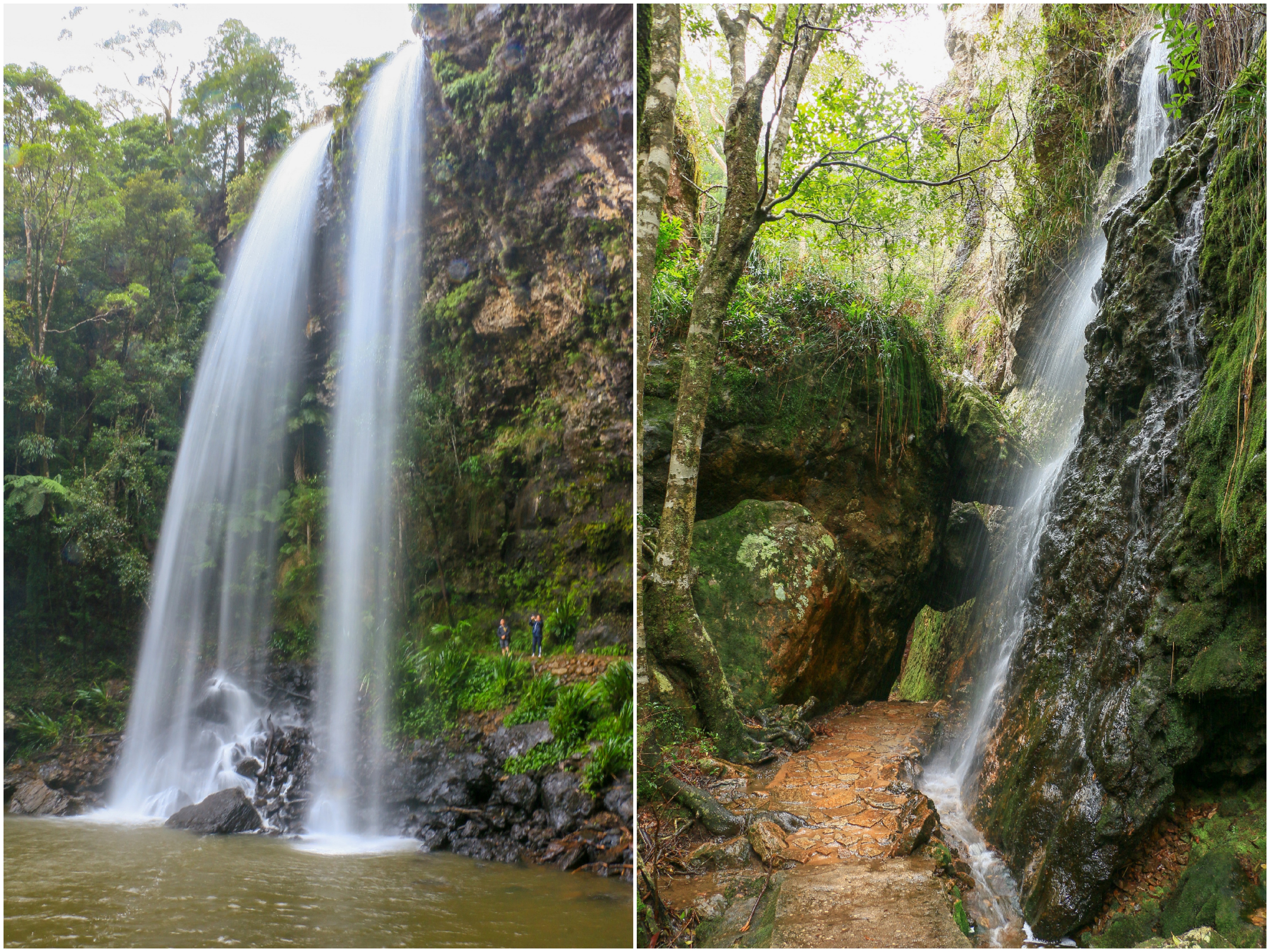
Today, it’s significantly cooler and punctuated by cotton wool pockets of vapour drifting above the trees. Water is a major aspect of life up here, including a recent Cyclone Alfred inspired 1146mm in 7 days. It’s surprising the roads are – with a little repair ongoing – still open. And not at all surprising that the waterfalls are full crescendo. An idyllic honeymoon spot. An adventure invigorating. A location not immune to influencers but with enough space and spectacle to spare. A few miles and a million years from the Gold Coast.
Waterfalls plunging down to the ground

Not an influencer taking a rest in the rainforest

———————————-

From a land of water to a land of water, unfortunately timed for the final weekend of Dad’s visit and our disjointed sort-of-honeymoon. We were heading to Tathra on the far south coast of New South Wales. Compared to the Gold Coast it’s like going from The Prodigy at a rave to Enya in a spa. I would use more contemporary pop culture references but I’m getting old. Besides, Tathra has a mid nineties vibe, a time when presidents played jazz and unhinged dictatorish ones were being prophesised in The Simpsons.

Despite portents of doom, the weather wasn’t exactly terrible when we arrived. Sure, take a raincoat to walk to the pub but do so with hood down. Then up. Then down again. And, as the last remnants of daylight savings endure, sit outside but make sure you are close enough to the walls to be under the veranda, just in case.

The next morning started with promise too, in that I don’t think it was raining much. But arrangements to meet down on the wharf were changed in the space of thirty seconds. Let’s try coffee inside and see if things pick up. Then let’s have some lunch and see if things pick up. How about after afternoon tea… maybe things will pick up then? But you surely know the rain has set in when the monopoly board is unleashed and you take comfort in a jam and cream lamington.

Two people taking photos of large waves at sea

Wispy wave action from a long exposure iPhone shot of the ocean

Thankfully these are good indoor Sundays, when hearty food and drink is matched by cheery company and chat. When cats retreat to bedrooms and paper planes rain down from the indoor skies. A time and place where it only costs $400 to buy land on Sydney Harbour and then, almost inevitably, end up in jail. Hoping to break free as the wind and the rain lashes at forty five degrees.

It was almost dusk when things did marginally pick up. And me, my Dad and my wife managed that kind of walk which was invigorating and refreshing and all the more enjoyable because of the wildness of the weather. Sure, let’s hope none of those branches sway any further than a few metres, and watch out for the newly formed rivulet trails. But check out those waves and those sounds and the clouds blowing through to dump more rain on the hills.

This weather all sounds very British. Which, by good narrative fortune and by way of Bermagui and Batemans Bay takes us back to that figurative Bath. Most of the passengers who came together are now on their way, the final one set for the 1540 to London. Balloons have deflated and cards are packed away. On the platform, two solo travellers have united, ready to embark on the next leg as one. Stand clear of the closing doors. Bristol Parkway, and far better places, await.

Australia Driving Green Bogey Photography

Holiday viewing

Growing up, Christmas TV viewing used to be such a big thing. A double episode of Eastenders in which someone and/or something sizzles in a suspicious blaze. A blockbuster movie that was so new it had only aired in the cinema little more than a year previous. A Father Ted comedy special which was really fecked. And of course – usually avoided because of concurrent feasting on dried up old turkey – The Queen.

While others still go crazy over Love Actually or A Muppets Christmas Carol or even the old royal turkey himself, I have mostly been watching the BOM radar this holiday season. Only Big Bash cricket – for all its stupidity – competes for airtime, though usually in the background, usually while looking at the BOM radar. It’s riveting viewing, where you simply won’t believe the biggest twist yet.

They say Christmas comes around earlier every year and it was just ticking over into December when BOM radar became the must watch event of the year. Was Mount Kosciuszko up in the clouds, was that storm clipping Thredbo, would it ever stop raining in Jindabyne? Would Yarrongobilly Caves provide best refuge or how about the local pub? As long as you get in after the meat raffle and before the Christmas karaoke, yes.

A wallaby and flower in the bush

Rain, rain go away and come back in the form of a waterfall. A lull in weather drama one morning providing relief and release and joyous, primitive, natural freshness. Sawpit Creek plunging and fizzing and totally out of mobile range to check the radar. Ignorance and bliss and all that.

A waterfall among some trees

Nimmitabel also produced sketchy mobile data and all I can say about that is it was a stroke of luck that I fancied a pie. Or, supposedly, Cornish Pasty. While discovering the sacrilege of sweetcorn the heavens opened, rapid rivulets formed and I prayed for the car outside. By time I forced down the last corner of dry pastry it had stopped, and Dad and I plunged down towards the coast.

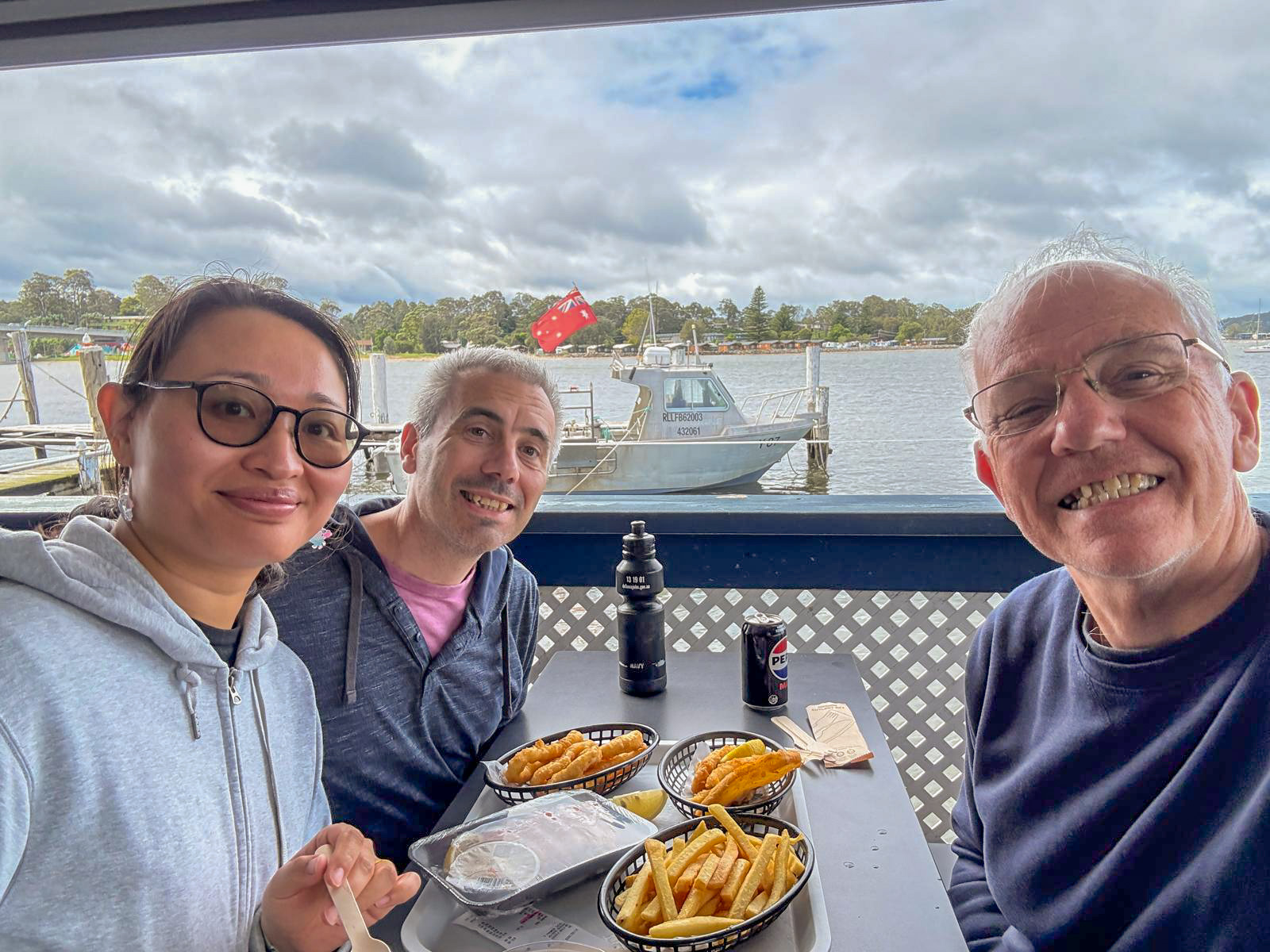
I wouldn’t quite say the rain followed us. At least not until after we navigated flooded detours in the Bega Valley, stopped the car, and went to discover sea foam oozing through Wallagoot Gap. Only then did the rain return, obliterating the scenic drive to Bermagui and forcing fish and chip consumption in the car.

A black and white image of a wild seascape

There was clearly a bit of a British summer holiday vibe going on. This extended to the following day when it was – in spite of more downpours forecast – only really mostly cool and cloudy. Relativism a conduit of positivity, low expectations a nurturer of delight. Mustn’t grumble. Things could be worse. We could do something.

It wasn’t really a peachy beachy day, unless seeking moody shots of rock formations and blustery coastlines. So we ended up in Tilba, drinking coffee and eating cheese. In between, taking a tour of its lush environs under the brooding hulk of Gulaga. Briefly the sun came out, and so too the flies.

A decorative garden and a view of some hills

With all the runoff of recent days the normally sapphire seas around Bermagui were a bit more Bognor. But Monday – the day of travelling back to Canberra – was much better. Radar viewing indicated little going on, much like a filler episode of Home and Away (or a normal episode to be fair). There was good coffee on the beach to kick things off, good waterside coffee again in Narooma and fish and chips by the lake in Tuross for lunch. Filling the time between dining stops, beach views and maybe the risk of sunburn.

In fact we stopped stopping at beaches because we were tiring a little of golden sand and fabulous blue waves. A bushwalk among the spotted gums was calling. A search for elusive butterflies and a surprise sugar glider, taking advantage of a respite in the weather to feed on nectar and ambrosia. Inspiration for the ice cream at Bodalla Dairy.

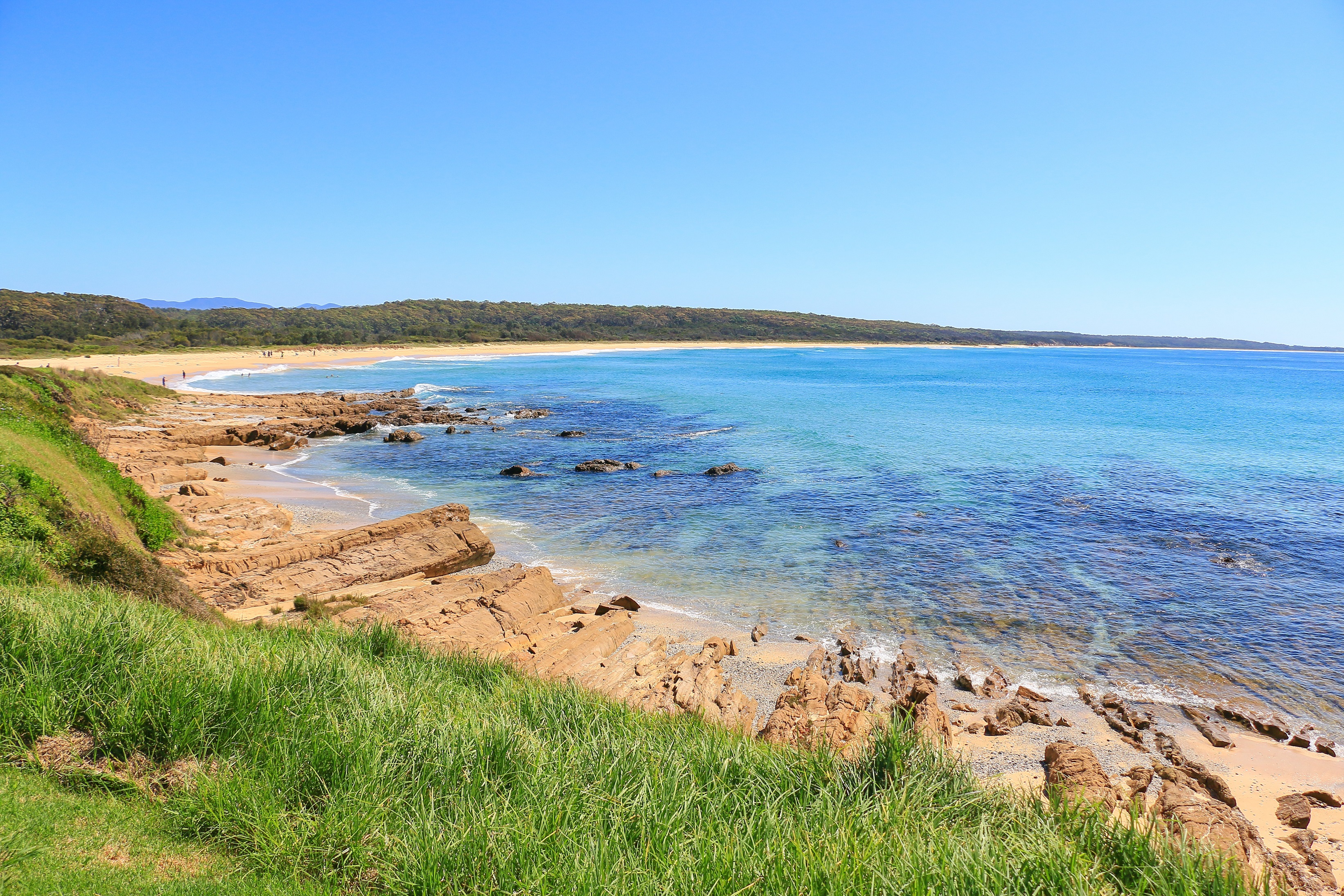
A beach and blue water

coffee, coffee and ice cream

For a day, BOM Radar was barely a thing. The Australian summer in all its glory was back. Even the sea started to look that little more sapphire. But then I heard they commissioned a second season. Featuring a Christmas special. In which there will be some even bigger twists you never ever saw coming in an unprecedented TV first. Oh how I hark back to a spot of arson among the mince pies in Eastenders.

Australia Driving Food & Drink Green Bogey Walking

Grenful

I cannot believe I totally missed the big pick and pan. I mean, it’s not like the town of Grenfell is burgeoning with tourist sights. Yes, there are the archetypal painted silos, an old railway station and various manifestations of Henry Lawson, but that’s barely enough curiosity to fill a week. I’ll have to go back.

For the many billions of people unaware, Grenfell is situated in Central West New South Wales, a crossroads (or roundabout) between Young and Forbes, Cowra and West Wyalong. In many ways you may find it indistinct from all those other towns which regularly pop up every fifty clicks or so. In this indeterminate swathe of country, only gentrified Orange and an Elvis-upped Parkes may rise above the fields of canola, waiting to be cut down.

Still, I wasn’t really in Grenfell for touristing. Just being homeless and getting my laundry done, just like the good old days. Working remotely and staying with dear friends. Being grateful. And frequently offering entertainment for a three-year-old.

Oh to be three in Grenfell, where the world must seem full of stimulus. For us adults there is the Main Street and its chain of pubs which offer their own unique character. For me, it was hard to beat the Railway for its old school ice cold midis, the same again please on a warming summer afternoon. Quietly infiltrating a semicircle of locals with hats propping up the bar, one eye on the cricket.

In between work breaks and play breaks I sampled the local country coffee, taking on board various recommendations. I dunno, I think my friends have been living here too long because not once was I any more than mildly accepting of the coffee quality. I could blame the skim milk, but what else is token recompense for a caramel slice?

Given the abundance of caramel slice, I was pleased that among the essential items of life filling my car (clothes, water, mobile office) I had managed to fit in a bike. The roads of Grenfell are quiet and mostly flat and trips to the Main Street become more inviting with a breeze. The week endured hot, with early mornings proving the most comfortable for galahs and humans alike.

Yet it was a couple of evening rides that garnered more joy, despite the heat and surprising hilliness on the way to Company Dam. Three’s company you see, even if my two buddies, Howard and Henry, are benefiting from electric power. It was nice up here, replenished by La Niña rains and golden evening sunshine. Plus it was (mostly) downhill all the way to ice creams at the servo.

Servos – formerly known as petrol stations – tend to take on extra responsibilities in country towns such as Grenfell. For as well as U91 and chamois, you can usually buy an array of deep fried beige coloured goods: hot chips, chiko rolls, potato scallops, meat pies, fish bites. Most of the home cooking I was treated to was excellent but occasional chips on the side never hurt anyone.

Indeed, chips on the side were a highlight on the one foray out of Grenfell, to the neighbouring and larger town of Cowra (size being measured by the presence of Maccas and Aldi). In between, Conimbla National Park punctuates the farmland and proves both bountiful and sparse.

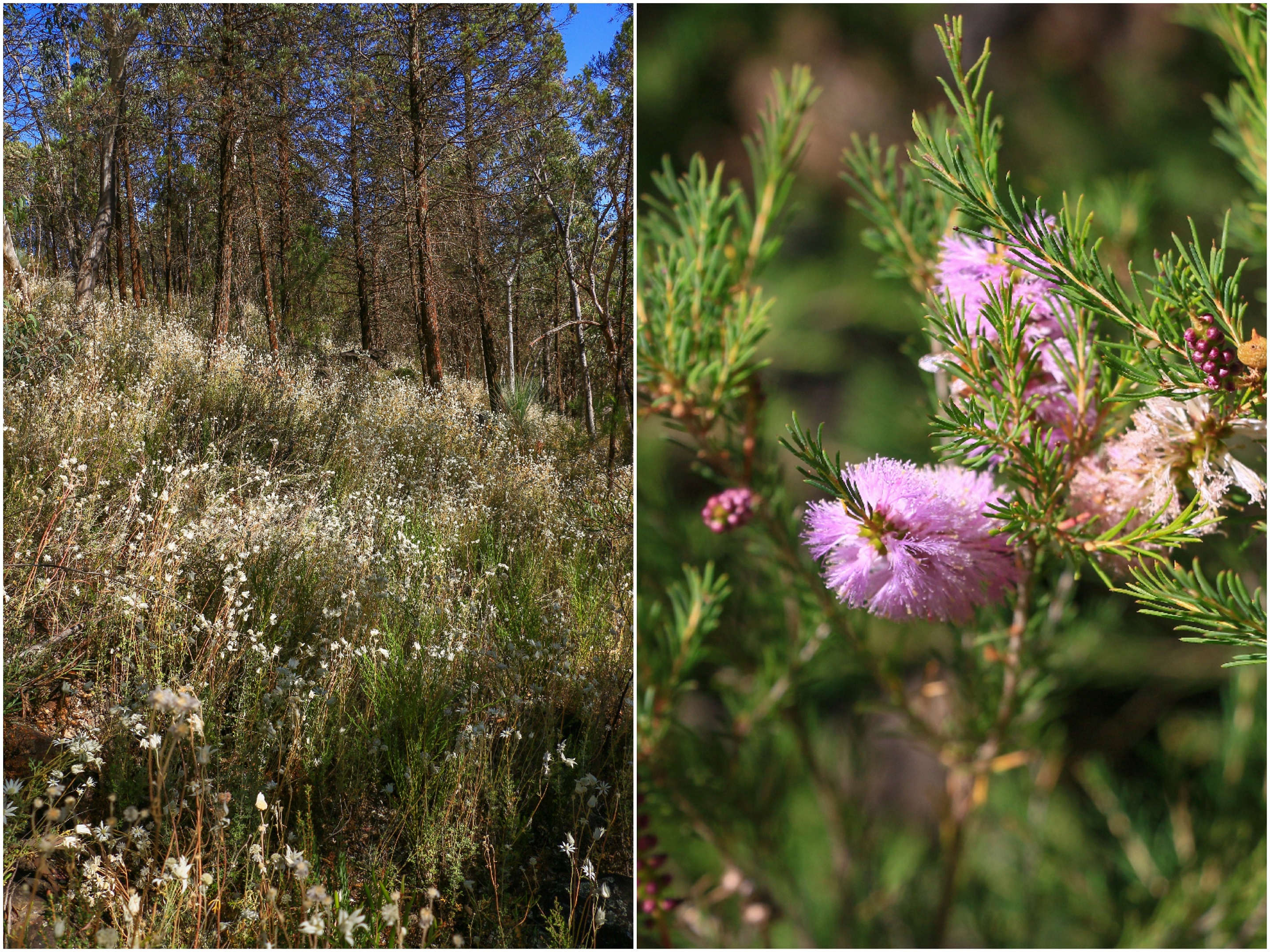
It is highly probable that both Norz and I were the only people walking the only tracks in the park that morning, the Wallaby linking up with the Ironbark. Beautiful swathes of flannel flower were a highlight but the other vegetation was tending towards the spiky and overgrown. Throw in a few spiderwebs for added spice and I was satisfied at my choice of long-legged activewear. Norz, on the other hand, had prioritised temperature control. The resultant encounters between nature and bare leg frequently provoking a soundtrack of short, sharp oohs and ows.

At least there was a lookout, and morning tea strawberries. The view a less dramatic and more modest interpretation of gorges visited in the past. Devoid of humans other than us two, it was a sensation to be replicated down in Cowra on a Sunday lunchtime.

I once had a nice pub lunch in Cowra but it must have been on a Saturday. Today, pub closed. Norz heard of a cute cafe that had recently started up, today closed. An ad hoc Aldi charcuterie or McAussie burger? Or the local chook shop on the main road, which appeared to at least be open? How can you look past chips on the side, with chicken salt.

In servos and chook shops and old fashioned bars with the cricket on in the background and average coffee and building heat and (admittedly overlooked) big things, it turns out this week in country NSW was fulfilling the quota of much that is regional, rural and remote. And when it came time to leave, I felt like I was only just getting used to there being nothing much going on at all. The journey back to Canberra heralded relative hustle and bustle and more trawling through the stairwells and cupboards of open homes. While the most open home of the lot, a home of warmth and friendship, was fading away in the rear view mirror. Until next time.

Australia Driving Food & Drink Green Bogey

A tale of two valleys

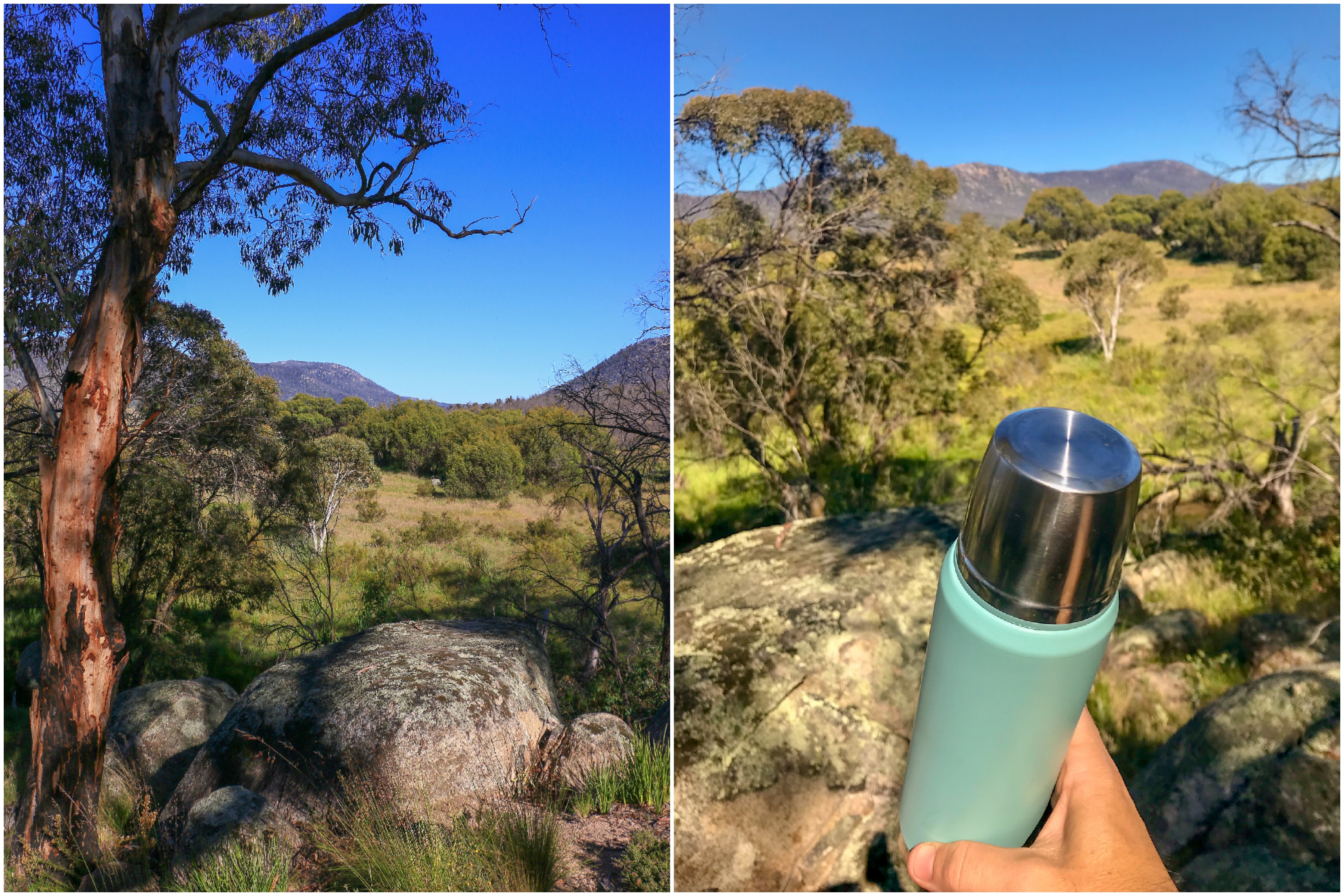
Well, I hope you had yourself a merry little Christmas. In a clear sign of ageing gracefully I was pleased to unpack a new, lightweight, bagless, cordless vacuum cleaner and a brand new thermos flask in pastel hues. I think part of the joy was in unpacking something rather than packing it up. Other festive highlights included a love-hate relationship with a ham (I’m so over you) and sitting in the dark in the middle of the day. I haven’t felt so hot since being in, um, England.

So it seems I’m at the point where vacuum cleaners are exciting, too much heat is wearisome and I find ample satisfaction in ambling around the NSW town of Tumut. It was noticeable how many times I was asked Why Tumut?, including from the Airbnb host making money from people actually staying in the town of Tumut. But it’s just nice. Cute and a little cosy, I could live here in something actually affordable. There is a decent café and a Woollies and an awful McDonalds all out of Caramilk McFlurries but most of all there is the river swishing fulsome through leafy parkland and cow-filled meadows.

The Tumut River joins the Murrumbidgee River which joins the Murray River, feeding gigalitres of water downstream during the La Niña spring. For once there is almost too much water, and too much Dorothea Mackellar, espoused by the usual suspects to justify this as normal. Even my pretty little Tumut is not immune.

Feeding into the Tumut River, the Goobarragandra shows signs of flood in its flattened banks and weedy debris. It’s been a lovely drive through luscious countryside to Thomas Boyd Campsite and a trailhead for the Hume and Hovell. I walk a little of the track, barely decipherable through tall, snake-infested grass. It’s okay but nothing to write poetry about.

I pause for coffee (in an old flask) and a Macadamia slice purchased from Gundagai bakery. And decide the best means to perk things up – and fulfil the clichés of middle age – is to hop on the bike.

Flat and sun-kissed, the going is joyous as the road nears the banks of the river, seemingly wilder and more dramatic than it was around the campground. Grassy plains yield to undulating meadows, the shadows from cotton wool clouds projecting onto higher, bush cloaked peaks.

All too soon the river meanders away from the road and those undulations kick in. I climb one and decide that will be enough. And dream of Christmas futures when I can unpack an e-bike.


Is another sign of getting old waking up with the kookaburras? I certainly have evidence to support this theory but then there are also those outliers. Or inliers, so to speak.

In truth the Christmas break has produced some relative lie ins, but this has been countered by a desire to get out early before the furnace is at full force. So there have been a few mornings where instead of sedately lying in bed listening to Radio National and sipping tea I have hopped and skipped out into the bush.

I entered Namadgi National Park around seven and was surprised to find a number of cars at the visitor centre. I suspect they had smartly set out for Mount Tennent while it was still cool and fresh. I wasn’t going to join them, instead heading further south to a rendezvous with a creek.

I do believe the Rendezvous Creek walk is one of the few marked trails in Namadgi I have never set foot on before. And with relatively low expectations (I find that can be the best approach here) I discovered utter delight. At first shady and fragrant, the trail opens out into a hills are alive style valley. The only sound being the rustle of grass in the breeze, the trickle of water, and the buzz of the great Australian blowfly.

Who needs touchscreens and Twitter and endless ham and Michael Buble schmaltz and David Warner tons and lightweight vacuum cleaners and Caramilk McFlurries when you can simply be blessed with the vastness of nature, the blueness of the sky and the buzz of a fly? But allow me one modern day indulgence. Make that two. A brand new pastel flask filled with tea and a Walkers shortbread mince pie. Well, it is Christmas after all.

Australia Driving Green Bogey Walking

Wales done us

Pretty much at the beginning of this UK22 odyssey I heard one of the blandest songs possible, warbled out by George Ezra on The One Show, spouting insipid lyrics about green grass and blue skies. A summertime money-spinner predictably pounced on by Heart and played every half hour. What young George didn’t take into account was the abundance of blue, blue skies which would naturally turn the green, green grass a tinge of yellow, yellow straw.

The UK is still a green place but I have found myself of late detecting a slight Australian essence: an earthy smell at the end of a hot, hot day, of golden grasses secreting some relief as the sun, sun sets. Waking with an expectation of wearing shorts. Drawing the curtains in the day. Frequent use of sunscreen. Wildfires on the TV news.

One area that might just retain the green, green grass of home longer than others is northwest Wales. And while warm sunshine continued as Caroline and I entered the principality on the second phase of our up over olde at heart road trip, this unseasonal weather was set to wane. Soak it up I say, pausing beside the waters at Tal-y-llyn on our way into the hills…

Woodlands, green views and the Co-op

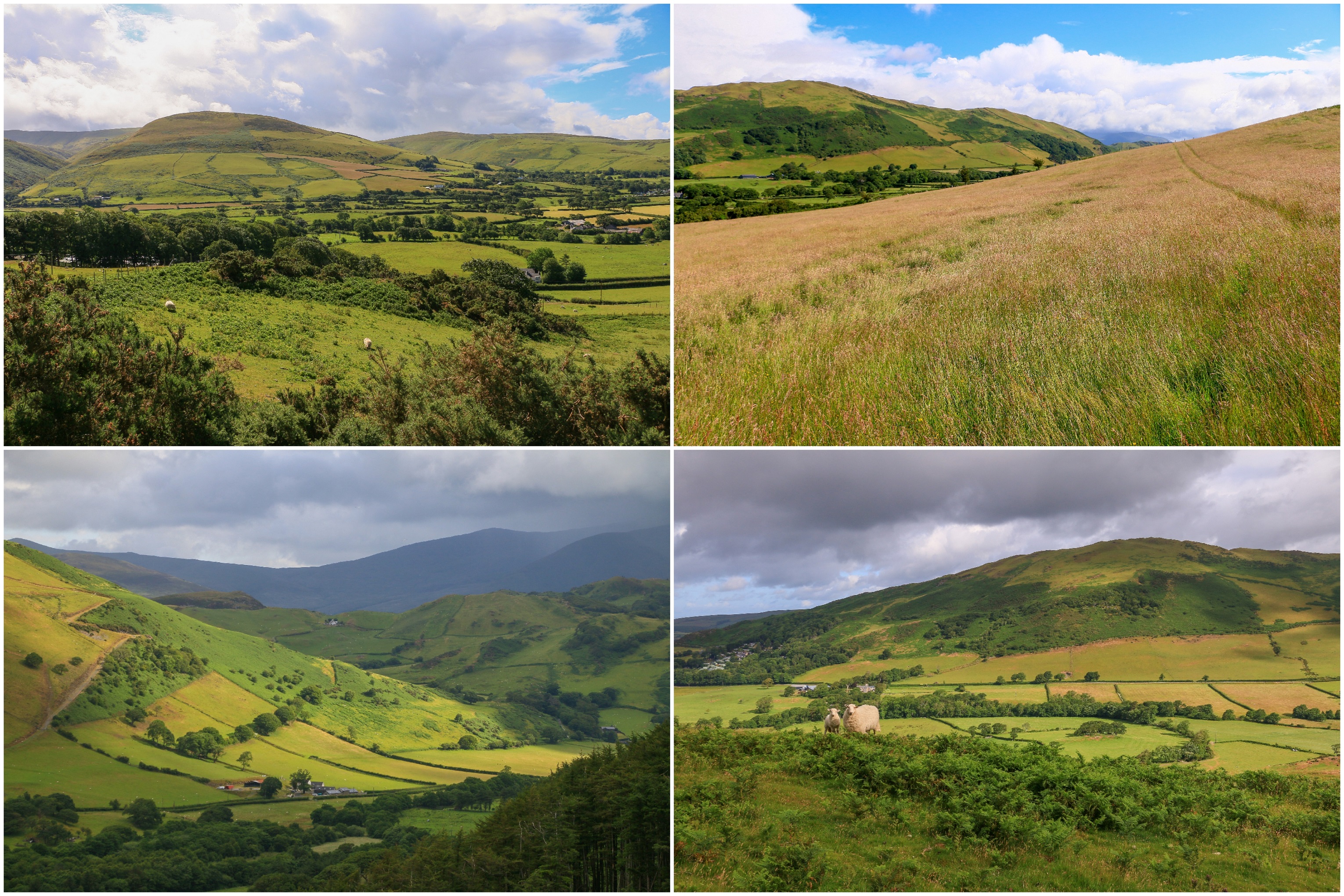
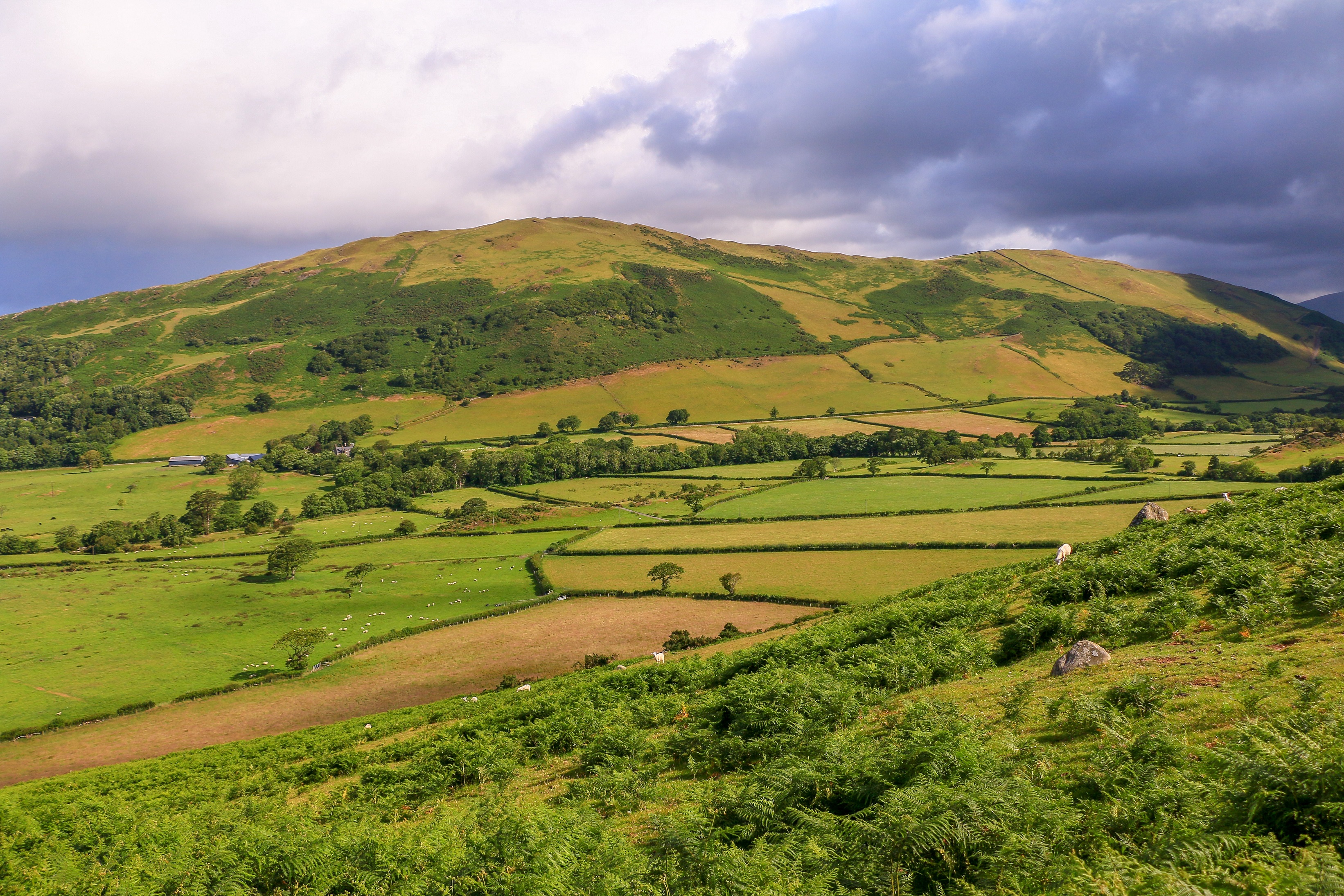
By handy coincidence, we were staying in Green View Chalet, perched loftily within the Woodlands Holiday Park. It was a neat, quiet little place with a distracting view. Pure Wales rolling down the hill and climbing up the other side, stone walls, sheep and all. With altitude comes a transition from temperate, lush valleys to unkempt, windy moors, topped with all sorts running wild.

Early on I took a short walk, encountering sheep galore and a minefield of droppings. Much the same happened on a longer circular walk that satisfied all the greater for taking place from the front door. The walk was a bit of a gamble in blustery conditions, cloudbursts evident both out to sea and further up towards the high mountain crags of Cader Idris. But I mostly stayed dry, treated instead to changing light and shadows, distant rainbows and soaring birds.

The closest town of note from here, sitting upon Cardigan Bay, is Tywyn. While devoid of vowels, it was handy for supplies, hosting a remarkably large Co-op and at least three Indian Restaurants where cash is king. Meanwhile, down on the seafront there was an old school feel to the air, conjuring a town tucked away in the nostalgia of childhood bucket and spade holidays. A town that is lost in time. A town where steam from the railways still rises into a disappointing monotone sky…

Tally ho Talyllyn

One of the very interesting things about North Wales is the multitude of heritage railway lines. You can imagine Portillo on constant loop here, stoking coals in blue dungarees or shoving a homemade Welsh Cake into his plummy mouth. While naturally providing tourist tucker, the network of vintage railways probably provides a more reliable service than the modern, expensive, strike-riven mainlines of Tory Britain, 2022.

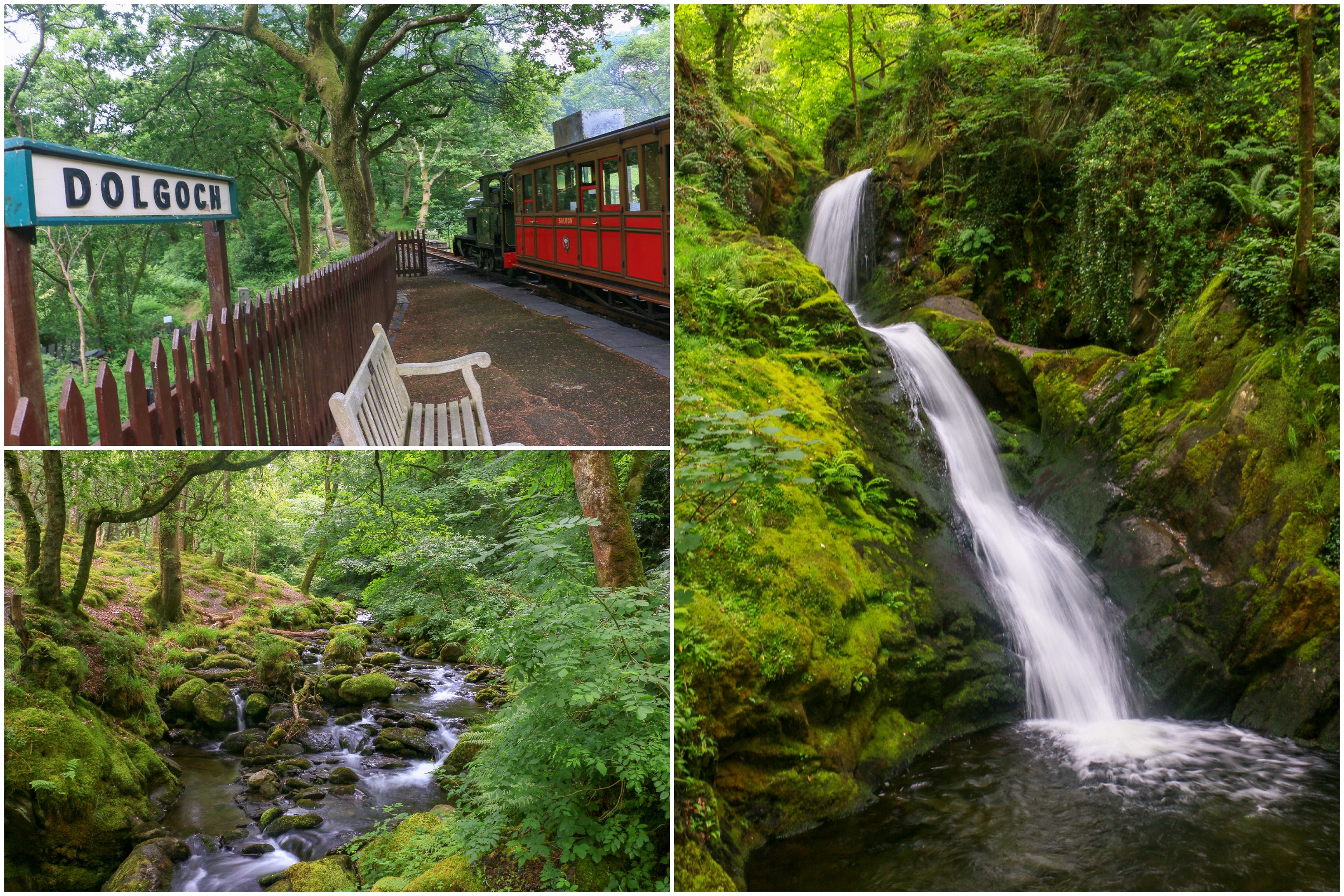
The Talyllyn Railway departs from Tywyn, heading up the valley to Abergynolwyn. The railway was constructed in 1863 and – like many others in this region – was used to transport slate from the hills to the sea. Today, the slate lingers on in trackside fence lines and in the specials boards of train station cafés.

It was a grey, patchy rain kind of day, a suitably slate-like sky greeting us at Tywyn Station. More alarmingly, a parade of schoolchildren appeared to be heading in the same direction, seemingly set to infest numerous wooden carriages on the 10:00 to Nant Gwernol. But a stroke of luck – either they were off to the museum or a tour of the Co-op, which would keep them occupied for some time.

Full steam ahead then to the first stop of the day at Dolgoch, via chalet-spotting views over to Woodlands. Disembarkation here was a controversial affair – just us and two others while everyone else on board wonders what the heck. The attraction are some falls, silky slivers of white enveloped among a peaceful forested gorge. And hopefully a tea shop.

A tea shop that looks like a council house and looks very closed. It’s drizzling and sometimes more than drizzling and the next train is an hour away. What to do with an hour in Dolgoch? Check out the historic slate fence and wait for a train coming the other way and be entertained by the nesting sparrow chicks in the waiting area and the returning couple living life in imperfect harmony.

And then full steam ahead again, the arrival of the train a moment of great fanfare when a quiet forest glade transforms into a hissing, steaming pocket of noise and fury. The sparrows hide, the wayward tourists board, the drivers stoke coals and in one final giant puff of steam toot-toot we’re away.

The journey seems more attractive as we progress up the valley, partly because the sun briefly comes out, trees parting to reveal a patchwork of fields inching upwards into the exposed bracken and gorse of steeply rising hills. Here and there the odd farmhouse, the odd car, the odd siding decorated with purple foxglove. Briefly summer again before more rain sets in.

Turning around in a downpour, the train heads back with a layover of thirty minutes at Abergynolwyn. A period of time insufficient to do little else than converge en masse upon the station café. As if it was designed that way.

At first, there is panic as everyone wonders whether they can get served, eat, and do the toilet in time. But the café operates smoothly and efficiently. As if they do it every day. I get my bacon sandwich, Caroline gets her jacket potato and the two old-timers sharing our table get their crisps, partly funded by a 60p increase in their pension, so I am informed.

It is unlikely they have money left over for that delicious looking cake. But perhaps some shortbread. A tasty treat that is balm to my coffee and lingers long in the memory, longer than it felt to head back to the future in Tywyn. Or 1980 at least.

Aberdyfi-dovey

Though hardly light years ahead, I think it’s fair to say the town of Aberdyfi is a notch above Tywyn in the seaside locations of upper mid-Wales stakes. Slightly more genteel, slightly more attractive, slightly more touristy, even the jellyfish seem to prefer it here.

We stopped at Aberdyfi a couple of times. The first a grey affair that still warranted ice cream, the second of sunnier disposition that still warranted ice cream. Any visit to Aberdyfi would warrant ice cream, simply because the Aberdyfi Ice Cream Company produces some top-notch stuff. The fruits of all that green, green grass.

The other highlight of Aberdyfi (and certainly up there in terms of the whole trip) was pizza on the beach. Sure, it was probably 14C and a tad blustery, but after a long day and the threat of frequent showers, we were rewarded with a touch of tranquility, golden light and golden sands bathing a stone-baked feast. Close your eyes, wrap yourself up and pretend you’re in Bondi. With an ice cream on top.

Shut your Barmouth

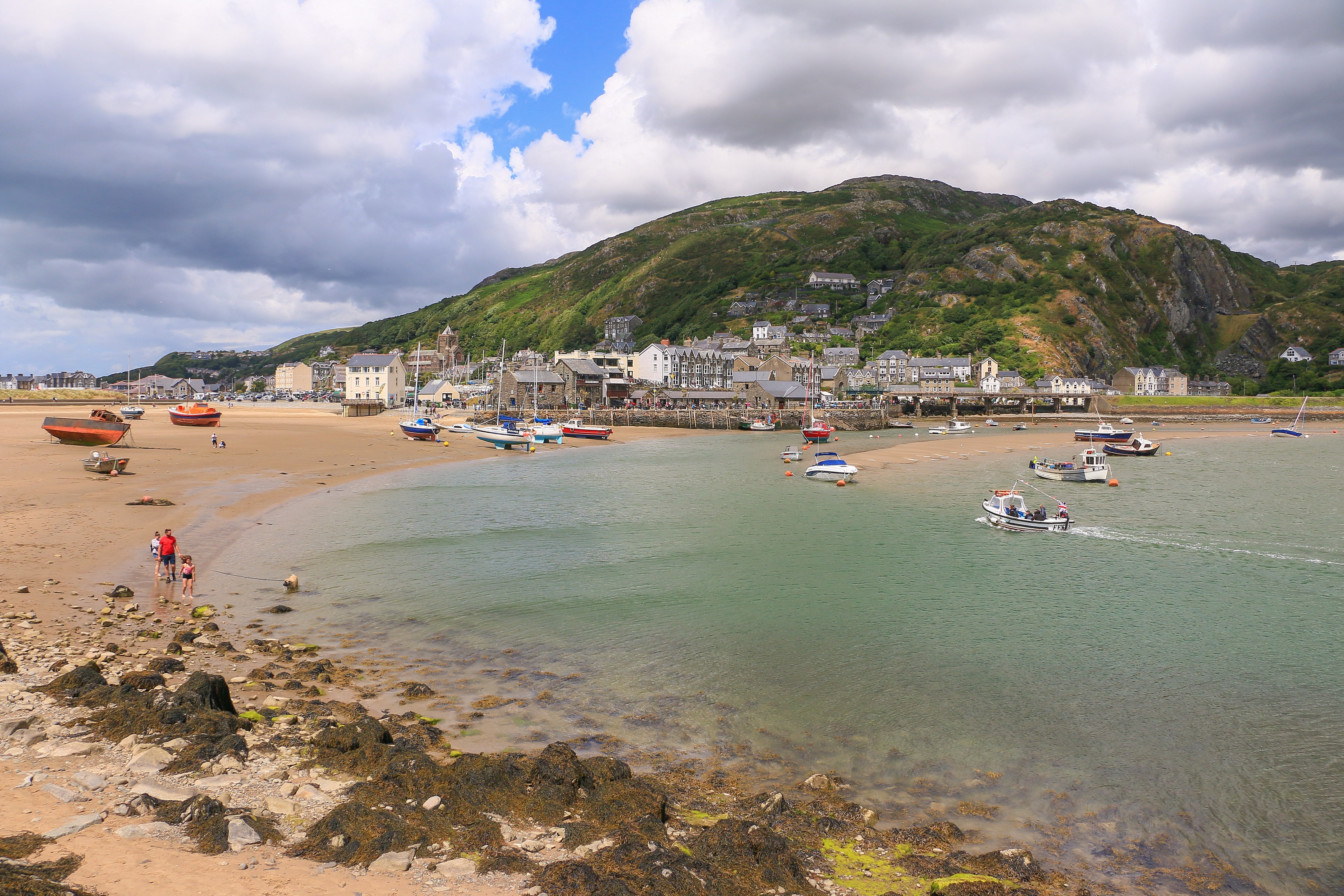
In the other direction from Tywyn the road becomes a rugged affair, hugging the coastline on one side and winding below calamitous slopes on the other. The sea eventually forces its way inland at Barmouth, the wide estuary of Afon Mawddach forcing its way around tidal flats into the heart of Snowdonia. It is all rather impressive and grand.

It is a landscape that proves difficult to tame, the road resigned to following the Mawwdach for many miles on either side before it can even attempt to cross. But fortunately for us and for Michael Portillo there is a long rail bridge spanning the estuary. A considerable engineering feat that sits perfectly within a breathtaking landscape of shifting sands and looming mountains.

While lacking steam and turn-of-the-century attire, the train ride would no doubt prove an interesting affair. Today the trains are on strike but thankfully the bridge includes a pedestrian and cycle-friendly thoroughfare. A suggested voluntary toll of two pounds to cross would be worth it if it didn’t convey the air of dodgy scam.

Still, Barmouth was far from a freebie with lunch and afternoon tea at the same place; seemingly the only place that had a small garden and didn’t offer an array of fast food and sticks of rock served up with seagull terror. While possessing an attractive harbour and ample sands, the approach to Barmouth proves more compelling than the town itself, where West Midland accents are as commonplace as vape shops and amusement arcades. I begin to tire of Barmouth, perked up by the prospect that the exit is the very best part. Majestic in fact.

Prisoners

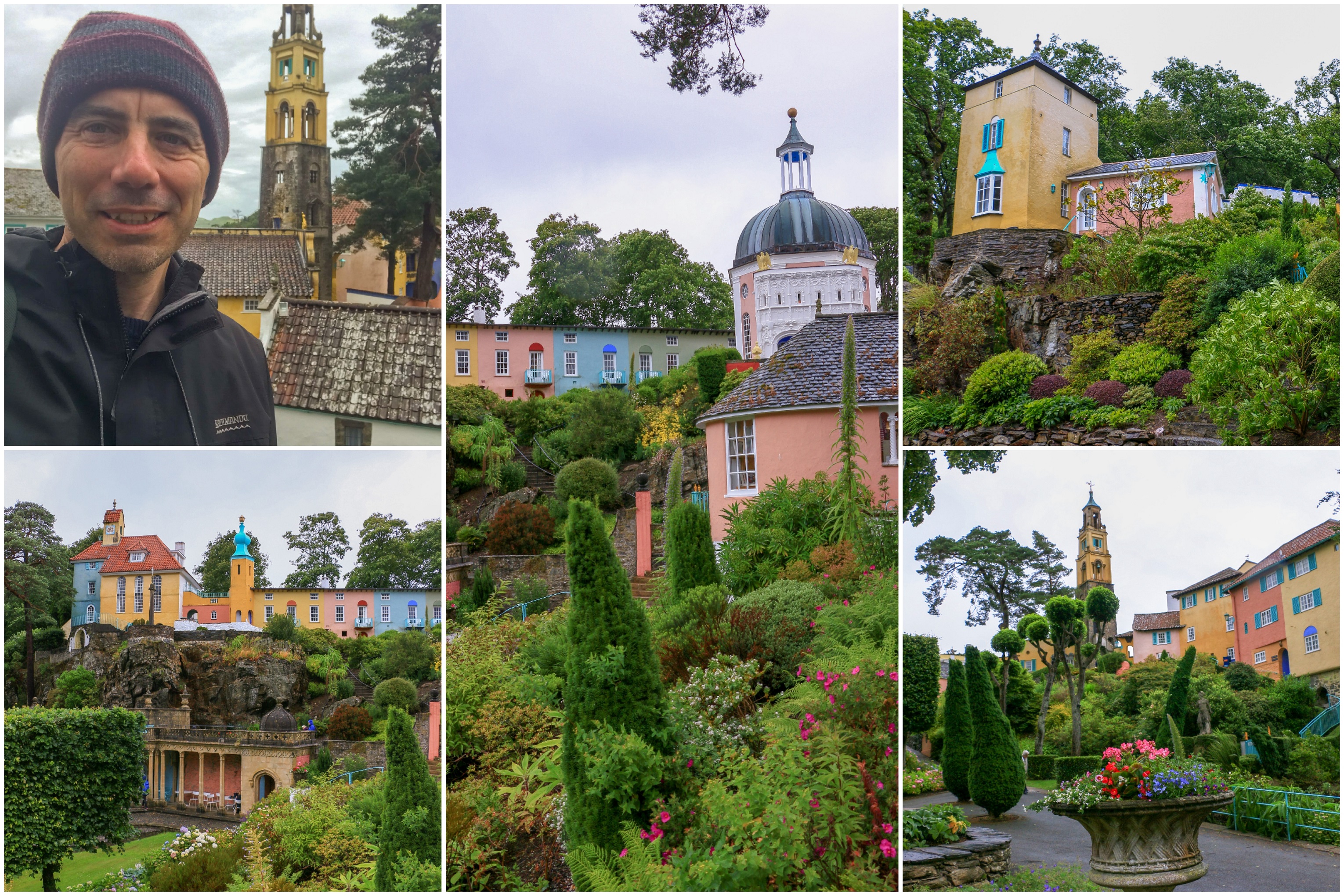
And so we reach our last day in Wales and what a way to end. Heavy rain, gusty winds, cloaked in four layers and topped with the beanie I wasn’t sure about packing. Feels like something is in the air.

Driving north it certainly wasn’t a very Italian Riviera feeling day; more hot drink in a cosy cafe in a grey slate town like Dolgellau vibes. Still, we push on through a downpour, sit in traffic and park up to be greeted by only the slightest drizzle and possibly one of the most startling sights in Wales: Portmeirion.

How to describe Portmeirion? A vaguely Italianate village near the French border acting as a film set in the guise of a theme park pretending it is not in North Wales. A perverse colourful curiosity that is equally weird and enchanting at the same time. Possibly qualifying as a bit quirky. And naturally a beacon for all those COVID-confined celebrities yearning to make travel television somewhere, anywhere.

With all that publicity you would expect the place to be heaving, but the rain today actually has a benefit in keeping the crowds at bay. This means at times we seem to have a Mediterranean square to ourselves, a quiet Tuscan alcove to explore alone, pastel views unimpeded by fluoro kagools and monotone brollies. And thankfully most of the bad weather bypasses Portmeirion, the heaviest of showers conveniently coinciding with a car picnic.

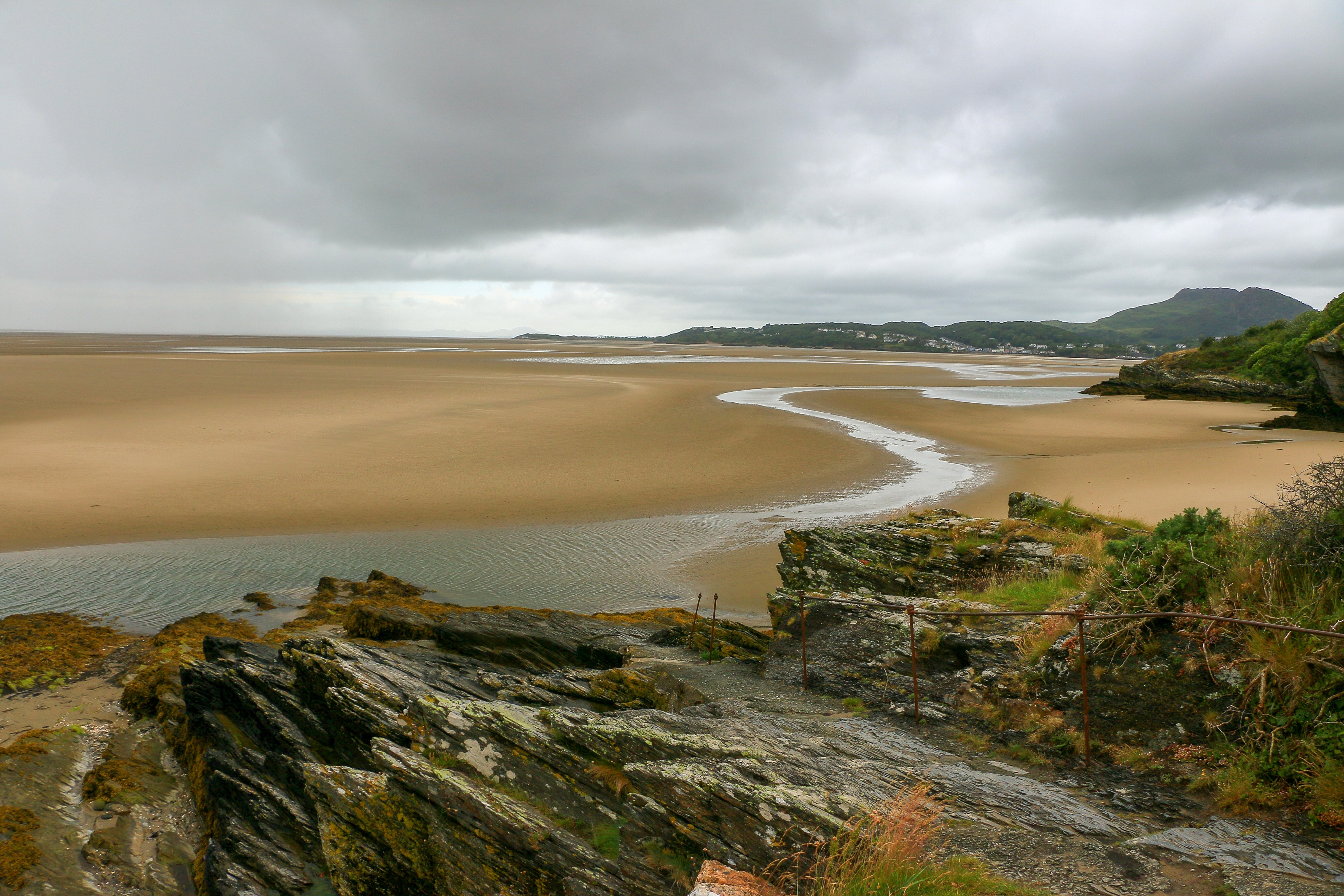
I’m not sure how the plants feel about this weather. Some, I suspect, are struggling a bit like us. Nonetheless, the grounds at Portmeirion are a delight, boasting exotic species from around the globe, hidden pagodas and ornamental ponds. And from loftier heights there are snatched views of downtown and out across the estuary towards Porthmadog. Loftier heights that prove occasionally breathtaking as the rain marches forth.

Farewales…

The morning after dawned bright and fresh at Green View, features of the landscape cleansed like sparkling champagne flutes straight out of the dishwasher. The view, how you are drawn to that view. Those wild, undulating hills, plunging into a rich patchwork of fields. Lone cottages and barns and the perfectly imperfect lines of hedgerow and dry stone wall. Copses of broadleaf woodland sprout up while clusters of white dots decorate the grass. And a little after 10:00, slicing through it all is the toot and steam of a choo-choo train inching ever up the valley.

And there we are, yet another corner of this incredibly ample little country successfully navigated with much enjoyment, comfort and companionship over the past few days. Nothing could go wrong. Wales done us.

Driving Food & Drink Great Britain Green Bogey Photography Walking

The golden days

Is anyone else fed up of living in ‘interesting times’? If there wasn’t the death of a rock icon followed by the self-harm of isolationism followed by the election of a rabble-rousing orange manbaby preceding the onset of catastrophic bushfires coming just before the spread of a deadly virus leading into wild lockdown parties before another calamitous war broke out would things really have been that boring? It’s no wonder many people my age seem to hanker back to the 1990s, when the biggest deal was Jennifer Aniston’s hairdo.

If you are seeking uninteresting times, you could look no further than a long drive from Canberra to Coonamble and back, especially if this takes you through Dubbo. Admittedly that would make for some pretty uninspiring content, but there is comfort and reassurance to be had in the boring. I just don’t know how I will stay awake though, and it’s probably the same for you, dear reader, as well. So, in an effort to entertain all round, I contrived to make the journey into one big loop, extending the kilometres but exposing myself to some new tarmac – and dirt – along the way.

The first of the new ground was along blacktop through rugged Karst country, taking me from Abercrombie Caves down into the fertile plains around Bathurst. I could have detoured around Mount Panorama the right way while I was here, but time was pushing on and I was getting low on fuel. Stopping at a nearby servo offering the cheapest E10 for miles around, I became the proud owner of the most expensive tank of petrol I have ever bought. Until next week.

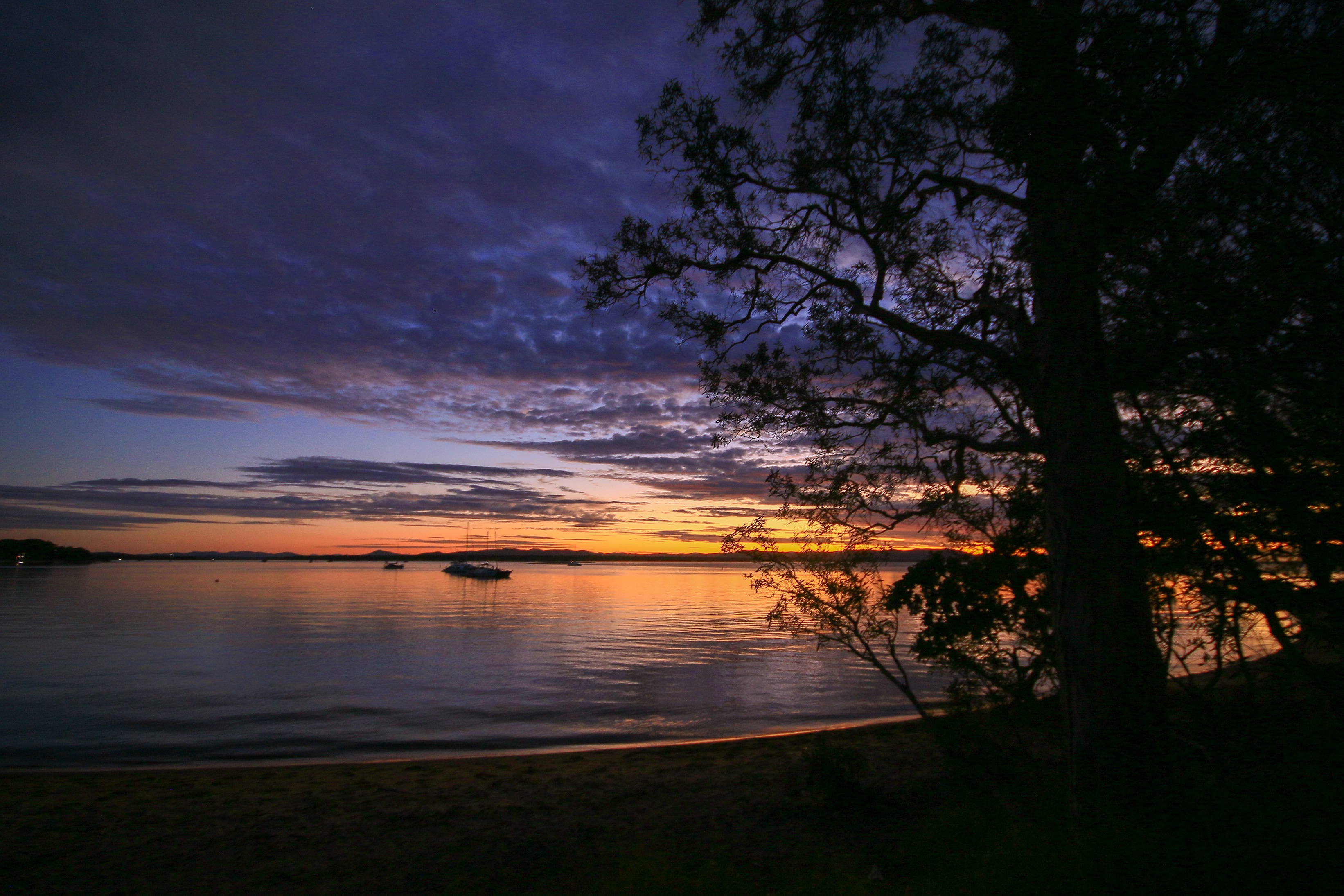
As the last glowing oranges and indigo hues of sky gave way to a starry night, I settled down for the evening in Sofala. By settling down I mean parking my car in a free camping area next to the Turon River, eating salad and cold pizza in the front seat, before clambering into the back and onto an air mattress. For a night of sweet cheesy dreams, eventually.

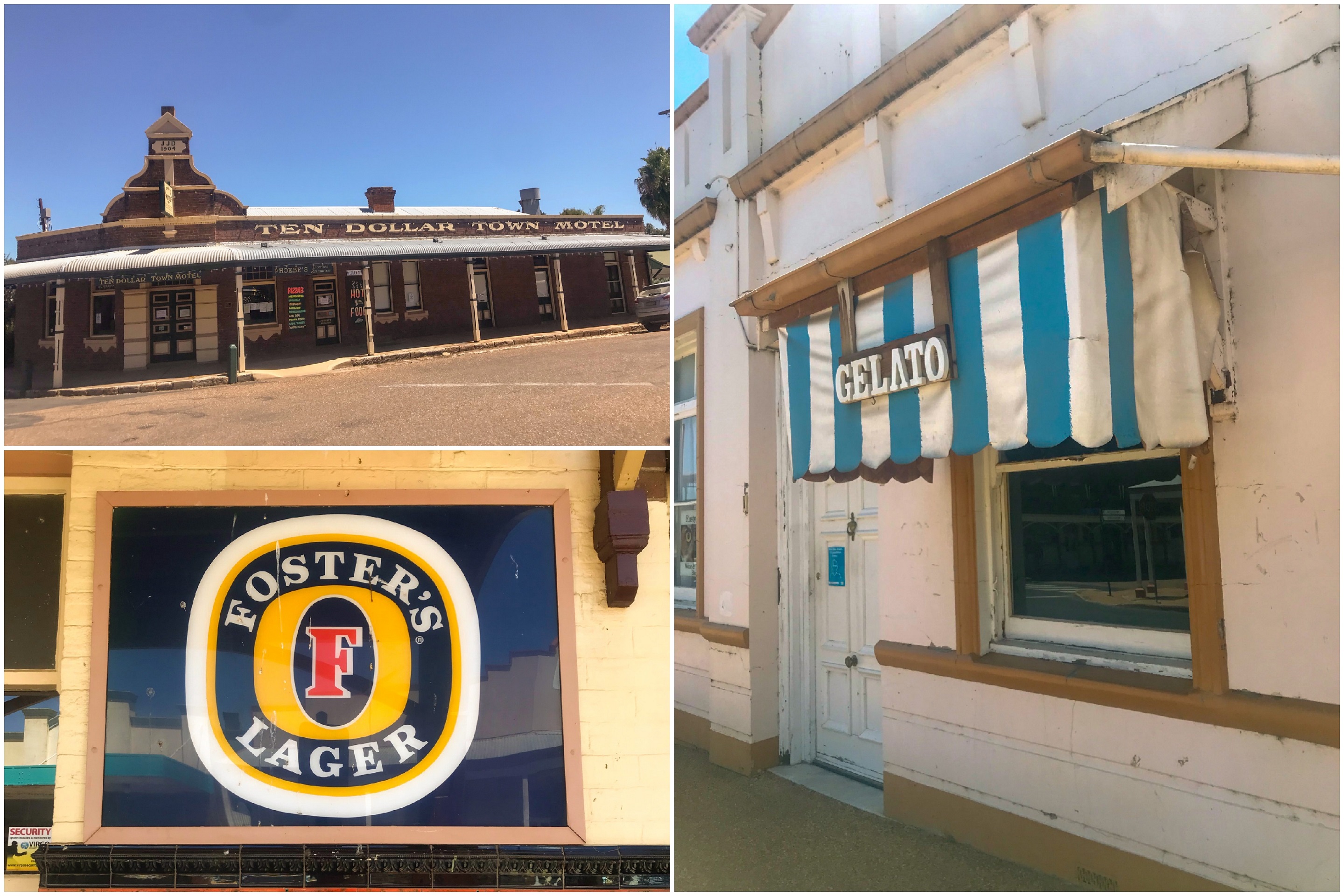
Sofala is one of those tiny places whose glory days have long passed. The glory days being – like many of the settlements in this region – the discovery of rich deposits of gold. Information boards display grainy black and white images and describe a bustling town featuring stage coaches and banks and theatres and, naturally, several raucous hostelries. Today, the high street is a sedate affair offering understated charm and just the one, currently lifeless pub.

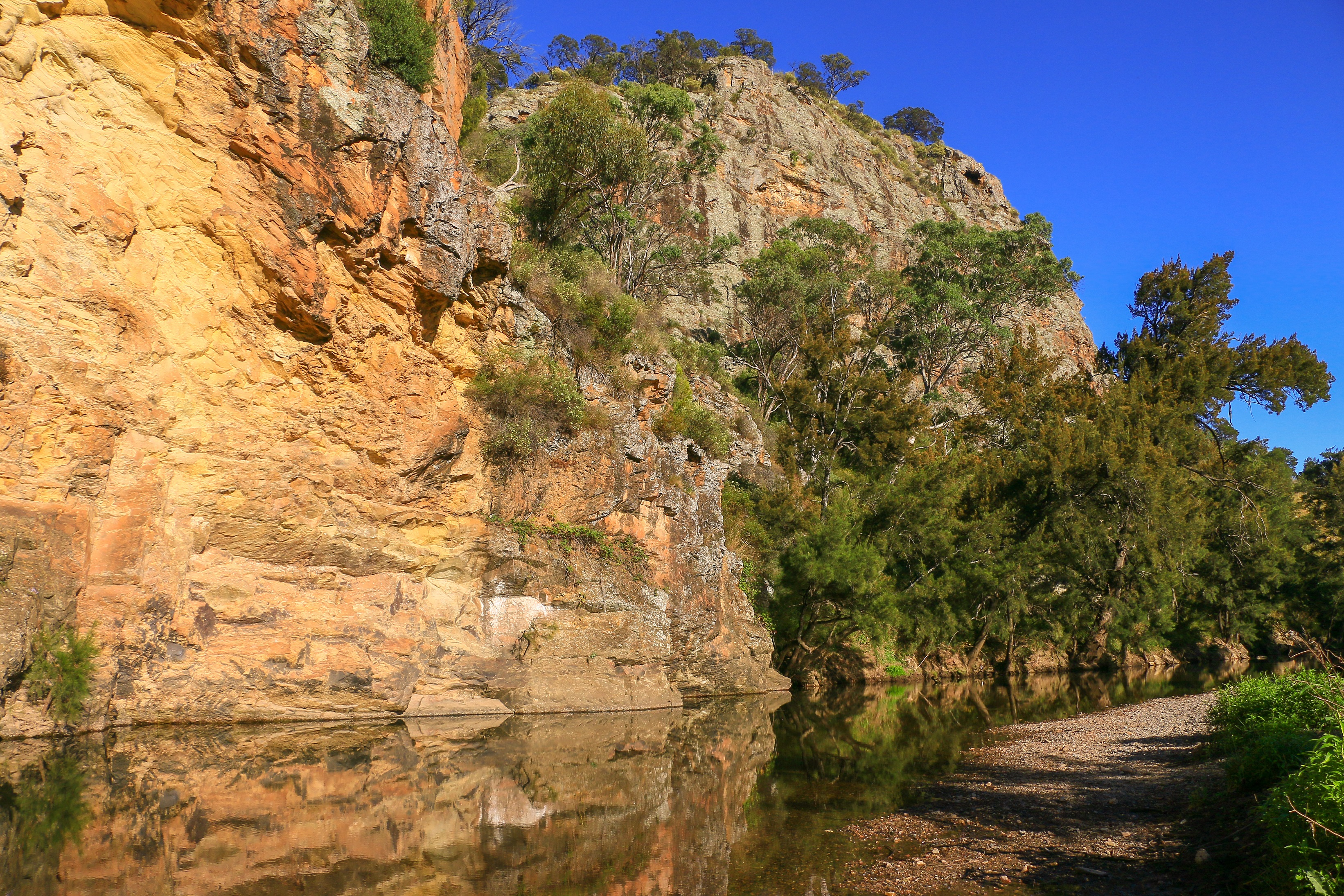
It turns out there is gold remaining just out of town, or at least the same glow emanating alongside the river. Water has scoured a course deep into the earth, leaving precipitous cliffs towering high above the mirrorlike pools of the Turon. Known locally as Wallaby Rocks (as indicated by a small, hand painted sign), this came as a total surprise, an interesting feature of an interesting drive that you wouldn’t have known about without passing this way.

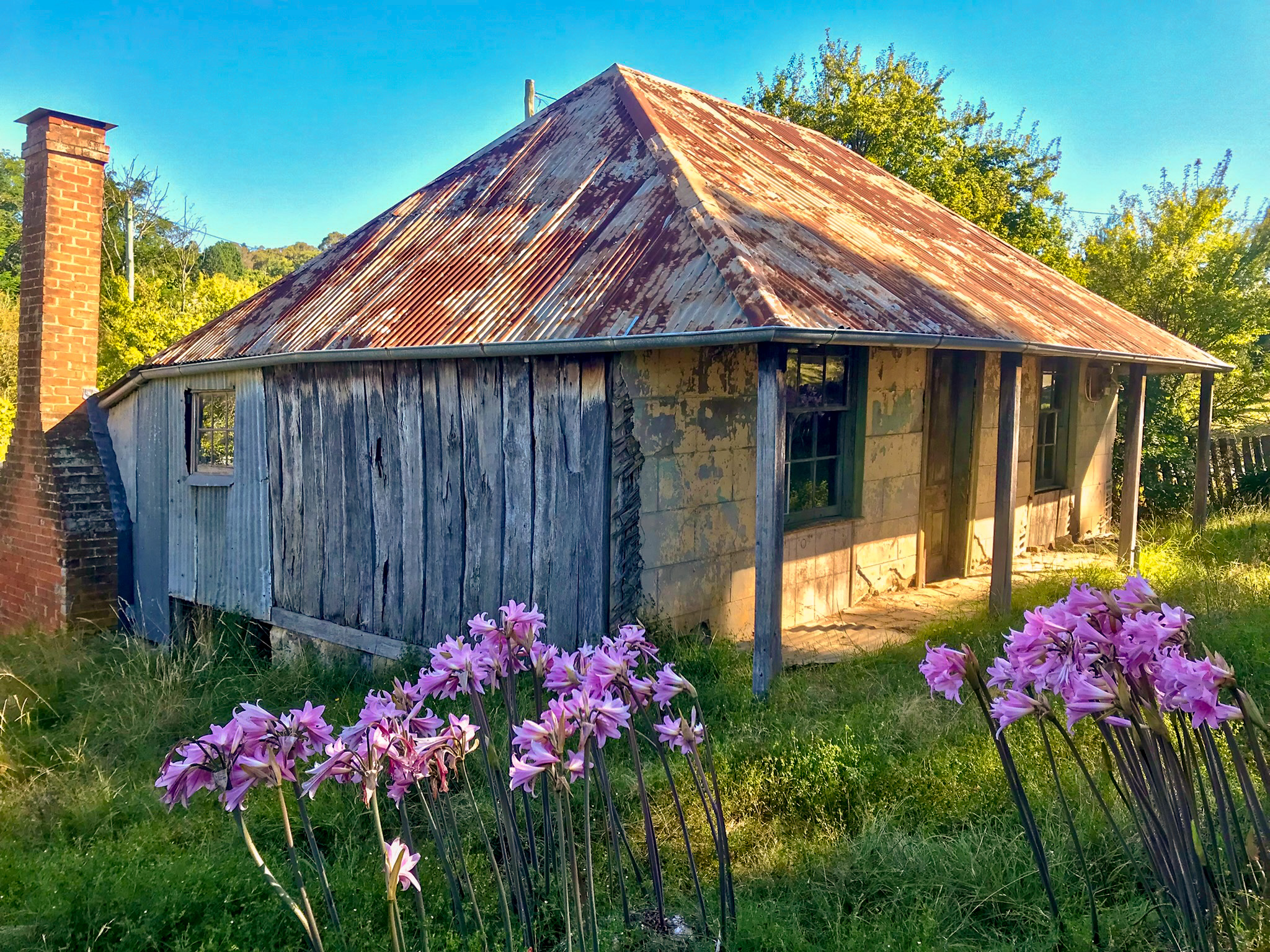
I was heading up towards Hill End, another settlement grown rich on the sunlight shimmer of minerals. Today it is preserved by NSW National Parks as a historic site, a village of the past functioning in the present. And so there is an old pub that still operates as a pub, a general store that still operates as a general store, and a scattering of private residences with owners doing the usual mowing and chook-feeding and sitting on creaky wooden verandas. I expected a more bustling affair here, but on a Friday morning it felt like I was the only visitor, a conspicuous sight wandering the streets and peering into people’s gardens.

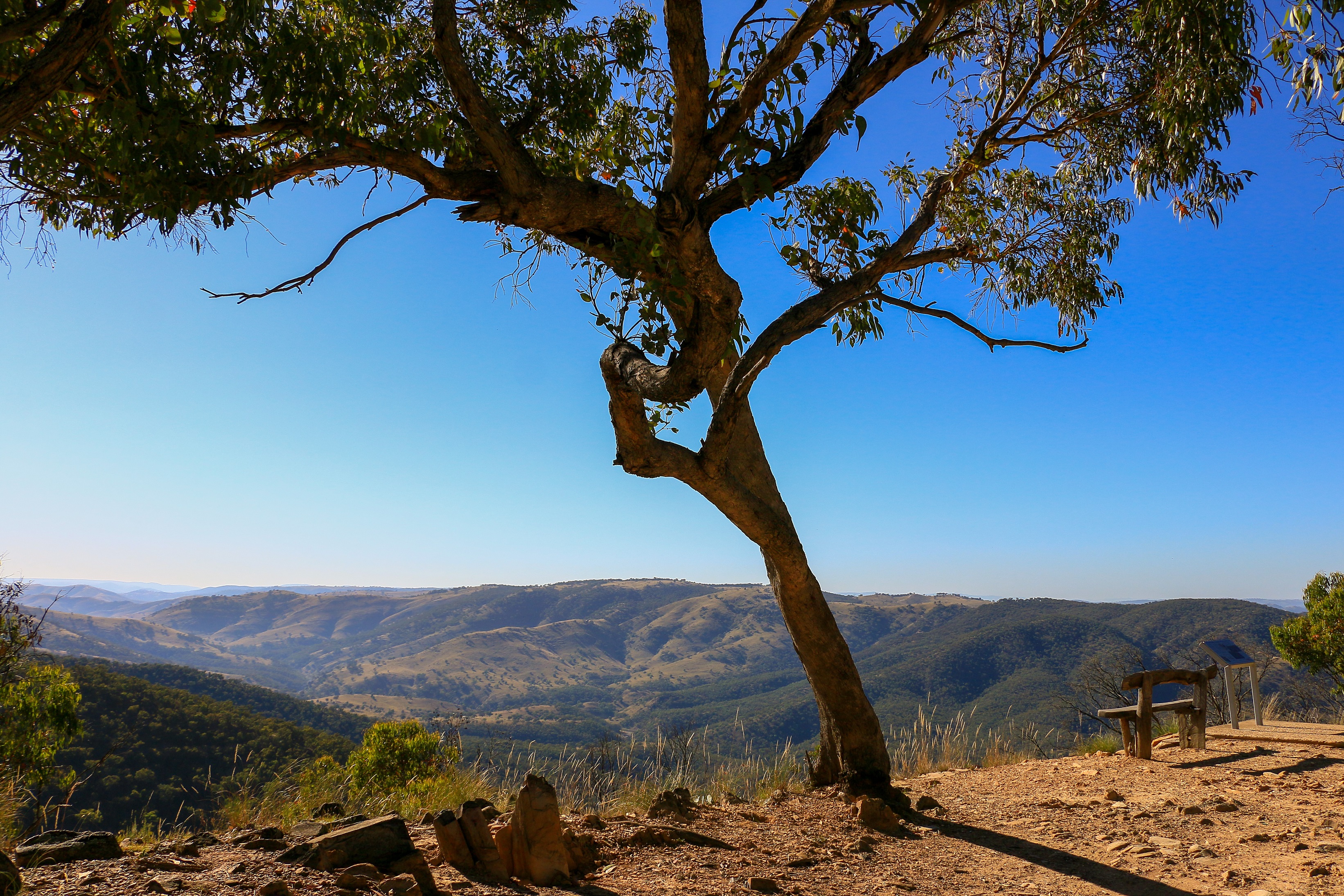
If nothing else, the village is aptly named, clustering at the end of a long plateau above the deep valley of that Turon River. This results in the promise of three separate lookouts and though not quite of a scale of – say – the Blue Mountains or Kosciuszko, they offered fine views of the golden, rolling countryside. Vistas that were, I suppose, somewhat interesting.

From Hill End I took a lengthy, winding road down towards Mudgee. This would be one of the more interesting towns along the route but cognisant of making progress north and noting the fact that I had stayed there before, I eschewed the town centre and made for lunch in Gulgong instead. The lunch would not be as fancy or as overpriced, but it was satisfying enough on a shady bench in a town that appeared to be rooted in the 1950s. Or maybe 80s. Golden times, whenever they were.

With every kilometre the level of interest along the road peters out, the landscape flattening and becoming dominated by grain. A painted silo at Dunedoo testifies to its abundance alongside the effort of these towns to generate some form of tourism through silo art. Further along at Mendooran there isn’t even a silo to justify stopping, but I stop anyway, grabbing a country coffee and slice of carrot cake to appease the bitterness of the coffee.

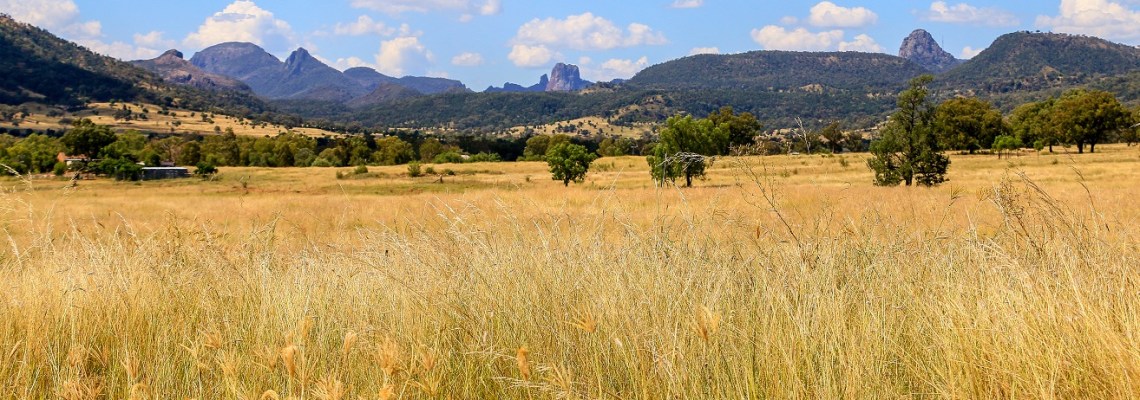
It is perhaps the plainness of these plains, today frazzled hot and windy, that makes the volcanic pinnacles and rugged chasms of Warrumbungle National Park all the more interesting. More than interesting in fact. Spectacular. I’ve said it before and I’ll say it again, I love this place and its very magnetism makes it impossible to drive on by. The view from Tooraweenah beseeches: come hither.

I should be making for dinner in Coonamble but cannot quite turn left. Sure it is thirty-five degrees, but the midday sun is well and truly a thing of the past and the return of trees to the landscape should offer some shade. Besides, I need to do something more interesting today, something other than largely sitting on my arse as Australia passes by. Climbing more than a thousands steps to Fans Horizon and marvelling in a conglomeration of sweat and awe at an incredible landscape is pretty interesting.

Prior experience of Warrumbungle National Park alerted me to the presence of showers in the campground, something I was thankful to use before completing the final leg to Coonamble. Last time I came here, the town had quite the aroma courtesy of the mouse plague. I didn’t want to be the one bringing that reminder to its townsfolk today. And be turned away for dinner.

And what a dinner, as always. The interest here is less Coonamble but more friendship and warmth and good food and loud voices and love. From twilight walks along the flat roads with my dear friend Norz, to tales of sand-blown motorbike adventures and potential pizza toppings with Howard. And then there is the joyous company of a two year old, one minute impelling me to drag race him in a plastic toy car, the next inventing the new sport of whisk tennis.

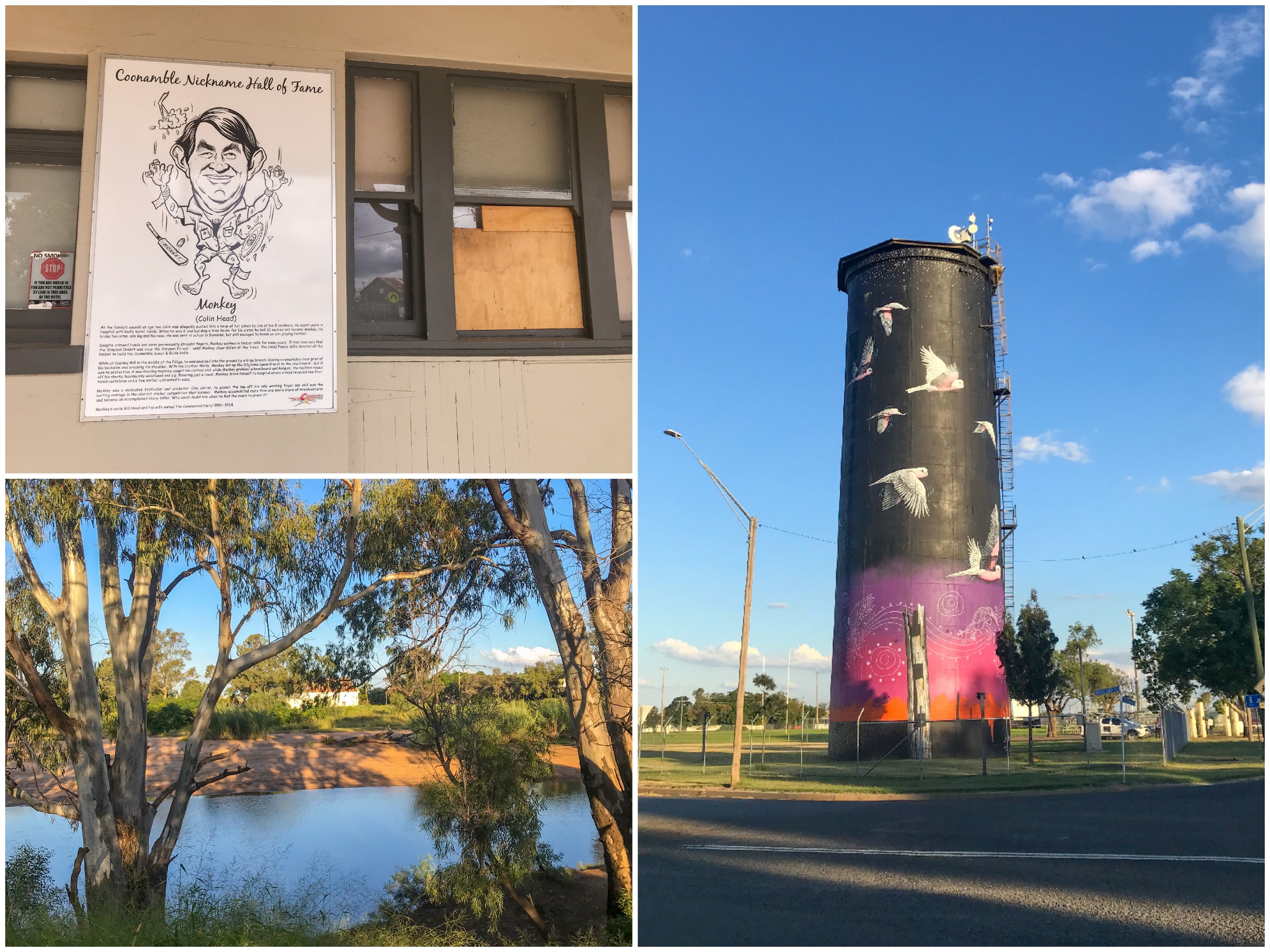
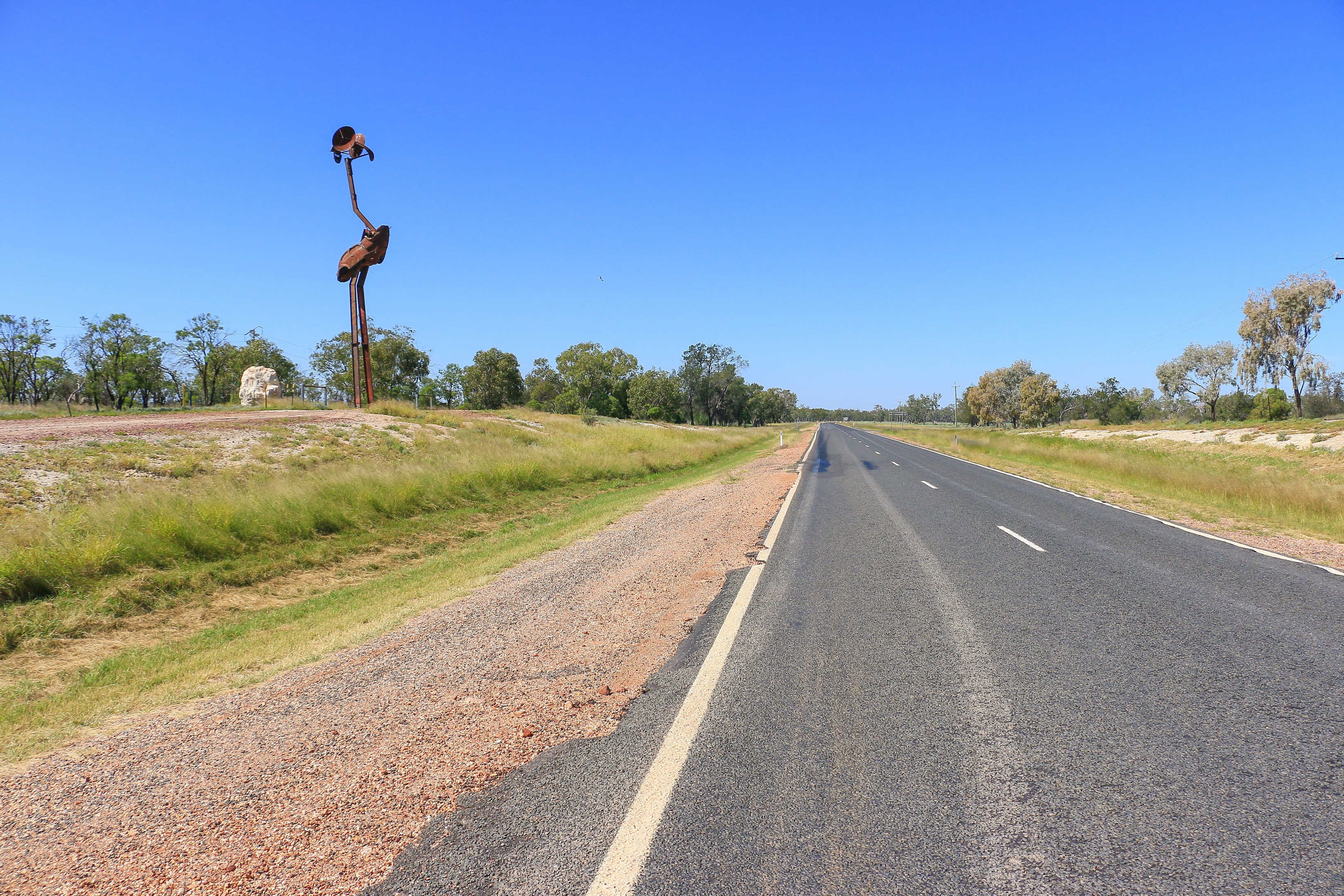
There are some mildly interesting things in Coonamble, including a painted silo, the nickname hall of fame, and the languid brown ribbon of the Castlereagh River. This time I discovered the weir, some new metal emus (competing with the Galahs of Gulargambone), an impromptu water park at the pub, and consumption of a different slice at the only café open on a Sunday. It’s not much, but it doesn’t matter.

There were some surprises remaining out of town, most notably the splendid Sculptures in the Scrub. Tucked away in The Pilliga, the setting was unexpected: a fine, forested gorge whose escarpment is punctuated by artistic installations of meaning and connection. I always thought of The Pilliga as one big flat sandy forest, a landscape of monotony that would imperil any who should veer off its dirt roads. Here, you can feel things which are rich and timeless.
Just a stone’s throw away is Pilliga Pottery, but only if you’re a crow or galah. The generous rains of this summer meant the fording of a creek was out of the question, with further unknowns awaiting beyond. So, an hour and a half later, on mostly sealed road via Baradine and Coonabarabran, we were finally feasting on pizza and drinking out of earthenware cups. Another little enclave hidden in the woods, perfect to bunker down from the world.

Interestingly enough, in many ways the world was also here. The terracotta and tiled roofs and earthen walls evoked a late lunch in Spain, pre-siesta. The scattering of outbuildings and cars and rusted trinkets could be backwoods America. And then, as well as pizza on the menu, there was Bratwurst and Sauerkraut to be enjoyed. The reason became clear hearing staff converse in German, a multigenerational family thriving in The Pilliga. A veritable United Nations, without the veto power of a deluded kleptocracy.

And so, we return to those interesting times. Via Warren and Trangie and Forbes and Cowra and Murrumbateman and Moscow. With more time, Warren warrants greater exploration, particularly among the fringes of the reinvigorated Macquarie Marshes. Back in big sky grain country, Trangie may warrant a return purely for cake. I paused in Forbes for a late lunch, one of the last remaining towns of the Central West that I had yet to visit. This too had charm, elegant municipal buildings rising up among a town centre boasting a fifties Cadillac drive-in vibe. Elvis does live just up the road after all.

From Cowra the road is more familiar and home is on the horizon. Interest fades and thoughts turn from the rear-view mirror to what lays ahead. Hopefully avoiding the Highway to Hell.

Australia Driving Food & Drink Green Bogey Photography Walking

New territories

Well, this hot vaxxed summer thing ain’t exactly going to plan is it. More like a tepid damp squib. I suppose it’s all that hope and promise unfulfilled which jars the most. There were supposed to be unlimited hugs and nonstop parties, the kinds of things almost all of us have gone without for two years. Instead we get to spend the summer cooped up with Uncle Omi enduring The Ashes.

If Christmas were a Christmas present it would have been the kind of one you tactfully accept and immediately place on the regift pile, hoping that the next one finally brings you that shiny bike you’ve had your eye on. In the end I did well for Christmas gifts, mainly because I embraced that newfound mantra of individual responsibility and thought f**k it. New belt, new shoes, new car. If only I could get some new rapid antigen tests.

So the belt, I mean car. Ford Territory. 2009. Immaculate. Judging by its condition it may well actually have been in the care of one careful lady owner. It’s still in the state where I feel guilty about loading it with a bike and treading in half of Red Hill in the footwell. Today I ate a muffin with the utmost caution, catching and recycling crumbs off my lap. I bet no-one has even thought about the prospect of sleeping in it.

As test drives go, the journey from Canberra to Tumbarumba via Gundagai is quite the examination. Though to tell the truth, everything was so smooth and cruisy I was feeling very sedate by the time I reached Murrumbateman and picked up a coffee. And muffin.

At Coolac, a few random beeps enlivened events. I still have no idea what they were all about but my best guess is speed cameras. Such are the joys of discovery, frequently embodied in the age-old use of windscreen wipers to indicate.

Turning off the Hume Highway, the first encounter with dirt came on a short stretch down to Adelong Falls Gold Mill Ruins. It was nice to reach the parking area without every bump in the road flowing through my hands and arms and shoulders and back. The only alarm was the slight residue of dust on the shiny white exterior, again besmirching its untainted soul.

The falls were busy, but this was a warm Saturday and it soon became clear there were plenty of swimming holes and replenishing rapids along the river. I’m not quite sure where all these people came from given the size of Adelong itself; I guess passing through, touring, going on extended test drives and the like. Still, it was a nice spot to pause and amble and eat a sandwich from my fridge plugged into one of three power outlets available.

Through Batlow and Tumbarumba I was reminded of Saturday afternoons in small town Australia, where small towns become even smaller. Barely an IGA and a sleepy pub open to distract from the nothing much going on at all. It feels all very siesta like, as lackadaisical as the large Australian flag hanging limply in the front yard of a wooden cottage.

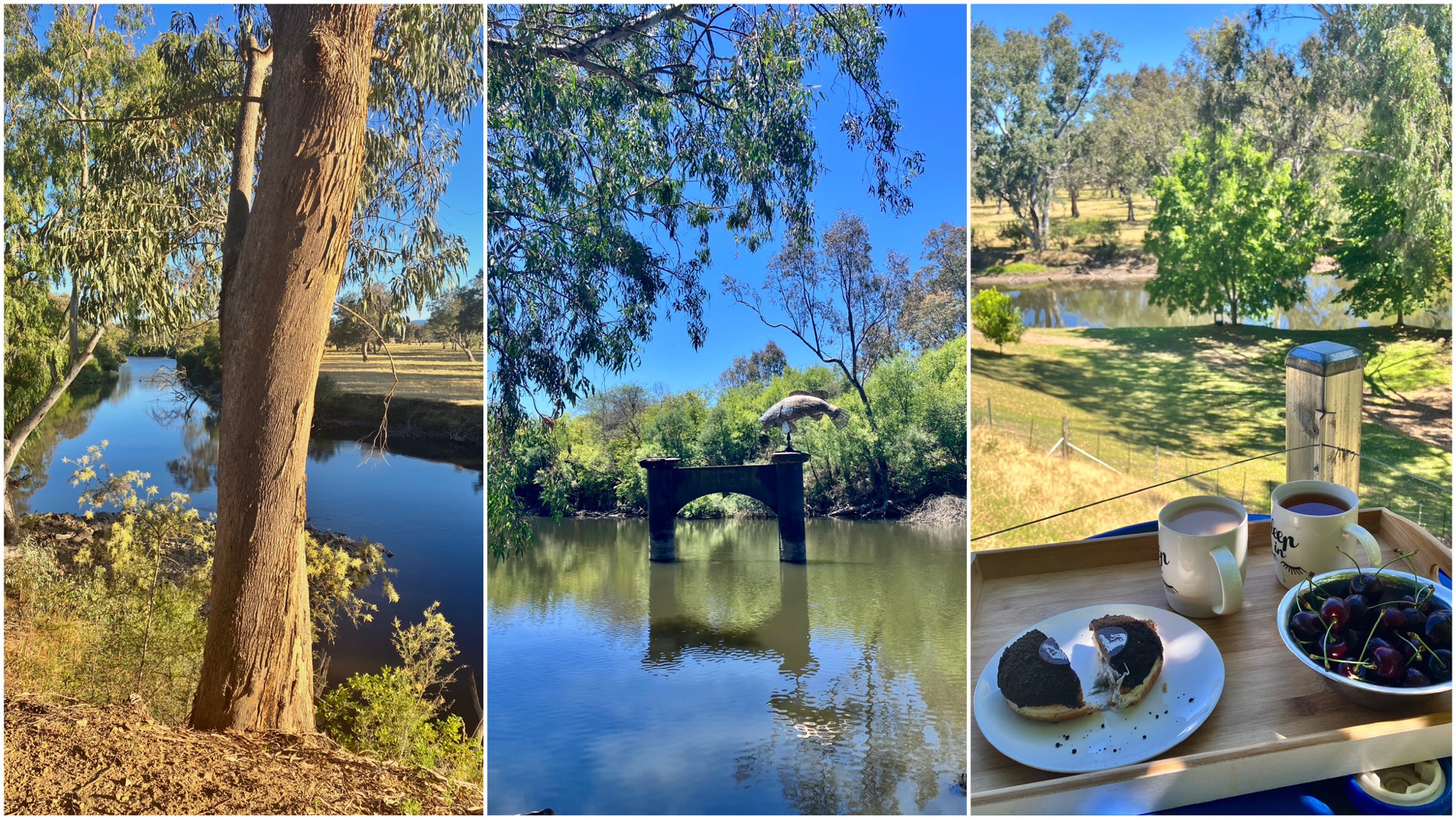
And what else to do but naturally acquiesce to the next part of the test drive experience: sleep. The excess of space in the Territory provides the option to lie flat. To lie flat parked under a shady tree, the open back door framing views of a burbling river as chirpy wrens and a delightful breeze induce that state of lolling semi-consciousness. Everything working as it should.

I had parked at Paddy’s River Flats, where a free campground attracted plenty of others with the allure of flushing toilets and hot water. Other than one or two tents, most visitors were equipped with opulent caravans and big rigs and six ring barbecues and diesel generators and that most prized accessory of the dyed hair nomad, the satellite dish. The fact that I could just about arrange seats in a car to lie flat seemed relatively insignificant.

Without a TV I was content to make a cup of tea and sit in my chair beside the river for a while. I would have gone for a drive to explore some more but I was reluctant to risk losing this prime waterfront location. Lessons for next time, where bringing a tent – even if half-heartedly assembled – would at least allow me to mark my territory.

Unable to sit and do nothing for too long, I set off on a walk downstream where there was the promise of some waterfalls. Unfortunately the track to reach them had fallen into considerable disrepair following floods and fires, and it simply became too much to try and bush bash my way through. The road near the campground was quiet and I walked along this for a while instead, soaking up the golden hour as vistas opened up.

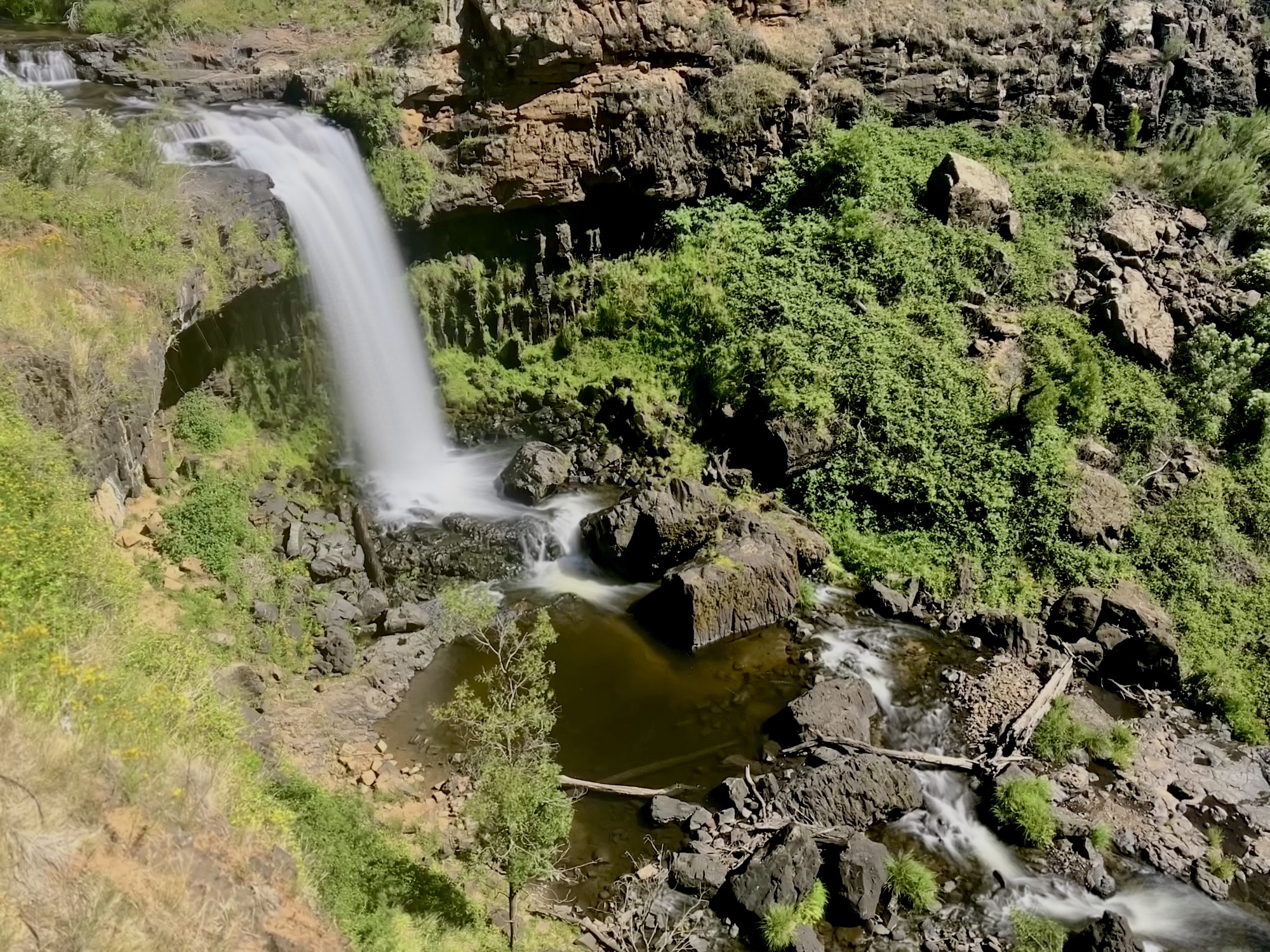
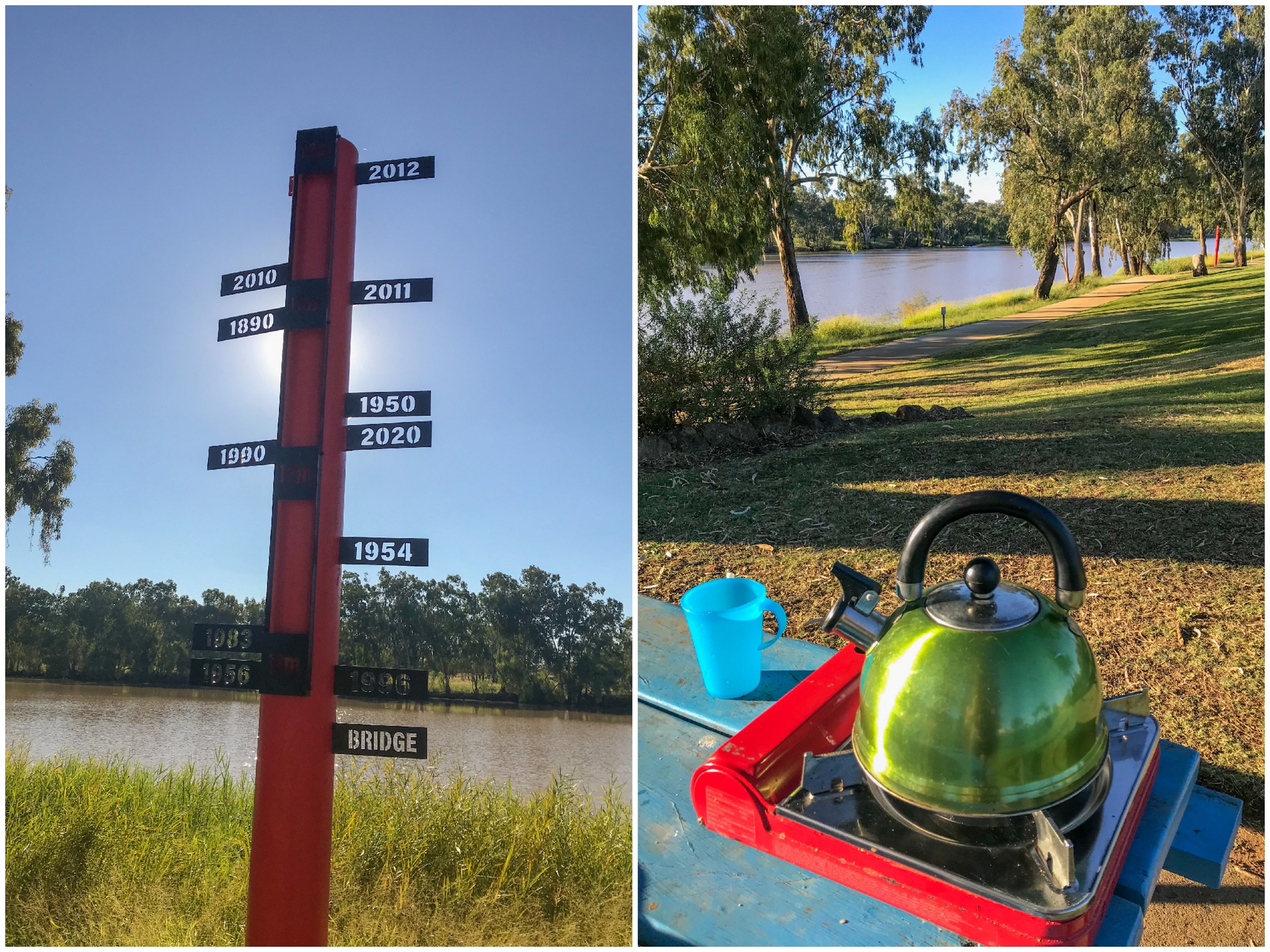
It was disappointing not to see the falls but there was another way, another time. An episode in which the Territory really felt at home, really felt like it started to belong. Seeing me through a reasonably comfortable night, the car took me along the road to the falls, twisting downwards to a parking area among the eucalypts. The first orange light of the rising sun lit up a picnic table and beckoned me to have breakfast and a cup of tea. The whistle of the shiny green kettle was poor competition for the sound of thundering water rising from somewhere deep below.

And what a spectacle Paddy’s River Falls turned out to be, that classic Australia assemblage of escarpment and water and generous growth fed by never-ending spray. A wonderful, inspiring culmination to this test drive that evokes the promise of more adventures, more enchantments, more new territory to come.

Now all that is left is to retrieve the bike also comfortably stored in the back, and adventure on two wheels instead. But that is a story, a gift, for another day.

Australia Driving Green Bogey

Wide green land

In what can only be taken as a positive sign, I will soon need a visit to a petrol station. The last such experience was on Monday 13th September at 10:20am, a level of precision recorded in posterity – or at least for one month – by the magic of QR code. Looking back at it now, it felt a risky manoeuvre at the time, beyond the boundaries of my self-administered geographical bubble, justified in my mind by being significantly cheaper and twinned with the prospect of a different coffee shop. It was quite the holiday.
Since that date, the petrol gauge dipped in small increments only to hasten in more recent days. Friday 1st October granted the freedom for human beings to enter national parks – or a national park more precisely – and outlying nature reserves within the boundaries of the ACT. Just in time for a long weekend that would see newfound lovers of national parks and nature reserves flock to suffocate them with their devotion.
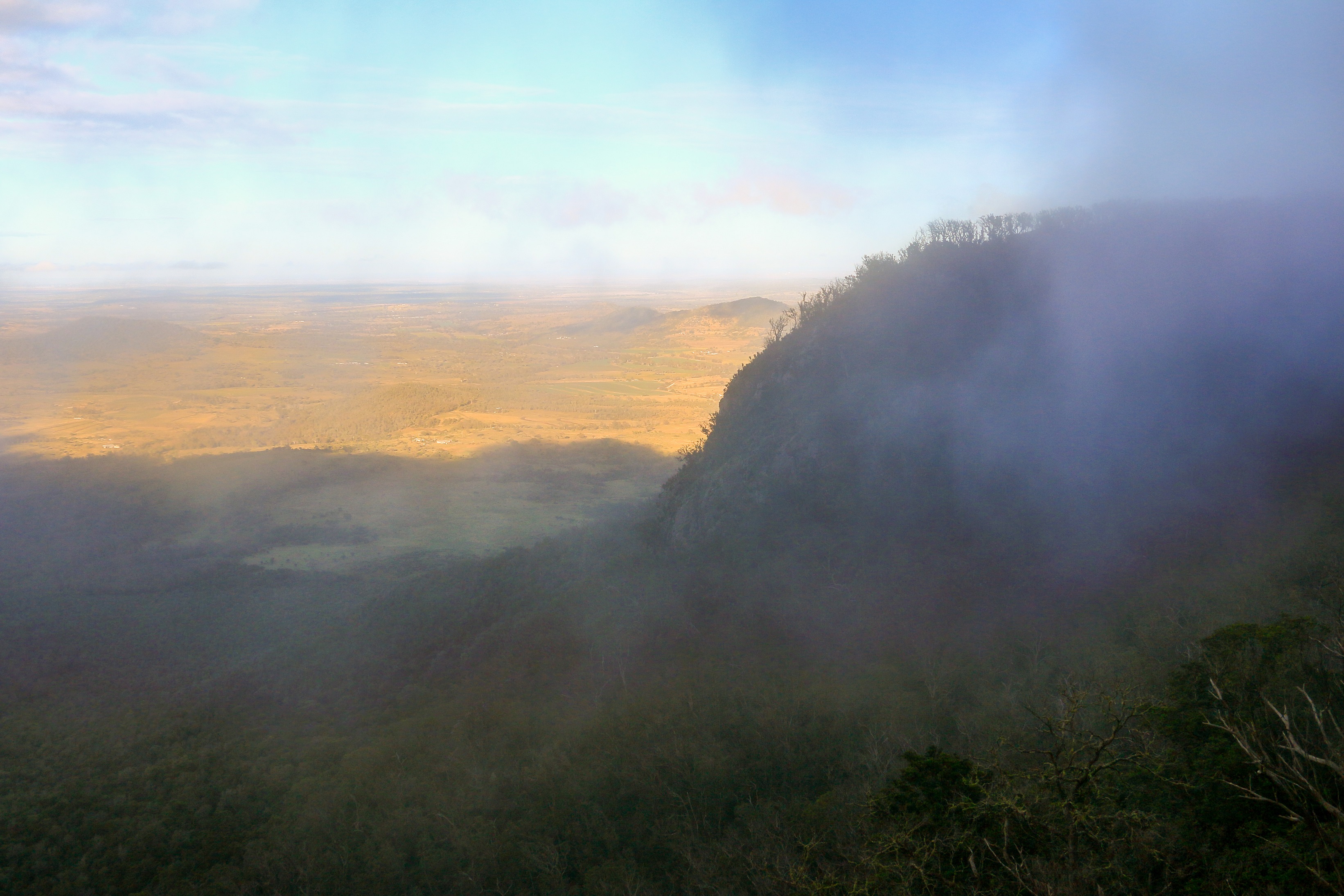
I was primed to wait, to let the suddenly-engaged nature enthusiasts have their maskless moment in the sun. But then I awoke early on the Monday – infuriatingly early given daylight savings had just kicked in – and saw an opportunity too good to pass.

An open road had been an object of desire for many weeks. Being Canberra there have been empty roads and there have been open vistas but never have these situations quite provided that sensation of travelling in a landscape. Of countryside flying past your window in an everchanging composition of shapes and colours and light and space. Each second a unique expression of time and place curated for your eyes only.

And what expressions of time and place these proved. Just out of town on the road to Tharwa, a countryside cloaked in misty lingerings and golden dew. Sturdy ranges rise up from sweeping grasslands, scattered with the withered trunks and branches of old gum tree. Cows and sheep and the odd outbuilding catch the eye, mere dots on a magnificent green canvas stretching to the sky. And oh how green.

If I were restrained within a bubble for but a few minutes this sight would still make my heart sing. And now that it is here again, I want it all the more.

I can leave the car and venture out on foot into the fringes of Namadgi National Park. Already at the Visitor Centre a dozen or so cars are parked up as their inhabitants embrace the outdoors. The trail – worn from good rains and the numerous footsteps of a long weekend – cuts a muddy swathe towards the looming summit of Mount Tennent, still capped by its own personal cloud. Today, that exertion is far from my goal. I want to linger and learn.

For all the joyous expansiveness of the landscape, topped off with flask tea on a seat at the Cypress Pine Lookout, I am distracted, fascinated, heartened by the more miniscule. The work of nature overcoming winter, recovering from fire, embracing spring. All emerging into the world once more.

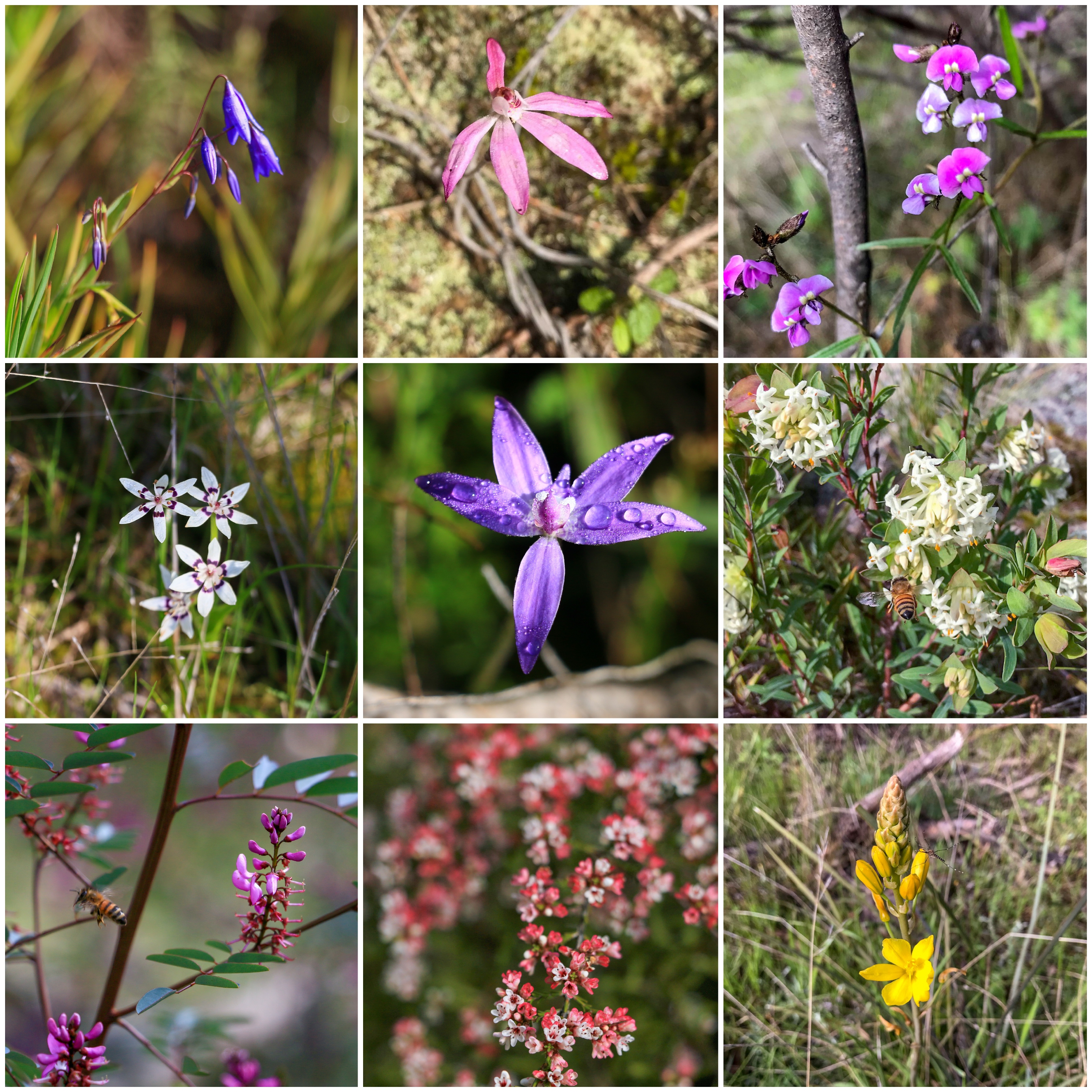
One of my attempts at Lockdown 2 Self Improvement Projects has been aligned to the season and the pursuit (and somewhat more challenging identification) of our native wildflowers. Provided with generous encouragement and impetus, I have found this a satisfying, almost addictive pursuit, one that can easily turn an hour walk into two.

So, from the fragrant myrtles to the delicate orchids, the indecipherable varieties of pea to the bulbous generosity of golden lilies, there is so much to discover. Far and near, it truly is spectacular how much you can see when you actually look. Checking out as much as checking in.

Australia Driving Green Bogey Photography Walking

Homecomings

Two weeks on holiday normally wouldn’t be such a strange thing. But it seems a pretty big deal these days. In the world BC, holidays would involve a month crisscrossing the UK in search of friends, family, scones and ales. Plus a European side trip featuring alps of snow and mountains of cheese. One day I’ll make it home again.

However, over the years I’ve come to think of home as more than a singular physicality. There are homes and, following the big bike ride, I needed to somehow find my way from Point B – Caloundra in Queensland – to Point A – Home, Canberra.

It had been a hectic holiday really, and I had visions of a couple of days nestled beside the ocean in some mild clime with good coffee. Perhaps a pool to soothe aching muscles. And a regular ice cream jaunt in the afternoon before taking in the final golden light of sundown. Alas, the weather forecast didn’t look especially conducive to this fantasy so – once again – I opted for the John Denver approach to travelling home.

Still, this wasn’t before at least taking in the sand and water on the Sunshine Coast. It was a brief foray, in between heavy showers and ocean chop at Alexandra Headland. Nearby, the Sunshine Plaza didn’t really offer a brighter disposition but eventually I located some much sought after rocky road. For later.

Faring Jason well with the understanding that we will one day again reunite for rail trail cycling magnificence, I fired up the four wheels and headed west. The road home was all smooth to start, taking me back – as it happened – into a land previously criss-crossed on two wheels. The second time around offered an opportunity to right some wrongs.

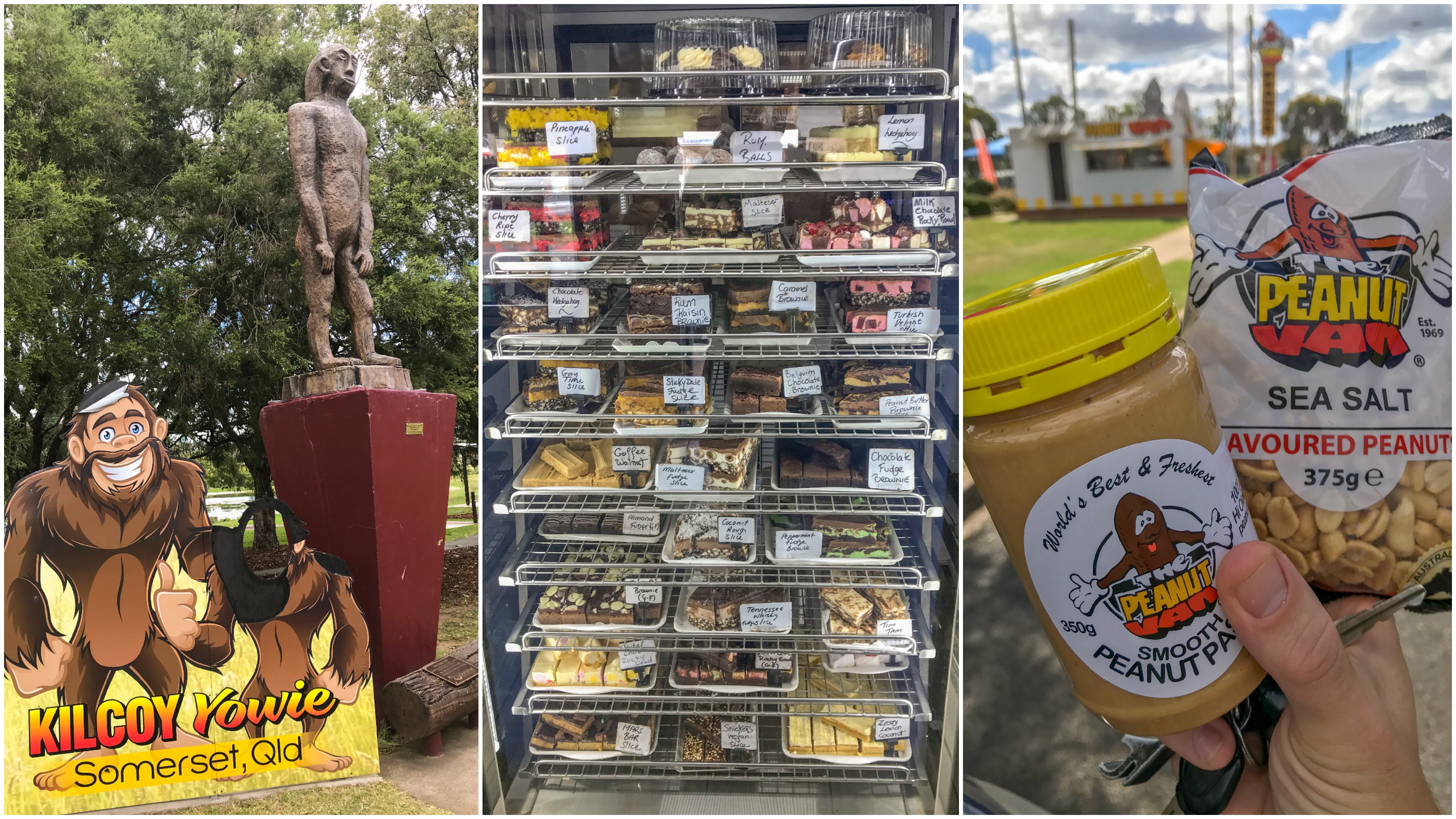
The first was pausing to marvel at the Kilcoy Yowie, which I had failed to note when we drove through here on the way to start our bike ride. It’s just, well, I cannot really explain. Further on, once more in Blackbutt, I called into the bakery where I scored a coffee and was confronted with the kind of display that causes indecisive cake-lovers like me to break out in a cold sweat. I think I went for sticky date fudge slice when pressed.

After the kilometre zero of Yarraman, the road led on towards Kingaroy. The extent of my knowledge about Kingaroy is absolute peanuts. Which is pretty spot on, given the area is famed for the cultivation of kernels. When in Kingaroy, Go Nuts is not the motto on the town sign, but you should at least stop by the Peanut Van. And if you want a taste of the manic, pop to the local Woolworths.  

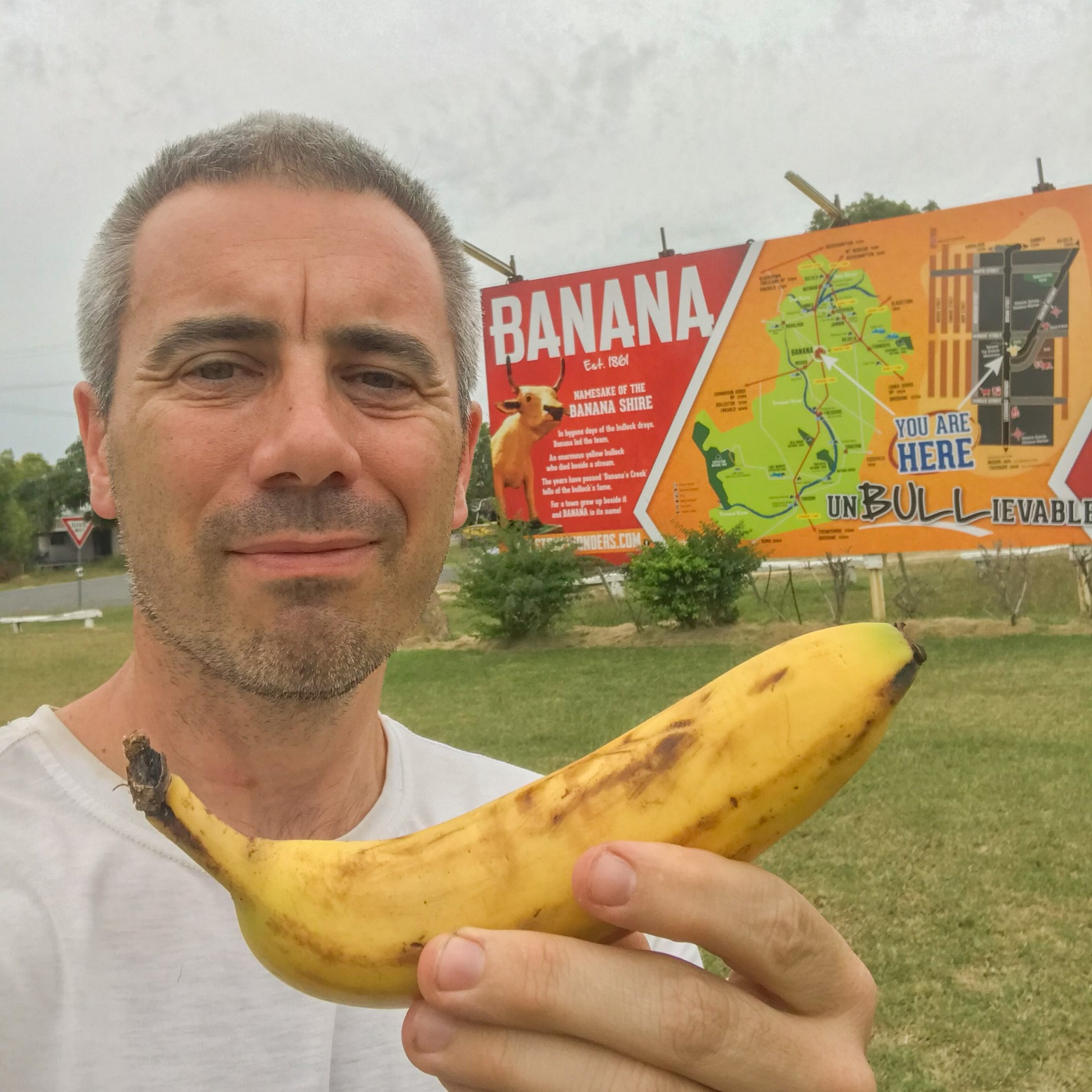
I was stocking up for the return to camping with a laser-like focus on making it as minimal effort as possible. Banana for breakfast. Packet soup for dinner, with a carrot and five frozen gyoza to add some bulk. Tent popped up, cooking by torchlight would never be so satisfying, and soup proved perfect in the cold.

At altitude in Bunya Mountains National Park it was surprising how cold things were, given I was still in Queensland. The Bunya Mountains rise up distinctly from the surrounding plains, a wild island among the productive downs. It is very much an island of biodiversity, illustrated by the large swathes of unique Bunya Pine. These giant, Monkey Puzzle type trees only grow naturally here and in a few smaller, dispersed pockets further north.

The trees yield massive cones which offered good tucker for Aboriginal Australians. When I see one in the small visitor centre, I am relieved my walking for the day has finished. Not only do you need to be wary of snakes, spiders, ticks, and stinging trees, but giant bloody cones falling on your noggin as well.

I absorbed the Bunya Mountains with a nice loop walk through dense forest, following lush gullies and creeks and occasionally peering out of the woods to see Queensland below. The gentle chirping of birds was a constant, but the dappled light and dark undergrowth made it impossible to sight any of the blighters. The forest had the becalmed air and melody of one of those meditation soundtracks cobbled together on Spotify by a bearded man wearing loose flowery pants. 

Not that this led to a relaxing night. While I managed to get fairly snug, gusts of wind provoked regular rattling of canvas. With fitful rest, I rose early the next morning to discover my head in the clouds. With patience, this would rise and fall in swirls, chinks in the gloom revealing a sunny day unfolding for the Darling Downs.   

Gravity would propel my car that way, rapidly plunging from the Bunya Mountains towards Dalby, where the day was indeed sunny. Dalby seems every bit a forgettable town, neither obviously appalling nor exceptionally outstanding. This is perfectly encapsulated by the popularity of a Coffee Club and Brumby’s Bakery on the high street.

Out of Dalby, large cotton fields once again spilled out towards the horizon. It is one of the regrets of the trip that I never managed to find a spot where I could brake abruptly and take a photo of them. Instead, here’s a metal yabbie at Moonie next to tennis courts and much sought after public toilets. 

Moonie was little more than a junction on the way to Goondiwindi, a border town receiving attention over the past year for its checkpoints ensuring Queenslanders are kept safe from nasty viruses prior to a state election. As a border town it possesses all the essentials, retaining the chain store vibe of Dalby for passers-by who simply yearn for a bit of predictability. For lunch I grabbed some takeaway from Red Rooster, before a fuel stop and then a frozen coke from McDonalds to take me into New South Wales.

Crossing the border, one step closer to home. Yet still a million miles away. It certainly felt that way once my frozen coke had run out and I found myself on a bumpy road through endless fields of grain. The road – between Boggabilla and Warialda – was doing few favours to my left shoulder and arm, which had now developed post-cycling strain and pain.

In my ideal version of today I was reaching Bingara by two, allowing time for a relaxing nap before a potter around. But I’ve continued to underestimate Australia and the quest of driving across it. It was pretty much four when I checked into a motel – cheap, basic but welcoming in a countrified beige blanket kind of way. And not camping. One of the two double beds still looked good for a nap.

I vaguely remember passing through Bingara on another trip back from Queensland, the town now an intersection with the past. That time around I had come through Inverell and Myall Creek on my way to Narrabri and the Warrumbungles. Again attempting to cover a million miles in a day, I didn’t even stop here, but remember it conveyed a surprising rustic charm.

In the remaining light of day I therefore walked down to the Gwydir River and back into town where clusters of tradie and caravanning couples were gathering for Friday night dinner outside the pub. Along the high street, trees turned auburn signalled the passage of time and place that had gone on since I left home. And with the sun dipping over the hills, there was a tangible chill in the air. And plenty of chilli on my pizza.

Bingara enjoys a fine setting, nestled in a valley backed by rolling ranges. It’s technically in New England and feels that little bit closer to civilisation, if civilisation is Tamworth. I took in the surrounds from a lookout high upon one of many hills, wondering if I could see my destination. But that was still a long way off.

The road between Bingara and Narrabri must surely rank as a hidden gem. In between the two towns, the crazy volcanic landscape of Mount Kaputar National Park infiltrates, regularly revealing golden panoramas and rugged lumps thrust upward from the horizon. It’s one of those landscapes that makes you want to stop at regular intervals, eating yet again into your estimated journey time.

With a lunch date in the diary, I didn’t really have time to pause. I was in two minds whether to stop at Sawn Rocks, but being only a few hundred metres walk from the car park I figured I could squeeze such spectacle in. This is one of Australia’s best ‘organ-pipe’ rock formations, created in geological tumult and chaos. An experience I’m sure my car was feeling for the rest of the day.

I am not going to profess to taking it any faster than 110kph of course as I progressed towards Narrabri. The sacrifice for Sawn Rocks was no coffee in Narrabri and no wee in Wee Waa. By time I reached the small settlement of Pilliga I was more than ready to pause for some brief relief.

Pilliga is – shock horror – in the heart of The Pilliga, a vast, largely flat plain of sprawling dry forest and sandy soil. At one point – and I may have been hallucinating by that stage – I passed three camels. There was no chance to stop, and I’m not entirely sure if they were on a large farm or simply roaming wild. But the fact that you can easily imagine them roaming wild here says everything about the type of environment you are in.

Talking of wildlife, did I expect to find myself in Coonamble again? Well, yes, but I never expected I would be so ecstatic at reaching the place. Oh, there’s that spot I got chased by rabid dogs. Over there, the only café open on Sunday. There’s the river, languid and brown. The supermarket with the chemical mice killer aroma. The partly constructed public toilets embroiled in drama. And the home just out of town where I can again feel at home.

My plans were vague and uncertain and once pork belly was mentioned for dinner I knew this would be my spot for the night. Before dinner, lunch, a mere 45 minutes out of town. The Armatree Hotel is the best pub in town, the only pub in town, practically the only building in town. It has character and authenticity soaking through the wooden floorboards, corrugated iron bar, and XXXX on tap. Out back, the outback. And a beer garden, lively with get togethers and celebration of another week fulfilled.

I like the fact that I can come away from the Armatree Hotel having chatted to an old codger in a ten gallon cowboy hat while we both emptied the contents of our bladders. “Great place out here, hey”. Sure is mate, sure is.

After a restorative night, it finally was time for a homecoming. Coonamble to Canberra in one hit is a pretty lengthy affair but once through Dubbo (and a much-needed stop for coffee), the drive was pretty enjoyable. The weather had closed in and rain was falling as I reached Molong, giving the place an added autumnal melancholy. All across the Central West, trees were exploding crimson and gold in small towns like Cudal and on toward Cowra.

The rain had stopped and things were brighter by time I reached fairly familiar territory in Cowra. Not so long to go now. Just need a final country coffee to push me on, eclipsed by a delicious treat…because I am still on holiday after all. Just about. Down the road, Boorowa. Then Yass. Murrumbateman. Hall. And at last, home.

Australia Driving Food & Drink Green Bogey Photography

Stimulants

I had entered the point of no return. Doors closing behind me, confronted by a depleted selection of pre-cooked yellow food. A smoky, greasy vapour emanated from behind the counter. Around one of the square Formica tables, a trio of young people huddled around a carton of chips.

I had rolled into Injune desperate for a pick-me-up to push me on to the end of the road. For coffee this was the last outpost. And like a rabbit in headlights I was now captive. I had to order. Miraculously, I spotted a handwritten note on one of those fluorescent orange stars. Iced latte for $5.50. Coffee, ice, and milk which surely wouldn’t turn into a complete hash. Relief. A safer proposition than the risk of first degree burns.

Happily – should you find yourself in the situation – you’ll find iced latte and a pack of 39 cent custard creams from Aldi a winning combination on the Carnarvon Highway between Injune and Rolleston. It propels you into a more interesting landscape with plateaus rising up to the east and west. The road, finally, allows a speed limit of 110kph. And then you turn off, to fulfil a few goals and dreams.

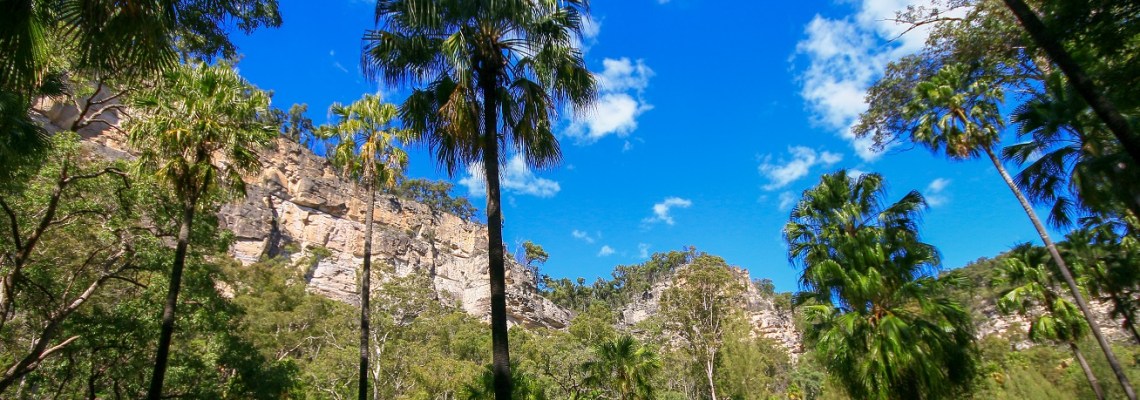
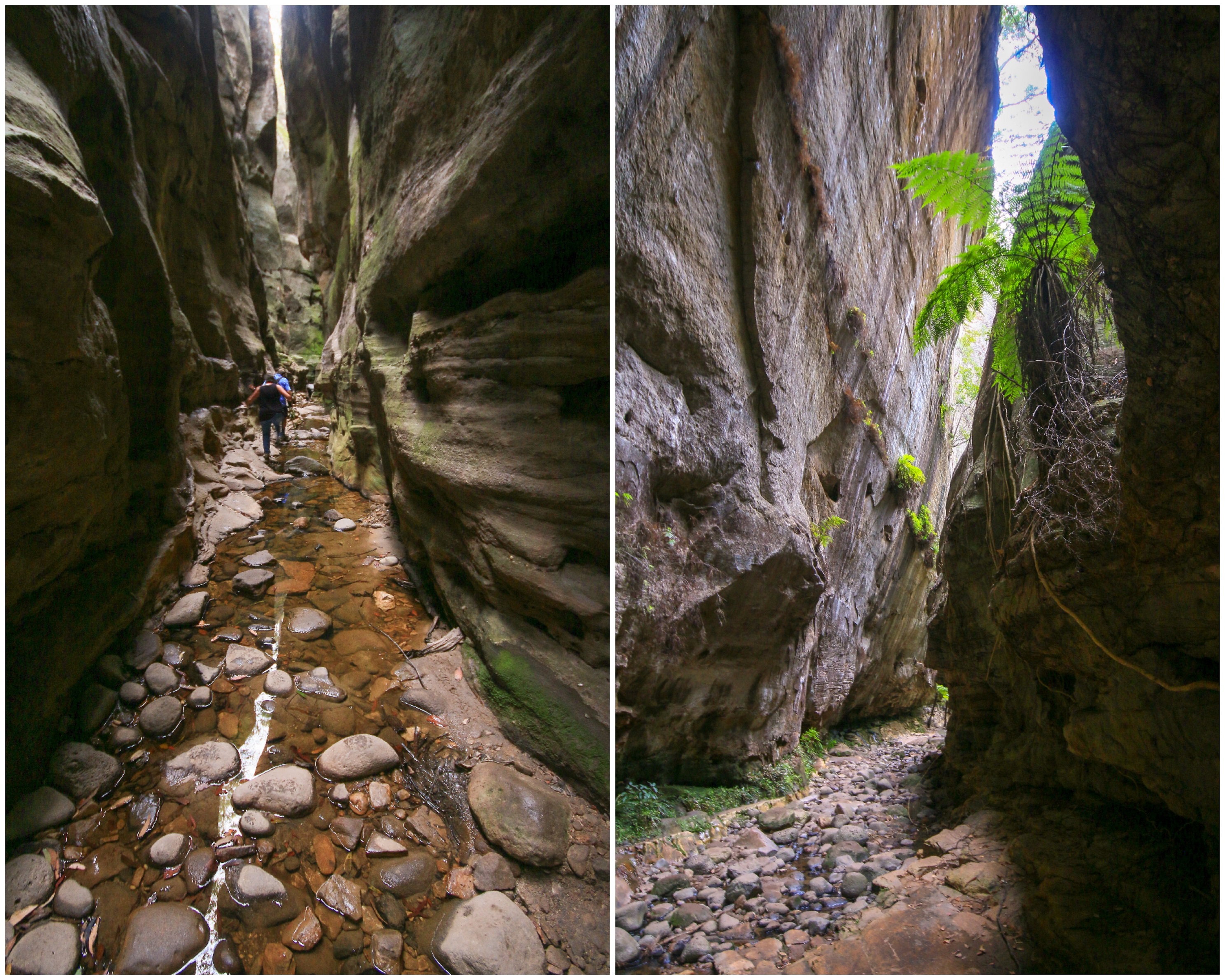
I remember when Carnarvon National Park first piqued my interest. It was in a Qantas magazine, back when flying was more of a thing. I was probably on the last plane out of Sydney after some stupid meeting, feasting on two crackers and a vomit-coloured dip. A double-page photograph of intricately textured sandstone, a dark narrow fissure, vibrant green ferns, and the dizzying perspective provided by a human figure felt a long way away. 

It’s a credit to that Qantas magazine that they managed to condense Carnarvon National Park into a few glossy pages. It’s also a credit to the professional photographers who managed to fit it all in. The vast, monotone plains in the surrounding landscape truly situate this as an oasis. The solitude required to get there leads to stimulus galore.

Hyper-stimulation first emerges a few kilometres outside the park. People and Hiluxes amass, caravans are adorned with satellite dishes, trailers, awnings and everything including the kitchen sink. There may even be – in the middle of Queensland – a large boat or two. Instantly I know this is not my type of campground. But there is little other choice and I set up home for two nights, conscious of beady eyes judging my unfolding canvas.

Many of the people I talk to are here for a week, maybe two. They can afford to spend whole days sitting in a fold-up chair playing candy crush. I have one complete day to head into the gorge, go as far as I can, and turn back again. One whole day that is immense in so many ways.

My phone tells me it was a 41,397 step kind of day, taking me along 29.1 kilometres. It was a day that started around six in the morning, when I parked up near the visitor centre. There was an orderly-looking campground here but for some reason it is only open during school holidays. Still, I took advantage of one of the many tables to make a cuppa and eat some breakfast, free from the guilt of disturbing the old folk getting their beauty sleep.

The walk starts with a sign of things to come: a crossing of Carnarvon Creek via a series of stepping stones. The first crossing is easy, reassuring everyone who finds themselves on this path to strike out further into the wilderness. Others later on require a bit more planning and a touch of blind faith. But don’t let this put you off. Just grab a big stick and think of the reward.

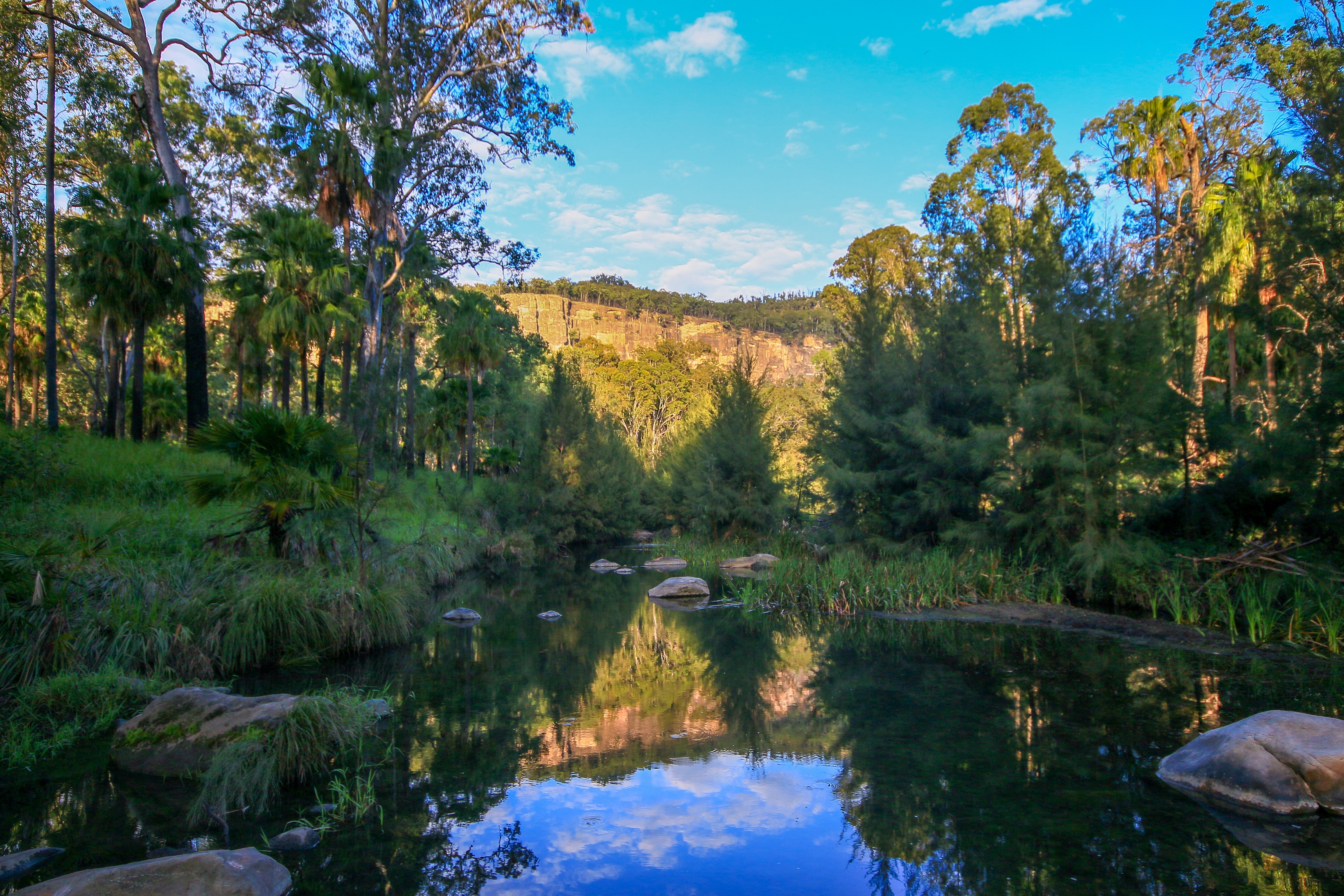
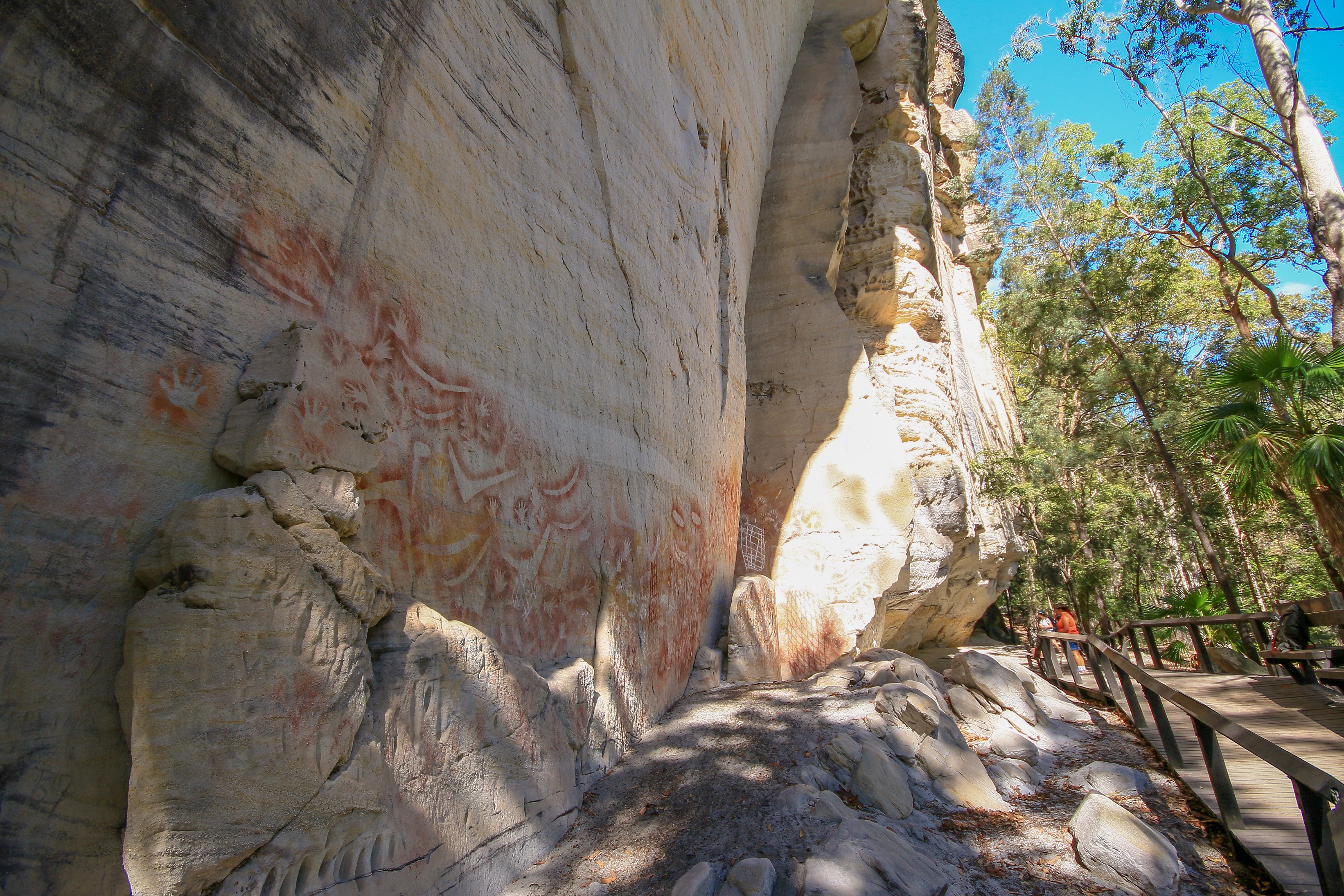
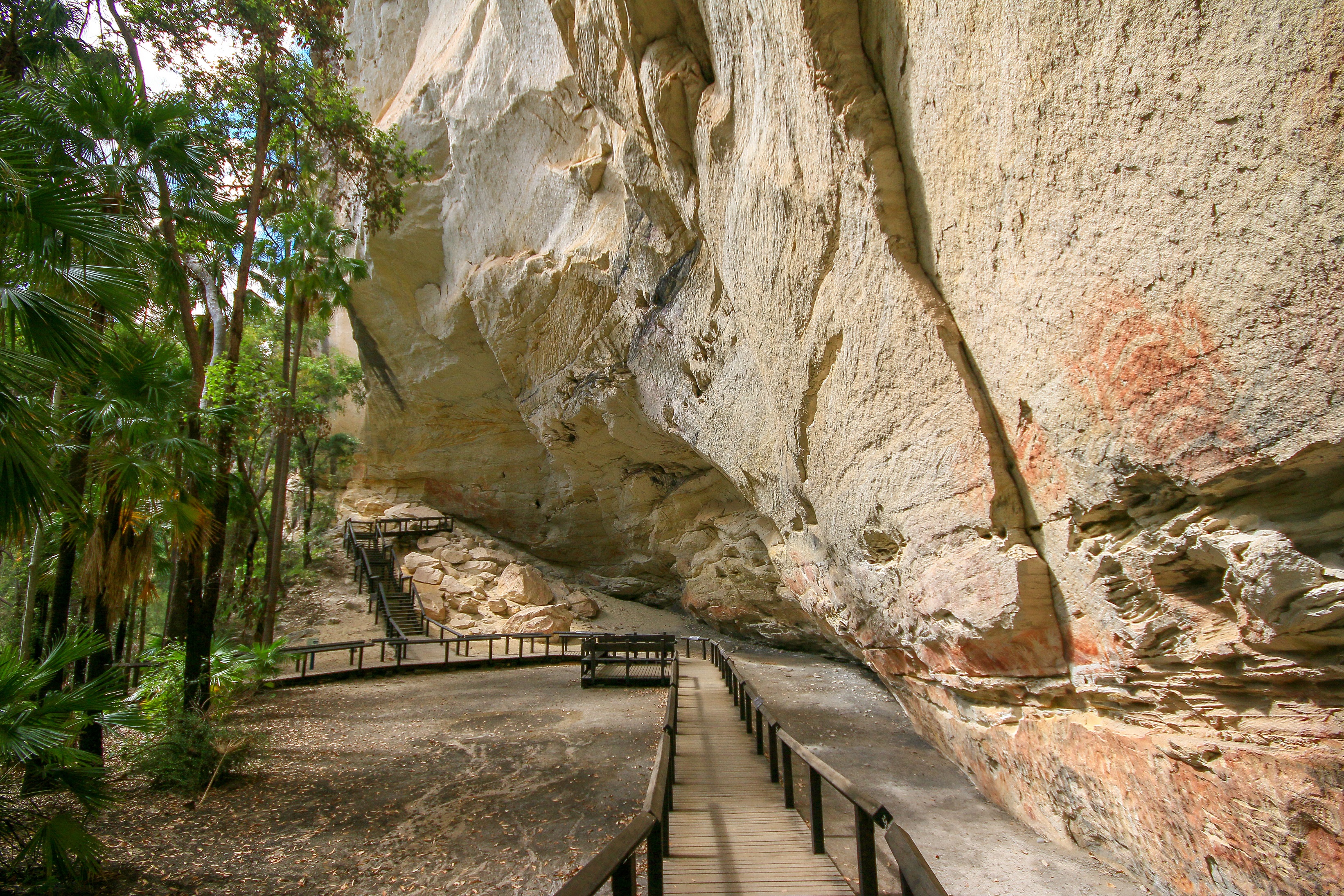
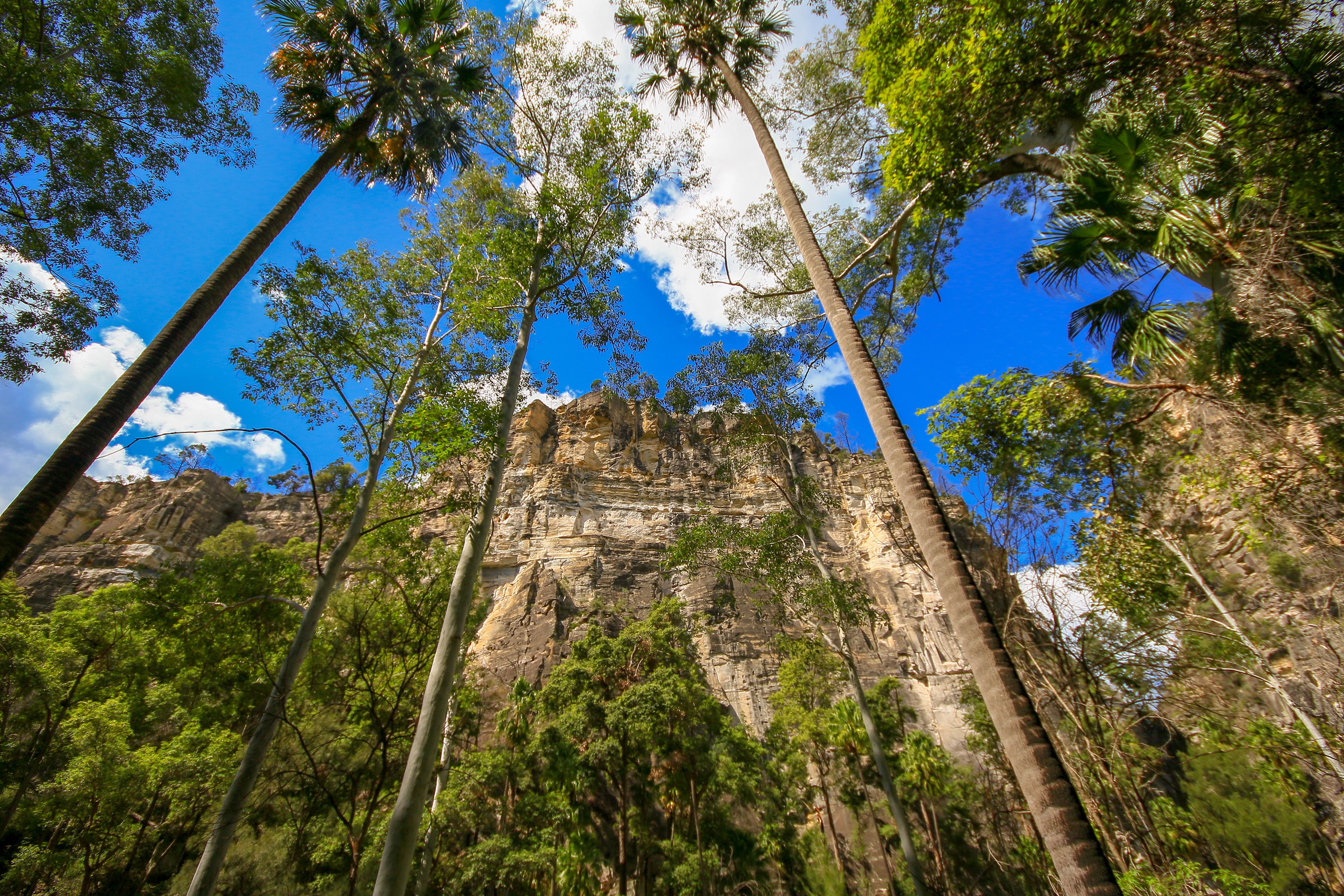
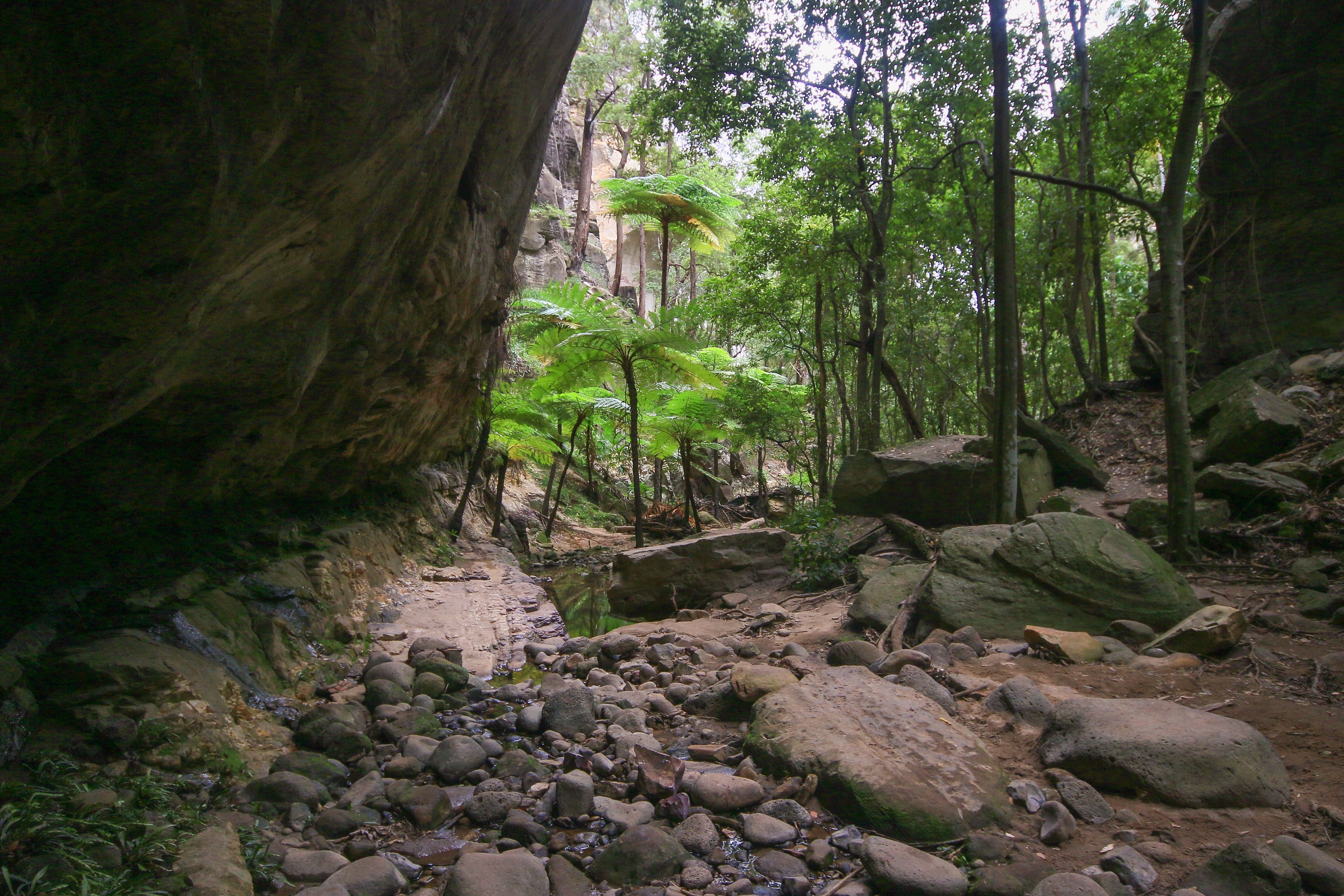
The gorge is said to extend for 30 kilometres, but the day walk goes as far as Big Bend, where there is a carry-in campground for those intrepid enough to explore further. Along the way, nature has created a series of incredible rock features, shady pools, and slot canyons, while original inhabitants have left their own mark. It is these spectacles – reached via shortish detours from the main trail – that create a natural itinerary to the walk, numbered like stops on a coach tour. Only here, self-propulsion is the required vehicle, and the only souvenir stands are those that assemble within your mind. And do they sure etch their way into it…

Moss Garden

Reaching the first stop seems to take forever, but I think that comes down to an eagerness to get there. It’s akin to sitting in the back of the car as a child, heading for a day at the beach. The side track also requires a little creek crossing and climbing of steps, penetrating into a small, fern-filled gully.

What can I say about the Moss Garden? It’s mossy and moist, fed by a narrow creek spilling into several clear pools. It’s the kind of garden that might be constructed at some expense in a billionaire megalomaniac’s estate, funded by worker exploitation and home shopping. Or constructed in the airport of some oil rich emirate to show off to the world. But nothing contrived here, just thousands and thousands of years of nature. Water, rock, vegetation. Gathering in blissful harmony.

Amphitheatre

If the Moss Garden was beautiful in a serene kind of way, the Amphitheatre is, fittingly, all head-shaking drama. I think this is the setting for that double-page spread in the Qantas magazine many years back and you would need to be a professional photographer with a mega-wide angle lens and tripod and hours of patience waiting for the right light to come anywhere close to evoking the feeling of being in this place.

At first, you wouldn’t expect much. Nothing to see here. But walking towards giant luminous sandstone walls you notice a small doorway at their foot. And a series of metal steps up to the entrance. It is a crack perhaps little more than a metre, a corridor into a cavernous courtyard of wonder. Above, a small window to the sky, afoot a delicate display of vibrant ferns. It cries out for a massive “COOEE!” but somehow feels too reverential for that. A handful of people, myself included, just sit and soak it all in.   

Art Gallery

The National Gallery of Australia is much more accessible and has a better café than the Art Gallery in Carnarvon Gorge. But you won’t find a 62 metre natural sandstone wall featuring over 2,000 engravings, ochre stencils, and free-hand paintings. The stencilling is considered to be some of the finest and most-sophisticated of its kind in their world.

This sacred spot serves a reminder that this is the land of the Bidjara and Karingbal People, and you are lucky enough to be here for a fleeting moment in time.  

Cathedral Cave

Many people culminate their walk at the Art Gallery fulfilled, turning around and heading back home for an afternoon rest. The next stop up the gorge is four kilometres distant, and the track grading increases a notch on the scale. There are more stones to traverse and one creek crossing in particular requires a degree in trigonometry and dose of good fortune.

I’m glad I pushed on though, for this section is perhaps the most scenic. The main trail sticks closer to the rocky course of Carnarvon Creek, and sheer-sided multicoloured outcrops begin to press in on both sides. Palms and ferns and eucalyptus gather in the valley, nurturing colourful butterfly and chirpy birds, while emerald pools attract fast-moving dragonfly.

As a destination, Cathedral Cave undoubtedly has a spiritual quality, hosting further displays of Aboriginal art. It also possesses that echoey ambience formed from the hollow of a massive rock overhang. A chamber of secrets. Peaceful and shady, the benches situated opposite the walls encourage lingering. A rest before the return journey.  

Boowinda Gorge

But don’t turn around! After Cathedral Cave, it’s a kilometre or so on to the end of the trail at Big Bend, but I neither had the energy nor the desire to visit a camping area. Just 200 metres on from Cathedral Cave, however, another dry creek cuts in from the west. At first, it’s nothing special, just an unending collection of large pebbles that make walking a little more taxing. But pursue further and you enter Boowinda Gorge.

This I found the most staggering spectacle of the day. I can’t really explain. Nature has formed something that engineering genius and billions of dollars would struggle to replicate. Curving walls, pebble paths, ferns and trees flourishing where chinks of light again emerge. And I had it all to myself.

————————–

I’m all for saving the best to last, especially when it comes to roast dinners. But what goes up must come down and, as much as I tried to conjure up a helicopter taxi from Big Bend, the return journey needed to be undertaken. On the plus side, things were still incredibly scenic the second time around, stepping stone confidence was sky-high, and I had a few Aldi custard creams to perk me up when needed.

There was also Wards Canyon, one of the stops between the Amphitheatre and Art Gallery which I had saved for the journey home. As lovely as this was – think more small cascades and rocky walled gullies – I can’t help but think my impression was overshadowed by weariness and the wonders that had gone before. It also took a bit of a climb and used up the last custard cream.

To get back to the car, I started to concentrate more on the little things. Some of the butterflies that would never settle. The blur of small birds flitting between shrubs. The red and blue dragonflies hovering above water. The people passing me by, saying G’day and inquiring just how much further it was to so and so. Push on, I encouraged, and don’t miss Boowinda Gorge.

In all honesty though, the last hour turned into a bit of a drag. There were a surprising number of steps and undulations that I didn’t notice in my excited state on the way out. The light was now brighter, the heat of the day well and truly upon us. Creek crossings were less an adventure, more a chore. My feet hurt.

Towards the end I was pretty much walking at the same pace as a man a hundred metres in front of me. It came as no great surprise when he let out a thank feck kind of “yahoo” upon sighting the visitor centre. I didn’t need empathy training to totally get it.

And so my walk in Carnarvon Gorge, years in the making, had reached its conclusion. I felt happy and fulfilled and in desperate need of a shower, cup of tea, slice of Christmas cake and a nap. Unfortunately, Takarakka ‘Bush Resort’ had other ideas. I returned to find I had neighbours, sat outside their caravan under the awning, playing candy crush and listening to the radio. Other neighbours were setting up with a clink of a camp kitchen here and a thud of a mallet there. Four-by-fours rocked up every few minutes, engines idling as they checked in at reception. The shower, tea and cake were divine. The nap non-existent.

At least I slept well that night. Very well, for tenting. Still, I was awake before sunrise so made a bit of noise and headed up a track to a nearby hill. A few other people were there, including a dad with a wide-awake baby and a couple of what I would say are younger boomers. The sunrise was – fleetingly – dramatic, while the younger boomers were lovely.

We chatted for a good while. They had arrived yesterday and were staying for a week. I was off to 1770 today. I passed on my tips and wished them a wonderful stay. They wished me well for my big bike ride. We parted, me feeling a little more favourable towards caravanning boomers, and them possibly thinking he is never going to manage that bike ride. Maybe.

Keen to get moving, and also keen to avoid the amenities block that was always dirty whenever I had to use it, I passed up the opportunity of a shower and hit the road. Yet instead of turning left, back to the highway, I veered right. I had come so far and something was bugging me. This had been years in the making, and when would I ever be here again?

When I arrived in Carnarvon National Park on Tuesday afternoon, I used the last of the daylight to explore a short walking trail along Mickey Creek. It was a simple and – in hindsight – relatively undramatic stroll. But that is only until the formed trail ends. 

A bag left on a rock signalled I wouldn’t be the only one transitioning from a gentle amble to a rock-hopping adventure. Beyond the stones and the ferns, an entrance led into a narrowing gap. Walls closing in, the sound of ‘oohs’ and ‘ahs’ travelling down the chasm encouraged further exploration.

There was only really one spot that was a little challenging – in that I might get my feet wet. But I could do it. And so could my sunrise friends who I met again on the way out. So much better than just sitting outside your caravan playing candy crush. We both agreed, and I felt envious of the wondrous discoveries that still awaited them.

Farewell friends, and farewell finally this most magnificent oasis.

————————–

That could have been a good ending, but the road never ends. Neither does this blog post but all I can say if you are labouring is just imagine living and breathing it as opposed to a mere skim-read in your PJs.

After endeavours at Carnarvon, I planned a bit of R&R on the Queensland coast, 550km away. Worryingly I was desperate for a coffee by time I reached Rolleston, only a hundred clicks in. Even more worryingly, Rolleston didn’t look up to much. But beside the public toilets in a park, a cute caravan had popped up selling coffee and a few light snacks. The owner was charming and chatty, and I really really really wanted her coffee to be good. But scalding hot country ways are always difficult to cast off.

There is little to note between Rolleston and Biloela. The road, almost arrow straight, offers frequent car stopping bays and I realise these are essentially unofficial toilet stops as I recycle my coffee in a hedge. The highlight of this section of the road should really be the town of Banana, in Banana Shire. Yet, there is no comedy sized fibro banana or Banana World Theme Park incorporating Mango Village. A large sign erected for losers like me actually informs the world that Banana was named after a big bullock. Surrounded by coalfields, this is peak QLD.

Sadly, the only thing I knew of Biloela was the Australian Government’s really tough posturing to lock up a couple with two young children who were seeking asylum here. They now sit festering on an offshore island. The #hometobilo movement made me feel warm towards Biloela. The family in question had become part of the community, and the community part of them. They simply want their community back.

I didn’t find out much more about Biloela in my brief stop there. It didn’t seem the most appealing place, but then it is far more appealing than – say – a war zone or dictatorship inclined to ethnic-cleansing. Petrol was cheaper here, and I was surprised at the quality of coffee and a slice from the bakery – this is more like it. Road trip essentials.

Almost as Australian-sounding as locking up dark-skinned people seeking protection is the Bruce Highway. For me, it was a bit of a milestone, a sign that I had reached the Queensland coast. But like most highways along the east coast, the ocean is still miles away. And, hitting the highway south of Gladstone, the Towns of Agnes Water and Seventeen-Seventy were still 90 minutes away. 

A sign that I was pretty much over the drive came when I didn’t even stop for a ‘big crab’ at Miriam Vale. It wasn’t that big, looking more like an elaborate shop sign than anything. And I don’t really like crab, stemming I think from my brother taunting me with crab claws as a kid. The same can be said for peanut butter, but I did at least stab his hand with a fork when he tried to steal some of my chips.

————————–

1770 clearly stands out from the crowd just by being a number. That was some good marketing by Lieutenant Cook and Joe Banks when they decided to make their second stop in Australia at this spot; I think Joe had seen some plants that took his fancy. If you look on the map, you will see a marker for the 1770 toilets, which you can only hope have been updated since they visited.

Confusingly 1770 has the postcode of 4667. So – in a remarkable turnaround for Australian abbreviation – it is often spelled out as Seventeen-Seventy. It also typically gets lumped together with its southern neighbour, Agnes Water. And I was staying on a campground between the two. Let me tell you the joy of driving past tents and awnings and trailers to take up home in a cabin with a double bed and kitchen and bathroom. The closest I will ever get to feeling all North Shore Sydney.

And so, with good rest, I had a lovely day in the Towns of Agnes Water and Seventeen-Seventy. In preparation for what is to come, I decided to explore it by bike. There were beaches and lookouts and a lovely coffee in some lovely gardens, embellished with sweet baklava. It was the best coffee in a long while, a clear indication this is a coastal location on the up.

Beyond the coffee stop, I was delighted by the Paperbark Forest Boardwalk. It wasn’t especially long but well worth the additional cycle up a small incline. Among the stands of paperbark, butterflies frequently floated and birds sang with joy. A nice way to get off the two wheels and stretch the legs.

Being beside the coast I had long targeted fish and chips during my stay here, which I gorged on beside the water on the wharf in 1770. Gorging again. The downside to this was that it required an uphill climb back to my cabin and a post-lunch nap. Later in the day, I returned to 1770 by car, and walked out to the headland, hopeful, like many others, that sundown would put on a decent show.

Now Saturday morning, I had been travelling for little over a week. I’d be leaving the ocean today and in memory of this I felt that getting a takeaway coffee first thing and sipping it on the beach would be a perfect moment. Situated next to a waterfront campground, the coffee took an age but when it came it was everything I had hoped for. Order and civilisation were being restored.

And so, next up Caloundra and then the Brisbane Valley Rail Trail. Heading south, I briefly paused in Bundaberg, picking up some provisions and a gift for my cycling buddy, Jason. Never would a $16 bike rack from Kmart prove so popular.

My final stop was in Childers, one last pause before hitting the elongated development of the Sunshine Coast. I had arrived, it would seem, in a town of coffee extremism. Ten minutes out of town, billboards implored me to stop at The Drunk Bean or Insane Caffeine. Nine hundred kilometres after Injune, the sound of coffee insanity appealed. It had largely been madness the whole way.

Australia Driving Green Bogey Photography Walking

Entering the finger zone

You’d have to be slightly crazy to drive six hours just to visit the Gilgandra Rural Museum. Yet craziness is exactly the vibe. Assembled outside, various mechanical contraptions seek to separate wheat from chaff or draw water from the ground or power the transistor radio of old Sheepwash Charley of Dunedoo. Among the pioneering relics, random two-dimensional figures play out a scene which probably didn’t make the final cut of the original Ned Kelly movie. All the while, the incredible Man on the Thunder Box remains impassive.

I didn’t travel six hours for the Gilgandra Rural Museum, but paused for one final stop before setting out for Coonamble. For me, Gilgandra signified a final outpost of familiarity if not necessarily civilisation. Along the way, more gentrified country towns like Boorowa and Cowra and Molong had breezed on by. A stop in Wellington illuminated both the charm and economic fragility of life in a country town, while the major centre of Dubbo came with all the drawn out trappings of tractor dealerships, coffee clubs and chequered fashion wear.

It was after Dubbo that I first encountered a finger or two. A single raised pinky from fellow drivers attempting to overcome the boredom of the Newell Highway. They obviously hadn’t stopped at the Gilgandra Rural Museum for there was little cheer or energy in their movements. More an obliging duty to signify they are alive and to acknowledge the presence of other lifeforms.  

It is never clear when, where or why the finger zone starts or ends. Remoteness plays a key role, but then some areas of barren desolation barely provoke a twitch. This confuses me to the extent that some people get the finger, others get a V sign, others a full hand and, when I have faced enough rejection for one day, the rest receive absolutely nothing. One of the worst feelings in the world is being too late to acknowledge a cheerfully waving man in an akubra as he whizzes by south, just because you have been spurned one too many a time.

Another hour of this kept me mildly entertained as I broke new ground on the Castlereagh Highway. Occasionally the road’s namesake river snaked nearby, sandy with pools of water nurturing gum trees and fields of weedy yellow flowers. Corrugated metal galahs counted down the approach to Gulargambone, while a fence emblazoned with a big G’DAY greeted me as I left town. Late in the day, Coonamble embraced me with fiery skies and the smell of mice disinfectant.      

I had come to Coonamble as part of a bigger trip on my way to Queensland. And while there was distraction in its artistic water tower and a sense of disappointment in its Nickname Hall of Fame (not even being so bad to be good), the main purpose of the stopover was to visit old – and young – friends.

And so good food, company, and row row row your boat was the main order of events, delivered in abundance. I did sample hot coffee from both local cafes and discovered the intricacies of a remote town of 2,000 people where everyone knows everyone else’s business.

One late afternoon I even went for a little bike ride, which was quite delightful at first, cruising along flat countryside lanes and discovering a peaceful spot by the river. Then I ended up in town and got chased quite aggressively by the obligatory roaming hounds. The full Coonamble experience.

One of the plus points to Coonamble is its proximity (at least in regional Australia terms) to Warrumbungle National Park. A jumble of volcanic lumps and spires rise up prominently from the flat surrounds, tantalising from afar in every direction. A dirt road takes us to a spectacular reveal of this massif from the west, before becoming more deeply immersed into the heart of the park.

I’ve done longer, signature hikes here before but with little Henry enjoying shooing flies in a backpack we take on a shorter walk to Tara Cave. Still, it’s a delight featuring a small creek crossing and burgeoning bushland, rising up to reach an interesting shelter with signs of tool-sharpening from many centuries before David Bowie put on some red shoes and danced. And being in the north west of the park, a balcony view reveals the splendid panorama of this wonderful land.  

On the other side of the Warrumbungles is the town of Coonabarabran. I discover this is known locally as ‘Coona’, even by the Coonamble locals who might also claim that moniker. Coona is a pleasant enough place, with an extravagantly decorated and tasty Chinese restaurant and – the piece de resistance – a Woolworths. Coming from Coonamble, there is something utopian about entering a supermarket with fresh produce and aisle upon aisle of comforting familiarity. Like a child in a candy shop. Or Francois in a fromagerie.

And so, a final fresh dinner on Sunday night and another fine breakfast the following morning sets me up for the journey ahead. It’s a long and lonely road, and I feel a touch flat about leaving a world of comfort and companionship. After an hour or so, Walgett appears, which is hardly the kind of place to lift a funk. Fuel, toilet, and a crossing of the Barwon River at least interrupt the journey.

The river is fascinating in its own way – still partly in flood thanks to storms several weeks ago in an area many hundreds of kilometres distant. Waters progress at the rate of Australia’s vaccine roll out, gradually collecting into wide channels and floodplains, seeping slowly through the interior. Eventually these waters will meet the Darling, which will meet the Murray and then find their way to enter the Southern Ocean southeast of Adelaide. They are taking a far more leisurely trip than me.

After the Barwon, the landscape alternates between wide flat expanses of saltbush and clusters of hardy eucalyptus forming around further pools of floodwater. Emu sightings are becoming commonplace and as I near Lightning Ridge, the most astounding sighting yet: an emu comprised of steel girders, car parts and a whole VW Beetle. Stanley the Emu is – according to Tripadvisor – only number 8 of 17 things to do in Lightning Ridge. I clearly need to take the short detour to visit this place.

Lightning Ridge is not just a flashy name but offers some genuine drawcards. There are artesian bore baths and a house made of bottles and – probably the best of the lot – a gallery featuring Australian classics from John Murray. I almost buy a signed print of a rich red sky over a dusty outback road to remember my trip by, but figure it is far too early in the trip. Damage from dust or mice or man-eating snakes would probably become its fate.

A spot of fossicking may provide some funding for such works of art though. Lightning Ridge is best known for its opals, which have been heavily mined and continue to be sought after today. All around town, deposits of rock form in small mounds and people still come to set up a home among the pickings. Corrugated metal and rust are a predominant theme which, set into a glaring white earth and fierce sky, offer a certain Mad Max vibe.

Seriously hoping Mel Gibson is not out in town harassing people I decide it’s time to move on and head north. Well into uncharted territory, even finger waves become few and far between on the way to the Queensland border. In the middle of nowhere, a giant billboard featuring smug people on an idyllic white beach blares “WELCOME TO QUEENSLAND”. A few kilometres further on in Hebel, a ramshackle pub bedecked with golden signs for the insipid state beer confirms the change.

It feels like Queenslanders are – in this part at least – not so much into the finger waves. Perhaps they notice my ACT plates and are suspicious of southerners with their lattes and COVID-19 outbreaks. Gradually the barren landscape around the border appears to become more tamed, more cultivated. Cattle studs, sheep farms, giant silos. I notice fluffy white patches lining the side of the road and correctly deduce the presence of cotton farms. All I really know about cotton is that it is very water-intensive and seems at odds with the land I have come through. But that’s utter Balonne.

I’m not exactly sure how you pronounce Balonne, but it is the big river of the area, part of that same system which will end up in the seas off South Australia. I initially encounter it in the town of St. George, the first place of any size in my progress north. The river lends St. George a somewhat graceful air and no doubt a certain prosperity from cotton and other crops. It’s the kind of spot – at four in the afternoon – that would be perfect as a stop for the night, but I haven’t really made any plans. I decide a cup of tea and slice of Christmas cake will be enough to spur me on for another hour to camp.

Thus I arrive in Surat as the daylight fades. While escaping ferocious heat is a benefit of travelling at this time of year, the downside is the early sinking of the sun. I decide setting up the tent in the dark would be too much of a palaver, so organise my car so that I can sleep in the back. A process which also involved much palaver. But somehow, after 550km on the road, I manage a reasonable, comfortable night of sleep.

As the morning light emerges, I am pleased with my choice of accommodation. The free camping spot in Surat is spacious and shady, next to the river and includes the luxury of a well-kept toilet block with clean, running water. I think havens like this are a good idea for tiny towns in which you probably wouldn’t stop otherwise. Especially for those weary travellers who are in need of a coffee.

Crossing the Balonne again I walk over towards town and follow the course of the river through well-kept parkland with well-kept barbecues and well-kept playgrounds. I am starting to notice just about everything in Surat is well-kept. There is a clear civic pride and welcoming air around the place that you wouldn’t really imagine by just looking at it on the map. 

The main street – which is also the Carnarvon Highway – boasts a swanky looking grocery store, a pub and motel, a small museum, a few civic buildings, and a number of bottle trees. I noticed a few of these last night on the drive up and they are impressive specimens which conjure up a touch of African exoticism.

There is also a café doubling up as providore-cum-giftware shop. It’s still before nine in the morning but the sticky date and walnut cake looks too good to pass up, and I feel obliged to support the local economy given the free accommodation. That is, once I finally download ‘Check In QLD’ to add to the growing array of pandemic-related apps cluttering my phone.

I was keen to linger with coffee and cake until nine to poke my head into the museum opposite. This appeared from the outside to boast a little bit of everything. And indeed there was everything from old bottles and wool specimens to bushrangers and drovers around a campfire. A supplementary aquarium contained species from the Balonne and an adjacent art gallery was crammed full of work from one person which can most generously be described as eclectic.

The centrepiece however – and main claim to Surat – is being the setting for the last ever regular service of a Cobb & Co stagecoach in 1924. While life in an old Subaru can seem a little uncomfortable, these coach rides were another matter altogether. Passengers were able to pay handsomely for the privilege of freeing bogged wheels, clambering in tight spaces to shelter from storms, delivering post, opening and closing gates, and occasionally wading through flooded creeks and streams.

Such ardours meant the journeys were slow, and changing stations popped up along the way for a swap out of horses, crew, packages, and people. Cups of tea and plates of scones might have been arranged or accommodation for the night provided if it was getting late. Kind of like a nicer version of a Travelodge on the M42.

While the form of transport might have evolved over the years, it felt like Surat – this most unexpected of well-kept towns – was still engaged in such a modus operandi. Allowing weary travellers like me to take stock and convalesce, to rest heads and bodies, to receive generous nourishment. And most critically, to recover our worn out pinkies so that we can suitably venture out once more into the finger zone.

Australia Driving Food & Drink Green Bogey Photography Walking

Dipsy

Over the hills and far away, everyone come out to play. One. Two. Three. Four. Thousand.

Such are the conical lumps and bumps of the countryside around Jugiong, you never know what you might find down a rabbit hole. Today, it is bursting at the seams with all sorts of characters, the village swollen with trippers pausing for drinks, pastries, ice creams, chocolate eggs. It is Good Friday and, even so, I am astonished. I have never seen the Hume Highway so busy.

It’s the kind of day where you could get hot and cross sat on your buns waiting an interminable time for a coffee. Unless you cheekily pop around the corner to the Jam Factory Outlet. And leave the gourmet country mecca that has become Jugiong raking in the cash.

It is heartening to see. Down the road a little, Coolac is the precise antithesis. A one street kind of town with a forty year old Holden parked eternally outside the pub. A Memorial Hall hosts a little life as a couple of old dears negotiate the keys and lights. Outside, the picket-fenced oval surprises given the difficulty in conjuring enough people for a cricket team. It seems more likely a host to rusty tractors and bizarre sculptures made from hay. I kind of like Coolac.

I’m detouring off the Hume and am making my way to Gundagai via a scenic route. One year on and surely I must be getting close to traversing all the sealed highways and byways of the Hilltops region. This one is a beauty, at times narrowing to a single track nestled into steep-sided embankments following the Murrumbidgee. Other traffic is a rare sight, only increasing as I approach Gundagai from the south.

I was originally thinking of camping by the river here. As I cross over the town’s rickety bridge, I glance down to see an accumulating complex of trailers and awnings and canvas-themed opulence. I feel relieved and slightly smug at the thought of booking somewhere quieter in Tumut instead. Well, I think it should be quieter.

So Gundagai becomes simply a pause for lunch. It sounds ridiculously middle class, but one of my camping road trip staples has become homemade quiche. It’s hearty, tasty fare and means I don’t have to lug my whole box of camp kitchen paraphernalia with me. Okay, it might make it hard for me to ingratiate myself with certain other types of campground people, but it sure does use up the out-of-date eggs.

I’ve never really dwelt for long in Gundagai. The town is clearly shaped by the Murrumbidgee, with the coloured roofs of houses rising up a series of hills like a scattering of Lego bricks. The floodplain divides and is sensibly reserved for non-essential infrastructure such as a golf course, a park, and the campground. Two old bridges indicate the perils of flood, suitably ramshackle as they pass by clusters of stately river red gum. You sense the trees will be here long after man-made debris has finally washed away.

And so on to the campground in Tumut which was – yikes – just as busy as everywhere else. This one was situated on a farm alongside the banks of the Tumut River, a natural attraction to fishers and kayakers and people who simply like to empty the contents of an esky while lounging to the sound of soft rock classics on endless rotation.

Occasionally I like to ride my bicycle and – after putting up the ‘instant’ tent in one of the better times yet – was keen to immerse myself in the surrounding countryside. Enclosed within a broad river valley I assumed the riding would be pretty flat and for the most part that was the case. Still, any incline was unwelcome in the late afternoon warmth, nearing thirty degrees.

On the northern side of the valley I headed towards Lacmalac, which was really just a cluster of farm buildings with hints of charming homestead within manicured garden. Occasional wafts of silage reminded of Devon, but then a giant southern cross reinforced the Australian condition. Crossing water at Little River, it was all Devon again, embodied in a rolling hill which was simply too steep for me to pedal.

In one of the quieter moments I realised that bike-riding is quite the bipolar experience. The inclines are irritating and often lack enjoyment. But then crest the top and the downhill is all exhilaration and relief. Flat stretches are simple compromise, somewhere in between. Most of the way back to Tumut was as flat as a pancake, along – oh I see – Tumut Flats Road.

With the sinking western sun in my face it was a relief to reach a little oasis called Tumut Junction. This is no Clapham or Spaghetti, but the point at which the Tumut River splits with the Goobarragandra. Lovingly manicured by the Lions Club, it would have been a wonderful place to linger longer. But daylight was fading and I still had a little way to go, crossing the bridge built in 1893 and returning through town to the campsite.

I returned to find a camp trailer had squeezed into the little space between me and the group of let’s-see-who-can-talk-the loudest millennials. On the other side, the medley of Jimmy Barnes and Fleetwood Mac continued without pause. Fires were being lit everywhere, including one that had been arranged crazily close to my car.

Now, I can see advantages in writing off a 21 year old car, but I really would like it to stay intact for a while longer. So I shifted it a little further away as we all jovially chuckled how I could always have driven it into the river if it caught fire haw haw haw. Safe and settled, I lounged beside the river with a cold beer and a conspicuous slice of quiche. 

It’s about this time, as darkness descends, that you begin to wonder how you will fill a couple of hours before bed. There is always plenty of phaff associated with camping to pass much of that period – sort out food and drinks and dishes, arrange bed, piddle about with various items in the car, ensuring you have everything you might ever need in the middle of the night.

There is also the ‘guess who will be the most annoying neighbour’ game to play. It wasn’t going to be the trailer couple. Despite their fondness for arson, they were rather civilised, quaffing rose and engaging in chit chat. The obvious contenders would be the gang of millennials all a hootin’ and a hollerin’. But as soon as one young lady said she was off to bed after throwing up, silence descended.

Apart from the faint sound of Midnight Oil accompanied by the clink of another empty bottle returning to its carton.

It was way past two by the time I properly got to sleep but at least I had a relative lie in, waking around seven on the final morning of daylight saving. It was still before sunrise and I was glad to find a child making a racket proximate to the late night soft rockers. Outside the scene was ethereal, a light mist floating inches above the ground. Standing within the haze, the silhouettes of eucalypts competed with the stick figures of humanity queuing for the long drop.

Thankfully, the mist didn’t survive too long as the sun rose to bathe the countryside an early gold. It was to be a crucial weapon in my operation to achieve a dry canvas by ten in the morning. A contraption of car doors, chair and bike slowly aired the flysheet while I shook the beads of moisture out of various flaps. It was the closest thing to having a morning shower. 

In the absence of the camp kitchen box I didn’t get a morning cuppa, but at least found comfort with a cold hot cross bun in bed. By time everything was dry and packed up, coffee in Tumut was essential, this time accompanied by a big breakfast that kept me going for most of the day.

I spent the remainder of the morning exploring a little more around Tumut, finding it just as charming as on previous occasions. While not peaking yet, the passage of autumn was undeniably playing its hand, the yellows and ambers first to appear within riverside parks and along quiet country lanes.

Pleasantly warm and breathless, there was temptation again to jump on the bike. But I was weary, and the amble was more in keeping with my mood. Goodness knows how I am going to accomplish 162kms over three days in a few weeks. My only comfort is that I feel more prepared and bike-fit than others due to embark on that journey.

For now, soak up the tranquillity back at the Junction. What a delightful spot this would be for a picnic, if only I was hungry. I really do think in the yet-to-be-published Exploration of Regional Towns Within a Few Hours of the National Capital During the Coronavirus (COVID-19) Pandemic, Tumut would be up there in the top three. Unless there are other places unknown.

For instance, what about Cootamundra? Having only skirted once before I decided to head home in a larger loop: from Tumut to Gundagai and up to Cootamundra before tracking back via Harden along the Burley Griffin Way to Yass. I had already checked out cake opportunities in Cootamundra to justify the extra drive.

Coota, in its inevitably abridged nomenclature, will not make my top three, unless you are reading the yet-to-be-published Regional Towns Within a Few Hours of the National Capital Still Stuck in the 1950s. The town seems harmless enough, but it was very much of the everything closed on a Saturday afternoon persuasion.

With Coota Hot Bake shut, a few stragglers were heading to Woolworths for their daily bread. Even here, the sounds from a busker gave off a mangled Buddy Holly vibe. I entered the one café open – well, it said it was open despite looking deserted – and eventually found some humans. An old guy clearly way beyond retirement age diligently sprayed tables with disinfectant. He was keen to regale me with the events of the day, which were allegedly incredibly hectic. Over four hundred cups of coffee he said. So many people on the roads he claimed. It is hard to imagine.

In my Cootamundra, I can imagine bumping into Donald Bradman at Coota Hot Bake. All chipper and strutting like a peacock in his flat cap, shouting at the young lady behind the counter that the knots in his knot rolls are not knotted enough. If she was smart, she’d reply that unfortunately the bake was 0.06 degrees too low today, hence the knot rolls not being so perfect after all.

The Don is very much alive in Cootamundra, as the town does all it can to milk the fact that he was born here. Indeed, as advertised, you can “Stand in the very room the Don was born” at the modest but pretty little cottage on the edge of town. Next door is a spot promoting rare and unusual cricketing memorabilia, perhaps like those awful collages of Warnie lolloping around the crease that used to be pushed at viewers on Nine’s Wide World of Sport.

Closer to the town centre, in a lovely shady park, is Captain’s Walk. If Donaldmania is irksome for an Englishman weaned on a diet of capitulating pommie wickets and smirking Australian assassins with beer guts, then this is not an enjoyable walk at all. Busts of every Australian cricket captain are arranged here, though it is not true to say that Steven Smith’s nose was smoothed down with a sheet of sandpaper hidden in my pants.

Passing the head of Greg Chappell inches above the grass, I departed Cootamundra before pausing in Harden for fuel and a much needed frozen sugar slush. Harden was one of those places already featured in Exploration of Regional Towns Within a Few Hours of the National Capital During the Coronavirus (COVID-19) Pandemic back in spring, when the canola was all a riot. Population 2,030 it is quite the feat to have a town which stretches on for what seems like forever along the main road.

When you finally do leave town, it’s a really pleasant drive with pleasant countryside and pleasant curves. Encountering unpleasant roadwork at one point I decided why not pull into the “Historic Village of Galong” just because it was there. Naturally even quieter than Coota I felt as though a few eyes were peering through old wooden windows at this interloper. Perhaps a banjo string being tightened. It is no Jugiong.

Yet in the afternoon sun, unseasonably hot once again, sleepiness seemed the perfect state of affairs. I could’ve quite happily joined the village for a siesta. All four of us. But I didn’t. There is Binalong and Bowning and Yass and Murrumbateman still to come before the sun will set in the sky. And then it really will be time to say goodbye. Bye-bye!

Australia Driving Food & Drink Green Bogey

Pain and pleasure

There is much comedic value in a torn pair of pantaloons. I’m sure for the wallabies it was simply poetic justice. Why detour many miles when you can simply climb a locked gate? And catch your shorts and rip them apart and walk back to your car desperate not to bump into anyone and feel the need to explain to them that you were just spying on the sex lives of wallabies. Pouch empty you say?

I will not elaborate further, other than to say the consequences of these misdemeanours included spending a Sunday lunchtime trying not to overhear the intricate details of random strangers (gammy ankles, shingles, a scratchy throat but not been tested), receiving a shot in the arm that isn’t actually the one I really, really want, and making a late dash to the coast at four in the afternoon.

With inclement weather it was always going to be a last minute affair and my procrastination barometer finally tipped over the edge when it stopped raining and I saw that Tuross Boatshed would be one of the few fish and chip outlets open on a Monday. And thus I dashed through Bungendore, whizzed through Braidwood, shot through Batemans Bay, paused briefly in Moruya, and almost sped past the turn off for Brou Lake. I am now rather pleased I spent $700 fixing my brakes.

Among the beautiful spotted gums betwixt ocean and lake, a national park campground offered the kind of real estate that only someone juiced up on old school superannuation perks and franking credits could dream of. A few of them were here, I figure, sheltering within cavernous COVID-safe caravans and gathering to compare fishing spots. I had the option of sleep in a twenty year old Subaru Outback with shining brake discs or a $200 tent.

Cognisant of time and the fading light, the mattress in the back would have been a reasonable option, especially as I was keen to get some exercise while I could still see. But a home among the gum trees just looked so appealing. Plus I had an ‘instant’ tent after all. And so, as an orange glow finally emerged on the western horizon through the trees, the final peg slid into leafy, yielding ground.

After a stroll and video call 12,000 miles away on the beach, it was pitch black by time I returned for dinner. Fortunately, I had foraged in Moruya Woolworths for a simple gourmet affair of reduced price potato, egg and bacon salad, some leafy lettuce, and a nutritious pack of mini cabanossi. Yes, it was so good even the local possums gathered around the car.

I also had some wine, which may have contributed to the amazing-for-camping feat of falling asleep almost instantaneously. This would have been worthy of celebration if I hadn’t woken around 1am and stayed awake to the sound of the sea for another couple of hours. Oceanside real estate is so overrated.

Of course, you can forgive the incessant roaring truck of an ocean when you wake after a few more hours to stumble upon the sand. With everyone else still snoring away, it’s just you and the pounding surf patiently waiting for the sun to rise. Things are surprisingly chilly and you’re glad you went for the camp style classic hoodie under fleece mismatch. In the cold, the sun seems to take forever to emerge, obscured by that perpetual band of cloud on the distant horizon. Even the birds are starting to get tetchy. But then, all is forgiven again.

They are a fleeting five minutes when – paradoxically – the world seems to stand still. When the land and sea and sky glow amber as one. When nature briefly pauses to take it all in and say thank you. Before getting on with business.

—————————

With the sun now higher in the sky I arrive in Dalmeny and endeavour to spin at something a bit lower than 1,600 km/h. More like 8, by time I dawdle and pause at bays and clifftops along the coastal path towards Narooma. I decided to throw my bike in the back of the car and now I am rather glad I did. The path is consistently gorgeous and the weather now mild with only a gentle breeze.

The sandy bays and azure coves appear with as much frequency as old men walking dogs. Dalmeny seems to be full of them this morning, dispatched from getting under the feet of their long-suffering partners. At times they congregate for a chat in the middle of the shared path, seemingly oblivious to the sound of a bell ringing with increasing panic. Startled perhaps at the sight of someone below the age of seventy.

Helpfully for these chaps and others there are little reminders everywhere to ‘scoop a poop’ when out and about with your furry friend. I feel like this was a Kanye West lyric once and – while disturbed – it also makes me feel at least a little younger than the average. 

Narooma was a touch more youthful and surprisingly busy for a Monday; I noticed an inordinate number of campervans and caravans and car conversions around Bar Beach. With calm clear waters, pelicans and rays, a boardwalk and a hole in the rock that looks like Australia just across the mouth of the inlet, it has everything going for #vanlife. Apart from much being open on a Monday.

Still, the cycle path continues into town along the quite wonderful Mill Bay boardwalk. There is a pleasing rattle of wheel on wood as you pass over the water, distracted by boats and crabs and fisherfolk. Across the bridge spanning Wagonga Inlet, a café that is actually open proves a milestone of sorts. All that is left is to drink up, turn around and do it all again.

—————————

The natural course of events would have resulted in a muffin or caramel slice with coffee in Narooma, but with nothing jumping out and saying “Eat Me” I was content to reserve space for other things. I had, after all, been propelled down this way with thoughts of crispy, salty, fishy batter upon the shores of Tuross Lake. Not that this would have been my first choice but – you guessed it – waterside options in Narooma were closed.

Back in the car, I bypassed the campground and made straight for Tuross, enjoying a long stretch of roadwork along the way. The slower trundle made for observations not normally captured at a hundred kilometres an hour: over Stony Creek, into Bodalla, past the turn off for Potato Point. Here, a sign for a very big and not that bad kind of shop caught my attention. Partly the fact that I had been uttering Potato Point in an Irish lilt for the last five minutes made this feel distinctly Father Ted

It seems you’re never too far from something a bit odd driving through this craggy island of Australia and perhaps the concentrated parameters of COVID travel have placed such oddities into greater focus. I would never, for instance, usually stop to appreciate a replica pink plane crashing into the ground next to a service station. Nor would I even usually consider buying the sadly defunct and derelict Big Cheese complex in Bodalla. Okay, I lie. It is the ultimate dream.

For now, foodstuffs other than cheese were on my mind and all roads point to potatoes, with fish. The Boatshed at Tuross Lake appears the epitome of the general affluence and good fortune that is Australia. Perched on the water under a big blue sky, boats pull up for a six pack of salt and pepper squid. Mature age cyclists signal their arrival with too-tight clothing and the signature clickety-clack of cleats and soy lattes all round. Spritely retirees discuss the appearance of flathead and mullet while out of the water the fish emerges deep-fried and without any malt vinegar. This is – almost – the life.

While most depart lunch for ample homes with double garages and soft beige décor, I still had a tent standing. For this I was rather glad, not only banishing any lingering damp but offering a cocoon in which to briefly nap. Lolling off to the birds and ocean never felt so relaxing. This is – perhaps – the life. 

Refreshed I packed up the tent in impressive time, keen to squeeze in one last thing before returning to a more permanent home. Make that two more things. It dawned on me that I hadn’t even set my feet into the sea. Right about now seemed perfect, especially since the ocean is probably at its warmest at this point in the year. The clear salt water soothed toes and ankles and maybe even knees, but mercifully kept shy of my wallaby-induced fence intrusion.

I should have lingered and in hindsight I should definitely have lingered for another ten minutes at least. But that last thing on the agenda was pressing, and I was concerned I would miss out. With each visit it becomes clear to me that the ice cream at Bodalla Dairy is the absolute best in at least the whole of the radius of coronavirus wanderings from Canberra. If not the southern hemisphere. I could taste a little Devon in it, infusing with the Devon in me*.

As she scooped two generous dollops – one coffee and wattle seed, the other hokey-pokey – the lady taking my electronic money gave me a tender, heartfelt “thank you so much.” As if my custom would somehow make the difference, perhaps allowing them to expand into the sadly defunct Big Cheese complex. But as I replied, taking on board the present and the past 24 hours, in spite of ripped shorts and tetanus dead arm, the pleasure was all mine.

* for the benefit of Antipodean acquaintances I should clarify I mean the English county of Devon, rather than the shocking variety of ham. That would be disgusting.

Australia Driving Food & Drink Green Bogey Photography

Plenty

Many of Men at Work’s lyrics from that infamous song are undoubtedly insane. And for a sparsely populated continental land mass frequently sun-baked and on the very fringes of survival, there are legitimate question marks about its plentifulness. Plenty in size and scale and cultural history. Plenty in coal and iron ore and brazen luck. Plenty in toilet roll, despite everything.

Today, in the natural world around me, there appears again this land of plenty. Turn back a year and there would have been much head-shaking at such a thought. A cruel fantasy. But since that point, we’ve had plenty of rain resulting in plenty of growth leading to plenty of productivity. Not all of this is welcome, with rabbits and mice and locusts replicating at the rate of viruses in Kent. And the plentiful fruits of this rejuvenation are proving challenging to reap without a stream of acquiescent backpackers.

Still, “she’ll be apples” as they say. Surprising apples if you find yourself on a road between Bundanoon and Marulan. I was heading back from a day of plenty when I spotted a small sign saying ‘Big Apple’ pointing to the left. Already astounded by the incredible-in-so-many ways Big Potato, the apple emerged as a more subtle dessert.

Giant fruits and vegetables are apt in the Southern Highlands given the land is – for the most part – rich farming country. Babe was also filmed around here, combining perfectly with some of the local apple sauce and roast spuds. I could see snatches of Babe country throughout, supercharged by the verdant green rolling landscape, scattered with fine weatherboard homes and lacy verandas. Such is the well-groomed nature of this land, that it comes as a dramatic contrast when the countryside falls suddenly towards the sea. Delivering plenty.

This happens at Carrington Falls, situated within Budderoo National Park to the south of Robertson. It was a misty, head-in-the-clouds morning, the kind that lends itself to Jurassic Park moments. Tall white trees disappear into the clouds, giant ferns at their base dripping with beads of moisture. The air smells earthy and rich, peppered with wafts of cool mint. Only the fizzing sound of water signals a break in this most stagnant of scenes.

Several lookouts provide the wow factor, the intake of breath, the magnetic allure of millions of litres of water falling fifty metres into a deep pool. It is unclear whether the mist swirling through the eucalypts are remnants of waterfall or lowering fingers of cloud. I suppose they are all part of the same big cycle taking on different forms. Steaming glasses and feeding natural spectacles.

I’m surprised by how busy the place is on a cool, damp Monday. A steady flow of visitors park up, loop along the lookouts and leave again. Most pause for a picture or two, alternating between ultra-serious brooding to comical selfies. One senior lady poses with what looks like a car windscreen shade over her head, arranged to resemble Mickey Mouse ears. The youth – students from Wollongong I suspect – brave the waters of the creek before they succumb to gravity.

There is another turn off near Carrington Falls that suggests further valley lookouts. I head to the first and closest, greeted with even denser mist and a disappearing view. Fine rain is now falling and – for February – it’s cold.

Back near the car and now thinking of a warming lunch, a sign points to something called Nellie’s Glen. It’s only a hundred metres, which is hardly going to delay the arrival of comfort food. And what a pleasant surprise this turned out to be, a gorgeous pool fed by gently cascading waters. The kind of place on a warmer day to soak and swim and avoid water dragons and hope that leeches aren’t longing for a bit of attachment.  

With other lookouts and a campground I feel there is unfinished business in Budderoo National Park. But my mind – and stomach – has become fixated on pie. At the junction with the Illawarra Highway stands the self-proclaimed ‘World Famous Robertson Pie Shop’. Have you heard of it over there? It looks exactly the kind of place that would disappoint and end up on the news as a COVID hotspot. A pie of plenty instead came at the Robertson Pub, no doubt known as The Robbo, oppo the big potato.

It was perfect weather for pie and mash and gravy, washed down by a surprisingly good local ale whose name I sadly do not recall. Such feasting naturally induces a contented lethargy that makes the thought of further activity, further driving, further walking, further gazing at amazing, just that little bit less enticing. But I had to get home somehow, and there was still a waterfall way to go.

Thus the afternoon heralded Belmore Falls, a double delight viewed from afar. Some people had managed to find closer views next to the top of the falls and a couple – spied through my zoom lens – had made their way between upper and lower falls. I figured, judging by the size and athleticism of said couple, that it couldn’t be too hard to reach, though how they did so remains very much a mystery. Perhaps abseiling or helicopters were involved.

The drive from Belmore Falls to Fitzroy Falls proved joyful, a pocket of pure Babes country starting to welcome a brighter, afternoon sky. At Fitzroy Falls itself – the trustiest and most accessible of the waterfalls in this area – I felt a little as though I was going through the motions, but walked and stopped and took photos and gazed out in awe nonetheless. As well as both Fitzroy and Twin Falls adding to the daily tally, the view into the Yarrunga Valley never fails to enchant.

By the time I passed through Exeter and Bundanoon and abruptly turned to the left in Tallong, the sun had started to reassert itself and offer some welcome warmth. Better conditions for ripening apples I would imagine, and less potato friendly. A landscape now drier and more typical of great swathes of eastern Australia.

As a final stop before joining the highway I detoured to Long Point Lookout, where a spur of land thrusts itself out into an incredible wilderness. Below, some five hundred metres, the Shoalhaven River turns 180 degrees, carving out the steep hills and ravines which disappear off into the distance. All that water has to lead somewhere, and the Shoalhaven is quite a remarkable gathering of natural forces.

I spent a good half hour at this spot, as the late afternoon light cast itself in fits and starts upon the scene. Not one other car, not one other person stopped by during that time. Somewhere else, in another continent, in another country I couldn’t imagine such absence, such indifference. It would be a highlight, a spectacle, hustling with people and coaches and tacky souvenirs.

Here, it was as if no-one else knew. Here, in a country of vast open space, of forests and gorges still existing untouched, still largely unexploited, it was nothing special. Just another view, just another scene, just another place. And surely that is what makes it a land of plenty, he said, smiling with a Vegemite sandwich.

Australia Driving Food & Drink Green Bogey Photography Walking